
Native and Denaturing Mass Spectrometry MS in the
- Slides: 1
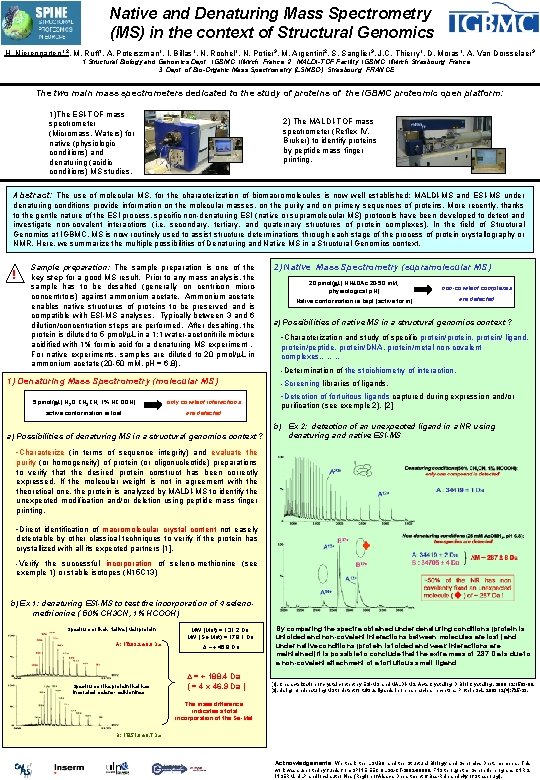
Native and Denaturing Mass Spectrometry (MS) in the context of Structural Genomics H. Nierengarten 1, 2, M. Ruff 1, A. Poterszman 1, I. Billas 1, N. Rochel 1, N. Potier 3, M. Argentini 2, S. Sanglier 3, J. C. Thierry 1, D. Moras 1, A. Van Dorsselaer 3 1 Structural Biology and Genomics Dept. , IGBMC, Illkirch, France 2. MALDI-TOF Facility IGBMC, Illkirch Strasbourg, France 3. Dept. of Bio-Organic Mass Spectrometry (LSMBO), Strasbourg, FRANCE The two main mass spectrometers dedicated to the study of proteins of the IGBMC proteomic open platform: 1)The ESI-TOF mass spectrometer (Micromass, Waters) for native (physiologic conditions) and denaturing (acidic conditions) MS studies. 2) The MALDI-TOF mass spectrometer (Reflex IV, Bruker) to identify proteins by peptide mass finger printing. Abstract: The use of molecular MS, for the characterization of biomacromolecules is now well established: MALDI-MS and ESI-MS under denaturing conditions provide information on the molecular masses, on the purity and on primery sequences of proteins. More recently, thanks to the gentle nature of the ESI process, specific non-denaturing ESI (native or supramolecular MS) protocols have been developed to detect and investigate non-covalent interactions (i. e. secondary, tertiary, and quaternary structures of protein complexes). In the field of Structural Genomics at IGBMC, MS is now routinely used to assist structure determinations through each stage of the process of protein crystallography or NMR. Here, we summarize the multiple possibilities of Denaturing and Native MS in a Structural Genomics context. ! Sample preparation: The sample preparation is one of the key step for a good MS result. Prior to any mass analysis, the sample has to be desalted (generally on centricon microconcentrtors) against ammonium acetate. Ammonium acetate enables native structures of proteins to be preserved and is compatible with ESI-MS analyses. Typically between 3 and 6 dilution/concentration steps are performed. After desalting, the protein is diluted to 5 pmol/m. L in a 1: 1 water-acetonitrile mixture acidified with 1% formic acid for a denaturing MS experiment. For native experiments, samples are diluted to 20 pmol/m. L in ammonium acetate (20 -50 m. M, p. H = 6. 8). 1) Denaturing Mass Spectrometry (molecular MS) 5 pmol/m. L( H 2 O: CH 3 CN, 1% HCOOH) only covalent interactions active conformation is lost are detected a) Possibilities of denaturing MS in a structural genomics context ? 2) Native Mass Spectrometry (supramolecular MS) 20 pmol/m. L( NH 4 OAc 20 -50 m. M, physiological p. H) non-covalent complexes Native conformation is kept (active form) are detected a) Possibilities of native MS in a structural genomics context ? -Characterization and study of specific protein/protein, protein/ ligand, protein/peptide, protein/DNA, protein/metal non-covalent complexes……. . -Determination of the stoichiometry of interaction. -Screening libraries of ligands. -Detection of fortuitous ligands captured during expression and/or purification (see exemple 2). [2] b) Ex 2: detection of an unexpected ligand in a NR using denaturing and native ESI-MS -Characterize (in terms of sequence integrity) and evaluate the purity (or homogeneity) of protein (or oligonucleotide) preparations to verify that the desired protein construct has been correctly expressed. If the molecular weight is not in agreement with theoretical one, the protein is analyzed by MALDI-MS to identify the unexpected modification and/or deletion using peptide mass finger printing. -Direct identification of macromolecular crystal content not easely detectable by other classical techniques to verify if the protein has crystallized with all its expected partners [1]. -Verify the successful incorporation of seleno-methionine (see exemple 1) or stable isotopes (N 15 C 13) b) Ex 1: denaturing ESI-MS to test the incorporation of 4 selenomethionine ( 50% CH 3 CN, 1% HCOOH) Spectrum of theh Native (Met) protein A: 17263. 2 ± 0. 6 Da MW (Met) = 131. 2 Da MW (Se-Met) = 178. 1 Da D = + 46. 9 Da By comparing the spectra obtained under denaturing conditions (protein is unfolded and non-covalent interactions between molecules are lost) and under native conditions (protein is folded and weak interactions are maintained) It is possible to conclude that the extra mass of 287 Da is due to a non-covalent attachment of a fortuitous small ligand. D = + 188. 4 Da Spectrum of the protein that has incorated seleno-methionines ( = 4 x 46. 9 Da ) [1]. Characterization of crystal content by ESI-MS and MALDI-MS, Acta Crystallogr D Biol Crystallogr, 2000 12: 1583 -90. [2]. Using nondenaturing MS to detect fortuitous ligands in orphan nuclear receptors, Protein Sci. , 2003 12(4): 725 -33. The mass difference indicates a total incorporation of the Se-Met B: 17451. 6 ± 0. 7 Da Acknowledgements: We thank the LSMBO and the Structural Biology and Genomics Dept. members. This work was supported by funds from SPINE EEC QLG 2 -CT-2002 -00988, FNS through the Genopole program, CNRS, INSERM, ULP and local authorities (Region of Alsace, Department of Bas-Rhin and city of Strasbourg).