
Native American Health Issues Lessons Learned from Communitybased
Native American Health Issues Lessons Learned from Communitybased Interventions, and Overview of Native Cancer Projects Linda Burhansstipanov, Dr. P. H. Director, Native American Cancer Research Program Copyright © 2000, Linda Burhansstipanov

“American Indians” and Alaskan Natives (AIAN): • Tribes and clans of Indigenous Natives of Alaska • Smallest racial group in the United states (0. 8 % of the U. S. population) • 554 federally recognized groups with distinct cultural backgrounds Copyright © 2000, Linda Burhansstipanov
“American Indians” and Alaskan Natives (AIAN): • 19. 8 % of all American Indians live on federal reservations, over 60% reside in urban areas • In 1989, 30. 9% AIAN lived at or below the poverty level – Total U. S. Population = 13. 1% at or below – Whites living at or below in 1989 = 9. 8% Copyright © 2000, Linda Burhansstipanov
Most Visible Health Problems • • • Alcoholism Violence Diabetes Accidents Cardiovascular Disease Copyright © 2000, Linda Burhansstipanov
Emerging Problems • HIV/AIDS • Cancer Copyright © 2000, Linda Burhansstipanov
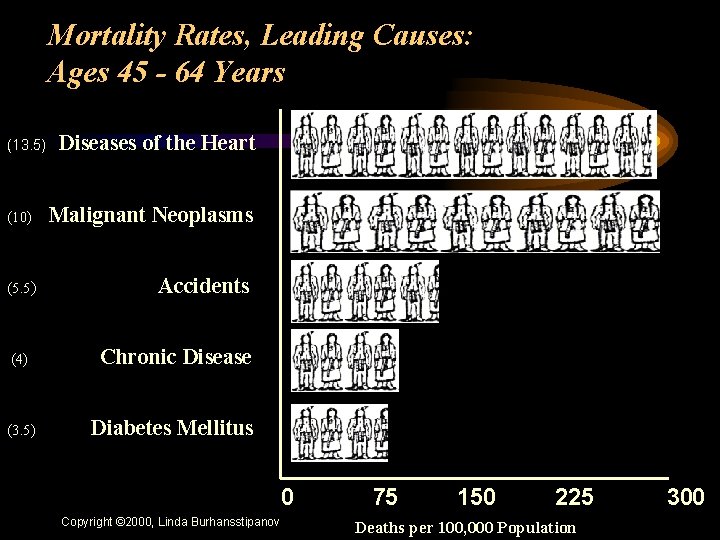
Mortality Rates, Leading Causes: Ages 45 - 64 Years (13. 5) Diseases of the Heart (10) Malignant Neoplasms (5. 5) Accidents (4) Chronic Disease (3. 5) Diabetes Mellitus 0 Copyright © 2000, Linda Burhansstipanov 75 150 225 Deaths per 100, 000 Population 300
Potential Beneficial Uses of Accurate Data (Burhansstipanov and Satter, submitted for publication) • Helps tribal nations / health boards / urban Indian clinics identify health priorities • Funding agencies recognize unmet needs within selected communities • Justifies the need for unique programs within tribes, counties, states, regions, territories (data from one region of the country cannot be generalized to another region / tribe, thus use of data from a SW region misrepresents the seriousness of selected problems among Northern Plains’ tribes) Copyright © 2000, Linda Burhansstipanov
Potential Beneficial Uses of Accurate Data • Documents behavioral practices that are related to health and disease • Clarifies the disparity and variation in disease rates among population groups • Clarifies the impact selected behaviors have on disease or health in selected populations or regions of the country • Documents unique disease patterns among small communities (who continue to remain unserved communities) Copyright © 2000, Linda Burhansstipanov
Potential Beneficial Uses of Accurate Data • Obtain sufficient resources to address selected health problems • Sets research priorities at federal (e. g. , DHHS, NIH, CDC, IHS) and state agencies to serve the needs of AIAN communities. • Allows health data to be compared with other medically unserved or underserved populations and nations. • Documents health trends over time. Copyright © 2000, Linda Burhansstipanov
Potential Hazards of Inaccurate Data (Burhansstipanov and Satter, submitted for publication) • Limited tribal fiscal resources are allocated for problems which may be of less concern for the local community • Insufficient data is interpreted as there not being a problem rather than due to data error or lack of inclusion in data collection (e. g. , low participation on BRFSS due to lack of telephones) • Funding agencies do not support selected programs because the health condition is “unrecognized” as a problem by the data Copyright © 2000, Linda Burhansstipanov
Potential Hazards of Inaccurate Data • Funding agencies erroneously assume that data from one part of the country is generalizable to another tribal community • Lack of data is interpreted to mean that there is no problem behavior (e. g. , habitual tobacco use) • Unique patterns of disease for a specific tribal community are not identified as problems, not addressed • Lack of local behavior data frequently results in inaccurate conclusions Copyright © 2000, Linda Burhansstipanov
Potential Hazards of Inaccurate Data • Unusual patterns continue to go unnoticed by local tribal programs and subsequently more community members can be affected (e. g. HIV and sexual activity with multiple partners) • Infrastructure (including staff, facilities, resources) are not available to support growing health problem Copyright © 2000, Linda Burhansstipanov
Potential Hazards of Inaccurate Data • Federal documents tend to use New Mexico or Arizona data when setting research priorities; elevated problems for other tribal communities are not acknowledged in federal priorities (e. g. Native American breast cancer) • Insufficient and inaccurate health data prohibits comparisons among tribes, undeserved populations (e. g. , Native Hawaiians and American Indians), and racial groups (e. g. , Native American and whites). Copyright © 2000, Linda Burhansstipanov
Potential Hazards of Inaccurate Data • Inability to determine if a health problem is “new” or simply previously undocumented Copyright © 2000, Linda Burhansstipanov
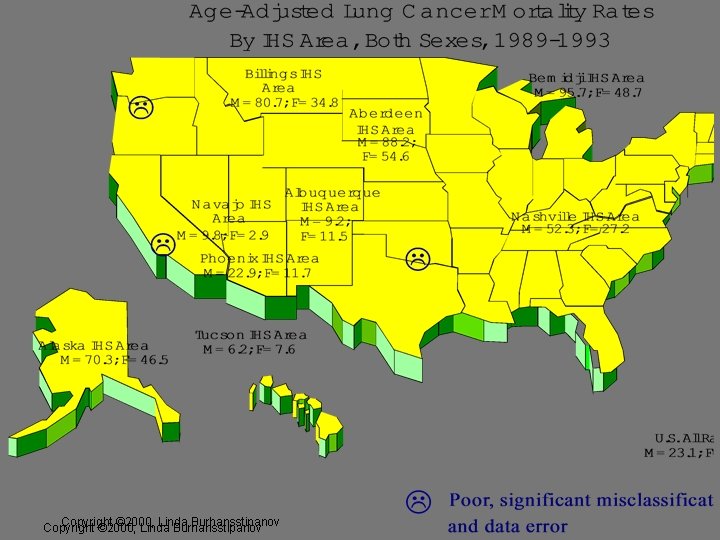
Racial Misclassification • Use of Spanish surnames to determine a person’s race • Personal observation by the data collector in completing the race item on the hospital/death/other records/certificates • AIAN not a response category in medical records (e. g. , hospital, health clinic); • Imprecise and inconsistent definitions of American Indians; Copyright © 2000, Linda Burhansstipanov
Racial Misclassification • Changing self-identification; – Tribe formerly “unrecognized” becoming federally recognized by Congress; – Tribal enrollment ordinances changing (e. g. , minimum blood quantum of 25% versus proof of regarding Paternal versus Maternal lineage) Copyright © 2000, Linda Burhansstipanov
Insufficient Inclusions of AIAN on National Surveys • National Health Interview Survey (NHIS) • National Health and Nutrition Examination Survey (NHANES and NHANES II) • Behavioral Risk Factor Surveillance Survey (BRFSS) • National Medical Expenditures Survey (NMES and SAIAN) • National Survey of Family Growth Copyright © 2000, Linda Burhansstipanov
Healthy People 2010 • Of the 128 that are population-specific health objectives for American Indians and Alaska Natives , – More than half (n=78, 61%) have no baseline data; – Only 39% have any baseline data Copyright © 2000, Linda Burhansstipanov
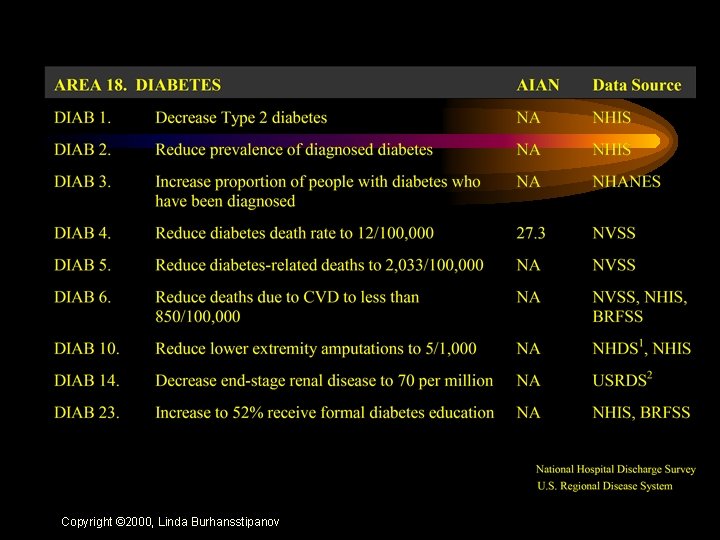
Healthy People 2010 • Primary data are NHIS, NHANES, BRFSS, NMES and NSFG • Alternative data sources exist (e. g. NIDDK, HIS) but are not included • Example: Diabetes and Cancer data Copyright © 2000, Linda Burhansstipanov
Copyright © 2000, Linda Burhansstipanov
Copyright © 2000, Linda Burhansstipanov
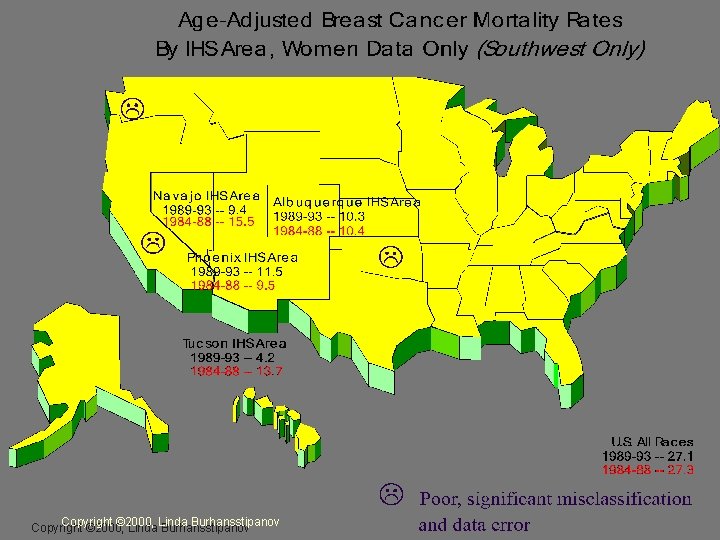
Copyright © 2000, Burhansstipanov Copyright © 2000, Linda Burhansstipanov
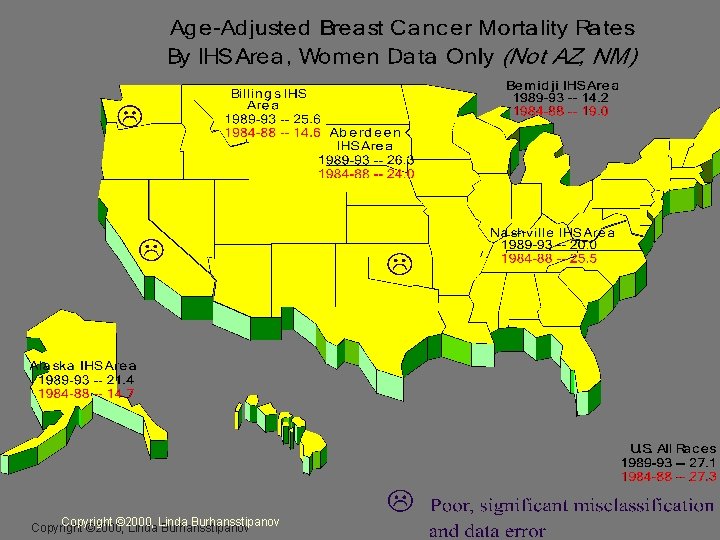
Copyright © 2000, Burhansstipanov Copyright © 2000, Linda Burhansstipanov
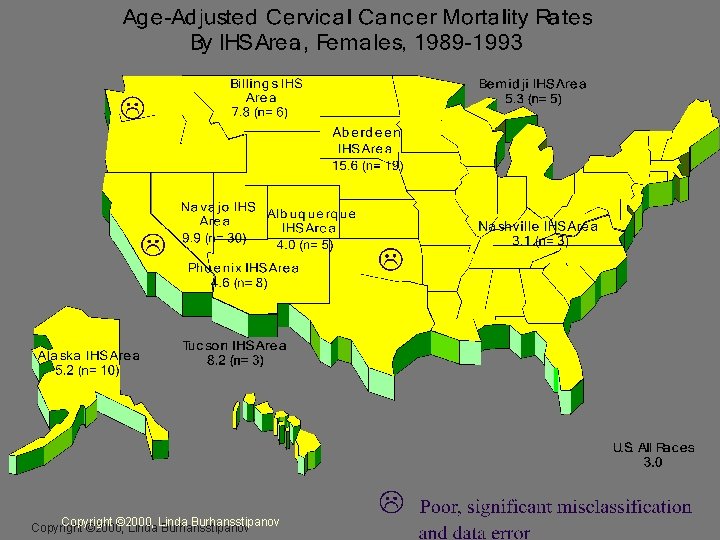
Copyright © 2000, Burhansstipanov Copyright © 2000, Linda Burhansstipanov
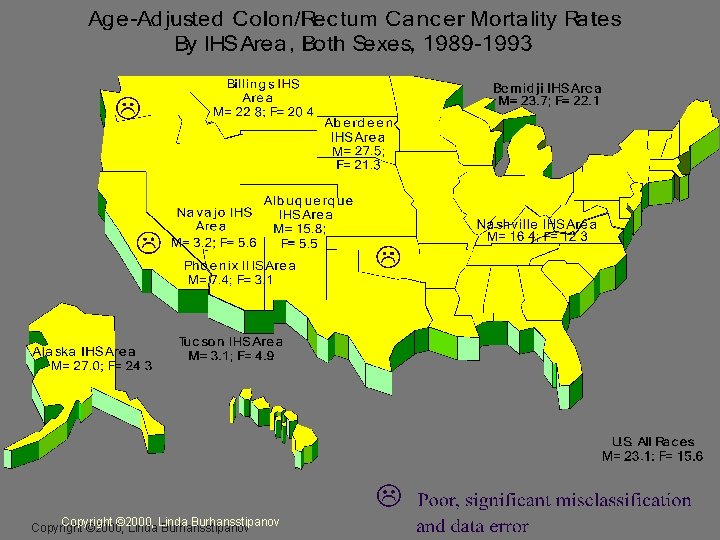
Copyright © 2000, Burhansstipanov Copyright © 2000, Linda Burhansstipanov
“Other” Racial Data • Lose all racially specific information and cultural relevance • Are of no use when attempting to develop, assess, and monitor public health programs and services • Have the same effectiveness as having “no” data • Result in insulting and being disrespectful of smaller communities Copyright © 2000, Linda Burhansstipanov
Why bother recruiting medically underserved communities into a study if not willing to share the data with them? Copyright © 2000, Linda Burhansstipanov
Of what benefit is it to take part in a study when there are no usable data for your community? Copyright © 2000, Linda Burhansstipanov
Recommendations • All federally funded research and service projects should be mandated to implement OMB Directive 15 racial categories when providing study findings. • Studies which have small numbers of selected racial groups should still publish results as specified within OMB Directive 15. Copyright © 2000, Linda Burhansstipanov
Recommendations • Special efforts should be incorporated to insure the inclusion of medically underserved populations within large scale national and state surveys as well as surveillance systems. • When feasible, AIAN racial data collection should allow for specification of tribal affiliation Copyright © 2000, Linda Burhansstipanov
Recommendations • Partnerships need to be created, implemented and supported among national, state, tribal nations, and urban Indian organizations for the collection of geographically diverse tribal data Copyright © 2000, Linda Burhansstipanov
Examples of Common Misconceptions about AIAN and Cancer • Natives don’t develop cancer • American Indians have a natural immunity from cancer • Native people have access to free health care • Native cancer survivors receive equivalent quality of care for cancer treatment as do other cultural groups • Indian Reservations have access to casino gambling profits to provide cancer education, services, and care for tribal members Copyright © 2000, Linda Burhansstipanov
Examples of Contemporary Cultural Perspectives among Different Native American Communities • Cancer Diagnosis – “White man’s” disease – Punishment (from your actions or a family member’s actions) – “Wear the pain” to protect other members of one’s communities – Natural part of one’s path and the lessons to learn – Doctor’s shoot a hole through your spirit when they diagnose you with cancer (results in depression, fear rather than trust…. etc. ) Copyright © 2000, Linda Burhansstipanov
Examples of Contemporary Cultural Perspectives among Different Native American Communities • Cancer Diagnosis (continued) – Results from a curse from someone or violation of tribal mores (stepping on a frog, urinating on a spider) – Contagious (catch from mammography machine…catch the cancer spirit from child of someone who had cancer…ostracize the children from their playmates…) – “Heard the cancer” and catch the cancer spirit by someone discussing it… result: don’t talk about it? ? Copyright © 2000, Linda Burhansstipanov
Examples of Contemporary Cultural Perspectives among Different Native American Communities • Treatment – Surgery results in losing part of one’s body and affects one’s spiritual path…cannot find one’s ancestors when one “goes to the other side: – Whole family involved with the treatment and recovery • Family as advocates and caregivers • Family needing to deal with own emotions related to Cancer “experience” – Combination of “western medicine” with traditional Indian healing • “Symptoms” • “Ceremonies” Copyright © 2000, Linda Burhansstipanov
Examples of Contemporary Cultural Perspectives among Different Native American Communities • Recovery – Lessons of balance (small crises remain “small”); Family striving for balance – Fear of reoccurrence and Creator’s Power to protect against such a reoccurrence – “Living, Loving, Laughter” (Tobias Martinez, Mescalero Apache) – Healing the holes in one’s spirit Copyright © 2000, Linda Burhansstipanov
Examples of Lessons Learned • Background – Standardized instruments require modification for cultural acceptability within local community – Models require modification for cultural acceptability within local community – Most common Health Education Models modified, implemented and evaluated in Native American Communities (Note: the first three are the same as for other communities): • Health Belief Model, Social Cognitive Model, Self. Efficacy, Social Support, Social Marketing Copyright © 2000, Linda Burhansstipanov
Examples of Lessons Learned • Culturally Competent Interventions to Address Poverty-Related Barriers – – Transportation Child care Lack of Telephone Lack of medical insurance Copyright © 2000, Linda Burhansstipanov
Examples of Lessons Learned • Culturally Competent Interventions to Address Psychosocial Barriers – Making information easier to understand – Back-translation – Health system navigators Copyright © 2000, Linda Burhansstipanov
Examples of Lessons Learned • Interventions to Address Socio-cultural-related Barriers – – – Culturally relevant resource materials Culturally relevant cancer education programs Survivors as community lay educators Training providers Need accurate data to educate both providers and community Copyright © 2000, Linda Burhansstipanov
Examples of Lessons Learned • Interventions to Address Socio-cultural-related Barriers (continued) – – – Cultural belief structures Ceremonies Addressing the Fears of Genocide Modesty Combination of Western Medicine with Traditional Native Healing Copyright © 2000, Linda Burhansstipanov
Examples of Lessons Learned • Lesson#1: “Every time an elder dies, a library burns. ” Our elders need to be cherished, respected, and supported to maintain their health and well-being. • Lesson#2: Cancer is usually a disease that primarily affects people who are older, our elders. • Lesson#3: Community-based and communitydriven interventions work. Excerpt from Burhansstipanov L. Lessons Learned from Native American Cancer Prevention, Control and Supportive Care Projects. Asian American and Pacific Islander Journal of Health. 1998: vol. 6. No. 2. pp. 91 -99. Copyright © 2000, Linda Burhansstipanov
Examples of Lessons Learned • Lesson#4: It takes between three to five years for a community-driven cancer prevention, control, or supportive care program to become accepted by the community. • Lesson#7: We have learned that cancer interventions which are directed to the overall health and well-being of the individual, family, and community are more acceptable than are interventions limited to “cancer” alone. Excerpt from Burhansstipanov L. Lessons Learned from Native American Cancer Prevention, Control and Supportive Care Projects. Asian American and Pacific Islander Journal of Health. 1998: vol. 6. No. 2. pp. 91 -99. Copyright © 2000, Linda Burhansstipanov
Examples of Lessons Learned • Lesson#14: We have found that Native men and women from our communities who are diagnosed with cancer, do better--that is live longer and in better health--when they integrate Western medical treatment with traditional Indian healing. • Lesson#18: There are many effective communitybased interventions being implemented among Native American communities throughout the continent. However, they are not in peer reviewed published journals. Excerpt from Burhansstipanov L. Lessons Learned from Native American Cancer Prevention, Control and Supportive Care Projects. Asian American and Pacific Islander Journal of Health. 1998: vol. 6. No. 2. pp. 91 -99. Copyright © 2000, Linda Burhansstipanov
Examples of Lessons Learned • Lesson#19: We need to use culturally relevant cancer informational resources. • Lesson#20: Navigator programs continue to be among the most effective strategy in our communities… and are unique from other such programs. • Lessons#24: No proven successful model can simply be implemented into any community Excerpt from Burhansstipanov L. Lessons Learned from Native American Cancer Prevention, Control and Supportive Care Projects. Asian American and Pacific Islander Journal of Health. 1998: vol. 6. No. 2. pp. 91 -99. Copyright © 2000, Linda Burhansstipanov
Examples of Lessons Learned • Lesson#26: Regardless of how effective an intervention may be in one community, even another Native American community, the project team still must be prepared to have the local community take leadership to adapt that model to be respectful and appropriate to their culture. • Lesson#29: Staff need to be salaried rather than “volunteer. ” Excerpt from Burhansstipanov L. Lessons Learned from Native American Cancer Prevention, Control and Supportive Care Projects. Asian American and Pacific Islander Journal of Health. 1998: vol. 6. No. 2. pp. 91 -99. Copyright © 2000, Linda Burhansstipanov
Examples of Lessons Learned • Lesson#27: The cancer prevention and control staff need to be respected by the community • Lesson#30: Staff need to be full time when economically feasible • Lesson#31: The staff of the cancer prevention, control and/or supportive care program needs to model healthy behavior. Excerpt from Burhansstipanov L. Lessons Learned from Native American Cancer Prevention, Control and Supportive Care Projects. Asian American and Pacific Islander Journal of Health. 1998: vol. 6. No. 2. pp. 91 -99. Copyright © 2000, Linda Burhansstipanov
Examples of Lessons Learned • Lesson#32: Actively seek out good proactive people and programs with whom you can partner to collaborate and coordinate your cancer projects. By reinforcing one another, you will find less staff duplication, broader based initiatives, and innovative creative ideas and strategies emerging. Excerpt from Burhansstipanov L. Lessons Learned from Native American Cancer Prevention, Control and Supportive Care Projects. Asian American and Pacific Islander Journal of Health. 1998: vol. 6. No. 2. pp. 91 -99. Copyright © 2000, Linda Burhansstipanov
Examples of National Native American Cancer Projects/Grants • American Indian Alaska Native Leadership Initiative on Cancer – Mayo Clinic, Rochester, MN (Judith Kaur, M. D. ) – Phoenix Indian Medical Center, AZ (Michael Lobell, M. D. ) • The Native CIRCLE (Dr. Judith Kaur, Mayo Clinic, MN) • Native American Cancer Researchers Training Program (Drs. Tom Becker, OHSU, Portland, OR and Jennie Joe, NARTC, Tucson AZ) Copyright © 2000, Linda Burhansstipanov
Examples of National Native American Cancer Projects/Grants • National Native American Breast Cancer Survivors’ Support Program, Pine, CO Copyright © 2000, Linda Burhansstipanov
More Extensive List of Examples of Federally Funded Native American Cancer Projects • National Cancer Institute – The Native CIRCLE (Dr. Judith Kaur, Mayo Clinic, MN) – Native American Cancer Researchers Training Program (Drs. Tom Becker, OHSU, Portland, OR and Jennie Joe, NARTC, Tucson, AZ) – Increasing Mammography Screening among Urban American Indian Women (Dr. Linda Buhansstipanov, Pine, CO) – Colorectal Screening among Alaska Natives (Dr. Barbara Stillwater, Southcentral Foundation, Anchorage, AK) – Alaska Native Tumor Registry (Dr. Anne Lanier, Alaska Native Health Board, Anchorage, AK) Copyright © 2000, Linda Burhansstipanov
More Extensive List of Examples of Federally Funded Native American Cancer Projects – Clinical Trials Education for Colorado Providers (Dr. Linda Krebs, UCHSC, Denver, CO -- note: this grant includes Native issues as well as other medically underserved communities) • Centers for Disease Control and Prevention – Northwest Tribal Cancer Control Project (Northwest Portland Area Indian Health Board, Portland, OR) – Arctic Slope Native Association, Barrow, AK – Cherokee Nation, Talequah, OK – Cheyenne River Sioux Tribe, Eagle Butte, SD – Consolidated Tribal Health Project, Calpella, CA Copyright © 2000, Linda Burhansstipanov
More Extensive List of Examples of Federally Funded Native American Cancer Projects – – – Eastern Band of Cherokee* Hopi Tribe, Kyotsmovi, AZ Maniilaq Association*, Kotzebue, AK Navajo Nation, Window Rock, AZ Native American Community Health Center, Inc. , Phoenix AZ – Native American Rehabilitation Association of the Northwest, Portland, OR – Pleasant Point Passamaquoddy*, ME – Poarch Band of Creek Indians, Atmore, AL *Project funding in the midst of termination Copyright © 2000, Linda Burhansstipanov
More Extensive List of Examples of Federally Funded Native American Cancer Projects – South East Alaska Regional Health Consortium, Sitka, AK – South Puget Intertribal Planning Agency, Shelton, WA – Southcentral Foundation, Anchorage, AK • Department of Defense – National Native American Breast Cancer Survivors’ Support Program, Pine, CO • Indian Health Service – Patterns of Cancer Care (Dr. Nat Cobb and Robin Taylor Wilson) – Cancer Mortality (Dr. Nat Cobb and Roberta Paisano)** **Best source for cancer data in Indian Country Copyright © 2000, Linda Burhansstipanov
Examples of National Foundation Funded Native American Cancer Projects • National Susan G. Komen Breast Cancer Foundation – National Native American Breast Cancer Survivors’ Support Network (Dr. Burhansstipanov, Pine, CO) – Native American Cancer Support Groups (Dr. Diane Weiner, L. A. , CA) • Avon Breast Health – The Native Web (Ms. Mary Alice Trapp, Mayo Clinic, Rochester, MN) – Women Reaching for Wellness Program (Billings, MT) Copyright © 2000, Linda Burhansstipanov
Examples of National Foundation Funded Native American Cancer Projects • American Cancer Society – Medically Under-served Populations – Circle of Life (dev OK ACS) NOTICE: What is obviously missing are cancer programs directed to Native men ( with the exception of the colorectal project in Anchorage! The National Native American Breast Cancer Survivors’ Support Networks with all cancer sites for both Native men and women… Copyright © 2000, Linda Burhansstipanov
- Slides: 56