
NATIONALISM REVOLUTIONS IN LATIN AMERICA Why were nationalist



- Slides: 7
NATIONALISM: REVOLUTIONS IN LATIN AMERICA Why were nationalist revolutions occurring in Latin America? Mexico Spanish South America
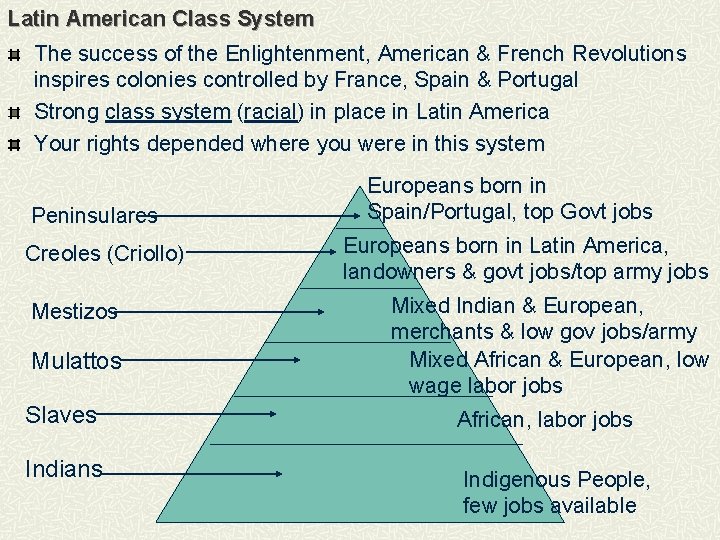
Latin American Class System The success of the Enlightenment, American & French Revolutions inspires colonies controlled by France, Spain & Portugal Strong class system (racial) in place in Latin America Your rights depended where you were in this system Peninsulares Creoles (Criollo) Mestizos Mulattos Slaves Indians Europeans born in Spain/Portugal, top Govt jobs Europeans born in Latin America, landowners & govt jobs/top army jobs Mixed Indian & European, merchants & low gov jobs/army Mixed African & European, low wage labor jobs African, labor jobs Indigenous People, few jobs available
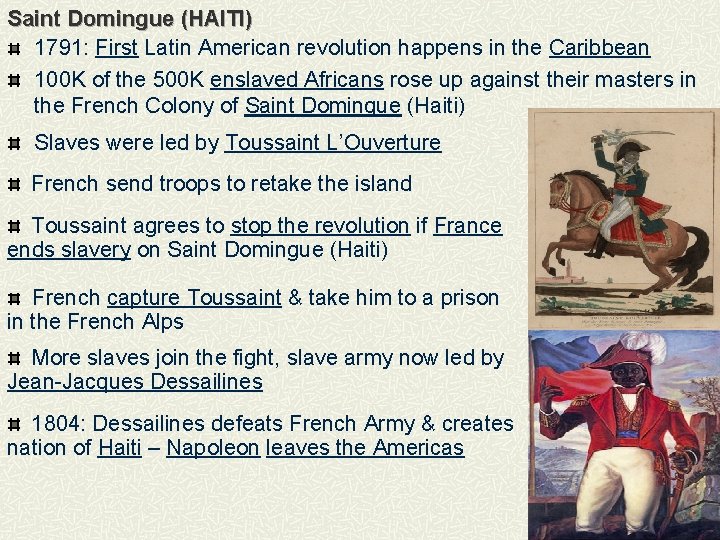
Saint Domingue (HAITI) 1791: First Latin American revolution happens in the Caribbean 100 K of the 500 K enslaved Africans rose up against their masters in the French Colony of Saint Domingue (Haiti) Slaves were led by Toussaint L’Ouverture French send troops to retake the island Toussaint agrees to stop the revolution if France ends slavery on Saint Domingue (Haiti) French capture Toussaint & take him to a prison in the French Alps More slaves join the fight, slave army now led by Jean-Jacques Dessailines 1804: Dessailines defeats French Army & creates nation of Haiti – Napoleon leaves the Americas
SPANISH SOUTH AMERICA 1811: Influenced by Am. Rev a Creole general named Simon Bolívar fights for independence in Venezuela Bolívar has little success until 1819, leads an army over Andes Mountains into New Granada (Colombia/Ecuador), surprising Spain • 1821: Venezuela & New Granada are independent (become Gran Colombia), 1822: Bolívar heads to Peru • 1816: Creole General Jose de San Martín begins independence movement in Rio De La Plata (Argentina/Paraguay) Simon Bolívar • 1817: Heads into Andes to fight Spanish army in nearby Chile Jose de San Martín
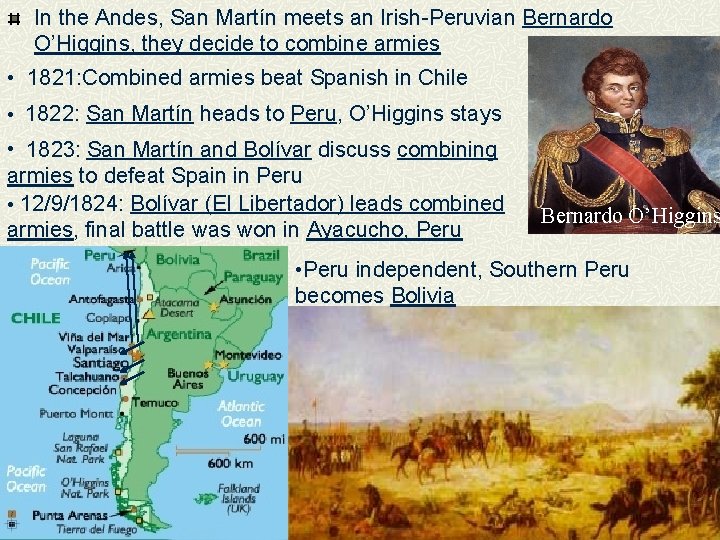
In the Andes, San Martín meets an Irish-Peruvian Bernardo O’Higgins, they decide to combine armies • 1821: Combined armies beat Spanish in Chile • 1822: San Martín heads to Peru, O’Higgins stays • 1823: San Martín and Bolívar discuss combining armies to defeat Spain in Peru • 12/9/1824: Bolívar (El Libertador) leads combined armies, final battle was won in Ayacucho, Peru Bernardo O’Higgins • Peru independent, Southern Peru becomes Bolivia
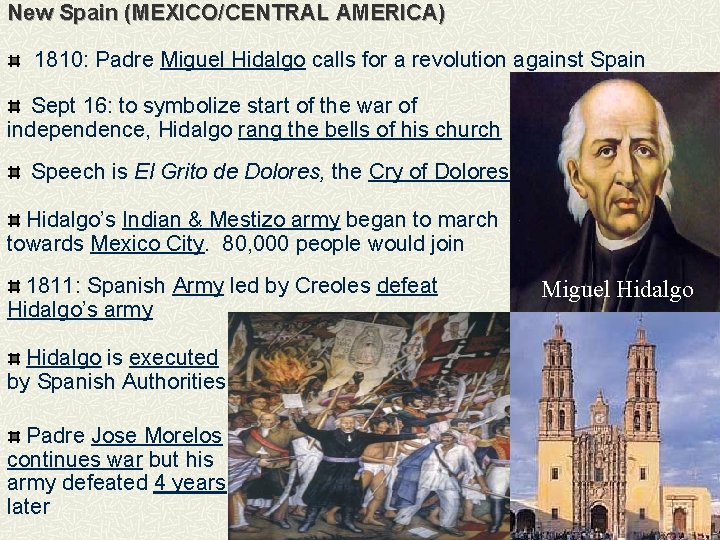
New Spain (MEXICO/CENTRAL AMERICA) 1810: Padre Miguel Hidalgo calls for a revolution against Spain Sept 16: to symbolize start of the war of independence, Hidalgo rang the bells of his church Speech is El Grito de Dolores, the Cry of Dolores Hidalgo’s Indian & Mestizo army began to march towards Mexico City. 80, 000 people would join 1811: Spanish Army led by Creoles defeat Hidalgo’s army Hidalgo is executed by Spanish Authorities Padre Jose Morelos continues war but his army defeated 4 years later Miguel Hidalgo
1816: King of Spain returns to power, Creoles lose their privileges Creoles unite with Mestizos and Indians, General Agustin Iturbide declares Mexican Independence 1821: Fed up w/ wars, Spain grants independence to Mexico which includes Central America 1823: Central American leaders win independence when Emp. Iturbide is overthrown Agustin Iturbide BRAZIL 1808: Royal family of Portugal flees to Brazil when Napoleon invades (Happy King João gives Brazil co-kingdom status Creoles) 1821: João returns to Portugal leaves son Dom Pedro in charge of Brazil 1822: João takes away co-Kingdom status Creoles threaten war, João gives Brazil independence, his son Dom Pedro is Emperor Dom Pedro I