
NATIONALISM IN INDIA Module 44 BY T R
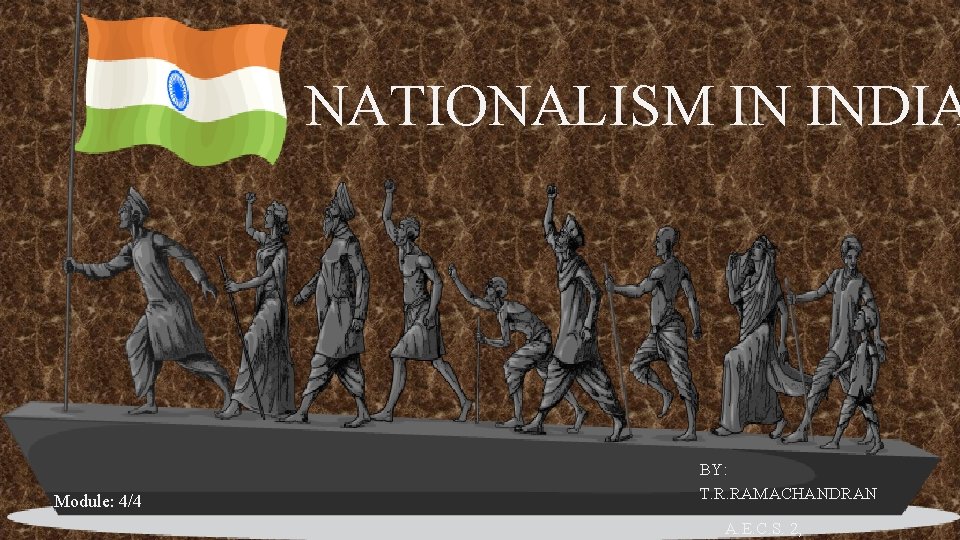
NATIONALISM IN INDIA Module: 4/4 BY: T. R. RAMACHANDRAN A. E. C. S. 2,
INTRODUCTION This module is divided into three parts 1. Participation of different social groups 2. Limits of the civil disobedience movement 3. Cultural factors and identities which created a sense of collective belonging among the people of India. Let us see first about the participation of different social groups in civil disobedience movement.
DIFFERENT SOCIAL GROUPS PARTICIPATED IN THE CIVIL DISOBEDIENCE MOVEMENT • Rich Peasants: Depression and fall in prices affected them badly. They demanded reduction in land revenue. Swaraj meant reduction of taxes for them. • Poor Peasants: Depression affected them badly. They demanded reduction in rent. Swaraj meant reduction of rent for them. • Business classes: They demanded protection against the import of foreign goods. They wanted a Rupee-Sterling exchange rate that would discourage import. They formed the Indian Industrial and Commercial Congress in 1920. • Industrial Workers: They were poorly paid. Conditions of work were miserable. Swaraj meant better wages and working conditions for them. Railway workers and dockyard workers conducted strike. Workers in mines wore Gandhi Caps and took part in rallies. • Participation of Women
RICH PEASANTS COMMUNITY • In the countryside, rich peasants communities- like the Patidars of Gujarat and the Jats of Uttar Pradesh joined the movement. • Being producers of commercial crops, they were very hard hit by the trade depression and falling prices. As their cash income disappeared, they found it impossible to pay the government’s revenue demand. • The refusal of the government to reduce the revenue demand led to widespread resentment. These rich peasants were active in organizing their communities, and at times forcing reluctant members, to participate in the boycott programmes. • For them the fight for swaraj was a struggle against high revenues. • But they were deeply disappointed when the movement was called off in 1931 without the revenue rates being revised. Therefore, when the movement was restarted in 1932, many of them refused to participate.
POOR PEASANTS COMMUNITY • The poorer peasants were not just interested in the lowering of the revenue demand. Many of them were small tenants cultivating land they had rented from landlords. • As the Depression continued and cash incomes decreased, the small tenants found it difficult to pay their rent. They wanted the unpaid rent to the landlord to be remitted. • They joined a variety of radical movements, often led by Socialists and Communists. • Congress did not want to upset the rich peasants and landlords, and was unwilling to support ‘no rent’ campaigns of the poor peasants in most places. So the relationship between the poor peasants and the Congress remained uncertain.
BUSINESS COMMUNITY • Indian merchants and industrialists wanted protection against imports of foreign goods and a rupee-sterling foreign exchange ratio that would discourage imports. • They wanted to end colonial control over Indian economy. They joined Civil Disobedience Movement and gave financial assistance and refused to buy or sell imported goods. • Most businessmen came to see swaraj as a time when colonial restrictions on business would no longer exist and trade and industry would flourish without constraints. • As the industrialists came closer to the Congress, workers stayed aloof. The Congress was reluctant to include workers’ demands as part of its programme of struggle. It felt that this would alienate industrialists and divide the anti-imperial forces. • To organize business interests, they formed the Indian Industrial and Commercial Congress in 1920 and the Federation of the Indian Chamber of Commerce and Industries (FICCI) IN 1927. • Led by prominent industrialists like Purshottamdas Thakurdas and G. D. Birla, the industrialists attacked colonial control over the Indian economy, and supported the Civil Disobedience Movement when it was first launched. They gave the financial assistance and refused to buy or sell imported goods.
INDUSTRIAL WORKING CLASS • The industrial working classes did not participate in the Civil Disobedience Movement in large numbers, except in the Nagpur region. • As the industrialists came closer to the Congress, workers stayed aloof. But in spite of that, some workers did participate in the Civil Disobedience Movement. • They adopted some of the ideas of the Gandhian programme, like boycott of foreign goods, as part of their own movements against low wages and poor working conditions. • There were strikes by railway workers in 1930 and dockworkers in 1932. • In 1930 thousands of workers in Chotanagpur tin mines wore Gandhi caps and participated in protest rallies and boycott campaigns.
PARTICIPATION OF WOMEN • An important feature of the Civil Disobedience Movement was the large scale participation of women. During Gandhiji’s salt march, thousands of women came out of their homes to listen to him. • They participated in protest marches, manufactured salt, and picketed foreign cloth and liquor shops. Many went to jail. • In urban areas, these women were from high-caste families; in rural areas, they came from rich peasant households. Moved by Gandhiji’s call, they began to see service to the nation as a sacred duty of women. • Gandhiji was convinced that it was the duty of women to look after home and hearth, be good mothers and good wives. • And for a long time the Congress was reluctant to allow women to hold any position of authority within the organization. It was keen only on their symbolic presence.
MAIN CONTRIBUTIONS OF CIVIL DISOBEDIENCE MOVEMENT • Civil Disobedience Movement was the first struggle to win Poorna Swaraj or Complete Independence, • It was based on non-violent Satyagraha. Gandhian ideas were widely followed. • Women participated in large numbers in this movement. • It was a real mass movement. Different social groups participated. • It was an open challenge to the British rule. The people openly disobeyed laws.
CIVIL DISOBEDIENCE MOVEMENT - ITS LIMITS • Dalit participation in civil disobedience movement. • Depressed classes association. • Poona Pact • Lukewarm response of Muslims to movement demands of Muslim leaders.
DALIT PARTICIPATION IN CIVIL DISOBEDIENCE MOVEMENT • Not all social groups were moved by the abstract concept of swaraj. One such group was the nation’s ‘untouchables’, who from around the 1930 s had begun to call themselves dalit or oppressed. • For long the Congress had ignored the dalits, for fear of offending the sanatanis, the conservative high-caste Hindus. But Mahatma Gandhi declared that swaraj would not come for a hundred years if untouchability was not eliminated. • He called the ‘untouchables’ harijan, or the children of God, organized satyagraha to secure them entry into temples, and access to public wells, tanks, roads and schools. • Many dalit leaders were keen on a different political solution to the problems of the community. • They began organizing themselves, demanding reserved seats in educational institutions, and a separate electorate. • Dalit participation in the Civil Disobedience Movement was therefore limited, particularly in the Maharashtra and Nagpur region.
DEPRESSED CLASSES ASSOCIATION AND POONA PACT • Dr B. R. Ambedkar, who organized the dalits into the Depressed Classes Association in 1930. • He clashed with Mahatma Gandhi at the second Round Table Conference by demanding separate electorates for dalits. • When the British government conceded Ambedkar’s demand, Gandhiji began a fast unto death. • He believed that separate electorates for dalits would slow down the process of their integration into society. • Ambedkar ultimately accepted Gandhiji’s position and the result was the Poona Pact of September 1932. • It gave the Depressed Classes (later to be known as the Schedule Castes) reserved seats in provincial and central legislative councils.
LUKEWARM RESPONSE OF MUSLIMS TO MOVEMENT DEMANDS OF MUSLIM LEADERS • After the decline of the Non-Cooperation-Khilafat movement, a large section of Muslims felt alienated from the Congress. The Congress and the Muslim League made efforts to renegotiate an alliance. • The important differences were over the question of representation in the future assemblies that were to be elected. But the negotiations failed. • When the Civil Disobedience Movement started there was an atmosphere of suspicion and distrust between communities. • Alienated from the Congress, large sections of Muslims could not respond to the call for a united struggle. • Many Muslim leaders and intellectuals expressed their concern about the status of Muslims as a minority within India. They feared that the culture and identity of minorities would be submerged under the domination of a Hindu majority.
CULTURAL FACTORS AND IDENTITIES WHICH CREATED A SENSE OF COLLECTIVE BELONGING AMONG THE PEOPLE OF INDIA. Images, Icons, Flags, Songs, Dance Forms, folktales, etc. were used to promote nationalism or collective belongingness in the people of India. In India, many leaders played very important role in promoting nationalism through cultural factors and identities. Let us see some of them under the following heads: 1. Image of Bharat Mata 2. Vande Mataram 3. Folklore of South India 4. National Flag 5. Rediscovery of India’s past
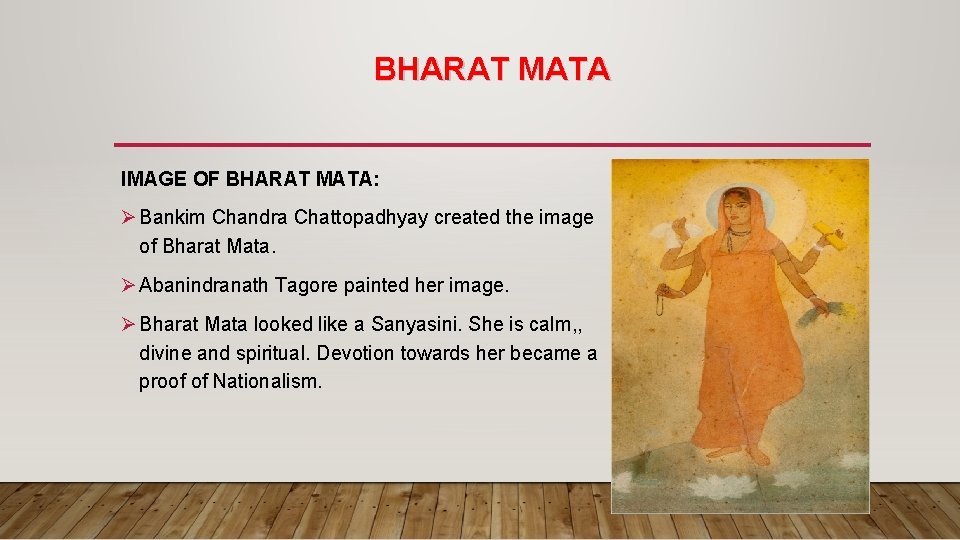
BHARAT MATA IMAGE OF BHARAT MATA: Ø Bankim Chandra Chattopadhyay created the image of Bharat Mata. Ø Abanindranath Tagore painted her image. Ø Bharat Mata looked like a Sanyasini. She is calm, , divine and spiritual. Devotion towards her became a proof of Nationalism.
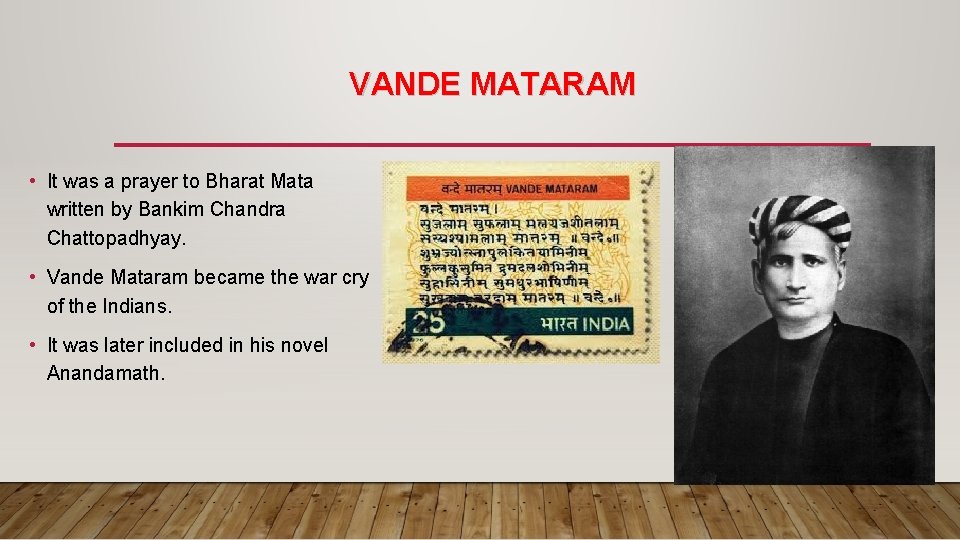
VANDE MATARAM • It was a prayer to Bharat Mata written by Bankim Chandra Chattopadhyay. • Vande Mataram became the war cry of the Indians. • It was later included in his novel Anandamath.
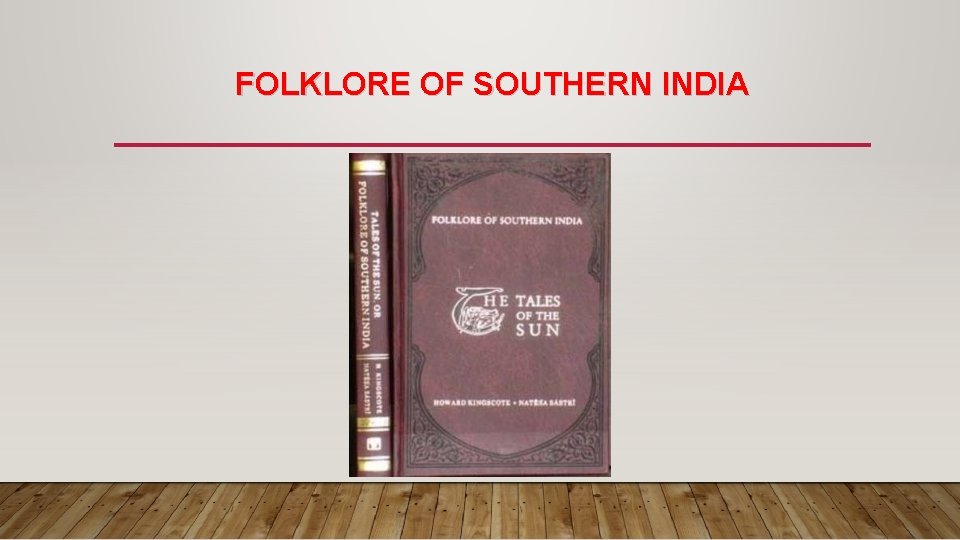
FOLKLORE OF SOUTHERN INDIA
REVIVAL OF FOLKLORE • Nationalists toured the villages to collect the folk songs and legends. • Rabindranath Tagore collected a number of folk songs and legends. • In Madras, Natesa Sastri published a four volume collection of Tamil folk tales (The Folklore of Southern India). • The folk songs and legends gave a true picture of Indian culture. They showed there all thoughts and characteristics of Indians. • They created National Pride among the people.
NATIONAL FLAG • During the Swadeshi Movement a tricolor flag (red, green and yellow) was developed. It had 8 lotuses representing the 8 provinces of the British India. It also had crescent moon which represented Hindu and Muslims. • In 1921, Gandhiji designed the Swaraj flag. It was also a tricolor flag (red, green and white). It had a spinning wheel which represented the Gandhian idea of Self Help. • The flag became a symbol of the Nation. It created feeling of oneness. The people carried flag in protest marches and rallies.
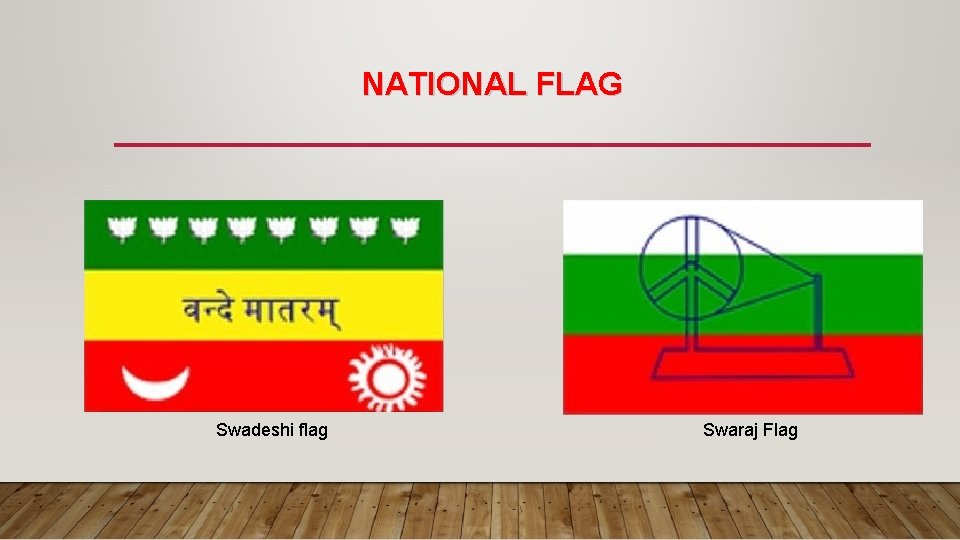
NATIONAL FLAG Swadeshi flag Swaraj Flag
REDISCOVERY OF INDIA’S PAST • The British considered Indians backward and primitive. They said that the Indians were not capable of ruling themselves. • In the 19 th century, some educated Indians started the efforts of rediscover India’s great achievements. They rediscovered the achievements made by the Indians in art, architecture, science, mathematics, religion, culture, law, philosophy, crafts and trade. • Knowledge about the great achievements of Indians created national pride, selfconfidence and patriotism among the Indians.
- Slides: 21