
National Womens Empowerment and Gender Equality Tonga Policy
- Slides: 18
National Women’s Empowerment and Gender Equality Tonga Policy and Strategic Plan of Action 20192025 MINISTRY OF INTERNAL AFFAIRS (MIA), WOMEN’S EMPOWERMENT AND GENDER EQUALITY DIVISION (WEGED)
Contents 1. Why Gender 2. Government of Tonga (Go. T) agreed commitments 3. Introduction to gender basics, mainstreaming and analysis, disaggregation and indicators 4. Lessons learned so far 5. Summary of presentation 6. Way Forward & Timeline
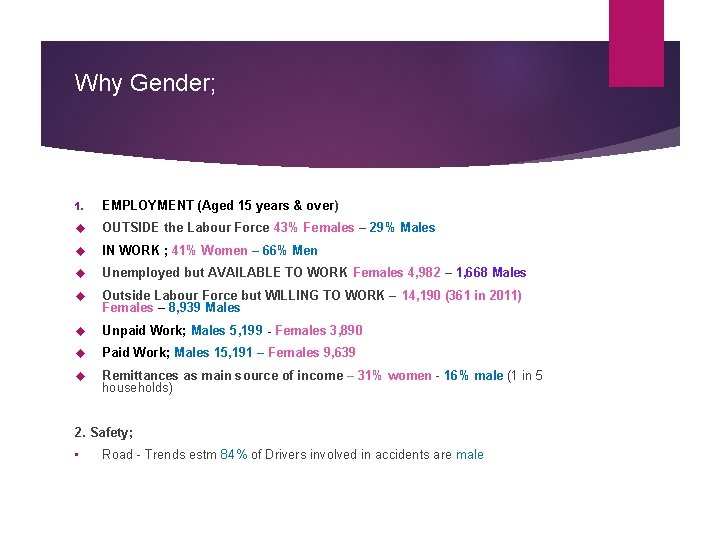
Why Gender; 1. EMPLOYMENT (Aged 15 years & over) OUTSIDE the Labour Force 43% Females – 29% Males IN WORK ; 41% Women – 66% Men Unemployed but AVAILABLE TO WORK Females 4, 982 – 1, 668 Males Outside Labour Force but WILLING TO WORK – 14, 190 (361 in 2011) Females – 8, 939 Males Unpaid Work; Males 5, 199 - Females 3, 890 Paid Work; Males 15, 191 – Females 9, 639 Remittances as main source of income – 31% women - 16% male (1 in 5 households) 2. Safety; • Road - Trends estm 84% of Drivers involved in accidents are male
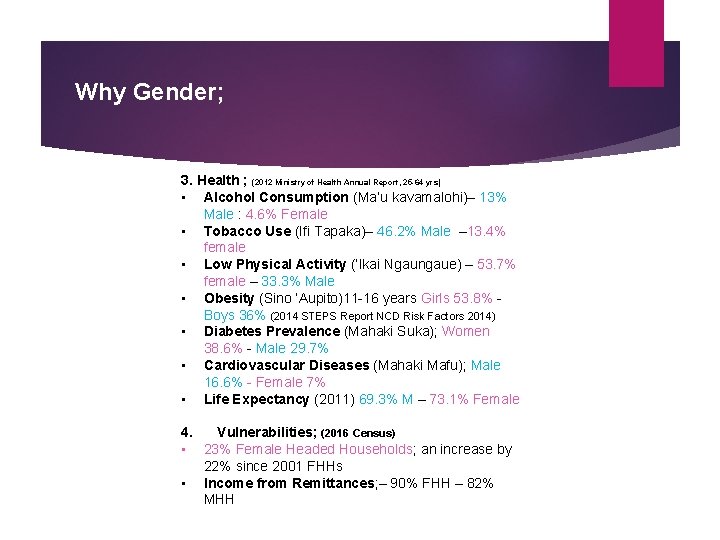
Why Gender; 3. Health ; (2012 Ministry of Health Annual Report, 25 -64 yrs) • Alcohol Consumption (Ma’u kavamalohi)– 13% Male : 4. 6% Female • Tobacco Use (Ifi Tapaka)– 46. 2% Male – 13. 4% female • Low Physical Activity (‘Ikai Ngaungaue) – 53. 7% female – 33. 3% Male • Obesity (Sino ‘Aupito)11 -16 years Girls 53. 8% Boys 36% (2014 STEPS Report NCD Risk Factors 2014) • Diabetes Prevalence (Mahaki Suka); Women 38. 6% - Male 29. 7% • Cardiovascular Diseases (Mahaki Mafu); Male 16. 6% - Female 7% • Life Expectancy (2011) 69. 3% M – 73. 1% Female 4. Vulnerabilities; (2016 Census) • 23% Female Headed Households; an increase by 22% since 2001 FHHs • Income from Remittances; – 90% FHH – 82% MHH
Why Gender; 5. Discriminatory Laws ; 6. Land Act ; • Divorce Act 1996 • Discriminatory Policies ; • Maternity Leave
Some of the Go. T’s Reporting Commitments (regional and international) The following signed documents contain gender accountabilities for Tonga: SPC Pacific Platform for Action on Gender Equality and Women’s Human Rights 20182030 Pacific Islands Forum Leaders’ Declaration on Gender Equality, 2012 The Pacific Plan and various Forum Communiqués UN Sustainable Development Goals (SDGs), 2016 ILO Conventions 2016 (especially No. 100, No. 111, No. 156 and No. 183) United Nations General Assembly Special Session (UNGASS) on the Implementation of the Outcomes of the Platform for Action (Beijing +5), New York, June 2000 Commonwealth Plan of Action on Gender and Development, 1995 Convention on the Rights of the Child, 1995 All contribute to the achievement of the Tonga Strategic Development Framework II 2015 – 2025. National Outcome 3: ‘a more inclusive, sustainable and empowering human development with gender equality’.
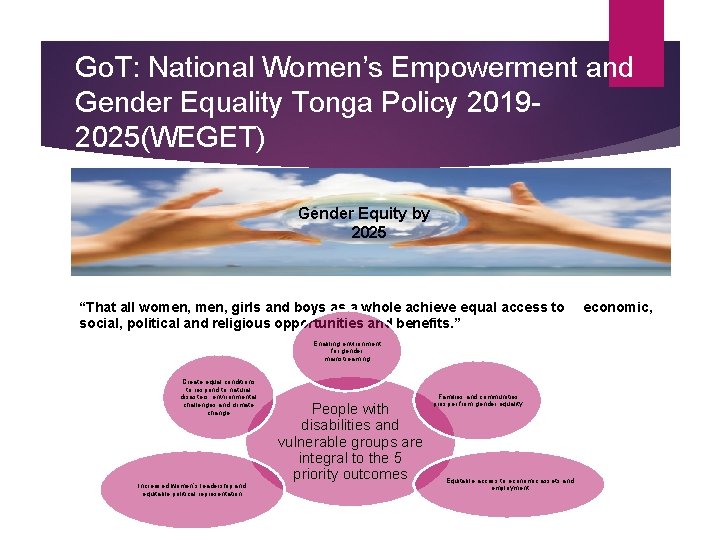
Go. T: National Women’s Empowerment and Gender Equality Tonga Policy 20192025(WEGET) Gender Equity by 2025 “That all women, girls and boys as a whole achieve equal access to social, political and religious opportunities and benefits. ” Enabling environment for gender mainstreaming Create equal conditions to respond to natural disasters, environmental challenges and climate change Increased women’s leadership and equitable political representation People with disabilities and vulnerable groups are integral to the 5 priority outcomes Families and communities prosper from gender equality Equitable access to economic assets and employment economic,
Introduction to Gender: Definitions Definition: The concept of gender refers to the norms, expectations and beliefs about the roles, relations and values attributed to girls and boys, women and men. These norms are socially constructed, they are neither unable to change nor are they biologically determined (babies are not born a gender). They are learned from families and friends, in schools and communities, and from the media, government and religious organizations. These norms, expectations and beliefs change over time.
Why We Focus on Gender Empowering women to participate fully in economic life across all sectors and throughout all levels of economic activity is essential to: ■ Build strong economies; ■ Establish more stable and just societies; ■ Achieve internationally agreed goals for development, sustainability and human rights; ■ Improve quality of life for women, families and communities; and ■ Propel businesses’ operations and goals. Equitable societies and economies are more prosperous AND it makes good economic sense!
Gender Equality Gender equality: Where women and men have the same status, rights and responsibilities. The relative positions in society of women, girls and boys are based on standards that, while not fixed, tend to advantage men and boys and disadvantage women and girls. A gender equality approach identifies and understands these relative differences and then designs policies, programmes and services with these differences in mind. Example: Equal numbers of women and men on boards, committees, any decision-making body relating to the investment. With only men making decisions the investment will not be as successful because decisions may be made that don’t work for women and girls.
Women’s Empowerment Women developing confidence in their own capabilities: Having decision-making power of their own (not attributed through a male) Having access to information and resources for taking proper decision Having a range of options from which you can make choices (not just yes/no, either/or) Ability to exercise assertiveness in collective decision making Having positive thinking on the ability to make change Ability to learn skills for improving personal or group power Ability to change others’ perceptions by democratic means A growth process and changes that are never ending and self-initiated An increasingly positive self-image and overcoming stigma Source: http: //www. selfgrowth. com/articles/Articles_Women_Empowerment. html
How to Mainstream Gender � By analysing the ways in which any issue affects women and men differently and/or unequally through: � sex disaggregated data, � qualitative gender analysis and consultation with women and men. � Then feed this information into: � policy � and programme or project gender equality objectives � Backed up with budgeted action and indicators to address gender gaps, and to meet needs specific to women and girls or men and boys.
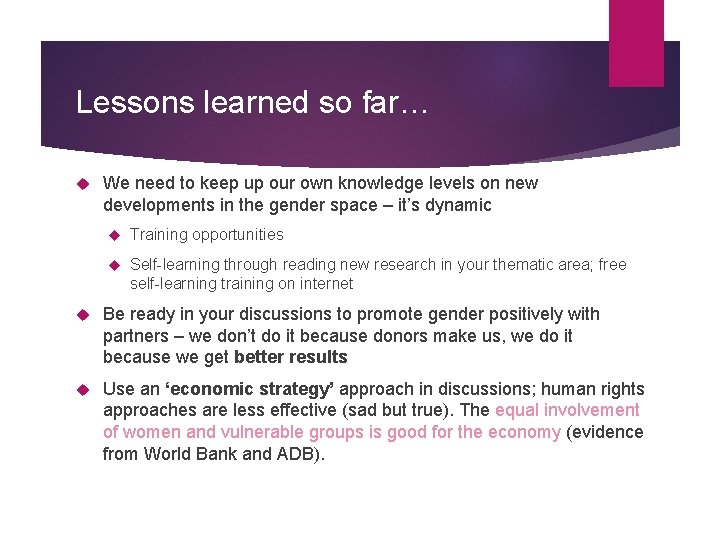
Lessons learned so far… We need to keep up our own knowledge levels on new developments in the gender space – it’s dynamic Training opportunities Self-learning through reading new research in your thematic area; free self-learning training on internet Be ready in your discussions to promote gender positively with partners – we don’t do it because donors make us, we do it because we get better results Use an ‘economic strategy’ approach in discussions; human rights approaches are less effective (sad but true). The equal involvement of women and vulnerable groups is good for the economy (evidence from World Bank and ADB).
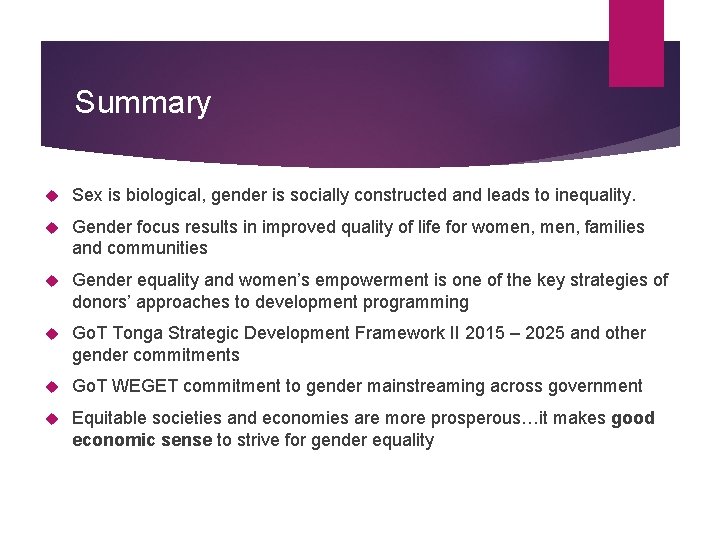
Summary Sex is biological, gender is socially constructed and leads to inequality. Gender focus results in improved quality of life for women, families and communities Gender equality and women’s empowerment is one of the key strategies of donors’ approaches to development programming Go. T Tonga Strategic Development Framework II 2015 – 2025 and other gender commitments Go. T WEGET commitment to gender mainstreaming across government Equitable societies and economies are more prosperous…it makes good economic sense to strive for gender equality
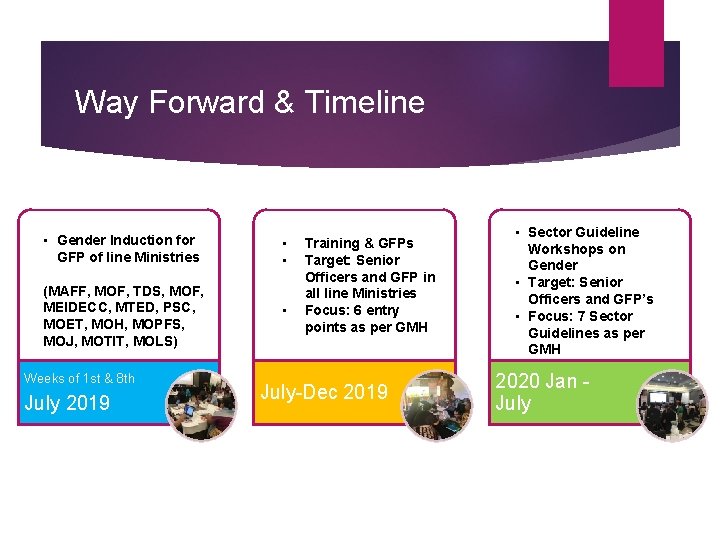
Way Forward & Timeline • Gender Induction for GFP of line Ministries • • (MAFF, MOF, TDS, MOF, MEIDECC, MTED, PSC, MOET, MOH, MOPFS, MOJ, MOTIT, MOLS) • Weeks of 1 st & 8 th July 2019 Training & GFPs Target: Senior Officers and GFP in all line Ministries Focus: 6 entry points as per GMH July-Dec 2019 • Sector Guideline Workshops on Gender • Target: Senior Officers and GFP’s • Focus: 7 Sector Guidelines as per GMH 2020 Jan July
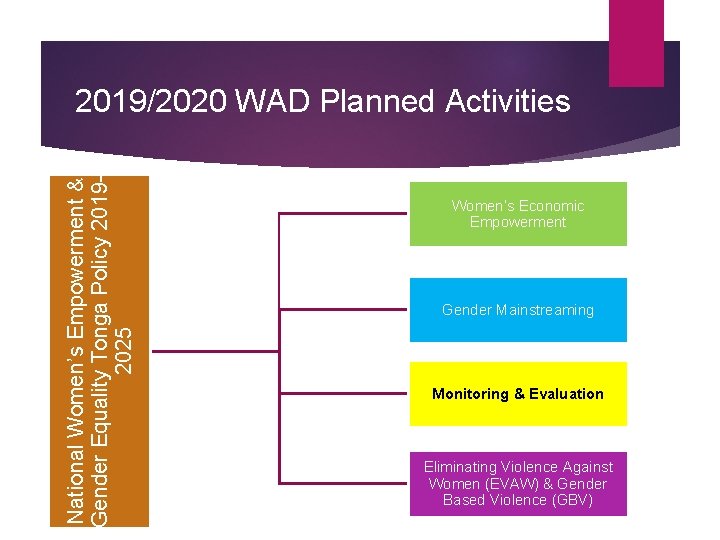
National Women’s Empowerment & Gender Equality Tonga Policy 20192025 2019/2020 WAD Planned Activities Women’s Economic Empowerment Gender Mainstreaming Monitoring & Evaluation Eliminating Violence Against Women (EVAW) & Gender Based Violence (GBV)
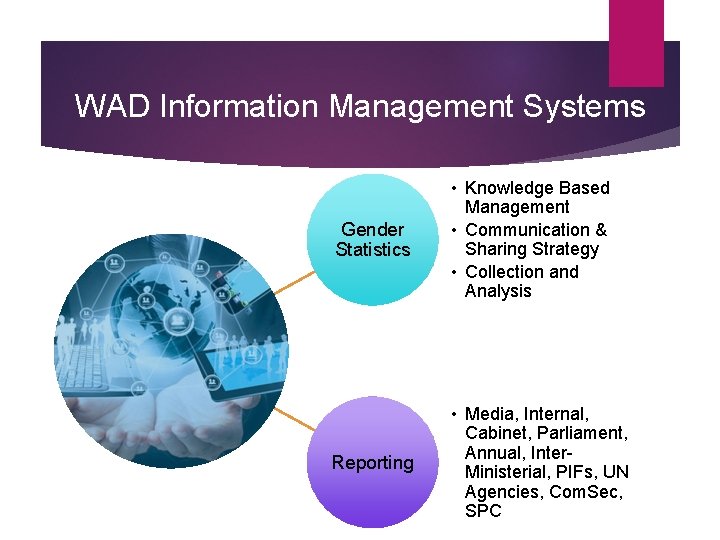
WAD Information Management Systems Gender Statistics • Knowledge Based Management • Communication & Sharing Strategy • Collection and Analysis Reporting • Media, Internal, Cabinet, Parliament, Annual, Inter. Ministerial, PIFs, UN Agencies, Com. Sec, SPC
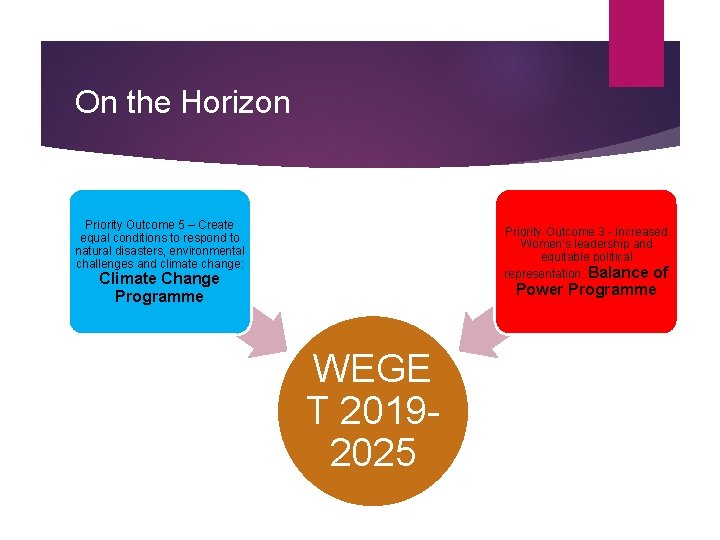
On the Horizon Priority Outcome 5 – Create equal conditions to respond to natural disasters, environmental challenges and climate change: Priority Outcome 3 - Increased Women’s leadership and equitable political representation: Balance of Climate Change Programme Power Programme WEGE T 20192025