
National University of Sciences Technology Overview Developed and

- Slides: 51
National University of Sciences & Technology
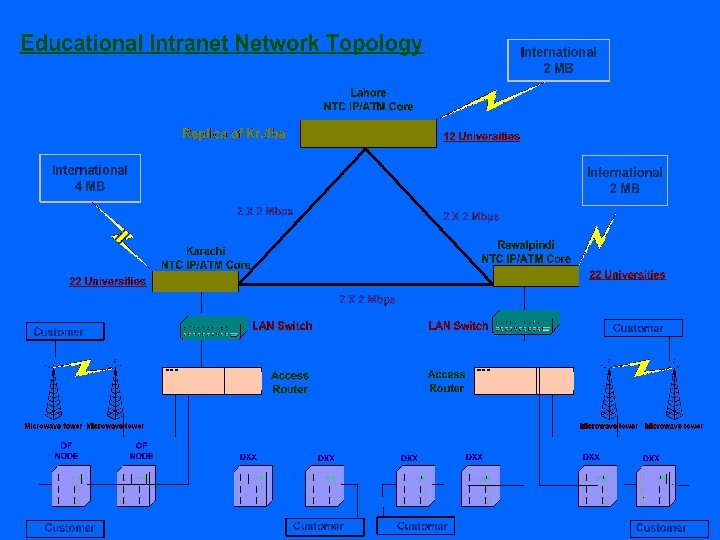
Overview • Developed and Developing Countries • Little Known Facts About Pakistan • Govt initiatives in Bridging Digital Divide • Pakistan Educational Research Network Architecture • NUST-CERN-Caltech Research Collaboration initiative • Research Performance Analysis • Conclusion • Recommendations
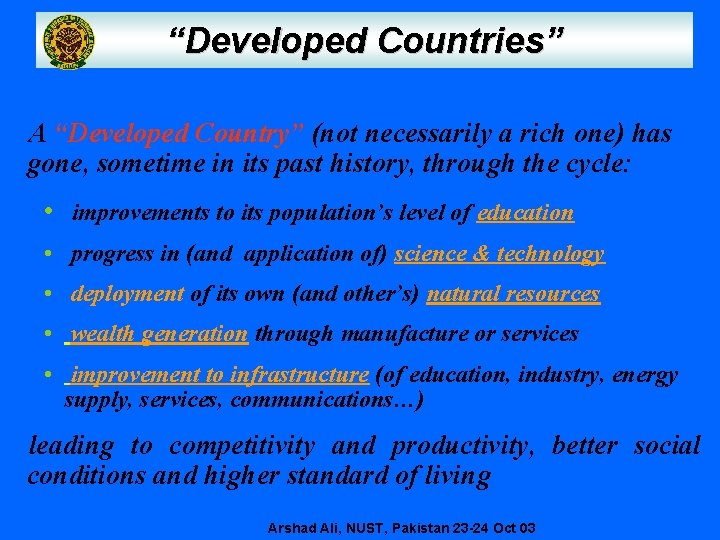
“Developed Countries” A “Developed Country” (not necessarily a rich one) has gone, sometime in its past history, through the cycle: • improvements to its population’s level of education • progress in (and application of) science & technology • deployment of its own (and other’s) natural resources • wealth generation through manufacture or services • improvement to infrastructure (of education, industry, energy supply, services, communications…) leading to competitivity and productivity, better social conditions and higher standard of living Arshad Ali, NUST, Pakistan 23 -24 Oct 03
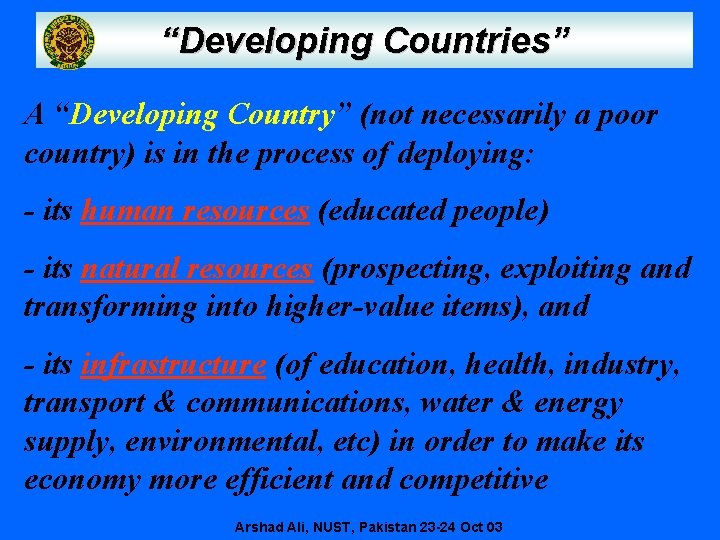
“Developing Countries” A “Developing Country” (not necessarily a poor country) is in the process of deploying: - its human resources (educated people) - its natural resources (prospecting, exploiting and transforming into higher-value items), and - its infrastructure (of education, health, industry, transport & communications, water & energy supply, environmental, etc) in order to make its economy more efficient and competitive Arshad Ali, NUST, Pakistan 23 -24 Oct 03
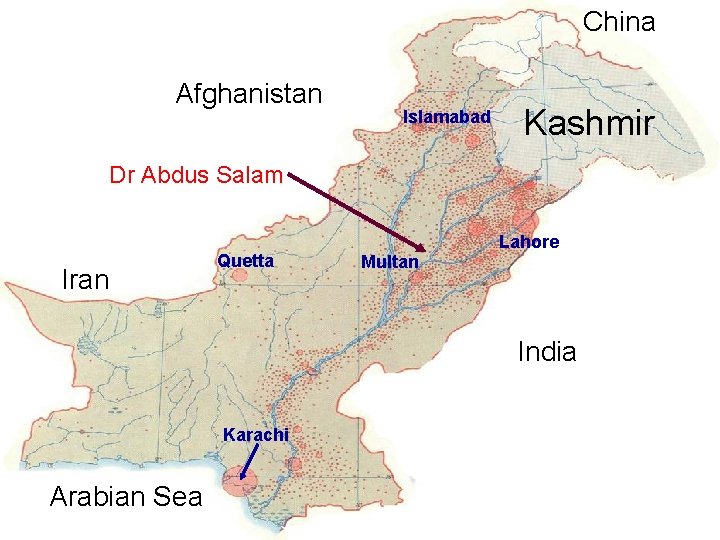
China 2002 Afghanistan Kashmir Islamabad Dr Abdus Salam Iran Quetta Lahore Multan India Iran Karachi Arabian Sea India
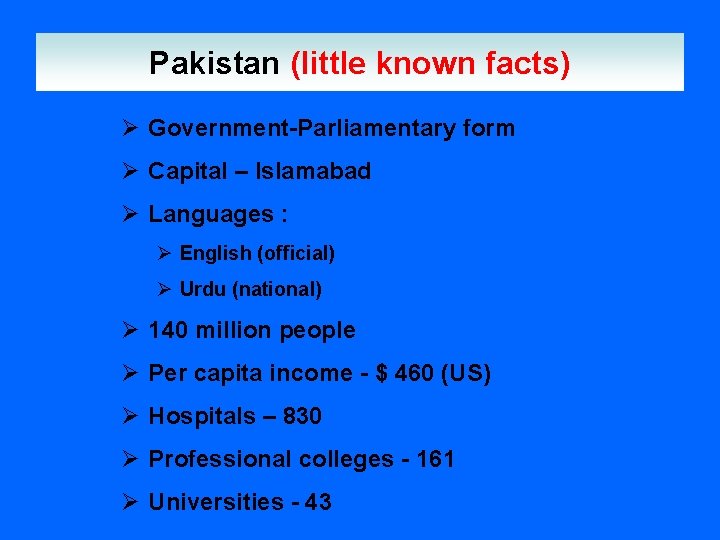
Pakistan (little known facts) Ø Government-Parliamentary form Ø Capital – Islamabad Ø Languages : Ø English (official) Ø Urdu (national) Ø 140 million people Ø Per capita income - $ 460 (US) Ø Hospitals – 830 Ø Professional colleges - 161 Ø Universities - 43
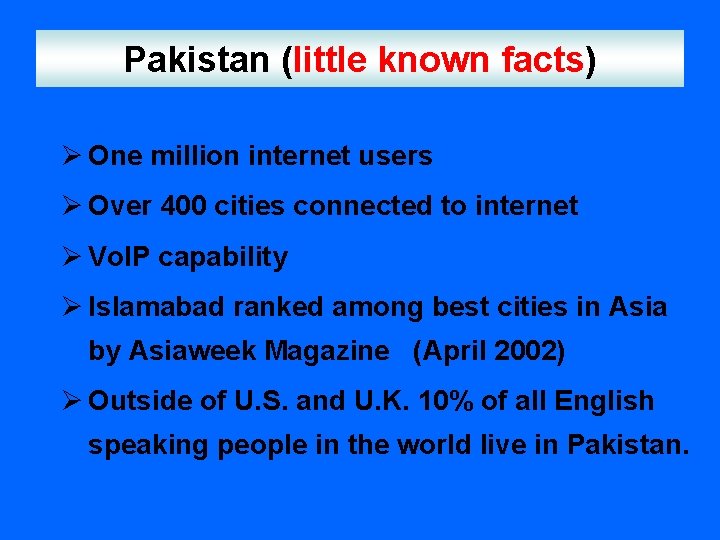
Pakistan (little known facts) Ø One million internet users Ø Over 400 cities connected to internet Ø Vo. IP capability Ø Islamabad ranked among best cities in Asia by Asiaweek Magazine (April 2002) Ø Outside of U. S. and U. K. 10% of all English speaking people in the world live in Pakistan.
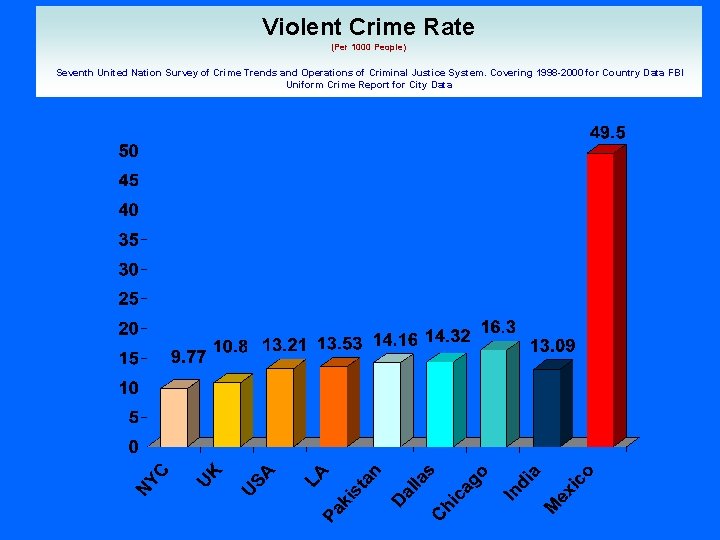
Violent Crime Rate (Per 1000 People) Seventh United Nation Survey of Crime Trends and Operations of Criminal Justice System. Covering 1998 -2000 for Country Data FBI Uniform Crime Report for City Data
Human Resources: Talented and Educated People Talented people are born anywhere in the world they are not a privilege of developed countries! Talented people without education, however, will remain talented but uneducated people! Talented, but uneducated people: • will not contribute much to their country’s development • some of them will even use their talents in a detrimental way
Educated, not just Talented People Maxwell, Thomson, Rutherford, Curie, Fermi, Dirac, Einstein (physics), Watson, Crick (biology), Mendeleev, Pauling (chemistry), Fleming, Pasteur (medicine)…. have dramatically changed our world through their research followed by its technological applications All these scientists were not just talented, they were found to be talented as they were educated! Therefore, without education their talents would have been lost for the progress of mankind!
Natural Resources & Infrastructure Educated people are a necessary, but not a sufficient condition for the development of a country: A country’s wealth thus depends on its educated people producing items or a providing service commerce or just selling natural resources does not produce wealth
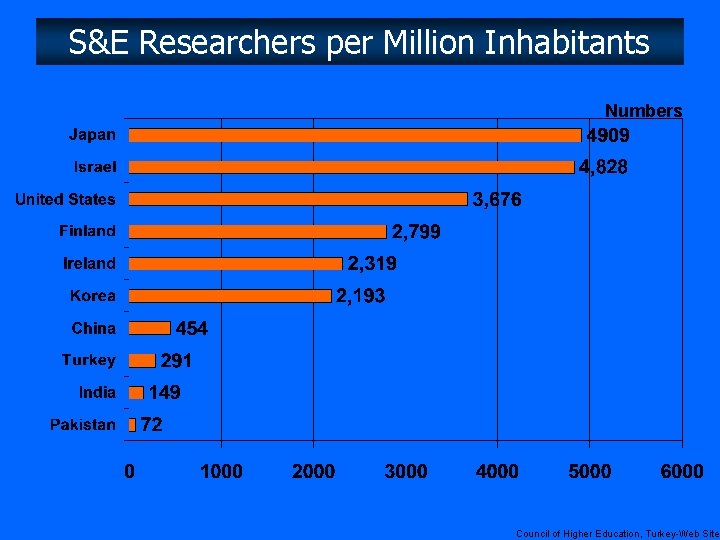
S&E Researchers per Million Inhabitants Numbers Council of Higher Education, Turkey-Web Site
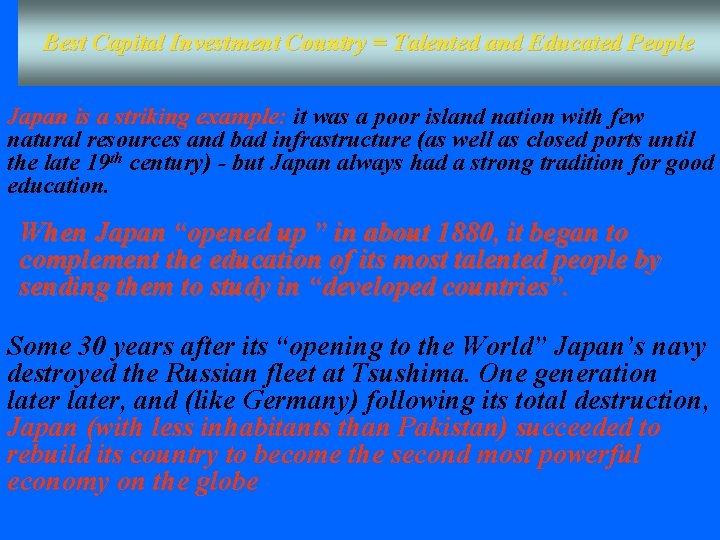
Best Capital Investment Country = Talented and Educated People Japan is a striking example: it was a poor island nation with few natural resources and bad infrastructure (as well as closed ports until the late 19 th century) - but Japan always had a strong tradition for good education. When Japan “opened up ” in about 1880, it began to complement the education of its most talented people by sending them to study in “developed countries”. Some 30 years after its “opening to the World” Japan’s navy destroyed the Russian fleet at Tsushima. One generation later, and (like Germany) following its total destruction, Japan (with less inhabitants than Pakistan) succeeded to rebuild its country to become the second most powerful economy on the globe
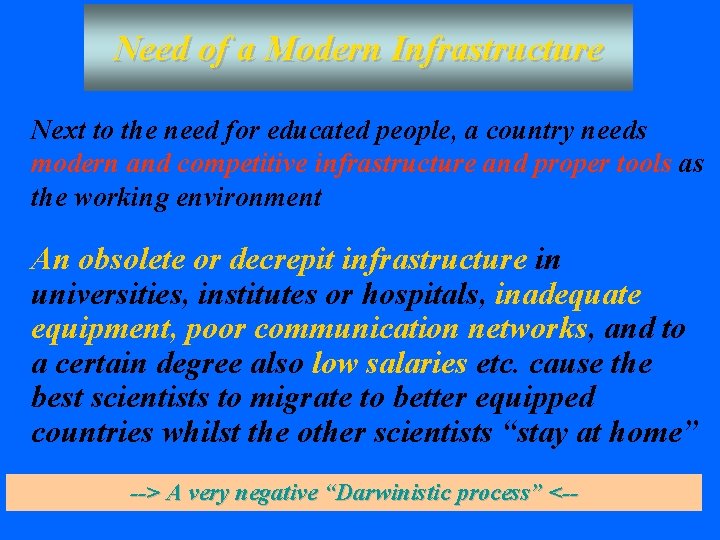
Need of a Modern Infrastructure Next to the need for educated people, a country needs modern and competitive infrastructure and proper tools as the working environment An obsolete or decrepit infrastructure in universities, institutes or hospitals, inadequate equipment, poor communication networks, and to a certain degree also low salaries etc. cause the best scientists to migrate to better equipped countries whilst the other scientists “stay at home” --> A very negative “Darwinistic process” <--
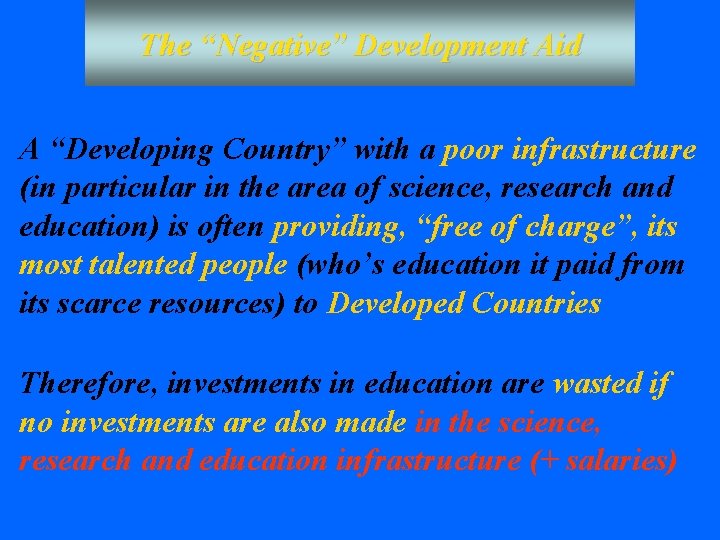
The “Negative” Development Aid A “Developing Country” with a poor infrastructure (in particular in the area of science, research and education) is often providing, “free of charge”, its most talented people (who’s education it paid from its scarce resources) to Developed Countries Therefore, investments in education are wasted if no investments are also made in the science, research and education infrastructure (+ salaries)
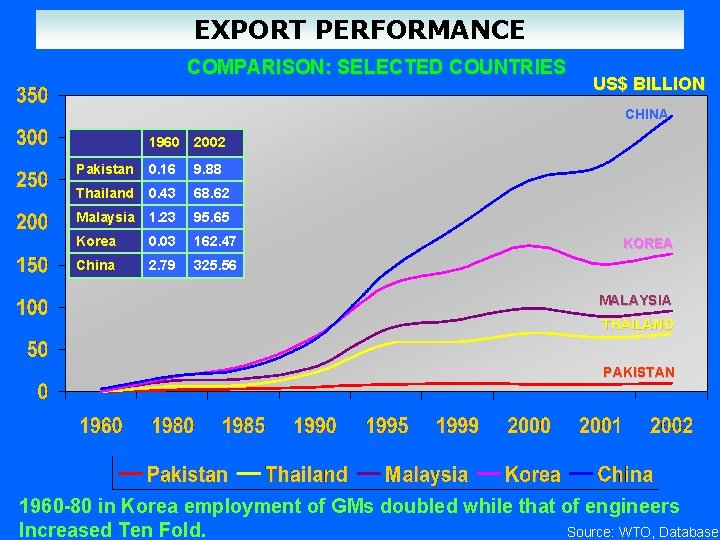
EXPORT PERFORMANCE COMPARISON: SELECTED COUNTRIES US$ BILLION CHINA 1960 2002 Pakistan 0. 16 9. 88 Thailand 0. 43 68. 62 Malaysia 1. 23 95. 65 Korea 0. 03 162. 47 China 2. 79 325. 56 KOREA MALAYSIA THAILAND PAKISTAN 1960 -80 in Korea employment of GMs doubled while that of engineers Increased Ten Fold. Source: WTO, Database
Help scientists from Developing Countries to work “at home” Governments should therefore make their best effort to provide opportunities to its scientists to work in their home country, and make it also attractive for them work there. Governments should also provide good communications with the rest of the world Arshad Ali NUST Pakistan 23 -24 Oct 03
Science cannot progress in Isolation However, science has become rather complex, and only very few scientists can make any progress in isolation: “to limit the community of scientists to a small group leads to common spiritual poverty” (A. Einstein) Most scientists in isolation will soon cease to be scientists as such they will no longer be able to educate younger talents, and their “knowledge” will eventually have become obsolete. This was recognized by Abdus Salam, and others when they promoted institutions like the ICTP, ……. Arshad Ali NUST Pakistan 23 -24 Oct 03
International Basic Science Collaborations At the same time, scientists must be also able to collaborate with their colleagues from other countries - as otherwise they would soon be “out of touch”, i. e. they would become much less useful (or quite useless) for the development of their own country… and there are plenty of opportunities for international basic science collaborations (CERN, FNAL, ICTP, GENOME etc which are a good training ground - or an opportunity to make a major contribution to mankind
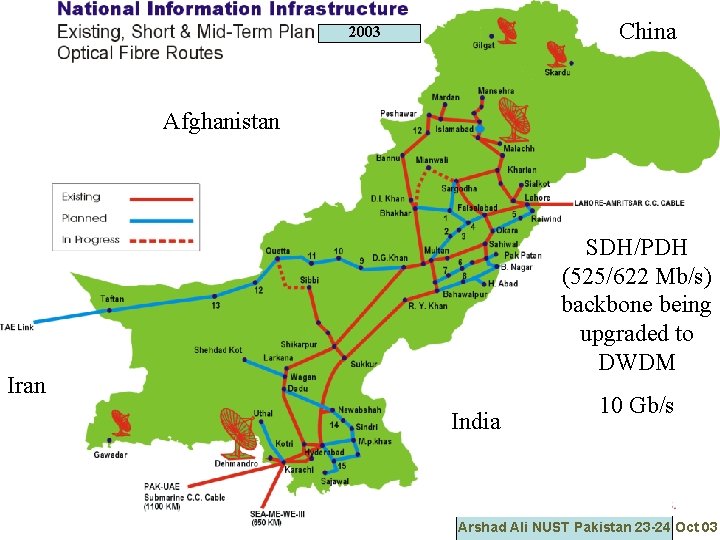
China 2003 Afghanistan SDH/PDH (525/622 Mb/s) backbone being upgraded to DWDM Iran India 10 Gb/s Arshad Ali NUST Pakistan 23 -24 Oct 03
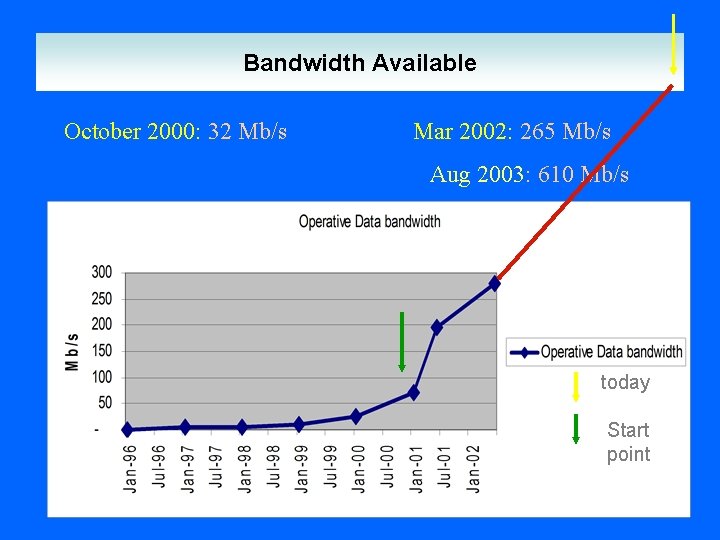
Bandwidth Available October 2000: 32 Mb/s Mar 2002: 265 Mb/s Aug 2003: 610 Mb/s today Start point
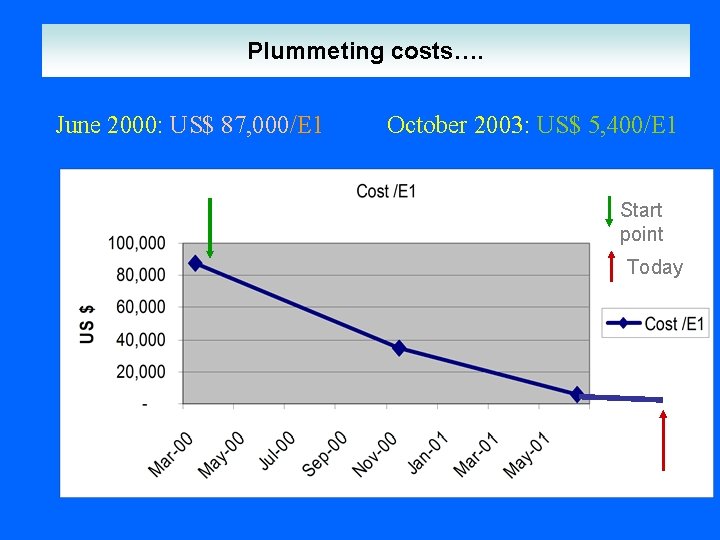
Plummeting costs…. June 2000: US$ 87, 000/E 1 October 2003: US$ 5, 400/E 1 Start point Today
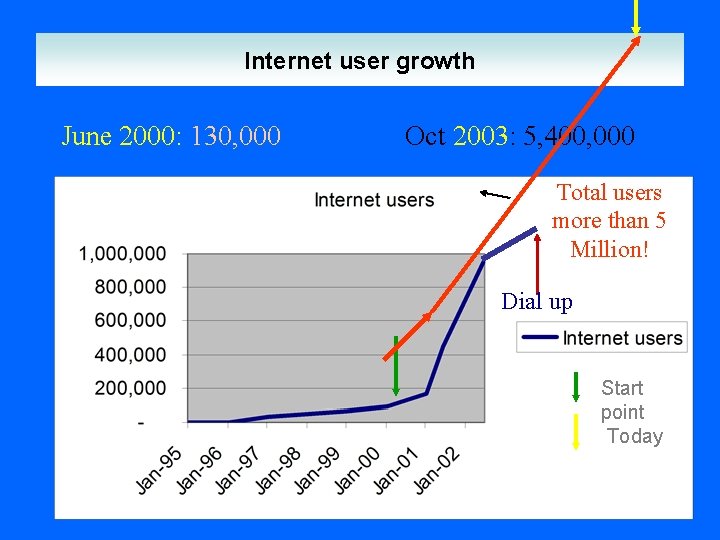
Internet user growth June 2000: 130, 000 Oct 2003: 5, 400, 000 Total users more than 5 Million! Dial up Start point Today
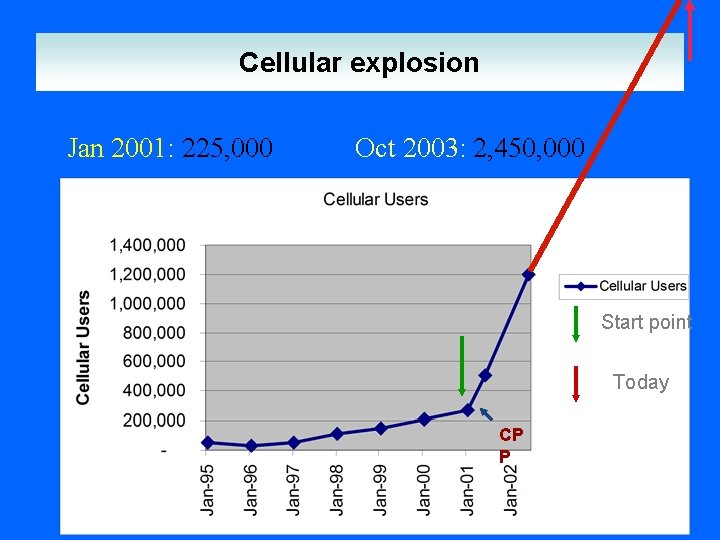
Cellular explosion Jan 2001: 225, 000 Oct 2003: 2, 450, 000 Start point Today CP P
NUST-CERN Collaboration · Dec 2000: CERN scientists visited NUST · Feb 2001: WISDOM II Project started at NUST with CERN and University of West England (UWE) UK · April 2001: Monalisa module development started with Caltech, USA (Thanks to Ian Willers, Harvey Newman and Richard Mc. Clatchey for their role in making this a success)
Collaboration Projects • End Host Monitoring Agent (EMA) for Mona. Lisa -Caltech, USA • IP Network Topology Discovery Module -- Caltech, USA • Grid Enabled Analysis Application for Handheld Devices --Caltech, USA • Java Based Claren Server for Physics Analysis -Caltech, USA • Data Warehousing Services for Grid -- Caltech, USA
Collaboration Projects • Establishment of CMS Production Centre and LCG Grid deployment -- CMS CERN • Integration of Agents and Web Services in Semantic Grid -- Comtec Japan • FIPA Compliant Multi Agent System -Comtec Japan • Mobilen Grid for Ubquitous computing – KHU Korea
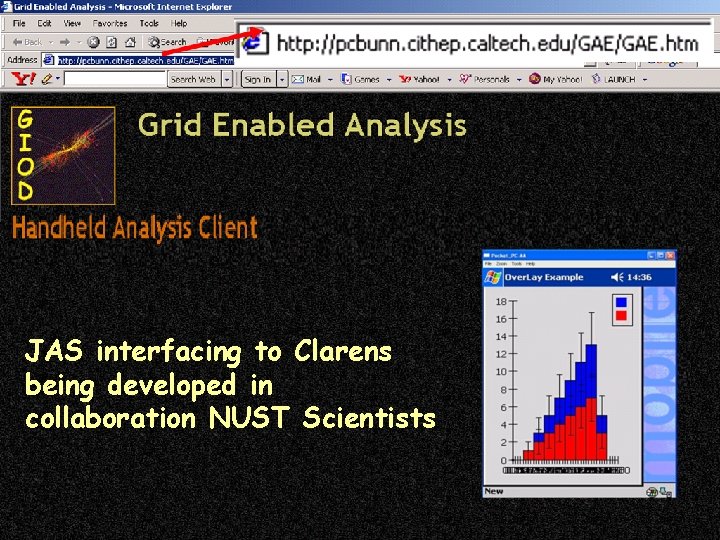
JAS interfacing to Clarens being developed in collaboration NUST Scientists
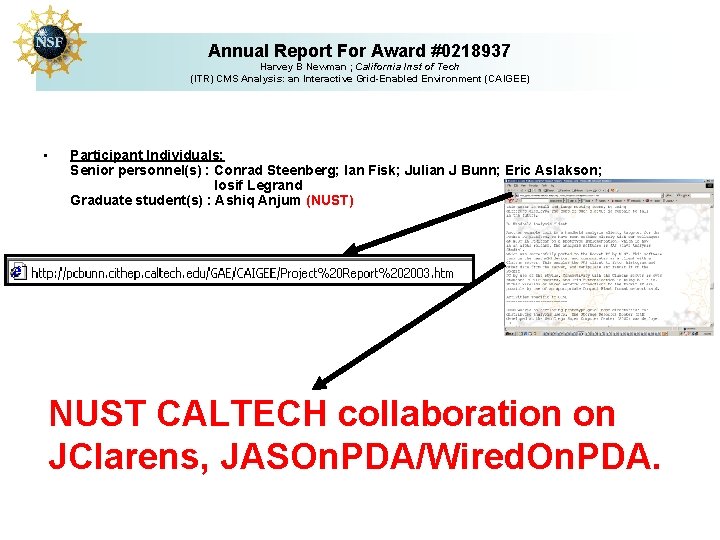
Annual Report For Award #0218937 Harvey B Newman ; California Inst of Tech (ITR) CMS Analysis: an Interactive Grid-Enabled Environment (CAIGEE) • Participant Individuals: Senior personnel(s) : Conrad Steenberg; Ian Fisk; Julian J Bunn; Eric Aslakson; Iosif Legrand Graduate student(s) : Ashiq Anjum (NUST) NUST CALTECH collaboration on JClarens, JASOn. PDA/Wired. On. PDA.
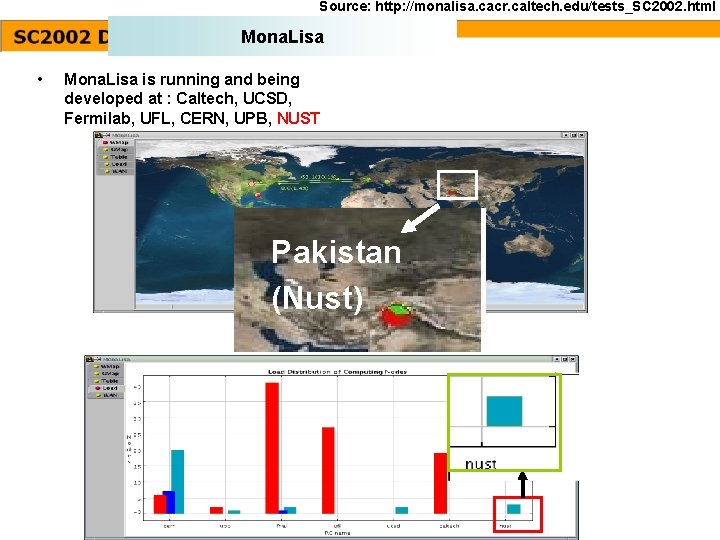
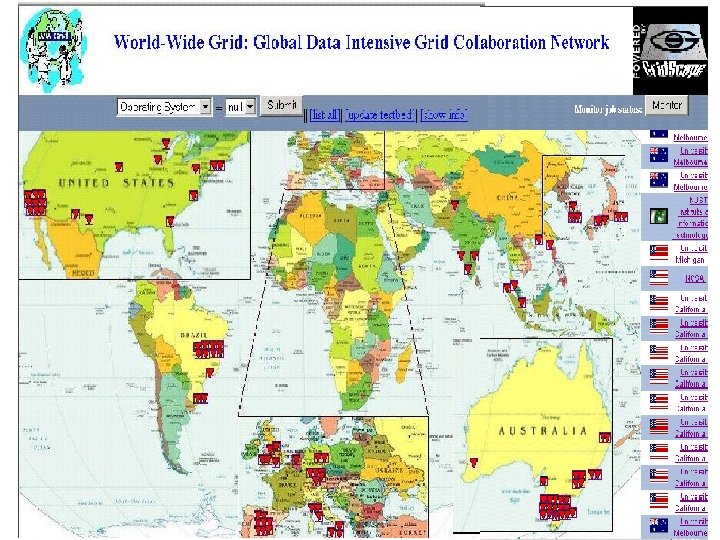
Source: http: //monalisa. cacr. caltech. edu/tests_SC 2002. html Mona. Lisa • Mona. Lisa is running and being developed at : Caltech, UCSD, Fermilab, UFL, CERN, UPB, NUST Pakistan (Nust)
Grid analysis demo by Caltech, CERN, KEK (Japan), Sinica (Taiwan), NUST (Pakistan), UERJ (Rio de Janeiro), PUB (Bucharest).
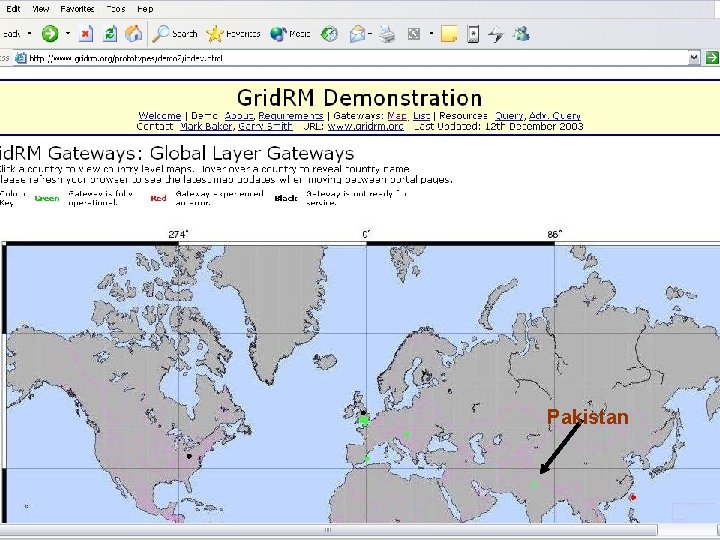
Pakistan
Establishment of LHC Grid Node at NUST • Establishment of LHC Grid node at NUST – Grid node will help in developing state of the art technologies in Pakistan for socioeconomic development – Strengthen research in priority areas – Breed technologies for Pakistani industrial sector – Enhance scientific research profile of Pakistan
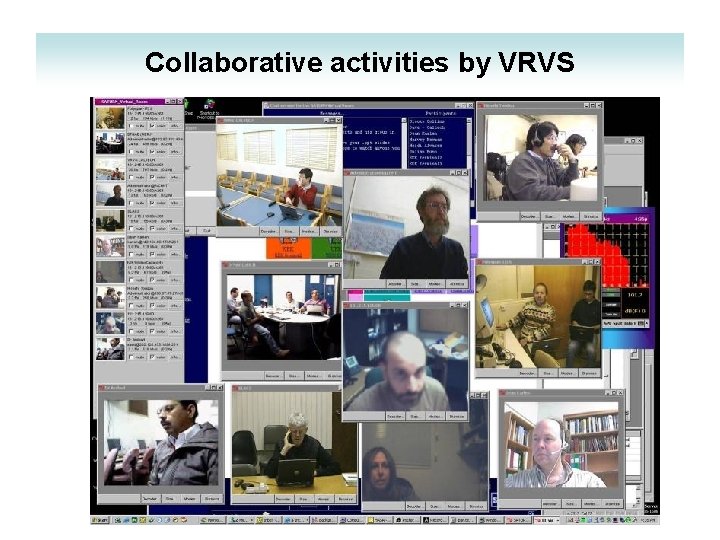
Collaborative activities by VRVS
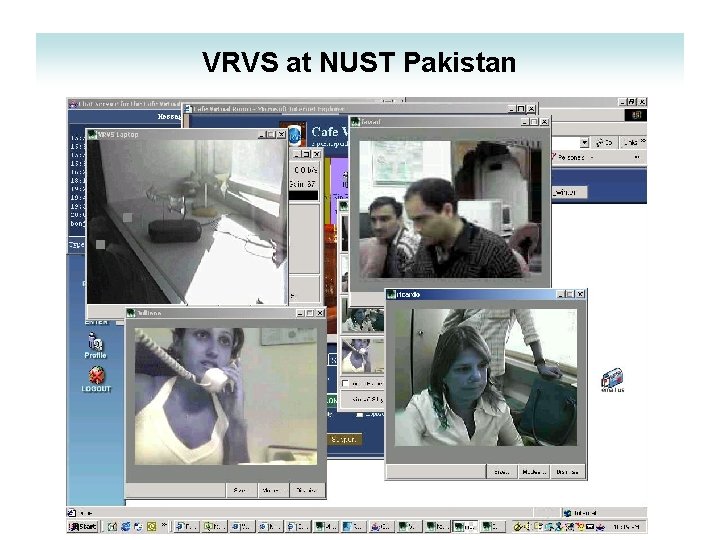
VRVS at NUST Pakistan
NIIT & SLAC Research Collaboration IEPM/Ping. ER Internet End-to-end Performance Monitoring and the Ping. ER project
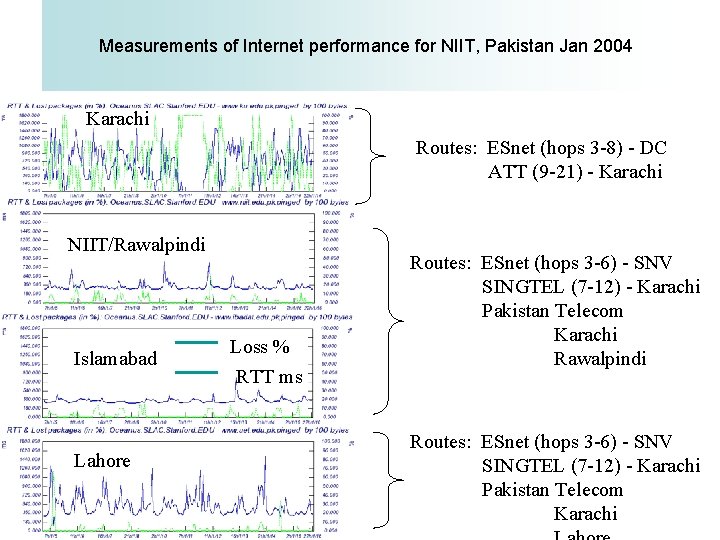
Measurements of Internet performance for NIIT, Pakistan Jan 2004 Karachi Routes: ESnet (hops 3 -8) - DC ATT (9 -21) - Karachi NIIT/Rawalpindi Islamabad Lahore Loss % RTT ms Routes: ESnet (hops 3 -6) - SNV SINGTEL (7 -12) - Karachi Pakistan Telecom Karachi Rawalpindi Routes: ESnet (hops 3 -6) - SNV SINGTEL (7 -12) - Karachi Pakistan Telecom Karachi
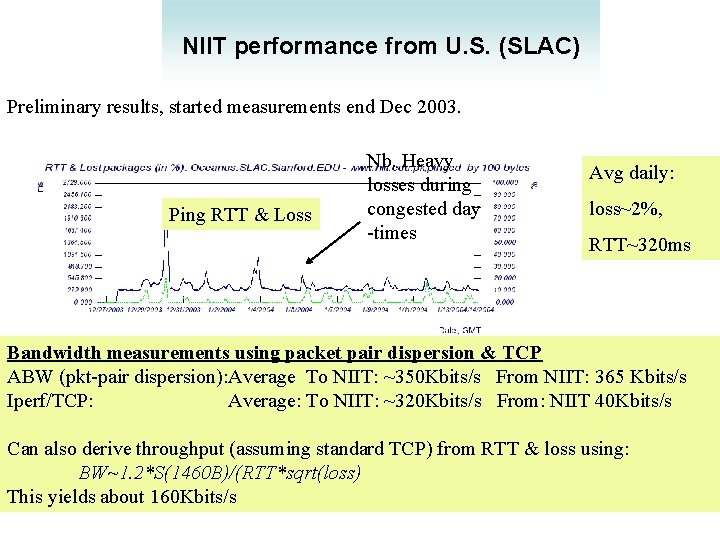
NIIT performance from U. S. (SLAC) Preliminary results, started measurements end Dec 2003. Ping RTT & Loss Nb. Heavy losses during congested day -times Avg daily: loss~2%, RTT~320 ms Bandwidth measurements using packet pair dispersion & TCP ABW (pkt-pair dispersion): Average To NIIT: ~350 Kbits/s From NIIT: 365 Kbits/s Iperf/TCP: Average: To NIIT: ~320 Kbits/s From: NIIT 40 Kbits/s Can also derive throughput (assuming standard TCP) from RTT & loss using: BW~1. 2*S(1460 B)/(RTT*sqrt(loss) This yields about 160 Kbits/s
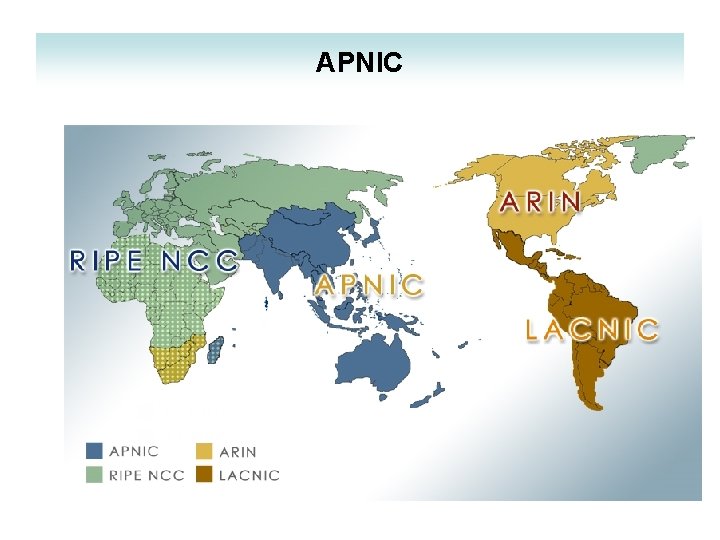
APNIC
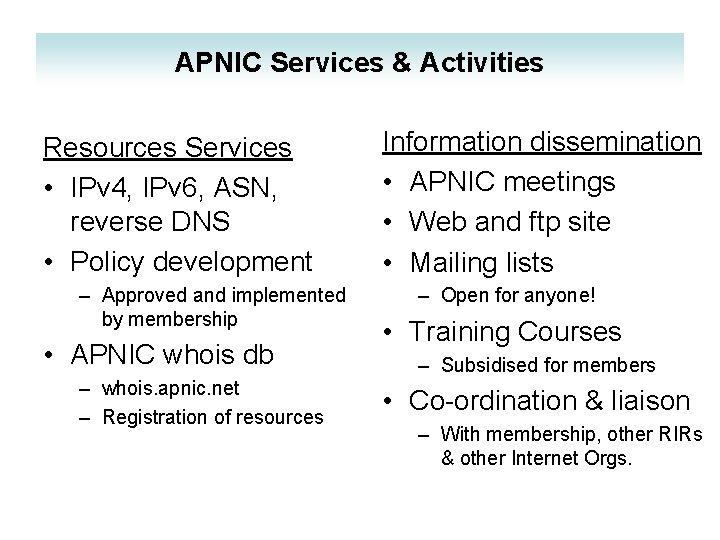
APNIC Services & Activities Resources Services • IPv 4, IPv 6, ASN, reverse DNS • Policy development – Approved and implemented by membership • APNIC whois db – whois. apnic. net – Registration of resources Information dissemination • APNIC meetings • Web and ftp site • Mailing lists – Open for anyone! • Training Courses – Subsidised for members • Co-ordination & liaison – With membership, other RIRs & other Internet Orgs.
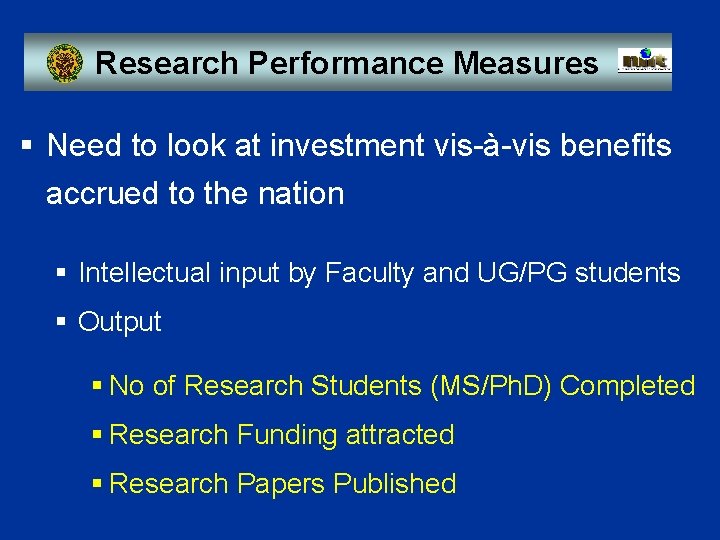
Research Performance Measures § Need to look at investment vis-à-vis benefits accrued to the nation § Intellectual input by Faculty and UG/PG students § Output § No of Research Students (MS/Ph. D) Completed § Research Funding attracted § Research Papers Published
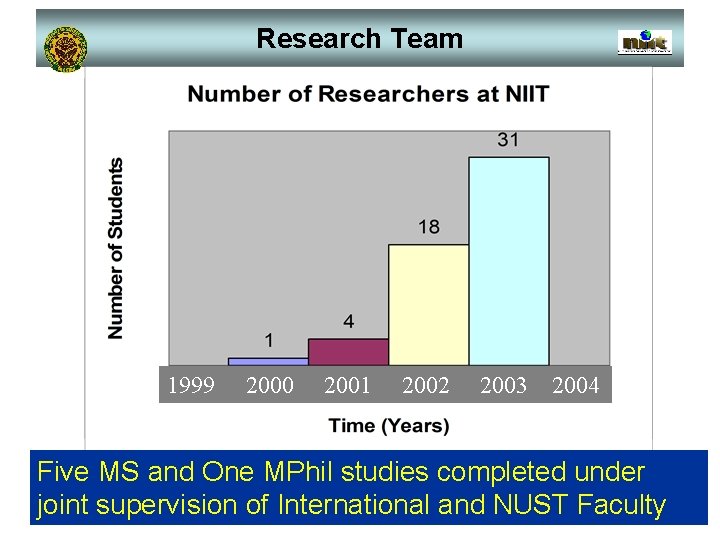
Research Team 1999 2000 2001 2002 2003 2004 Five MS and One MPhil studies completed under joint supervision of International and NUST Faculty
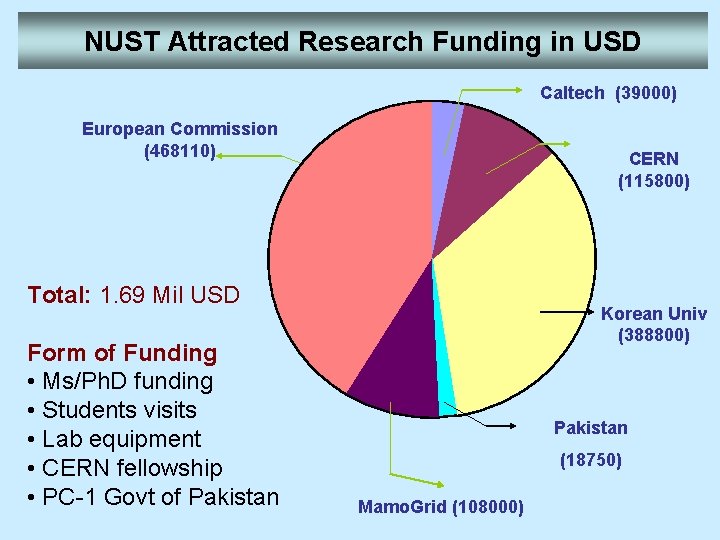
NUST Attracted Research Funding in USD Caltech (39000) European Commission (468110) CERN (115800) Total: 1. 69 Mil USD Form of Funding • Ms/Ph. D funding • Students visits • Lab equipment • CERN fellowship • PC-1 Govt of Pakistan Korean Univ (388800) Pakistan (18750) Mamo. Grid (108000)
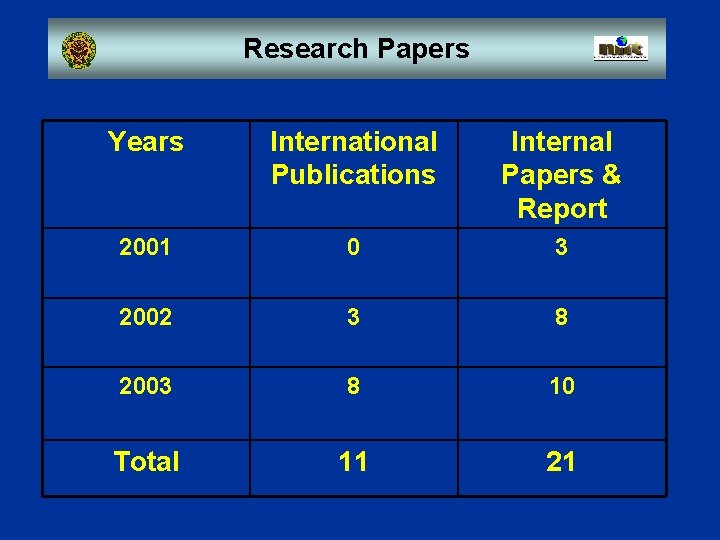
Research Papers Years International Publications Internal Papers & Report 2001 0 3 2002 3 8 2003 8 10 Total 11 21
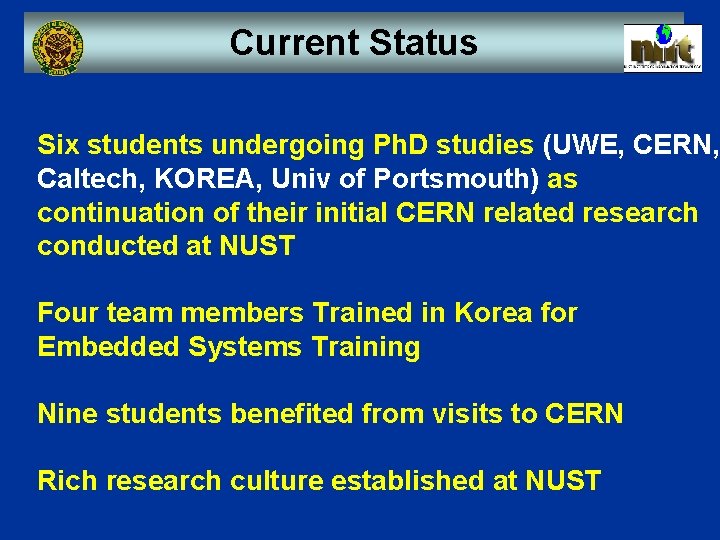
Current Status Six students undergoing Ph. D studies (UWE, CERN, Caltech, KOREA, Univ of Portsmouth) as continuation of their initial CERN related research conducted at NUST Four team members Trained in Korea for Embedded Systems Training Nine students benefited from visits to CERN Rich research culture established at NUST
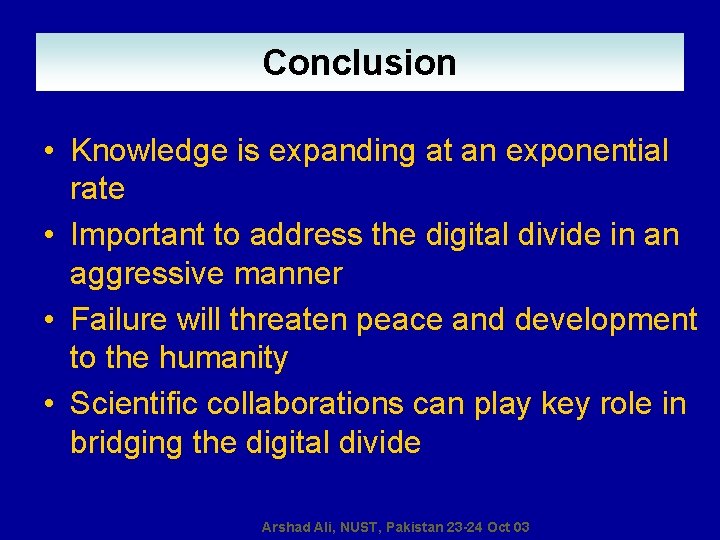
Conclusion • Knowledge is expanding at an exponential rate • Important to address the digital divide in an aggressive manner • Failure will threaten peace and development to the humanity • Scientific collaborations can play key role in bridging the digital divide Arshad Ali, NUST, Pakistan 23 -24 Oct 03
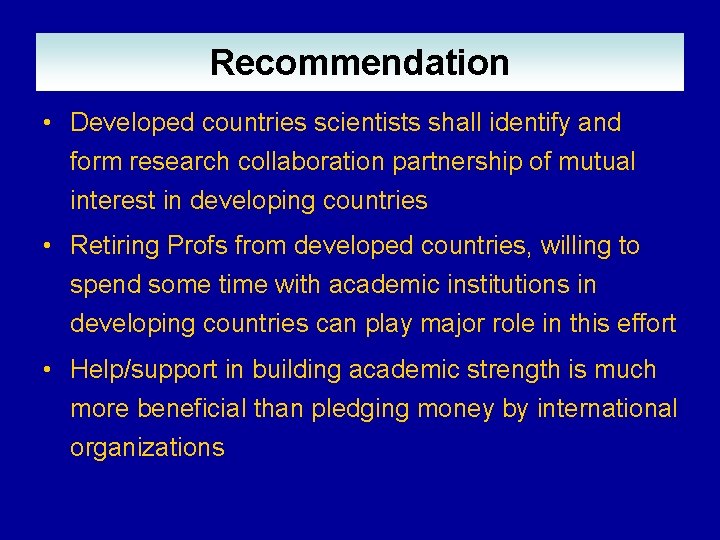
Recommendation • Developed countries scientists shall identify and form research collaboration partnership of mutual interest in developing countries • Retiring Profs from developed countries, willing to spend some time with academic institutions in developing countries can play major role in this effort • Help/support in building academic strength is much more beneficial than pledging money by international organizations
Recommendation • World Bank/UN shall ensure that a good percentage of the loan / donation is spent on education by the developing countries • International scientific community can play key role in making developing countries aware about need for high speed network requirements: ( Thanks to Harvey Newman and Ian Willers )
The 2 nd International Workshop on Distributed Computing, Communication and Applications IWDCCA 2005 March 10 – 12, 2005 (Islamabad, Pakistan) Email: arshad. ali@niit. edu. pk URL: www. niit. edu. pk Thanks