
National Training Roll Out 2020 Key business processes
National Training Roll Out 2020 Key business processes and minimum system requirements underpinning m. SCOA Presented by National Treasury - Maritz van Zyl – 10 December 2020 1
Contents • The LG Reform Agenda • Minimum business processes and system specifications that underpins m. SCOA • Requirements of the m. SCOA Regulation 2
Constitutional requirement for LG budget and financial reforms The Constitution and MFMA are the cornerstones for the LG Reform Agenda Section 216(1) of the Constitution states that: National legislation must establish a National Treasury and prescribe measures to ensure both transparency and expenditure control in each sphere of government, by introducing - (a) Generally recognized accounting practice (GRAP – OAG); (b) Uniform expenditure classifications (Standard Chart of Accounts / General Ledger); and (c) Uniform treasury norms and standards (MFMA, Regulations, Circulars and Guidelines). Section 168 (1) of the MFMA further states that: The Minister (of Finance), acting with the concurrence of the Cabinet member responsible for local government, may make regulations for, among other things – (a) any matter that may be prescribed …and… (b) any other matter that may facilitate the enforcement and administration of the Act. 3
Reporting challenges • Although all municipalities were submitting reports to the LG Database and Reporting System, the credibility and reliability of information was a challenge. This was attributed to: – Lack of unified norms, standards and classification frameworks across all of local government. Each municipality (257) used different municipal ‘charts of accounts’ (COA), making aggregation and comparison of municipal information difficult; – Financial systems did not meet the financial management and reporting requirements of local government as informed by the legislative framework such as Municipal Budget and Reporting Regulations and GRAP; – Limited technical skill in municipalities to produce financial management information; and – Deliberate distortion of reported financial performance by municipalities. • Municipalities continuously changed and amended the detail of their COA – inconsistency in information year-on-year impacted on trend analysis. A need was identified for a standard Chart of Accounts for municipalities and municipal entities…and so the m. SCOA journey began and m. SCOA was regulated on 22 April 2014. 4
LG Reform Agenda • The introduction of MFMA in 2003 laid foundation for LG financial management reforms, including development of a comprehensive reporting system for LG. • A Local Government Database and Reporting System (LGDRS) was developed to facilitate the collection and storage of data and establish a culture of reporting in terms of the MFMA. • Development started in 2002; started with in-year monthly reporting, followed by standardised budget formats and m. SCOA classification framework. • The routine publication of budget and in-year financial performance information for LG has escalated the performance of LG into the public domain. These publications provide a foundation for the development of policy responses and other stakeholders such as economists and academics who now have access to information which was previously not readily available. • • A sound reporting system facilitates transparency, better in-year management and oversight of budgets, making these reports management tools and early warning mechanisms for councils to improve municipal performance. • The aim of an early warning system for LG is to provide government with timely information on the state of municipalities’ finances that highlights possible areas of risk so that such risks can be investigated and mitigated before they give rise to serious problems. 5
Objective of m. SCOA • The object of the m. SCOA Regulations is to provide a national standard for the uniform recording and classification of municipal budget and financial information at a transaction level – across all municipalities and financial systems • It is a multi segmental chart where LG information is classified according project, fund, function, Item, costing and region dimensions to enhance “whole of government” reporting • Unlike the National and provinces SCOA, municipalities are on accrual-based accounting (vs modified cash) and must plan, budget, report and generate the AFS directly in the system. • This will facilitate seamless alignment between policy formulation, planning, budgeting, implementation, reporting, monitoring (accountability cycle) • m. SCOA is not limited to a standardised financial classification but incorporates: Modernisation of LG business processes (regulation of minimum business processes and system specifications); Application of basic processes and procedures for the daily operation of the municipality; and Improvement of the municipal ITC and control environment. • Comply by 01 July 2017, giving municiplaities a 3 -year preparation period.
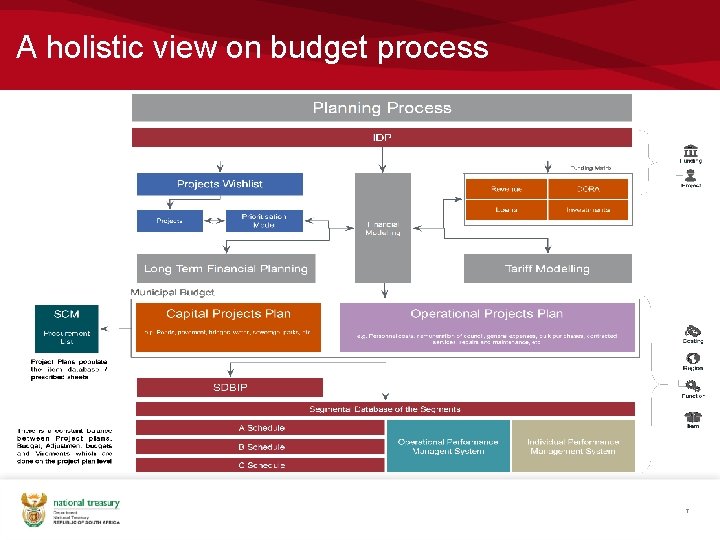
A holistic view on budget process 7
Key business processes and minimum system specifications that underpins m. SCOA • What constitutes an effective enterprise management system (ERP) that supports the regulation • MFMA Circular 80 and the addendum to Circular 80 (18 October 2016) - Municipal Financial Systems and Processes, replaces MFMA Circular No. 57, with effect 8 March 2016, and formalizes the minimum system functionality and business process requirements a municipality’s financial management and internal control system(s) should meet to enable successful transacting in the m. SCOA classification by 1 July 2017. 8
Key business processes and minimum system specifications that underpins m. SCOA • In addition, the regulation recommends fifteen key business processes that incorporates all business activities across functions and supports the regulation as a business reform and not only a financial reform. • These business processes are expected to be regulated during the maturity projection of the regulation and will be aligned to the standard operating procedures (SOP) that underpins these key business processes. 9
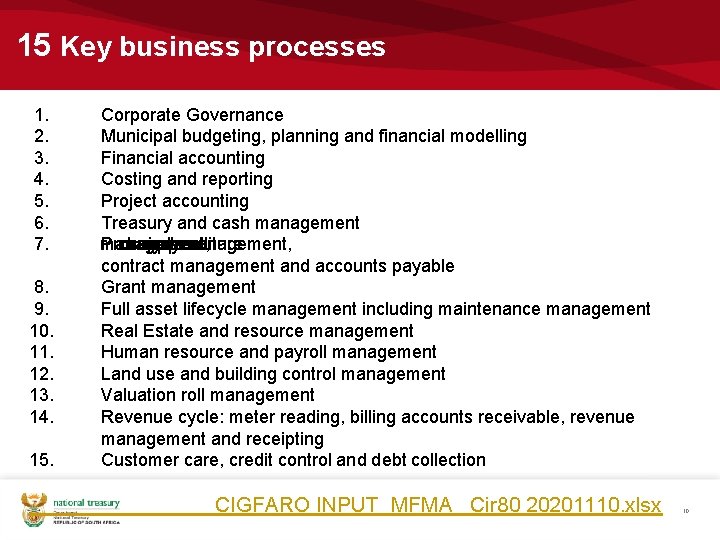
15 Key business processes 1. 2. 3. 4. 5. 6. 7. 8. 9. 10. 11. 12. 13. 14. 15. Corporate Governance Municipal budgeting, planning and financial modelling Financial accounting Costing and reporting Project accounting Treasury and cash management, Procurement chain supply cycle: expenditure management, contract management and accounts payable Grant management Full asset lifecycle management including maintenance management Real Estate and resource management Human resource and payroll management Land use and building control management Valuation roll management Revenue cycle: meter reading, billing accounts receivable, revenue management and receipting Customer care, credit control and debt collection CIGFARO INPUT_MFMA _Cir 80 20201110. xlsx 10
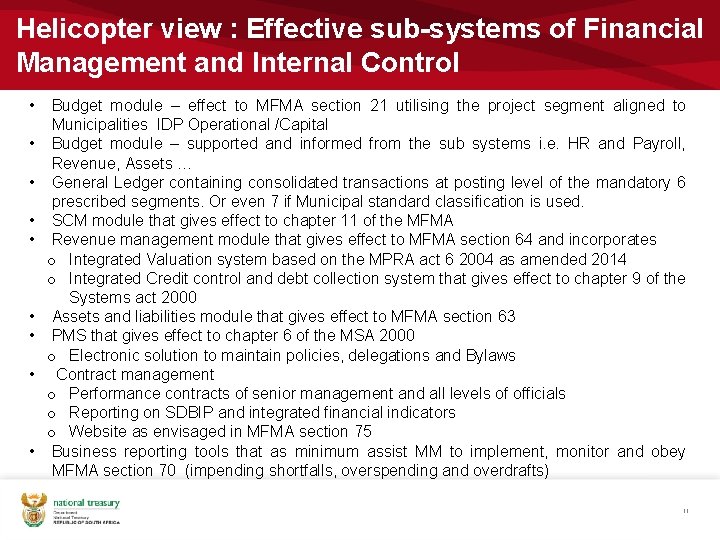
Helicopter view : Effective sub-systems of Financial Management and Internal Control • • • Budget module – effect to MFMA section 21 utilising the project segment aligned to Municipalities IDP Operational /Capital Budget module – supported and informed from the sub systems i. e. HR and Payroll, Revenue, Assets … General Ledger containing consolidated transactions at posting level of the mandatory 6 prescribed segments. Or even 7 if Municipal standard classification is used. SCM module that gives effect to chapter 11 of the MFMA Revenue management module that gives effect to MFMA section 64 and incorporates o Integrated Valuation system based on the MPRA act 6 2004 as amended 2014 o Integrated Credit control and debt collection system that gives effect to chapter 9 of the Systems act 2000 Assets and liabilities module that gives effect to MFMA section 63 PMS that gives effect to chapter 6 of the MSA 2000 o Electronic solution to maintain policies, delegations and Bylaws Contract management o Performance contracts of senior management and all levels of officials o Reporting on SDBIP and integrated financial indicators o Website as envisaged in MFMA section 75 Business reporting tools that as minimum assist MM to implement, monitor and obey MFMA section 70 (impending shortfalls, overspending and overdrafts) 11
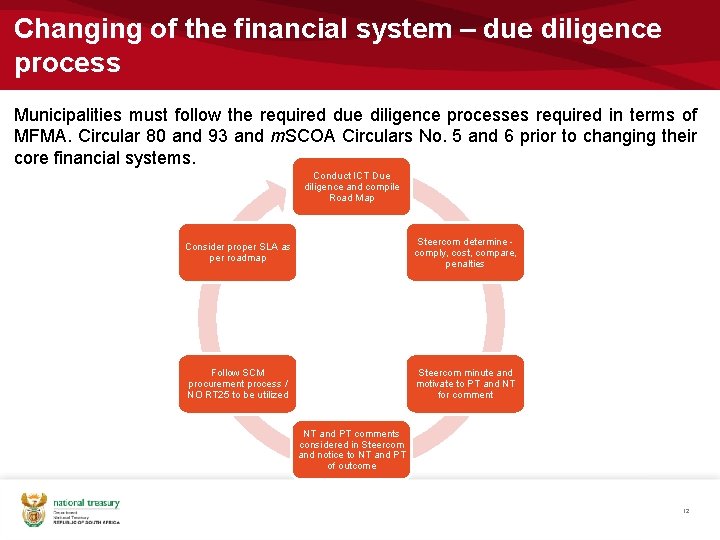
Changing of the financial system – due diligence process Municipalities must follow the required due diligence processes required in terms of MFMA. Circular 80 and 93 and m. SCOA Circulars No. 5 and 6 prior to changing their core financial systems. Conduct ICT Due diligence and compile Road Map Consider proper SLA as per roadmap Steercom determine comply, cost, compare, penalties Follow SCM procurement process / NO RT 25 to be utilized Steercom minute and motivate to PT and NT for comment NT and PT comments considered in Steercom and notice to NT and PT of outcome 12
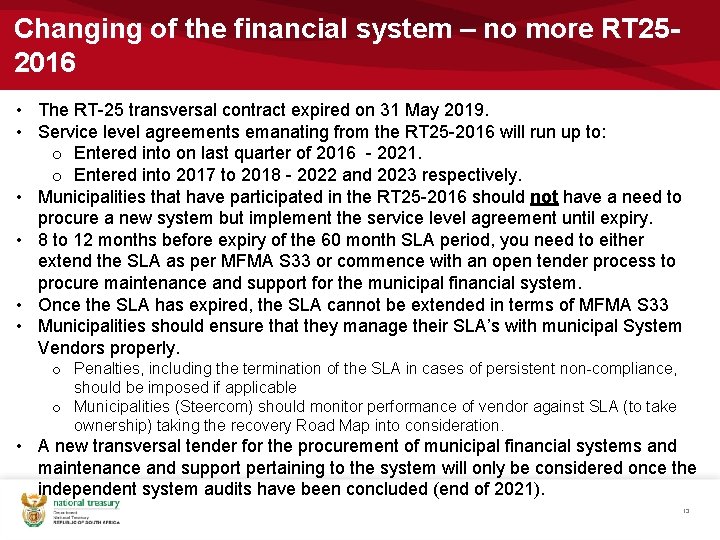
Changing of the financial system – no more RT 252016 • The RT-25 transversal contract expired on 31 May 2019. • Service level agreements emanating from the RT 25 -2016 will run up to: o Entered into on last quarter of 2016 - 2021. o Entered into 2017 to 2018 - 2022 and 2023 respectively. • Municipalities that have participated in the RT 25 -2016 should not have a need to procure a new system but implement the service level agreement until expiry. • 8 to 12 months before expiry of the 60 month SLA period, you need to either extend the SLA as per MFMA S 33 or commence with an open tender process to procure maintenance and support for the municipal financial system. • Once the SLA has expired, the SLA cannot be extended in terms of MFMA S 33 • Municipalities should ensure that they manage their SLA’s with municipal System Vendors properly. o Penalties, including the termination of the SLA in cases of persistent non-compliance, should be imposed if applicable o Municipalities (Steercom) should monitor performance of vendor against SLA (to take ownership) taking the recovery Road Map into consideration. • A new transversal tender for the procurement of municipal financial systems and maintenance and support pertaining to the system will only be considered once the independent system audits have been concluded (end of 2021). 13
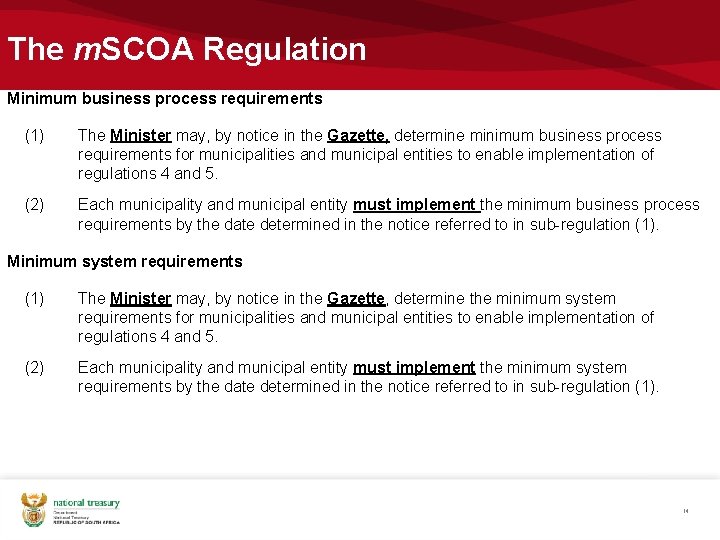
The m. SCOA Regulation Minimum business process requirements (1) The Minister may, by notice in the Gazette, determine minimum business process requirements for municipalities and municipal entities to enable implementation of regulations 4 and 5. (2) Each municipality and municipal entity must implement the minimum business process requirements by the date determined in the notice referred to in sub-regulation (1). Minimum system requirements (1) The Minister may, by notice in the Gazette, determine the minimum system requirements for municipalities and municipal entities to enable implementation of regulations 4 and 5. (2) Each municipality and municipal entity must implement the minimum system requirements by the date determined in the notice referred to in sub-regulation (1). 14
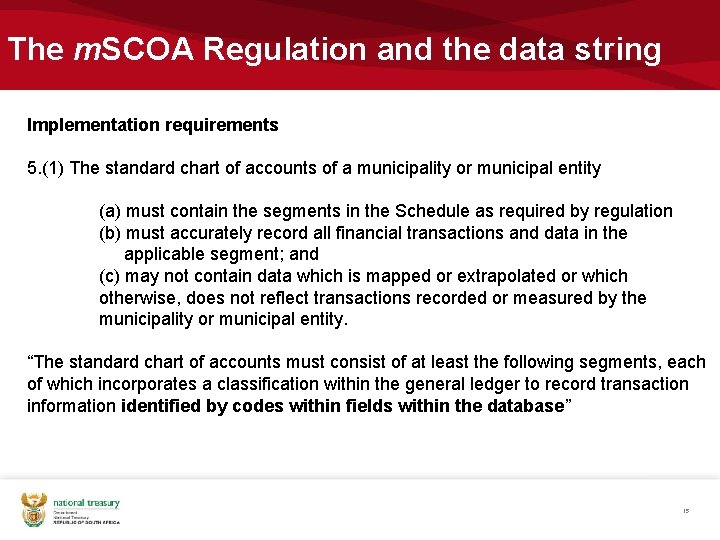
The m. SCOA Regulation and the data string Implementation requirements 5. (1) The standard chart of accounts of a municipality or municipal entity (a) must contain the segments in the Schedule as required by regulation (b) must accurately record all financial transactions and data in the applicable segment; and (c) may not contain data which is mapped or extrapolated or which otherwise, does not reflect transactions recorded or measured by the municipality or municipal entity. “The standard chart of accounts must consist of at least the following segments, each of which incorporates a classification within the general ledger to record transaction information identified by codes within fields within the database” 15
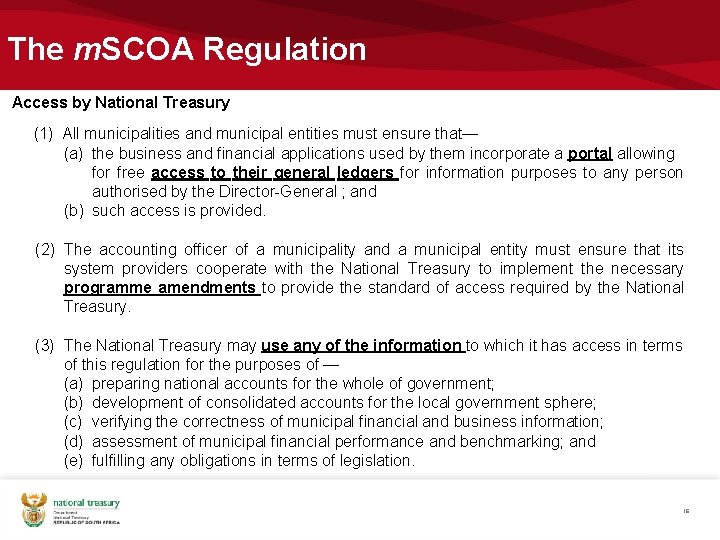
The m. SCOA Regulation Access by National Treasury (1) All municipalities and municipal entities must ensure that— (a) the business and financial applications used by them incorporate a portal allowing for free access to their general ledgers for information purposes to any person authorised by the Director-General ; and (b) such access is provided. (2) The accounting officer of a municipality and a municipal entity must ensure that its system providers cooperate with the National Treasury to implement the necessary programme amendments to provide the standard of access required by the National Treasury. (3) The National Treasury may use any of the information to which it has access in terms of this regulation for the purposes of — (a) preparing national accounts for the whole of government; (b) development of consolidated accounts for the local government sphere; (c) verifying the correctness of municipal financial and business information; (d) assessment of municipal financial performance and benchmarking; and (e) fulfilling any obligations in terms of legislation. 16
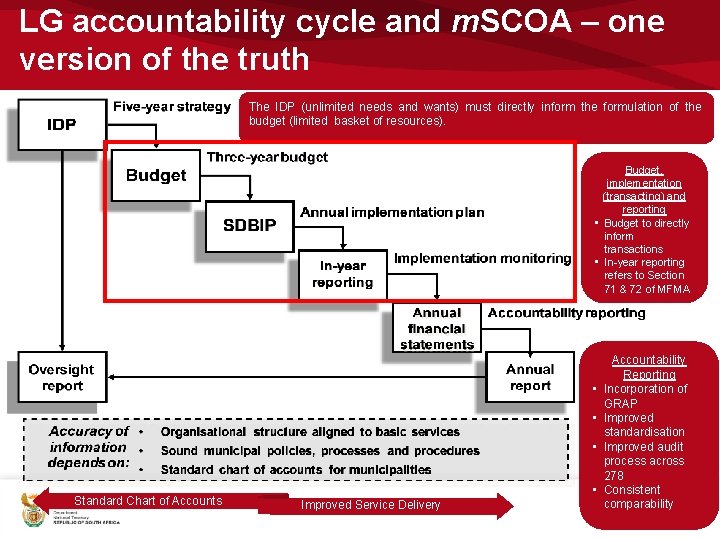
LG accountability cycle and m. SCOA – one version of the truth The IDP (unlimited needs and wants) must directly inform the formulation of the budget (limited basket of resources). Budget, implementation (transacting) and reporting • Budget to directly inform transactions • In-year reporting refers to Section 71 & 72 of MFMA • • • Standard Chart of Accounts • Improved Service Delivery Accountability Reporting Incorporation of GRAP Improved standardisation Improved audit process across 278 Consistent comparability 17
THANK YOU For additional information on national and provincial budgets, please visit our new budget data portal: https: //vulekamali. gov. za For information on local government finances, please visit: https: //municipalmoney. gov. za 18
- Slides: 18