
National Survey of Medication Safety Practice Preparation of
- Slides: 5
National Survey of Medication Safety Practice: Preparation of Medication and Dispensing at Primary Healthcare Centers/Community Pharmacies in Riyadh, Saudi Arabia Yousef Ahmed Alomi, Adel Mehmas H. Alragas, Manar Mohammed Alslim, Rana Mohammed Alslim, Khulud Abdulrahman Alamoudi, Zainab Abdulmunem Almuallem
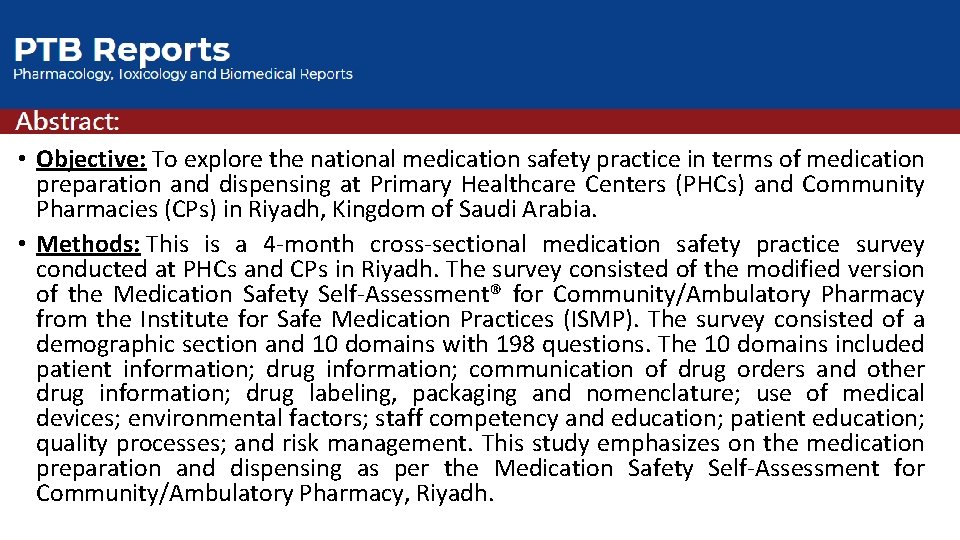
• Objective: To explore the national medication safety practice in terms of medication preparation and dispensing at Primary Healthcare Centers (PHCs) and Community Pharmacies (CPs) in Riyadh, Kingdom of Saudi Arabia. • Methods: This is a 4 -month cross-sectional medication safety practice survey conducted at PHCs and CPs in Riyadh. The survey consisted of the modified version of the Medication Safety Self-Assessment® for Community/Ambulatory Pharmacy from the Institute for Safe Medication Practices (ISMP). The survey consisted of a demographic section and 10 domains with 198 questions. The 10 domains included patient information; drug information; communication of drug orders and other drug information; drug labeling, packaging and nomenclature; use of medical devices; environmental factors; staff competency and education; patient education; quality processes; and risk management. This study emphasizes on the medication preparation and dispensing as per the Medication Safety Self-Assessment for Community/Ambulatory Pharmacy, Riyadh.
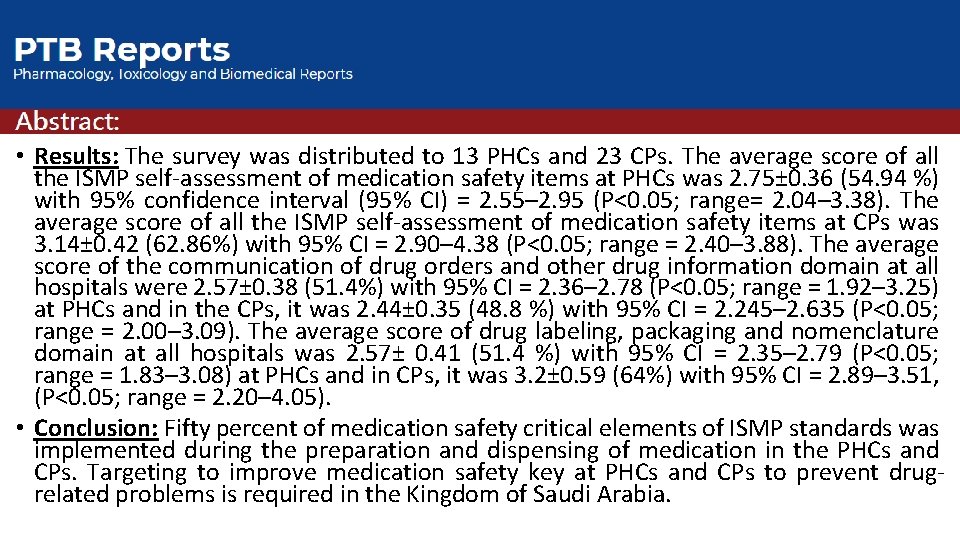
• Results: The survey was distributed to 13 PHCs and 23 CPs. The average score of all the ISMP self-assessment of medication safety items at PHCs was 2. 75± 0. 36 (54. 94 %) with 95% confidence interval (95% CI) = 2. 55– 2. 95 (P<0. 05; range= 2. 04– 3. 38). The average score of all the ISMP self-assessment of medication safety items at CPs was 3. 14± 0. 42 (62. 86%) with 95% CI = 2. 90– 4. 38 (P<0. 05; range = 2. 40– 3. 88). The average score of the communication of drug orders and other drug information domain at all hospitals were 2. 57± 0. 38 (51. 4%) with 95% CI = 2. 36– 2. 78 (P<0. 05; range = 1. 92– 3. 25) at PHCs and in the CPs, it was 2. 44± 0. 35 (48. 8 %) with 95% CI = 2. 245– 2. 635 (P<0. 05; range = 2. 00– 3. 09). The average score of drug labeling, packaging and nomenclature domain at all hospitals was 2. 57± 0. 41 (51. 4 %) with 95% CI = 2. 35– 2. 79 (P<0. 05; range = 1. 83– 3. 08) at PHCs and in CPs, it was 3. 2± 0. 59 (64%) with 95% CI = 2. 89– 3. 51, (P<0. 05; range = 2. 20– 4. 05). • Conclusion: Fifty percent of medication safety critical elements of ISMP standards was implemented during the preparation and dispensing of medication in the PHCs and CPs. Targeting to improve medication safety key at PHCs and CPs to prevent drugrelated problems is required in the Kingdom of Saudi Arabia.
KEYWORDS • Adverse Drug Reaction, • System, • Pharmaceutical Care, • Ministry of Health, • Saudi Arabia.
The self-assessment of medication safety study in PHCs and CPs was first conducted in the KSA, Gulf and Middle East countries. Approximately half of the medication safety key elements were implemented during the preparation and dispensing stage. Implementation of Computerized Physician Order Entry is required to prevent drug-related problems and improve medication safety system. The annual or biannual study of self-assessment of medication safety in PHCs and CPs is highly appreciated in the Kingdom of Saudi Arabia.