
National Strategy for Trusted Identities in Cyberspace Jeremy
National Strategy for Trusted Identities in Cyberspace Jeremy Grant NIST National Strategy for Trusted Identities in Cyberspace 1
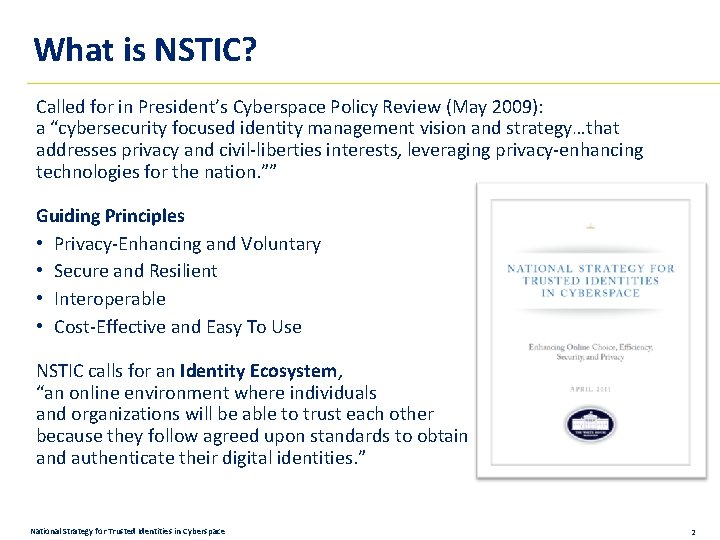
What is NSTIC? Called for in President’s Cyberspace Policy Review (May 2009): a “cybersecurity focused identity management vision and strategy…that addresses privacy and civil-liberties interests, leveraging privacy-enhancing technologies for the nation. ”” Guiding Principles • Privacy-Enhancing and Voluntary • Secure and Resilient • Interoperable • Cost-Effective and Easy To Use NSTIC calls for an Identity Ecosystem, “an online environment where individuals and organizations will be able to trust each other because they follow agreed upon standards to obtain and authenticate their digital identities. ” National Strategy for Trusted Identities in Cyberspace 2
The Problem Today Usernames and passwords are broken • Most people have 25 different passwords, or use the same one over and over • Even strong passwords are vulnerable…criminals can get the “keys to the kingdom” • Rising costs of identity theft – 123% increase in financial institution Suspicious Activity Reports in last 6 years (FINCEN) – 11. 7 million est. victims over 2 years (BJS, 2008) – $17. 3 billion est. cost to economy over 2 years (BJS, 2008) • Cybercrime is also on the rise – Incidents up 22% from 2009 to 2008 (IC 3 report) – Total loss from these incidents up 111%, to $560 million. National Strategy for Trusted Identities in Cyberspace 3
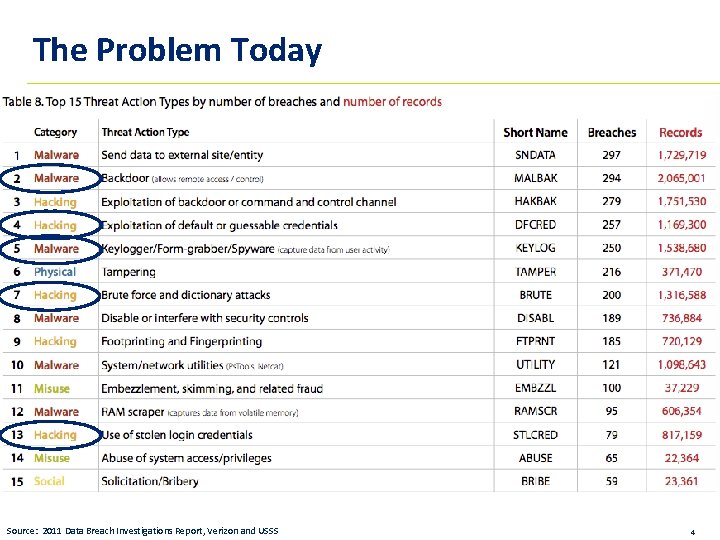
The Problem Today Source: 2011 Strategy Data Breach Investigations Report, Verizon and USSS National for Trusted Identities in Cyberspace 4
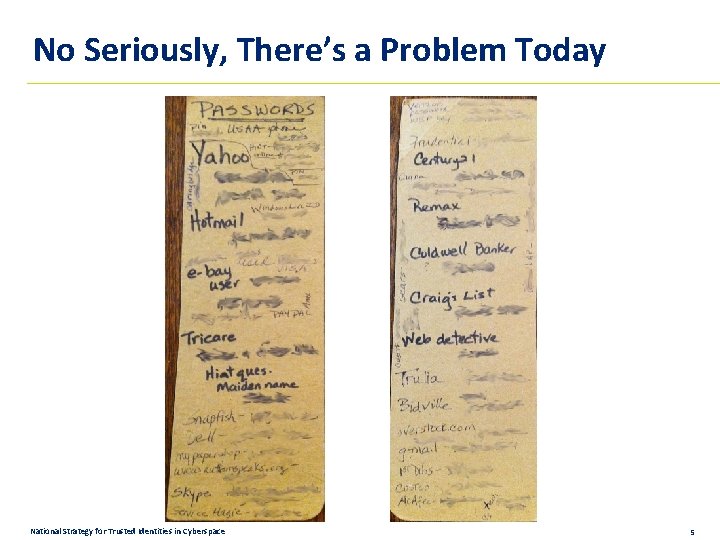
No Seriously, There’s a Problem Today National Strategy for Trusted Identities in Cyberspace 5

There’s a Problem Today, Travel Edition National Strategy for Trusted Identities in Cyberspace 6
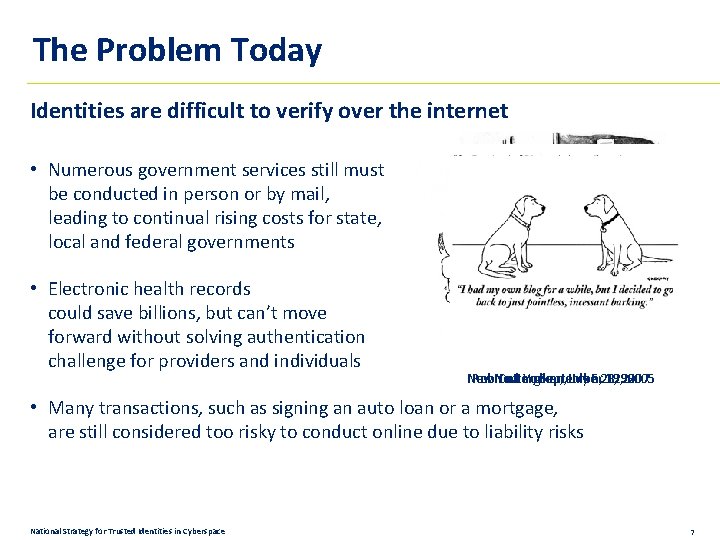
The Problem Today Identities are difficult to verify over the internet • Numerous government services still must be conducted in person or by mail, leading to continual rising costs for state, local and federal governments • Electronic health records could save billions, but can’t move forward without solving authentication challenge for providers and individuals New Rob. New Yorker, Cottingham, Yorker, September July June 5, 23, 1993 12, 2007 2005 • Many transactions, such as signing an auto loan or a mortgage, are still considered too risky to conduct online due to liability risks National Strategy for Trusted Identities in Cyberspace 7
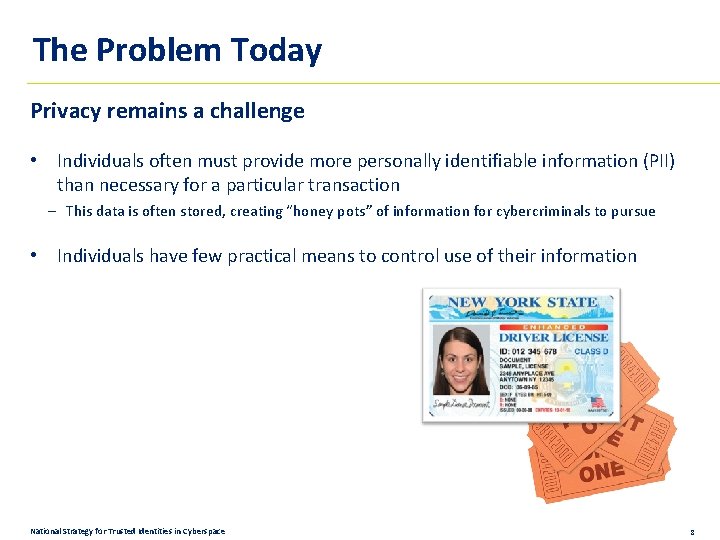
The Problem Today Privacy remains a challenge • Individuals often must provide more personally identifiable information (PII) than necessary for a particular transaction – This data is often stored, creating “honey pots” of information for cybercriminals to pursue • Individuals have few practical means to control use of their information National Strategy for Trusted Identities in Cyberspace 8
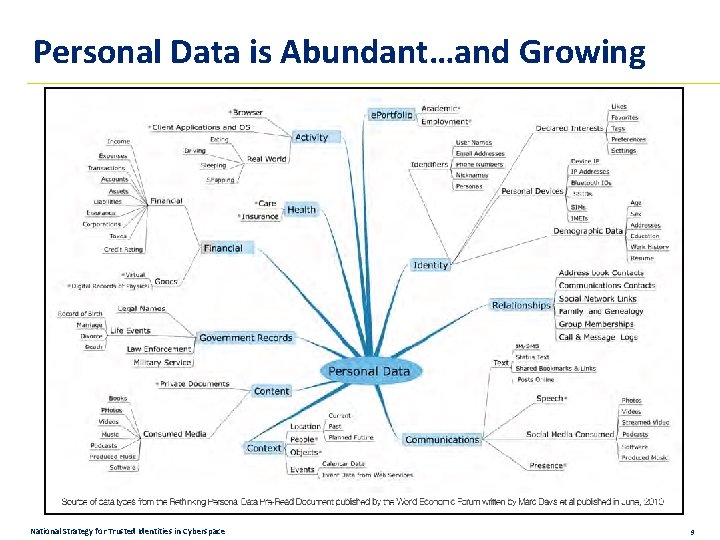
Personal Data is Abundant…and Growing National Strategy for Trusted Identities in Cyberspace 9
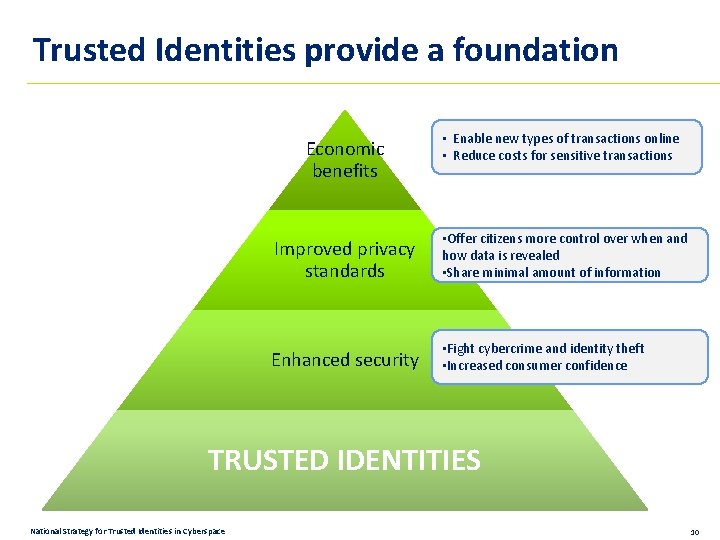
Trusted Identities provide a foundation Economic benefits • Enable new types of transactions online • Reduce costs for sensitive transactions Improved privacy standards • Offer citizens more control over when and how data is revealed • Share minimal amount of information Enhanced security • Fight cybercrime and identity theft • Increased consumer confidence TRUSTED IDENTITIES National Strategy for Trusted Identities in Cyberspace 10
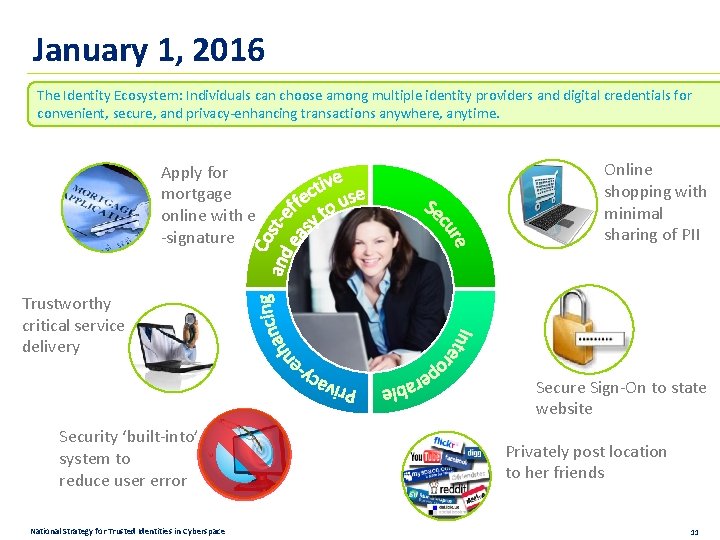
January 1, 2016 The Identity Ecosystem: Individuals can choose among multiple identity providers and digital credentials for convenient, secure, and privacy-enhancing transactions anywhere, anytime. Apply for mortgage online with e -signature Online shopping with minimal sharing of PII Trustworthy critical service delivery Secure Sign-On to state website Security ‘built-into’ system to reduce user error National Strategy for Trusted Identities in Cyberspace Privately post location to her friends 11
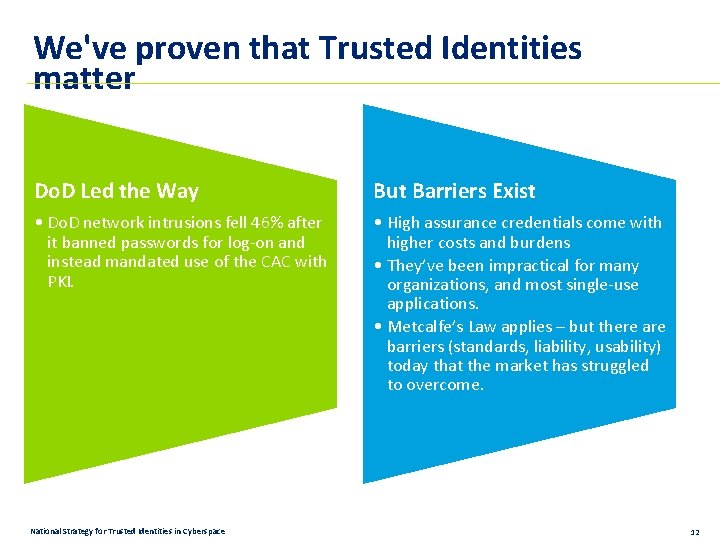
We've proven that Trusted Identities matter Do. D Led the Way But Barriers Exist • Do. D network intrusions fell 46% after it banned passwords for log-on and instead mandated use of the CAC with PKI. • High assurance credentials come with higher costs and burdens • They’ve been impractical for many organizations, and most single-use applications. • Metcalfe’s Law applies – but there are barriers (standards, liability, usability) today that the market has struggled to overcome. National Strategy for Trusted Identities in Cyberspace 12
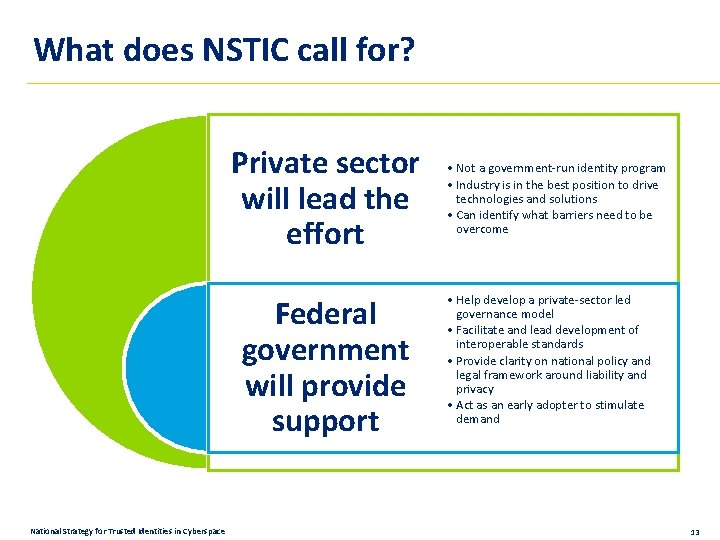
What does NSTIC call for? Private sector will lead the effort Federal government will provide support National Strategy for Trusted Identities in Cyberspace • Not a government-run identity program • Industry is in the best position to drive technologies and solutions • Can identify what barriers need to be overcome • Help develop a private-sector led governance model • Facilitate and lead development of interoperable standards • Provide clarity on national policy and legal framework around liability and privacy • Act as an early adopter to stimulate demand 13
Privacy and Civil Liberties are Fundamental Increase privacy • Minimize sharing of unnecessary information • Minimum standards for organizations - such as adherence to Fair Information Practice Principles (FIPPs) Voluntary and private-sector led • Individuals can choose not to participate • Individuals who participate can choose from public or private-sector identity providers • No central database is created Preserves anonymity • Digital anonymity and pseudonymity supports free speech and freedom of association National Strategy for Trusted Identities in Cyberspace 14
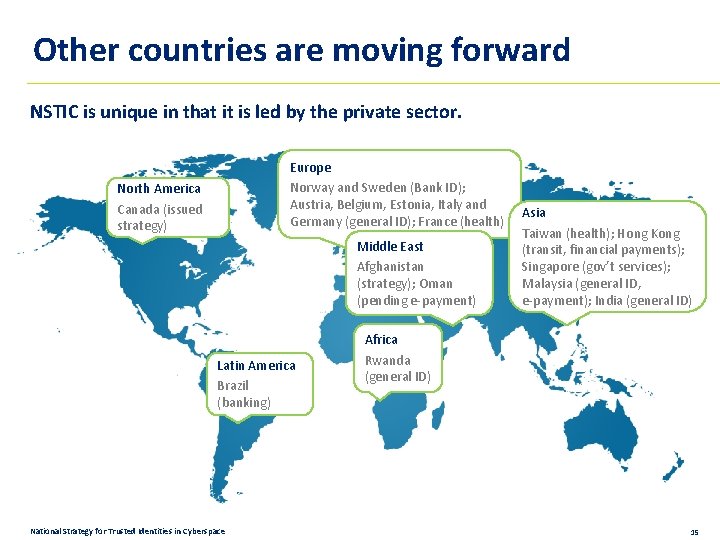
Other countries are moving forward NSTIC is unique in that it is led by the private sector. Europe Norway and Sweden (Bank ID); Austria, Belgium, Estonia, Italy and Germany (general ID); France (health) North America Canada (issued strategy) Middle East Afghanistan (strategy); Oman (pending e-payment) Latin America Brazil (banking) National Strategy for Trusted Identities in Cyberspace Asia Taiwan (health); Hong Kong (transit, financial payments); Singapore (gov’t services); Malaysia (general ID, e-payment); India (general ID) Africa Rwanda (general ID) 15
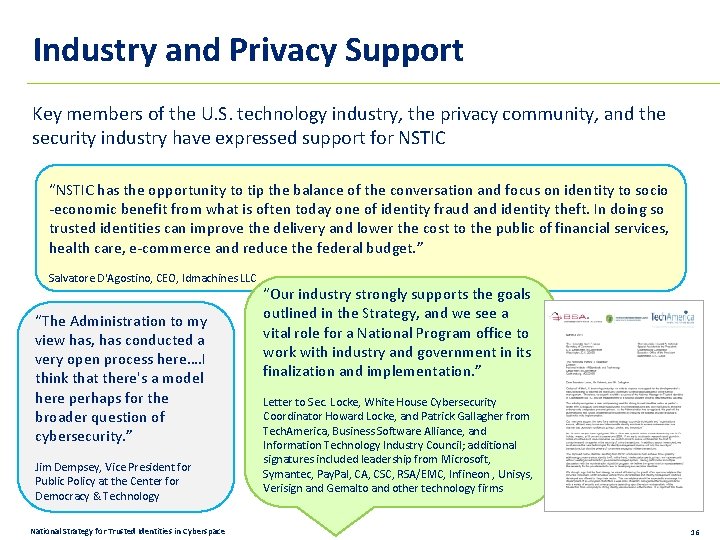
Industry and Privacy Support Key members of the U. S. technology industry, the privacy community, and the security industry have expressed support for NSTIC “NSTIC has the opportunity to tip the balance of the conversation and focus on identity to socio -economic benefit from what is often today one of identity fraud and identity theft. In doing so trusted identities can improve the delivery and lower the cost to the public of financial services, health care, e-commerce and reduce the federal budget. ” Salvatore D'Agostino, CEO, Idmachines LLC “The Administration to my view has, has conducted a very open process here…. I think that there's a model here perhaps for the broader question of cybersecurity. ” Jim Dempsey, Vice President for Public Policy at the Center for Democracy & Technology National Strategy for Trusted Identities in Cyberspace “Our industry strongly supports the goals outlined in the Strategy, and we see a vital role for a National Program office to work with industry and government in its finalization and implementation. ” Letter to Sec. Locke, White House Cybersecurity Coordinator Howard Locke, and Patrick Gallagher from Tech. America, Business Software Alliance, and Information Technology Industry Council; additional signatures included leadership from Microsoft, Symantec, Pay. Pal, CA, CSC, RSA/EMC, Infineon , Unisys, Verisign and Gemalto and other technology firms 16
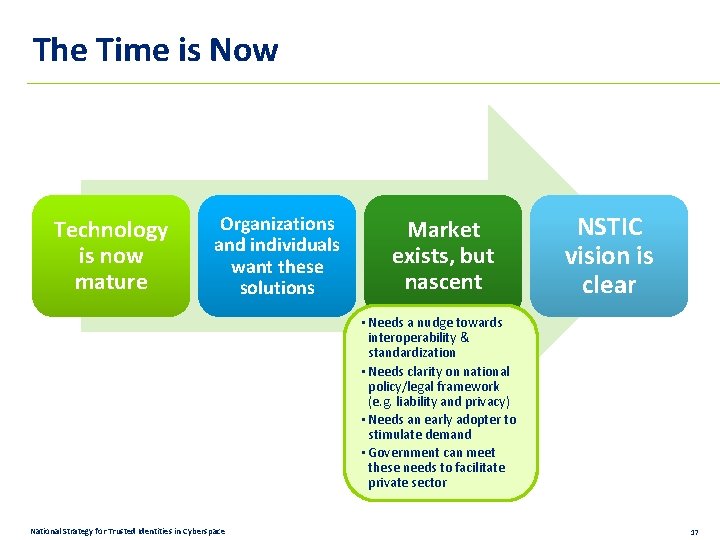
The Time is Now Technology is now mature Organizations and individuals want these solutions Market exists, but nascent NSTIC vision is clear • Needs a nudge towards interoperability & standardization • Needs clarity on national policy/legal framework (e. g. liability and privacy) • Needs an early adopter to stimulate demand • Government can meet these needs to facilitate private sector National Strategy for Trusted Identities in Cyberspace 17
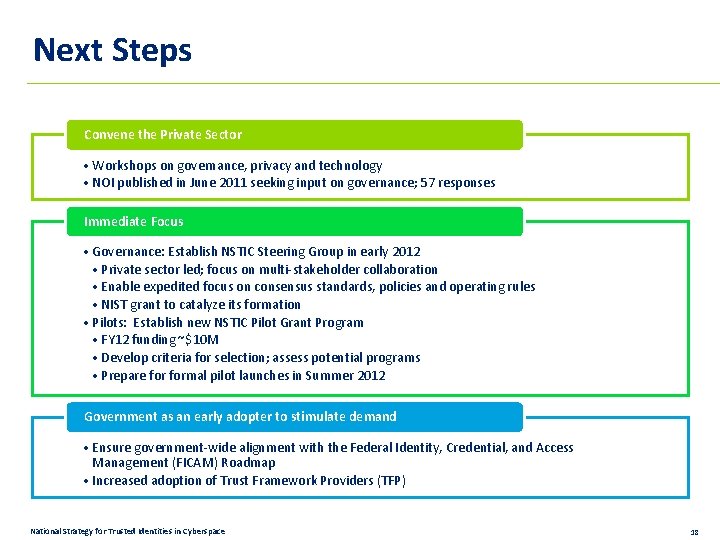
Next Steps Convene the Private Sector • Workshops on governance, privacy and technology • NOI published in June 2011 seeking input on governance; 57 responses Immediate Focus • Governance: Establish NSTIC Steering Group in early 2012 • Private sector led; focus on multi-stakeholder collaboration • Enable expedited focus on consensus standards, policies and operating rules • NIST grant to catalyze its formation • Pilots: Establish new NSTIC Pilot Grant Program • FY 12 funding ~$10 M • Develop criteria for selection; assess potential programs • Prepare formal pilot launches in Summer 2012 Government as an early adopter to stimulate demand • Ensure government-wide alignment with the Federal Identity, Credential, and Access Management (FICAM) Roadmap • Increased adoption of Trust Framework Providers (TFP) National Strategy for Trusted Identities in Cyberspace 18

Questions? Jeremy Grant jgrant@nist. gov 202. 482. 3050 National Strategy for Trusted Identities in Cyberspace 19
- Slides: 19