
National Standard for Spatial Data Accuracy Missoula GIS
- Slides: 33
National Standard for Spatial Data Accuracy Missoula GIS Coffee Talk and MT GPS Users Group Julie Binder Maitra March 17, 2006 1
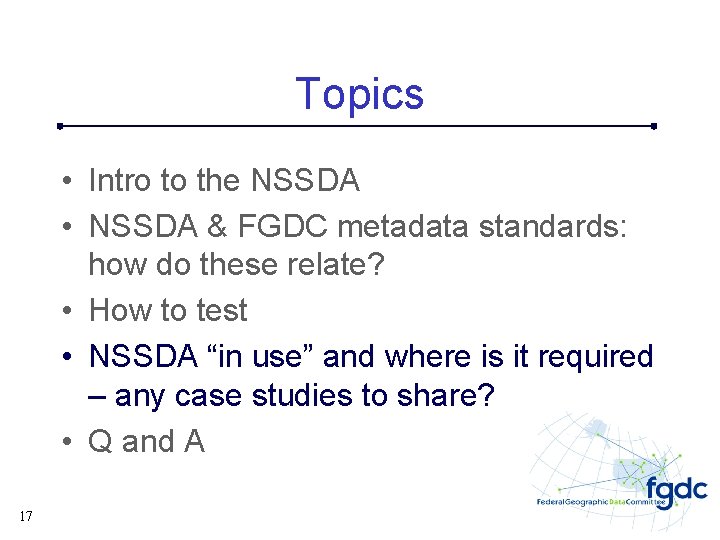
Topics • Intro to the NSSDA • NSSDA & FGDC metadata standards: how do these relate? • How to test • NSSDA “in use” and where is it required – any case studies to share? • Q and A 2
Introduction to NSSDA • • • 3 Background What NSSDA is/Characteristics Accuracy and confidence levels Reporting Compare to National Map Accuracy Standard
Background Why is a new accuracy standard needed? • Growth in digital geospatial data applications • NMAS dependent on map scale, contour interval • Digital data not limited by map characteristics • Diversity in geospatial data community • • 4 More data producers with different product specs More data users with different applications
What NSSDA is • Testing and reporting methodology so that users can directly compare and assess accuracy of data sets for their applications. • NSSDA reports positional accuracy at ground scale • NSSDA does not specify thresholds • Agencies set thresholds or tolerances for their product specifications 5
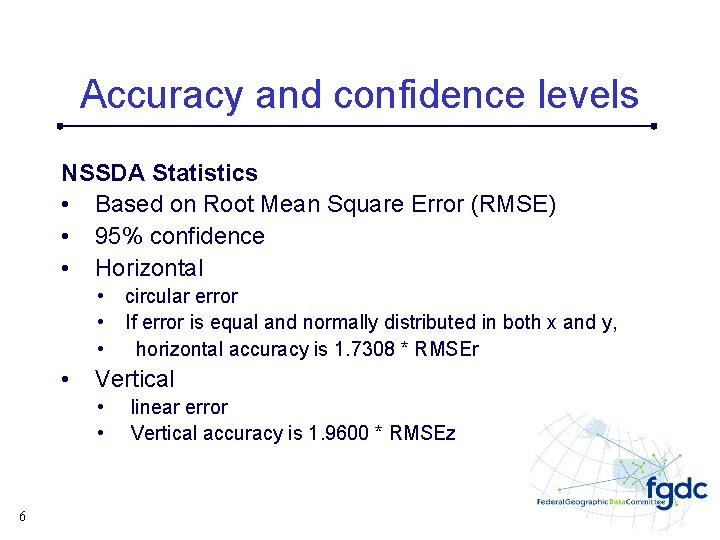
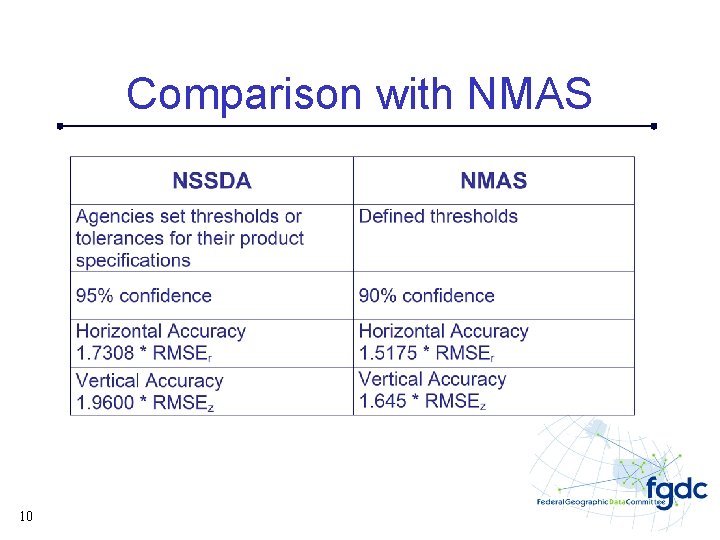
Accuracy and confidence levels NSSDA Statistics • Based on Root Mean Square Error (RMSE) • 95% confidence • Horizontal • • Vertical • • 6 circular error If error is equal and normally distributed in both x and y, horizontal accuracy is 1. 7308 * RMSEr linear error Vertical accuracy is 1. 9600 * RMSEz
NSSDA Reporting • Statements • Tested__(feet, meters) accuracy at 95% confidence level • Compiled to meet__(feet, meters) accuracy at 95% confidence level • 7 Document sources and process steps in Metadata
NSSDA Reporting accuracy of a dataset with data of varying accuracies: • If data of varying accuracies can be identified separately in a dataset, compute and report separate accuracy values • If data of varying accuracies are composited and cannot be separately identified AND the dataset is tested, report the accuracy value for the composite data. • If a composite dataset is not tested, report the accuracy value for the least accurate dataset component. 8
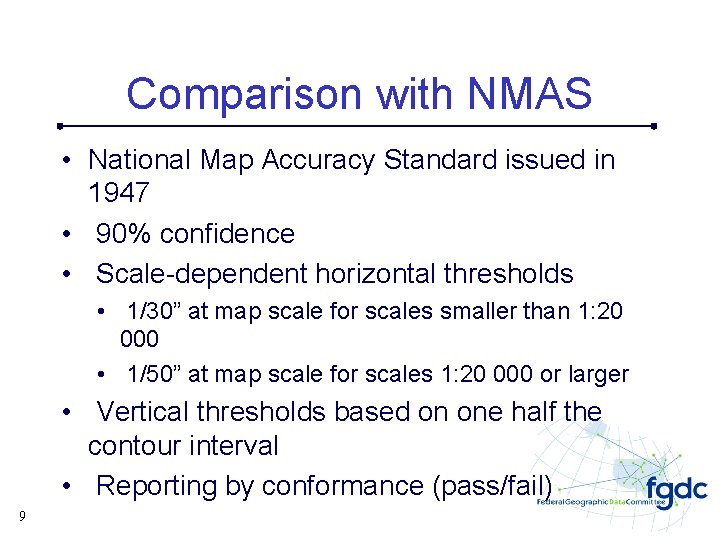
Comparison with NMAS • National Map Accuracy Standard issued in 1947 • 90% confidence • Scale-dependent horizontal thresholds • 1/30” at map scale for scales smaller than 1: 20 000 • 1/50” at map scale for scales 1: 20 000 or larger • Vertical thresholds based on one half the contour interval • Reporting by conformance (pass/fail) 9
Comparison with NMAS 10
Topics • Intro to the NSSDA • NSSDA & FGDC metadata standards: how do these relate? • How to test • NSSDA “in use” and where is it required – any case studies to share? • Q and A 11
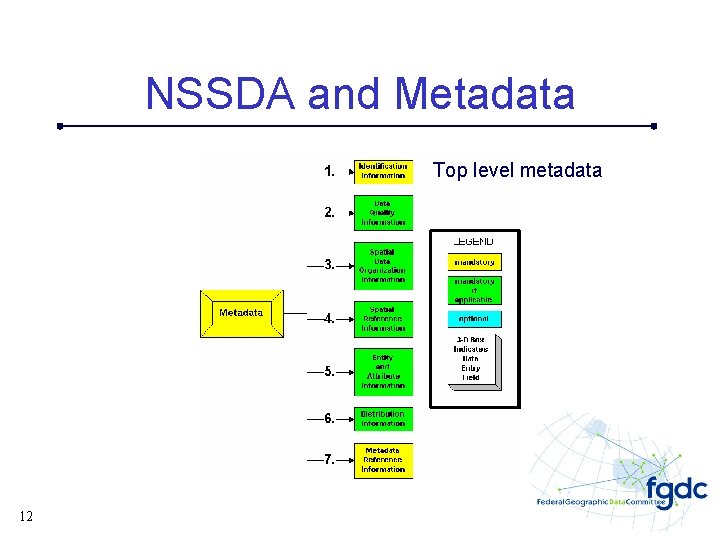
NSSDA and Metadata Top level metadata 12
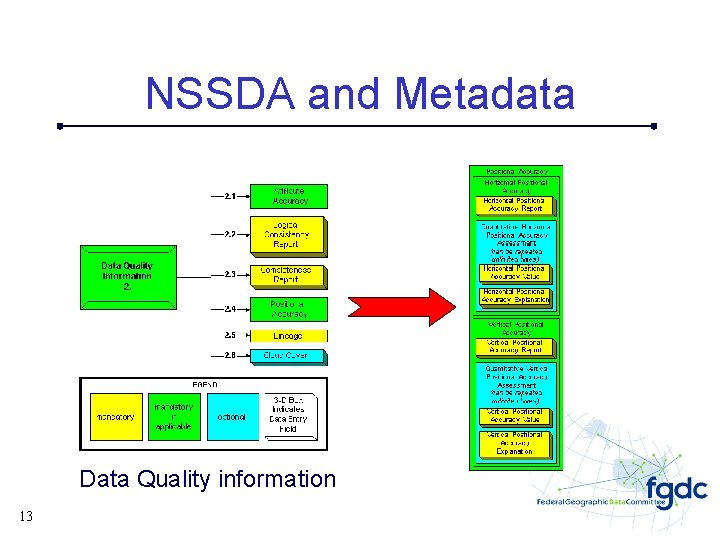
NSSDA and Metadata Data Quality information 13
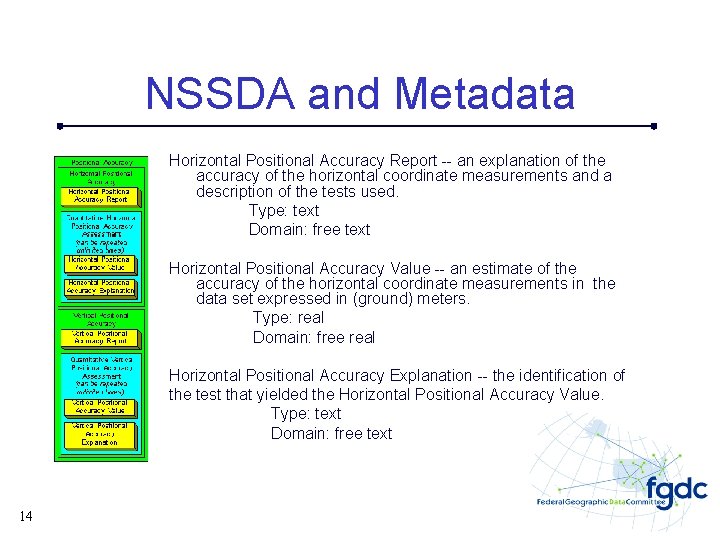
NSSDA and Metadata Horizontal Positional Accuracy Report -- an explanation of the accuracy of the horizontal coordinate measurements and a description of the tests used. Type: text Domain: free text Horizontal Positional Accuracy Value -- an estimate of the accuracy of the horizontal coordinate measurements in the data set expressed in (ground) meters. Type: real Domain: free real Horizontal Positional Accuracy Explanation -- the identification of the test that yielded the Horizontal Positional Accuracy Value. Type: text Domain: free text 14
Topics • Intro to the NSSDA • NSSDA & FGDC metadata standards: how do these relate? • How to test • NSSDA “in use” and where is it required – any case studies to share? • Q and A 15
How to test • Independent source of higher accuracy preferred • not used in the generation of the data set • accuracy is the highest accuracy feasible and appropriate to the data set being tested • Testers determine: • the geographic area for testing • the number of points to be tested (minimum of 20 points) • the distribution of points 16
Topics • Intro to the NSSDA • NSSDA & FGDC metadata standards: how do these relate? • How to test • NSSDA “in use” and where is it required – any case studies to share? • Q and A 17
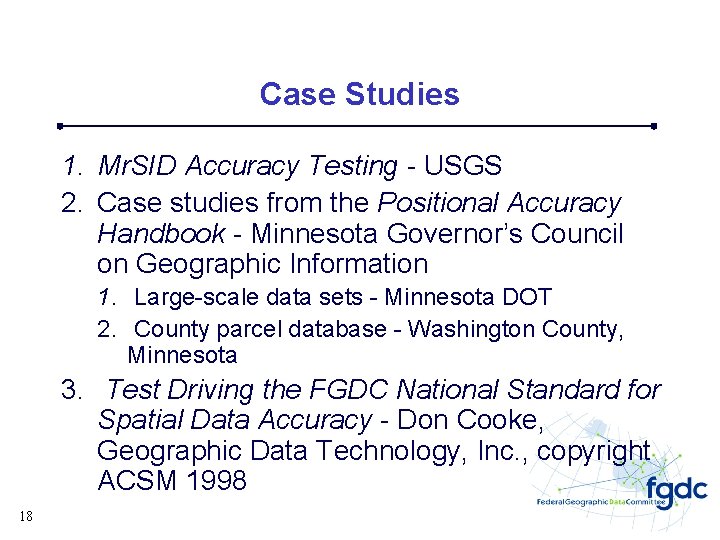
Case Studies 1. Mr. SID Accuracy Testing - USGS 2. Case studies from the Positional Accuracy Handbook - Minnesota Governor’s Council on Geographic Information 1. Large-scale data sets - Minnesota DOT 2. County parcel database - Washington County, Minnesota 3. Test Driving the FGDC National Standard for Spatial Data Accuracy - Don Cooke, Geographic Data Technology, Inc. , copyright ACSM 1998 18
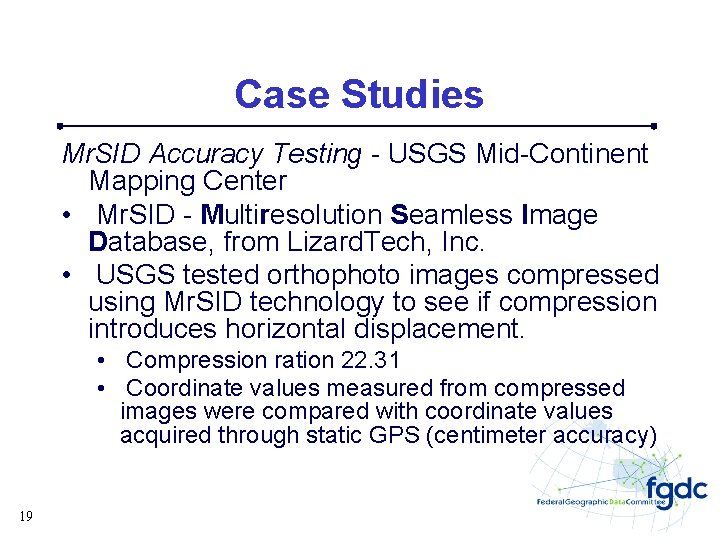
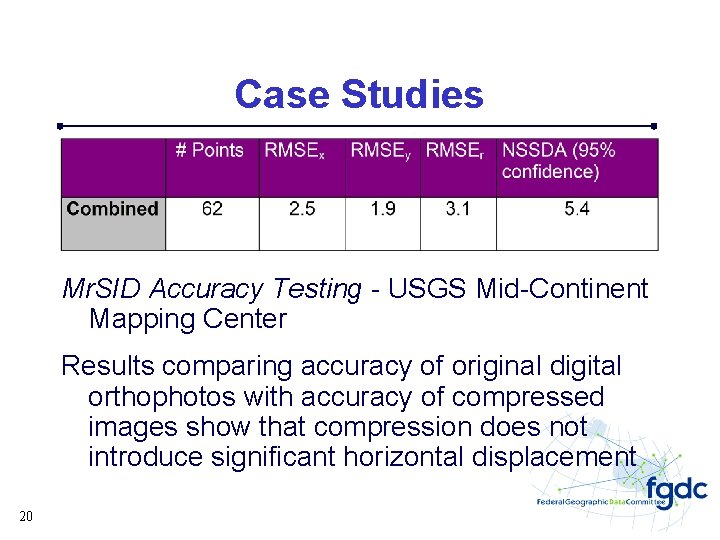
Case Studies Mr. SID Accuracy Testing - USGS Mid-Continent Mapping Center • Mr. SID - Multiresolution Seamless Image Database, from Lizard. Tech, Inc. • USGS tested orthophoto images compressed using Mr. SID technology to see if compression introduces horizontal displacement. • Compression ration 22. 31 • Coordinate values measured from compressed images were compared with coordinate values acquired through static GPS (centimeter accuracy) 19
Case Studies Mr. SID Accuracy Testing - USGS Mid-Continent Mapping Center Results comparing accuracy of original digital orthophotos with accuracy of compressed images show that compression does not introduce significant horizontal displacement 20
Case Studies Positional Accuracy Handbook - Minnesota • Large-scale data sets - Minnesota DOT • I-94 corridor in Minneapolis • Tested horizontal accuracy of 40 points from digital topographic map to points acquired by GPS (10 -15 mm expected accuracy) • • Tested vertical accuracy of points from a digital terrain stereomodel to points acquired by GPS (10 -15 mm expected accuracy) • 21 Tested 0. 181 meters horizontal accuracy at 95% confidence Tested 0. 134 meters vertical accuracy at 95% confidence
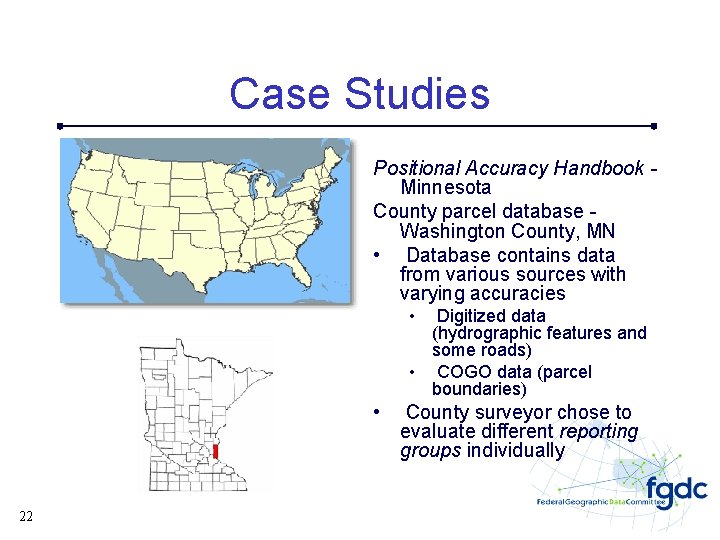
Case Studies Positional Accuracy Handbook Minnesota County parcel database Washington County, MN • Database contains data from various sources with varying accuracies • Digitized data (hydrographic features and some roads) • COGO data (parcel boundaries) • 22 County surveyor chose to evaluate different reporting groups individually
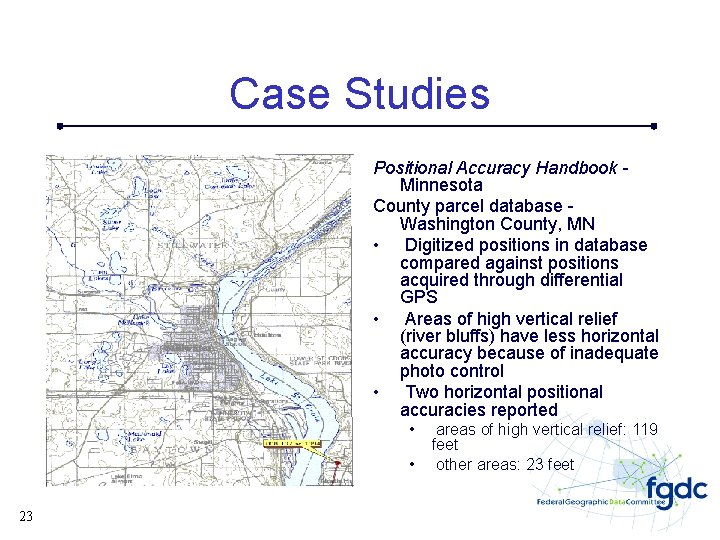
Case Studies Positional Accuracy Handbook Minnesota County parcel database Washington County, MN • Digitized positions in database compared against positions acquired through differential GPS • Areas of high vertical relief (river bluffs) have less horizontal accuracy because of inadequate photo control • Two horizontal positional accuracies reported • • 23 areas of high vertical relief: 119 feet other areas: 23 feet
Case Studies Positional Accuracy Handbook - Minnesota County parcel database - Washington County, MN • COGO data contain • PLSS section lines based on PLSS survey corners, which are based on GPS control • Parcel lines mapped from legal descriptions • boundary corners in legal documents may not always match ground truth - focus of NSSDA • 24 County surveyor provided cautionary note in metadata
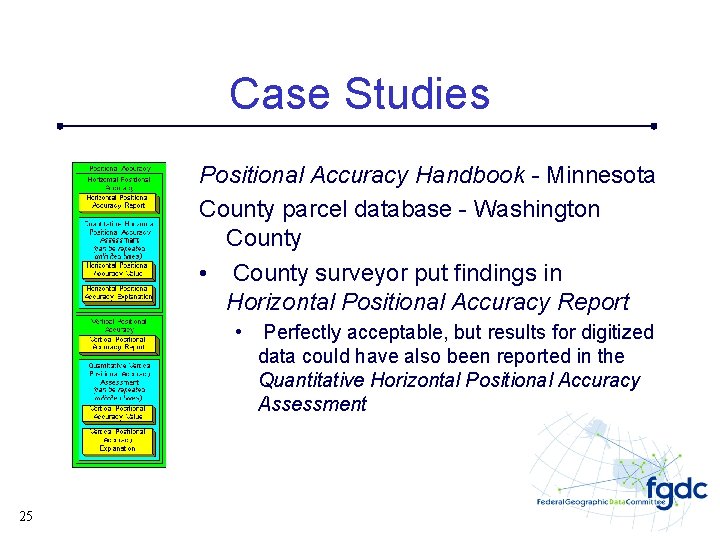
Case Studies Positional Accuracy Handbook - Minnesota County parcel database - Washington County • County surveyor put findings in Horizontal Positional Accuracy Report • 25 Perfectly acceptable, but results for digitized data could have also been reported in the Quantitative Horizontal Positional Accuracy Assessment
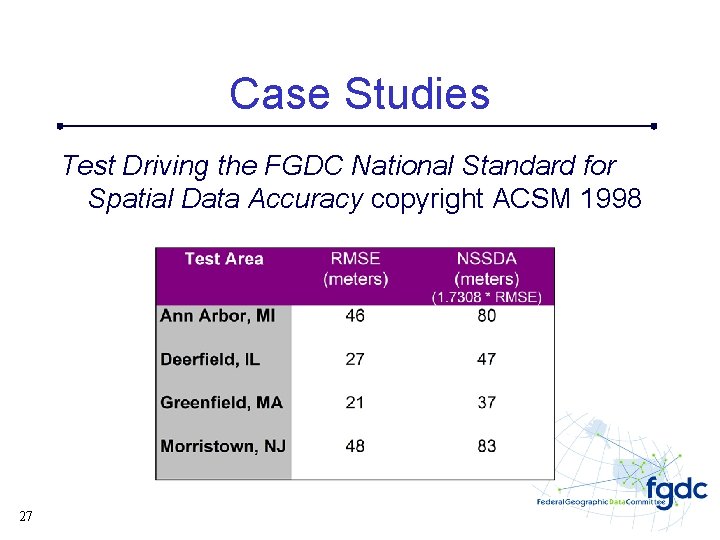
Case Studies Test Driving the FGDC National Standard for Spatial Data Accuracy copyright ACSM 1998 Tested coordinate values of nodes (road intersections) in Census TIGER data against coordinate values acquired through Differential GPS • Results were reported for these test areas • • 26 Ann Arbor, MI Deerfield, IL Greenfield, MA Morristown, NJ
Case Studies Test Driving the FGDC National Standard for Spatial Data Accuracy copyright ACSM 1998 27
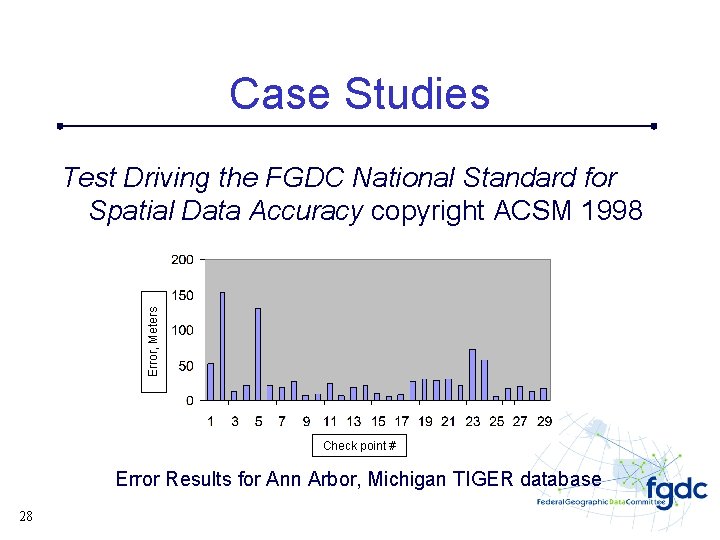
Case Studies Error, Meters Test Driving the FGDC National Standard for Spatial Data Accuracy copyright ACSM 1998 Check point # Error Results for Ann Arbor, Michigan TIGER database 28
Case Studies Test Driving the FGDC National Standard for Spatial Data Accuracy copyright ACSM 1998 • Conclusions • For many business applications that use TIGER data, currentness is more important than accuracy • larger errors acceptable • Recommends that TIGER Coordinate values should be individually tagged for accuracy • tags may be descriptive 29
Topics • Intro to the NSSDA • NSSDA & FGDC metadata standards: how do these relate? • How to test • NSSDA “in use” and where is it required – any case studies to share? • Q and A 30
Q and A 31
References • • • 32 FGDC Standards, http: //www. fgdc. gov/standards National Standard for Spatial Data Accuracy, http: //www. fgdc. gov/standards/projects/FGDC-standardsprojects/accuracy/part 3/chapter 3 FGDC Digital Content Standard for Digital Geospatial Metadata, http: //www. fgdc. gov/standards/projects/FGDC-standardsprojects/metadata/base-metadata/v 2_0698. pdf Mr. SID Accuracy Testing, 404: File Not Found Implementing the National Standard for Spatial Data Accuracy Minnesota Governor's Council on Geographic Information, http: //www. mnplan. state. mn. us/press/accurate. html Test Driving the FGDC National Standard for Spatial Data Accuracy, by Donald Cooke and Mary Welsh, copyright ACSM 1998
Thank you! For more information, contact Julie Binder Maitra FGDC Standards Coordinator c/o U. S. Geological Survey 590 National Center 12201 Sunrise Valley Drive Reston, Virginia 20192 E-mail: jmaitra@usgs. gov Phone: (703) 648 -4627 Fax: (703) 648 -5755 33