
National SpaceBased PNT Coordination Office Global Positioning System
National Space-Based PNT Coordination Office Global Positioning System: A Policy and Modernization Review United Nations International Committee on GNSS 1 -2 December, 2005 Michael E. Shaw Director National Space-Based PNT Coordination Office
Overview National Space-Based PNT Coordination Office • U. S. Space-Based PNT Policy • GPS Modernization • The Way Ahead UN International Comm, 1 -2 Dec 2
National Space-Based PNT Coordination Office Need for Updated U. S. Policy • In past decade, GPS has grown into global utility – Integral to economic growth, transportation safety, homeland security, and critical infrastructure – Essential element of worldwide economic infrastructure • GPS is critical to U. S. national security – Integrated into virtually every facet of U. S. military ops • Expanding number of GNSS systems and their augmentations • Need to improve existing management mechanisms for GPS and its augmentations UN International Comm, 1 -2 Dec 3
U. S. Policy National Space-Based PNT Coordination Office • U. S. Space-Based Positioning, Navigation, and Timing (PNT) Policy – Signed on 8 Dec 04; publicly released on 15 Dec 04 – Updated U. S. policy while retaining prior GPS principles • Established a stronger National Space-Based PNT Executive Committee; IGEB disestablished – Chaired by Deputy Secretaries of Defense and Transportation – Membership includes: State, Commerce, Homeland Security, JCS, and NASA – Supported by a new National Coordination Office UN International Comm, 1 -2 Dec 4
Policy: Objectives National Space-Based PNT Coordination Office • Provide uninterrupted access to U. S. space-based PNT services for U. S. /allied national security capabilities • Provide space-based civil PNT services free of direct user fees on a continuous, worldwide basis – Civil, commercial, homeland security and scientific use • Provide open, free access to information necessary to use these civil services • Improve capabilities to deny hostile use of any space-based PNT services – Without unduly disrupting civil and commercial access UN International Comm, 1 -2 Dec 5
Policy: Objectives (cont’d) National Space-Based PNT Coordination Office • Maintain the GPS as a component of multiple sectors of the U. S. Critical Infrastructure • Improve the performance of space-based PNT – Includes robust resistance to interference for civil, commercial, homeland security, and scientific users worldwide – Ensure civil services exceed, or are at least equivalent to, those of foreign civil space-based PNT services • Ensure that foreign PNT systems are interoperable with GPS – Or, at a minimum, are compatible UN International Comm, 1 -2 Dec 6

Implementation Actions National Space-Based PNT Coordination Office • Set-Up National Space-Based PNT Coordination Office – Director, Deputy Director, and 6 staff • Initiate National Space-Based PNT Advisory Board – Board to conduct studies and provide advice as directed by Executive Committee • Prepare the following: – 5 -Year National Space-Based PNT Plan – GPS Interference Detection and Mitigation Plan UN International Comm, 1 -2 Dec 7
New U. S. Policy National Space-Based PNT Coordination Office • Demonstrates U. S. Government commitment to all stakeholders • Provides framework for public/private decision makers • Improves ability to coordinate efforts between different agencies • Creates basis for meaningful dialogue between service providers and end users • Promotes common standards for worldwide interoperability UN International Comm, 1 -2 Dec 8
Overview National Space-Based PNT Coordination Office • U. S. Space-Based PNT Policy • GPS Modernization • The Way Ahead UN International Comm, 1 -2 Dec 9
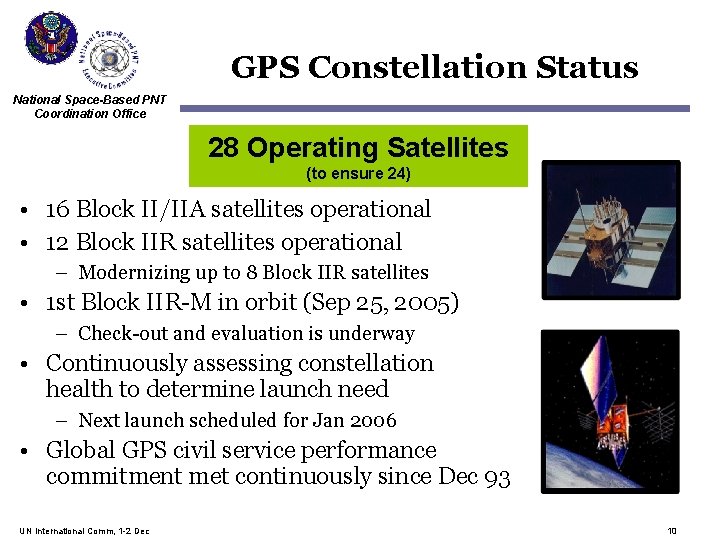
GPS Constellation Status National Space-Based PNT Coordination Office 28 Operating Satellites (to ensure 24) • 16 Block II/IIA satellites operational • 12 Block IIR satellites operational – Modernizing up to 8 Block IIR satellites • 1 st Block IIR-M in orbit (Sep 25, 2005) – Check-out and evaluation is underway • Continuously assessing constellation health to determine launch need – Next launch scheduled for Jan 2006 • Global GPS civil service performance commitment met continuously since Dec 93 UN International Comm, 1 -2 Dec 10
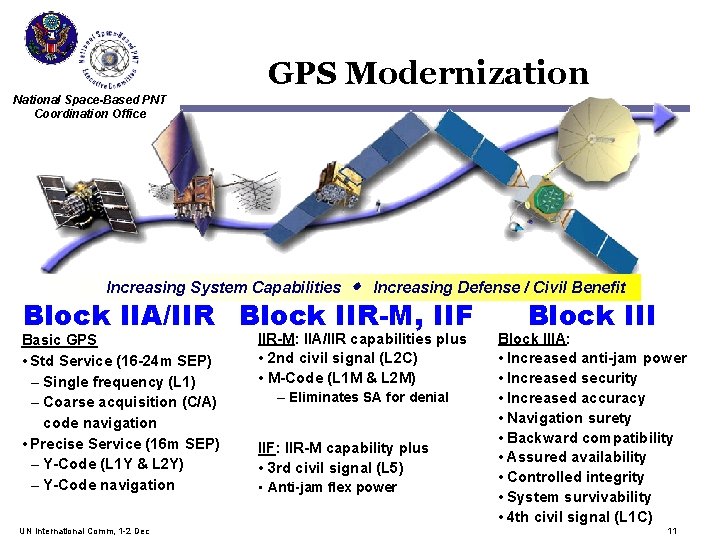
GPS Modernization National Space-Based PNT Coordination Office Increasing System Capabilities w Increasing Defense / Civil Benefit Block IIA/IIR Block IIR-M, IIF Basic GPS • Std Service (16 -24 m SEP) – Single frequency (L 1) – Coarse acquisition (C/A) code navigation • Precise Service (16 m SEP) – Y-Code (L 1 Y & L 2 Y) – Y-Code navigation UN International Comm, 1 -2 Dec IIR-M: IIA/IIR capabilities plus • 2 nd civil signal (L 2 C) • M-Code (L 1 M & L 2 M) – Eliminates SA for denial IIF: IIR-M capability plus • 3 rd civil signal (L 5) • Anti-jam flex power Block IIIA: • Increased anti-jam power • Increased security • Increased accuracy • Navigation surety • Backward compatibility • Assured availability • Controlled integrity • System survivability • 4 th civil signal (L 1 C) 11
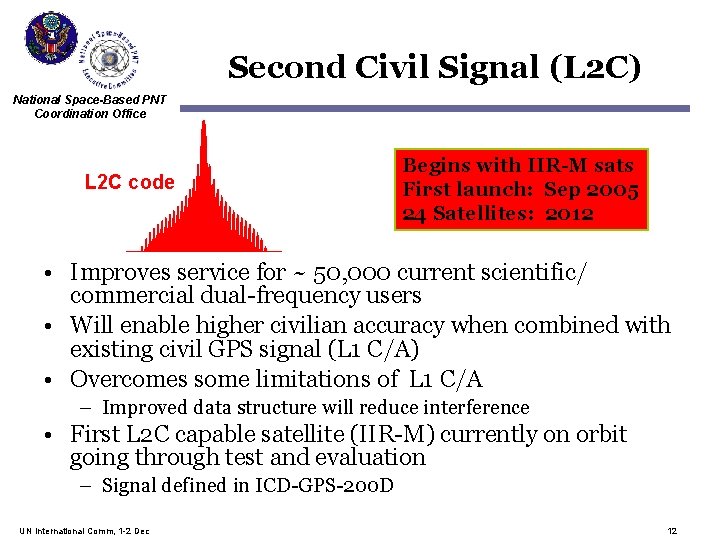
Second Civil Signal (L 2 C) National Space-Based PNT Coordination Office L 2 C code Begins with IIR-M sats First launch: Sep 2005 24 Satellites: 2012 • Improves service for ~ 50, 000 current scientific/ commercial dual-frequency users • Will enable higher civilian accuracy when combined with existing civil GPS signal (L 1 C/A) • Overcomes some limitations of L 1 C/A – Improved data structure will reduce interference • First L 2 C capable satellite (IIR-M) currently on orbit going through test and evaluation – Signal defined in ICD-GPS-200 D UN International Comm, 1 -2 Dec 12
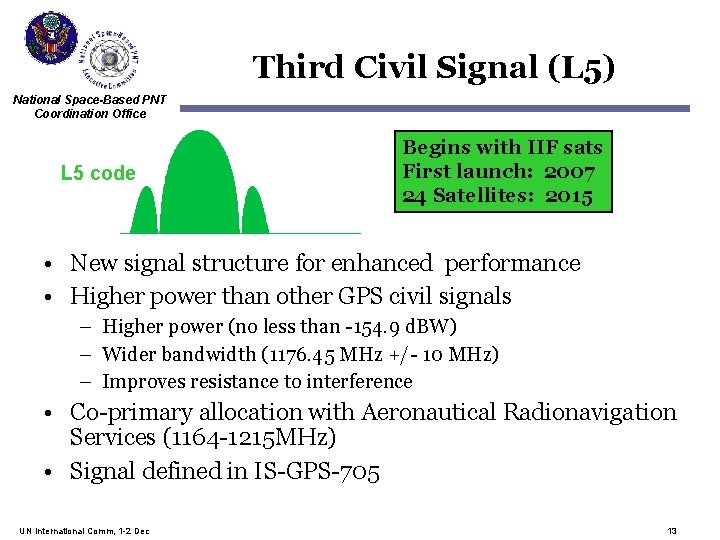
Third Civil Signal (L 5) National Space-Based PNT Coordination Office L 5 code Begins with IIF sats First launch: 2007 24 Satellites: 2015 • New signal structure for enhanced performance • Higher power than other GPS civil signals – Higher power (no less than -154. 9 d. BW) – Wider bandwidth (1176. 45 MHz +/- 10 MHz) – Improves resistance to interference • Co-primary allocation with Aeronautical Radionavigation Services (1164 -1215 MHz) • Signal defined in IS-GPS-705 UN International Comm, 1 -2 Dec 13
GPS III Civil Benefits National Space-Based PNT Coordination Office • • Significant increase in system accuracy Improved availability of accuracy with integrity Backward compatibility with existing receivers Operational capability for L 2 C and L 5 – In combination with GPS IIR-M and IIF satellites • Flexibility to respond to evolving requirements with limited programmatic impacts • Opportunity to converge with Galileo Open Service UN International Comm, 1 -2 Dec 14
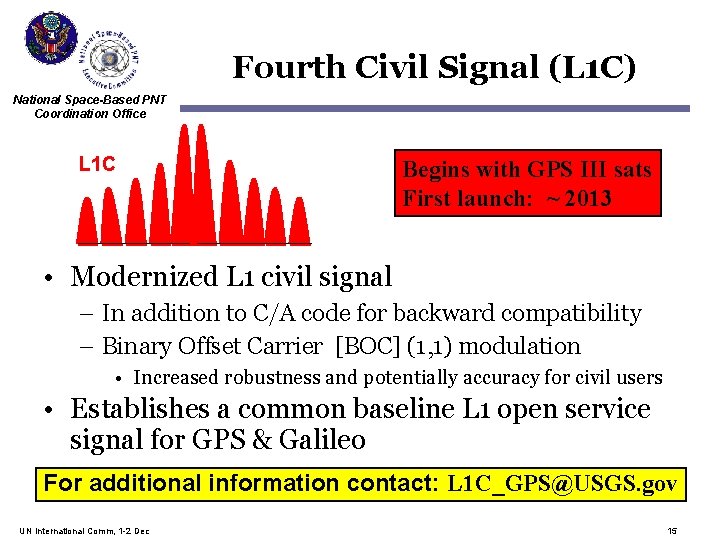
Fourth Civil Signal (L 1 C) National Space-Based PNT Coordination Office L 1 C Begins with GPS III sats First launch: ~ 2013 • Modernized L 1 civil signal – In addition to C/A code for backward compatibility – Binary Offset Carrier [BOC] (1, 1) modulation • Increased robustness and potentially accuracy for civil users • Establishes a common baseline L 1 open service signal for GPS & Galileo For additional information contact: L 1 C_GPS@USGS. gov UN International Comm, 1 -2 Dec 15
Summary National Space-Based PNT Coordination Office • • • First GPS IIR-M launch -- Sep 25, 2005 First GPS IIF launch in 2007 GPS III – study contracts ongoing since Jan 04 Ops Control Segment – study contracts in Jul 05 6 NGA Monitor Stations brought on line in GPS Master Control Station in Aug 05 – 5 more to follow next year • Implementing space-based and ground-based GPS augmentations – WAAS commissioned in July 2003 – NDGPS single coverage of CONUS at 92% UN International Comm, 1 -2 Dec 16
The Way Ahead National Space-Based PNT Coordination Office • Implementing U. S. National Space-Based PNT Policy – Coordination Office activated on November 1 st • First new civil/military GPS signals currently undergoing test and evaluation – Further enhancements continuing through GPS III – Fielding of GPS augmentations continuing • Other GNSS systems are being implemented – US-EC GPS-Galileo Working Groups – Compatibility and Interoperability are critical UN International Comm, 1 -2 Dec 17
Contact information National Space-Based PNT Coordination Office Michael E. Shaw, Director National Space-Based PNT Coordination Office Herbert C. Hoover Bldg. , Rm. 6822 1401 Constitution Avenue, NW Washington, D. C. 20230 Ph: +1 (202) 482 -5809 Fax: +1 (202) 482 -4429 michael. shaw@PNT. gov Presentations available: www. PNT. gov UN International Comm, 1 -2 Dec 18
- Slides: 18