
National Screening Brief Intervention and Referral to Treatment
National Screening, Brief Intervention and Referral to Treatment (SBIRT) ATTC Substance Use Screening, Brief Intervention, and Referral to Treatment Behavioral Health is Essential to Health Prevention Works | Treatment is Effective | People Recover
WELCOME • Please introduce yourself to the group: – Name. – Education. – Current position. – General experience. – Knowledge of SBIRT. – Knowledge of Motivational Interviewing. – Personal goals for the training. – One thing you hope to learn. 2
Icebreaker: The carrot 3
Goals and Objectives The goal of this training course is to help participants develop their Substance Use Screening, Brief Intervention, and Referral to Treatment (SBIRT) knowledge, skills, and abilities. At the end of this training participants will be able to: • Identify SBIRT as a system change initiative. • Compare and contrast the current system with SBIRT. • Understand the public health approach. • Discuss the need to change how we think about substance use behaviors, problems, and interventions. • Understand the information screening does and does not provide. • Define brief intervention/brief negotiated interview. • Describe the goals of conducting a BI/BNI. • Understand the counselor’s role in providing BI/BNI. • Develop knowledge of Motivational Interviewing as it relates to the SBIRT model. • Describe referral to treatment. 4

SBIRT Module One Re-conceptualizing Our Understanding of Substance Use Problems Behavioral Health is Essential to Health Prevention Works | Treatment is Effective | People Recover
Forget Everything You Know • About what constitutes a substance use problem. • About how substance use problems are identified. • About how to treat substance use problems. 6
A New Initiative • Substance use screening, brief intervention, and referral to treatment (SBIRT) is a systems change initiative. As such, we are required to shift our view toward a new paradigm, and; – Re-conceptualize how we understand substance use problems. – Re-define how we identify substance use problems. – Re-design how we treat substance use problems. 7
Historically Society has viewed substance use as: A moral problem An individual problem A family problem A social problem A criminal justice problem A combination of one or more The solution to any problem must be driven by its presumed cause. If substance use is caused by a moral problem… …. what is its solution? If substance use is caused by a criminal justice problem……what is its solution? 8

Substance Use Is A Public Health Problem 9
Learning from Public Health • The public health system of care routinely screens for potential medical problems (cancer, diabetes, hypertension, tuberculosis, vitamin deficiencies, renal function), provides preventative services prior to the onset of acute symptoms, and delays or precludes the development of chronic conditions. 10
Historically • Substance Use Services have been bifurcated, focusing on two areas only: – Primary Prevention – Precluding or delaying the onset of substance use. – Tertiary Treatment – Providing time, cost, and labor intensive care to patients who are acutely or chronically ill with a substance use disorder. 11
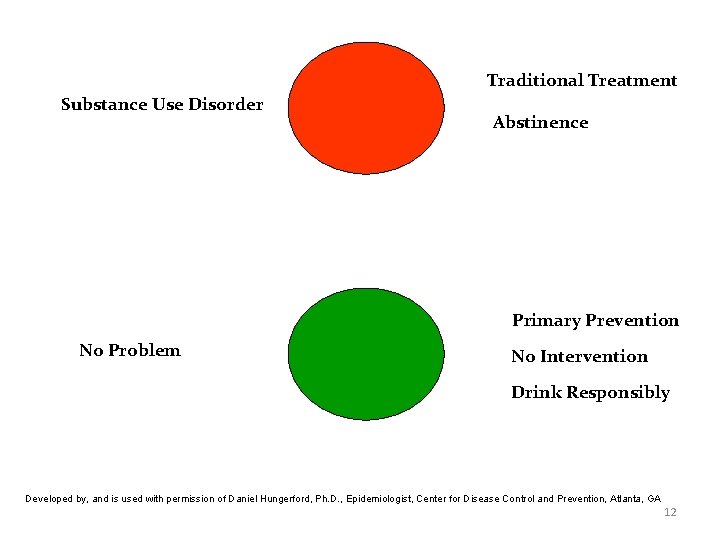
Traditional Treatment Substance Use Disorder Abstinence Primary Prevention No Problem No Intervention Drink Responsibly Developed by, and is used with permission of Daniel Hungerford, Ph. D. , Epidemiologist, Center for Disease Control and Prevention, Atlanta, GA 12

The Current Model A Continuum of Substance Use Abstinence Responsible Use Addiction 13
An Outdated Model • This model (paradigm) of substance use: – Fails to recognize a full continuum of substance use behavior. – Fails to recognize a full continuum of substance use problems. – Fails to provide a full continuum of substance use interventions. WHY? 14
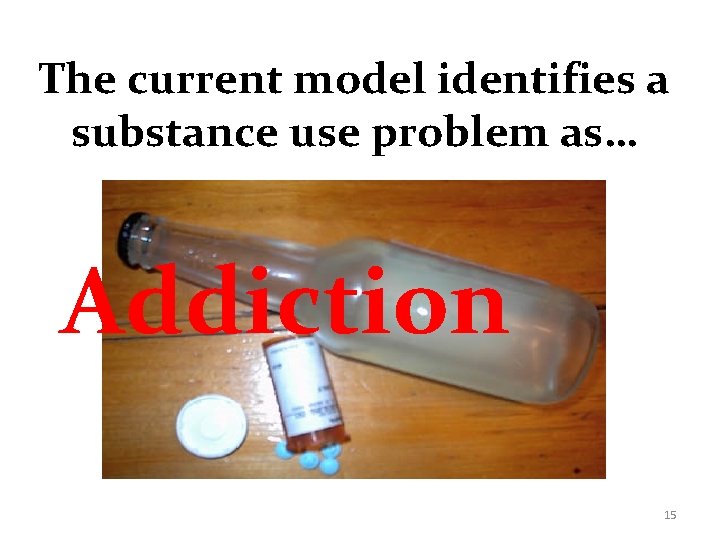
The current model identifies a substance use problem as… Addiction 15
By defining the problem as addiction or dependence this outdated model fails to recognize a full continuum of substance use behavior, a full continuum of substance use problems, and does not provide a full continuum of substance use interventions. As a result the outdated model has failed to provide resources in the area of greatest need. 16
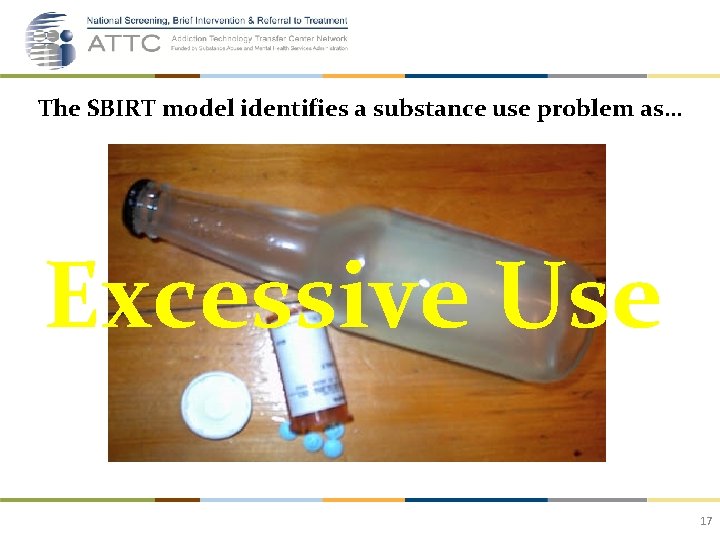
The SBIRT model identifies a substance use problem as… Excessive Use 17
Excessive Use is Correlated to • • • Trauma and trauma recidivism. Causation or exacerbation of health conditions. Exacerbation of mental health conditions. Alcohol poisoning. DUI. Domestic and other forms of violence. Transmission of sexually transmitted diseases. Unintended pregnancies. Substance Use Disorder. 18
By defining the problem as excessive use the SBIRT model recognizes a full continuum of substance use behavior, a full continuum of substance use problems, and provides a full continuum of substance use interventions. As a result the SBIRT model can provide resources in the area of greatest need. 19
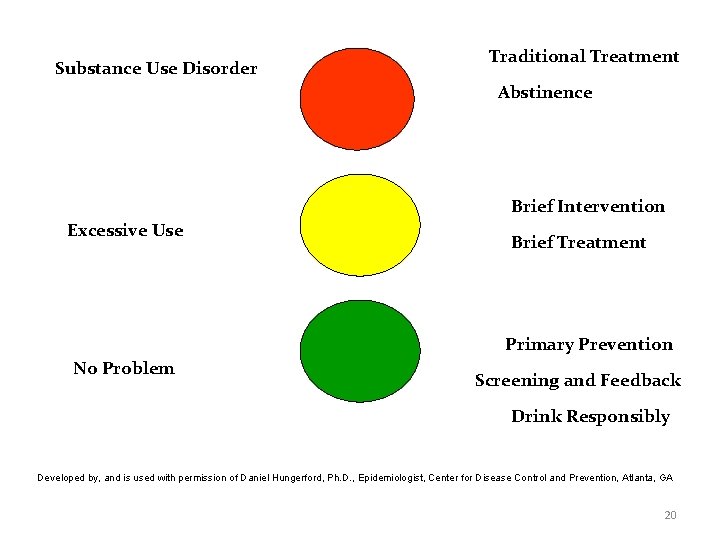
Substance Use Disorder Traditional Treatment Abstinence Brief Intervention Excessive Use Brief Treatment Primary Prevention No Problem Screening and Feedback Drink Responsibly Developed by, and is used with permission of Daniel Hungerford, Ph. D. , Epidemiologist, Center for Disease Control and Prevention, Atlanta, GA 20
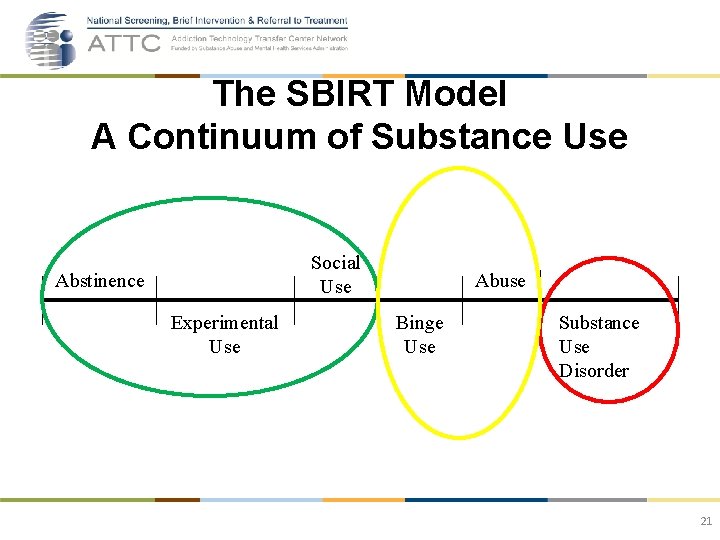
The SBIRT Model A Continuum of Substance Use Social Use Abstinence Experimental Use Abuse Binge Use Substance Use Disorder 21
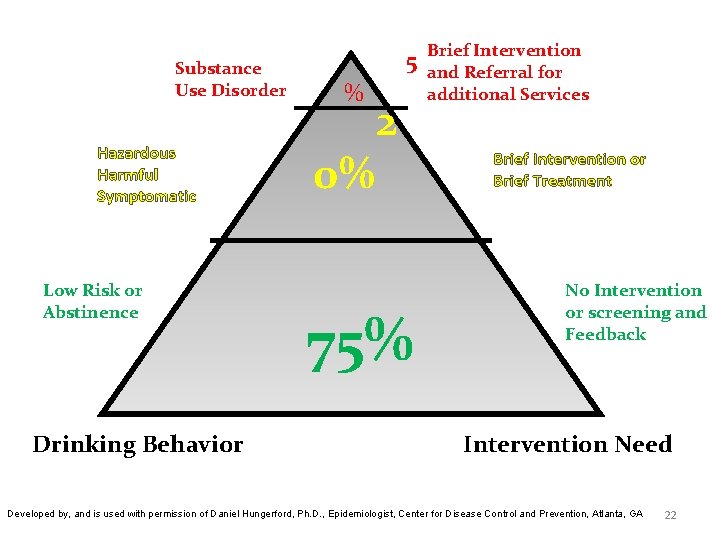
Substance Use Disorder Hazardous Harmful Symptomatic Low Risk or Abstinence Drinking Behavior 5 % 0% 2 75% Brief Intervention and Referral for additional Services Brief Intervention or Brief Treatment No Intervention or screening and Feedback Intervention Need Developed by, and is used with permission of Daniel Hungerford, Ph. D. , Epidemiologist, Center for Disease Control and Prevention, Atlanta, GA 22
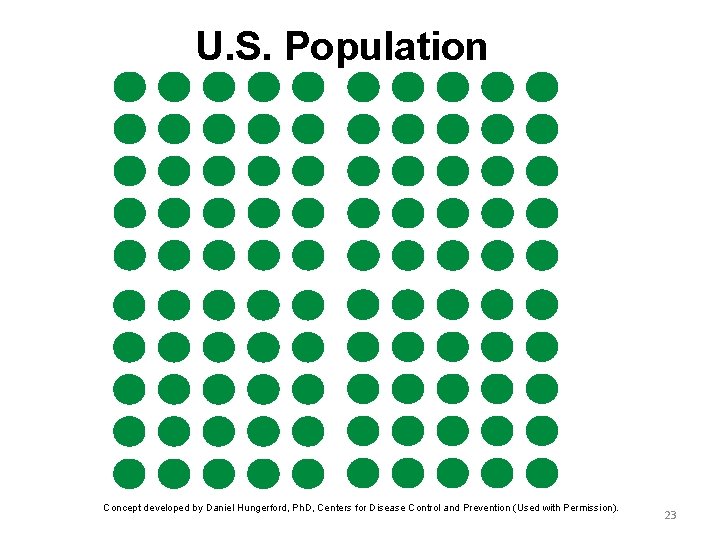
U. S. Population Concept developed by Daniel Hungerford, Ph. D, Centers for Disease Control and Prevention (Used with Permission). 23
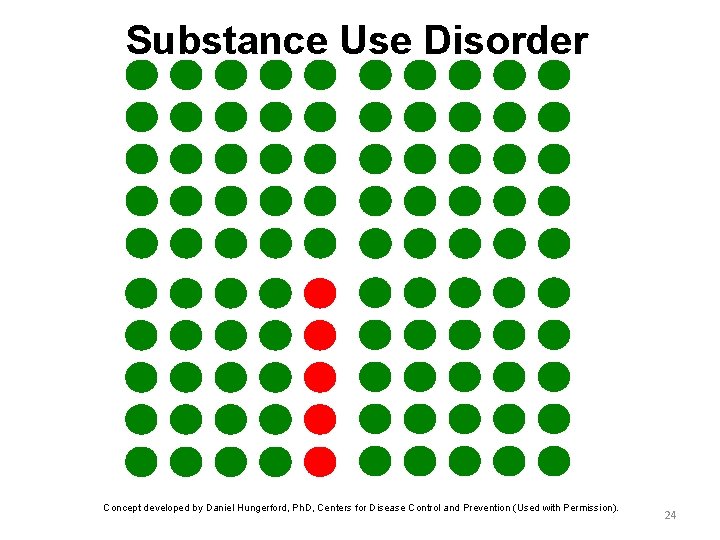
Substance Use Disorder Concept developed by Daniel Hungerford, Ph. D, Centers for Disease Control and Prevention (Used with Permission). 24
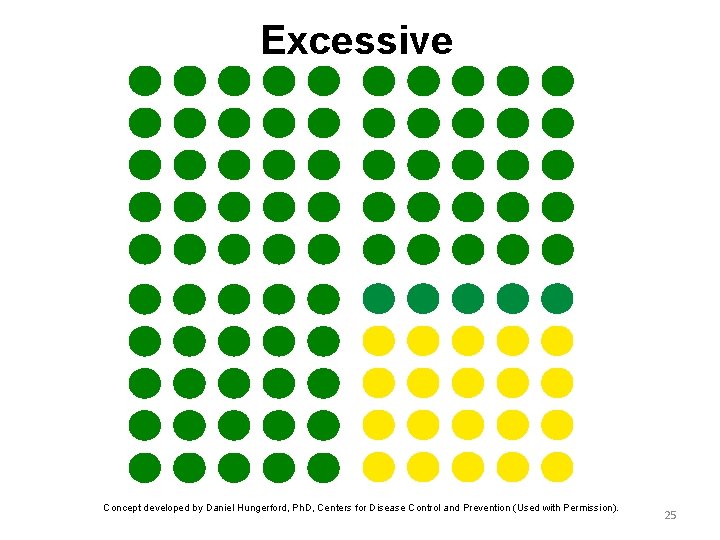
Excessive Concept developed by Daniel Hungerford, Ph. D, Centers for Disease Control and Prevention (Used with Permission). 25

5 1 26
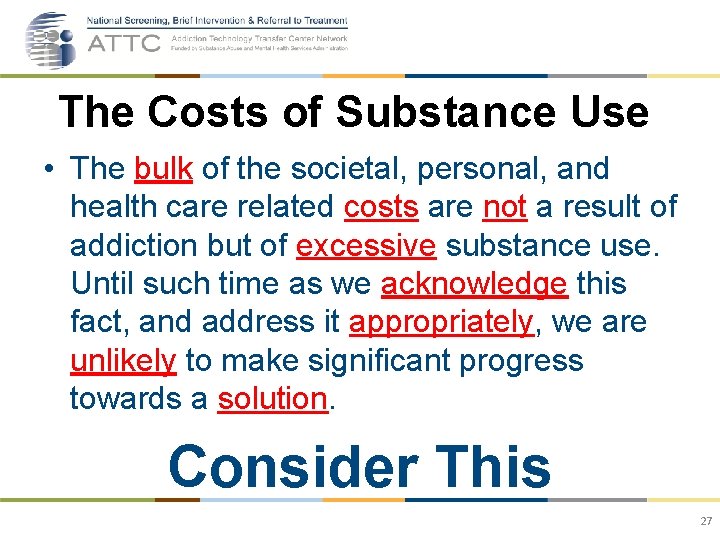
The Costs of Substance Use • The bulk of the societal, personal, and health care related costs are not a result of addiction but of excessive substance use. Until such time as we acknowledge this fact, and address it appropriately, we are unlikely to make significant progress towards a solution. Consider This 27
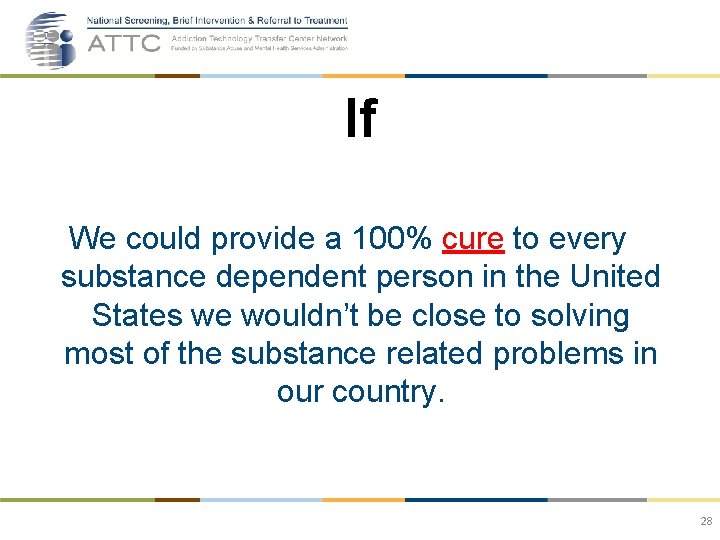
If We could provide a 100% cure to every substance dependent person in the United States we wouldn’t be close to solving most of the substance related problems in our country. 28
The SBIRT Model A Continuum of Interventions Primary Prevention – Precluding or delaying the onset of substance use. Secondary Prevention and Intervention – Providing time, cost, and labor sensitive care to patients who are at risk for psycho-social or healthcare problems related to their substance use choices. Tertiary Treatment – Providing time, cost, and labor intensive care to patients who are acutely or chronically ill with a substance use disorder. 29
Primary Goal • The primary goal of SBIRT is not to identify those who are have a substance use disorder and need further assessment. • The primary goal of SBIRT is to identify those who are at moderate or high risk for psycho-social or health care problems related to their substance use choices. 30
NIAAA Definitions Low Risk: Healthy Men < 65 ≤ 4 drinks per day AND NOT MORE THAN 14 drinks per week Healthy Women & Men ≥ 65 ≤ 3 drinks per day AND NOT MORE THAN 7 drinks per week Hazardous: Pattern that increases risk for adverse consequences. Harmful: Negative consequences have already occurred. 31
The SBIRT Concept • SBIRT uses a public health approach to universal screening for substance use problems. – SBIRT provides: • Immediate rule out of non-problem users; • Identification of levels of risk; • Identification of patients who would benefit from brief advise; • Identification of patients who would benefit from further assessment, and; • Progressive levels of clinical interventions based on need and motivation for change. 32
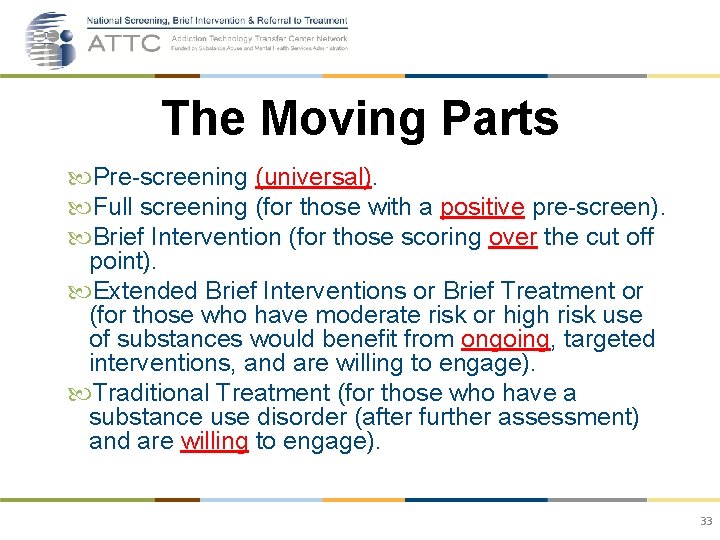
The Moving Parts Pre-screening (universal). Full screening (for those with a positive pre-screen). Brief Intervention (for those scoring over the cut off point). Extended Brief Interventions or Brief Treatment or (for those who have moderate risk or high risk use of substances would benefit from ongoing, targeted interventions, and are willing to engage). Traditional Treatment (for those who have a substance use disorder (after further assessment) and are willing to engage). 33
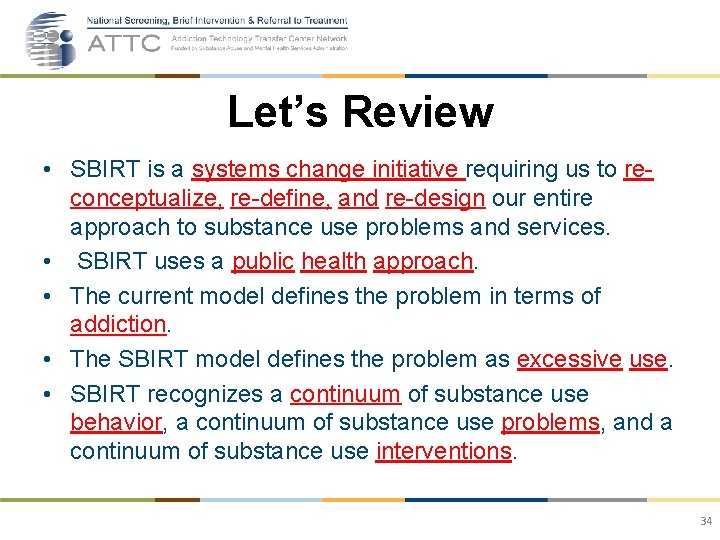
Let’s Review • SBIRT is a systems change initiative requiring us to reconceptualize, re-define, and re-design our entire approach to substance use problems and services. • SBIRT uses a public health approach. • The current model defines the problem in terms of addiction. • The SBIRT model defines the problem as excessive use. • SBIRT recognizes a continuum of substance use behavior, a continuum of substance use problems, and a continuum of substance use interventions. 34
Screening Module Two Re-defining the Identification of Substance Use Problems Behavioral Health is Essential to Health Prevention Works | Treatment is Effective | People Recover
Screening Does Not Provide A Diagnosis 36
Two Levels of Screening Universal: Provided to all adult patients. Serves to rule-out patients who are at low or no-risk. Can (should) be done at intake or triage. Positive universal screen = proceed with full screen. Targeted: Provided to specific patients (alcohol on breath, positive BAL, suspected alcohol/drug related health problems) Provided to patients who score positive on the universal screen. 37
Screening Does Provide Immediate rule-out of low/no risk users. Immediate identification of level of risk. A context for a discussion of substance use. Information on the level of involvement in substance use. Insight into areas where substance use may be problematic. Identification of patients who are most likely to benefit from brief intervention. Identification of patients who are most likely in need of referral for further assessment. 38
Four Types of Intervention • Feedback only. • Brief Intervention. • Extended Brief Intervention or Brief Treatment. • Referral for further assessment. 39
Validated Screening Tools AUDIT: Alcohol Use Disorder Identification Test. DAST: Drug Abuse Screening Test. POSIT: Problem Oriented Screening Instrument for Teenagers. CRAFFT: Car, Relax, Alone, Forget, Family or Friends, Trouble (for adolescents). ASSIST: Alcohol, Smoking, and Substance Abuse Involvement Screening Test. GAIN or GAIN-SS: Global Appraisal of Individual Needs. 40
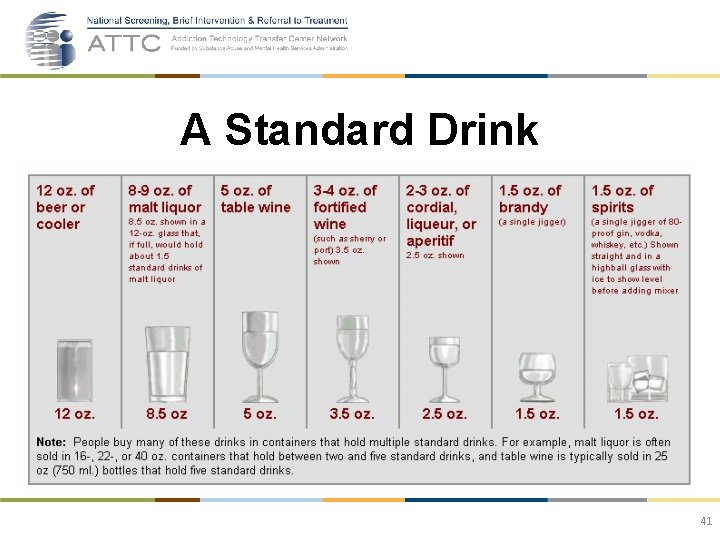
A Standard Drink 41
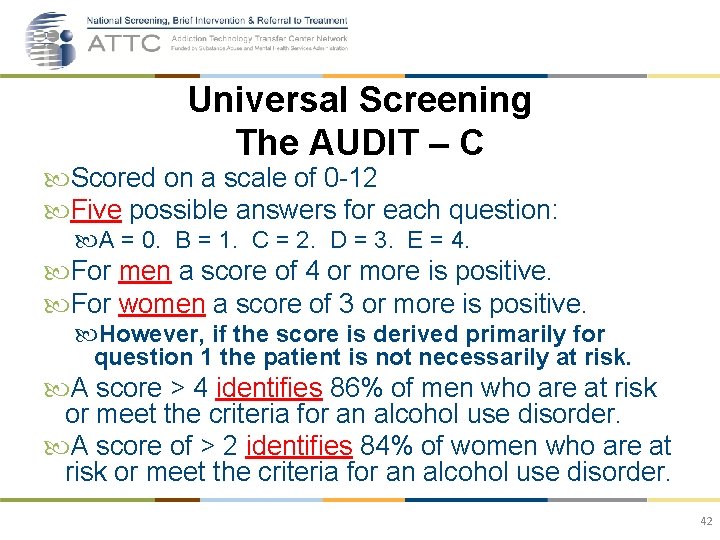
Universal Screening The AUDIT – C Scored on a scale of 0 -12 Five possible answers for each question: A = 0. B = 1. C = 2. D = 3. E = 4. For men a score of 4 or more is positive. For women a score of 3 or more is positive. However, if the score is derived primarily for question 1 the patient is not necessarily at risk. A score > 4 identifies 86% of men who are at risk or meet the criteria for an alcohol use disorder. A score of > 2 identifies 84% of women who are at risk or meet the criteria for an alcohol use disorder. 42
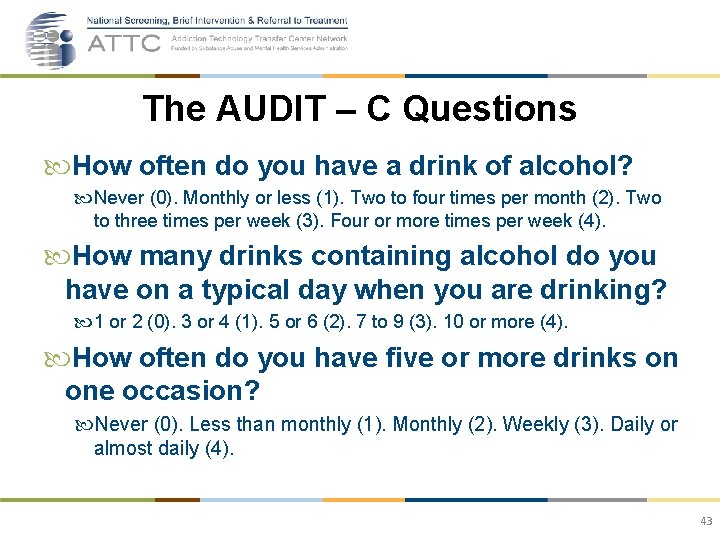
The AUDIT – C Questions How often do you have a drink of alcohol? Never (0). Monthly or less (1). Two to four times per month (2). Two to three times per week (3). Four or more times per week (4). How many drinks containing alcohol do you have on a typical day when you are drinking? 1 or 2 (0). 3 or 4 (1). 5 or 6 (2). 7 to 9 (3). 10 or more (4). How often do you have five or more drinks on one occasion? Never (0). Less than monthly (1). Monthly (2). Weekly (3). Daily or almost daily (4). 43

Universal Screening NIAAA Single Question • How many times in the past year have you had 5 or more drinks in a day (Men) or 4 (Woman)? NIDA Single Question • How many times in the past year have you used illegal drugs or prescription drugs other than how they were prescribed by your physician? 44
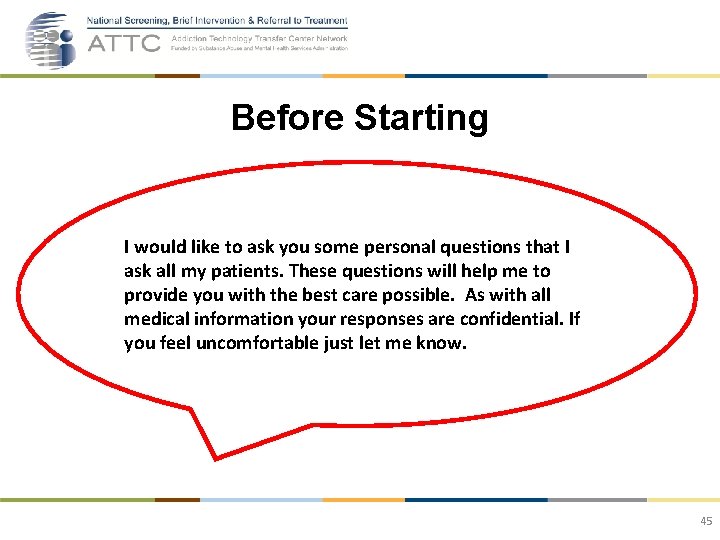
Before Starting I would like to ask you some personal questions that I ask all my patients. These questions will help me to provide you with the best care possible. As with all medical information your responses are confidential. If you feel uncomfortable just let me know. 45
Full Screen AUDIT (Alcohol Use Disorders Identification Test) • Benefits: – – – Created by the World Health Organization. Comprised of 10 multiple choice questions. Simple scoring and interpretation. Provides 4 zones of risk and intervention based on score. Valid and reliable across different cultures. Available in numerous languages. • Limitations: – Addresses alcohol only. 46
AUDIT Ten Questions. Five possible answers to each question. Alcohol Specific. Provides information on frequency of use. Provides information on level of use. Provides misuse and outlines symptoms of SUD. Preface: In the past 12 months…. . 47
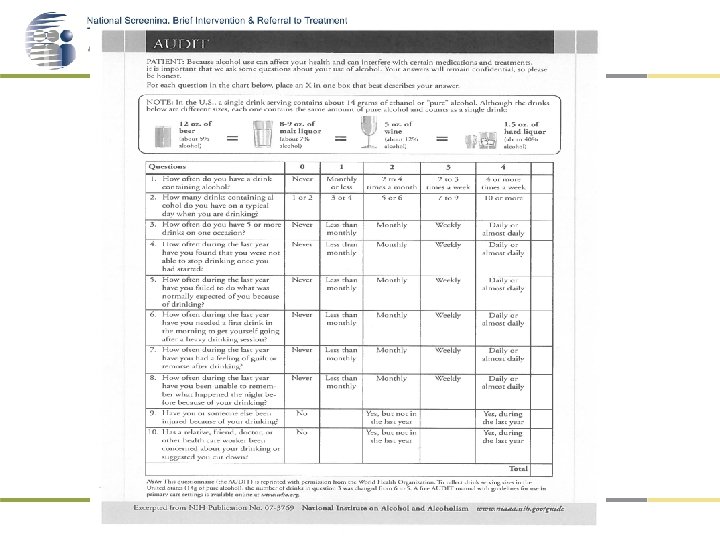
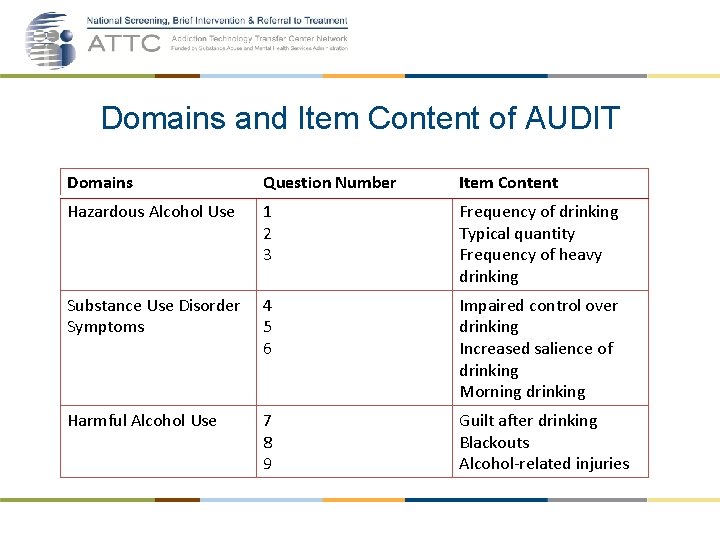
Domains and Item Content of AUDIT Domains Question Number Item Content Hazardous Alcohol Use 1 2 3 Frequency of drinking Typical quantity Frequency of heavy drinking Substance Use Disorder Symptoms 4 5 6 Impaired control over drinking Increased salience of drinking Morning drinking Harmful Alcohol Use 7 8 9 Guilt after drinking Blackouts Alcohol-related injuries
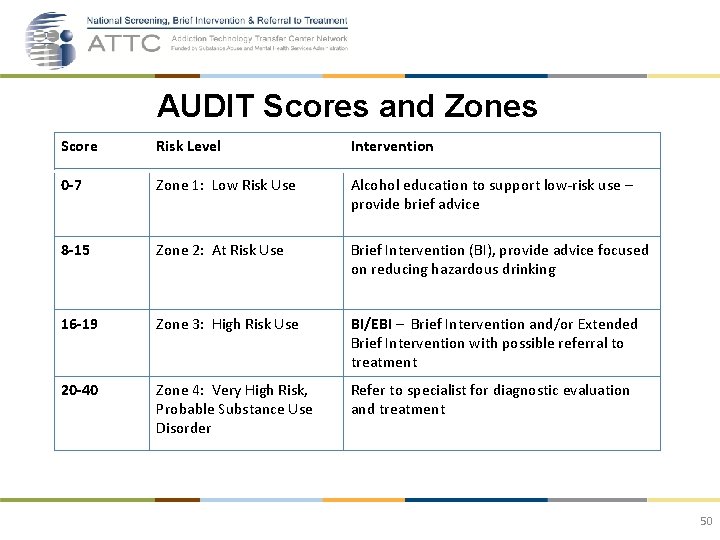
AUDIT Scores and Zones Score Risk Level Intervention 0 -7 Zone 1: Low Risk Use Alcohol education to support low-risk use – provide brief advice 8 -15 Zone 2: At Risk Use Brief Intervention (BI), provide advice focused on reducing hazardous drinking 16 -19 Zone 3: High Risk Use BI/EBI – Brief Intervention and/or Extended Brief Intervention with possible referral to treatment 20 -40 Zone 4: Very High Risk, Probable Substance Use Disorder Refer to specialist for diagnostic evaluation and treatment 50
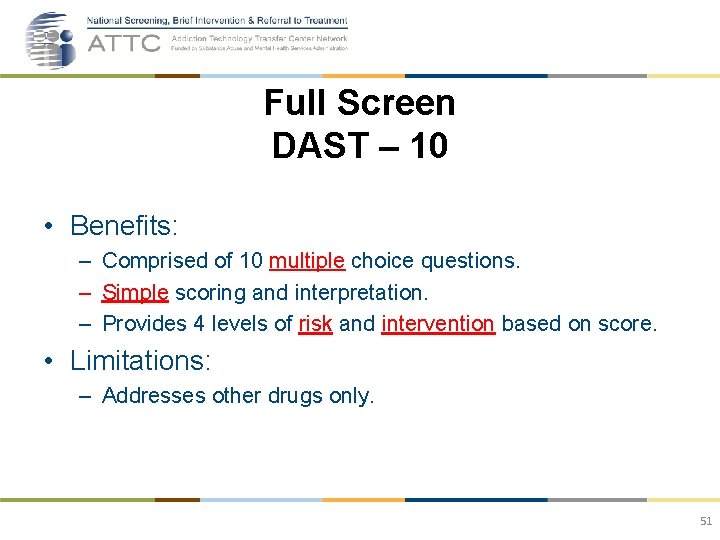
Full Screen DAST – 10 • Benefits: – Comprised of 10 multiple choice questions. – Simple scoring and interpretation. – Provides 4 levels of risk and intervention based on score. • Limitations: – Addresses other drugs only. 51
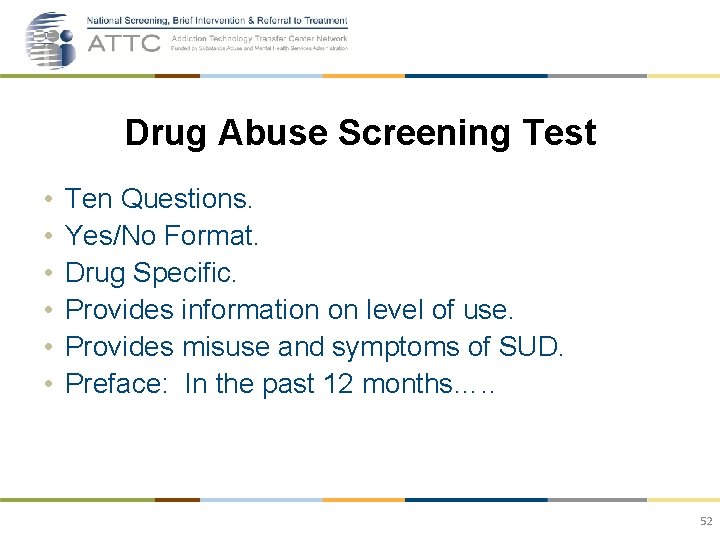
Drug Abuse Screening Test • • • Ten Questions. Yes/No Format. Drug Specific. Provides information on level of use. Provides misuse and symptoms of SUD. Preface: In the past 12 months…. . 52

53
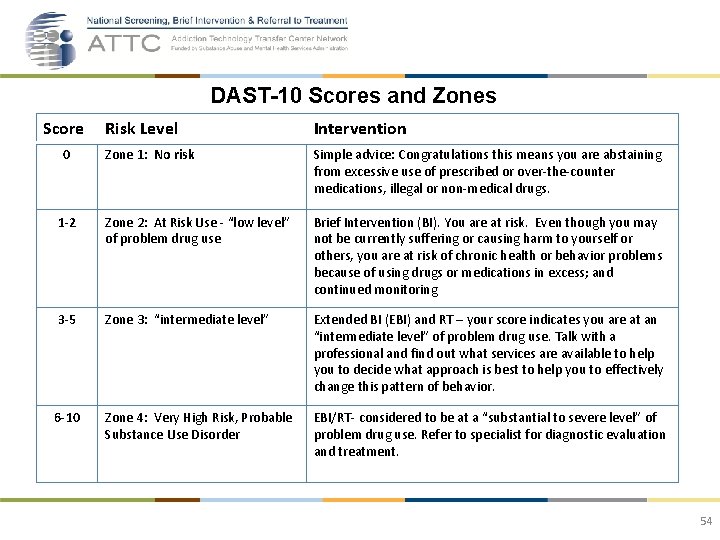
DAST-10 Scores and Zones Score Risk Level Intervention Zone 1: No risk Simple advice: Congratulations this means you are abstaining from excessive use of prescribed or over-the-counter medications, illegal or non-medical drugs. 1 -2 Zone 2: At Risk Use - “low level” of problem drug use Brief Intervention (BI). You are at risk. Even though you may not be currently suffering or causing harm to yourself or others, you are at risk of chronic health or behavior problems because of using drugs or medications in excess; and continued monitoring 3 -5 Zone 3: “intermediate level” Extended BI (EBI) and RT – your score indicates you are at an “intermediate level” of problem drug use. Talk with a professional and find out what services are available to help you to decide what approach is best to help you to effectively change this pattern of behavior. 6 -10 Zone 4: Very High Risk, Probable Substance Use Disorder EBI/RT- considered to be at a “substantial to severe level” of problem drug use. Refer to specialist for diagnostic evaluation and treatment. 0 54
DAST Questions 1 and 2 Have you used drugs other than those required for medical reasons? Rule out question - If the answer is no screen stops here. Do you abuse more than one drug at a time? Involvement question - Implies deeper use history. 55
DAST Questions 3 and 4 Are you unable to stop using drugs when you want to? Addiction question – Loss of control. Have you ever had blackouts or flashbacks as a result of drug use? Addiction question – Psychological problems caused or exacerbated by substance use. 56
DAST Questions 5 and 6 Do you ever feel bad or guilty about your drug use? Implies awareness of negative results of substance use/use consequences. Does your spouse (or parents) ever complain about your involvement with drugs? Abuse question – Recurrent social or interpersonal problems. 57
DAST Questions 7 and 8 Have you neglected your family because of your drug use? Abuse question – Failure to meet role obligations. Have you engaged in illegal activities in order to obtain drugs? Involvement question – Implies changes in social norms. 58
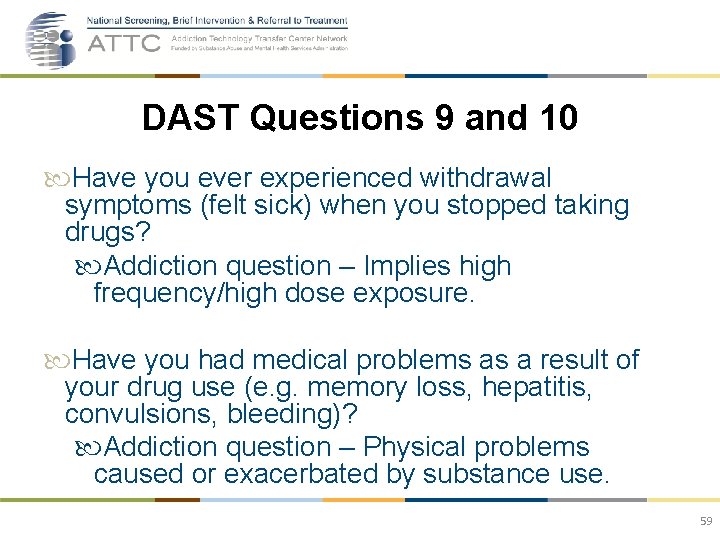
DAST Questions 9 and 10 Have you ever experienced withdrawal symptoms (felt sick) when you stopped taking drugs? Addiction question – Implies high frequency/high dose exposure. Have you had medical problems as a result of your drug use (e. g. memory loss, hepatitis, convulsions, bleeding)? Addiction question – Physical problems caused or exacerbated by substance use. 59
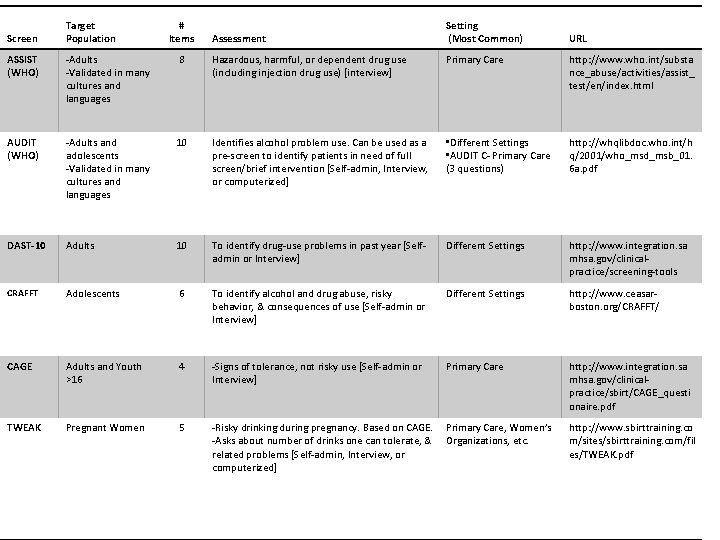
Screen Target Population # Items Assessment Setting (Most Common) URL ASSIST (WHO) -Adults -Validated in many cultures and languages 8 Hazardous, harmful, or dependent drug use (including injection drug use) [interview] Primary Care http: //www. who. int/substa nce_abuse/activities/assist_ test/en/index. html AUDIT (WHO) -Adults and adolescents -Validated in many cultures and languages 10 Identifies alcohol problem use. Can be used as a pre-screen to identify patients in need of full screen/brief intervention [Self-admin, Interview, or computerized] • Different Settings • AUDIT C- Primary Care (3 questions) http: //whqlibdoc. who. int/h q/2001/who_msd_msb_01. 6 a. pdf DAST-10 Adults 10 To identify drug-use problems in past year [Selfadmin or Interview] Different Settings http: //www. integration. sa mhsa. gov/clinicalpractice/screening-tools CRAFFT Adolescents 6 To identify alcohol and drug abuse, risky behavior, & consequences of use [Self-admin or Interview] Different Settings http: //www. ceasarboston. org/CRAFFT/ CAGE Adults and Youth >16 4 -Signs of tolerance, not risky use [Self-admin or Interview] Primary Care http: //www. integration. sa mhsa. gov/clinicalpractice/sbirt/CAGE_questi onaire. pdf TWEAK Pregnant Women 5 -Risky drinking during pregnancy. Based on CAGE. -Asks about number of drinks one can tolerate, & related problems [Self-admin, Interview, or computerized] Primary Care, Women’s Organizations, etc. http: //www. sbirttraining. co m/sites/sbirttraining. com/fil es/TWEAK. pdf
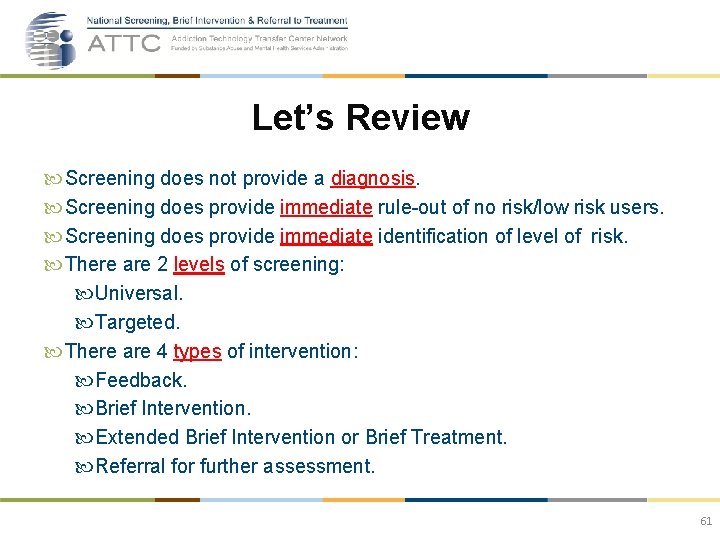
Let’s Review Screening does not provide a diagnosis. Screening does provide immediate rule-out of no risk/low risk users. Screening does provide immediate identification of level of risk. There are 2 levels of screening: Universal. Targeted. There are 4 types of intervention: Feedback. Brief Intervention. Extended Brief Intervention or Brief Treatment. Referral for further assessment. 61
Rules for Role Plays Conducting a Screening Using the AUDIT and/or DAST-10 Behavioral Health is Essential to Health Prevention Works | Treatment is Effective | People Recover
Conducting a Screening Using the AUDIT and/or DAST-10 Form Dyads • Therapist/counselor. • Patient

Conducting a Screening Using the AUDIT and/or DAST-10 • Each role play should be approximately 3 -5 minutes. • At the end of each role play spend a minute or 2 discussing your experience. • First practice the AUDIT, then switch roles and practice the DAST-10. When you have experienced both roles, discuss how it felt from each perspective. • After completing the cycle we will have an open large group discussion.
Conducting a Screening Using the AUDIT and/or DAST-10 And Remember Have Fun
Brief Intervention and Brief Negotiated Interview Motivational Interviewing and 4 BI Options Module Three Re-designing How We Treat Substance Use Problems Behavioral Health is Essential to Health Prevention Works | Treatment is Effective | People Recover
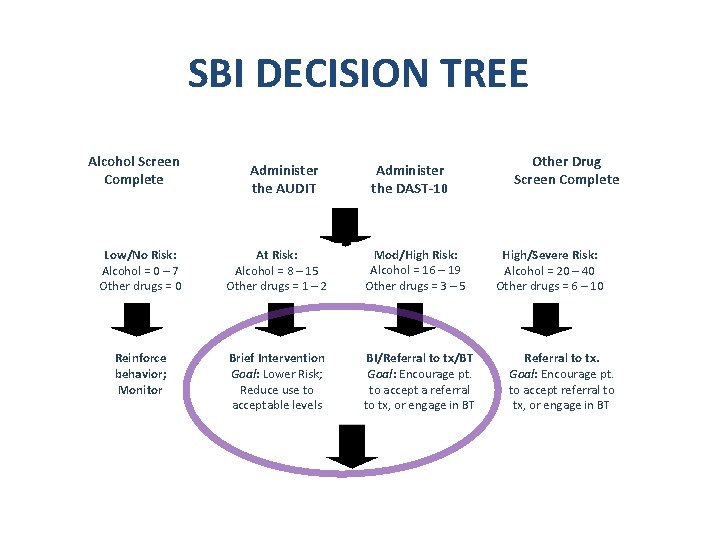
SBI DECISION TREE Alcohol Screen Complete Administer the AUDIT Administer the DAST-10 Low/No Risk: Alcohol = 0 – 7 Other drugs = 0 At Risk: Alcohol = 8 – 15 Other drugs = 1 – 2 Mod/High Risk: Alcohol = 16 – 19 Other drugs = 3 – 5 Reinforce behavior; Monitor Brief Intervention Goal: Lower Risk; Reduce use to acceptable levels BI/Referral to tx/BT Goal: Encourage pt. to accept a referral to tx, or engage in BT Other Drug Screen Complete High/Severe Risk: Alcohol = 20 – 40 Other drugs = 6 – 10 Referral to tx. Goal: Encourage pt. to accept referral to tx, or engage in BT
What is BI/BNI? A Brief Intervention or Brief Negotiated Interview is a time limited, individual counseling session. 68
What are the Goals of BI/BNI? The general goal of a BI/BNI is to: Educate the patient on safe levels of substance use. Increase the patients awareness of the consequences of substance use. Motivate the patient towards changing substance use behavior. Assist the patient in making choices that reduce their risk of substance use problems. The goals of a BI are fluid and are dependent on a variety of factors including: The patients screening score. The patients readiness to change. The patients specific needs. 69
What is Your Role? Provide feedback about the screening results. Offer information on low-risk substance use, the link between substance use and other lifestyle or healthcare related problems. Understand the client’s viewpoint regarding their substance use. Explore a menu of options for change. Assist the patient in making new decisions regarding their substance use. Support the patient in making changes in their substance use behavior. Give advice if requested. 70
Ask Yourself Who has the best idea in the room? The Patient 71
WHERE DO I START? What you do depends on where the patient is in the process of changing. The first step is to be able to identify where the patient is coming from.
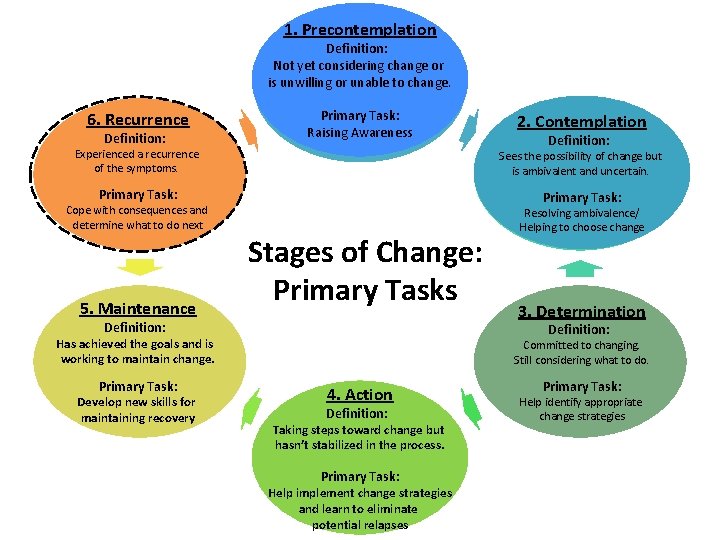
1. Precontemplation Definition: Not yet considering change or is unwilling or unable to change. 6. Recurrence Definition: Primary Task: Raising Awareness 2. Contemplation Definition: Experienced a recurrence of the symptoms. Sees the possibility of change but is ambivalent and uncertain. Primary Task: Cope with consequences and determine what to do next 5. Maintenance Stages of Change: Primary Tasks Definition: Develop new skills for maintaining recovery 3. Determination Definition: Has achieved the goals and is working to maintain change. Primary Task: Resolving ambivalence/ Helping to choose change Committed to changing. Still considering what to do. 4. Action Definition: Taking steps toward change but hasn’t stabilized in the process. Primary Task: Help implement change strategies and learn to eliminate potential relapses Primary Task: Help identify appropriate change strategies
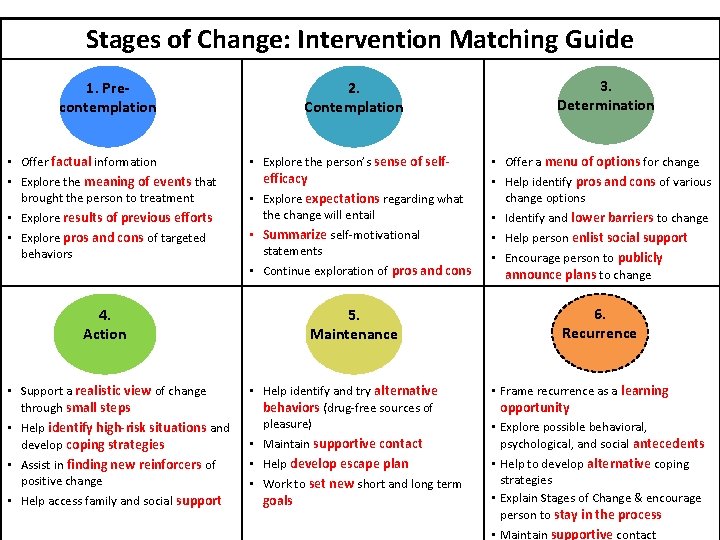
Stages of Change: Intervention Matching Guide 1. Precontemplation • Offer factual information • Explore the meaning of events that brought the person to treatment • Explore results of previous efforts • Explore pros and cons of targeted behaviors 4. Action • Support a realistic view of change through small steps • Help identify high-risk situations and develop coping strategies • Assist in finding new reinforcers of positive change • Help access family and social support 2. Contemplation • Explore the person’s sense of selfefficacy • Explore expectations regarding what the change will entail • Summarize self-motivational statements • Continue exploration of pros and cons 3. Determination • Offer a menu of options for change • Help identify pros and cons of various change options • Identify and lower barriers to change • Help person enlist social support • Encourage person to publicly announce plans to change 5. Maintenance 6. Recurrence • Help identify and try alternative behaviors (drug-free sources of pleasure) • Maintain supportive contact • Help develop escape plan • Work to set new short and long term goals • Frame recurrence as a learning opportunity • Explore possible behavioral, psychological, and social antecedents • Help to develop alternative coping strategies • Explain Stages of Change & encourage person to stay in the process • Maintain supportive contact
“PEOPLE ARE BETTER PERSUADED BY THE REASONS THEY THEMSELVES DISCOVERED THAN THOSE THAT COME INTO THE MINDS OF OTHERS” BLAISE PASCAL
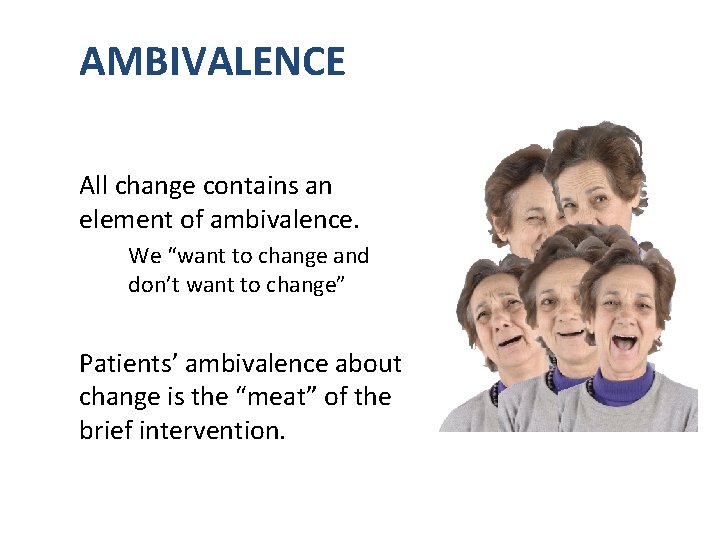
AMBIVALENCE All change contains an element of ambivalence. We “want to change and don’t want to change” Patients’ ambivalence about change is the “meat” of the brief intervention.
Motivational Interviewing Behavioral Health is Essential to Health Prevention Works | Treatment is Effective | People Recover
Motivational Interviewing is a person-centered, evidence-based, goal-oriented method for enhancing intrinsic motivation to change by exploring and resolving ambivalence with the individual. 78
Why Motivation • Research has shown that motivation-enhancing approaches are associated with greater participation in treatment and positive treatment outcomes. (Landry, 1996; Miller et al. , 1995 a) • A positive attitude and commitment to change are also associated with positive outcomes. (Miller and Tonigan, 1996) (Prochaska and Di. Clemente, 1992) 79
Motivation • Motivation is not something one has but is something one does. • Motivation is a key to change. • Motivation is dynamic and fluctuates. • Motivation can be influenced. • Motivation can be modified. • The clinician can elicit and enhance motivation. 80
The Spirit of MI • MI is an adaptation and extension of Carl Roger’s humanistic client-centered style. • MI is as much a way of being with patients as it is a therapeutic approach to counseling. 81
Motivational Interviewing Is focused on competency and strength: Motivational Interviewing affirms the client, emphasizes free choice, supports self efficacy, and encourages optimism that changes can be made. Is individualized and client centered: Research indicates that positive outcomes are associated with flexible program policies and focus on individual needs (Inciardi et al. , 1993). Does not label: Motivational Interviewing avoids using names, especially with those who may not agree with a diagnosis or don’t see a specific behavior as problematic. 82
Motivational Interviewing Creates therapeutic partnerships: Motivational Interviewing encourages an active partnership where the client and counselor work together to establish treatment goals and develop strategies. Uses empathy not authority: Research indicates that positive outcomes are related to empathy and warm and supportive listening. Focuses on less intensive treatment: Motivational Interviewing places an emphasis on less intensive, but equally effective care, especially for those whose use is problematic or risky but not yet serious. 83
Motivational Interviewing Assumes motivation is fluid and can be influenced. Motivation is influenced in the context of a relationship – developed in the context of a patient encounter. Principle tasks – to work with ambivalence and resistance. Goal – to influence change in the direction of health. 84
Goal of MI To create and amplify discrepancy between present behavior and broader goals. How? Create cognitive dissonance between where one is and where one wants to be. 85
UNDERLYING ASSUMPTIONS • Acceptance • • Autonomy/Choice Less is better Elicit versus Impart Ambivalence is normal Care-frontation Non-Judgmental Change talk Avoid the righting reflex 86
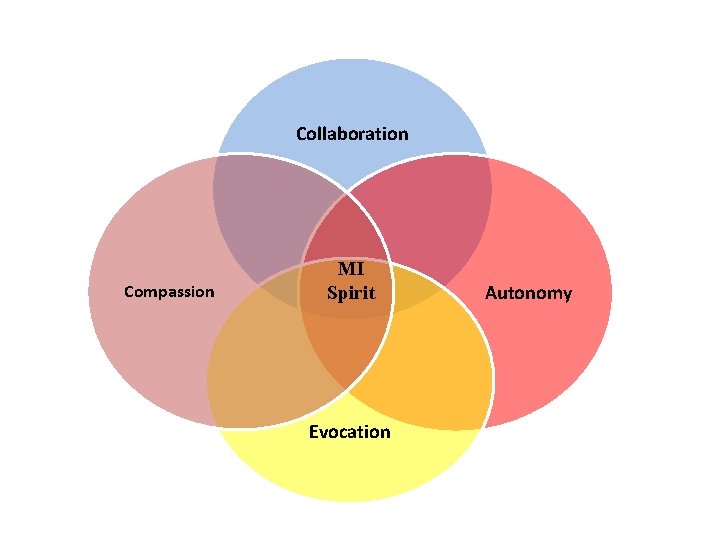
Collaboration Compassion MI Spirit Evocation Autonomy
The MI Shift From feeling responsible for changing patients’ behavior to supporting them in thinking & talking about their own reasons and means for behavior change. 88
Video of a practitioner who is not using Motivational Interviewing as their clinical practice http: //youtu. be/_Vlvan. BFkv. I 89
Rate the BI/BNI • How would you rate this providers Motivational Interviewing skills? • Imagine you are the patient…. How do you feel? • Is this approach: – Helpful? – Harmful? – Neutral? 90
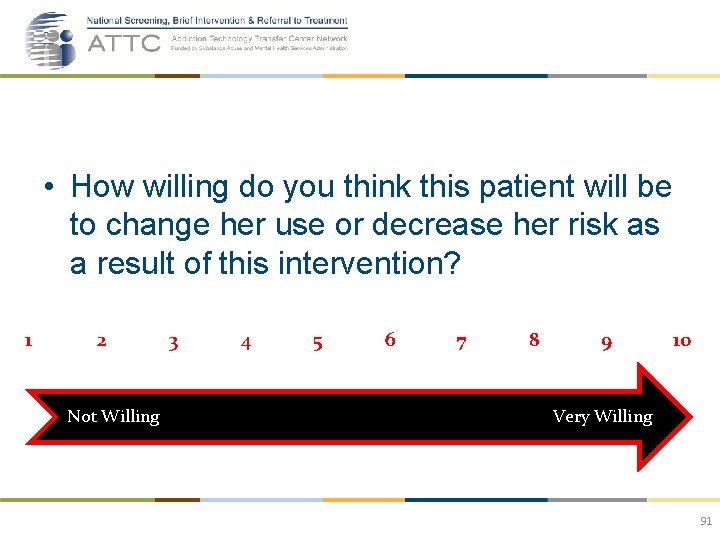
• How willing do you think this patient will be to change her use or decrease her risk as a result of this intervention? 1 2 Not Willing 3 4 5 6 7 8 9 10 Very Willing 91
MI Tools • DARN CAT • OARS • EARS 92
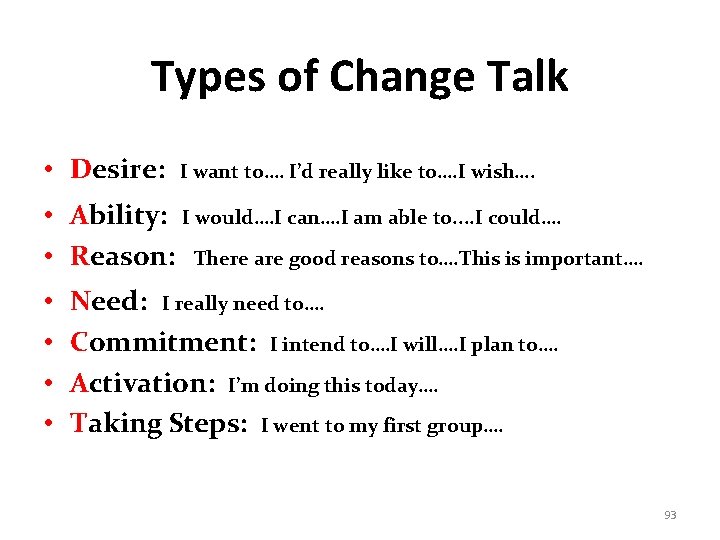
Types of Change Talk • Desire: I want to…. I’d really like to…. I wish…. • Ability: I would…. I can…. I am able to. . I could…. • Reason: There are good reasons to…. This is important…. • • Need: I really need to…. Commitment: I intend to…. I will…. I plan to…. Activation: I’m doing this today…. Taking Steps: I went to my first group…. 93
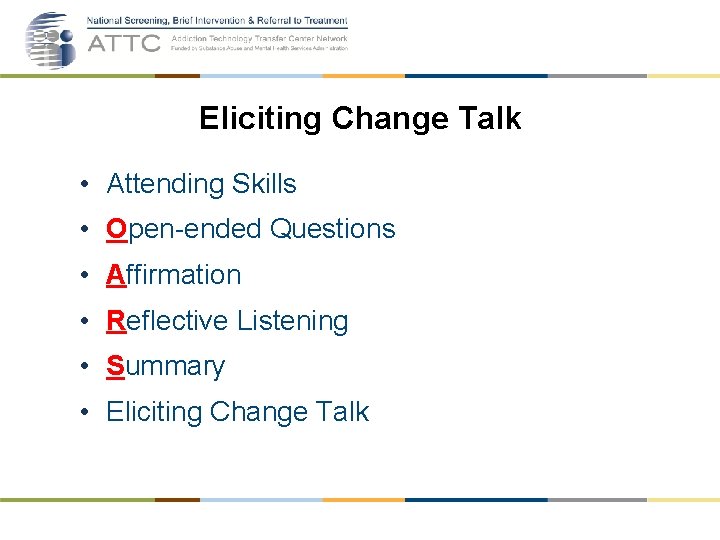
Eliciting Change Talk • Attending Skills • Open-ended Questions • Affirmation • Reflective Listening • Summary • Eliciting Change Talk
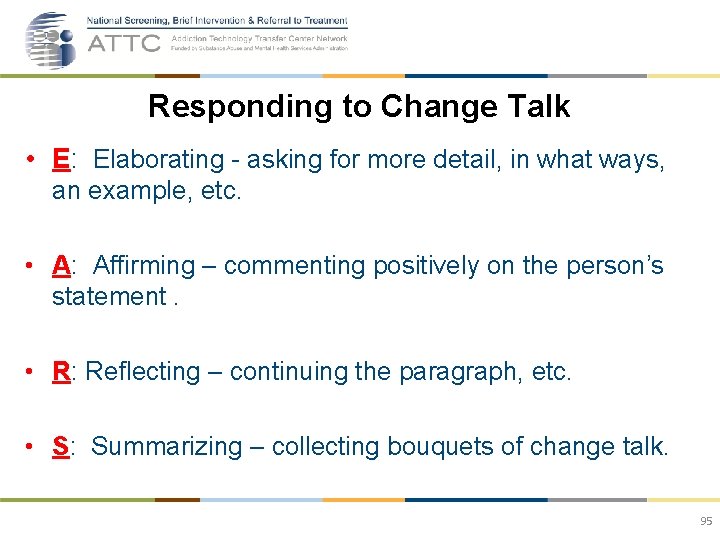
Responding to Change Talk • E: Elaborating - asking for more detail, in what ways, an example, etc. • A: Affirming – commenting positively on the person’s statement. • R: Reflecting – continuing the paragraph, etc. • S: Summarizing – collecting bouquets of change talk. 95
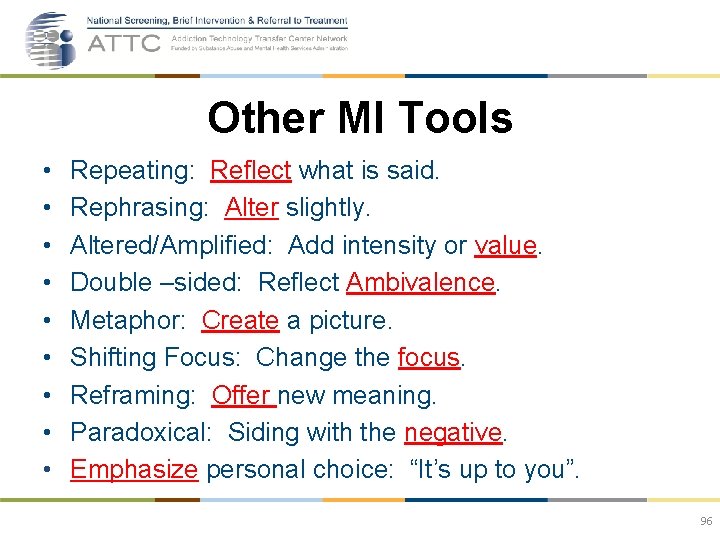
Other MI Tools • • • Repeating: Reflect what is said. Rephrasing: Alter slightly. Altered/Amplified: Add intensity or value. Double –sided: Reflect Ambivalence. Metaphor: Create a picture. Shifting Focus: Change the focus. Reframing: Offer new meaning. Paradoxical: Siding with the negative. Emphasize personal choice: “It’s up to you”. 96
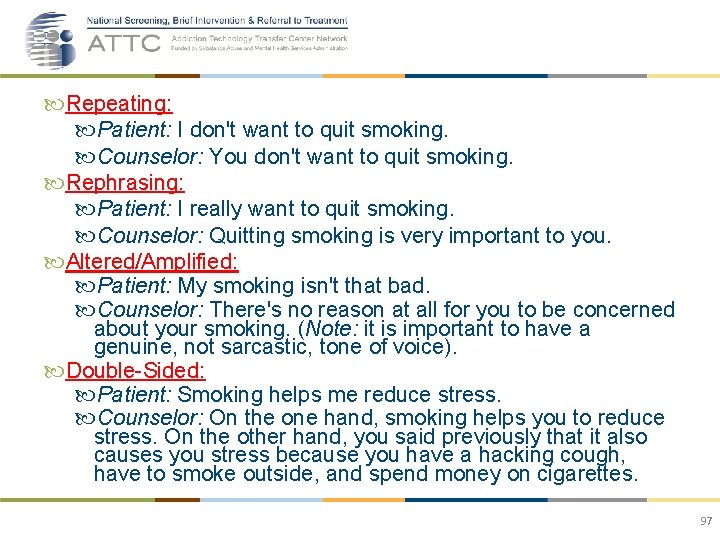
Repeating: Patient: I don't want to quit smoking. Counselor: You don't want to quit smoking. Rephrasing: Patient: I really want to quit smoking. Counselor: Quitting smoking is very important to you. Altered/Amplified: Patient: My smoking isn't that bad. Counselor: There's no reason at all for you to be concerned about your smoking. (Note: it is important to have a genuine, not sarcastic, tone of voice). Double-Sided: Patient: Smoking helps me reduce stress. Counselor: On the one hand, smoking helps you to reduce stress. On the other hand, you said previously that it also causes you stress because you have a hacking cough, have to smoke outside, and spend money on cigarettes. 97
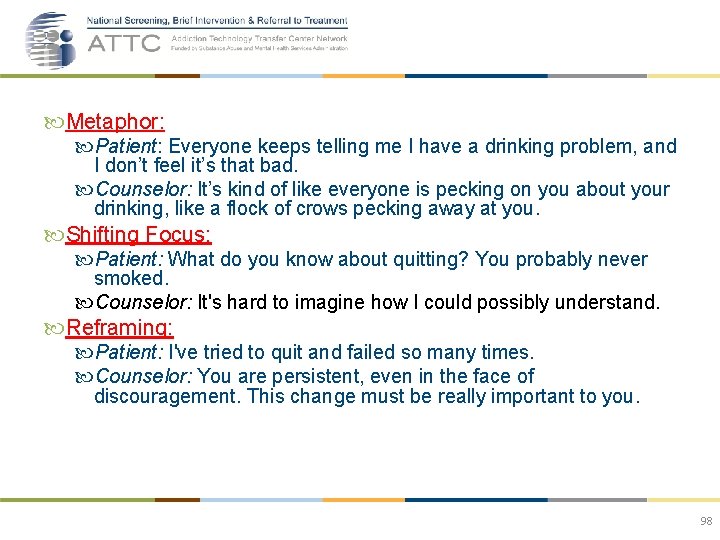
Metaphor: Patient: Everyone keeps telling me I have a drinking problem, and I don’t feel it’s that bad. Counselor: It’s kind of like everyone is pecking on you about your drinking, like a flock of crows pecking away at you. Shifting Focus: Patient: What do you know about quitting? You probably never smoked. Counselor: It's hard to imagine how I could possibly understand. Reframing: Patient: I've tried to quit and failed so many times. Counselor: You are persistent, even in the face of discouragement. This change must be really important to you. 98
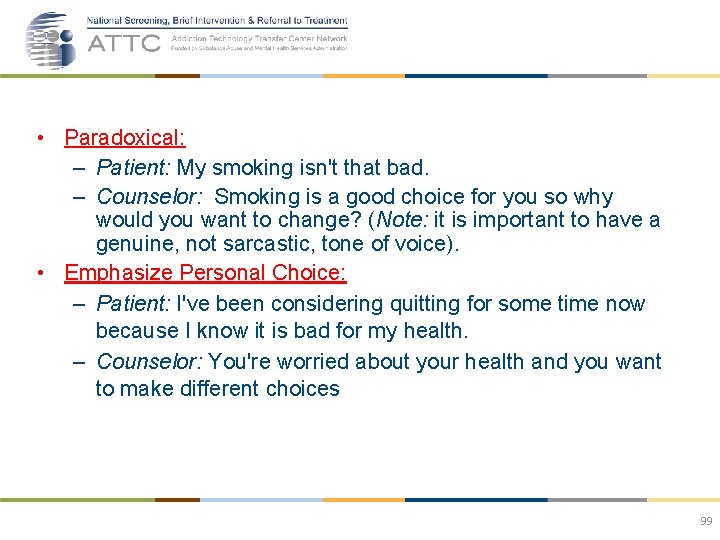
• Paradoxical: – Patient: My smoking isn't that bad. – Counselor: Smoking is a good choice for you so why would you want to change? (Note: it is important to have a genuine, not sarcastic, tone of voice). • Emphasize Personal Choice: – Patient: I've been considering quitting for some time now because I know it is bad for my health. – Counselor: You're worried about your health and you want to make different choices 99
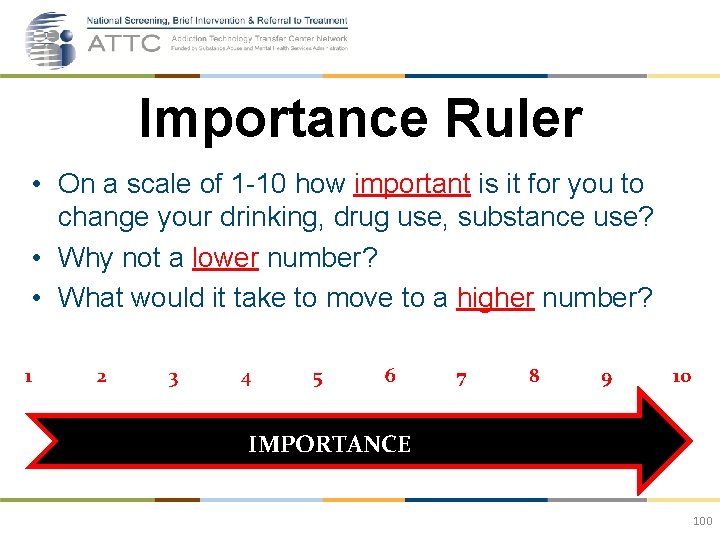
Importance Ruler • On a scale of 1 -10 how important is it for you to change your drinking, drug use, substance use? • Why not a lower number? • What would it take to move to a higher number? 1 2 3 4 5 6 7 8 9 10 IMPORTANCE 100
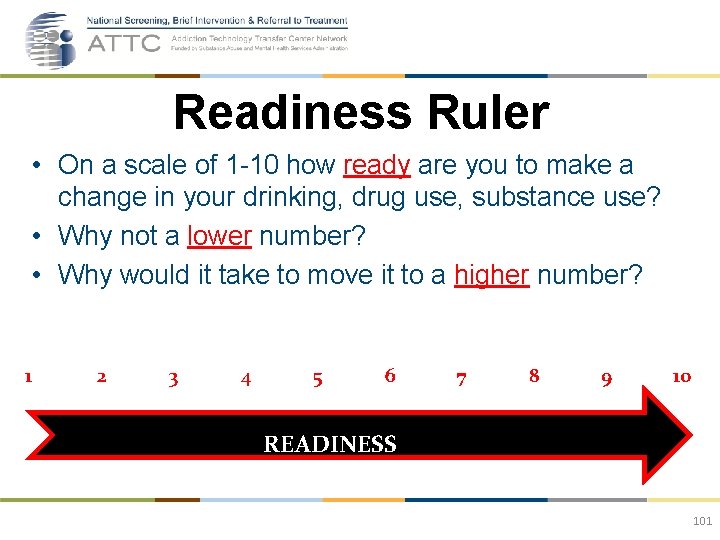
Readiness Ruler • On a scale of 1 -10 how ready are you to make a change in your drinking, drug use, substance use? • Why not a lower number? • Why would it take to move it to a higher number? 1 2 3 4 5 6 7 8 9 10 READINESS 101
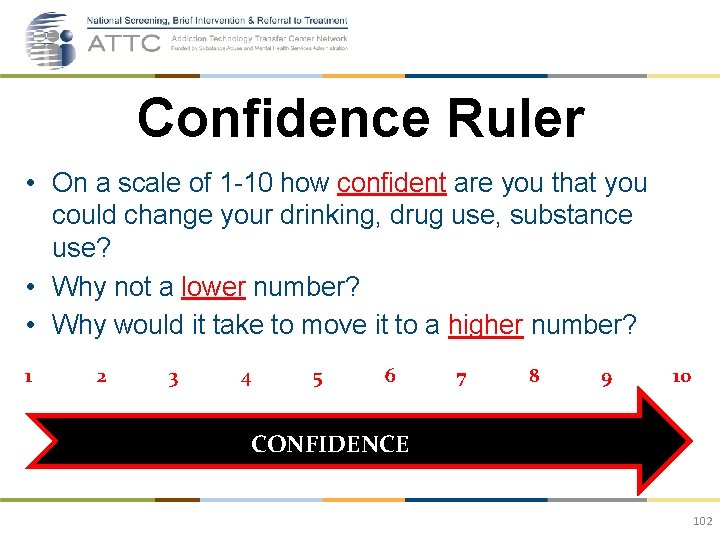
Confidence Ruler • On a scale of 1 -10 how confident are you that you could change your drinking, drug use, substance use? • Why not a lower number? • Why would it take to move it to a higher number? 1 2 3 4 5 6 7 8 9 10 CONFIDENCE 102
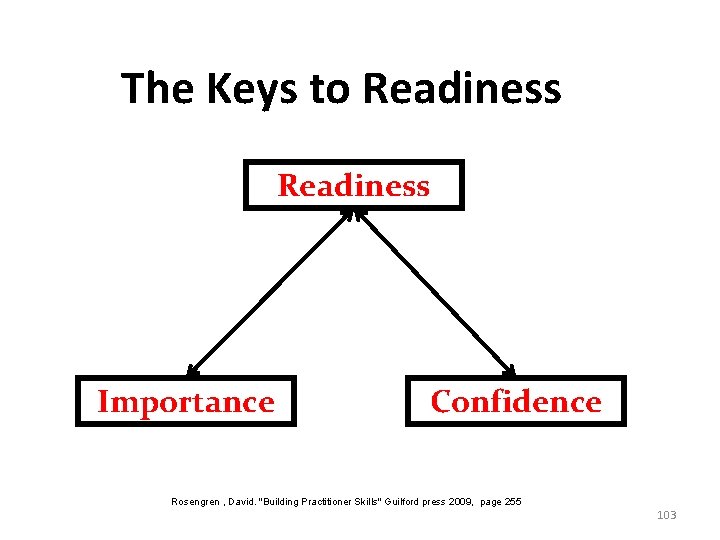
The Keys to Readiness Importance Confidence Rosengren , David. "Building Practitioner Skills" Guilford press 2009, page 255 103
Video of a practitioner who is using Motivational Interview in their clinical practice http: //youtu. be/67 I 6 g 1 I 7 Zao 104
Rate the BI/BNI • How would you rate this providers Motivational Interviewing skills? • Imagine you are the patient…. How do you feel? • Is this approach: – Helpful? – Harmful? – Neutral? 105
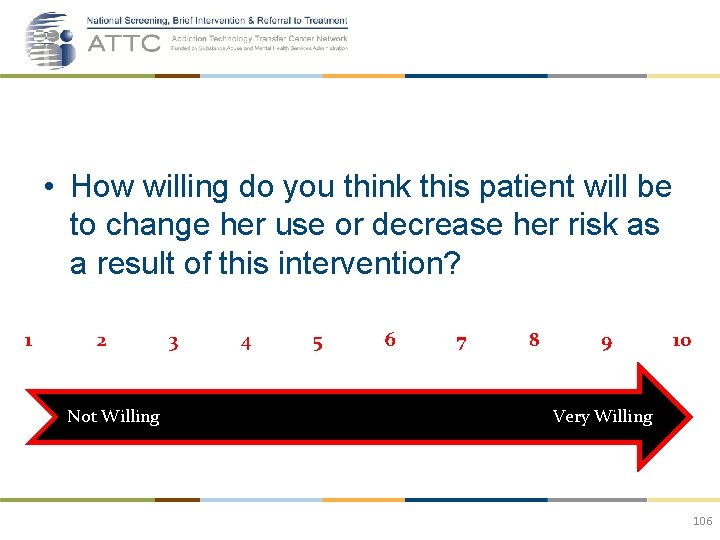
• How willing do you think this patient will be to change her use or decrease her risk as a result of this intervention? 1 2 Not Willing 3 4 5 6 7 8 9 10 Very Willing 106
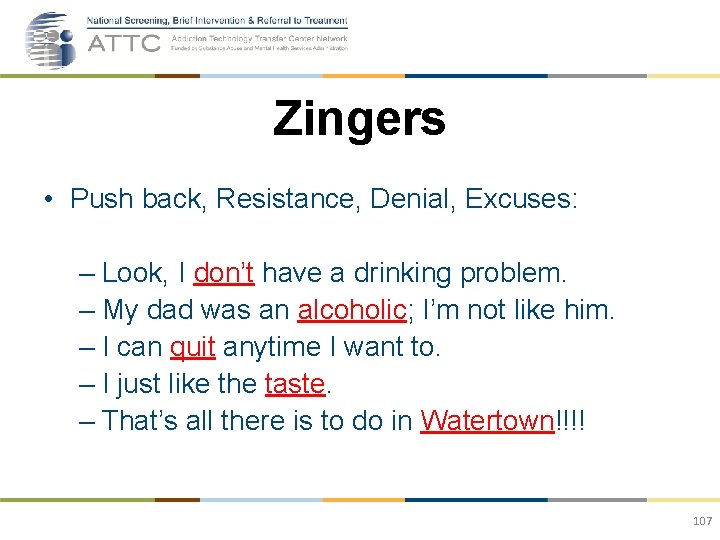
Zingers • Push back, Resistance, Denial, Excuses: – Look, I don’t have a drinking problem. – My dad was an alcoholic; I’m not like him. – I can quit anytime I want to. – I just like the taste. – That’s all there is to do in Watertown!!!! 107
Handling Zingers • I’m not going to push you to change anything you don’t want to change • I’m not here to convince you that you have a problem/are an alcoholic. • I’d just like to give you some information. • I’d really like to hear your thoughts about…. • What you decide to do is up to you. 108
Brief Interventions for Patients at Risk for Substance Use Problems
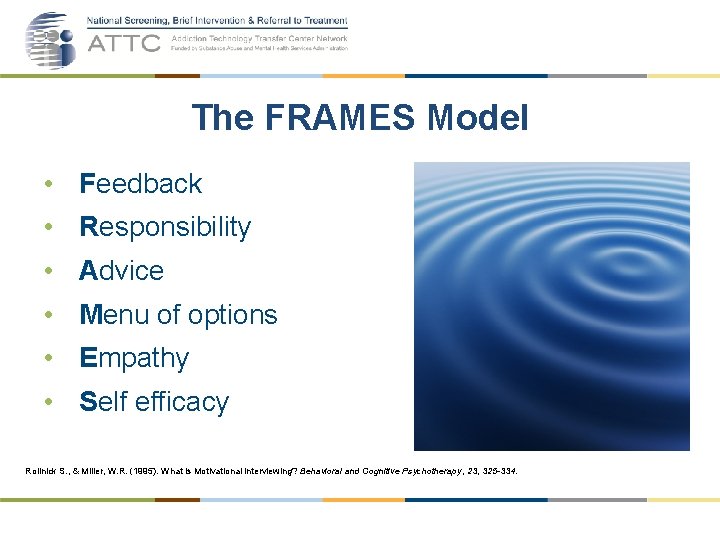
The FRAMES Model • Feedback • Responsibility • Advice • Menu of options • Empathy • Self efficacy Rollnick S. , & Miller, W. R. (1995). What is Motivational Interviewing? Behavioral and Cognitive Psychotherapy, 23, 325 -334.
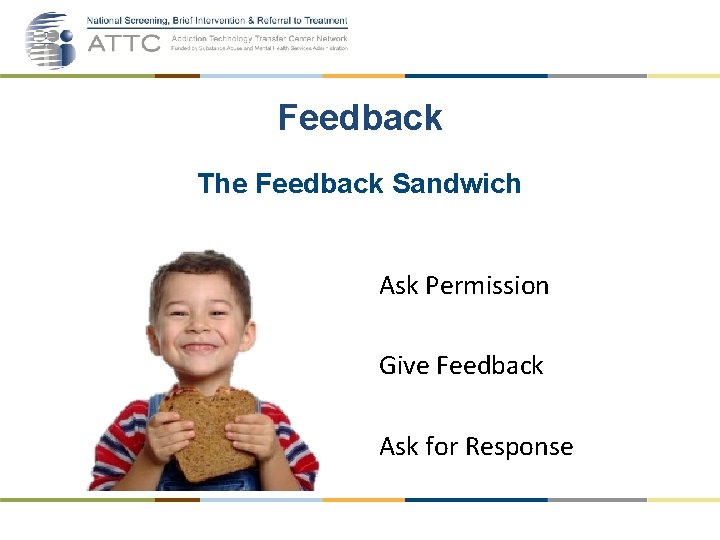
Feedback The Feedback Sandwich Ask Permission Give Feedback Ask for Response
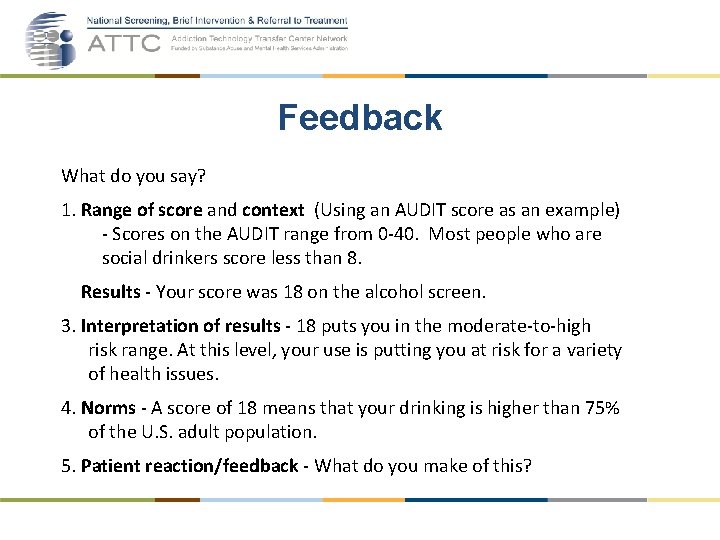
Feedback What do you say? 1. Range of score and context (Using an AUDIT score as an example) - Scores on the AUDIT range from 0 -40. Most people who are social drinkers score less than 8. 2. Results - Your score was 18 on the alcohol screen. 3. Interpretation of results - 18 puts you in the moderate-to-high risk range. At this level, your use is putting you at risk for a variety of health issues. 4. Norms - A score of 18 means that your drinking is higher than 75% of the U. S. adult population. 5. Patient reaction/feedback - What do you make of this?
Responsibility • Once you have given the feedback, let the patient decide where to go with it. • Remember that it’s the patients responsibility to make choices about their substance use • Your responsibility is to create an opportunity for the patient to discuss their substance use in a non-threatening, non-judgmental environment
Advice • Ask the patient if he/she is open to hearing your recommendations • Offer advice from your professional perspective • Elicit the patient’s response
Menu of Alternative Change Options • You can consider these ideas: • Manage your drinking (cut down to low risk limits) • Eliminate your drinking (Quit) • Never drink and drive (Reduce Harm) • Nothing (no change) • Seek help (referral for treatment)
Empathy • A consistent component of effective brief interventions is a warm, reflective, empathic and understanding approach by the person delivering the intervention. • Use of a warm, empathic style is a significant factor in the patient’s response to the intervention and leads to reduced substance use at follow up
Self-Efficacy (Self-Confidence for Change) • Self-efficacy has been described as the belief that one is capable of performing in a certain manner to attain certain goals • Solution focused interventions • Focuses on solutions not problems • Techniques designed to motivate and support change
Role Play • • • Let’s practice the FRAMES model: • Share at-risk drinking levels and give Advice about alcohol consumption techniques. • Discuss a Menu of Options with the patient and help the patient decide what changes she can realistically make in relation to reducing consumption. • Express an understanding of the patient’s situation and acknowledge that change can be difficult (Empathy); endorse the idea that even small changes in the direction of risk reduction can be very beneficial. • Express optimism that any change the patient can make will be a step on the path to achieving a lager, health-related goal. The key is to leave the patient with and increase in self-confidence (Self-Efficacy) Begin with Feedback Using Completed Screening Tools Emphasize that the patient can make a change but what she will do is up to her (Responsibility).
AUDIT Scores and Zones Score Risk Level Intervention 0 -7 Zone 1: Low Risk Use Alcohol education to support low-risk use – provide brief advice 8 -15 Zone 2: At Risk Use Brief Intervention (BI), provide advice focused on reducing hazardous drinking 16 -19 Zone 3: High Risk Use BI/EBI – Brief Intervention and/or Extended Brief Intervention with possible referral to treatment 20 -40 Zone 4: Very High Risk, Probable Substance Use Disorder Refer to specialist for diagnostic evaluation and treatment 119
Extended Brief Intervention A Brief Treatment Model Behavioral Health is Essential to Health Prevention Works | Treatment is Effective | People Recover
Extended BI/Brief Treatment • An extended BI/Brief Treatment consists of ongoing individual counseling sessions with patients scoring in AUDIT Zone III or DAST Level Moderate/High Risk. • Generally, extended BI/BT consist of 4 to 6 sessions, up to 1 hour in duration. • Additional tools and exercises can be used to enhance and support readiness to change. 121
Extended BI/BT Exercises • Ask your patient to write down: – What are the good things about my drinking/drug use? – What are the not so good things? – What are the good things about changing my drinking/drug use? – What are the not so good things? – What are the obstacles that will keep me from success? – How can I overcome those obstacles? – When is it hardest to keep moving forward? – What can I do deal with those situations? 122
Let’s Review • A brief intervention/brief negotiated interview is a time limited, individual counseling session. • The goals of a BI/BNI are fluid depending on a variety of factors. • The patient has the best idea in the room. • Always listen for change talk. • Be prepared for zingers. • Use your MI tools when doing extended BI/BT. • Always end on a positive note. 123
Referral to Treatment for Patients at Risk for Substance Dependence
Referral to Treatment • Approximately 5% of patients screened will require referral to substance use evaluation and treatment. • A patient may be appropriate for referral when: • Assessment of the patient’s responses to the screening reveals serious medical, social, legal, or interpersonal consequences associated with their substance use. These high risk patients will receive a brief intervention followed by referral. Substance Abuse & Mental Health Services Administration. (2011). Screening, Brief Intervention, and Referral to Treatment [Power. Point slides]. Rockville, MD: Author .
Referral to Treatment • Always: – Follow appropriate confidentiality (42, CFR-Part 2) and HIPAA regulations when sharing information. – Establish a relationship with your community provider(s) and ensure you have a referral agreement. – Maintain a list of providers, support services, and other information that may be helpful to patients. – Reduce barriers and build bridges. 126
“WARM HAND-OFF” APPROACH TO REFERRALS • Describe treatment options to patients based on available services • Develop relationships between health centers, who do screening, and local treatment centers • Facilitate hand-off by: • Calling to make appointment for patient/student • Providing directions and clinic hours to patient/student • Coordinating transportation when needed
WHAT IF THE PERSON DOES NOT WANT A REFERRAL? Encourage follow-up – at the point of contact • At follow-up visit: • Inquire about use • Review goals and progress • Reinforce and motivate • Review tips for progress
The Business of SBIRT Cost Effectiveness and Reimbursement Behavioral Health is Essential to Health Prevention Works | Treatment is Effective | People Recover
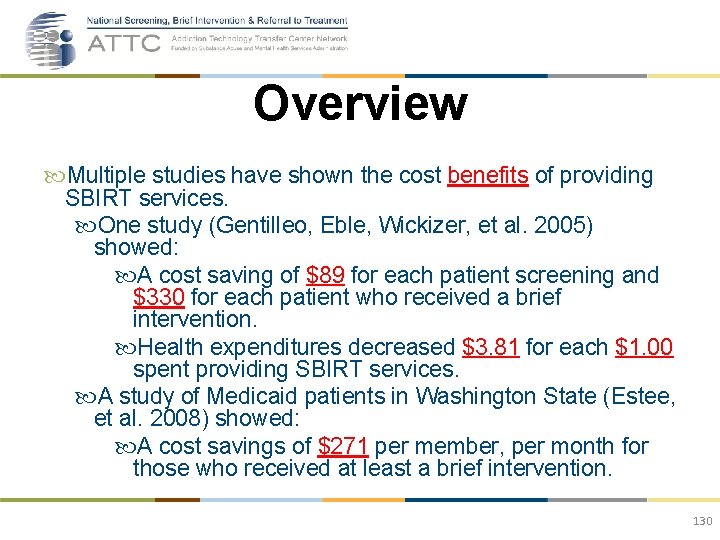
Overview Multiple studies have shown the cost benefits of providing SBIRT services. One study (Gentilleo, Eble, Wickizer, et al. 2005) showed: A cost saving of $89 for each patient screening and $330 for each patient who received a brief intervention. Health expenditures decreased $3. 81 for each $1. 00 spent providing SBIRT services. A study of Medicaid patients in Washington State (Estee, et al. 2008) showed: A cost savings of $271 per member, per month for those who received at least a brief intervention. 130
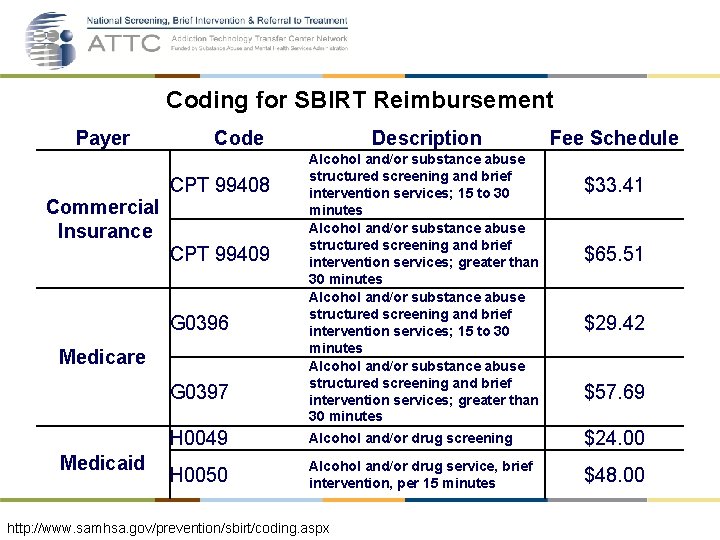
Coding for SBIRT Reimbursement Payer Code CPT 99408 Commercial Insurance CPT 99409 G 0396 Medicare G 0397 Medicaid Description Alcohol and/or substance abuse structured screening and brief intervention services; 15 to 30 minutes Alcohol and/or substance abuse structured screening and brief intervention services; greater than 30 minutes Fee Schedule $33. 41 $65. 51 $29. 42 $57. 69 H 0049 Alcohol and/or drug screening $24. 00 H 0050 Alcohol and/or drug service, brief intervention, per 15 minutes $48. 00 http: //www. samhsa. gov/prevention/sbirt/coding. aspx
SBIRT and the Electronic Health Record (EHR) • The Affordable Care Act encourages both prevention/early intervention and integration of behavioral health with primary care. This integration can be facilitated by imbedding validated alcohol and drug use screening results in the EHR • The Health Information Technology for Economic and Clinical Health (HITECH) Act promotes the meaningful use of the EHR to facilitate integration of care (which would include recording screening and prevention/intervention activities in the EHR) (Tai, B. , Wu, L. , Clark, H. W. (2012). Electronic health records: essential tools in integrating substance abuse treatment with primary care. Substance Abuse and Rehabilitation (3), 1 -8. )
SBIRT and the Electronic Health Record (EHR) • Storing SBIRT information in the EHR makes it readily available to clinicians who are monitoring patient treatment and coordinating services to promote the integration of Substance Use Disorder care with primary care (Tai, B. , Wu, L. , Clark, H. W. (2012). Electronic health records: essential tools in integrating substance abuse treatment with primary care. Substance Abuse and Rehabilitation (3), 1 -8. ) • SBIRT data in the EHR is easily retrieved for research and billing purposes
Thank you for your time and attention! Be sure to visit: sbirt@attcnetwork. org National Screening, Brief Intervention and Referral to Treatment ATTC
- Slides: 134