
National Science FoundationMESA SPAWAR TEACHING INTERNSHIP NSF Grant
- Slides: 1
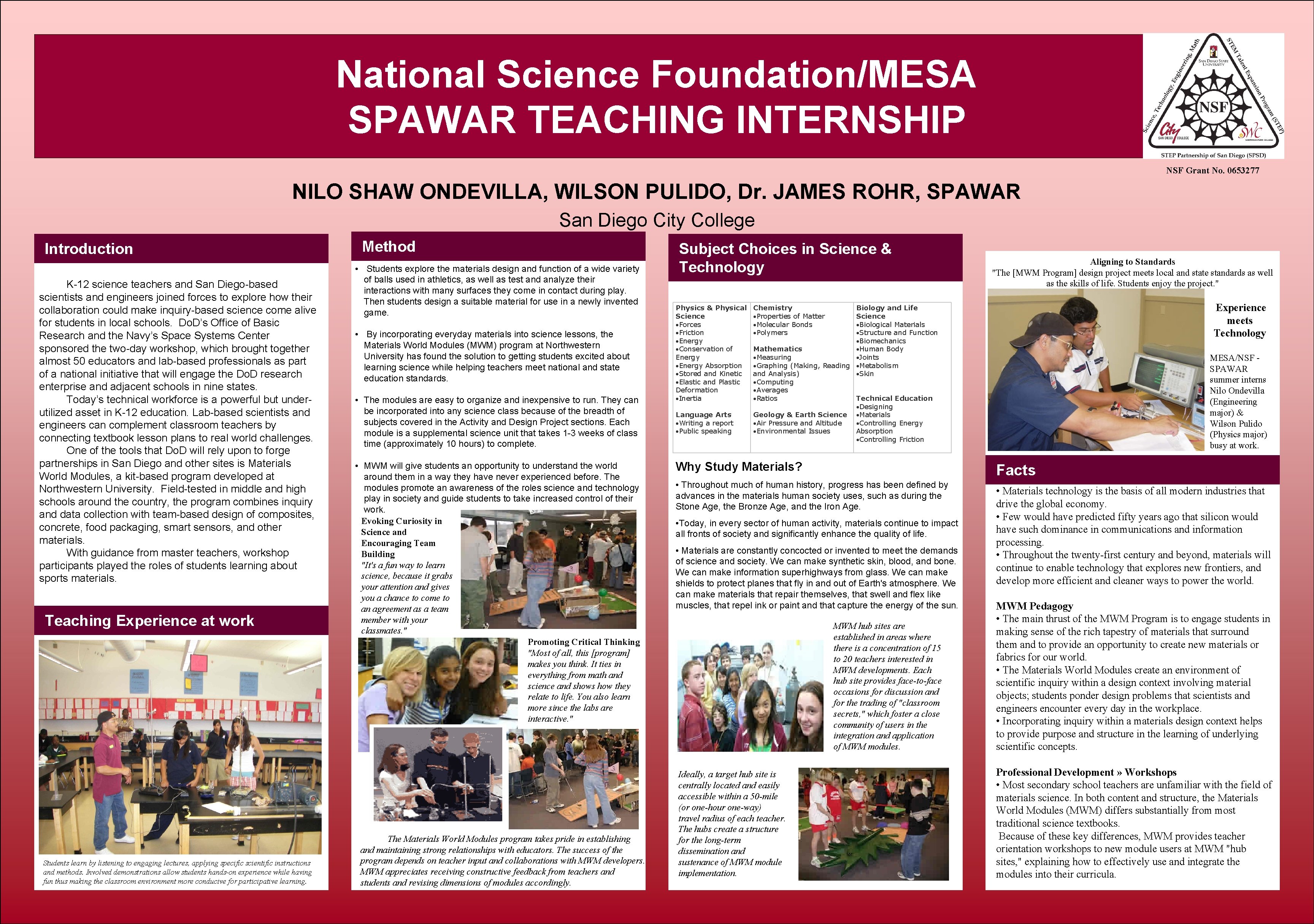
National Science Foundation/MESA SPAWAR TEACHING INTERNSHIP NSF Grant No. 0653277 NILO SHAW ONDEVILLA, WILSON PULIDO, Dr. JAMES ROHR, SPAWAR San Diego City College Introduction K-12 science teachers and San Diego-based scientists and engineers joined forces to explore how their collaboration could make inquiry-based science come alive for students in local schools. Do. D’s Office of Basic Research and the Navy’s Space Systems Center sponsored the two-day workshop, which brought together almost 50 educators and lab-based professionals as part of a national initiative that will engage the Do. D research enterprise and adjacent schools in nine states. Today’s technical workforce is a powerful but underutilized asset in K-12 education. Lab-based scientists and engineers can complement classroom teachers by connecting textbook lesson plans to real world challenges. One of the tools that Do. D will rely upon to forge partnerships in San Diego and other sites is Materials World Modules, a kit-based program developed at Northwestern University. Field-tested in middle and high schools around the country, the program combines inquiry and data collection with team-based design of composites, concrete, food packaging, smart sensors, and other materials. With guidance from master teachers, workshop participants played the roles of students learning about sports materials. Teaching Experience at work Students learn by listening to engaging lectures, applying specific scientific instructions and methods. Involved demonstrations allow students hands-on experience while having fun thus making the classroom environment more conducive for participative learning. Method • Students explore the materials design and function of a wide variety of balls used in athletics, as well as test and analyze their interactions with many surfaces they come in contact during play. Then students design a suitable material for use in a newly invented game. • By incorporating everyday materials into science lessons, the Materials World Modules (MWM) program at Northwestern University has found the solution to getting students excited about learning science while helping teachers meet national and state education standards. • The modules are easy to organize and inexpensive to run. They can be incorporated into any science class because of the breadth of subjects covered in the Activity and Design Project sections. Each module is a supplemental science unit that takes 1 -3 weeks of class time (approximately 10 hours) to complete. • MWM will give students an opportunity to understand the world around them in a way they have never experienced before. The modules promote an awareness of the roles science and technology play in society and guide students to take increased control of their work. Evoking Curiosity in Science and Encouraging Team Building "It's a fun way to learn science, because it grabs your attention and gives you a chance to come to an agreement as a team member with your classmates. " Promoting Critical Thinking "Most of all, this [program] makes you think. It ties in everything from math and science and shows how they relate to life. You also learn more since the labs are interactive. " The Materials World Modules program takes pride in establishing and maintaining strong relationships with educators. The success of the program depends on teacher input and collaborations with MWM developers. MWM appreciates receiving constructive feedback from teachers and students and revising dimensions of modules accordingly. Subject Choices in Science & Technology Physics & Physical Science Forces Friction Energy Conservation of Energy Absorption Stored and Kinetic Elastic and Plastic Deformation Inertia Language Arts Writing a report Public speaking Aligning to Standards "The [MWM Program] design project meets local and state standards as well as the skills of life. Students enjoy the project. " Experience meets Technology Chemistry Properties of Matter Molecular Bonds Polymers Biology and Life Science Biological Materials Structure and Function Biomechanics Mathematics Human Body Measuring Joints Graphing (Making, Reading Metabolism and Analysis) Skin Computing Averages Ratios Technical Education Designing Geology & Earth Science Materials Air Pressure and Altitude Controlling Energy Environmental Issues Absorption Controlling Friction Why Study Materials? Facts • Throughout much of human history, progress has been defined by advances in the materials human society uses, such as during the Stone Age, the Bronze Age, and the Iron Age. • Today, in every sector of human activity, materials continue to impact all fronts of society and significantly enhance the quality of life. • Materials are constantly concocted or invented to meet the demands of science and society. We can make synthetic skin, blood, and bone. We can make information superhighways from glass. We can make shields to protect planes that fly in and out of Earth's atmosphere. We can make materials that repair themselves, that swell and flex like muscles, that repel ink or paint and that capture the energy of the sun. MWM hub sites are established in areas where there is a concentration of 15 to 20 teachers interested in MWM developments. Each hub site provides face-to-face occasions for discussion and for the trading of "classroom secrets, " which foster a close community of users in the integration and application of MWM modules. Ideally, a target hub site is centrally located and easily accessible within a 50 -mile (or one-hour one-way) travel radius of each teacher. The hubs create a structure for the long-term dissemination and sustenance of MWM module implementation. MESA/NSF SPAWAR summer interns Nilo Ondevilla (Engineering major) & Wilson Pulido (Physics major) busy at work. • Materials technology is the basis of all modern industries that drive the global economy. • Few would have predicted fifty years ago that silicon would have such dominance in communications and information processing. • Throughout the twenty-first century and beyond, materials will continue to enable technology that explores new frontiers, and develop more efficient and cleaner ways to power the world. MWM Pedagogy • The main thrust of the MWM Program is to engage students in making sense of the rich tapestry of materials that surround them and to provide an opportunity to create new materials or fabrics for our world. • The Materials World Modules create an environment of scientific inquiry within a design context involving material objects; students ponder design problems that scientists and engineers encounter every day in the workplace. • Incorporating inquiry within a materials design context helps to provide purpose and structure in the learning of underlying scientific concepts. Professional Development » Workshops • Most secondary school teachers are unfamiliar with the field of materials science. In both content and structure, the Materials World Modules (MWM) differs substantially from most traditional science textbooks. Because of these key differences, MWM provides teacher orientation workshops to new module users at MWM "hub sites, " explaining how to effectively use and integrate the modules into their curricula.