
National Science Foundation The National SMET Education Digital
- Slides: 22
National Science Foundation The National SMET Education Digital Library (NSDL) Program: Context and Vision August 10, 2000 US-Korea Joint Workshop on Digital Libraries
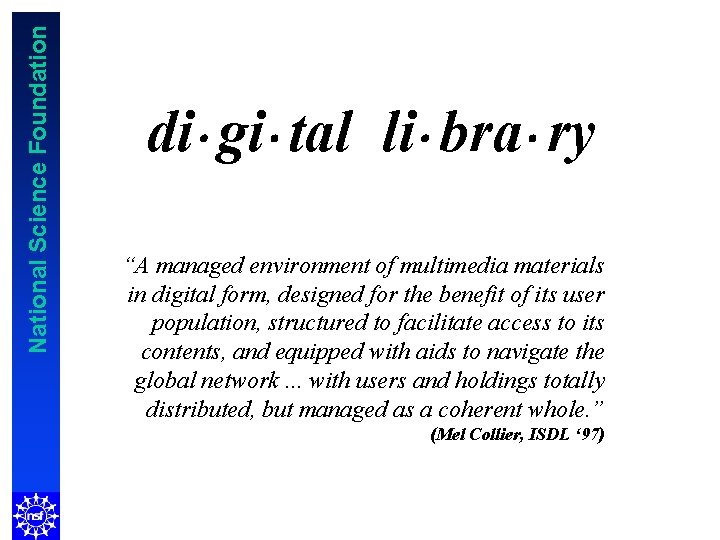
National Science Foundation di gi tal li bra ry “A managed environment of multimedia materials in digital form, designed for the benefit of its user population, structured to facilitate access to its contents, and equipped with aids to navigate the global network. . . with users and holdings totally distributed, but managed as a coherent whole. ” (Mel Collier, ISDL ‘ 97)
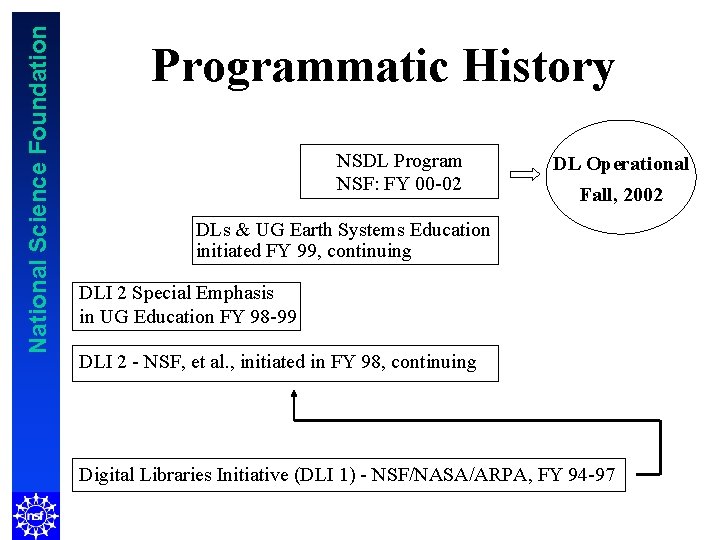
National Science Foundation Programmatic History NSDL Program NSF: FY 00 -02 DL Operational Fall, 2002 DLs & UG Earth Systems Education initiated FY 99, continuing DLI 2 Special Emphasis in UG Education FY 98 -99 DLI 2 - NSF, et al. , initiated in FY 98, continuing Digital Libraries Initiative (DLI 1) - NSF/NASA/ARPA, FY 94 -97
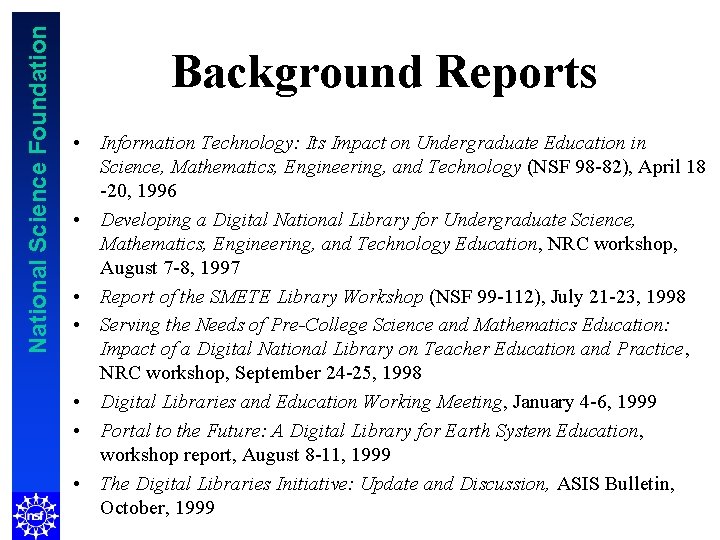
National Science Foundation Background Reports • Information Technology: Its Impact on Undergraduate Education in Science, Mathematics, Engineering, and Technology (NSF 98 -82), April 18 -20, 1996 • Developing a Digital National Library for Undergraduate Science, Mathematics, Engineering, and Technology Education, NRC workshop, August 7 -8, 1997 • Report of the SMETE Library Workshop (NSF 99 -112), July 21 -23, 1998 • Serving the Needs of Pre-College Science and Mathematics Education: Impact of a Digital National Library on Teacher Education and Practice, NRC workshop, September 24 -25, 1998 • Digital Libraries and Education Working Meeting, January 4 -6, 1999 • Portal to the Future: A Digital Library for Earth System Education, workshop report, August 8 -11, 1999 • The Digital Libraries Initiative: Update and Discussion, ASIS Bulletin, October, 1999
National Science Foundation NSDL Program Solicitation • http: //www. nsf. gov/cgi-bin/getpub? nsf 0044 • Anticipated deadlines: April 2001, 2002 • due-nsdl-program@nsf. gov (contact point) • http: //www. ehr. nsf. gov/EHR/DUE/programs/nsdl/ (links to background reports and related projects)
National Science Foundation Presidential Directive - 12/17/1999 Subject: Use of Information Technology to Improve Our Society “ 13. The Secretary of the Smithsonian Institution, the Director of the National Science Foundation, the Director of the National Park Service, and the Director of the Institute of Museum and Library Services shall work with the private sector and cultural and educational institutions across the country to create a Digital Library of Education to house this country's cultural and educational resources. ”
National Science Foundation e-Government Project Governmental Affairs Committee Senators Lieberman and Thompson http: //cct. georgetown. edu/development/e. Gov See entry on “Citizen Services” menu for: Online National Library
National Science Foundation Working Assumptions • • The WWW is the primary medium (for now) Content is a mix of “born digital” and analog There is no lack of “great piles of content” There is a need for “piles of great content” The “unit” of content can and will decrease in size Users will increasingly be creators, and vice versa While much of the use will be “free”, there is a need for multiple models of sustainability
National Science Foundation Vision A Learning Environments and Resources Network for SMET Education (LEARNS) • Designed to meet the needs of learners, in both individual and collaborative settings • Constructed to enable dynamic use of a broad array of materials for learning, primarily in digital format • Managed actively to promote reliable anytime anywhere access to quality collections and services, available both within and without the network
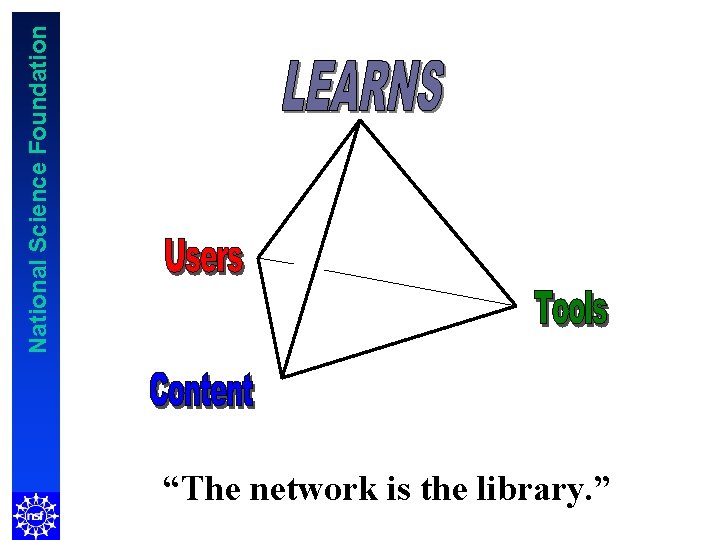
National Science Foundation “The network is the library. ”
National Science Foundation LEARNS Connects: Users: students, educators, life-long learners Content: structured learning materials; large real- time or archived datasets; audio, images, animations; primary sources; digital learning objects (e. g. applets); interactive (virtual, remote) laboratories; . . . Tools: search; refer; validate; integrate; create; customize; publish; share; notify; collaborate; . . .
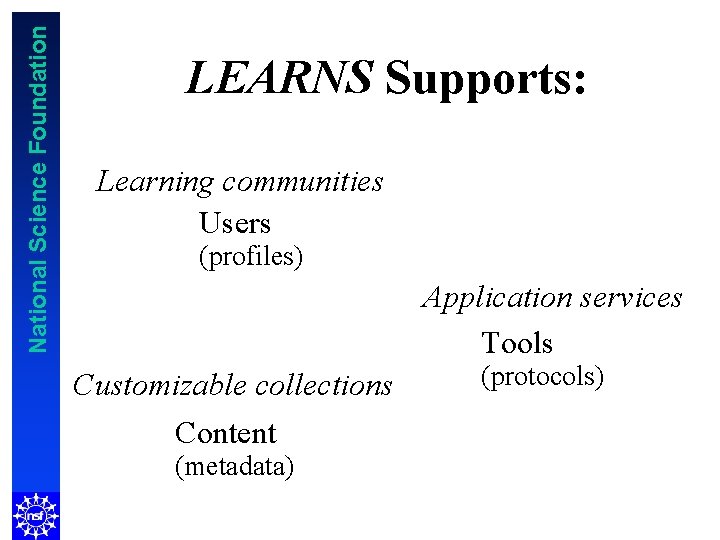
National Science Foundation LEARNS Supports: Learning communities Users (profiles) Application services Tools Customizable collections Content (metadata) (protocols)
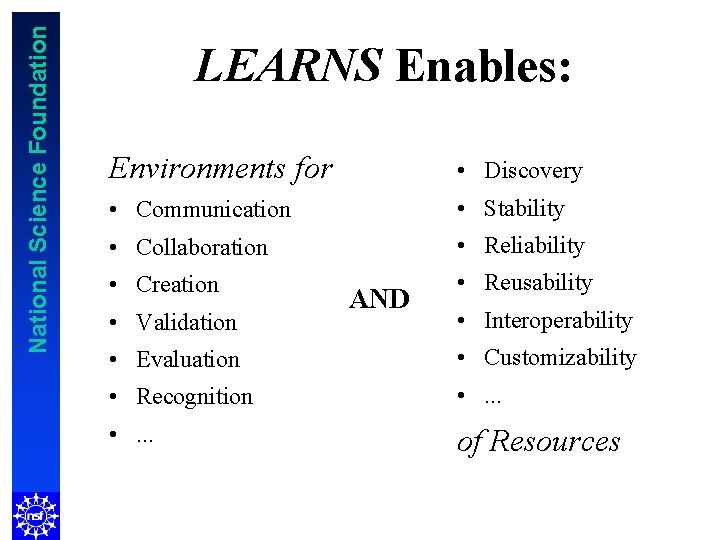
National Science Foundation LEARNS Enables: Environments for • Discovery • Communication • Stability • Collaboration • Reliability • Creation • Reusability • Validation AND • Interoperability • Evaluation • Customizability • Recognition • . . . of Resources
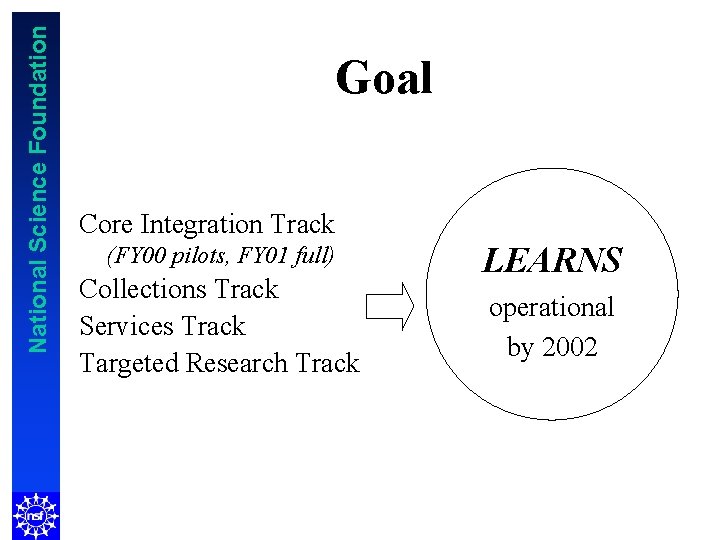
National Science Foundation Goal Core Integration Track (FY 00 pilots, FY 01 full) Collections Track Services Track Targeted Research Track LEARNS operational by 2002
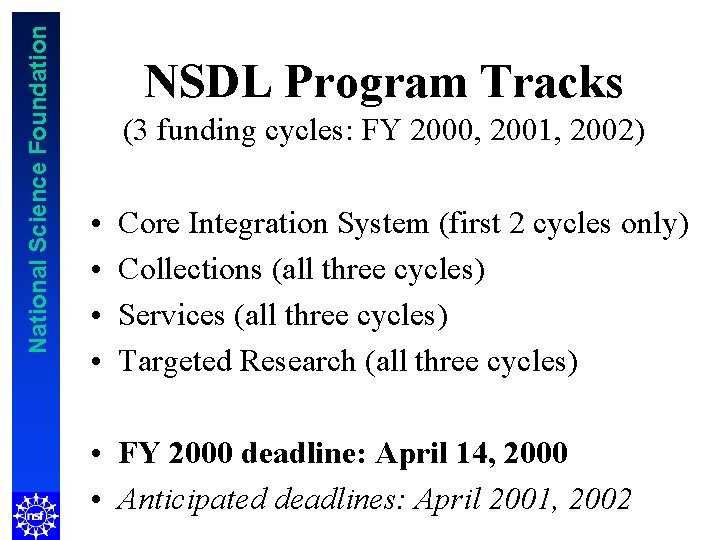
National Science Foundation NSDL Program Tracks (3 funding cycles: FY 2000, 2001, 2002) • • Core Integration System (first 2 cycles only) Collections (all three cycles) Services (all three cycles) Targeted Research (all three cycles) • FY 2000 deadline: April 14, 2000 • Anticipated deadlines: April 2001, 2002
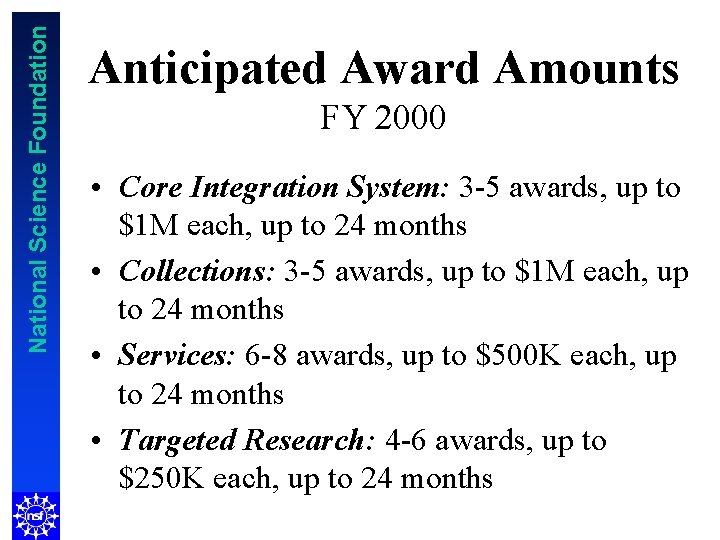
National Science Foundation Anticipated Award Amounts FY 2000 • Core Integration System: 3 -5 awards, up to $1 M each, up to 24 months • Collections: 3 -5 awards, up to $1 M each, up to 24 months • Services: 6 -8 awards, up to $500 K each, up to 24 months • Targeted Research: 4 -6 awards, up to $250 K each, up to 24 months
National Science Foundation Expectations of Tracks • Core Integration: to coordinate a distributed alliance of resource collection and service providers, and to ensure reliable and extensible access to and usability of the resulting network of learning environments and resources • Collections: to aggregate and actively manage a subset of the digital library’s content within a coherent theme or specialty • Services: to increase the impact, reach, efficiency, and value of the digital library in its fully operational form • Targeted Research: to have immediate impact on one or more of the other three tracks
National Science Foundation Types of projects funded to date • Evaluation of digital library prototypes: processes and linkages in support of a core integration system • Evaluation of the impact of digital library tools on teaching and learning • Evaluation of business models for sustainability of library resources • Development of representation models for different types of educational media • Domain/discipline-specific curricular collections and services
National Science Foundation Core Integration System · Maintain the premier gateway to the network; · Supplement and coordinate services developed to enable effective use of and access to the network’s content; · Provide leadership in the development of standards for including resource collections and services in the network; · Work with resource collection providers to establish a suite of review systems for inclusion of material; · Coordinate the formulation of requirements – in conjunction with appropriate standards organizations and/or consortia – for interoperability, reusability, reliability, and stability of resources and services; · Seek out new resource collections to join fully, or otherwise be affiliated with, the library
National Science Foundation Collections • • Discovery of content Classification and cataloguing Acquisition and/or linking; referencing Disciplinary-based themes define a natural body of content, but other possibilities are also encouraged • Access to massive real-time or archived datasets • Software tool suites for analysis, modeling, simulation, or visualization • Reviewed commentary on learning materials and pedagogy
National Science Foundation Services • Help services, frequently asked questions, etc. • Synchronous/asynchronous collaborative learning environments using shared resources • Mechanisms for building personal annotated digital information spaces • Reliability testing for applets or other digital learning objects • Audio, image, and video search capability • Metadata system translation • Community feedback mechanisms
National Science Foundation Targeted Research • Digital library usage studies • Building and sustaining user communities • Automated annotation of audio, image, or video resources • Applications of simulation or virtual world technology for virtual assistants • User interface construction and implementation