
National Science Foundation Robert Noyce Teacher Scholarship Program
National Science Foundation Robert Noyce Teacher Scholarship Program – Timelines, Budget, and Evaluation
2 National Science Foundation
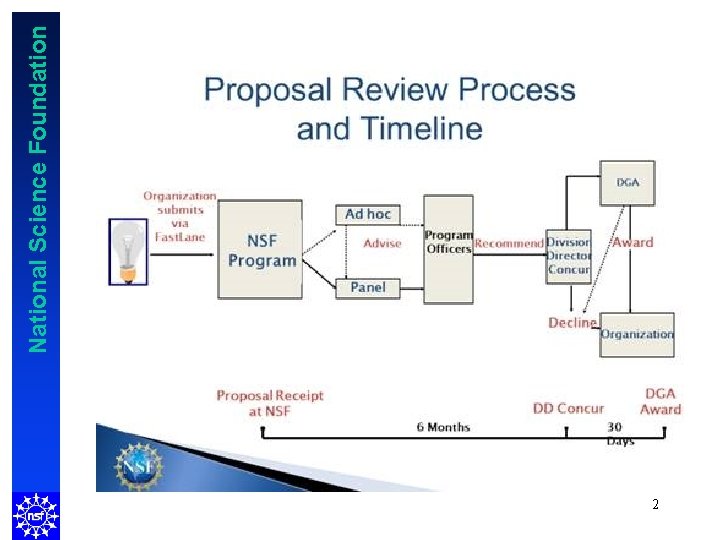
National Science Foundation Dates to Consider • Full proposal deadline ~ Aug. 29, 2017 • Six month processing window ~ Mar. 1, 2018 • Possible start date ~ April 15 – Aug. 15, 2018 (the 1 st or 15 th of a respective month, within 12 mo. of the submission date) 3
National Science Foundation Logistical considerations • When do you plan to start supporting Noyce scholars? • Is there time to implement your recruitment plan before scholar support is slated to begin? • Does your proposed project include novel features that need time to develop? 4
National Science Foundation Timing of Noyce recipient awards • It is not mandatory that you award scholarships and stipends in the first semester of your award. • You should not plan to make new S&S awards in year 5 (unless providing one year scholarships), since these recipients will not be able to complete a full two years of support. 5
National Science Foundation General Budget Guidelines • Information regarding budgetary guidelines can be found in PAPPG as well as NSF program solicitations. Amounts Should Be: • Realistic and reasonable • Well-justified and should establish need • Consistent with program guidelines Eligible costs consist of: • • • Personnel Equipment Travel Participant support Other direct costs (e. g. , subawards, consultant services, computer services, and publications costs) 6
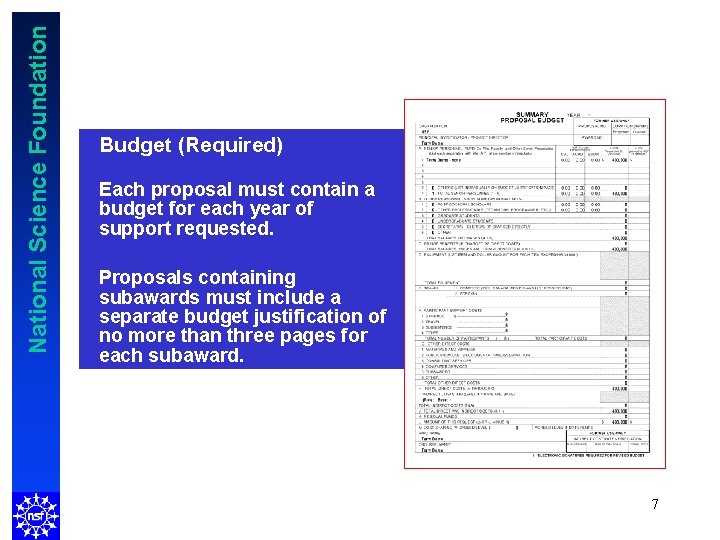
National Science Foundation Budget (Required) Each proposal must contain a budget for each year of support requested. Proposals containing subawards must include a separate budget justification of no more than three pages for each subaward. 7
National Science Foundation Budget Do’s • Contact the Sponsored Research Office early and often. • Remember Indirect Costs and Fringe Benefit rates. • Be sure that Budget and project description match – PI and senior personnel time should reflect the effort on the project • Limited to 2 months across ALL NSF awards • Justification required for more than 2 months – Remember to budget for fringe benefits – New rules on direct costs for clerical support 8
National Science Foundation Incentive Payments Incentives such as gift cards, souvenirs, t-shirts and/or other memorabilia are not typically considered allowable costs; however, when necessary to accomplish program objectives, and if reasonable in amount, these costs could be allowable. When it's unclear, you can ask the institution for additional information, such as: Ø What leads you to believe that participation is unlikely without the use of an incentive? Ø What is the estimated impact without the use of an incentive? Ø How will incentives be distributed and tracked? Ø What is the justification for the amount to be considered? 9
National Science Foundation Unallowable Costs THESE COSTS ARE UNALLOWABLE!! Entertainment: Costs of entertainment, amusement, diversion and social activities, and any costs directly associated with such activities (such as tickets to shows or sporting events, meals, lodging, rentals, transportation and gratuities) are unallowable. Intramural Meetings: No funds may be requested for meals or coffee breaks for intramural meetings of an organization or any of its components, including, but not limited to, laboratories, departments and centers. 10
National Science Foundation Unallowable Costs THESE COSTS ARE UNALLOWABLE!! Alcoholic Beverages: NSF funds may not be proposed or spent on alcoholic beverages Recognition Awards: Payments given for the purpose of conferring distinction or to symbolize respect, esteem, or admiration may not be paid from grant funds. Prizes: Prizes are unallowable costs on grants. 11
National Science Foundation Subaward Issues • No budget/justification included. • Incorrect or no indirect rate applied. • No policies and procedures.
National Science Foundation Indirect Costs • Explain any exclusions from your base. • Use 10 % modified total direct cost if grantee does not have a federally negotiated rate.
National Science Foundation Budget Helpful Hints • Adhere to your federally negotiated rate. Using any rate less than or more than any rate is unallowable and deemed involuntary cost sharing which is prohibited by NSF. • State if your institution has a current federally negotiated rate and the cognizant federal agency in budget justification. • Participant support costs are excluded from your indirect cost rate base allocation. • Provide a detailed budget justification along with your budget prepared by line item.
National Science Foundation Helpful Hints (cont. ) • Include tuition remission amounts for all years in budget justification. • Do not mingle travel funds between PIs and participants. • Place all related participant support costs in designated participant cost categories (more on this in a moment). • IRB approval or exemption must be completed by prior to receiving a NSF award regardless of project affected.
National Science Foundation Noyce-specific Budget Guidelines Award Information (NSF 17 -541, section III) • Track 1: S & S - up to $1, 200, 000, with a project duration of up to 5 years; • Track 2: TF and Track 3: MTF - up to $3, 000, with a project duration of up to 5 years for proposals supporting one cohort of NSF Teaching Fellows or NSF Master Teaching Fellows) or 6 years (for proposals supporting two cohorts of NSF Teaching Fellows or NSF Master Teaching Fellows); • Track 4: Noyce Research - up to $800, 000, with a project duration of up to 5 years. • Capacity Building -up to $75, 000, with a project duration of up to 1 year
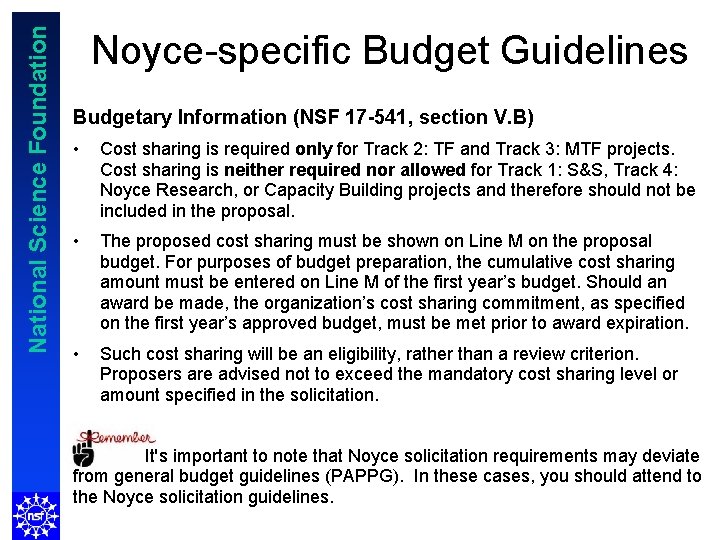
National Science Foundation Noyce-specific Budget Guidelines Budgetary Information (NSF 17 -541, section V. B) • Cost sharing is required only for Track 2: TF and Track 3: MTF projects. Cost sharing is neither required nor allowed for Track 1: S&S, Track 4: Noyce Research, or Capacity Building projects and therefore should not be included in the proposal. • The proposed cost sharing must be shown on Line M on the proposal budget. For purposes of budget preparation, the cumulative cost sharing amount must be entered on Line M of the first year’s budget. Should an award be made, the organization’s cost sharing commitment, as specified on the first year’s approved budget, must be met prior to award expiration. • Such cost sharing will be an eligibility, rather than a review criterion. Proposers are advised not to exceed the mandatory cost sharing level or amount specified in the solicitation. It's important to note that Noyce solicitation requirements may deviate from general budget guidelines (PAPPG). In these cases, you should attend to the Noyce solicitation guidelines.
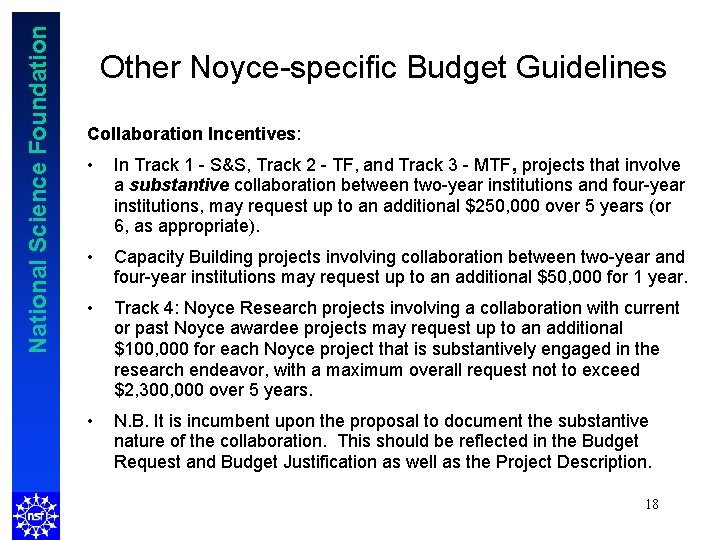
National Science Foundation Other Noyce-specific Budget Guidelines Collaboration Incentives: • In Track 1 - S&S, Track 2 - TF, and Track 3 - MTF, projects that involve a substantive collaboration between two-year institutions and four-year institutions, may request up to an additional $250, 000 over 5 years (or 6, as appropriate). • Capacity Building projects involving collaboration between two-year and four-year institutions may request up to an additional $50, 000 for 1 year. • Track 4: Noyce Research projects involving a collaboration with current or past Noyce awardee projects may request up to an additional $100, 000 for each Noyce project that is substantively engaged in the research endeavor, with a maximum overall request not to exceed $2, 300, 000 over 5 years. • N. B. It is incumbent upon the proposal to document the substantive nature of the collaboration. This should be reflected in the Budget Request and Budget Justification as well as the Project Description. 18
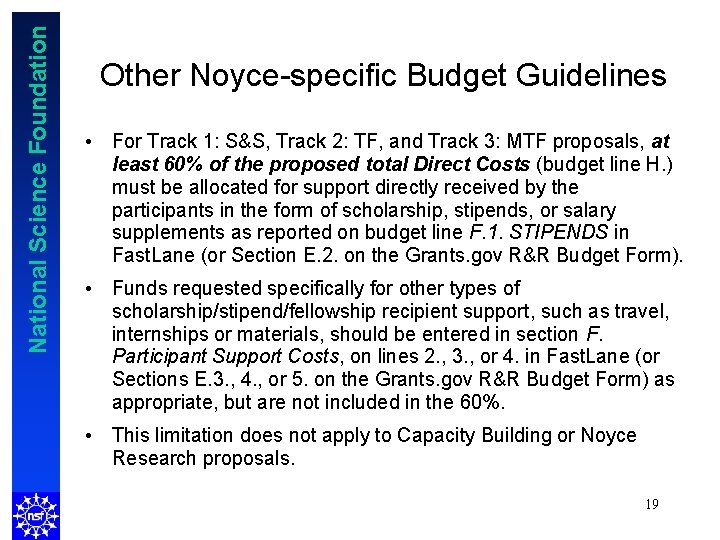
National Science Foundation Other Noyce-specific Budget Guidelines • For Track 1: S&S, Track 2: TF, and Track 3: MTF proposals, at least 60% of the proposed total Direct Costs (budget line H. ) must be allocated for support directly received by the participants in the form of scholarship, stipends, or salary supplements as reported on budget line F. 1. STIPENDS in Fast. Lane (or Section E. 2. on the Grants. gov R&R Budget Form). • Funds requested specifically for other types of scholarship/stipend/fellowship recipient support, such as travel, internships or materials, should be entered in section F. Participant Support Costs, on lines 2. , 3. , or 4. in Fast. Lane (or Sections E. 3. , 4. , or 5. on the Grants. gov R&R Budget Form) as appropriate, but are not included in the 60%. • This limitation does not apply to Capacity Building or Noyce Research proposals. 19
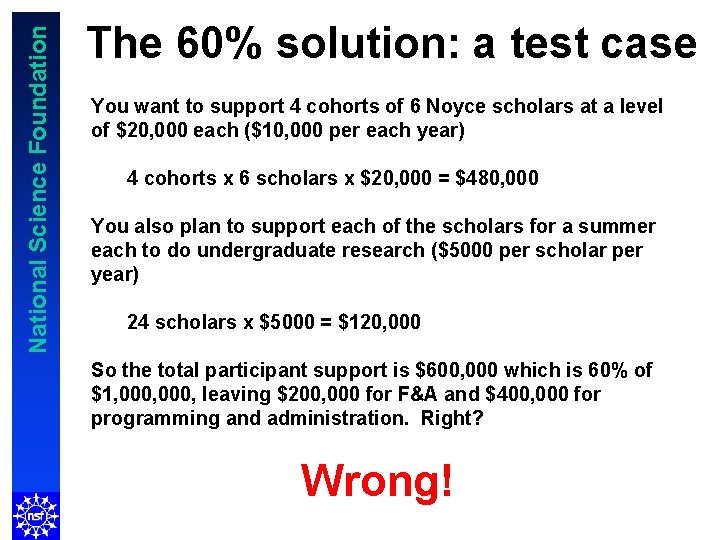
National Science Foundation The 60% solution: a test case You want to support 4 cohorts of 6 Noyce scholars at a level of $20, 000 each ($10, 000 per each year) 4 cohorts x 6 scholars x $20, 000 = $480, 000 You also plan to support each of the scholars for a summer each to do undergraduate research ($5000 per scholar per year) 24 scholars x $5000 = $120, 000 So the total participant support is $600, 000 which is 60% of $1, 000, leaving $200, 000 for F&A and $400, 000 for programming and administration. Right? Wrong!
National Science Foundation Participant Support – Noyce specific guidelines PARTICIPANT SUPPORT COSTS – BUDGET LINE F It's important to note that Noyce solicitation requirements may deviate from general budget guidelines (PAPPG). As per Noyce Budget Preparation Instructions: “Scholarships, stipends, and fellowships should be indicated on budget line F. 1. STIPENDS “ Ø Line F. 1 – Stipends: Specific to Noyce, line F. 1 denotes the funds dedicated to Noyce Scholar scholarships and stipends, only. Ø Line F. 2 – Travel: Funds may be requested for the travel costs of participants. These should include travel for at least one current and former scholar to attend the Noyce summit Ø Line F. 4 – Other: Funds associated with student payment (outside of scholarships & stipends), e. g. summer internships, stipends for learning/teaching assistantships, research fellowships, should be listed here, as well as field trips and similar activity requests
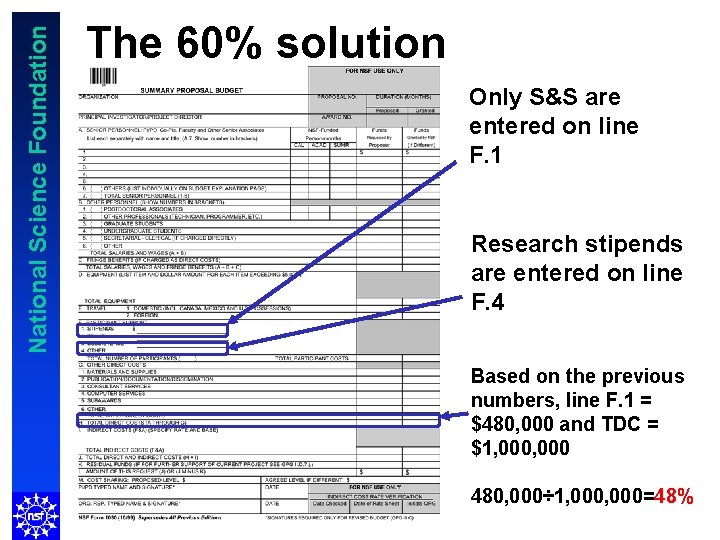
National Science Foundation The 60% solution Only S&S are entered on line F. 1 Research stipends are entered on line F. 4 Based on the previous numbers, line F. 1 = $480, 000 and TDC = $1, 000 480, 000÷ 1, 000=48%
National Science Foundation Project Evaluation Plan As stated in Section V. A. 3. a, proposals must describe: • x. An evaluation plan that will assess the effectiveness of the project in attracting, preparing, and retaining STEM majors and/or STEM professionals in teaching careers (for S&S and TF) or developing and retaining Master Teaching Fellows in teaching careers (for MTF) in high-need local educational agencies. The plan should include ways to measure the effectiveness of the recipients as teachers and teacher leaders. The proposal must identify an independent evaluator with the expertise to conduct an objective evaluation. A strong evaluation plan should align with the proposed goals and outcomes of the project. Evaluation results should provide an avenue for the project to contribute to the knowledge base. 23
National Science Foundation Project Evaluation Plan • Independent evaluator must be external to the project, but need not be external to the institution, e. g. member of a social science department or a university research institute. Collaborators on previous projects would not be considered independent. • Proposal should include a Biosketch for the project evaluator in order to evaluate his/her qualifications. • A budget request for the external evaluator should reflect the amount of work needed for the project. • Requests made under Budget section G. 3, Consultant Services must provide information on normal daily compensation rate, and number of days of expected service. Consultants’ travel costs, including subsistence, may be included. This information should be incorporated within the Budget Justification. 24
National Science Foundation Questions? Tom Kim tkim@nsf. gov Sandra Richardson srichard@nsf. gov Program Directors Division of Undergraduate Education 25
- Slides: 25