
National Rural Support Programme NRSP December 2019 NRSPs
National Rural Support Programme (NRSP) December, 2019
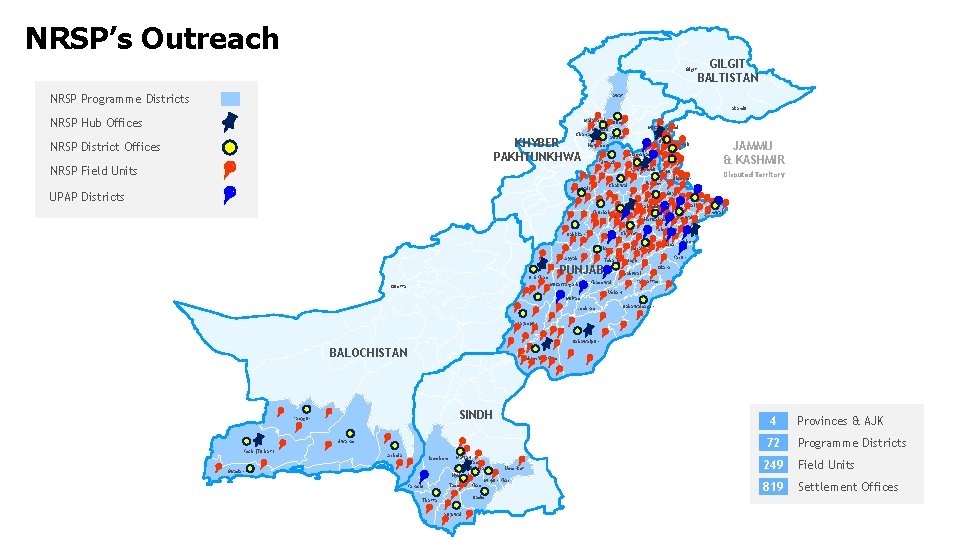
NRSP’s Outreach Gilgit NRSP Programme Districts GILGIT BALTISTAN Swat Skardu NRSP Hub Offices Malakand Buner Mardan Charsadda KHYBER PAKHTUNKHWA NRSP District Offices NRSP Field Units Swabi Muzaffarabad Bagh Haveli Poonch Sudhnuti Islamabad Nowshera Attock JAMMU & KASHMIR Kotli Rawalpindi Chakwal Mianwali UPAP Districts Mirpur Bhimber Jhelum Gujrat Mandi Bahuddin Khushab Sargodha Jhang Layyah Quetta Faisalabad Sahiwal Khanewal Narowal Sheikhupura Nankana Lahore Kasur Toba Tek Singh PUNJAB Muzaffargarh Sialkot Hafizabad Gujranwala Chiniot Bahkkar DG Khan Disputed Territory Okara Pakpattan Vehari Multan Lodhran Bahawalnagar Rajanpur Bahawalpur BALOCHISTAN Rahim Yar Khan SINDH Panjgur Awaran Kech (Turbat) Gwadar Lasbela Jamshoro Matiari Tando Allah Yar Umerkot Hyderabad Mirpur Khas Tando M. Khan Karachi Badin Thatta Sujawal 4 Provinces & AJK 72 Programme Districts 249 Field Units 819 Settlement Offices
Organization Structure of NRSP
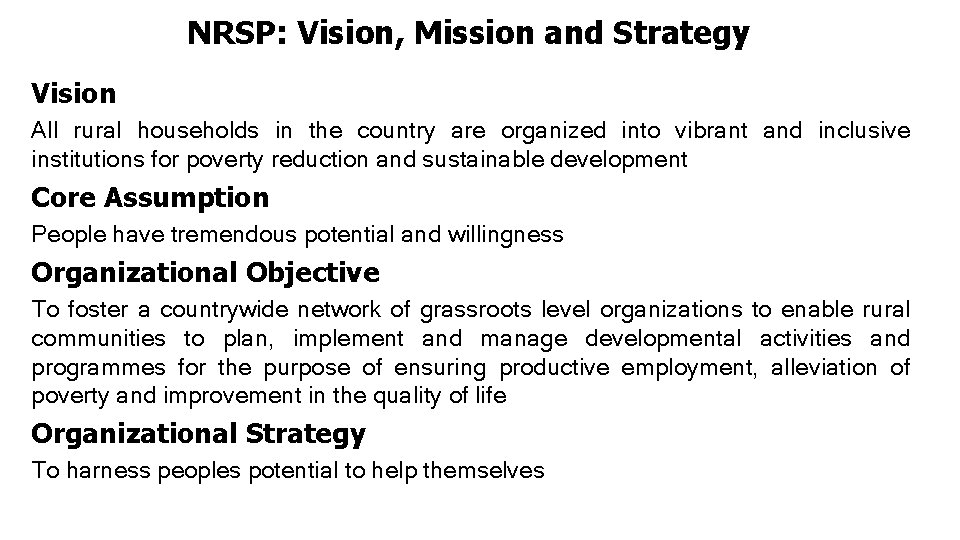
NRSP: Vision, Mission and Strategy Vision All rural households in the country are organized into vibrant and inclusive institutions for poverty reduction and sustainable development Core Assumption People have tremendous potential and willingness Organizational Objective To foster a countrywide network of grassroots level organizations to enable rural communities to plan, implement and manage developmental activities and programmes for the purpose of ensuring productive employment, alleviation of poverty and improvement in the quality of life Organizational Strategy To harness peoples potential to help themselves
Steps and Processes to undertake Development § Situational Analysis and Poverty Assessment § Offering partnership to community specially the poor through a series of Programme dialogues § Organize willing communities at settlement/mohalla level as Community Organizations (COs) for pooling of resources, cutting down overheads, achieving economies of scale etc § The COs federate at Village level into Village Organizations (VOs) and VOs federate at Union Council levels as Local Support Organizations(LSOs) § Identify true and genuine Activists and Community Resource Persons (CRPs) from amongst the community. It is only they who can harness the potential of the people not outsiders
Steps and Processes to undertake Development (Conti. . . ) § Identify and prioritize what people are willing to undertake in terms of opportunities and needs but not demands (Micro Investment Plans, Village Development Plans) § Undertake feasibility of identified opportunities and needs in terms of peoples capacity, willingness, equity, sustainability, availability and requirement of resources § Facilitate the flow of required resources to the community; and § Monitor, lobby and establish linkages between communities and other development agencies, such as government departments and donors
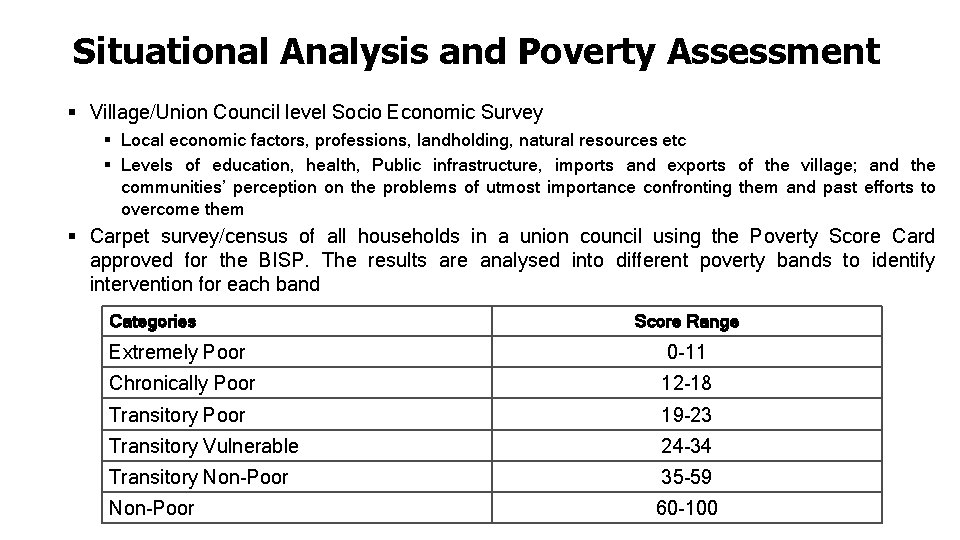
Situational Analysis and Poverty Assessment § Village/Union Council level Socio Economic Survey § Local economic factors, professions, landholding, natural resources etc § Levels of education, health, Public infrastructure, imports and exports of the village; and the communities’ perception on the problems of utmost importance confronting them and past efforts to overcome them § Carpet survey/census of all households in a union council using the Poverty Score Card approved for the BISP. The results are analysed into different poverty bands to identify intervention for each band Categories Score Range Extremely Poor 0 -11 Chronically Poor 12 -18 Transitory Poor 19 -23 Transitory Vulnerable 24 -34 Transitory Non-Poor 35 -59 Non-Poor 60 -100
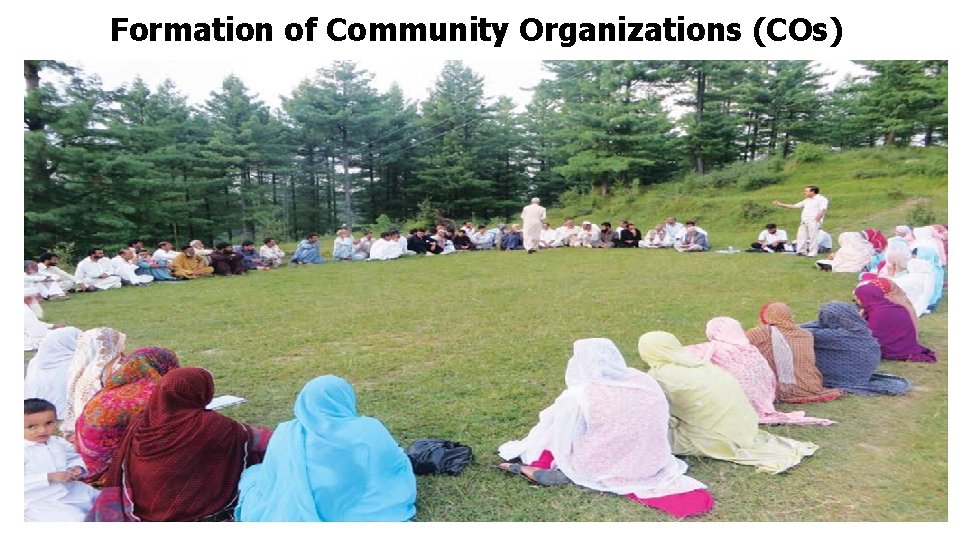
Formation of Community Organizations (COs)
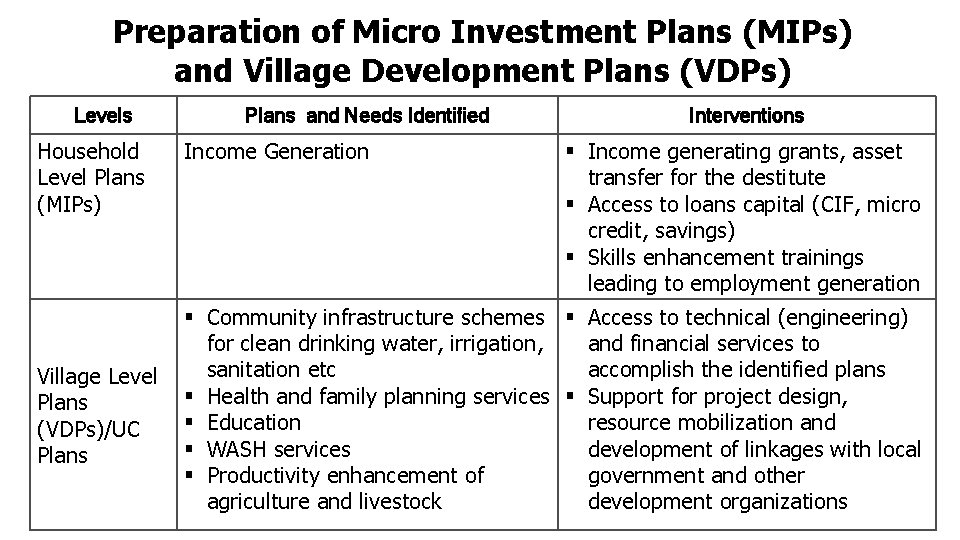
Preparation of Micro Investment Plans (MIPs) and Village Development Plans (VDPs) Levels Household Level Plans (MIPs) Village Level Plans (VDPs)/UC Plans and Needs Identified Income Generation Interventions § Income generating grants, asset transfer for the destitute § Access to loans capital (CIF, micro credit, savings) § Skills enhancement trainings leading to employment generation § Community infrastructure schemes § Access to technical (engineering) for clean drinking water, irrigation, and financial services to sanitation etc accomplish the identified plans § Health and family planning services § Support for project design, § Education resource mobilization and § WASH services development of linkages with local § Productivity enhancement of government and other agriculture and livestock development organizations
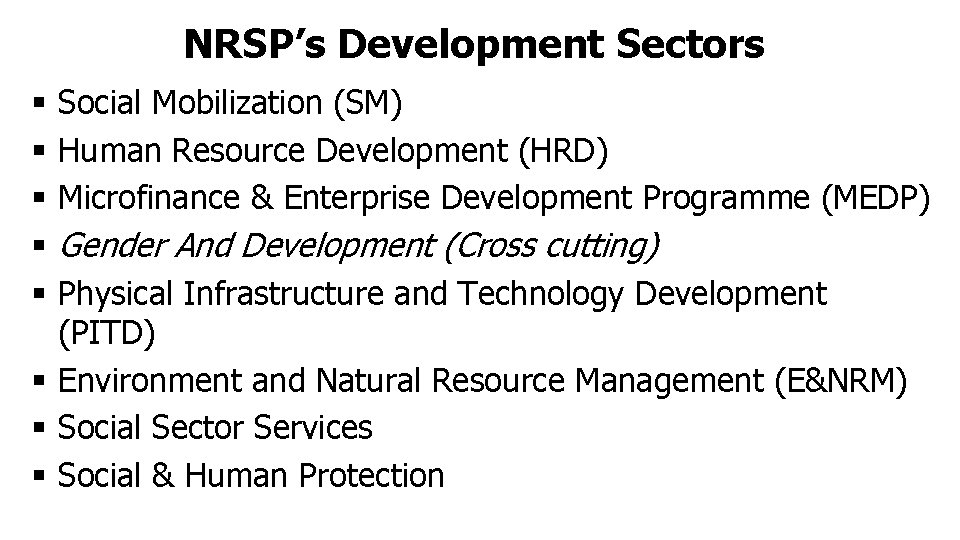
NRSP’s Development Sectors § § § Social Mobilization (SM) Human Resource Development (HRD) Microfinance & Enterprise Development Programme (MEDP) Gender And Development (Cross cutting) Physical Infrastructure and Technology Development (PITD) § Environment and Natural Resource Management (E&NRM) § Social Sector Services § Social & Human Protection
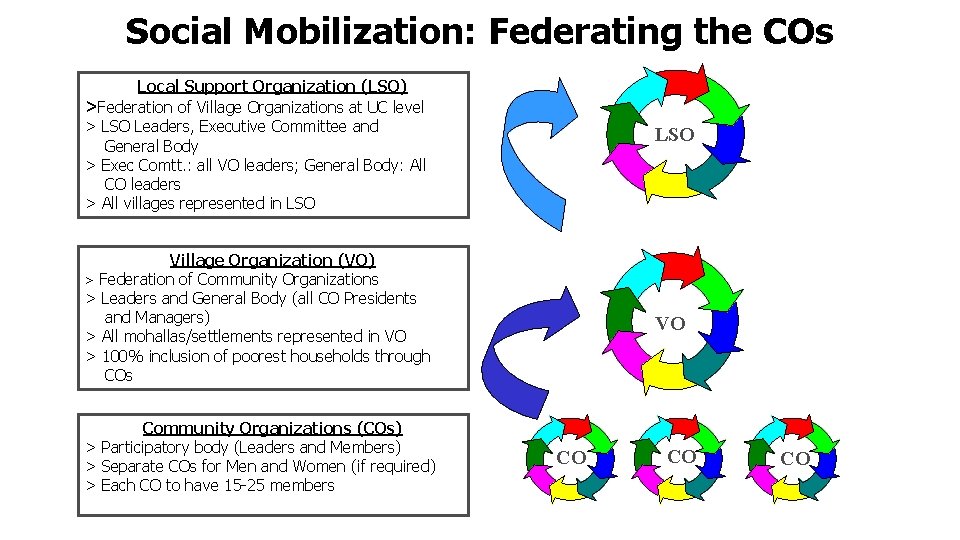
Social Mobilization: Federating the COs Local Support Organization (LSO) >Federation of Village Organizations at UC level > LSO Leaders, Executive Committee and General Body > Exec Comtt. : all VO leaders; General Body: All CO leaders > All villages represented in LSO Village Organization (VO) > Federation of Community Organizations > Leaders and General Body (all CO Presidents and Managers) > All mohallas/settlements represented in VO > 100% inclusion of poorest households through COs Community Organizations (COs) > Participatory body (Leaders and Members) > Separate COs for Men and Women (if required) > Each CO to have 15 -25 members VO CO CO CO
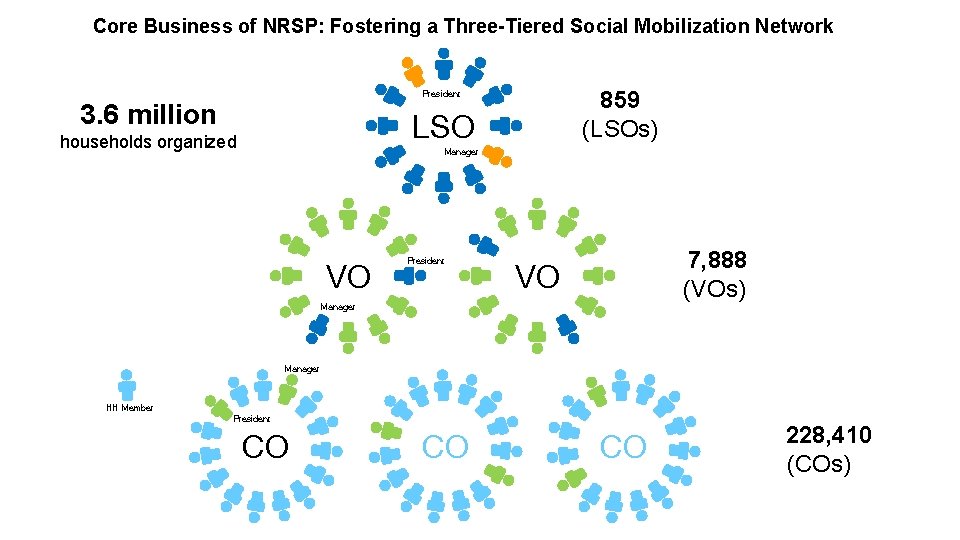
Core Business of NRSP: Fostering a Three-Tiered Social Mobilization Network 859 (LSOs) President 3. 6 million LSO households organized Manager VO President 7, 888 (VOs) VO Manager HH Member President CO CO CO 228, 410 (COs)
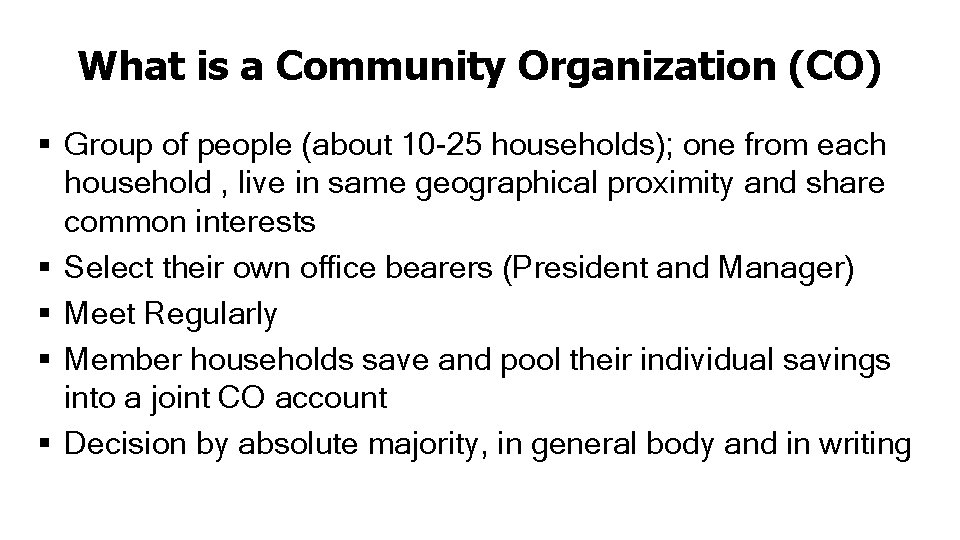
What is a Community Organization (CO) § Group of people (about 10 -25 households); one from each household , live in same geographical proximity and share common interests § Select their own office bearers (President and Manager) § Meet Regularly § Member households save and pool their individual savings into a joint CO account § Decision by absolute majority, in general body and in writing
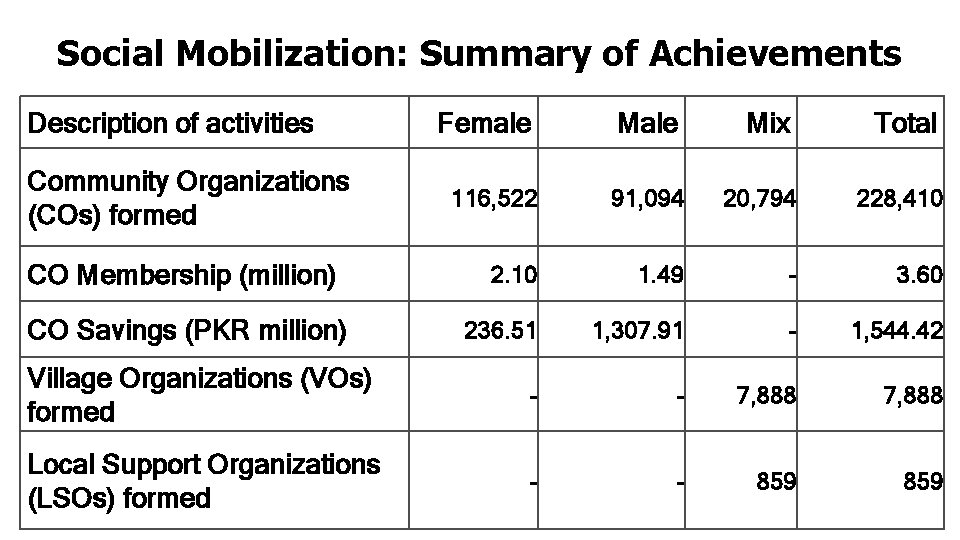
Social Mobilization: Summary of Achievements Description of activities Female Mix Total 116, 522 91, 094 20, 794 228, 410 2. 10 1. 49 - 3. 60 236. 51 1, 307. 91 - 1, 544. 42 Village Organizations (VOs) formed - - 7, 888 Local Support Organizations (LSOs) formed - - 859 Community Organizations (COs) formed CO Membership (million) CO Savings (PKR million)
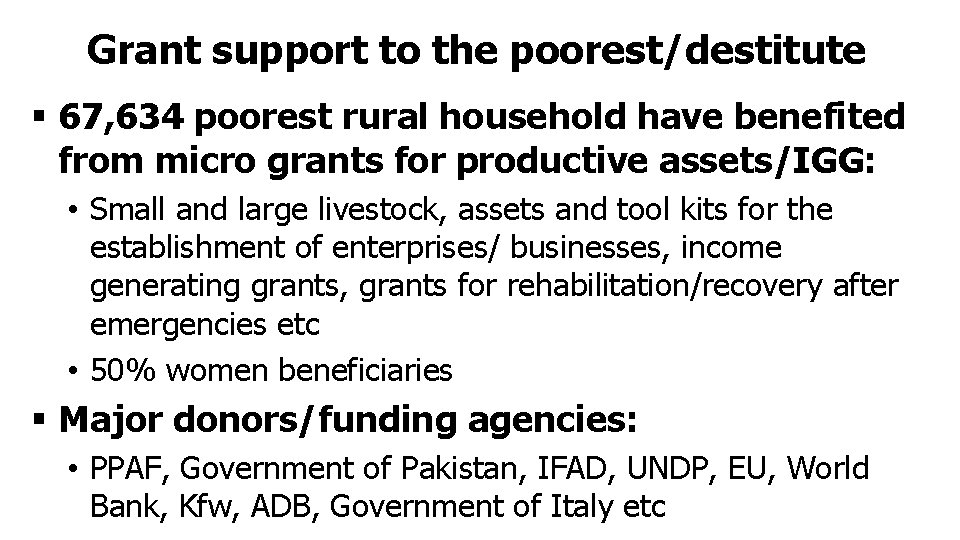
Grant support to the poorest/destitute § 67, 634 poorest rural household have benefited from micro grants for productive assets/IGG: • Small and large livestock, assets and tool kits for the establishment of enterprises/ businesses, income generating grants, grants for rehabilitation/recovery after emergencies etc • 50% women beneficiaries § Major donors/funding agencies: • PPAF, Government of Pakistan, IFAD, UNDP, EU, World Bank, Kfw, ADB, Government of Italy etc
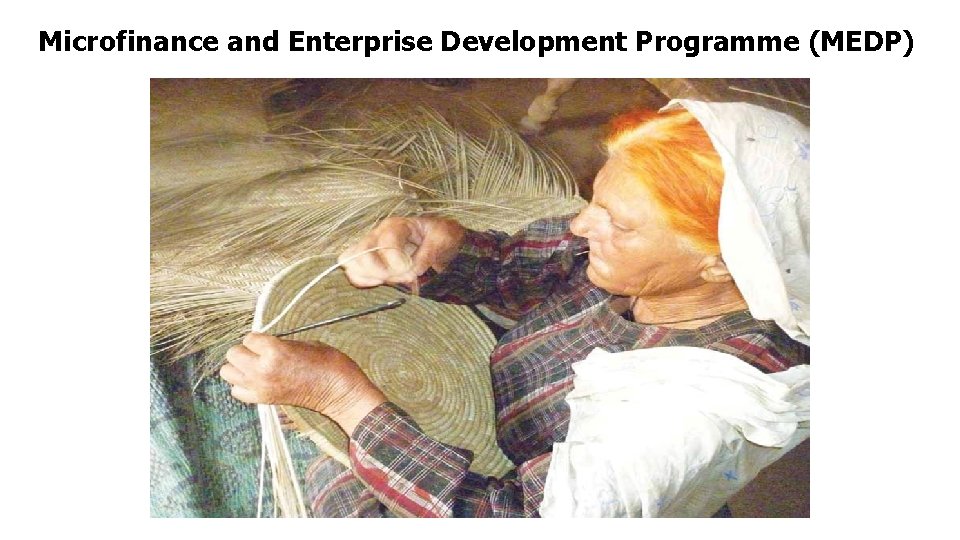
Microfinance and Enterprise Development Programme (MEDP)
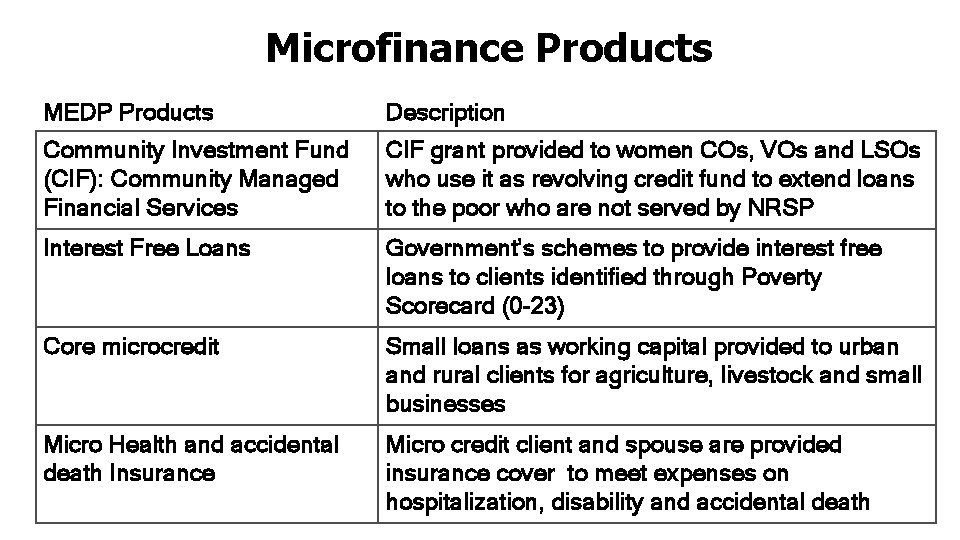
Microfinance Products MEDP Products Description Community Investment Fund (CIF): Community Managed Financial Services CIF grant provided to women COs, VOs and LSOs who use it as revolving credit fund to extend loans to the poor who are not served by NRSP Interest Free Loans Government’s schemes to provide interest free loans to clients identified through Poverty Scorecard (0 -23) Core microcredit Small loans as working capital provided to urban and rural clients for agriculture, livestock and small businesses Micro Health and accidental death Insurance Micro credit client and spouse are provided insurance cover to meet expenses on hospitalization, disability and accidental death
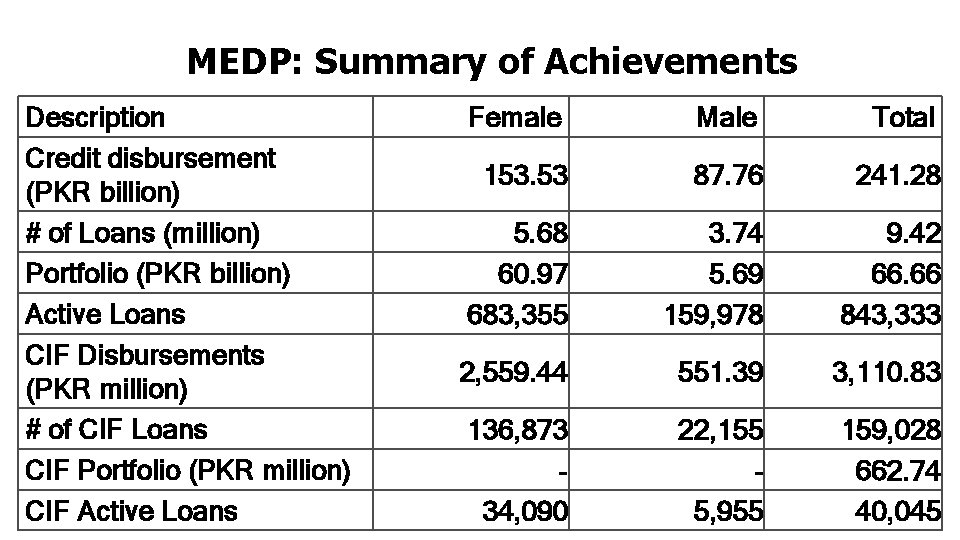
MEDP: Summary of Achievements Description Credit disbursement (PKR billion) # of Loans (million) Portfolio (PKR billion) Active Loans CIF Disbursements (PKR million) # of CIF Loans CIF Portfolio (PKR million) CIF Active Loans Female Male Total 153. 53 87. 76 241. 28 5. 68 60. 97 683, 355 3. 74 5. 69 159, 978 9. 42 66. 66 843, 333 2, 559. 44 551. 39 3, 110. 83 136, 873 34, 090 22, 155 5, 955 159, 028 662. 74 40, 045
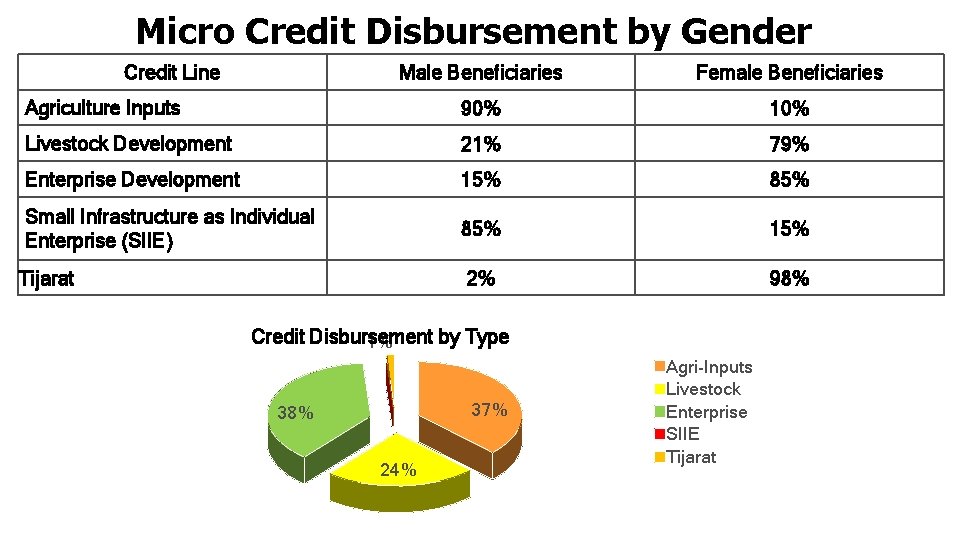
Micro Credit Disbursement by Gender Credit Line Male Beneficiaries Female Beneficiaries Agriculture Inputs 90% 10% Livestock Development 21% 79% Enterprise Development 15% 85% Small Infrastructure as Individual Enterprise (SIIE) 85% 15% 2% 98% Tijarat Credit Disbursement by Type 1% 0% 37% 38% 24% Agri-Inputs Livestock Enterprise SIIE Tijarat
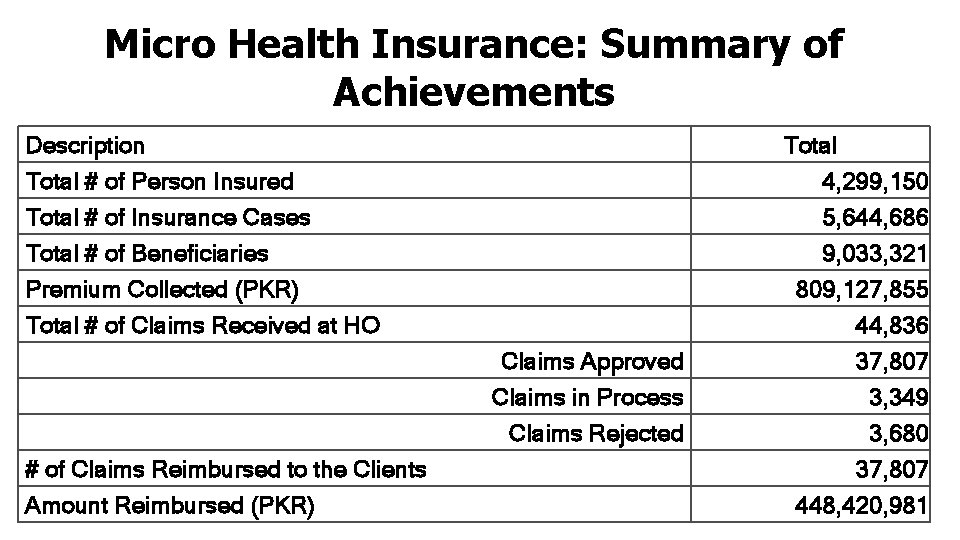
Micro Health Insurance: Summary of Achievements Description Total # of Person Insured Total # of Insurance Cases Total # of Beneficiaries Total Premium Collected (PKR) Total # of Claims Received at HO Claims Approved Claims in Process Claims Rejected # of Claims Reimbursed to the Clients Amount Reimbursed (PKR) 4, 299, 150 5, 644, 686 9, 033, 321 809, 127, 855 44, 836 37, 807 3, 349 3, 680 37, 807 448, 420, 981
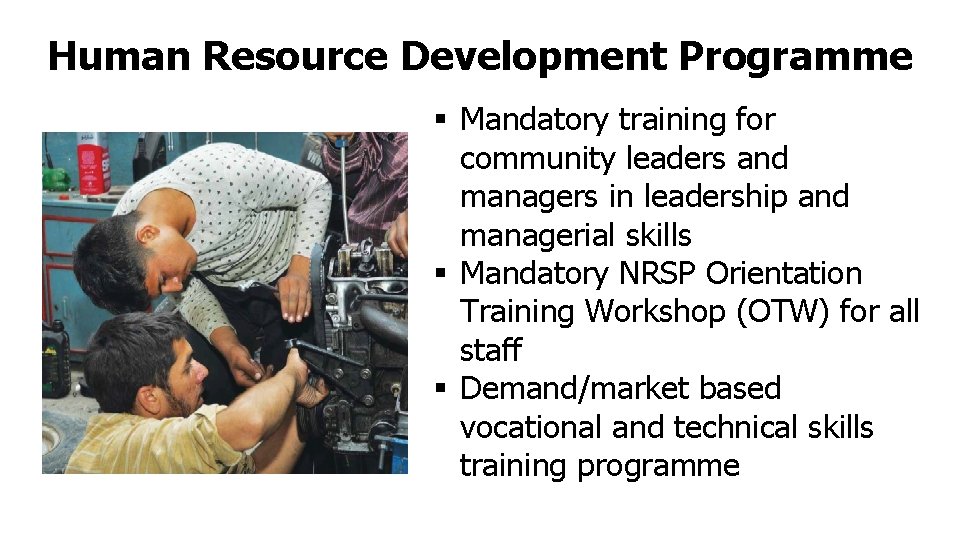
Human Resource Development Programme § Mandatory training for community leaders and managers in leadership and managerial skills § Mandatory NRSP Orientation Training Workshop (OTW) for all staff § Demand/market based vocational and technical skills training programme
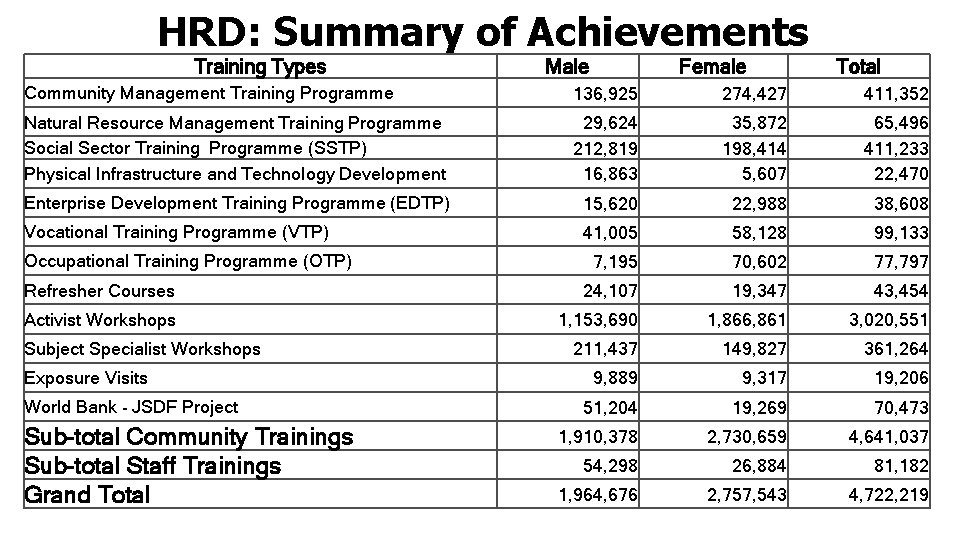
HRD: Summary of Achievements Training Types Male Female Total Community Management Training Programme 136, 925 274, 427 411, 352 Natural Resource Management Training Programme Social Sector Training Programme (SSTP) Physical Infrastructure and Technology Development 29, 624 212, 819 16, 863 35, 872 198, 414 5, 607 65, 496 411, 233 22, 470 Enterprise Development Training Programme (EDTP) 15, 620 22, 988 38, 608 Vocational Training Programme (VTP) 41, 005 58, 128 99, 133 7, 195 70, 602 77, 797 Refresher Courses 24, 107 19, 347 43, 454 Activist Workshops 1, 153, 690 1, 866, 861 3, 020, 551 211, 437 149, 827 361, 264 9, 889 9, 317 19, 206 51, 204 19, 269 70, 473 1, 910, 378 2, 730, 659 4, 641, 037 54, 298 26, 884 81, 182 1, 964, 676 2, 757, 543 4, 722, 219 Occupational Training Programme (OTP) Subject Specialist Workshops Exposure Visits World Bank - JSDF Project Sub-total Community Trainings Sub-total Staff Trainings Grand Total
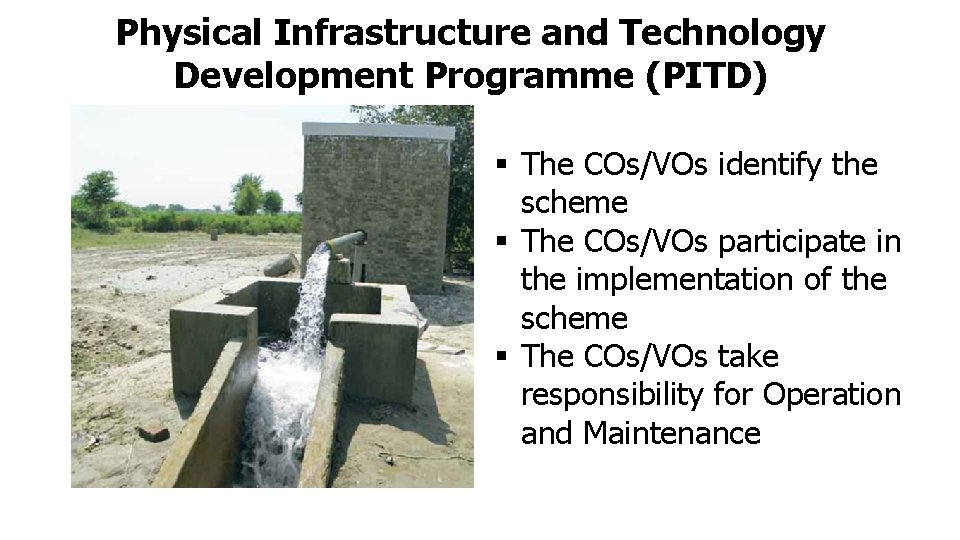
Physical Infrastructure and Technology Development Programme (PITD) § The COs/VOs identify the scheme § The COs/VOs participate in the implementation of the scheme § The COs/VOs take responsibility for Operation and Maintenance
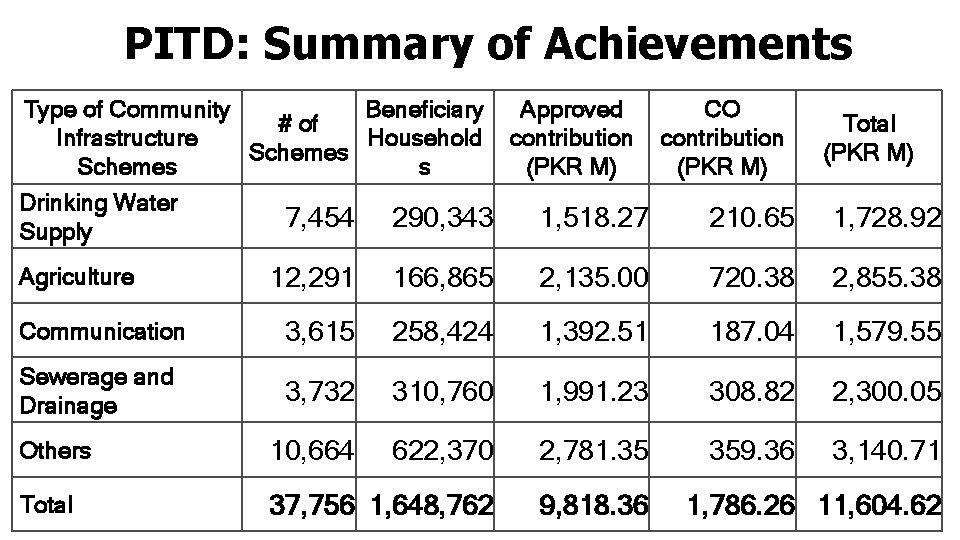
PITD: Summary of Achievements Type of Community Beneficiary Approved CO # of Infrastructure Household contribution Schemes s (PKR M) Drinking Water 7, 454 290, 343 1, 518. 27 210. 65 Supply Total (PKR M) 1, 728. 92 12, 291 166, 865 2, 135. 00 720. 38 2, 855. 38 Communication 3, 615 258, 424 1, 392. 51 187. 04 1, 579. 55 Sewerage and Drainage 3, 732 310, 760 1, 991. 23 308. 82 2, 300. 05 Others 10, 664 622, 370 2, 781. 35 359. 36 3, 140. 71 Total 37, 756 1, 648, 762 9, 818. 36 Agriculture 1, 786. 26 11, 604. 62
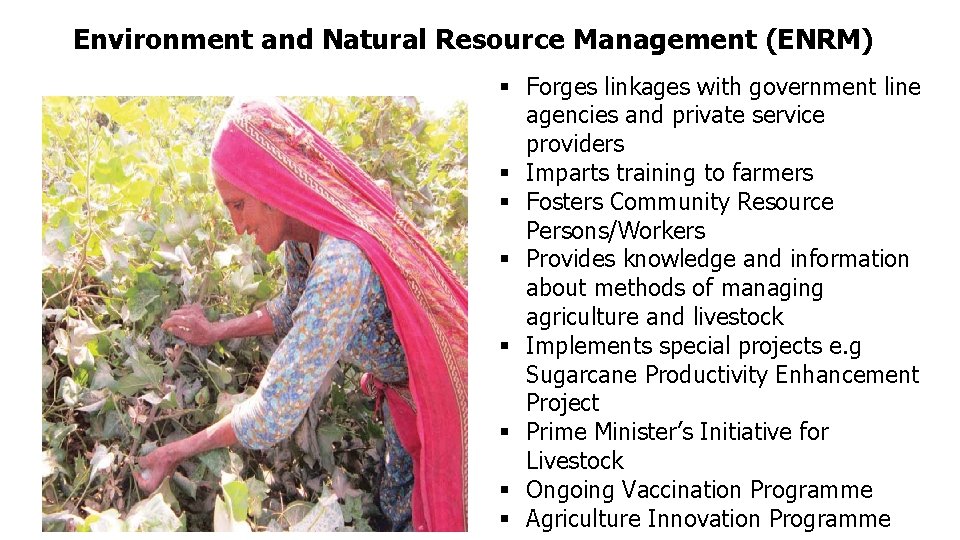
Environment and Natural Resource Management (ENRM) § Forges linkages with government line agencies and private service providers § Imparts training to farmers § Fosters Community Resource Persons/Workers § Provides knowledge and information about methods of managing agriculture and livestock § Implements special projects e. g Sugarcane Productivity Enhancement Project § Prime Minister’s Initiative for Livestock § Ongoing Vaccination Programme § Agriculture Innovation Programme
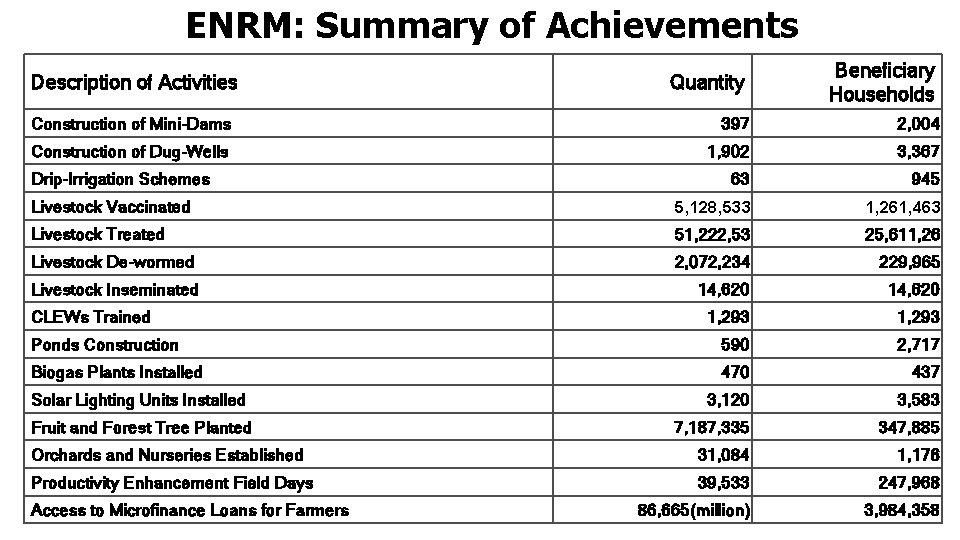
ENRM: Summary of Achievements Description of Activities Quantity Beneficiary Households Construction of Mini-Dams 397 2, 004 Construction of Dug-Wells 1, 902 3, 367 63 945 Livestock Vaccinated 5, 128, 533 1, 261, 463 Livestock Treated 51, 222, 53 25, 611, 26 Livestock De-wormed 2, 072, 234 229, 965 Livestock Inseminated 14, 620 1, 293 Ponds Construction 590 2, 717 Biogas Plants Installed 470 437 3, 120 3, 583 7, 187, 335 347, 885 Orchards and Nurseries Established 31, 084 1, 176 Productivity Enhancement Field Days 39, 533 247, 968 86, 665(million) 3, 984, 358 Drip-Irrigation Schemes CLEWs Trained Solar Lighting Units Installed Fruit and Forest Tree Planted Access to Microfinance Loans for Farmers
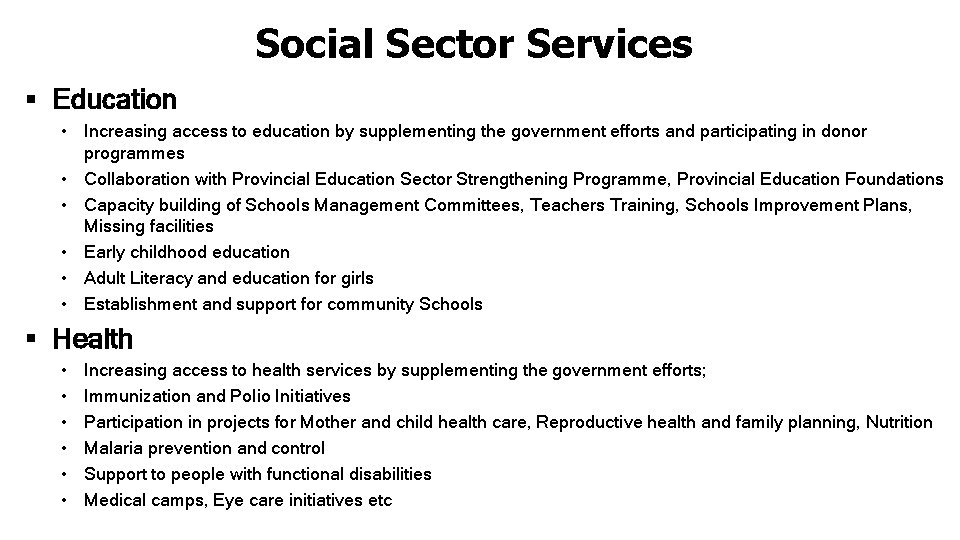
Social Sector Services § Education • Increasing access to education by supplementing the government efforts and participating in donor programmes • Collaboration with Provincial Education Sector Strengthening Programme, Provincial Education Foundations • Capacity building of Schools Management Committees, Teachers Training, Schools Improvement Plans, Missing facilities • Early childhood education • Adult Literacy and education for girls • Establishment and support for community Schools § Health • • • Increasing access to health services by supplementing the government efforts; Immunization and Polio Initiatives Participation in projects for Mother and child health care, Reproductive health and family planning, Nutrition Malaria prevention and control Support to people with functional disabilities Medical camps, Eye care initiatives etc
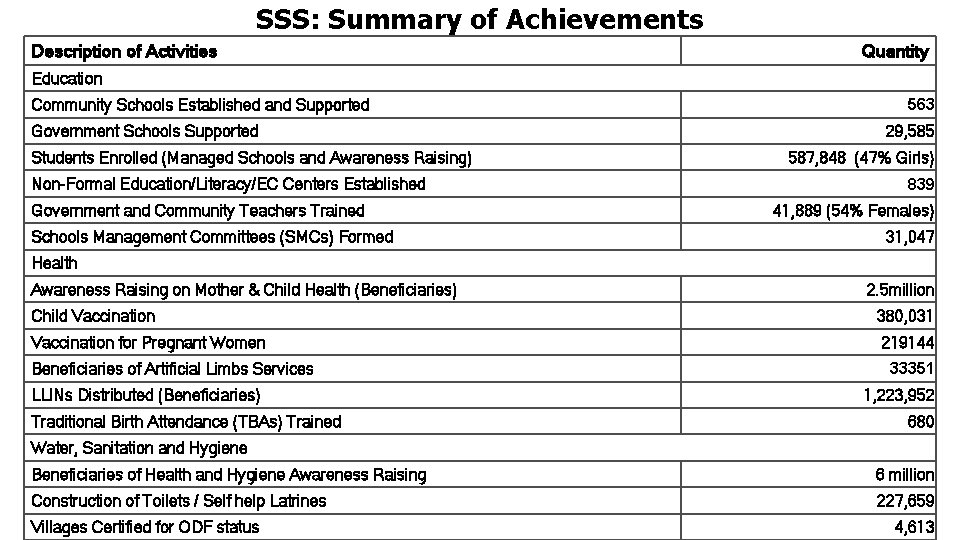
SSS: Summary of Achievements Description of Activities Quantity Education Community Schools Established and Supported Government Schools Supported Students Enrolled (Managed Schools and Awareness Raising) Non-Formal Education/Literacy/EC Centers Established Government and Community Teachers Trained Schools Management Committees (SMCs) Formed 563 29, 585 587, 848 (47% Girls) 839 41, 889 (54% Females) 31, 047 Health Awareness Raising on Mother & Child Health (Beneficiaries) 2. 5 million Child Vaccination 380, 031 Vaccination for Pregnant Women 219144 Beneficiaries of Artificial Limbs Services LLINs Distributed (Beneficiaries) Traditional Birth Attendance (TBAs) Trained 33351 1, 223, 952 680 Water, Sanitation and Hygiene Beneficiaries of Health and Hygiene Awareness Raising 6 million Construction of Toilets / Self help Latrines 227, 659 Villages Certified for ODF status 4, 613
Major Contracts/Projects § § § A major Partner Organization (PO) of the Pakistan Poverty Alleviation Fund (PPAF) (funding Go. P, World Bank, IFAD, KFW, Italian Fund) since year 2000 USAID Small Grants and Ambassador’s Fund (SGAFP) Union Council and Community Economic Strengthening Support (SUCCESS) Programme in Sindh (EU) Balochistan Rural Development Community Empowerment Programme (BRDCEP) UCBPRP in Sindh IFAD/Provincial Governments projects Gwadar/Lasbella Livelihood Support Project (GLLSP), Southern Punjab Poverty Alleviation Programme (SPPAP) funded projects, Barani Village Development mobilization expertise in the specific issues of the rain-fed areas of Punjab Asian Development Bank/Provincial Government funded Dera Ghazi Khan Rural Development Project, Agriculture Component of Swabi Scarp Project building NRSP’s capacity for working in poor and remote districts of southern Punjab, Sustainable Livelihoods in Barani Areas Project (SLBAP), Sindh Coastal Community Development Project (SCCDP) National Poverty Scorecard Survey for BISP National Poverty Graduation Programme in Sindh and Punjab Prime Minister’s Special Initiative for Livestock Project Education/Health Projects with provincial departments, USAID, UNICEF, World Bank, DFID etc Disaster Management and Response projects with various donors
NRSP as Relief, Rehabilitation and Reconstruction Organization § Preparing communities for disaster risks assessment and management § Participation in rescue efforts with government agencies § Participation in relief efforts in collaboration with local communities, donors and governments § Special projects for recovery and rehabilitation § Reconstruction of houses and local infrastructure (over 40, 000 houses)
Existing Oversight Mechanism § NRSP has a 11 members Bo. D, including 3 Federal Secretaries as ex-officio Directors. Board meetings are held on a quarterly basis § External statutory Annual Audit: • Ernest & Young § Internal Audit • Internal Audit Department set up under the direct supervision of the Chairman Internal Audit Committee of the Board; • Secretary Finance member of the Audit Committee § Separate audit by donors for every project Institutional assessments by donors § Pre-award institutional assessments carried out by USAID and EU § Micro assessments done by UNDP, UNICEF, OXFAM and many other institutions
Systems in place and Financial Capacity § Manuals for Financial Management, Internal Audit, HR, Procurement, Social Mobilization, IT, Physical Infrastructure and Technology Development, Microfinance and Enterprise Development , MER and HRD § Strong IT section to design and maintain MIS § Policy guidelines and major approvals by Finance Committee and oversight by the Internal Audit Committee of the Board of Directors § Ability to access commercial credit lines § Over 500 Bank Accounts § Strong HRM and HRD system in place § Strong Procurement system in place § Projects Tracking Systems § Weekly, monthly, six monthly Programme Planning Meetings at all levels
NRSP as a Support Organization § Played its role for establishing and strengthening the following organizations/RSPs • • • Ghazi Barotha Taraqiati Idara (GBTI) Punjab Rural Support Programme (PRSP) Rural Support Programmes Network (RSPN) Khushhali Bank Sindh Rural Support Organisation (SRSO) § Support RSPs and other development organizations for the following • • Project design, operational management and M&E Selects sponsors Registration Recruitment and training of staff Corporate matters for initial period Financial management systems Support to establish IT systems

Thanks !
- Slides: 35