
National Quality Strategy Webinar Using Measurement for Quality
National Quality Strategy Webinar Using Measurement for Quality Improvement September 17, 2014
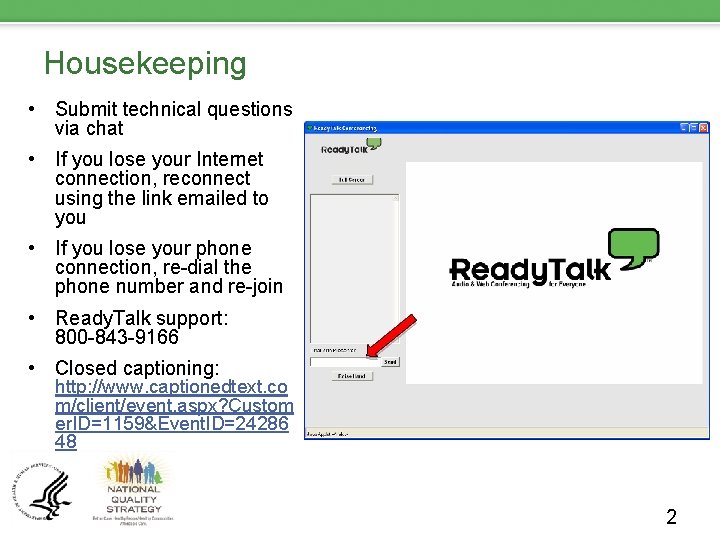
Housekeeping • Submit technical questions via chat • If you lose your Internet connection, reconnect using the link emailed to you • If you lose your phone connection, re-dial the phone number and re-join • Ready. Talk support: 800 -843 -9166 • Closed captioning: http: //www. captionedtext. co m/client/event. aspx? Custom er. ID=1159&Event. ID=24286 48 2
Agenda • Welcome Heather Plochman, Facilitator • Introduction to the National Quality Strategy Nancy Wilson, Executive Lead National Quality Strategy • Centers for Medicare & Medicaid Services Kate Goodrich, Director, Quality Measurement and Health Assessment Group • Office of the National Coordinator for Health Information Technology Kevin Larsen, Medical Director, Meaningful Use • Questions and Answers Presenters 3
The National Quality Strategy: Using Measurement for Quality Improvement Nancy Wilson, B. S. N. , M. D. , M. P. H. 4
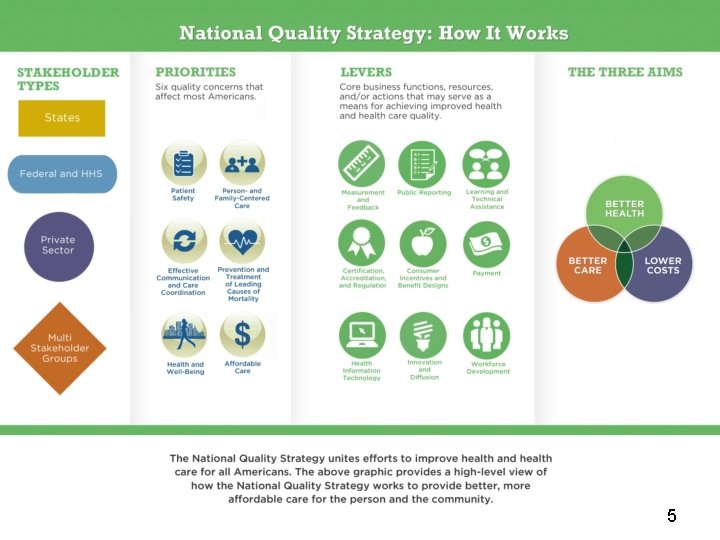
5
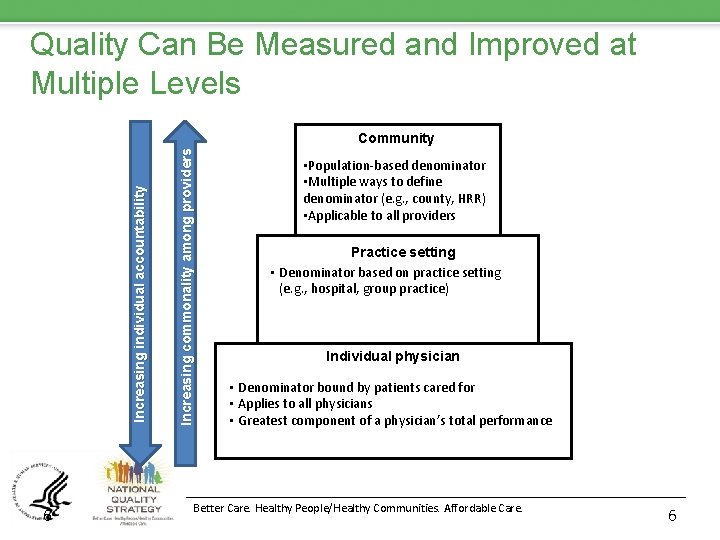
Quality Can Be Measured and Improved at Multiple Levels 6 Increasing commonality among providers Increasing individual accountability Community • Population-based denominator • Multiple ways to define denominator (e. g. , county, HRR) • Applicable to all providers Practice setting • Denominator based on practice setting (e. g. , hospital, group practice) Individual physician • Denominator bound by patients cared for • Applies to all physicians • Greatest component of a physician’s total performance Better Care. Healthy People/Healthy Communities. Affordable Care. 6
Rationale for Addressing Measure Proliferation • Proliferation of measures used by HHS Agencies for numerous programs and initiatives • Redundancies and overlaps leading to provider/data collector burden, conflicting results, inefficient use of HHS resources, and lost opportunities to drive improvement through reinforcing program use of key measures • No formal systematic mechanism to align, coordinate, and approve development, maintenance, implementation, and retirement of measures across HHS programs • Precedent work done by Million Hearts™, Partnership for Patients, internal CMS Quality Measures Task Force, and MU 2 7
HHS Measurement Policy Council (MPC) • Assembled in spring 2012 with membership representative across HHS Agencies • Establishes and operationalizes policies for HHS-wide measure development and implementation • Work to date has focused on: – Reviewing publicly available HHS Measures Inventory and tackling topics around nine measure areas – Developing a coordination plan for future measure development – Piloting rules for categorizing measures across the Federal Government and multi-stakeholder groups Better Care. Healthy People/Healthy Communities. Affordable Care. 8
MPC Guiding Principles • • Focus on measures and policies that maximize quality improvement, minimize provider burden, and allow for assessment of the health of populations Deliberately align with National Quality and Prevention Strategies (and others when relevant) Leverage lessons learned from related HHS and external activities Develop consensus on standard definitions for data components of measures as well as measures themselves Maintain a portfolio of easily accessed artifacts from MPC deliberations Recognize alignment may not always be appropriate, but document justification when this occurs Use Measure Applications Partnership (MAP) to measure selection criteria Better Care. Healthy People/Healthy Communities. Affordable Care. 9
MPC Scope of Work: Short-Term • To date, the Measurement Policy Council has reviewed and prioritized measures in nine major areas: – – – – – Hypertension Depression Smoking Cessation Hospital-Acquired Conditions Care Coordination (closing the referral loop) Patient Experience of Care HIV/AIDS Perinatal Obesity/BMI Better Care. Healthy People/Healthy Communities. Affordable Care. 10
MPC Scope of Work: Long-Term • Measure alignment – Develop criteria on when it is appropriate/not appropriate to align measures within HHS – Develop consensus on the measure aspects on which to align (concepts, specifications, data sources, etc. ) • New measure development and implementation – Implement strategic direction for future measurement priorities – Coordinate measure submissions to the MAP – Coordinate measure development contracts • Measurement policy/management – Manage measure domains – Identify measure selection, removal, and retirement criteria – Create core sets of measures Better Care. Healthy People/Healthy Communities. Affordable Care. 11
Kate Goodrich, M. D. , M. H. S. Director, Quality Measurement and Health Assessment Group Centers for Medicare & Medicaid Services 12
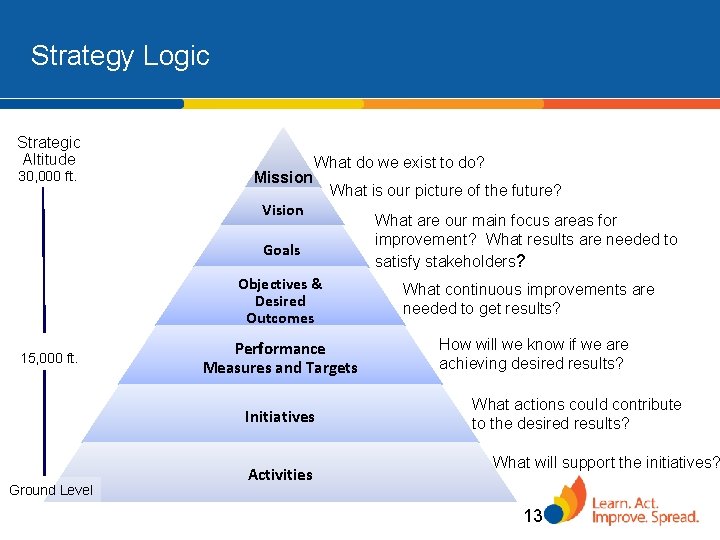
Strategy Logic Strategic Altitude 30, 000 ft. Mission What do we exist to do? What is our picture of the future? Vision Goals Objectives & Desired Outcomes 15, 000 ft. Performance Measures and Targets Initiatives Ground Level Activities What are our main focus areas for improvement? What results are needed to satisfy stakeholders? What continuous improvements are needed to get results? How will we know if we are achieving desired results? What actions could contribute to the desired results? What will support the initiatives? 13
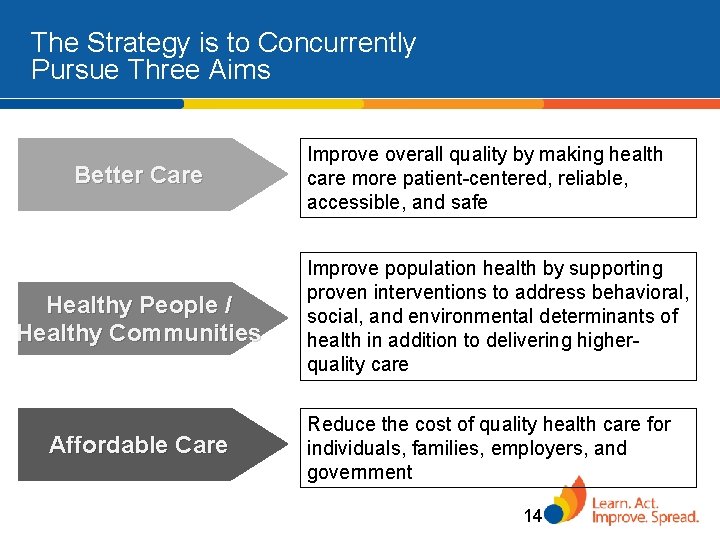
The Strategy is to Concurrently Pursue Three Aims Better Care Healthy People / Healthy Communities Affordable Care Improve overall quality by making health care more patient-centered, reliable, accessible, and safe Improve population health by supporting proven interventions to address behavioral, social, and environmental determinants of health in addition to delivering higherquality care Reduce the cost of quality health care for individuals, families, employers, and government 14
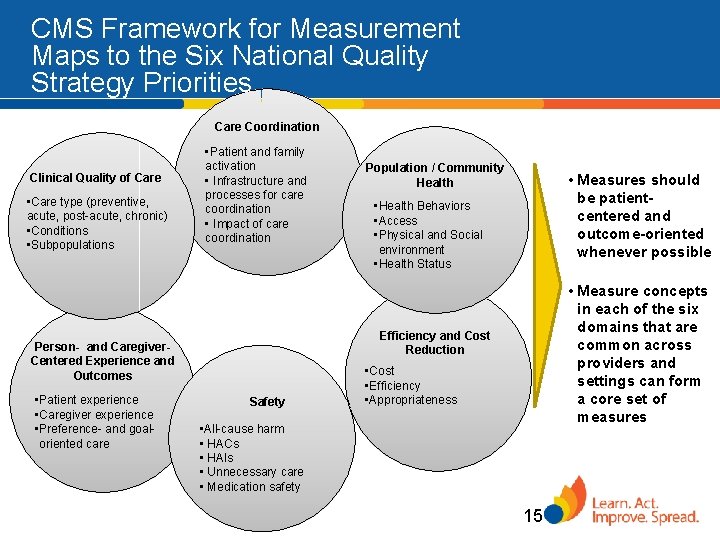
CMS Framework for Measurement Maps to the Six National Quality Strategy Priorities Care Coordination Clinical Quality of Care • Care type (preventive, acute, post-acute, chronic) • Conditions • Subpopulations • Patient and family activation • Infrastructure and processes for care coordination • Impact of care coordination • Measures should be patientcentered and outcome-oriented whenever possible • Health Behaviors • Access • Physical and Social environment • Health Status • Measure concepts in each of the six domains that are common across providers and settings can form a core set of measures Efficiency and Cost Reduction Person- and Caregiver. Centered Experience and Outcomes • Patient experience • Caregiver experience • Preference- and goaloriented care Population / Community Health Safety • Cost • Efficiency • Appropriateness • All-cause harm • HACs • HAIs • Unnecessary care • Medication safety 15
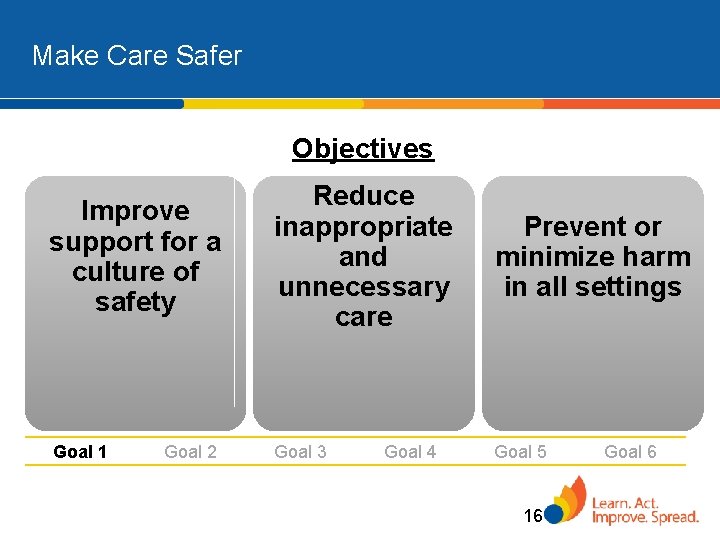
Make Care Safer Objectives Improve support for a culture of safety Reduce inappropriate and unnecessary care Prevent or minimize harm in all settings Goal 1 Goal 3 Goal 5 Goal 2 Goal 4 16 Goal 6
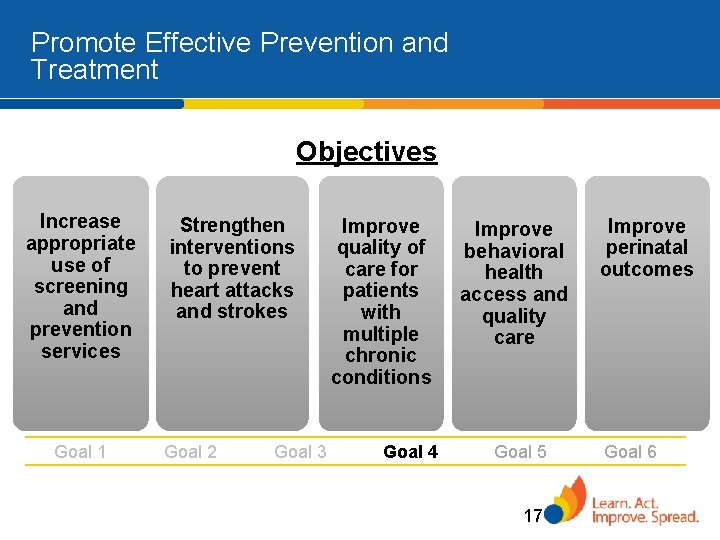
Promote Effective Prevention and Treatment Objectives Increase appropriate use of screening and prevention services Goal 1 Strengthen interventions to prevent heart attacks and strokes Goal 2 Goal 3 Improve quality of care for patients with multiple chronic conditions Goal 4 Improve behavioral health access and quality care Goal 5 17 Improve perinatal outcomes Goal 6
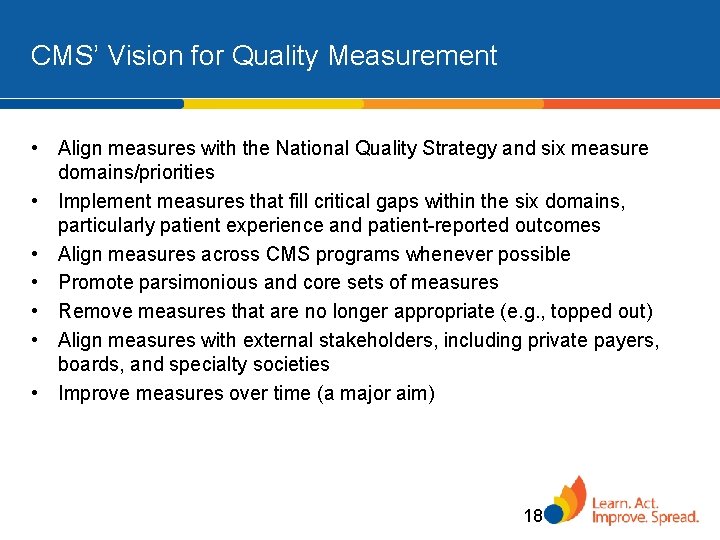
CMS’ Vision for Quality Measurement • Align measures with the National Quality Strategy and six measure domains/priorities • Implement measures that fill critical gaps within the six domains, particularly patient experience and patient-reported outcomes • Align measures across CMS programs whenever possible • Promote parsimonious and core sets of measures • Remove measures that are no longer appropriate (e. g. , topped out) • Align measures with external stakeholders, including private payers, boards, and specialty societies • Improve measures over time (a major aim) 18
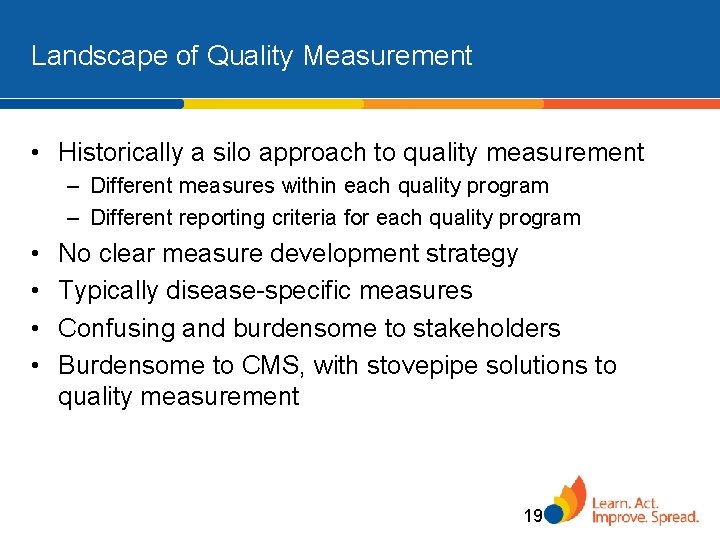
Landscape of Quality Measurement • Historically a silo approach to quality measurement – Different measures within each quality program – Different reporting criteria for each quality program • • No clear measure development strategy Typically disease-specific measures Confusing and burdensome to stakeholders Burdensome to CMS, with stovepipe solutions to quality measurement 19
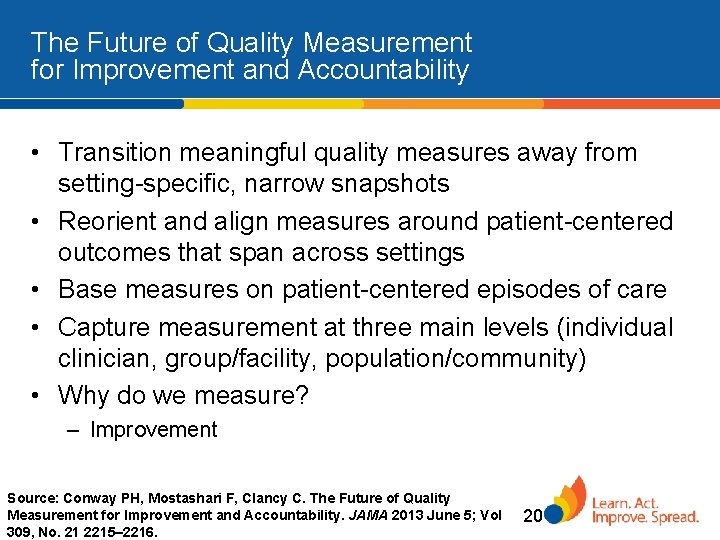
The Future of Quality Measurement for Improvement and Accountability • Transition meaningful quality measures away from setting-specific, narrow snapshots • Reorient and align measures around patient-centered outcomes that span across settings • Base measures on patient-centered episodes of care • Capture measurement at three main levels (individual clinician, group/facility, population/community) • Why do we measure? – Improvement Source: Conway PH, Mostashari F, Clancy C. The Future of Quality Measurement for Improvement and Accountability. JAMA 2013 June 5; Vol 309, No. 21 2215– 2216. 20
CMS Activities on Patient-Reported Outcome Measures (PROMs) • In 2012, CMS funded the NQF to develop guidance on development of PROMs • CMS currently uses a number of PROMs in our clinician reporting programs (e. g. , depression, functional status) • CMS and HHS are working to identify existing PROMs that can be rapidly incorporated into our quality reporting programs, including the ACO program and CMMI models • CMS and ONC are currently developing PROMs for the hospital and outpatient setting – Disease-specific functional status – General functional status • CMS now includes patients in all measure development work in order to understand the outcomes that are most important to patients and families 21
Kevin Larsen, M. D. , FACP Medical Director, Meaningful Use Office of the National Coordinator for Health Information Technology 22
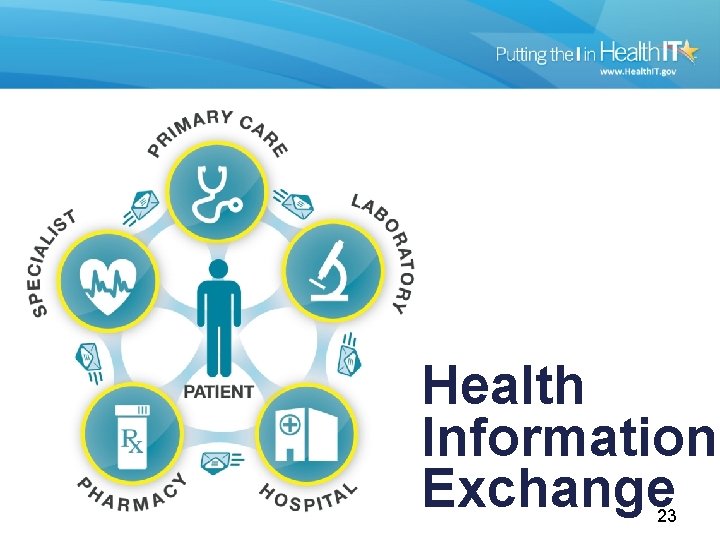
Health Information Exchange 23
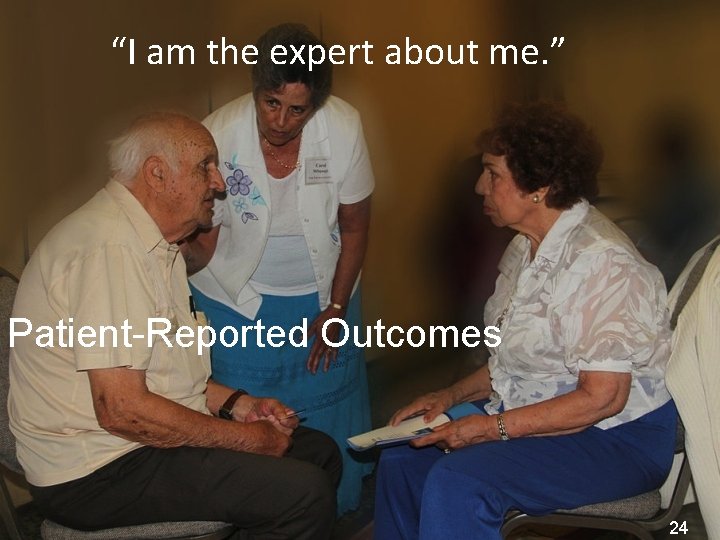
“I am the expert about me. ” Patient-Reported Outcomes 24
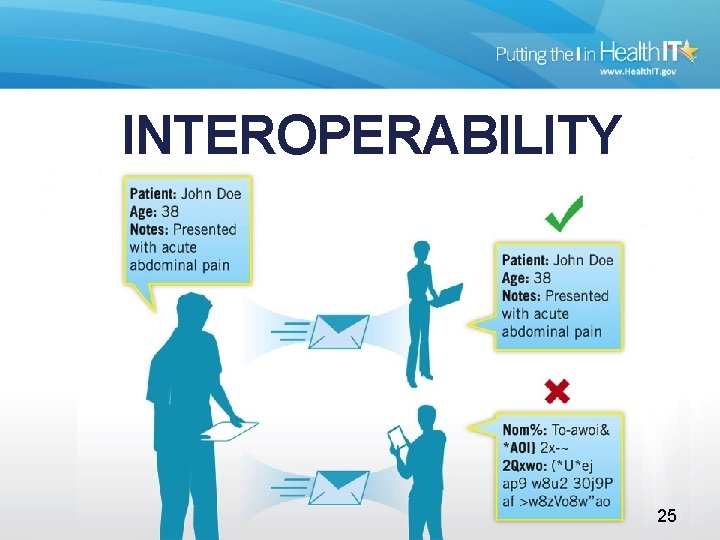
INTEROPERABILITY 25
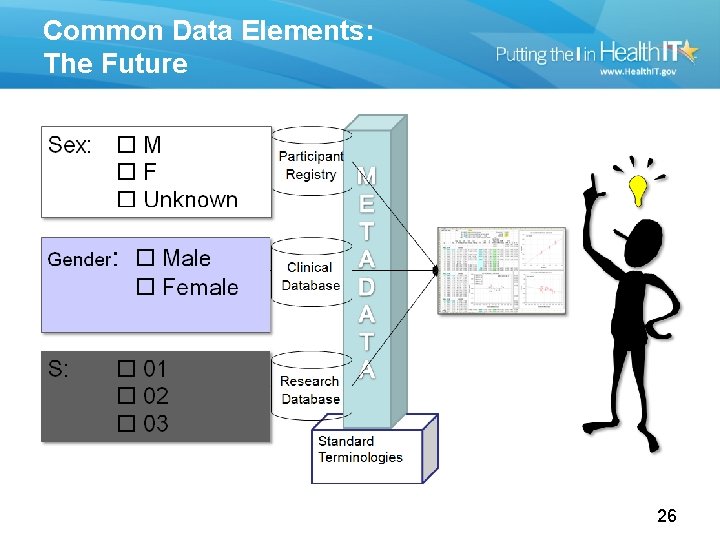
Common Data Elements: The Future A terminology based metadata solution frees data consumers from data interpretation 26
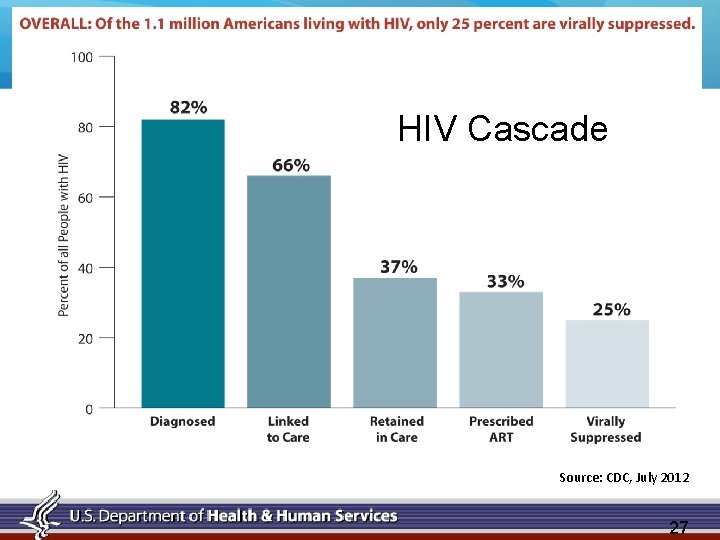
HIV Cascade Source: CDC, July 2012 27 27
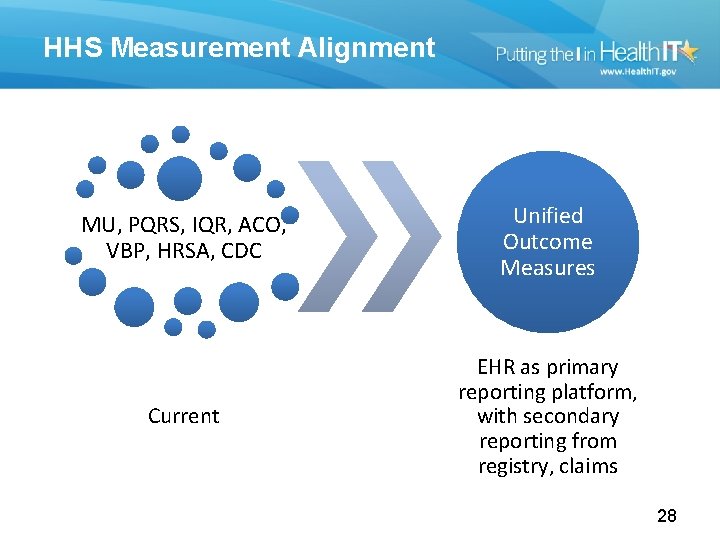
HHS Measurement Alignment MU, PQRS, IQR, ACO, VBP, HRSA, CDC Unified Outcome Measures Current EHR as primary reporting platform, with secondary reporting from registry, claims 28

Only those who provide care can improve care 29
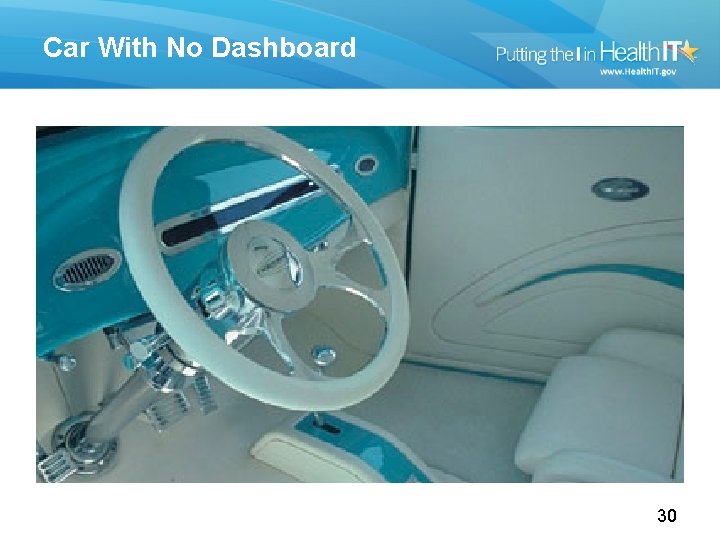
Car With No Dashboard 30
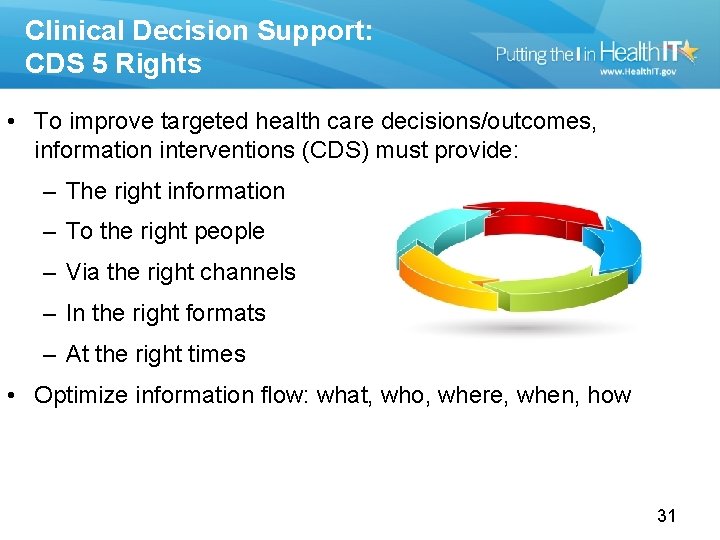
Clinical Decision Support: CDS 5 Rights • To improve targeted health care decisions/outcomes, information interventions (CDS) must provide: – The right information – To the right people – Via the right channels – In the right formats – At the right times • Optimize information flow: what, who, where, when, how 31
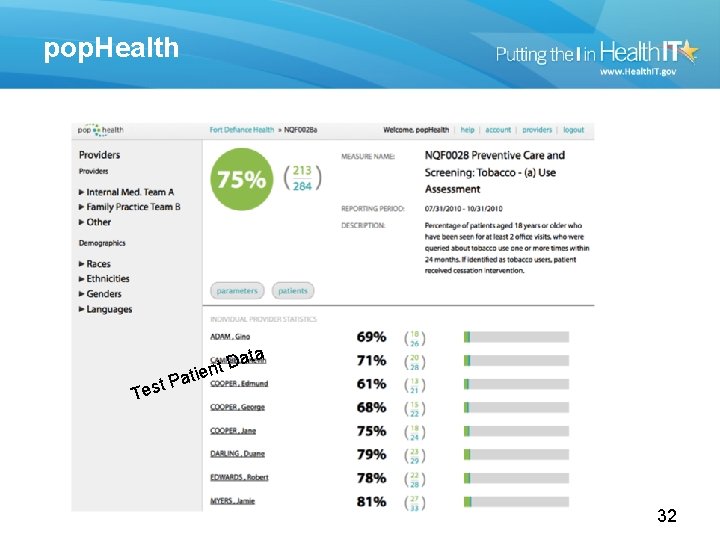
pop. Health t Tes Data t n e Pati 32
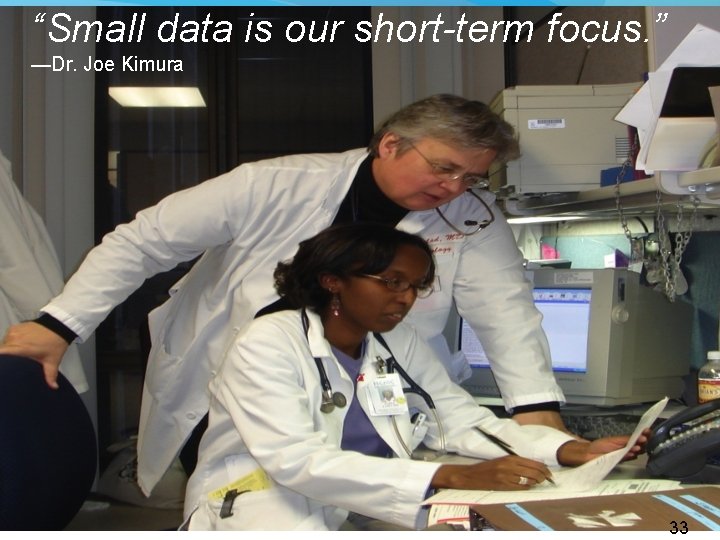
“Small data is our short-term focus. ” —Dr. Joe Kimura “Small Data is our short term focus” 33 33
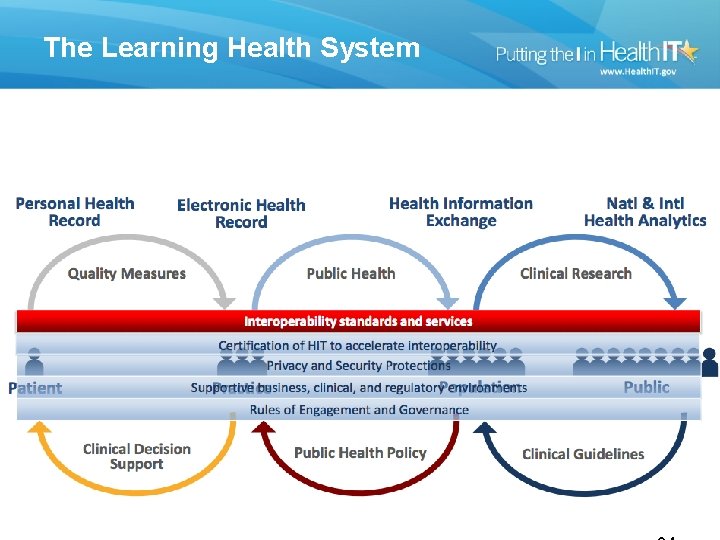
The Learning Health System
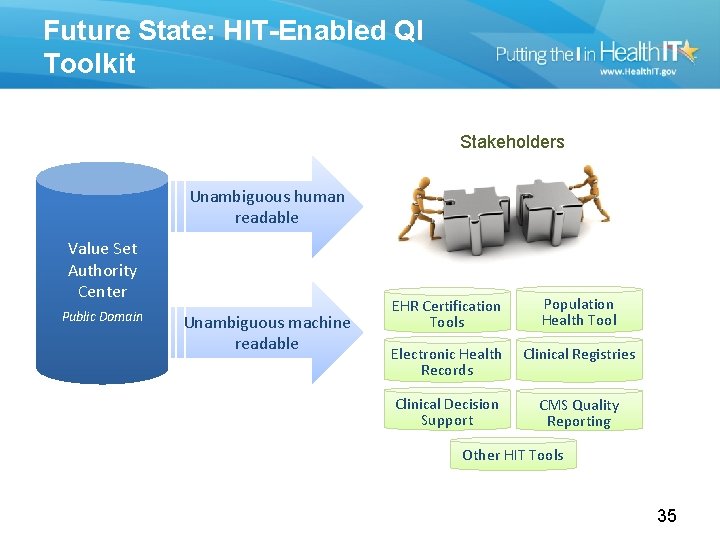
Future State: HIT-Enabled QI Toolkit Stakeholders Unambiguous human readable Value Set Authority Center Public Domain Unambiguous machine readable EHR Certification Tools Population Health Tool Electronic Health Records Clinical Registries Clinical Decision Support CMS Quality Reporting Other HIT Tools 35
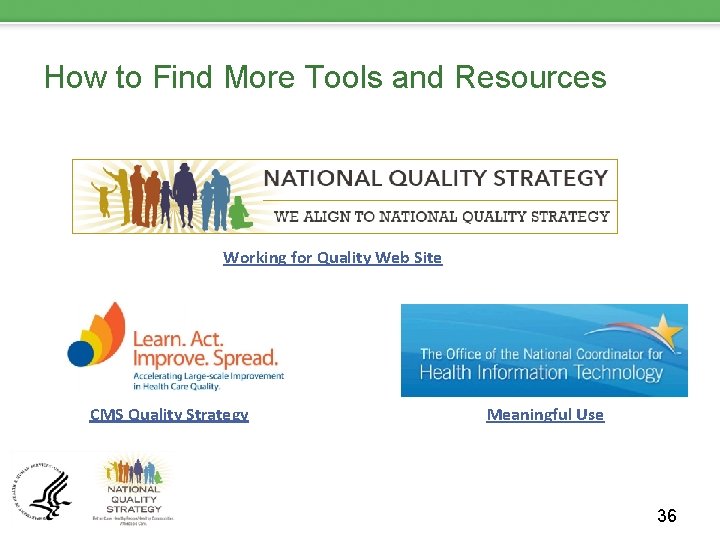
How to Find More Tools and Resources http: //www. ahrq. gov/workingforquality/ Working for Quality Web Site CMS Quality Strategy Meaningful Use 36

Questions and Answers Presenters 37
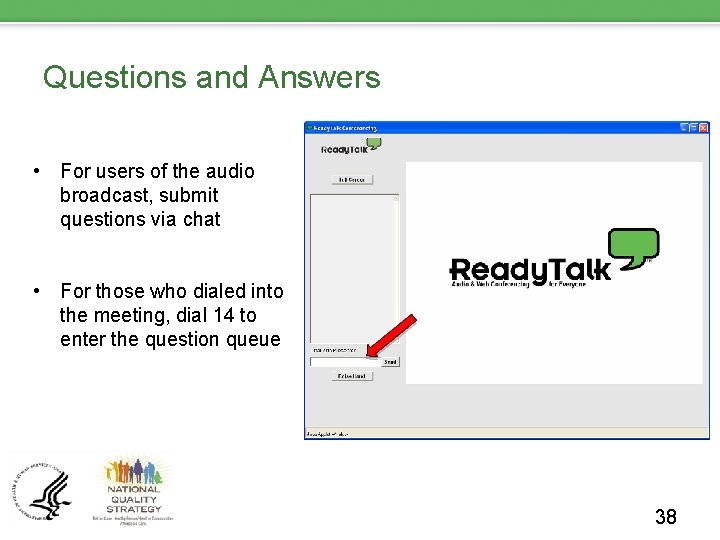
Questions and Answers • For users of the audio broadcast, submit questions via chat • For those who dialed into the meeting, dial 14 to enter the question queue 38
Thanks for attending today’s event The presentation archive will be available at www. ahrq. gov/workingforquality within 2 weeks 39
- Slides: 39