
National qualification framework in Bulgarian Higer Education policies

National qualification framework in Bulgarian Higer Education – policies and practicies Svetomira Kaloyanova Ministry of Education and Science Republic of Bulgaria
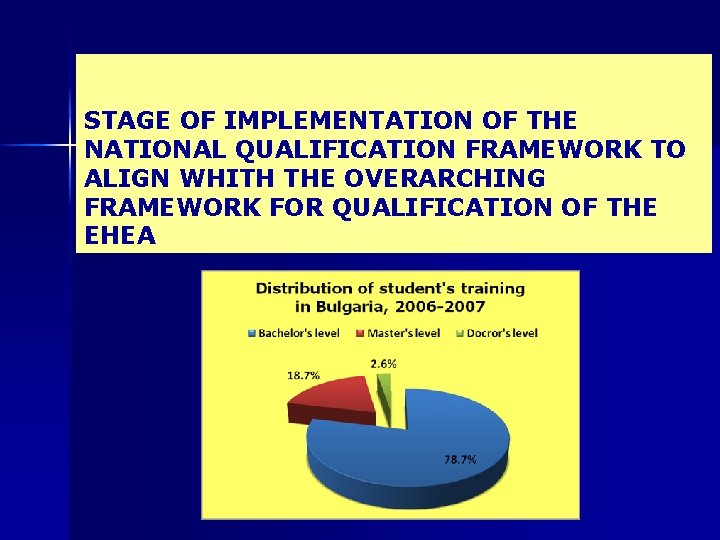
STAGE OF IMPLEMENTATION OF THE NATIONAL QUALIFICATION FRAMEWORK TO ALIGN WHITH THE OVERARCHING FRAMEWORK FOR QUALIFICATION OF THE EHEA

LEGISLATIVE REFORMS 1. Higher Education Act`s amendments; 2. Ordinance on state requirements for acquisition of higher education at bachelor, master and specialist degree; 3. The Ordinance on state requirements for admission and for training of doctorands; 4. Ordinances for acquisition of higher education in the specialties, which lead to practicing regulated professions, in compliance whit the Sectoral Directives of the EC; 5. The self-certification process in QA context; 6. Draft of new National Classifier of the Areas of the Higher Education and of the Professional Directions
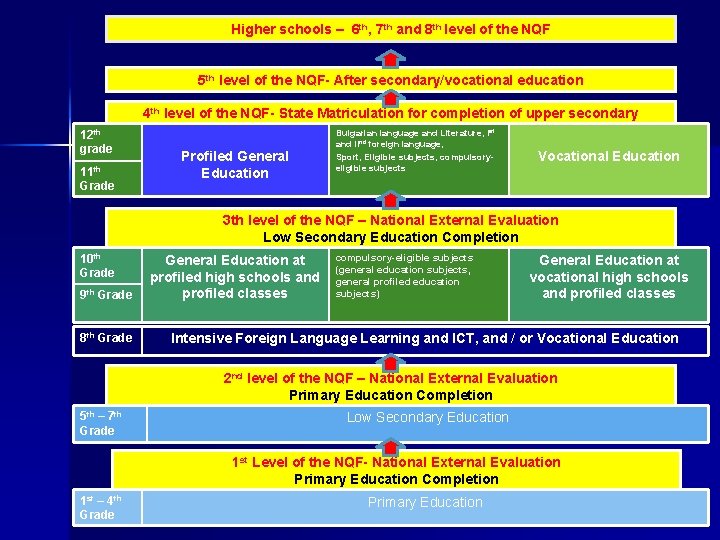
Higher schools – 6 th, 7 th and 8 th level of the NQF 5 th level of the NQF- After secondary/vocational education 12 th grade 11 th Grade 4 th level of the NQF- State Matriculation for completion of upper secondary education Bulgarian language and Literature, Ist Profiled General Education and IInd foreign language, Sport, Eligible subjects, compulsoryeligible subjects Vocational Education 3 th level of the NQF – National External Evaluation Low Secondary Education Completion 10 th Grade 9 th Grade 8 th Grade General Education at profiled high schools and profiled classes compulsory-eligible subjects (general education subjects, general profiled education subjects) General Education at vocational high schools and profiled classes Intensive Foreign Language Learning and ICT, and / or Vocational Education 2 nd level of the NQF – National External Evaluation Primary Education Completion 5 th – 7 th Grade Low Secondary Education 1 st Level of the NQF- National External Evaluation Primary Education Completion 1 st – 4 th Grade Primary Education
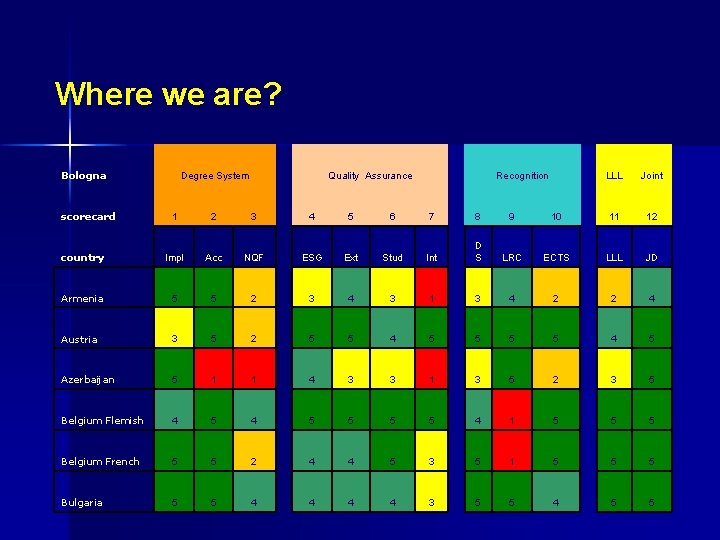
Where we are? Bologna scorecard Degree System Quality Assurance Recognition LLL Joint 1 2 3 4 5 6 7 8 9 10 11 12 country Impl Acc NQF ESG Ext Stud Int D S LRC ECTS LLL JD Armenia 5 5 2 3 4 3 1 3 4 2 2 4 Austria 3 5 2 5 5 4 5 Azerbaijan 5 1 1 4 3 3 1 3 5 2 3 5 Belgium Flemish 4 5 5 5 5 4 1 5 5 5 Belgium French 5 5 2 4 4 5 3 5 1 5 5 5 Bulgaria 5 5 4 4 3 5 5 4 5 5

ARRANGEMENTS FOR ACCESS • Between the first and second cycle. • Between the second and third cycle. • Opening up pathways to further higher education. • Flexibility whit respect to training methods.
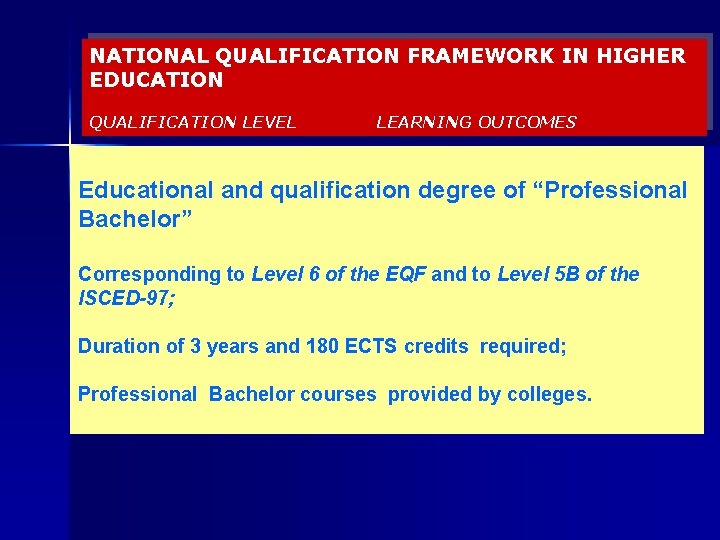
NATIONAL QUALIFICATION FRAMEWORK IN HIGHER EDUCATION QUALIFICATION LEVEL LEARNING OUTCOMES Educational and qualification degree of “Professional Bachelor” Corresponding to Level 6 of the EQF and to Level 5 B of the ISCED-97; Duration of 3 years and 180 ECTS credits required; Professional Bachelor courses provided by colleges.
NATIONAL QUALIFICATION FRAMEWORK IN HIGHER EDUCATION QUALIFICATION LEVEL LEARNING OUTCOMES Educational and qualification degree of“Bachelor” corresponding to Level 6 of the EQF and to Level 5 A of the ISCED-97 Duration of 4 years; Minimum 240 ECTS credits required; Bachelor courses are provided by HEIs.
NATIONAL QUALIFICATION FRAMEWORK IN HIGHER EDUCATION QUALIFICATION LEVEL LEARNING OUTCOMES Educational and qualification degree of “Master”, corresponding to Level 7 of the EQF and to Level 5 A of the ISCED-97 Duration of: 2 –year Master courses (120 ECTS credits required) after acquisition of “Professional Bachelor” degree; 1 -year Master courses (60 ECTS credits required) after acquisition of bachelor degree; 5 -year direct Master courses (300 ECTS credits required).
NATIONAL QUALIFICATION FRAMEWORK IN HIGHER EDUCATION QUALIFICATION LEVEL LEARNING OUTCOMES Educational and Scientific Degree of “Doctor”, corresponding to Level 8 of the EQF and to Level 7 of the ISCED-97 Duration of 3 years in regular and 4 years in extra-mural form of training; No educational credits awarded.

THANK YOU !
- Slides: 11