
National program for control of iodine deficiency disorders

- Slides: 11
National program for control of iodine deficiency disorders
Duties and responsibilities • Ministry of Health • Ministry of Industry • UNICEF
Situation analysis • 1992 survey showed that 41. 7% of childbearing age women had enlarged thyroid • 1993 survey indicated that 44% of primary school children and 51% of women had low urinary iodine
• Since 1993 a salt iodisation program started • Advocacy campaign were launched • Iodised salt distributed in food ration • Feeders were installed in salt factories • Potassium iodate (30 ton ) were procured by UNICEF on 2003 and 5 ton on 2007
• The program was supported by UNICEF in provision of KI. in addition in nineties most of salt producing factories were working so in nineties the house hold consumption of iodized salt was high. • Now Unicef stopped the provision of KI and most of salt producing factories closed for several factors that lead to sever decrease in house hold consumption of iodized salt.
Monitoring and evaluation • On 2003 a survey showed that the total number of salt factory was 60 and those with feeders were 45 • On 2009 total number of salt factory is • Monitoring and evaluation continue through supervision visits (at the production sites), at market and household level
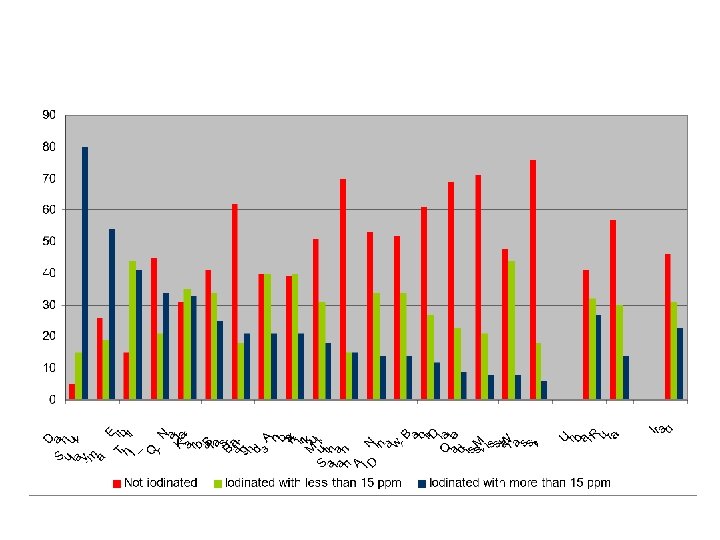
• Only 9% of salt available in markets locally produced • On 2009 the Iraqi specification for salt have been amended to be mandatory iodised (20 -80 PPM) • Only 22% of Iraqi families consume adequate iodised salt
Current and future view • • • Now there is no KI for different reasons in Iraqi market the most salt is imported and in study for assessment of Iraqi market salt we found that less than 40% of it is iodized. Now we work in 3 directions 1. Iraqi specification for salt have been amended to be mandatory iodised (20 -80 PPM). So we have to reinforce the health inspection to reach our goal by prevent the no iodized salt in Iraqi market. 2. work with MOI to import KI and distribute it to salt factories with hope to achieve that during 2010. 3. work with UNICEF to provide the program with KI at least for this year.
Test results of Iodised Salt used for cooking meals consumed by the household
Obstacles • • Security instability Lack of political commitment Insufficient data Monitoring and evaluation
Thank you