
NATIONAL OPERATIONS CENTRE FRAMEWORK 27 NOVEMBER 2020 1
NATIONAL OPERATIONS CENTRE: FRAMEWORK 27 NOVEMBER 2020 1
PURPOSE OF THE PRESENTATION To present to Management the draft National Operations Centre (NOC) Framework To solicit Management inputs for further enhancement To obtain Management concurrence and further directive on the draft Framework. 2
OUTLINE OF THE PRESENTATION • PROBLEM STATEMENT • STATEMENT OF INTENT REPORTING STRUCTURE OF OPERATIONS CENTRE • The National Operations Centre: Responsibilities • The Management Area Operations Centres: Responsibilities • The Local Operations Centres: Responsibilities INTERNAL AND EXTERNAL INFORMATION TRANSFER • Real-time collection, analysis and review • Reduced congestion in communication and approval channels • A communication channel • Creating a central office 3
OUTLINE OF THE PRESENTATION PROMINENT CONTINUOUS IMPROVEMENT TECHNIQUES • Total Quality Management • Kaizen • Six Sigma ü Information Flow And Reporting Lines ü Information Management ü Resourcing of the DCS Operation Centres ü Proposed Structure for NOC 4
PROBLEM STATEMENT • Department of Correctional Services (DCS), as with many South African Government Departments, struggle with a lack of modern technology and ICT infrastructure to better enable coordination and management from National level down to the service delivery level. • Information management and sharing are further hindered by concerns around the lack of competency at the service delivery level resulting in information quality issues, the absence of standardisation among the different regions and Management Areas as well as minimal consideration during system and process development. 5
PROBLEM STATEMENT… Unreliable and inconsistent data/information shared between the coalface level and management Endemic delays in accessing information, especially ‘real time’ information during emergency situations and for parliamentary reporting and media inquiry purposes Lack of an overarching and uniform structure that coordinates and integrates information throughout the correctional value chain in ways that assist and fasttrack decision-making 6
STATEMENT OF INTENT The Department of Correctional Services established the National Operations Centre at its Head Office with the intention to streamline and standardise the effective and timeous reporting of all operational information and also to provide readily accessible and ‘on-time’ dashboard information of the entire correctional environment. The National Operations Centre will be based primarily at national level (head office) and will have supporting operational service points at Regional, Management Area and Centre levels 7
NATIONAL OPERATIONS CENTRE RESPONSIBILITIES 8
NOC RESPONSIBILITIES Among others, the National Operation Centre (NOC) in terms of structure will fall directly under the National Commissioner (NC), providing a line of sight right down to Centres through real-time information access and must have the following responsibilities: • Develop and improve the information management system. • Oversee and regulate the MOC and LOC. • Draw information from all sources through the MOC at MA level and LOC at Centres as well as directly to NOC from external stakeholders, Centres of Excellence and Operations Management (OM). • Gather value-added info and analysis from Centres of Excellence; • Be the first alert of any incident taking place within DCS as well as relevant external incidents that may impact DCS. 9
NOC RESPONSIBILITIES CONT… • Provide verbal briefing of incidents to the relevant Centre of Excellence functionary or the OM delegate, followed up by written analysis and recommendations for the delegated authority to follow up with technical analysis and decide on response action. • Facilitate collaboration between strategic and operational functions and amongst the different Centres of Excellence. • Develop communication strategies and mediums for Centre of Excellence and Operations Management to communicate with external stakeholders, with the long-term strategic aim of continuous and fluent communication and inter-cluster and inter-governmental partnership development. • Provide an access point to all communication and information procurement and submission both internally and externally. 10
MANAGEMENT AREA OPERATIONS CENTRE RESPONSIBILITIES 11
MOC RESPONSIBILITIES Management Area Operation Centres (MOC) will sit parallel to Management Areas and be based at each Management Area; they will have the following responsibilities: • Draft gap-analysis and information reporting template adjustment requirements for Strategic Planning Monitoring and Evaluation (SPMM) at Head Office to implement, this will reduce unnecessary ad-hoc requests. • Provide a point of access to the information repository to MA level functions. • Conduct Monitoring and Evaluation (M&E )of LOCs. • Fast-track approval requests and requirements. • Monitor decision registers and performs preliminary risk assessments and analysis; and be the watch on ground level for the NOC. 12
LOCAL OPERATIONS CENTRE RESPONSIBILITIES 13
LOC RESPONSIBILITIES The Local Operation Centres (LOC) serves as an information-capturing and quality assurance hub at each Centre and feed in the information repository. Data sources must have direct uploading access to the information repository system; however, Centres lacking ICT infrastructure can be connected through a LAN (Internet) network to technologically capacitated LOCs which would then feed the data into the repository to enable real-time access throughout DCS, according to accessibility allocations. The LOC must have the following responsibilities: • Provide a point of access to the information repository to Centre Operations. • Fast-track approval requests and requirements. • Monitor and report on best practice proposals. • Be the watch dog on the ground level for the MOC. 14
OPERATIONS CENTRE DISASTER MANAGEMENT • Planning: develop disaster response plans & • • procedures Mitigation: conduct disaster prevention & contingency planning Preparedness: develop mechanisms for reporting & response Response: ensure dynamic & comprehensive response to disaster Recovery: Update disaster response plans & procedures 15
INTERNAL & EXTERNAL INFOR TRANSFER A centralised observatory or database of information based upon statistical, operational and strategic data must be collected and consolidated by the Decentralised Network Information Culture: • Real-time collection, analysis and review of information, which will lead to increased service delivery through continuous improvement and action; • Reduced congestion in communication and approval channels would lead to quicker reactions to unanticipated or forecasted problems; 16
INTERNAL & EXTERNAL INFOR TRANSFER • A communication channel which would serve as the foundation for short to medium-term automation of information management within DCS; and • Creating a central office MUST consolidate all DCS information: ü APP and non-APP reporting as well as ad-hoc information requests ; ü Any related news that impacts DCS internally or externally ; ü Incidents and threats that may affect DCS; ü Meeting readouts and decision registers regarding implementations at MA levels; ü Best practice initiatives. 17
PROMINENT CONTINUOUS IMPROVEMENT TECHNIQUES • Total Quality Management: aims to hold all parties involved in the production process accountable for the overall quality of the final product or service. • Kaizen: it is a continuous improvement framework that resolves process abnormalities in cross-functional teams. • Six Sigma: Six Sigma utilises statistics to reduce variation in a product or service line. 18
INFORMATION FLOW AND REPORTING LINES • In terms of information flow, core SDM functionaries • • within the Management Areas will retrieve data and insights from their respective centres for analysis and upwards reporting to the Centre of Excellence. The core SDM functionaries will receive technical support from the Centre of Excellence and translate it into operational initiatives to assist in improving service delivery in the Centres. They will also disseminate tools such as standards and procedures to the Centres. 19
INFORMATION MANAGEMENT • • Information Culture Data Acquisition Information Governance Data Management and Dissemination Disaster Management Lifecycle Management Data Technology and Security 20
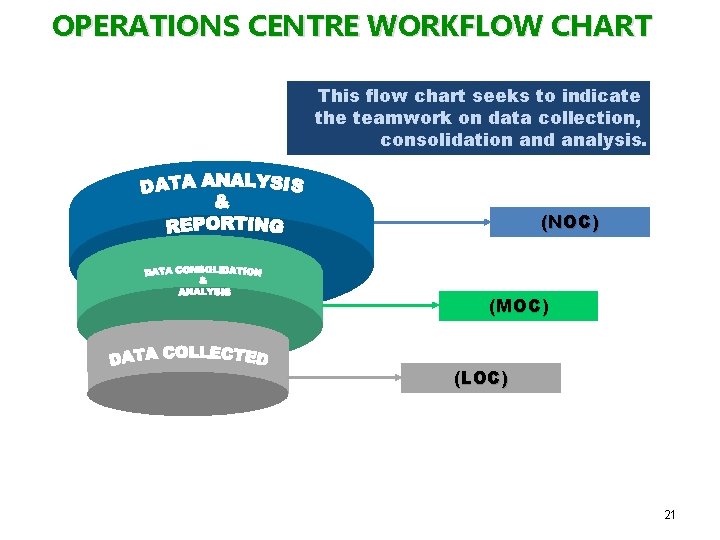
OPERATIONS CENTRE WORKFLOW CHART This flow chart seeks to indicate the teamwork on data collection, consolidation and analysis. (NOC) (MOC) (LOC) 21
RESOURCING OF THE DCS OPERATION CENTRES Key roles at the NOC: • Management of Staff • Management of Incidents • Management of Facilities • Public Communication Key role at the MOC: • Management of Incidents Key role at the LOC: • Collation of data 22
RESOURCING OF THE DCS OPERATION CENTRES A comprehensive Resource Plan should be developed to determine the quantities and quality of resources required to enable the Operation Centres to function optimally according to their respective levels: • Short term: human resources and information technology systems; • Medium term: work study to determine structures required at the MOC and LOC levels; • Long term: Implementation of the Comprehensive Resource Plan 23
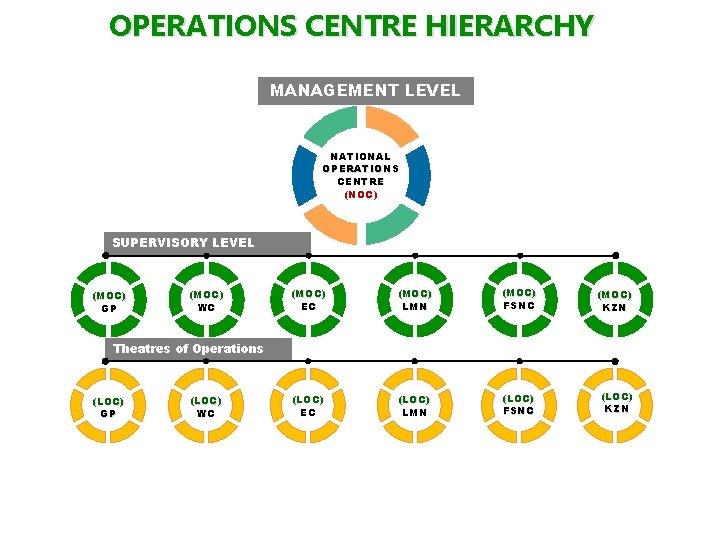
OPERATIONS CENTRE HIERARCHY MANAGEMENT LEVEL NATIONAL OPERATIONS CENTRE (NOC) SUPERVISORY LEVEL (MOC) GP (MOC) WC (MOC) EC (MOC) LMN (MOC) FSNC (MOC) KZN (LOC) EC (LOC) LMN (LOC) FSNC (LOC) KZN Theatres of Operations (LOC) GP (LOC) WC
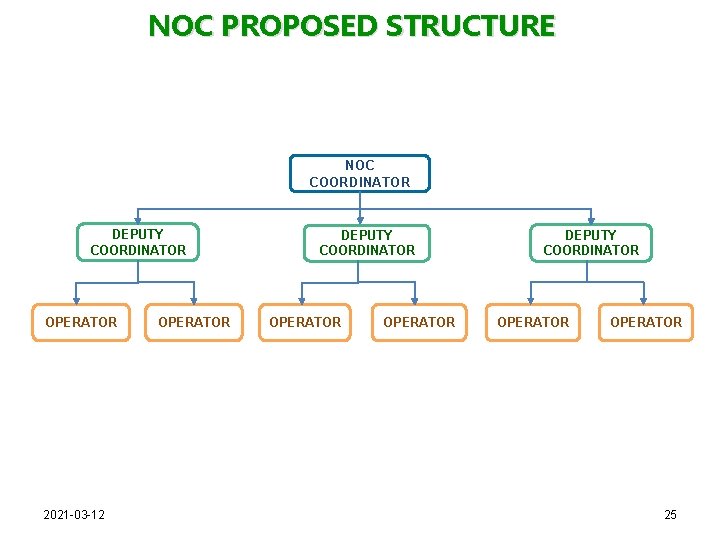
NOC PROPOSED STRUCTURE NOC COORDINATOR DEPUTY COORDINATOR OPERATOR 2021 -03 -12 OPERATOR DEPUTY COORDINATOR OPERATOR 25

Thank. You 26
- Slides: 26