
National Occupational Classification and Taxonomy Presentation by Labour
National Occupational Classification and Taxonomy Presentation by Labour Market Information Directorate Fall 2018
Revision Strategy � The NOC is reviewed jointly by Employment and Social Development Canada (ESDC) and Statistics Canada. � The objective of any revision is to ensure that the information of the NOC is accurate and current. � Research for NOC analysts involves (but is not limited to): Reviewing issues and classifying in order of priority; Conducting qualitative and quantitative research (including big data strategy) to provide a broad Canadian description of an occupation and; Discussion forum through Collaborative Workspace; Targeted consultations (e. g. professional associations, sectoral representatives); and Review comments and requests from different stakeholders.
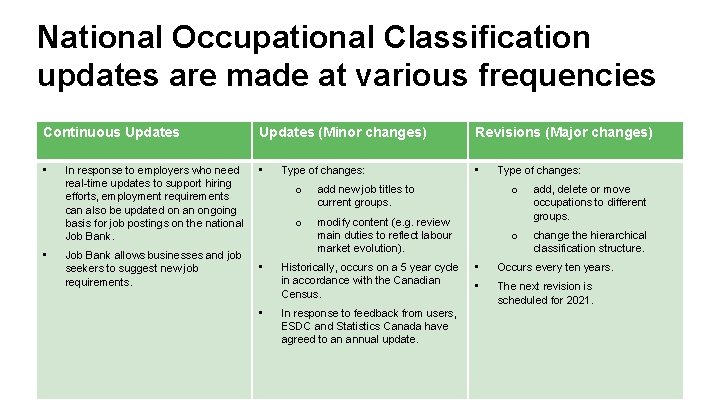
National Occupational Classification updates are made at various frequencies Continuous Updates (Minor changes) Revisions (Major changes) • • In response to employers who need real-time updates to support hiring efforts, employment requirements can also be updated on an ongoing basis for job postings on the national Job Bank allows businesses and job seekers to suggest new job requirements. • • Type of changes: o add new job titles to current groups. o modify content (e. g. review main duties to reflect labour market evolution). Historically, occurs on a 5 year cycle in accordance with the Canadian Census. In response to feedback from users, ESDC and Statistics Canada have agreed to an annual update. Type of changes: o add, delete or move occupations to different groups. o change the hierarchical classification structure. • Occurs every ten years. • The next revision is scheduled for 2021.
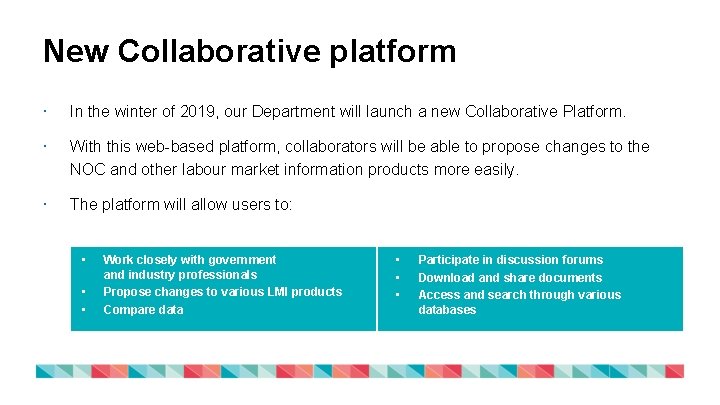
New Collaborative platform In the winter of 2019, our Department will launch a new Collaborative Platform. With this web-based platform, collaborators will be able to propose changes to the NOC and other labour market information products more easily. The platform will allow users to: • • • Work closely with government and industry professionals Propose changes to various LMI products Compare data • • • Participate in discussion forums Download and share documents Access and search through various databases

Skills and Competencies Taxonomy Skills Essential Skills (includes Digital) Analytical Technical Abilities Cognitive Physical Psychomotor Resource Management Sensory Interpersonal Personal Attributes e. g. Adaptability/ Flexibility, Attention to Detail, Cooperation, Creativity / Originality / Innovation, Dependability, Independence, Initiative, Judgment, Leadership, Self. Awareness, etc. Classification of Instructional Programs (CIP) Canada Agriculture, 2011 agriculture operations and related sciences Natural resources and conservation Interests Holland/ RIASEC • • • Canadian Work Preference Inventory (CWPI) Architecture and related services Communication, journalism and related programs Personal and culinary services Etc. Realistic Investigative Artistic Social Enterprising Conventional • • • Employment and Social Development Canada (September 5 th, 2018) Directive Innovative Methodical Objective Social Work Context Work Activities Work Values Information Input Physical Demands Interacting with Others Environmental Conditions Mental Processes Structural Job Characteristics Work Output Interpersonal Relations Service/Care Provision Tools & Technology Descriptors and descriptor subcategories to be defined 5
- Slides: 5