
National Mission for Sustainable AgricultureNMSA Operational Guidelines National
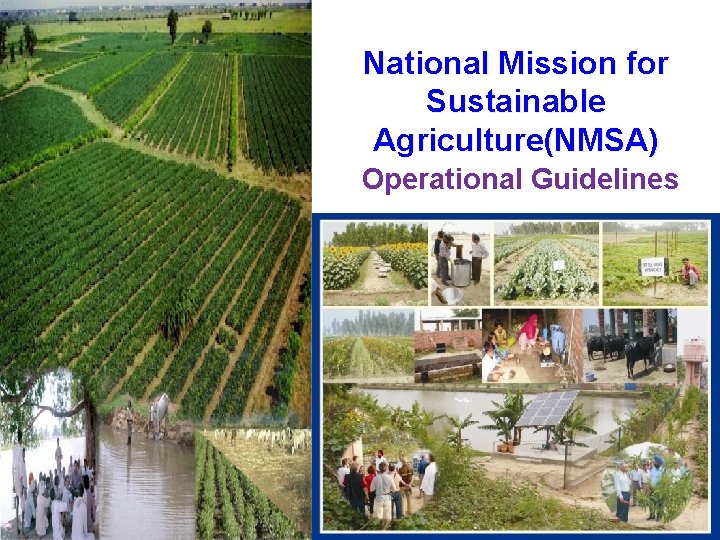
National Mission for Sustainable Agriculture(NMSA) Operational Guidelines
National Mission for Sustainable Agriculture Climate change is no more an environmental concern. It has emerged as the biggest developmental challenge for the planet. ( UNDP 2009)
National Mission for Sustainable Agriculture • Climate Change Projections • Climatic Variability and Extreme Events –Temperature Rise: 0. 2 degree Centigrade per decade –Mean Summer Rainfall to increase –Frequent and Longer dry spells –Shorter but Heavier Precipitation Events –Hot Extremes, Heat Waves to be more common –Contraction of Snow Cover –Rise in Sea Levels • Degradation of Natural Resources (Land/Water/Bio diversity )
National Mission for Sustainable Agriculture Impacts Reduction of Agriculture Yields in Long Term: Upto 40% by 2100 (NAPCC) If no adaptation and mitigation measures are taken
National Mission for Sustainable Agriculture
National Mission for Sustainable Agriculture Introduction: Ø NMSA is one of the eight missions outlined under National Action Plan for climate change (NAPCC). Ø Formulated to enhance Agricultural Productivity especially in Rainfed areas(RA's). Ø As RA's cover 60% of Net sown area and accounts only for 40% of total food production. Ø RA's hold the key to Burgeoning demand of food grains in the country.
National Mission for Sustainable Agriculture Introduction: ØMain Focus is on : 1. Integrated Farming 2. Water use efficiency 3. Soil Health Management 4. Synergizing resource conservation (Soil and Water)
National Mission for Sustainable Agriculture Introduction: ØNMSA will cater to key dimensions of 1. Water use Efficiency 2. Nutrient Management 3. Livelihood Diversification
National Mission for Sustainable Agriculture Introduction: ØTen key adaptation measures: 1. Improved Crop Seeds 2. Livestock and Fish cultures 3. Water Use Efficiency 4. Pest Management 5. Improved Farm Practices 6. Nutrient Management 7. Agricultural Insurance 8. Credit Support 9. Markets 10. Access to Information and Livelihood Diversification
National Mission for Sustainable Agriculture Introduction §NMSA architecture has been designed by converging, consolidating and subsuming all ongoing as well as newly proposed activities/programmes related to sustainable agriculture with a special emphasis on soil & water conservation, water use efficiency, soil health management and rainfed area development. § The focus of NMSA will be to infuse the judicious utilization of resources of commons through community based approach.
National Mission for Sustainable Agriculture Introduction §NMSA aims at promoting location specific improved agronomic practices through soil health management, enhanced water use efficiency, judicious use of chemicals, crop diversification, progressive adoption of crop livestock farming systems and integrated approaches like crop-sericulture, agro-forestry, fish farming, etc.
National Mission for Sustainable Agriculture Introduction §National Mission for Sustainable Agriculture (NMSA) has been formulated for enhancing agricultural productivity especially in rainfed areas focusing on integrated farming, water use efficiency, soil health management and synergizing resource conservation. §Sustaining agricultural productivity depends on quality and availability of natural resources like soil and water. §NMSA derives its mandate from Sustainable Agriculture Mission which is one of the eight Missions outlined under National Action Plan on Climate Change (NAPCC).
National Mission for Sustainable Agriculture Mission Objectives §To make agriculture more productive, and climate resilient by sustainable, remunerative promoting location specific Integrated/Composite Farming Systems; §To conserve natural resources through appropriate soil and moisture conservation measures; §To adopt comprehensive soil health management practices based on soil fertility maps, soil test based application of macro & micro nutrients, judicious use of fertilizers etc. ;
National Mission for Sustainable Agriculture Mission Objectives §To optimize utilization of water resources through efficient water management to expand coverage for achieving ‘more crop per drop’; To develop capacity of farmers & stakeholders, in conjunction with other on going Missions e. g. National Mission on Agriculture Extension & Technology, National Food Security Mission, National Initiative for Climate Resilient Agriculture (NICRA) etc. , in the domain of climate change adaptation and mitigation measures;
National Mission for Sustainable Agriculture Mission Objectives §To pilot models in select blocks for improving productivity of rainfed farming by mainstreaming rainfed technologies refined through NICRA and by leveraging resources from other schemes/Missions like Mahatma Gandhi National Rural Employment Guarantee Scheme(MGNREGS), Integrated Watershed Management Programme (IWMP), RKVY etc. ; and §To establish an effective inter and intra Departmental/Ministerial co-ordination for accomplishing key deliverables of National Mission for Sustainable Agriculture under the aegis of NAPCC.
National Mission for Sustainable Agriculture Mission Strategies §Promoting integrated farming system covering crops, livestock & fishery, plantation and pasture based composite farming for enhancing livelihood opportunities, ensuring food security and minimizing risks from crop failure through supplementary/ residual production systems; §Popularizing resource conservation technologies (both on farm and off farm) and introducing practices that will support mitigation efforts in times of extreme climatic events or disasters like prolonged dry spells, floods etc.
National Mission for Sustainable Agriculture Mission Strategies §Promoting effective management of available water resources and enhancing water use efficiency through application of technologies coupled with demand supply side management solutions; §Encouraging improved agronomic practices for higher farm productivity, improved soil treatment, increased water holding capacity, judicious use of chemicals/ energy and enhanced soil carbon storage;
National Mission for Sustainable Agriculture Mission Strategies §Creating database on soil resources through land use survey, soil profile study and soil analysis on GIS platform to facilitate adoption of location and soil specific crop management practices& optimize fertilizer use; §Promoting location and crop specific integrated nutrient management practices for improving soil health, enhancing crop productivity and maintaining quality of land water resources; §Involving knowledge institutions and professionals in developing climate change adaptation and mitigation strategies for specific agro climatic situations and promoting them through
National Mission for Sustainable Agriculture Mission Strategies §Programmatic interventions as per land capability and conducive to climatic parameters in select blocks as pilots for ensuring integrated development through dissemination and adoption of rainfed technologies with greater reach in disadvantaged areas & location specific planning by way of coordination, convergence and leveraging investments from other Schemes/Missions like MGNREGS, IWMP, RKVY, National Food Security Mission (NFSM), Mission for Integrated Development of Horticulture (MIDH), National Mission for Agricultural Extension & Technology (NMAE&T) etc. A consortium approach may be evolved with various stake holders including knowledge partners like State Agricultural Universities (SAUs), Krishi Vigyan Kendras (KVKs), Indian Council of Agricultural Research (ICAR) Centres, professional organisations etc. by the State Government to provide single window service/ knowledge provider system for the benefit of farming community.
National Mission for Sustainable Agriculture Mission Strategies §State Government implementation may engage reputed NGOs for of cluster/village development plan in case of limited govt. infrastructure is available in that area through a transparent system of selection and defined process of supervision and monitoring through a line department. §Strong technical monitoring and feedback systems on climate change mitigation and adaptation issues to the National Advisory council for regular updates on technical feasibility of various components and their effectiveness in bringing about the climate resilience. The experts of central institutes and state agricultural universities would be part of such technical monitoring/feedback. The capacity building of the implementing agencies would be steered by MANAGE.
National Mission for Sustainable Agriculture Mission Strategies §Establishing platform to liaison, review and coordinate implementation of interventions outlined in Mission Document of NMSA under aegis of National Action Plan on Climate Change.
National Mission for Sustainable Agriculture Mission Interventions: NMSA has following four (4) major programme components or activities 1. Rainfed Area Development (RAD): § RAD will adopt an area based approach for development and conservation of natural resources along with farming systems. § This component has been formulated in a ‘watershed plus framework’, i. e. , to explore potential utilization of natural resources base/assets available/created through watershed development and soil conservation activities /interventions under MGNREGS, NWDPRA, RVP&FPR, RKVY, IWMP etc. § This component will introduce appropriate farming systems by integrating multiple components of agriculture such as crops, horticulture, livestock, fishery, forestry with agro based income generating activities and value addition. Besides, soil test/soil health card based nutrient management practices, farmland development, resource conservation and crop selection conducive to local agro climatic condition will also be promoted under this component.
National Mission for Sustainable Agriculture Mission Interventions: NMSA has following four (4) major programme components or activities 1. Rainfed Area Development (RAD): § This component will be admissible for gap filling resource conservation activities under converging programmes. § RAD clusters should have soil analysis/soil health card/soil survey maps to justify the interventions proposed and at least 25% of the farming system area will have to be covered under On Farm Water Management. § Besides, creation and development of common property resources/assets/utilities like grain bank, biomass shredders, fodder bank, group marketing etc. will be encouraged under this component.
National Mission for Sustainable Agriculture Mission Interventions: NMSA has following four (4) major programme components or activities 2. On Farm Water Management (OFWM): § OFWM will focus primarily on enhancing water use efficiency by promoting efficient on farm water management technologies and equipment. § This will not only focus on application efficiency but, in conjunction with RAD component, also will emphasize on effective harvesting & management of rainwater. §Emphasis will also be given to manage and equitably distribute the resources of commons by involving the water users associations, etc. .
National Mission for Sustainable Agriculture Mission Interventions: NMSA has following four (4) major programme components or activities 2. Soil Health Management (SHM): § SHM will aim at promoting location as well as crop specific sustainable soil health management including residue management, organic farming practices by way of creating and linking soil fertility maps with macro micro nutrient management, appropriate land use based on land capability, judicious application of fertilizers and minimizing the soil erosion/degradation. §Besides, this component will also provide support to reclamation of problem soils (acid/alkaline/saline). This component will be implemented by State Govt. , National Centre of Organic Farming (NCOF), Central Fertilizer Quality Control & Training Institute (CFQC&TI) and Soil and Land Use Survey of India (SLUSI).
National Mission for Sustainable Agriculture Mission Interventions: NMSA has following four (4) major programme components or activities 2. Climate Change and Sustainable Agriculture: Monitoring Modeling and Networking (CCSAMMN): § CCSAMMN will provide creation and bidirectional (land/farmers to research/scientific establishments and vice versa)dissemination of climate change related information and knowledge by way of piloting climate change adaptation/mitigation research/model projects in the domain of climate smart sustainable management practices and integrated farming system suitable to local agro climatic conditions. § The dedicated expert teams of technical personnel will be institutionalized within NMSA to rigorously monitor and evaluate the mission activities thrice in a year and will inform the National Committee. Comprehensive pilot blocks will be supported to illustrate functional mechanism for dissemination of rainfed technologies, planning, convergence and coordination with flagship schemes/Missions like MGNREGS, IWMP, Accelerated Irrigation Benefit Programme (AIBP), RKVY, NFSM, NHM, NMAET etc.
National Mission for Sustainable Agriculture Mission Interventions: NMSA has following four (4) major programme components or activities 2. Climate Change and Sustainable Agriculture: Monitoring Modeling and Networking (CCSAMMN): § Such an integrated action of input and output flows across agriculture, livestock and other production systems will harness the growth potential of the rainfed production systems, imparting sustainability of local production systems while negotiating climate change risks. § A consortium approach will be evolved with various stake holders including knowledge partners like State Agricultural Universities (SAUs), Krishi Vigyan Kendras (KVKs), Indian Council of Agricultural Research (ICAR) Institutes etc. by the State Government to provide single window service/knowledge provider system for the benefit of farming community. § Climate change related monitoring, feedback, knowledge networking and skill development will also be supported under this component through State Agricultural Universities, ICAR Institutes National/International Institutes, KVKs, Public/Private R&D Organizations etc. § Awarding of Studies, Documentation & Publication, Domestic and Foreign Training, Workshops/Conferences etc. will be supported under this component.
National Mission for Sustainable Agriculture Mission Structure: NMSA has following three tier structure for planning, implementation and monitoring of various components: National Level Architecture: National Advisory Committee (NAC): constituted to implementation of the mission. A National Advisory Committee(NAC) under Chairmanship of Secretary (A&C) with the following provide strategic direction Secretary, Department of Agriculture & Cooperation members guidance will be and planning for Chairman Additional Secretary & Financial Advisor, DAC Member Representative from Ministry of Water Resources: Member Representative from Ministry Rural Development: Member Representative from Ministry of Panchayati Raj Member Representative from Ministry of Environment & Forest Member Representative from Ministry of Food Processing Industries Member Representative from Ministry of Tribal Affairs & Education for Member Representative from Department of Agricultural Research Member effective
National Mission for Sustainable Agriculture Mission Structure: NMSA has following three tier structure for planning, implementation and monitoring of various components: National Level Architecture: National Advisory Committee (NAC): Representative from Department of Animal Husbandry Dairying & Fisheries, Member Representative from Department of Land Resources Member Technical Expert of National Rainfed Area Authority (NRAA) Member Joint Secretary (INM), DAC Member Joint Secretary (NHM), DAC Member Joint Secretary (Crops), DAC Joint Secretary (NRM & RFS) &Mission Director (NMSA) Member Secretary
National Mission for Sustainable Agriculture Mission Structure: NMSA has following three tier structure for planning, implementation and monitoring of various components: § Project Sanctioning Committee (PSC): PSC will be serviced by Natural Resource Management (NRM) and Rainfed Farming System (RFS) Divisions of DAC. The proposals for reclamation of problem soils may be made under RAD components. Proposals of SHM components being demand based, would be scrutinized and approved by INM Division of DAC. A Project Sanctioning Committee (PSC) chaired by: 1. Mission Director, NMSA with representation from Indian Council of Agriculture Research (ICAR), 2. Department of Land Resources (Do. LR), 3. Ministry Water Resources (Mo. WR), 4. Ministry of Tribal Affairs (Mo. TA), 5. Ministry of Environment & Forests (Mo. EF), 6. Dept. of Animal Husbandry, Dairy & Fisheries (DAHD&F), 7. INM & NHM Divisions of DAC and other restructured Missions will prioritize and approve projects under NMSA.
National Mission for Sustainable Agriculture Mission Structure: NMSA has following three tier structure for planning, implementation and monitoring of various components: §Standing Technical Committee strongly supported by institutionalized feedback from scientific institutions for regular corrections. §The expert institutions management such as purpose and will coordinate the activities of Technical Committees. in CRIDA (STC): technical the field will be The of made backstopping climate the programme through change Main implementation research Knowledge well structured and Partner will natural be and for resources this § The scientific committee will have the ability and be provided adequate space within the NMSA to make their own assessment. §Standing Technical Committee (STC) will be set up at the National level to provide time to time knowledge support and technical feed back to the Project Sanctioning Committee and National Advisory Committee of NMSA to decide the policy content or change in any component if required. § The Complex for Region (Patna), national/international eminence. STC NEH IARI will Region, be IISS (Delhi), represented (Bhopal), selected by ICAR SAUs CRIDA, Research and CAZRI, Complex ICAR for professionals Research Eastern of
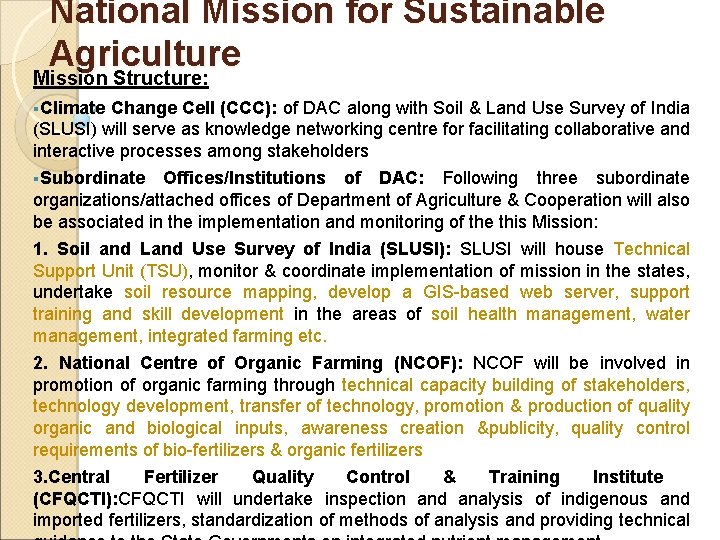
National Mission for Sustainable Agriculture Mission Structure: §Climate Change Cell (CCC): of DAC along with Soil & Land Use Survey of India (SLUSI) will serve as knowledge networking centre for facilitating collaborative and interactive processes among stakeholders §Subordinate Offices/Institutions of DAC: Following three subordinate organizations/attached offices of Department of Agriculture & Cooperation will also be associated in the implementation and monitoring of the this Mission: 1. Soil and Land Use Survey of India (SLUSI): SLUSI will house Technical Support Unit (TSU), monitor & coordinate implementation of mission in the states, undertake soil resource mapping, develop a GIS based web server, support training and skill development in the areas of soil health management, water management, integrated farming etc. 2. National Centre of Organic Farming (NCOF): NCOF will be involved in promotion of organic farming through technical capacity building of stakeholders, technology development, transfer of technology, promotion & production of quality organic and biological inputs, awareness creation &publicity, quality control requirements of bio fertilizers & organic fertilizers 3. Central Fertilizer Quality Control & Training Institute (CFQCTI): CFQCTI will undertake inspection and analysis of indigenous and imported fertilizers, standardization of methods of analysis and providing technical
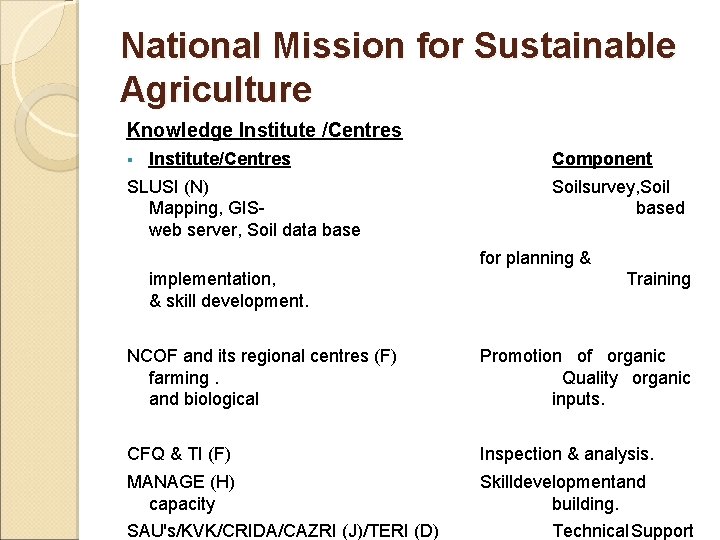
National Mission for Sustainable Agriculture Knowledge Institute /Centres § Institute/Centres SLUSI (N) Mapping, GIS web server, Soil data base Component Soil survey, Soil based for planning & implementation, & skill development. Training NCOF and its regional centres (F) farming. and biological Promotion of organic Quality organic inputs. CFQ & TI (F) Inspection & analysis. MANAGE (H) capacity Skill development and building. SAU's/KVK/CRIDA/CAZRI (J)/TERI (D) Technical Support
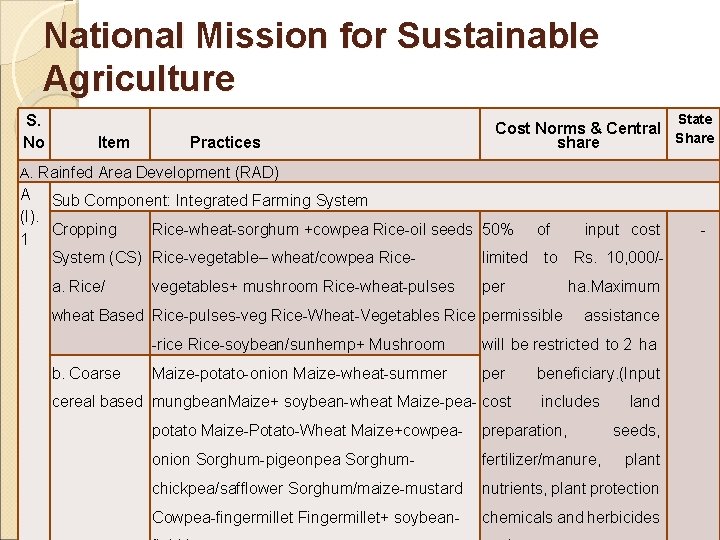
National Mission for Sustainable Agriculture S. No State Item Practices Cost Norms & Central Share share A. Rainfed Area Development (RAD) A Sub Component: Integrated Farming System (I). Cropping Rice wheat sorghum +cowpea Rice oil seeds 50% of input cost 1 System (CS) Rice vegetable– wheat/cowpea Rice limited to Rs. 10, 000/ a. Rice/ vegetables+ mushroom Rice wheat pulses per ha. Maximum wheat Based Rice pulses veg Rice Wheat Vegetables Rice permissible b. Coarse assistance rice Rice soybean/sunhemp+ Mushroom will be restricted to 2 ha Maize potato onion Maize wheat summer per cereal based mungbean. Maize+ soybean wheat Maize pea cost beneficiary. (Input includes land potato Maize Potato Wheat Maize+cowpea preparation, onion Sorghum pigeonpea Sorghum fertilizer/manure, plant seeds, chickpea/safflower Sorghum/maize mustard nutrients, plant protection Cowpea fingermillet Fingermillet+ soybean chemicals and herbicides
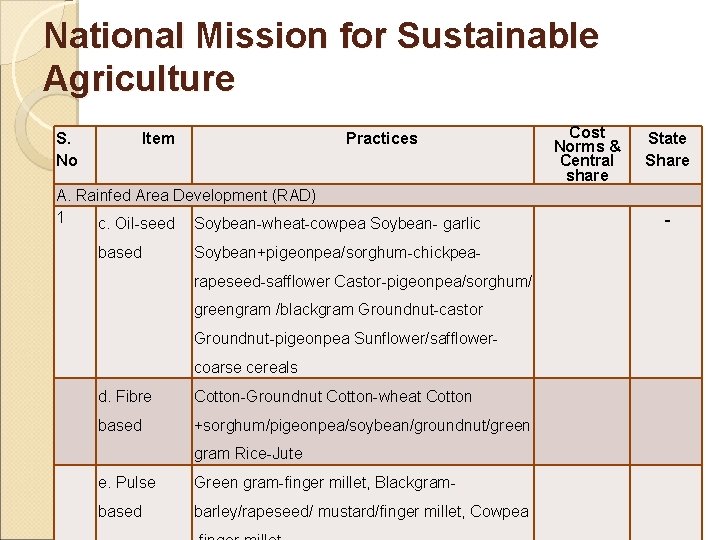
National Mission for Sustainable Agriculture S. No Item Practices A. Rainfed Area Development (RAD) 1 c. Oil seed Soybean wheat cowpea Soybean garlic based Soybean+pigeonpea/sorghum chickpea rapeseed safflower Castor pigeonpea/sorghum/ greengram /blackgram Groundnut castor Groundnut pigeonpea Sunflower/safflower coarse cereals d. Fibre Cotton Groundnut Cotton wheat Cotton based +sorghum/pigeonpea/soybean/groundnut/green gram Rice Jute e. Pulse Green gram finger millet, Blackgram based barley/rapeseed/ mustard/finger millet, Cowpea Cost Norms & Central share State Share
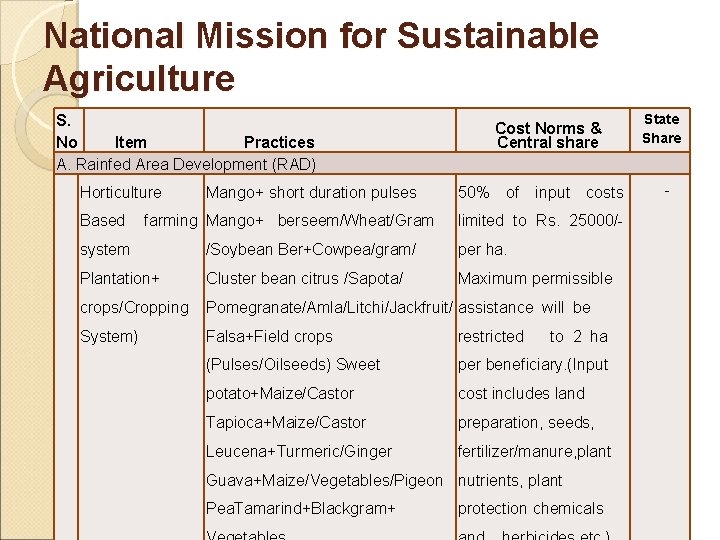
National Mission for Sustainable Agriculture S. No Item Practices A. Rainfed Area Development (RAD) Horticulture Mango+ short duration pulses Cost Norms & Central share 50% of input costs Based farming Mango+ berseem/Wheat/Gram limited to Rs. 25000/ system /Soybean Ber+Cowpea/gram/ per ha. Plantation+ Cluster bean citrus /Sapota/ Maximum permissible crops/Cropping Pomegranate/Amla/Litchi/Jackfruit/ assistance will be System) Falsa+Field crops restricted to 2 ha (Pulses/Oilseeds) Sweet per beneficiary. (Input potato+Maize/Castor cost includes land Tapioca+Maize/Castor preparation, seeds, Leucena+Turmeric/Ginger fertilizer/manure, plant Guava+Maize/Vegetables/Pigeon nutrients, plant Pea. Tamarind+Blackgram+ protection chemicals State Share
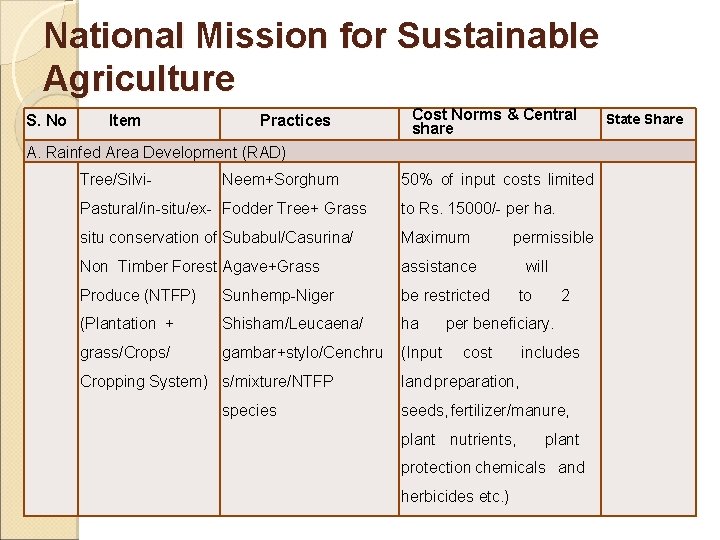
National Mission for Sustainable Agriculture S. No Item Practices Cost Norms & Central share A. Rainfed Area Development (RAD) Tree/Silvi Neem+Sorghum 50% of input costs limited Pastural/in situ/ex Fodder Tree+ Grass to Rs. 15000/ per ha. situ conservation of Subabul/Casurina/ Maximum Non Timber Forest Agave+Grass assistance will Produce (NTFP) Sunhemp Niger be restricted to 2 (Plantation + Shisham/Leucaena/ ha per beneficiary. grass/Crops/ gambar+stylo/Cenchru (Input cost includes Cropping System) s/mixture/NTFP species permissible land preparation, seeds, fertilizer/manure, plant nutrients, plant protection chemicals and herbicides etc. ) State Share
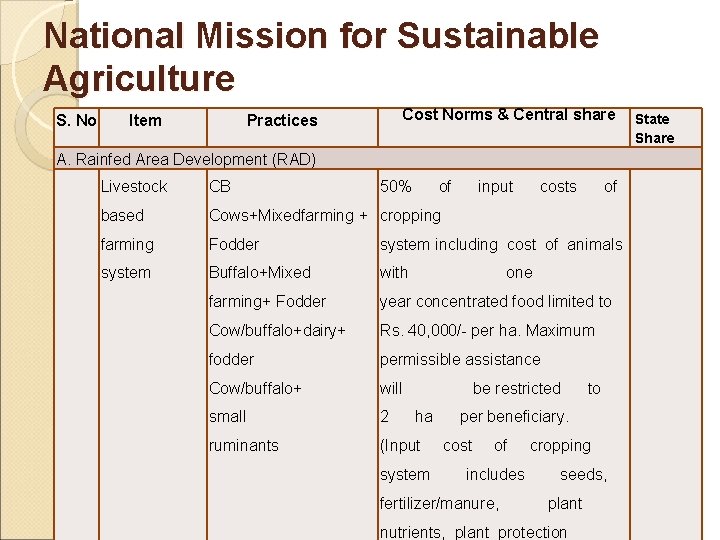
National Mission for Sustainable Agriculture S. No Item Practices Cost Norms & Central share State Share A. Rainfed Area Development (RAD) Livestock CB 50% of input costs of based Cows+Mixedfarming + cropping farming Fodder system including cost of animals system Buffalo+Mixed with one farming+ Fodder year concentrated food limited to Cow/buffalo+dairy+ Rs. 40, 000/ per ha. Maximum fodder permissible assistance Cow/buffalo+ will be restricted to small 2 ha per beneficiary. ruminants (Input cost of cropping system includes seeds, fertilizer/manure, plant nutrients, plant protection
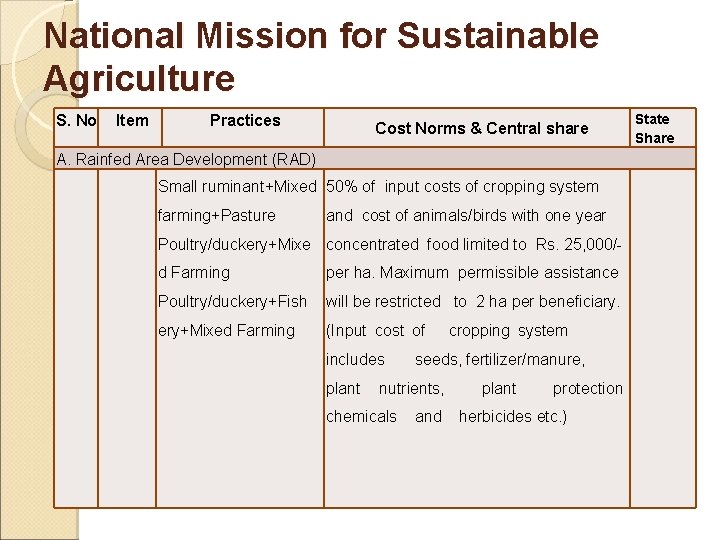
National Mission for Sustainable Agriculture S. No Item Practices Cost Norms & Central share A. Rainfed Area Development (RAD) Small ruminant+Mixed 50% of input costs of cropping system farming+Pasture and cost of animals/birds with one year Poultry/duckery+Mixe concentrated food limited to Rs. 25, 000/ d Farming per ha. Maximum permissible assistance Poultry/duckery+Fish will be restricted to 2 ha per beneficiary. ery+Mixed Farming (Input cost of cropping system includes seeds, fertilizer/manure, plant nutrients, plant protection chemicals and herbicides etc. ) State Share
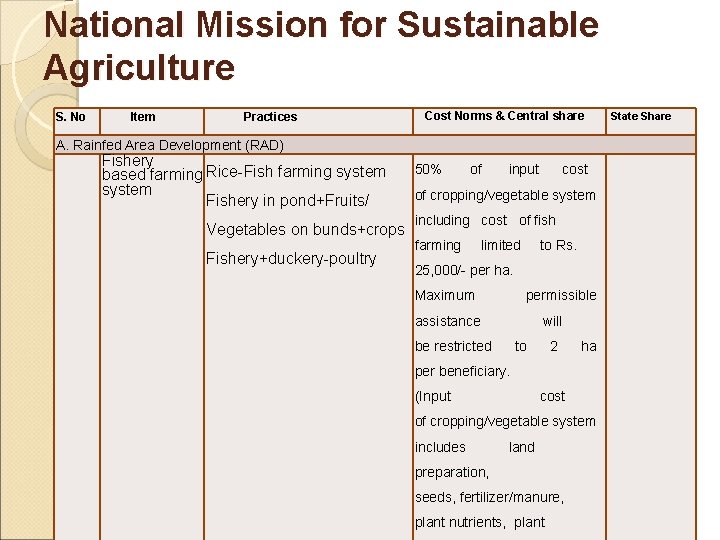
National Mission for Sustainable Agriculture S. No Item Practices Cost Norms & Central share State Share A. Rainfed Area Development (RAD) Fishery based farming Rice Fish farming system Fishery in pond+Fruits/ Vegetables on bunds+crops Fishery+duckery poultry 50% of input cost of cropping/vegetable system including cost of fish farming limited to Rs. 25, 000/ per ha. Maximum permissible assistance will be restricted to 2 ha per beneficiary. (Input cost of cropping/vegetable system includes land preparation, seeds, fertilizer/manure, plant nutrients, plant
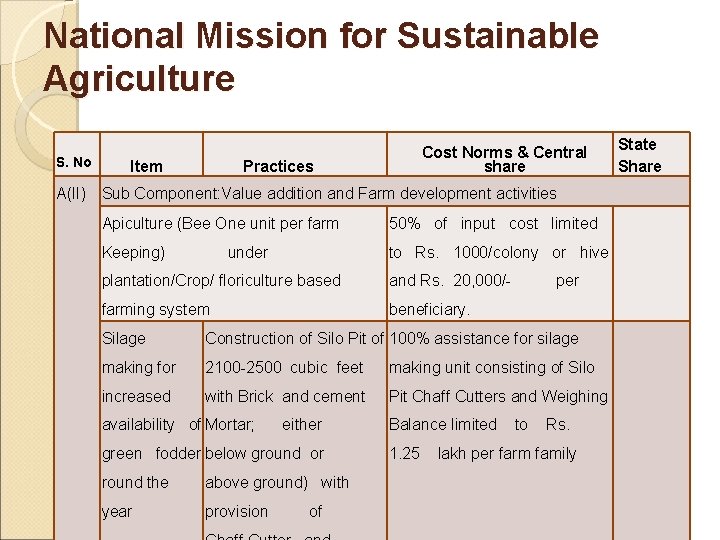
National Mission for Sustainable Agriculture S. No Item Practices State Share Cost Norms & Central share A(II) Sub Component: Value addition and Farm development activities Apiculture (Bee One unit per farm 50% of input cost limited Keeping) under to Rs. 1000/colony or hive plantation/Crop/ floriculture based and Rs. 20, 000/ per farming system beneficiary. Silage Construction of Silo Pit of 100% assistance for silage making for 2100 2500 cubic feet making unit consisting of Silo increased Pit Chaff Cutters and Weighing with Brick and cement availability of Mortar; either Balance limited to Rs. green fodder below ground or 1. 25 lakh per farm family round the above ground) with year provision of
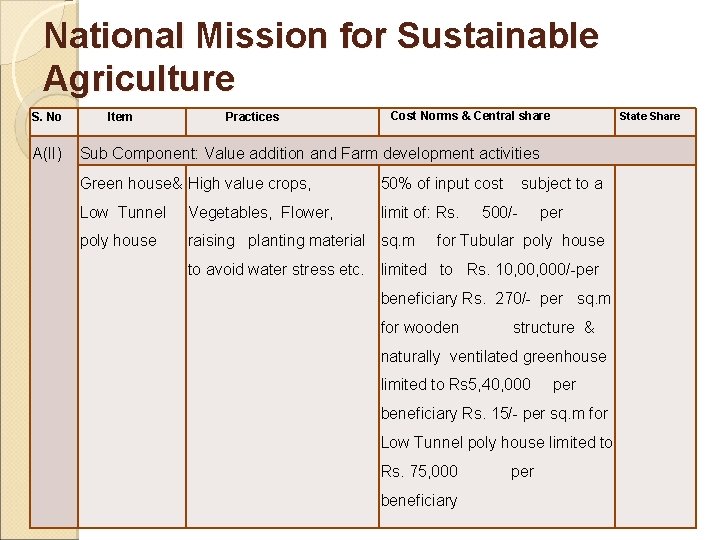
National Mission for Sustainable Agriculture S. No A(II) Item Practices Cost Norms & Central share State Share Sub Component: Value addition and Farm development activities Green house& High value crops, 50% of input cost subject to a Low Tunnel Vegetables, Flower, limit of: Rs. 500/ per poly house raising planting material sq. m for Tubular poly house to avoid water stress etc. limited to Rs. 10, 000/ per beneficiary Rs. 270/ per sq. m for wooden structure & naturally ventilated greenhouse limited to Rs 5, 40, 000 per beneficiary Rs. 15/ per sq. m for Low Tunnel poly house limited to Rs. 75, 000 per beneficiary
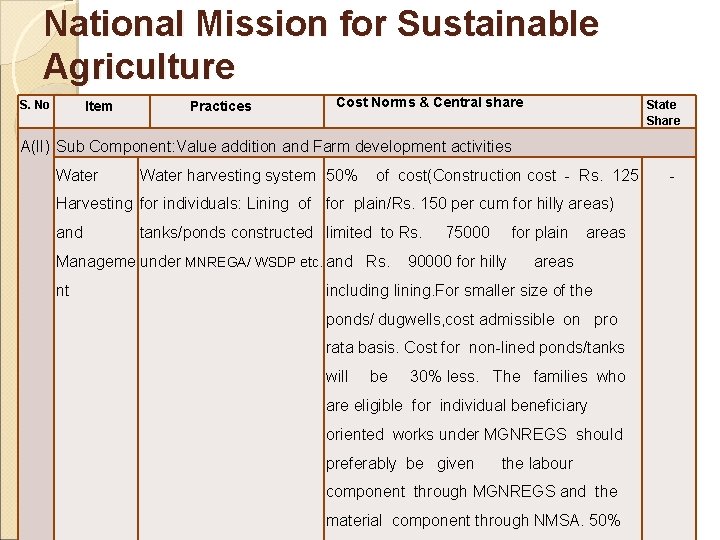
National Mission for Sustainable Agriculture S. No Item Practices Cost Norms & Central share State Share A(II) Sub Component: Value addition and Farm development activities Water harvesting system 50% of cost(Construction cost Rs. 125 Harvesting for individuals: Lining of for plain/Rs. 150 per cum for hilly areas) and tanks/ponds constructed limited to Rs. 75000 for plain areas Manageme under MNREGA/ WSDP etc. and Rs. 90000 for hilly areas nt including lining. For smaller size of the ponds/ dugwells, cost admissible on pro rata basis. Cost for non lined ponds/tanks will be 30% less. The families who are eligible for individual beneficiary oriented works under MGNREGS should preferably be given the labour component through MGNREGS and the material component through NMSA. 50%
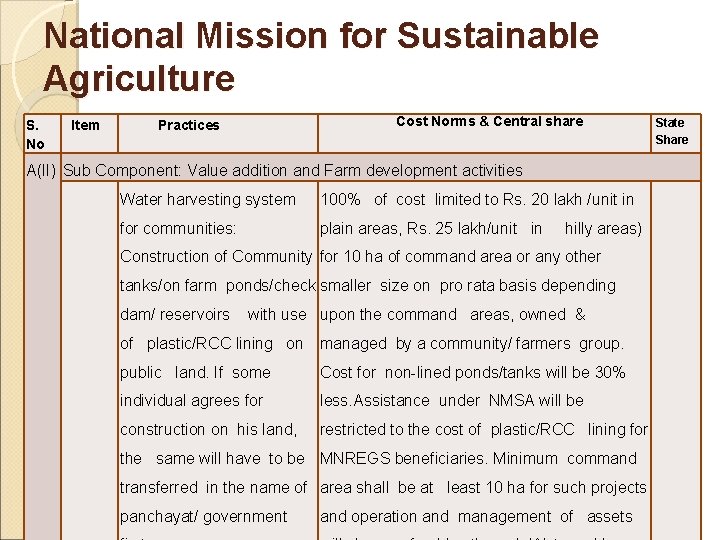
National Mission for Sustainable Agriculture S. No Item Practices Cost Norms & Central share State Share A(II) Sub Component: Value addition and Farm development activities Water harvesting system 100% of cost limited to Rs. 20 lakh /unit in for communities: plain areas, Rs. 25 lakh/unit in hilly areas) Construction of Community for 10 ha of command area or any other tanks/on farm ponds/check smaller size on pro rata basis depending dam/ reservoirs with use upon the command areas, owned & of plastic/RCC lining on managed by a community/ farmers group. public land. If some Cost for non lined ponds/tanks will be 30% individual agrees for less. Assistance under NMSA will be construction on his land, restricted to the cost of plastic/RCC lining for the same will have to be MNREGS beneficiaries. Minimum command transferred in the name of area shall be at least 10 ha for such projects panchayat/ government and operation and management of assets
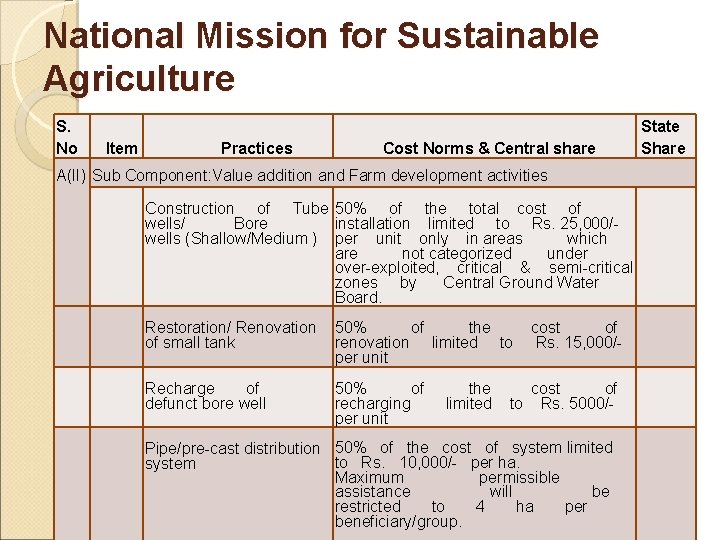
National Mission for Sustainable Agriculture S. No Item Practices Cost Norms & Central share State Share A(II) Sub Component: Value addition and Farm development activities Construction of Tube 50% of the total cost of wells/ Bore installation limited to Rs. 25, 000/ wells (Shallow/Medium ) per unit only in areas which are not categorized under over exploited, critical & semi critical zones by Central Ground Water Board. Restoration/ Renovation 50% of the cost of of small tank renovation limited to Rs. 15, 000/ per unit Recharge of defunct bore well 50% of the cost of recharging limited to Rs. 5000/ per unit Pipe/pre cast distribution 50% of the cost of system limited to Rs. 10, 000/ per ha. system Maximum permissible assistance will be restricted to 4 ha per beneficiary/group.
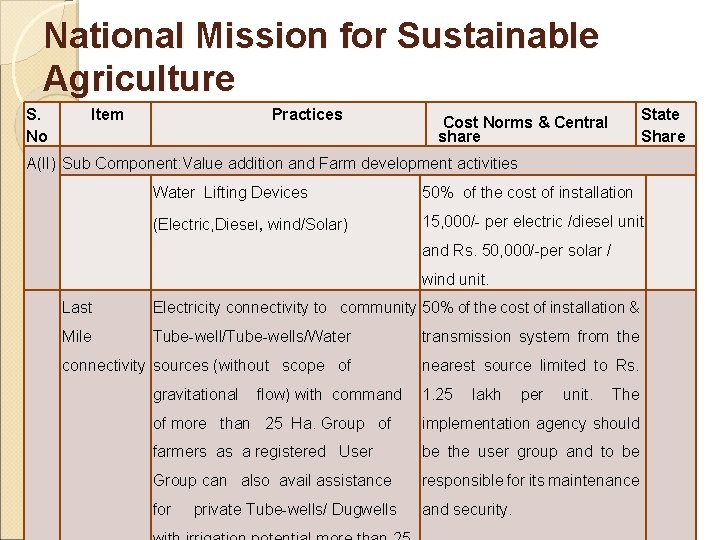
National Mission for Sustainable Agriculture S. No Item Practices Cost Norms & Central share State Share A(II) Sub Component: Value addition and Farm development activities Water Lifting Devices 50% of the cost of installation (Electric, Diesel, wind/Solar) 15, 000/ per electric /diesel unit and Rs. 50, 000/ per solar / wind unit. Last Electricity connectivity to community 50% of the cost of installation & Mile Tube well/Tube wells/Water connectivity sources (without scope of transmission system from the nearest source limited to Rs. gravitational flow) with command 1. 25 lakh per unit. The of more than 25 Ha. Group of implementation agency should farmers as a registered User be the user group and to be Group can also avail assistance responsible for its maintenance for private Tube wells/ Dugwells and security.
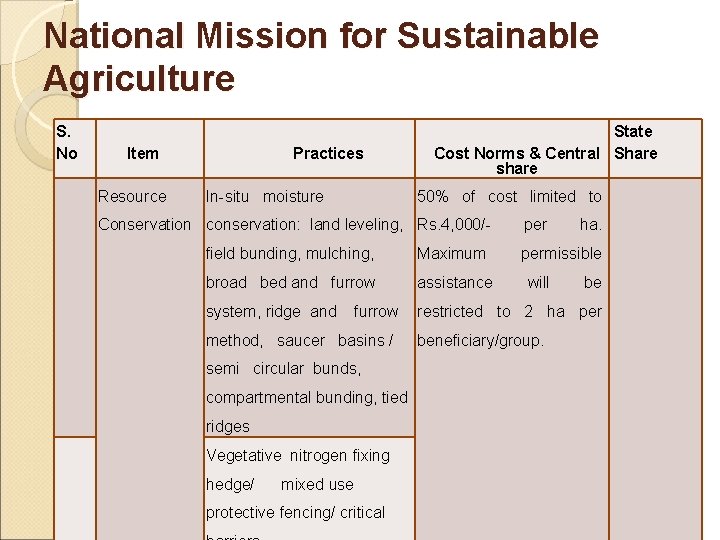
National Mission for Sustainable Agriculture S. No Item Resource Practices In situ moisture State Cost Norms & Central Share share 50% of cost limited to Conservation conservation: land leveling, Rs. 4, 000/ field bunding, mulching, Maximum broad bed and furrow assistance per ha. permissible will be system, ridge and furrow restricted to 2 ha per method, saucer basins / beneficiary/group. semi circular bunds, compartmental bunding, tied ridges Vegetative nitrogen fixing hedge/ mixed use protective fencing/ critical
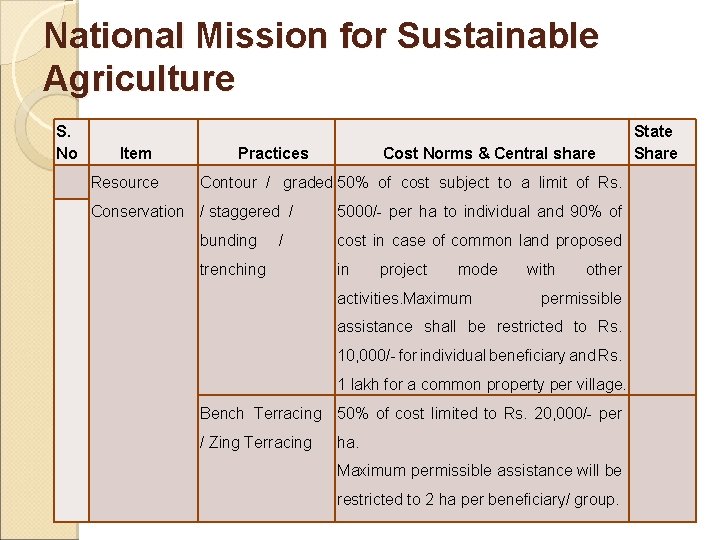
National Mission for Sustainable Agriculture S. No Item Resource Practices Cost Norms & Central share Contour / graded 50% of cost subject to a limit of Rs. Conservation / staggered / 5000/ per ha to individual and 90% of bunding / cost in case of common land proposed trenching in project mode activities. Maximum with other permissible assistance shall be restricted to Rs. 10, 000/ for individual beneficiary and Rs. 1 lakh for a common property per village. Bench Terracing 50% of cost limited to Rs. 20, 000/ per / Zing Terracing ha. Maximum permissible assistance will be restricted to 2 ha per beneficiary/ group. State Share
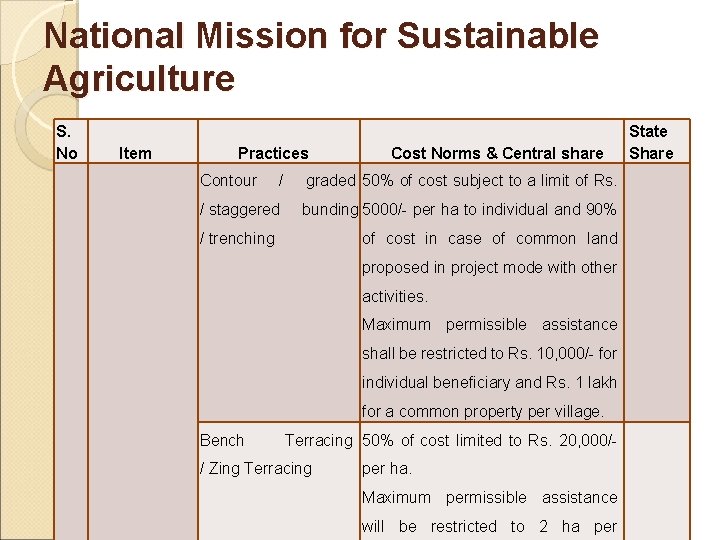
National Mission for Sustainable Agriculture S. No Item Practices Cost Norms & Central share Contour / graded 50% of cost subject to a limit of Rs. / staggered bunding 5000/ per ha to individual and 90% / trenching of cost in case of common land proposed in project mode with other activities. Maximum permissible assistance shall be restricted to Rs. 10, 000/ for individual beneficiary and Rs. 1 lakh for a common property per village. Bench Terracing 50% of cost limited to Rs. 20, 000/ / Zing Terracing per ha. Maximum permissible assistance will be restricted to 2 ha per State Share
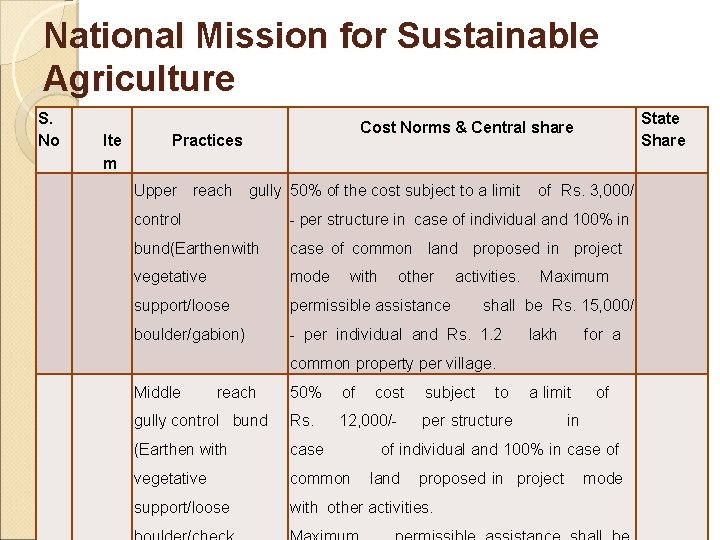
National Mission for Sustainable Agriculture S. No Ite m Practices Cost Norms & Central share Upper reach gully 50% of the cost subject to a limit of Rs. 3, 000/ control per structure in case of individual and 100% in bund(Earthen with case of common land proposed in project vegetative mode with other activities. Maximum support/loose permissible assistance shall be Rs. 15, 000/ boulder/gabion) per individual and Rs. 1. 2 lakh for a common property per village. Middle reach 50% of cost subject to a limit of gully control bund Rs. 12, 000/ per structure in (Earthen with case of individual and 100% in case of vegetative common land proposed in project mode support/loose with other activities. State Share
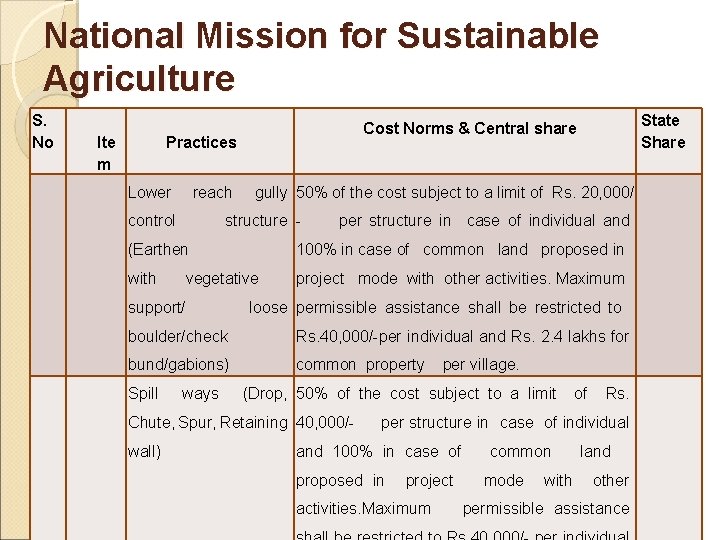
National Mission for Sustainable Agriculture S. No Ite m Cost Norms & Central share Practices Lower reach gully 50% of the cost subject to a limit of Rs. 20, 000/ control structure per structure in case of individual and (Earthen 100% in case of common land proposed in with vegetative support/ project mode with other activities. Maximum loose permissible assistance shall be restricted to boulder/check Rs. 40, 000/ per individual and Rs. 2. 4 lakhs for bund/gabions) common property per village. Spill ways (Drop, 50% of the cost subject to a limit of Rs. Chute, Spur, Retaining 40, 000/ per structure in case of individual wall) and 100% in case of common land proposed in project mode with other activities. Maximum permissible assistance State Share
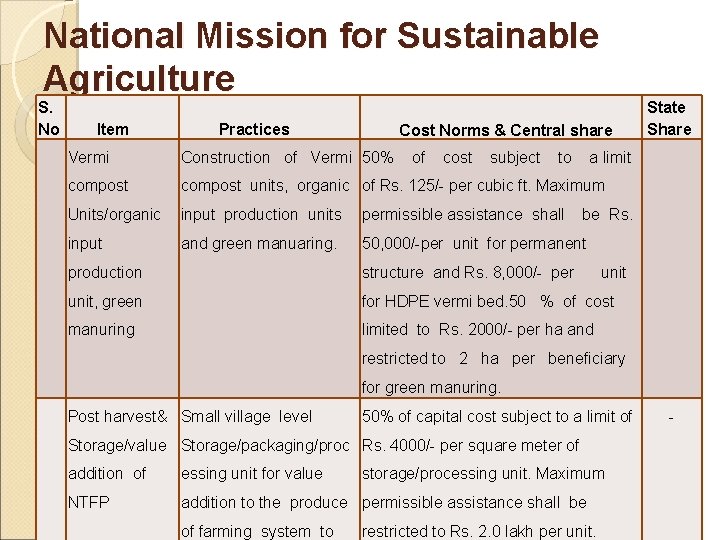
National Mission for Sustainable Agriculture S. No Item Practices Cost Norms & Central share Vermi Construction of Vermi 50% of cost subject to a limit compost units, organic of Rs. 125/ per cubic ft. Maximum State Share Units/organic input production units permissible assistance shall be Rs. input and green manuaring. 50, 000/ per unit for permanent production structure and Rs. 8, 000/ per unit, green for HDPE vermi bed. 50 % of cost manuring limited to Rs. 2000/ per ha and restricted to 2 ha per beneficiary for green manuring. Post harvest& Small village level 50% of capital cost subject to a limit of Storage/value Storage/packaging/proc Rs. 4000/ per square meter of addition of essing unit for value NTFP addition to the produce permissible assistance shall be of farming system to storage/processing unit. Maximum restricted to Rs. 2. 0 lakh per unit.
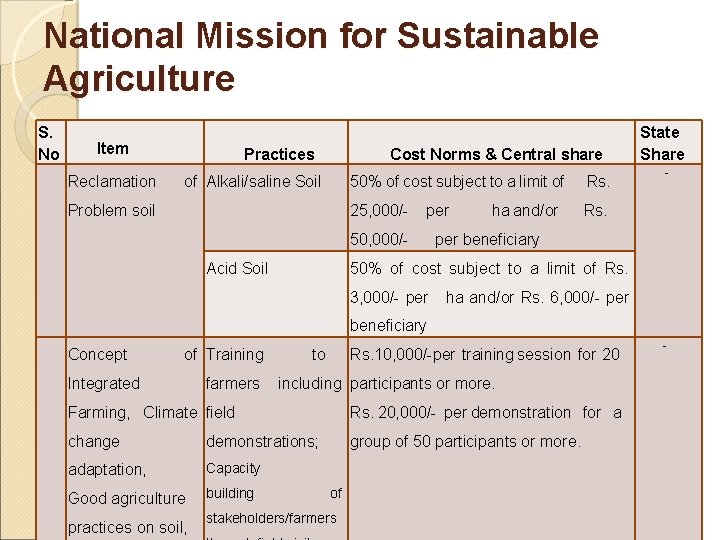
National Mission for Sustainable Agriculture S. No Item Practices Cost Norms & Central share Reclamation of Alkali/saline Soil 50% of cost subject to a limit of Rs. Problem soil 25, 000/ per ha and/or Rs. State Share 50, 000/ per beneficiary Acid Soil 50% of cost subject to a limit of Rs. 3, 000/ per ha and/or Rs. 6, 000/ per beneficiary Concept of Training to Rs. 10, 000/ per training session for 20 Integrated farmers including participants or more. Farming, Climate field Rs. 20, 000/ per demonstration for a change demonstrations; group of 50 participants or more. adaptation, Capacity Good agriculture building of practices on soil, stakeholders/farmers
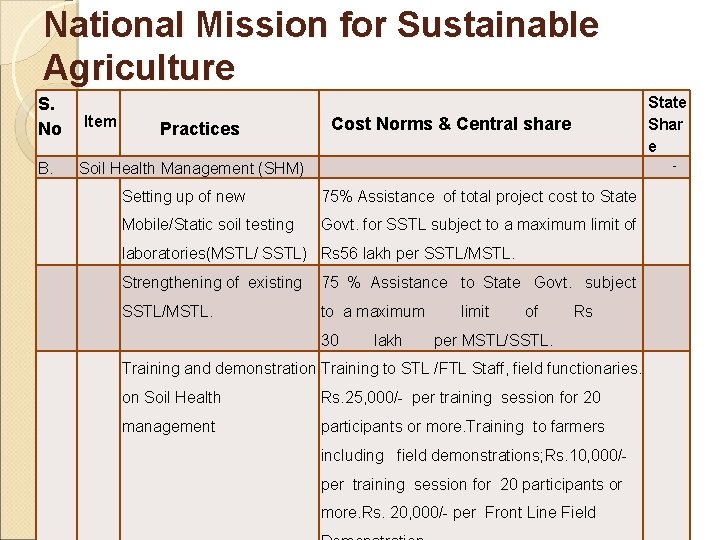
National Mission for Sustainable Agriculture S. No Item Practices Cost Norms & Central share State Shar e B. Soil Health Management (SHM) Setting up of new 75% Assistance of total project cost to State Mobile/Static soil testing Govt. for SSTL subject to a maximum limit of laboratories(MSTL/ SSTL) Rs 56 lakh per SSTL/MSTL. Strengthening of existing 75 % Assistance to State Govt. subject SSTL/MSTL. to a maximum limit of Rs 30 lakh per MSTL/SSTL. Training and demonstration Training to STL /FTL Staff, field functionaries. on Soil Health Rs. 25, 000/ per training session for 20 management participants or more. Training to farmers including field demonstrations; Rs. 10, 000/ per training session for 20 participants or more. Rs. 20, 000/ per Front Line Field
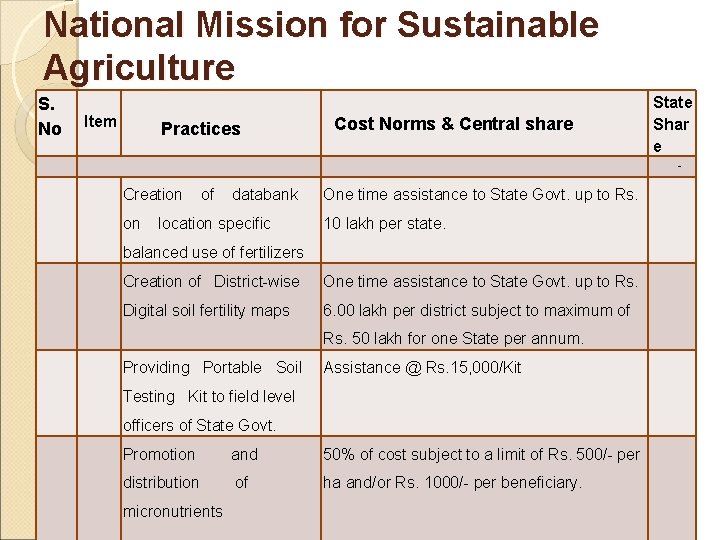
National Mission for Sustainable Agriculture S. No Item Practices Cost Norms & Central share State Shar e Creation of databank One time assistance to State Govt. up to Rs. on location specific 10 lakh per state. balanced use of fertilizers Creation of District wise One time assistance to State Govt. up to Rs. Digital soil fertility maps 6. 00 lakh per district subject to maximum of Rs. 50 lakh for one State per annum. Providing Portable Soil Assistance @ Rs. 15, 000/Kit Testing Kit to field level officers of State Govt. Promotion and 50% of cost subject to a limit of Rs. 500/ per distribution of ha and/or Rs. 1000/ per beneficiary. micronutrients
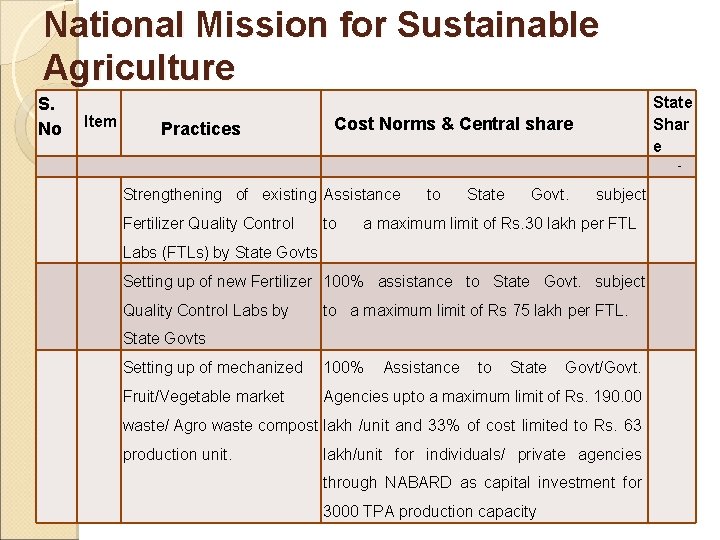
National Mission for Sustainable Agriculture S. No Item Practices Cost Norms & Central share State Shar e Strengthening of existing Assistance to State Govt. subject Fertilizer Quality Control to a maximum limit of Rs. 30 lakh per FTL Labs (FTLs) by State Govts Setting up of new Fertilizer 100% assistance to State Govt. subject Quality Control Labs by to a maximum limit of Rs 75 lakh per FTL. State Govts Setting up of mechanized 100% Assistance to State Govt/Govt. Fruit/Vegetable market Agencies upto a maximum limit of Rs. 190. 00 waste/ Agro waste compost lakh /unit and 33% of cost limited to Rs. 63 production unit. lakh/unit for individuals/ private agencies through NABARD as capital investment for 3000 TPA production capacity
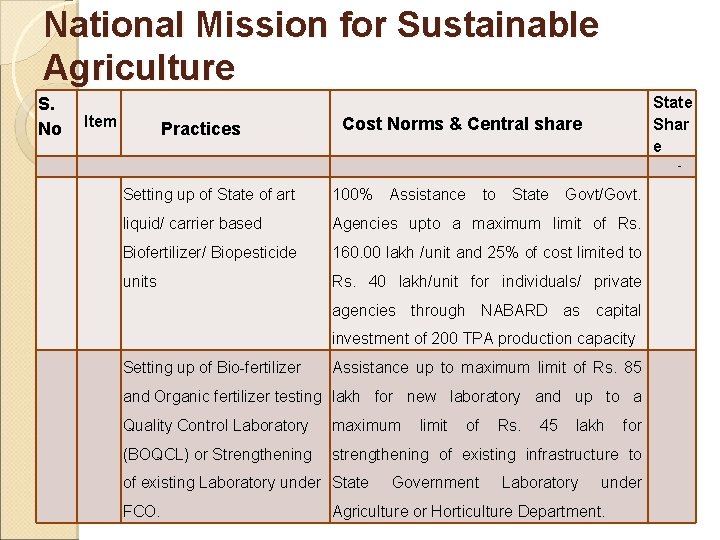
National Mission for Sustainable Agriculture S. No Item Practices State Shar e Cost Norms & Central share Setting up of State of art 100% Assistance to State Govt/Govt. liquid/ carrier based Agencies upto a maximum limit of Rs. Biofertilizer/ Biopesticide 160. 00 lakh /unit and 25% of cost limited to units Rs. 40 lakh/unit for individuals/ private agencies through NABARD as capital investment of 200 TPA production capacity Setting up of Bio fertilizer Assistance up to maximum limit of Rs. 85 and Organic fertilizer testing lakh for new laboratory and up to a Quality Control Laboratory maximum limit of Rs. 45 lakh for (BOQCL) or Strengthening strengthening of existing infrastructure to of existing Laboratory under State FCO. Government Laboratory under Agriculture or Horticulture Department.
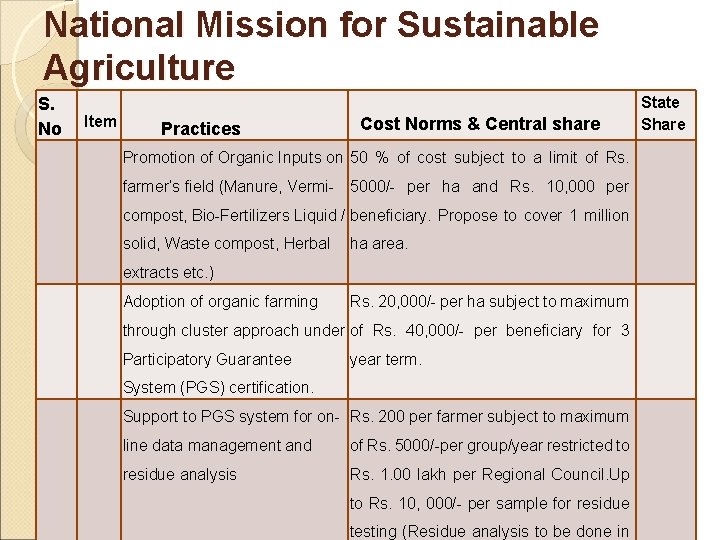
National Mission for Sustainable Agriculture S. No Item Practices Cost Norms & Central share Promotion of Organic Inputs on 50 % of cost subject to a limit of Rs. farmer’s field (Manure, Vermi 5000/ per ha and Rs. 10, 000 per compost, Bio Fertilizers Liquid / beneficiary. Propose to cover 1 million solid, Waste compost, Herbal ha area. extracts etc. ) Adoption of organic farming Rs. 20, 000/ per ha subject to maximum through cluster approach under of Rs. 40, 000/ per beneficiary for 3 Participatory Guarantee year term. System (PGS) certification. Support to PGS system for on Rs. 200 per farmer subject to maximum line data management and of Rs. 5000/ per group/year restricted to residue analysis Rs. 1. 00 lakh per Regional Council. Up to Rs. 10, 000/ per sample for residue testing (Residue analysis to be done in State Share
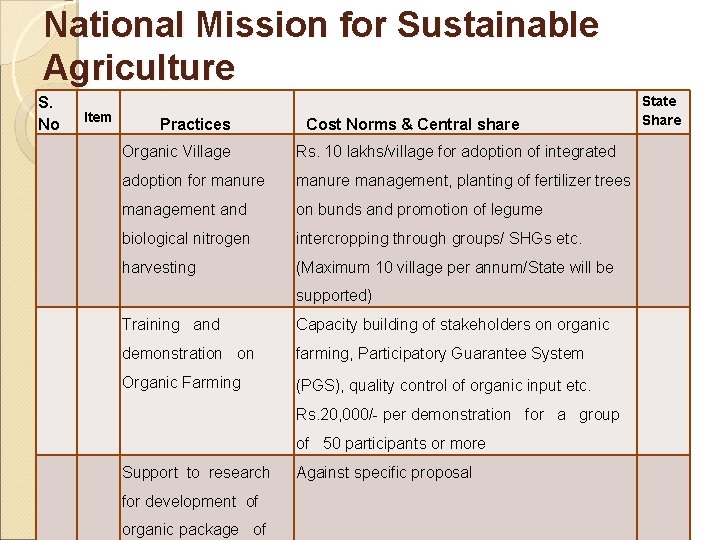
National Mission for Sustainable Agriculture S. No Item Practices Cost Norms & Central share Organic Village Rs. 10 lakhs/village for adoption of integrated adoption for manure management, planting of fertilizer trees management and on bunds and promotion of legume biological nitrogen intercropping through groups/ SHGs etc. harvesting (Maximum 10 village per annum/State will be supported) Training and Capacity building of stakeholders on organic demonstration on farming, Participatory Guarantee System Organic Farming (PGS), quality control of organic input etc. Rs. 20, 000/ per demonstration for a group of 50 participants or more Support to research for development of organic package of Against specific proposal State Share
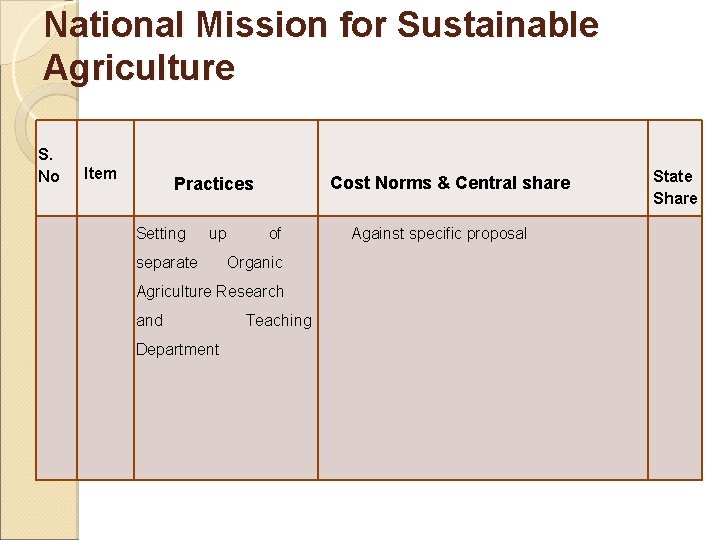
National Mission for Sustainable Agriculture S. No Item Cost Norms & Central share Practices Setting up of Against specific proposal separate Organic Agriculture Research and Department Teaching State Share
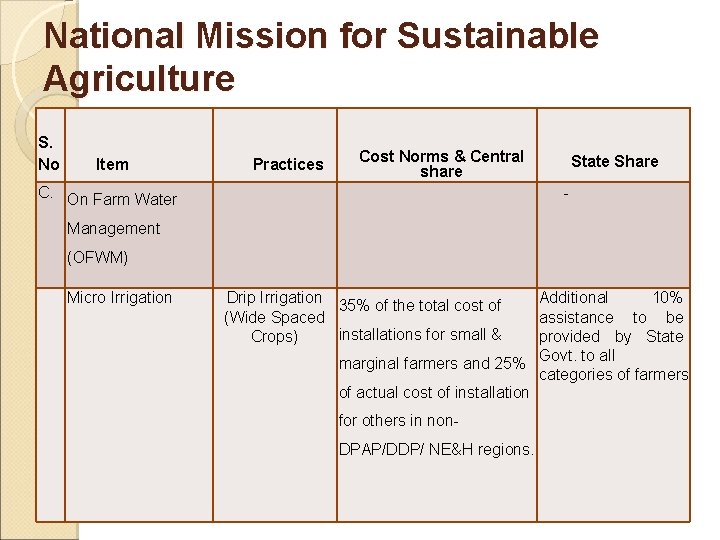
National Mission for Sustainable Agriculture S. No Item Practices Cost Norms & Central share C. On Farm Water State Share Management (OFWM) Micro Irrigation Drip Irrigation 35% of the total cost of (Wide Spaced installations for small & Crops) Additional 10% assistance to be provided by State marginal farmers and 25% Govt. to all categories of farmers of actual cost of installation for others in non DPAP/DDP/ NE&H regions.
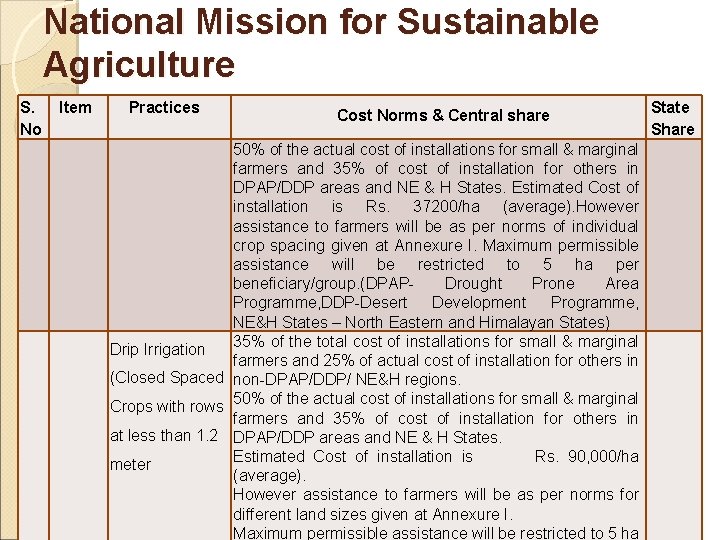
National Mission for Sustainable Agriculture S. Item No Practices Cost Norms & Central share 50% of the actual cost of installations for small & marginal farmers and 35% of cost of installation for others in DPAP/DDP areas and NE & H States. Estimated Cost of installation is Rs. 37200/ha (average). However assistance to farmers will be as per norms of individual crop spacing given at Annexure I. Maximum permissible assistance will be restricted to 5 ha per beneficiary/group. (DPAP Drought Prone Area Programme, DDP Desert Development Programme, NE&H States – North Eastern and Himalayan States) Drip Irrigation 35% of the total cost of installations for small & marginal farmers and 25% of actual cost of installation for others in (Closed Spaced non DPAP/DDP/ NE&H regions. Crops with rows 50% of the actual cost of installations for small & marginal farmers and 35% of cost of installation for others in at less than 1. 2 DPAP/DDP areas and NE & H States. Estimated Cost of installation is Rs. 90, 000/ha meter (average). However assistance to farmers will be as per norms for different land sizes given at Annexure I. Maximum permissible assistance will be restricted to 5 ha State Share
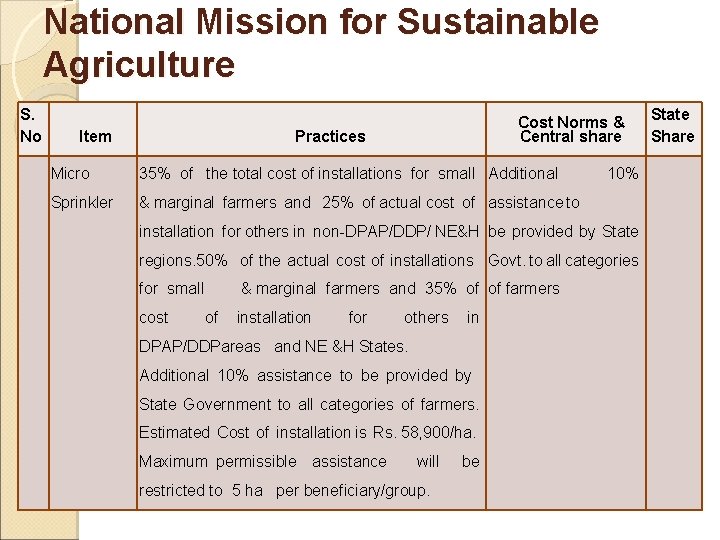
National Mission for Sustainable Agriculture S. No Item Micro Sprinkler Practices Cost Norms & Central share 35% of the total cost of installations for small Additional 10% & marginal farmers and 25% of actual cost of assistance to installation for others in non DPAP/DDP/ NE&H be provided by State regions. 50% of the actual cost of installations Govt. to all categories for small & marginal farmers and 35% of of farmers cost of installation for others in DPAP/DDPareas and NE &H States. Additional 10% assistance to be provided by State Government to all categories of farmers. Estimated Cost of installation is Rs. 58, 900/ha. Maximum permissible assistance will be restricted to 5 ha per beneficiary/group. State Share
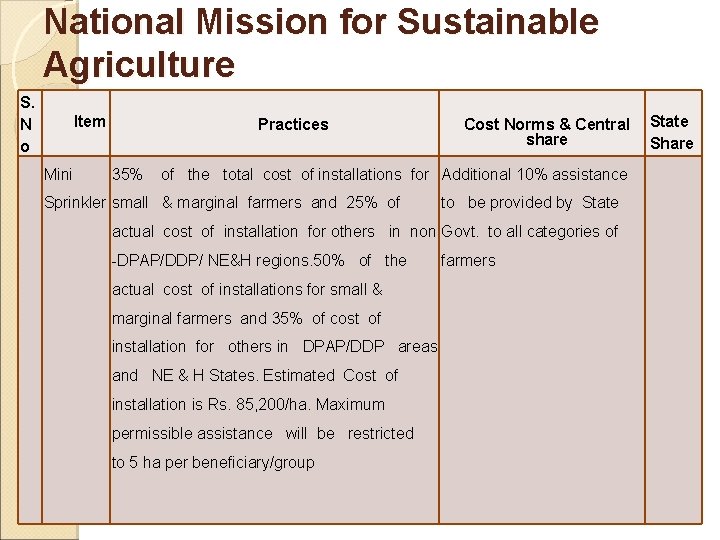
National Mission for Sustainable Agriculture S. N o Item Mini Practices Cost Norms & Central share 35% of the total cost of installations for Additional 10% assistance Sprinkler small & marginal farmers and 25% of to be provided by State actual cost of installation for others in non Govt. to all categories of DPAP/DDP/ NE&H regions. 50% of the farmers actual cost of installations for small & marginal farmers and 35% of cost of installation for others in DPAP/DDP areas and NE & H States. Estimated Cost of installation is Rs. 85, 200/ha. Maximum permissible assistance will be restricted to 5 ha per beneficiary/group State Share
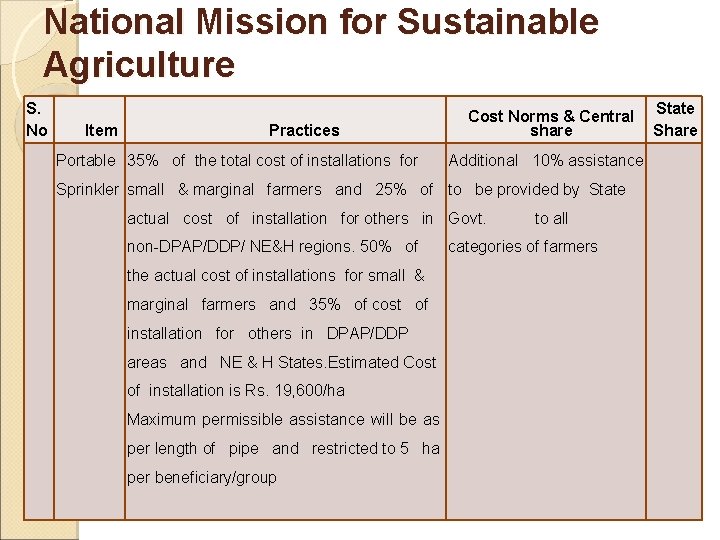
National Mission for Sustainable Agriculture S. No Item Practices Portable 35% of the total cost of installations for Cost Norms & Central share Additional 10% assistance Sprinkler small & marginal farmers and 25% of to be provided by State actual cost of installation for others in Govt. to all non DPAP/DDP/ NE&H regions. 50% of the actual cost of installations for small & marginal farmers and 35% of cost of installation for others in DPAP/DDP areas and NE & H States. Estimated Cost of installation is Rs. 19, 600/ha Maximum permissible assistance will be as per length of pipe and restricted to 5 ha per beneficiary/group categories of farmers State Share
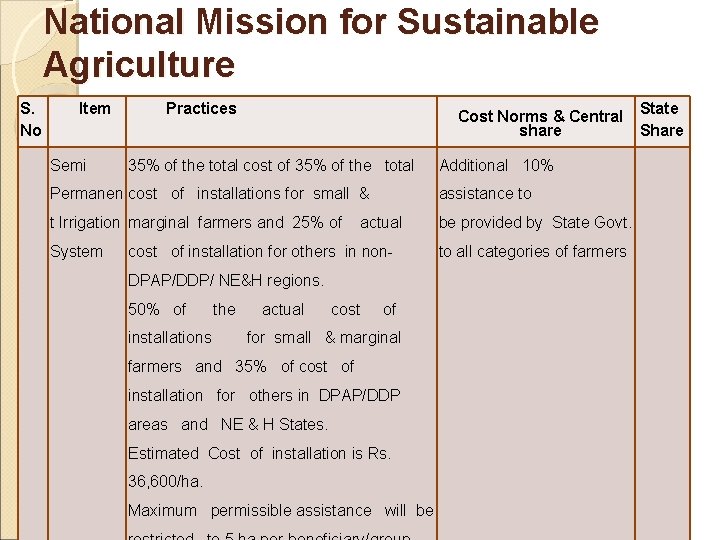
National Mission for Sustainable Agriculture S. No Item Practices State Cost Norms & Central Share share Semi 35% of the total cost of 35% of the total Additional 10% Permanen cost of installations for small & assistance to t Irrigation marginal farmers and 25% of actual be provided by State Govt. System to all categories of farmers cost of installation for others in non DPAP/DDP/ NE&H regions. 50% of the actual cost of installations for small & marginal farmers and 35% of cost of installation for others in DPAP/DDP areas and NE & H States. Estimated Cost of installation is Rs. 36, 600/ha. Maximum permissible assistance will be
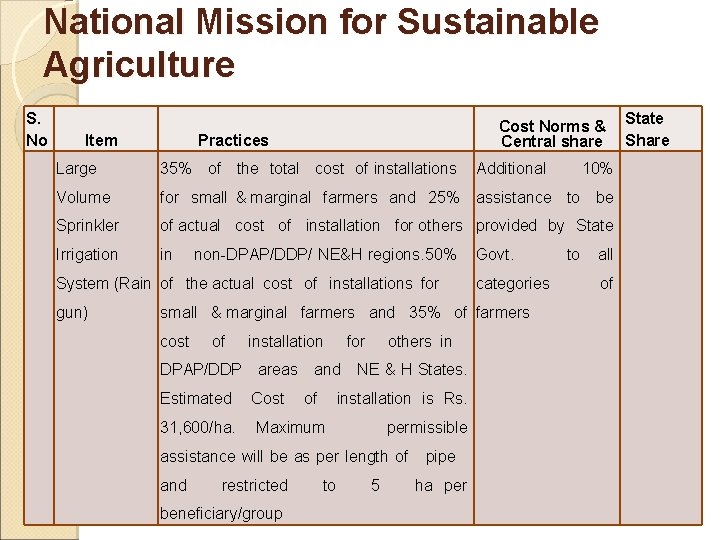
National Mission for Sustainable Agriculture S. No Item Practices Cost Norms & Central share Large 35% of the total cost of installations Additional Volume 10% for small & marginal farmers and 25% assistance to be Sprinkler of actual cost of installation for others provided by State Irrigation in non DPAP/DDP/ NE&H regions. 50% Govt. to all System (Rain of the actual cost of installations for categories gun) small & marginal farmers and 35% of farmers cost of installation for others in DPAP/DDP areas and NE & H States. Estimated Cost of installation is Rs. 31, 600/ha. Maximum permissible assistance will be as per length of pipe and restricted to 5 ha per beneficiary/group of State Share
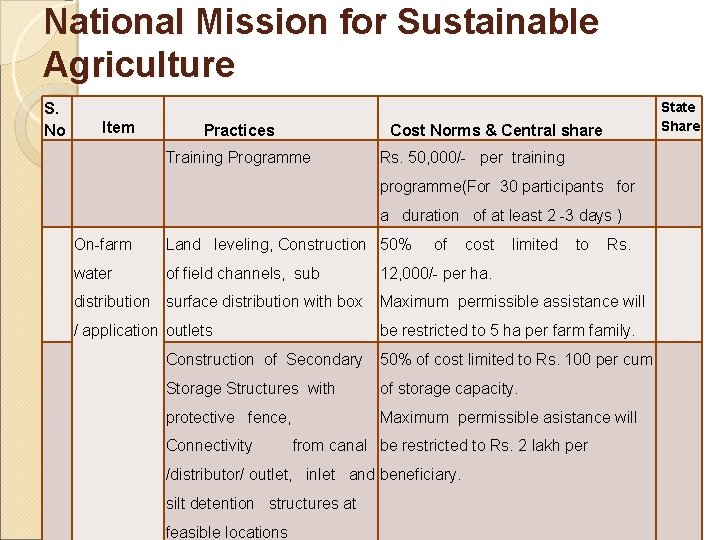
National Mission for Sustainable Agriculture S. No Item Practices Training Programme Cost Norms & Central share Rs. 50, 000/ per training programme(For 30 participants for a duration of at least 2 3 days ) On farm Land leveling, Construction 50% of cost limited to Rs. water of field channels, sub 12, 000/ per ha. distribution surface distribution with box Maximum permissible assistance will / application outlets be restricted to 5 ha per farm family. Construction of Secondary 50% of cost limited to Rs. 100 per cum Storage Structures with of storage capacity. protective fence, Maximum permissible asistance will Connectivity from canal be restricted to Rs. 2 lakh per /distributor/ outlet, inlet and beneficiary. silt detention structures at feasible locations State Share
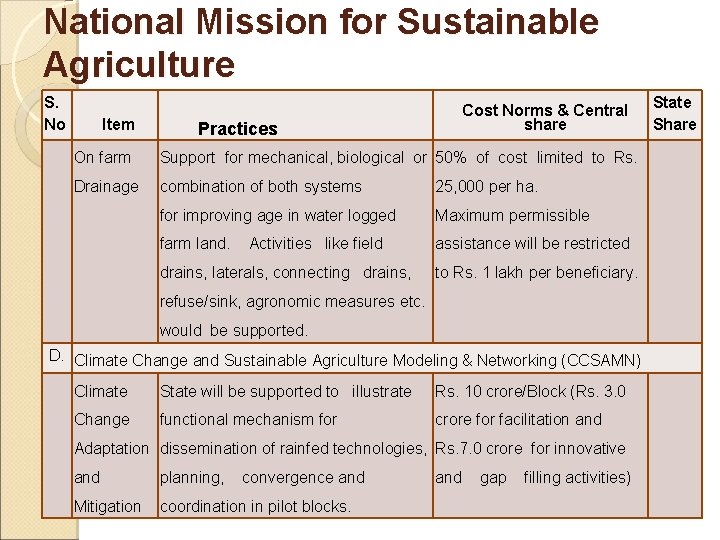
National Mission for Sustainable Agriculture S. No Item On farm Drainage Cost Norms & Central share Practices Support for mechanical, biological or 50% of cost limited to Rs. combination of both systems 25, 000 per ha. for improving age in water logged Maximum permissible farm land. Activities like field assistance will be restricted drains, laterals, connecting drains, to Rs. 1 lakh per beneficiary. refuse/sink, agronomic measures etc. would be supported. D. Climate Change and Sustainable Agriculture Modeling & Networking (CCSAMN) Climate State will be supported to illustrate Rs. 10 crore/Block (Rs. 3. 0 Change functional mechanism for crore for facilitation and Adaptation dissemination of rainfed technologies, Rs. 7. 0 crore for innovative and planning, convergence and Mitigation coordination in pilot blocks. and gap filling activities) State Share
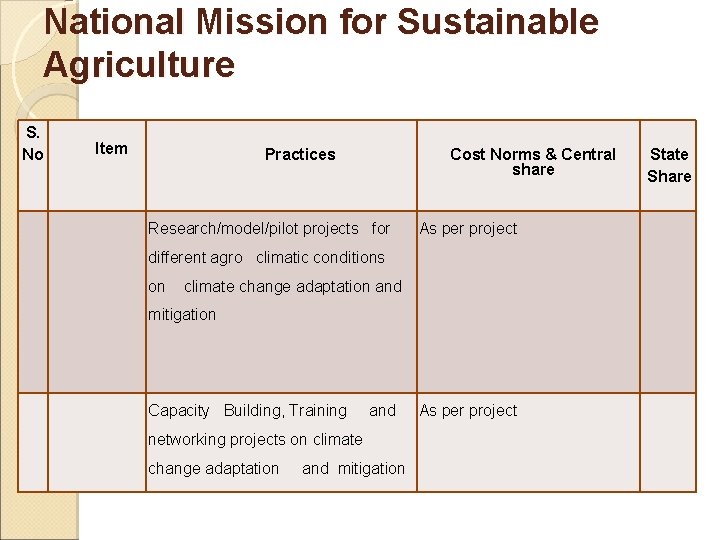
National Mission for Sustainable Agriculture S. No Item Practices Cost Norms & Central share Research/model/pilot projects for As per project different agro climatic conditions on climate change adaptation and mitigation Capacity Building, Training and networking projects on climate change adaptation and mitigation As per project State Share
National Mission for Sustainable Agriculture Thank s
- Slides: 71