
National Integrity System Assessment Tool Transparency International Secretariat


- Slides: 13
National Integrity System Assessment Tool Transparency International Secretariat www. transparency. org
What is a National Integrity System Assessment? § Holistic assessment of a country’s ‘integrity system’ § Focus on corruption prevention system (both in law and in practice) § Based on belief that corruption is best fought/avoided by institutional safe-guards & reforms § Complements TI’s global indices § Provides evidence-based policy recommendations § Carried out in-country by lead researcher working closely with TI National Chapter § Conceptual foundation for much of TI’s work (TI Source Book) § Wide global application to date
Dual Purpose of the NIS § Improved understanding of the strengths and weaknesses of the country’s National Integrity System among anti-corruption community § Momentum built among key anticorruption stakeholders for addressing priority reform areas in national integrity system
SU PUBLIC AWARENESS S O C I E T Y’ S V A L U E S TY OR IE OC NATIO N L OR A CT INTER SE E PRIVAT CIVIL CT S MEDIA PUBLIC SERVICE WATCHDOG AGENCIES OMBUDSMAN AUDITOR GENERAL JUDICIARY EXECUTIVE LEGISLATURE NAL INTEG RITY RU O LE LA F W LIT QUA Y OF LIFE NATIO ST A DE B AI V L N M ELO E EN P T - S
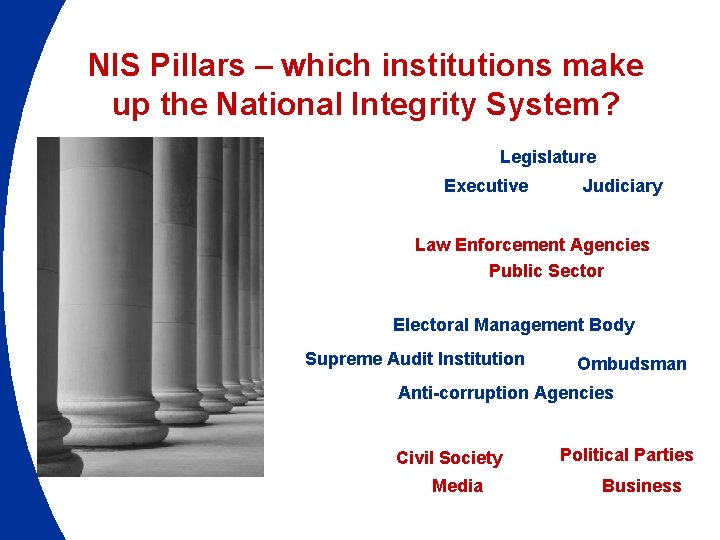
NIS Pillars – which institutions make up the National Integrity System? Legislature Executive Judiciary Law Enforcement Agencies Public Sector Electoral Management Body Supreme Audit Institution Ombudsman Anti-corruption Agencies Civil Society Media Political Parties Business
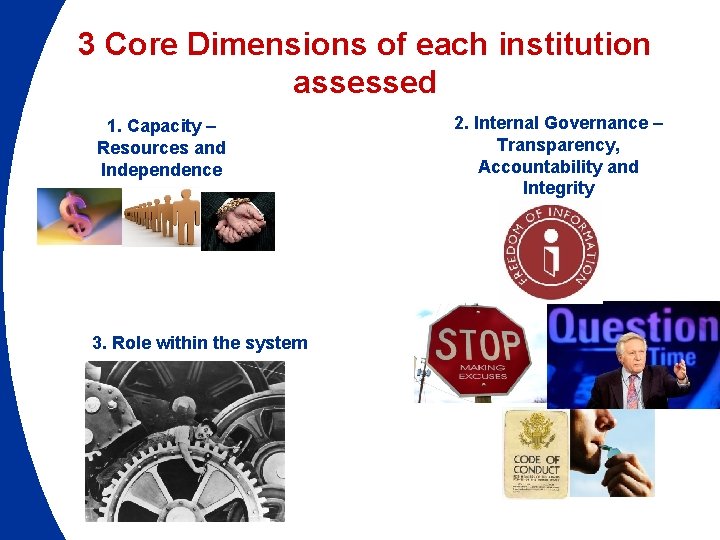
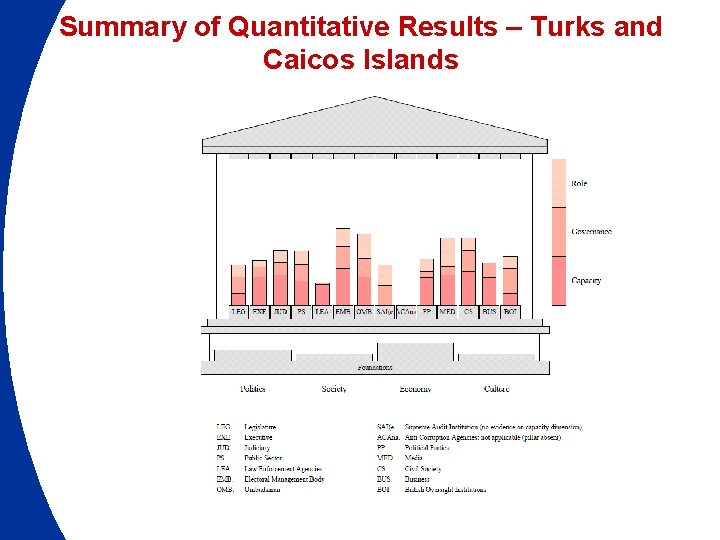
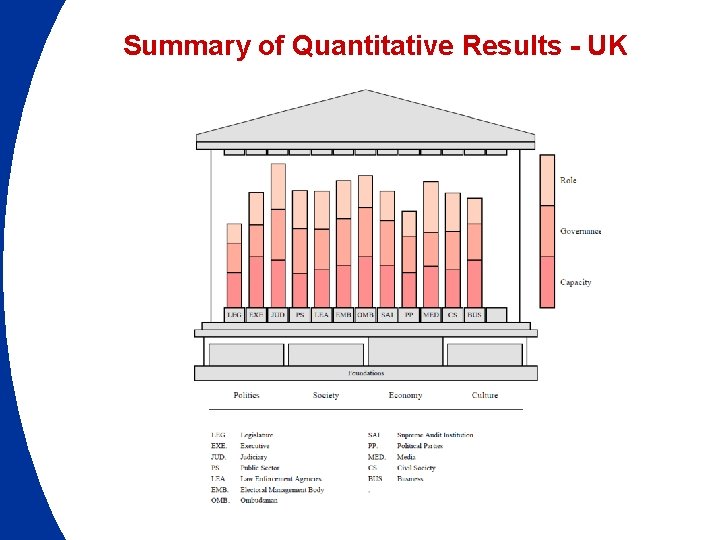
3 Core Dimensions of each institution assessed 1. Capacity – Resources and Independence 3. Role within the system 2. Internal Governance – Transparency, Accountability and Integrity
How to assess the institutions? § Toolkit, set of ‘indicator questions’ & training provided by TI-S to country team § Qualitative Data § Desk Review of existing secondary data § Key Informant Interviews with ‘insiders’ and ‘outsiders’ § Freedom of Information transparency field tests § Quantitative element § Scoring of indicators based on guidelines in toolkit § Consultative component § NIS Advisory Group § National Stakeholder Workshop § External Reviewer
Logistics § Approximately 12 months to complete (+ 12 months for advocacy) § § § Hiring lead researcher and coordinator 5 -6 months research Consultation with stakeholders Publication Follow up advocacy § $$$?
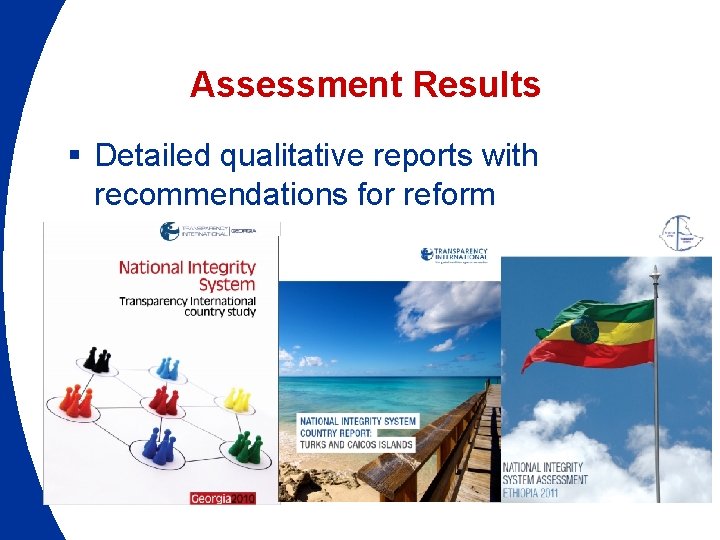
Assessment Results § Detailed qualitative reports with recommendations for reform
Summary of Quantitative Results – Turks and Caicos Islands
Summary of Quantitative Results - UK
Using NIS Studies for Policy Reform § Bosnia: starting point for anti-corruption strategy § Hungary: Impetus for introduction of whistleblower protection legislation § Cameroon: Basis for civil society advocacy for reform § Georgia: Initial govt scepticism but eventual constructive engagement on findings
For more information visit: www. transparency. org