
National Institute of Statistics of Rwanda Poverty Panel
![Analysis: Inequality 2014 Gini coefficient Estimate 95% confidence interval Theil’s T [= GE(1)] All](https://slidetodoc.com/presentation_image_h2/fb5cdcc26061ef3c1f32026d99ed1542/image-18.jpg "Analysis: Inequality 2014 Gini coefficient Estimate 95% confidence interval Theil’s T [= GE(1)] All")
- Slides: 26
National Institute of Statistics of Rwanda Poverty Panel Report Policy Dialogue about Poverty and Inequality EPRN and UNDP Marriott Hotel, Kigali May 28, 2019 Presented by: KAMANA Roger Data Analyst October 31, 2021 National Institute of Statistics of Rwanda 1
Outline Background: Evolution of GDP and poverty How poverty is measured Poverty dynamics: 1. 2. 3. a) b) 4. 5. 6. October 31, 2021 Moving into and out of poverty Moving up and down the income distribution Linking economic growth to changes in poverty Who has gained from economic growth? Correlates of movements into and out of poverty National Institute of Statistics of Rwanda 2
Outline Background: Evolution of GDP and poverty How poverty is measured Poverty dynamics: 1. 2. 3. a) b) 4. 5. 6. October 31, 2021 Moving into and out of poverty Moving up and down the income distribution Linking economic growth to changes in poverty Who has gained from economic growth? Correlates of movements into and out of poverty National Institute of Statistics of Rwanda 3
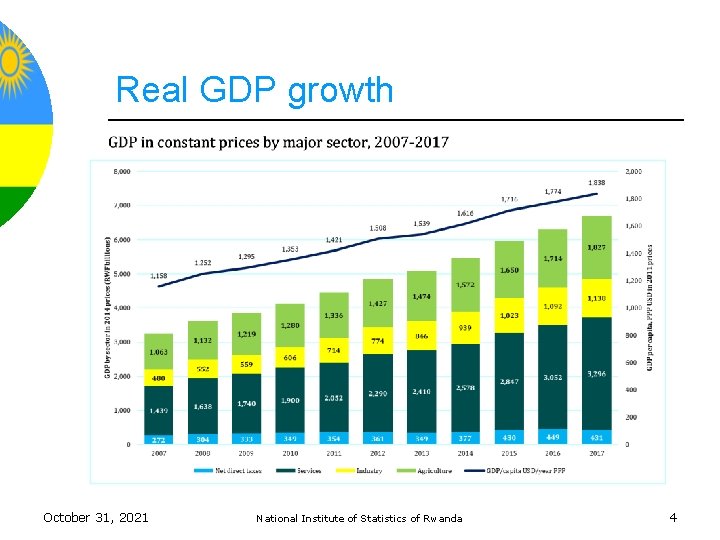
Real GDP growth October 31, 2021 National Institute of Statistics of Rwanda 4
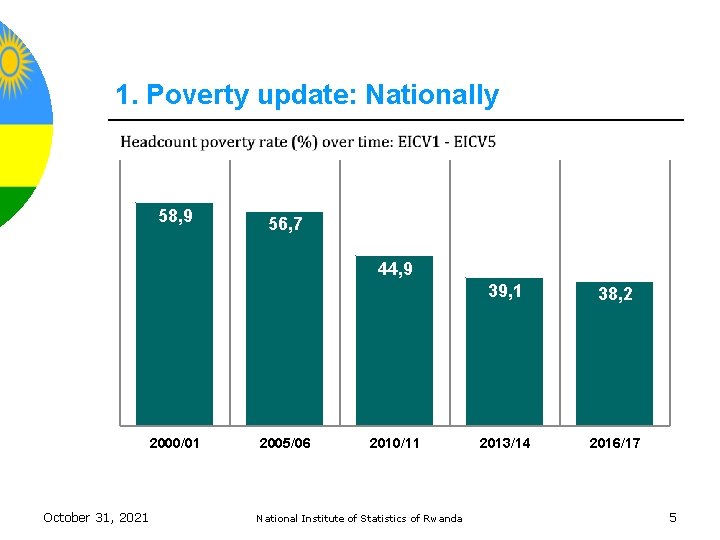
1. Poverty update: Nationally 58, 9 56, 7 44, 9 2000/01 October 31, 2021 2005/06 2010/11 National Institute of Statistics of Rwanda 39, 1 38, 2 2013/14 2016/17 5
Outline Background: Evolution of GDP and poverty How poverty is measured Poverty dynamics: 1. 2. 3. a) b) 4. 5. 6. October 31, 2021 Moving into and out of poverty Moving up and down the income distribution Linking economic growth to changes in poverty Who has gained from economic growth? Correlates of movements into and out of poverty National Institute of Statistics of Rwanda 6
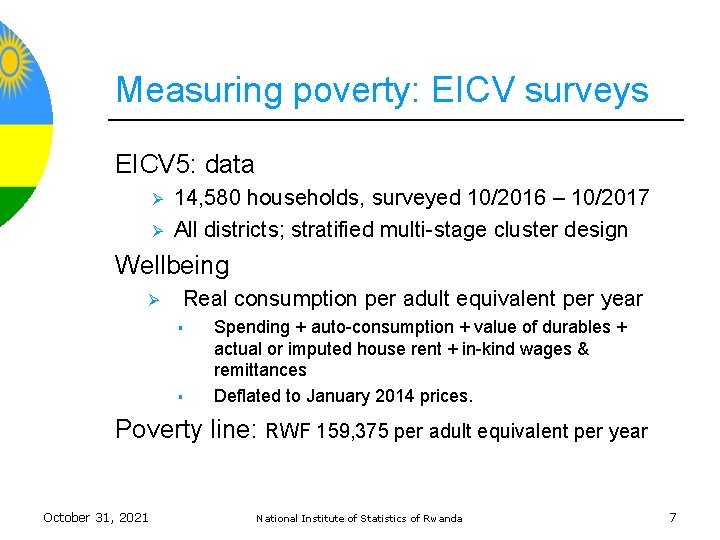
Measuring poverty: EICV surveys EICV 5: data Ø Ø 14, 580 households, surveyed 10/2016 – 10/2017 All districts; stratified multi-stage cluster design Wellbeing Ø Real consumption per adult equivalent per year § § Spending + auto-consumption + value of durables + actual or imputed house rent + in-kind wages & remittances Deflated to January 2014 prices. Poverty line: RWF 159, 375 per adult equivalent per year October 31, 2021 National Institute of Statistics of Rwanda 7
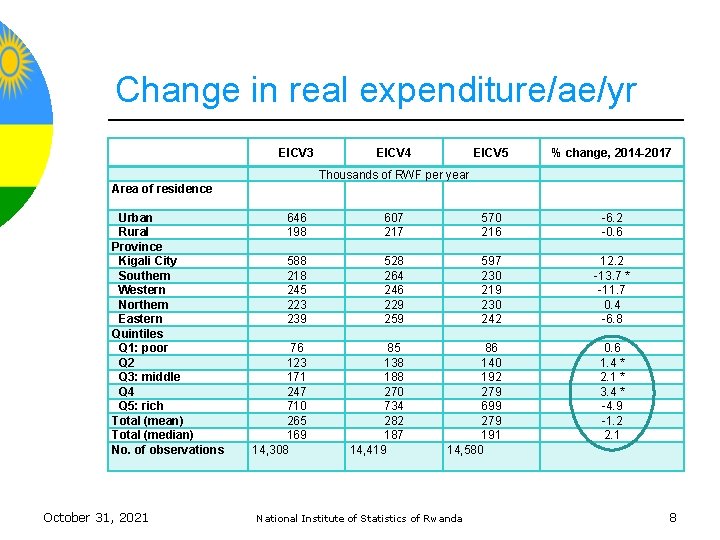
Change in real expenditure/ae/yr EICV 3 EICV 4 EICV 5 % change, 2014 -2017 Thousands of RWF per year Area of residence Urban Rural Province Kigali City Southern Western Northern Eastern Quintiles Q 1: poor Q 2 Q 3: middle Q 4 Q 5: rich Total (mean) Total (median) No. of observations October 31, 2021 646 198 607 217 570 216 -6. 2 -0. 6 588 218 245 223 239 528 264 246 229 259 597 230 219 230 242 12. 2 -13. 7 * -11. 7 0. 4 -6. 8 76 123 171 247 710 265 169 14, 308 85 138 188 270 734 282 187 14, 419 86 140 192 279 699 279 191 14, 580 National Institute of Statistics of Rwanda 0. 6 1. 4 * 2. 1 * 3. 4 * -4. 9 -1. 2 2. 1 8
Outline Background: Evolution of GDP and poverty How poverty is measured Poverty dynamics: 1. 2. 3. a) b) 4. 5. 6. October 31, 2021 Moving into and out of poverty Moving up and down the income distribution Linking economic growth to changes in poverty Who has gained from economic growth? Correlates of movements into and out of poverty National Institute of Statistics of Rwanda 9
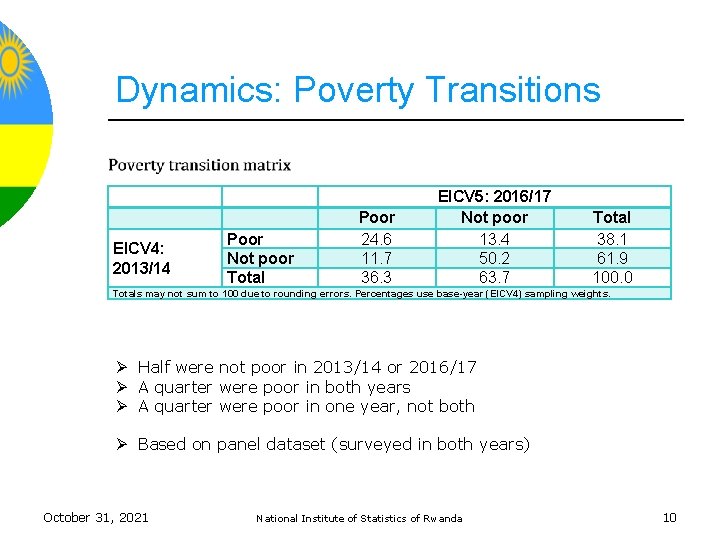
Dynamics: Poverty Transitions EICV 4: 2013/14 Poor Not poor Total Poor 24. 6 11. 7 36. 3 EICV 5: 2016/17 Not poor 13. 4 50. 2 63. 7 Total 38. 1 61. 9 100. 0 Totals may not sum to 100 due to rounding errors. Percentages use base-year (EICV 4) sampling weights. Ø Half were not poor in 2013/14 or 2016/17 Ø A quarter were poor in both years Ø A quarter were poor in one year, not both Ø Based on panel dataset (surveyed in both years) October 31, 2021 National Institute of Statistics of Rwanda 10
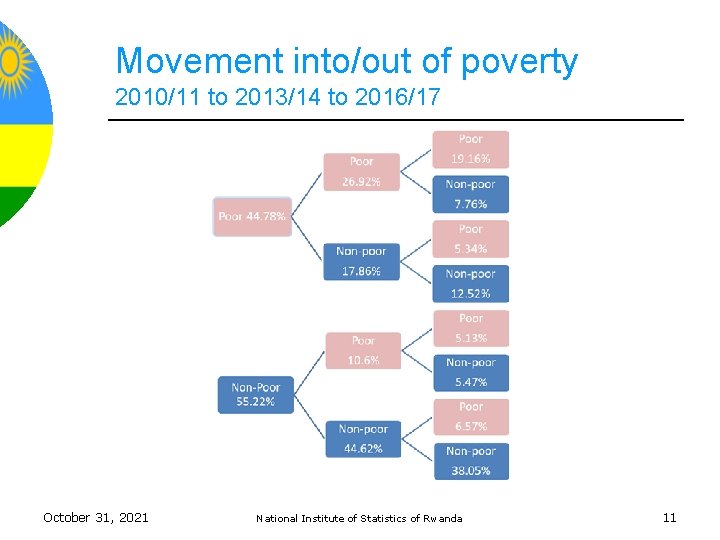
Movement into/out of poverty 2010/11 to 2013/14 to 2016/17 October 31, 2021 National Institute of Statistics of Rwanda 11
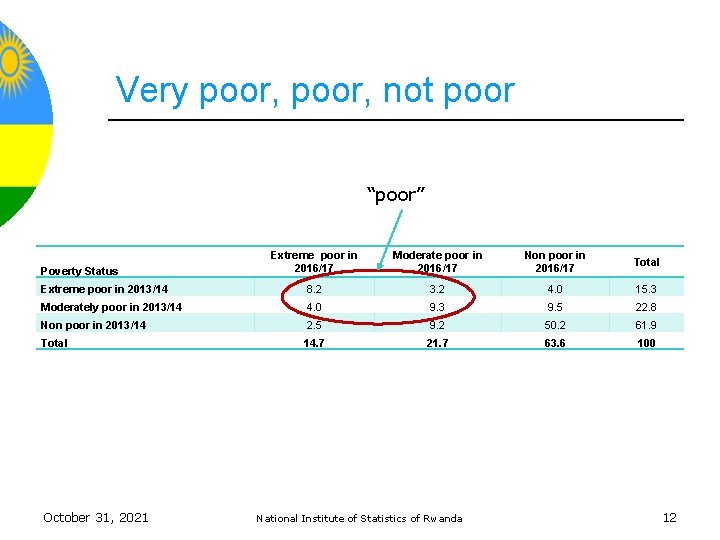
Very poor, not poor “poor” Extreme poor in 2016/17 Moderate poor in 2016/17 Non poor in 2016/17 Total Extreme poor in 2013/14 8. 2 3. 2 4. 0 15. 3 Moderately poor in 2013/14 4. 0 9. 3 9. 5 22. 8 Non poor in 2013/14 2. 5 9. 2 50. 2 61. 9 Total 14. 7 21. 7 63. 6 100 Poverty Status October 31, 2021 National Institute of Statistics of Rwanda 12
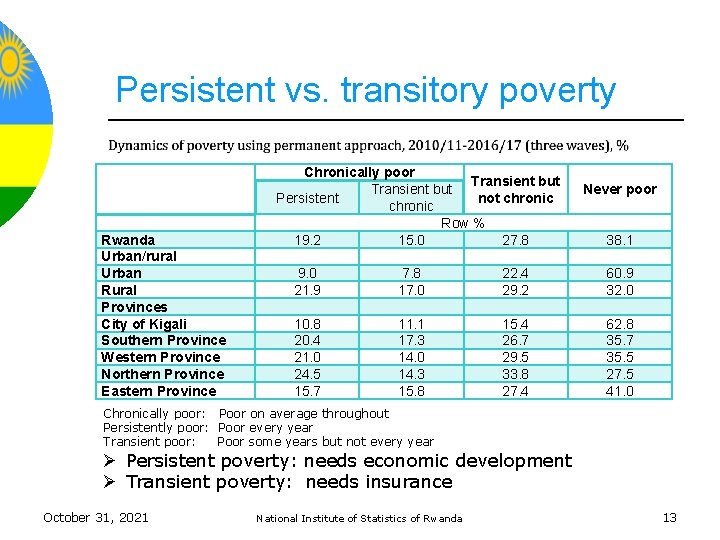
Persistent vs. transitory poverty Rwanda Urban/rural Urban Rural Provinces City of Kigali Southern Province Western Province Northern Province Eastern Province Chronically poor Transient but not chronic Persistent chronic Row % 19. 2 15. 0 27. 8 Never poor 38. 1 9. 0 21. 9 7. 8 17. 0 22. 4 29. 2 60. 9 32. 0 10. 8 20. 4 21. 0 24. 5 15. 7 11. 1 17. 3 14. 0 14. 3 15. 8 15. 4 26. 7 29. 5 33. 8 27. 4 62. 8 35. 7 35. 5 27. 5 41. 0 Chronically poor: Poor on average throughout Persistently poor: Poor every year Transient poor: Poor some years but not every year Ø Persistent poverty: needs economic development Ø Transient poverty: needs insurance October 31, 2021 National Institute of Statistics of Rwanda 13
Outline Background: Evolution of GDP and poverty How poverty is measured Poverty dynamics: 1. 2. 3. a) b) 4. 5. 6. October 31, 2021 Moving into and out of poverty Moving up and down the income distribution Linking economic growth to changes in poverty Who has gained from economic growth? Correlates of movements into and out of poverty National Institute of Statistics of Rwanda 14
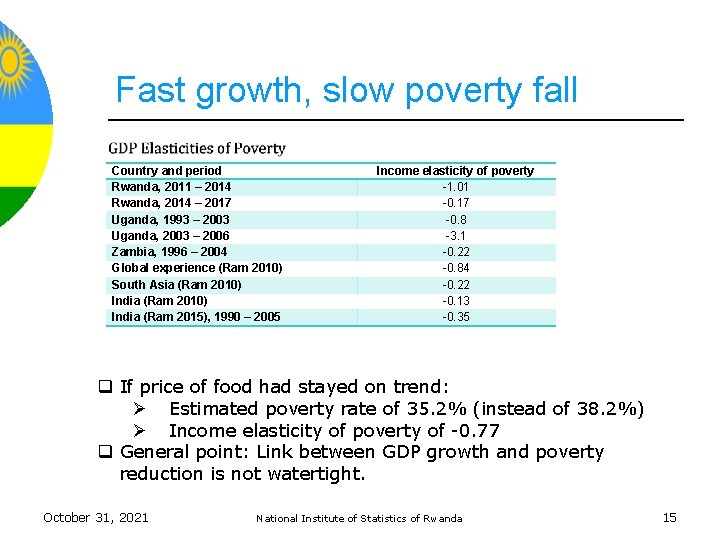
Fast growth, slow poverty fall Country and period Rwanda, 2011 – 2014 Rwanda, 2014 – 2017 Uganda, 1993 – 2003 Uganda, 2003 – 2006 Zambia, 1996 – 2004 Global experience (Ram 2010) South Asia (Ram 2010) India (Ram 2015), 1990 – 2005 Income elasticity of poverty -1. 01 -0. 17 -0. 8 -3. 1 -0. 22 -0. 84 -0. 22 -0. 13 -0. 35 q If price of food had stayed on trend: Ø Estimated poverty rate of 35. 2% (instead of 38. 2%) Ø Income elasticity of poverty of -0. 77 q General point: Link between GDP growth and poverty reduction is not watertight. October 31, 2021 National Institute of Statistics of Rwanda 15
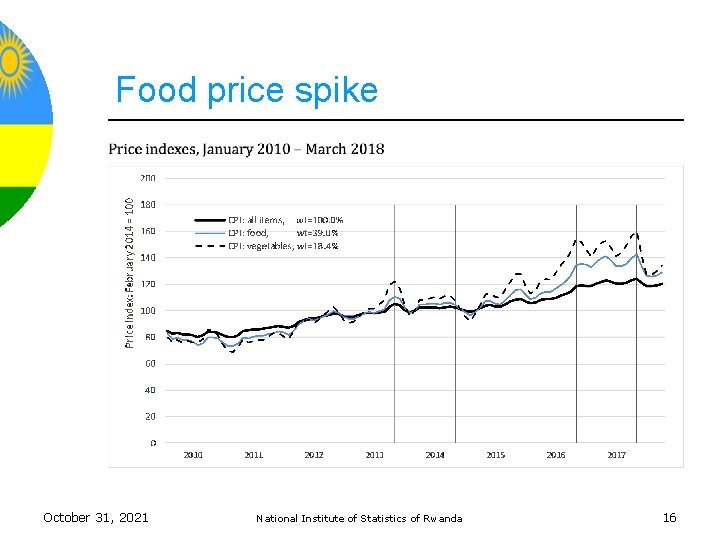
Food price spike October 31, 2021 National Institute of Statistics of Rwanda 16
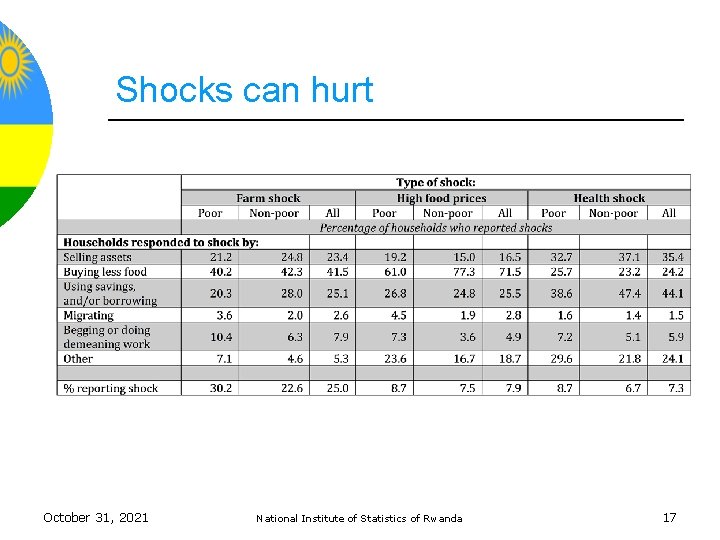
Shocks can hurt October 31, 2021 National Institute of Statistics of Rwanda 17
Analysis: Inequality 2014 Gini coefficient Estimate 95% confidence interval Theil’s T [= GE(1)] All Rwanda Urban Rural Decomposition: “within” inequality “between” inequality Memo: “between” inequality as % of total inequality 2017 Change 0. 447 0. 436 -0. 459 0. 420 -0. 438 -0. 018 0. 442 0. 533 0. 225 0. 374 0. 417 0. 198 -0. 068 -0. 116 -0. 027 0. 335 0. 107 0. 277 0. 097 -0. 058 -0. 010 24% 26% Ø Inequality fell between 2013/14 and 2016/17 Ø Rural inequality is low Ø A quarter of inequality is due to urban/rural divide Ø Why? Mainly because reported expend. /ae of rich fell October 31, 2021 National Institute of Statistics of Rwanda 18
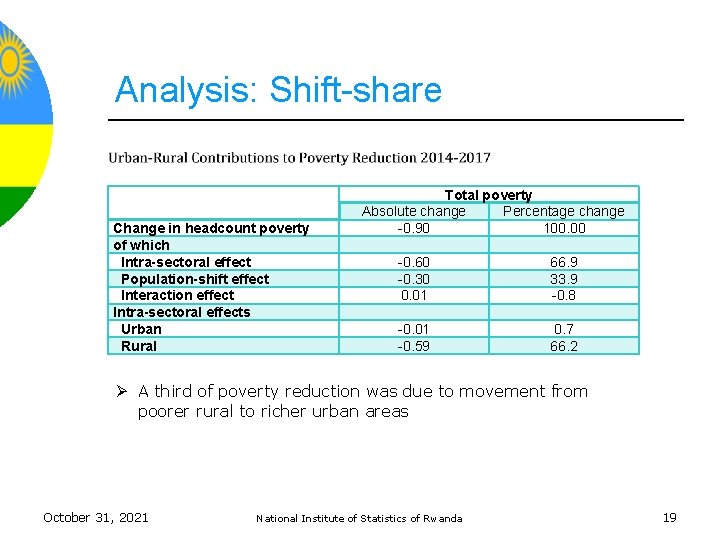
Analysis: Shift-share Change in headcount poverty of which Intra-sectoral effect Population-shift effect Interaction effect Intra-sectoral effects Urban Rural Total poverty Absolute change Percentage change -0. 90 100. 00 -0. 60 -0. 30 0. 01 66. 9 33. 9 -0. 8 -0. 01 -0. 59 0. 7 66. 2 Ø A third of poverty reduction was due to movement from poorer rural to richer urban areas October 31, 2021 National Institute of Statistics of Rwanda 19
Outline Background: Evolution of GDP and poverty How poverty is measured Poverty dynamics: 1. 2. 3. a) b) 4. 5. 6. October 31, 2021 Moving into and out of poverty Moving up and down the income distribution Linking economic growth to changes in poverty Who has gained from economic growth? Correlates of movements into and out of poverty National Institute of Statistics of Rwanda 20
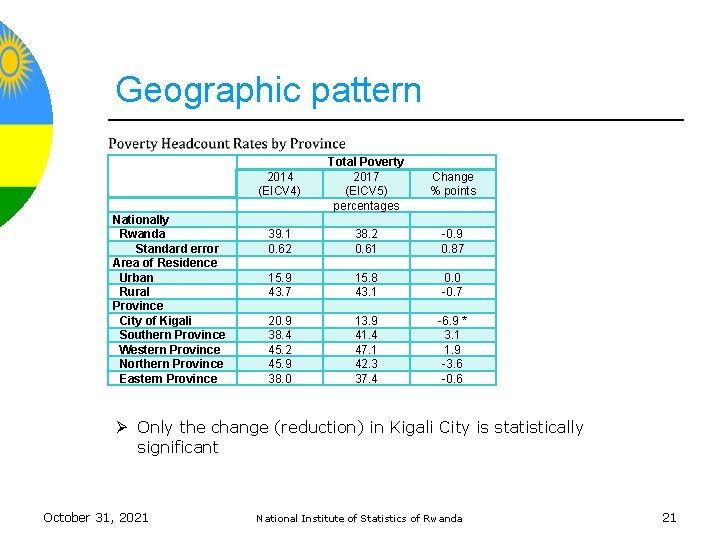
Geographic pattern Nationally Rwanda Standard error Area of Residence Urban Rural Province City of Kigali Southern Province Western Province Northern Province Eastern Province 2014 (EICV 4) Total Poverty 2017 (EICV 5) percentages Change % points 39. 1 0. 62 38. 2 0. 61 -0. 9 0. 87 15. 9 43. 7 15. 8 43. 1 0. 0 -0. 7 20. 9 38. 4 45. 2 45. 9 38. 0 13. 9 41. 4 47. 1 42. 3 37. 4 -6. 9 * 3. 1 1. 9 -3. 6 -0. 6 Ø Only the change (reduction) in Kigali City is statistically significant October 31, 2021 National Institute of Statistics of Rwanda 21
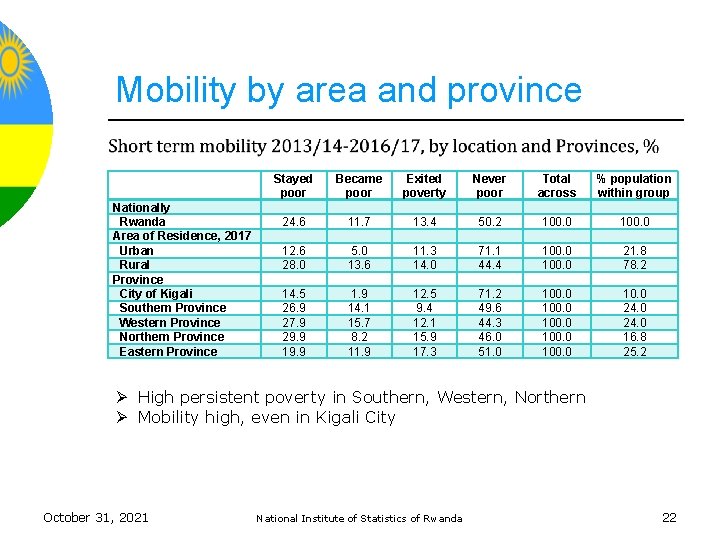
Mobility by area and province Nationally Rwanda Area of Residence, 2017 Urban Rural Province City of Kigali Southern Province Western Province Northern Province Eastern Province Stayed poor Became poor Exited poverty Never poor Total across % population within group 24. 6 11. 7 13. 4 50. 2 100. 0 12. 6 28. 0 5. 0 13. 6 11. 3 14. 0 71. 1 44. 4 100. 0 21. 8 78. 2 14. 5 26. 9 27. 9 29. 9 14. 1 15. 7 8. 2 11. 9 12. 5 9. 4 12. 1 15. 9 17. 3 71. 2 49. 6 44. 3 46. 0 51. 0 100. 0 10. 0 24. 0 16. 8 25. 2 Ø High persistent poverty in Southern, Western, Northern Ø Mobility high, even in Kigali City October 31, 2021 National Institute of Statistics of Rwanda 22
Outline Background: Evolution of GDP and poverty How poverty is measured Poverty dynamics: 1. 2. 3. a) b) 4. 5. 6. October 31, 2021 Moving into and out of poverty Moving up and down the income distribution Linking economic growth to changes in poverty Who has gained from economic growth? Correlates of movements into and out of poverty National Institute of Statistics of Rwanda 23
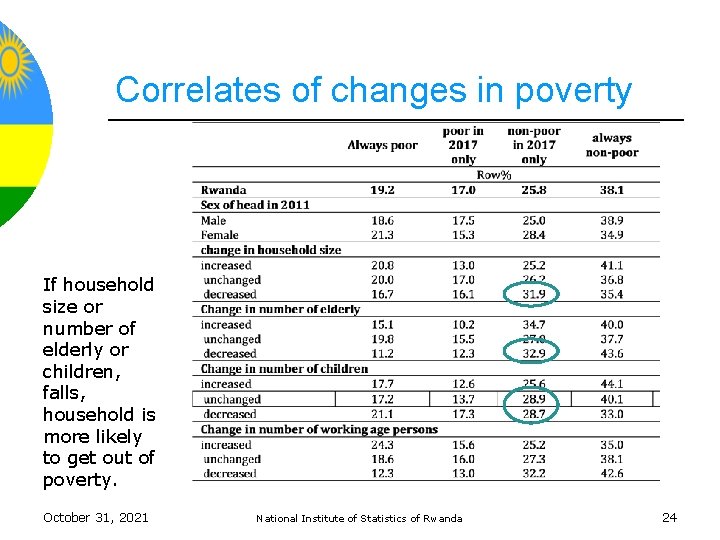
Correlates of changes in poverty If household size or number of elderly or children, falls, household is more likely to get out of poverty. October 31, 2021 National Institute of Statistics of Rwanda 24
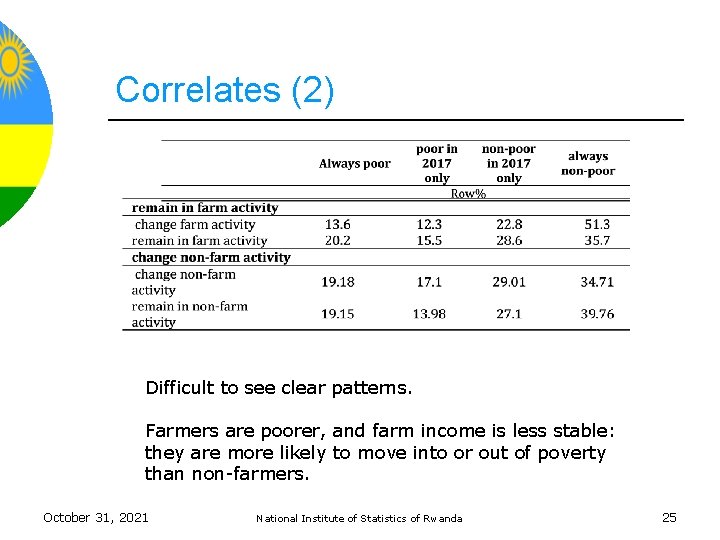
Correlates (2) Difficult to see clear patterns. Farmers are poorer, and farm income is less stable: they are more likely to move into or out of poverty than non-farmers. October 31, 2021 National Institute of Statistics of Rwanda 25
Thank you http: //www. statistics. gov. rw/ October 31, 2021 National Institute of Statistics of Rwanda 26