
National Institute of Food and AgricultureUpdate Presented to
- Slides: 10
National Institute of Food and Agriculture--Update Presented to the National Association of Agricultural Economics Administrators Sept. 9, 2011 by Robbin Shoemaker, NIFA
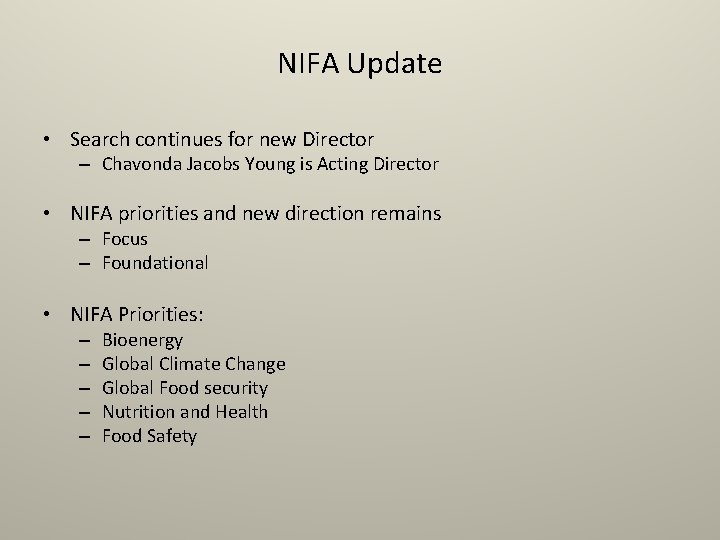
NIFA Update • Search continues for new Director – Chavonda Jacobs Young is Acting Director • NIFA priorities and new direction remains – Focus – Foundational • NIFA Priorities: – – – Bioenergy Global Climate Change Global Food security Nutrition and Health Food Safety
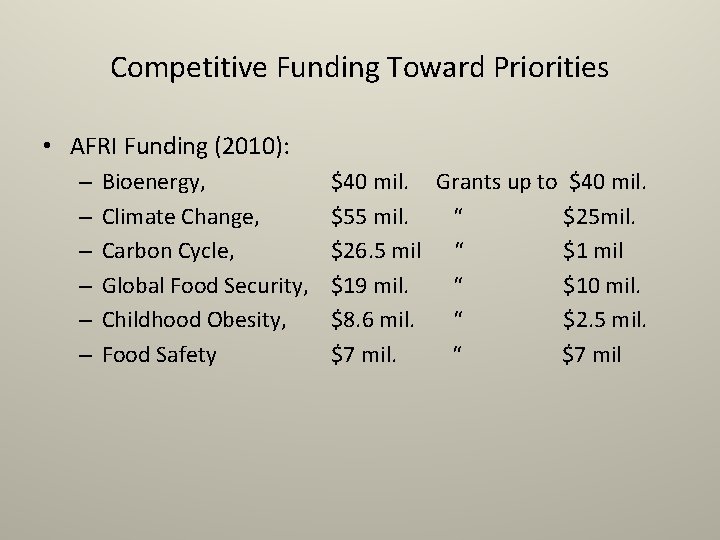
Competitive Funding Toward Priorities • AFRI Funding (2010): – – – Bioenergy, Climate Change, Carbon Cycle, Global Food Security, Childhood Obesity, Food Safety $40 mil. Grants up to $40 mil. $55 mil. “ $25 mil. $26. 5 mil “ $1 mil $19 mil. “ $10 mil. $8. 6 mil. “ $2. 5 mil. $7 mil. “ $7 mil
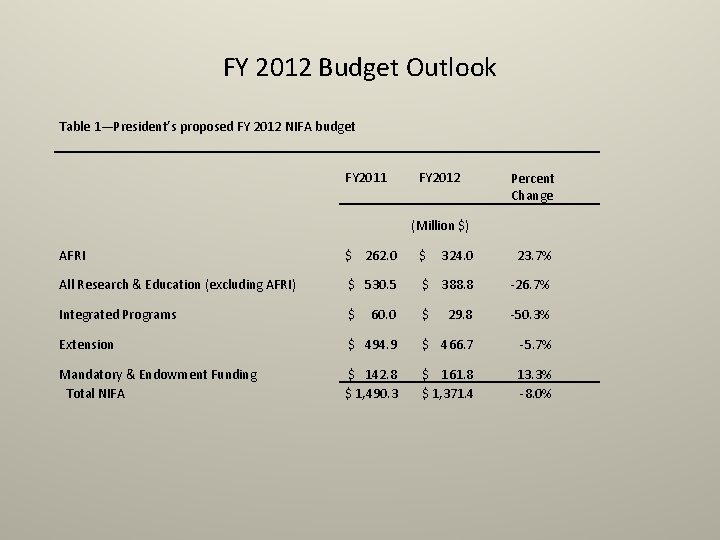
FY 2012 Budget Outlook Table 1—President’s proposed FY 2012 NIFA budget FY 2011 FY 2012 Percent Change (Million $) AFRI $ 262. 0 $ 324. 0 23. 7% All Research & Education (excluding AFRI) $ 530. 5 $ 388. 8 -26. 7% Integrated Programs $ $ 29. 8 -50. 3% Extension $ 494. 9 $ 466. 7 -5. 7% Mandatory & Endowment Funding Total NIFA $ 142. 8 $ 1, 490. 3 $ 161. 8 $ 1, 371. 4 13. 3% -8. 0% 60. 0
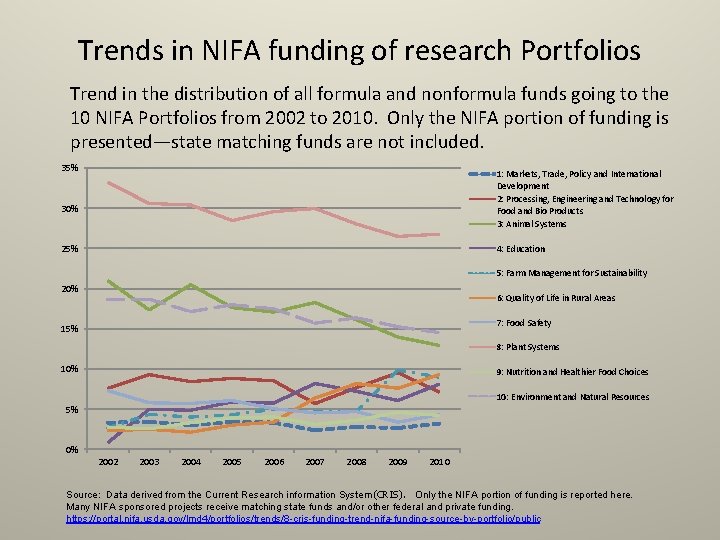
Trends in NIFA funding of research Portfolios Trend in the distribution of all formula and nonformula funds going to the 10 NIFA Portfolios from 2002 to 2010. Only the NIFA portion of funding is presented—state matching funds are not included. 35% 1: Markets, Trade, Policy and International Development 2: Processing, Engineering and Technology for Food and Bio Products 3: Animal Systems 30% 25% 4: Education 5: Farm Management for Sustainability 20% 6: Quality of Life in Rural Areas 7: Food Safety 15% 8: Plant Systems 10% 9: Nutrition and Healthier Food Choices 10: Environment and Natural Resources 5% 0% 2002 2003 2004 2005 2006 2007 2008 2009 2010 Source: Data derived from the Current Research information System (CRIS). Only the NIFA portion of funding is reported here. Many NIFA sponsored projects receive matching state funds and/or other federal and private funding. https: //portal. nifa. usda. gov/lmd 4/portfolios/trends/8 -cris-funding-trend-nifa-funding-source-by-portfolio/public
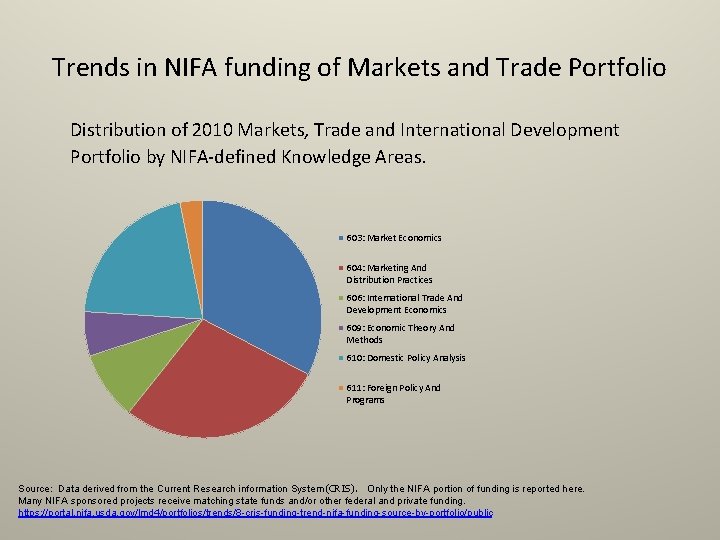
Trends in NIFA funding of Markets and Trade Portfolio Distribution of 2010 Markets, Trade and International Development Portfolio by NIFA-defined Knowledge Areas. 603: Market Economics 604: Marketing And Distribution Practices 606: International Trade And Development Economics 609: Economic Theory And Methods 610: Domestic Policy Analysis 611: Foreign Policy And Programs Source: Data derived from the Current Research information System (CRIS). Only the NIFA portion of funding is reported here. Many NIFA sponsored projects receive matching state funds and/or other federal and private funding. https: //portal. nifa. usda. gov/lmd 4/portfolios/trends/8 -cris-funding-trend-nifa-funding-source-by-portfolio/public
New Science Initiatives at USDA • USDA has joined two national science initiatives – VIVO—a researcher information and collaboration network – STAR METICS— an empirical framework to measure the outcomes of science investments and demonstrate the benefits of scientific investments to the public • The initiatives address two key questions: – Who is doing what kind of research (aids collaboration)? – What are the research accomplishments?
VIVO--An interdisciplinary national network • The national network of scientists facilitates the discovery of researchers and collaborators across the country. • The information accessible through VIVO's search and browse capability will reside and be controlled locally within institutions. • VIVO is an open source semantic web application developed at Cornell. When installed and populated with researcher interests, activities, and accomplishments, it enables the discovery of research and scholarship across disciplines at that institution and beyond. – VIVO supports browsing and a search function which returns faceted results for rapid retrieval of desired information. Content in any local VIVO installation may be maintained manually, brought into VIVO in automated ways from local systems of record, such as HR, grants, course, and faculty activity databases, or from database providers such as publication aggregators and funding agencies • USDA is implementing VIVO. Implementation of VIVO across USDA’s research community will allow the Department to better connect its researchers and the research of the Department, and also inform the public of the scope of its research. • ARS initiated adoption of VIVO in USDA with the National Agricultural Library. UDSA science agencies included are – Forest Service, ERS, NASS, and NIFA. • Other Department agencies and offices will join as the effort moves forward. One goal of the implementation process is to insure alignment with the VIVO core ontology so that it will be possible to link the USDA VIVO into other institutions using VIVO. Information about VIVO can be found at: http: //vivoweb. org/
STAR METRICS—Measuring science outcomes Science and Technology in America’s Reinvestment – Measuring the Effec. T of Research on Innovation, Competitiveness and Science • STAR METRICS is a federal and university partnership which provides an empirical framework to measure the outcomes of science investments and demonstrate the benefits of those investments to the public. The project is led by the NIH and the NSF under the auspices of OSTP. • USDA has recently joined the STAR METICS initiative along with DOE and EPA. • Project has two phases: – Phase I: Development of a uniform, auditable and standardized measures of the initial impact of ARRA (and non. ARRA) and science investments on job creation. – Phase II: The collaborative development of measures of the impact of federal science investment in four broad categories: • • • Economic growth (through patents, firm start ups and other measures), Workforce outcomes (through student mobility and employment), Scientific knowledge (such as publications and citations) and, later, Social outcomes (such as health and environment) The benefits of STAR METRICS are that a common empirical infrastructure will be available to all universities and science agencies to quickly respond to State, Congressional and OMB requests. Information about STAR METICS can be found at: www. starmetrics. nih. gov/
Let me know what you think • Ag Economist participation in AFRI is slight despite funding increases • Feedback during comment period is slight – ? • Send comments to Tamara for anonymity – tamarawagester@cfare. org • Or me (I can take it) – rshoemaker@nifa. usda. gov