
National Initiatives Federal Policy Update Carolinas Society for





- Slides: 67
National Initiatives & Federal Policy Update Carolinas Society for Post-Acute & Long-Term Care Medicine October 28, 2018
Speaker Disclosures § Christopher Laxton has no relevant financial disclosures.
Our Vision: A world in which all post-acute and long -term care patients and residents receive the highest- quality, compassionate care for optimum health, function, and quality of life.
Our Values: § We are dedicated above all to quality in PA/LTC processes and outcomes. § We affirm that a well-trained, collaborative, interprofessional team with physician guidance is best equipped to care for PA/LTC patients. § We strive to deliver individualized, goal-directed care in all PA/LTC settings of care. § We are tireless advocates in all venues. § We are committed to being a credible information resource on PA/LTC. § We are a community – connected to and supportive of each other.
Our Mission: § We promote and enhance the development of competent, compassionate and committed medical practitioners and leaders to provide goal-centered care across all post-acute and long-term care settings. § Dedicated to defining and improving quality, we advance our mission through timely professional development, evidencebased clinical guidance and tireless advocacy on behalf of members, patients, families and staff.
An Interprofessional Focus § 2014: § Renamed AMDA – The Society for Post-Acute and Long-Term Care Medicine § Expanded membership: NPs and PAs are “general members” with voting rights and may serve in the HOD and on the AMDA board § First APRN (Alice Bonner) elected to the AMDA Board in 2018 § 2016: § GAPNA joint membership agreement § 2017: § Practice Management Section and Practice Group Network established for PA/LTC practice groups § ACHCA joint membership agreement § 2018: § NADONA, AADNS interested in joint membership § More practices join PGN § PA/LTC Leadership Group formalized
Focus on Assisted Living § Three AL Summits: in 12/2014 and 11/2015 in Columbia, MD, and in 3/2017 at the Phoenix conference § Center for Excellence in Assisted Living (CEAL) co-sponsored the 2017 and future summits/intensives § All major players in assisted living participated § Report published in Caring, August 2018 § Acknowledges the higher/rising health care needs of AL residents § Seeks more consistency in care in a highly heterogeneous setting § AL intensives at AMDA 2015– 18 Annual Conferences; planning for 2019 § Editorials published in JAMDA to generate discussion § AL medical director model agreement in development
AMDA’s 2019 Strategy § Focus is on cross-setting care – medically complex population management: not about the buildings § Role is to be experts in transitions and medical complexity – two key characteristics of PA/LTC § Key is on collaboration: § Team-based care and building team capacity § Professional affiliation, collaboration – speaking with one voice
A Better Definition of Quality in PA/LTC § Transition from volume-based to value-based reimbursement requires appropriate quality measures for PA/LTC medicine § We are working on reportable, physician-sensitive quality measures that address relevant outcomes for patients § Quality Measures Committee is working to define a focused core measure set for PA/LTC medicine § Research group developing ACOVE measures for physicians practicing in nursing homes (JAMDA October 2018) § Funding opportunity through MACRA to field-test medical specialty measures announced in March; AMDA submitted an application but was not funded § Practice management leaders working to explore a registry to house and report measures for MIPS and possibly a QCDR
Support for PA/LTC Physicians § PA/LTC Physician Competencies § Physician Competencies approved by the AMDA board in March 2013 § Online training curriculum for PA/LTC clinicians is now completed and available § Plans for 2018 & beyond: Distribute the training widely through partnerships, Geriatric Fellowship programs, residency programs, large practices § ABPLM has completed job analyses (JA) for the medical director and attending physician to establish the unique and specialized nature of this practice setting § Both JAs slated for publication in JAMDA this year § Feasibility study this fall on the viability of a new credential § Next – Validation: Research to show the value of specialized training and skills
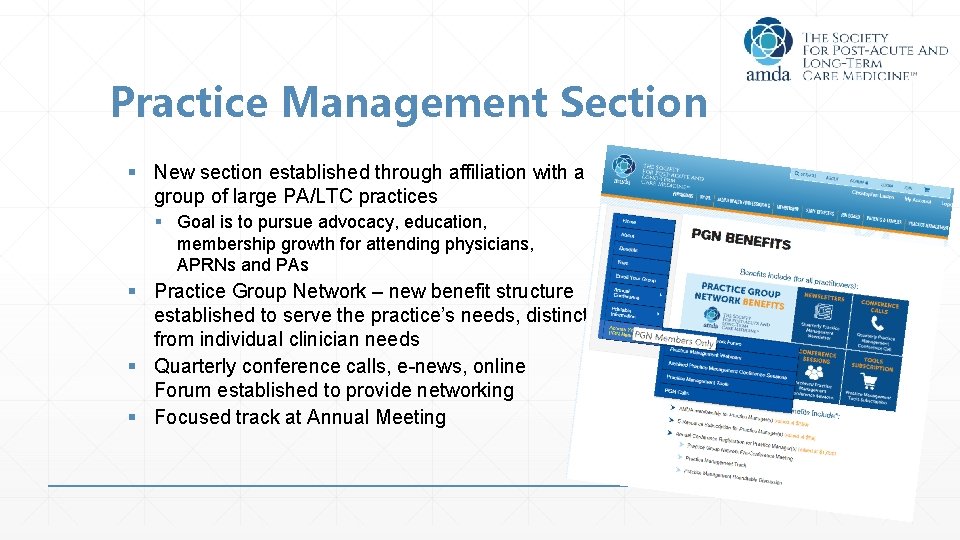
Practice Management Section § New section established through affiliation with a group of large PA/LTC practices § Goal is to pursue advocacy, education, membership growth for attending physicians, APRNs and PAs § Practice Group Network – new benefit structure established to serve the practice’s needs, distinct from individual clinician needs § Quarterly conference calls, e-news, online Forum established to provide networking § Focused track at Annual Meeting
PA/LTC Leadership Forum § Started years ago as a luncheon for nursing home chain CMOs at the Annual Meeting § Expanded to include practice group CMOs and ACO/MCO CMOs § Now meet in-person three times/year at Annual Meeting and at AMDA HQ § Unique forum for discussion of corporate medical issues in PA/LTC § No standards for the CMO role, but an interest in educational attainment
New Directions for Clinical Tools § Clinical Practice Guidelines improvements: § We need to continue to update the CPGs; possibly combine some, split others § Looking to publish updated CPGs in JAMDA for wider distribution/access § Actively working on conversion of CPG content to EHR use in CDS § § § Interactive versions of the Know-it-All series Mobile apps for clinical tools Pocket guides for quick reviews of clinical pathways Embed clinical decision support/order sets into EHRs A key AMDA Board priority § CPG/Tools Subcommittee established in 2017 for this purpose § 2019 strategy goal to establish mobile, actionable clinical guidance
AMDA Podcast Launched: AOTG! § Explore the field of post-acute and long-term care, with expert interviews, journal article reviews, innovations news, and more. § 18 episodes recorded so far § Two episodes/month are planned § ~20 minutes in duration § Eligible for CMD credit § Hosted by Dr. Wayne Saltsman § 7, 000 downloads so far!
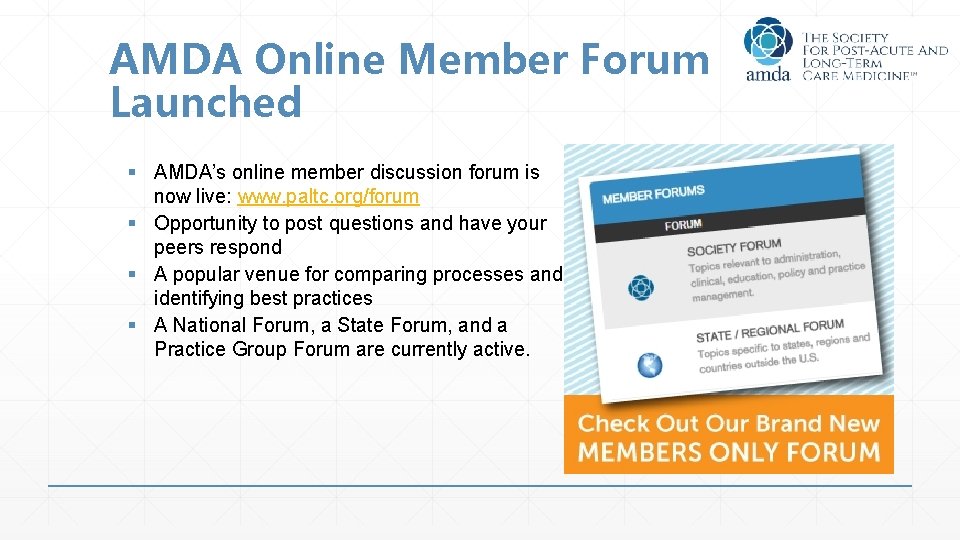
AMDA Online Member Forum Launched § AMDA’s online member discussion forum is now live: www. paltc. org/forum § Opportunity to post questions and have your peers respond § A popular venue for comparing processes and identifying best practices § A National Forum, a State Forum, and a Practice Group Forum are currently active.
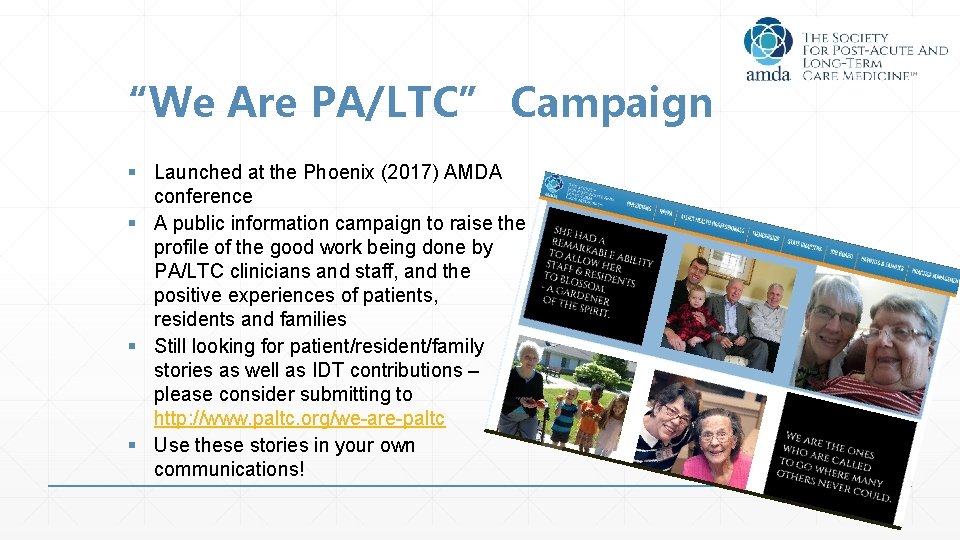
“We Are PA/LTC” Campaign § Launched at the Phoenix (2017) AMDA conference § A public information campaign to raise the profile of the good work being done by PA/LTC clinicians and staff, and the positive experiences of patients, residents and families § Still looking for patient/resident/family stories as well as IDT contributions – please consider submitting to http: //www. paltc. org/we-are-paltc § Use these stories in your own communications!
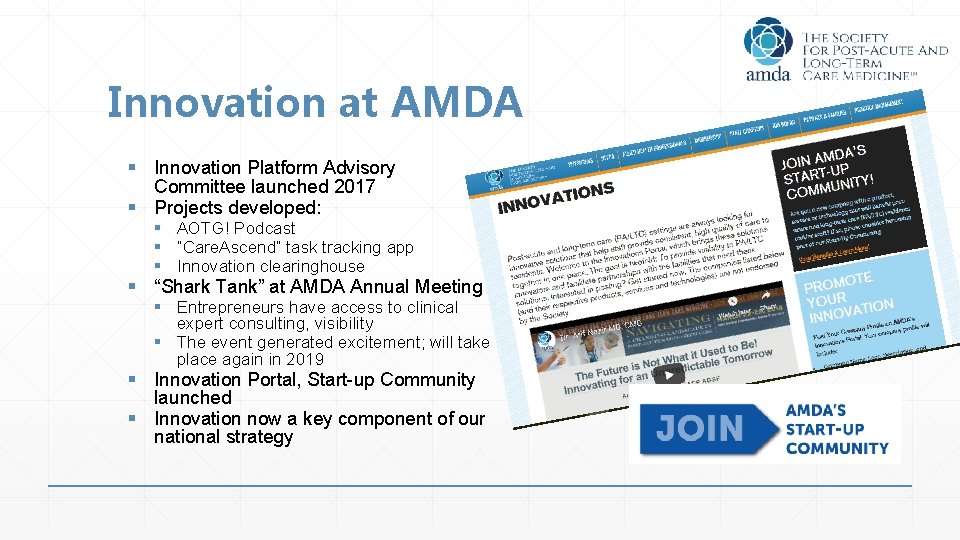
Innovation at AMDA § Innovation Platform Advisory Committee launched 2017 § Projects developed: § AOTG! Podcast § “Care. Ascend” task tracking app § Innovation clearinghouse § “Shark Tank” at AMDA Annual Meeting § Entrepreneurs have access to clinical expert consulting, visibility § The event generated excitement; will take place again in 2019 § Innovation Portal, Start-up Community launched § Innovation now a key component of our national strategy
Your Foundation
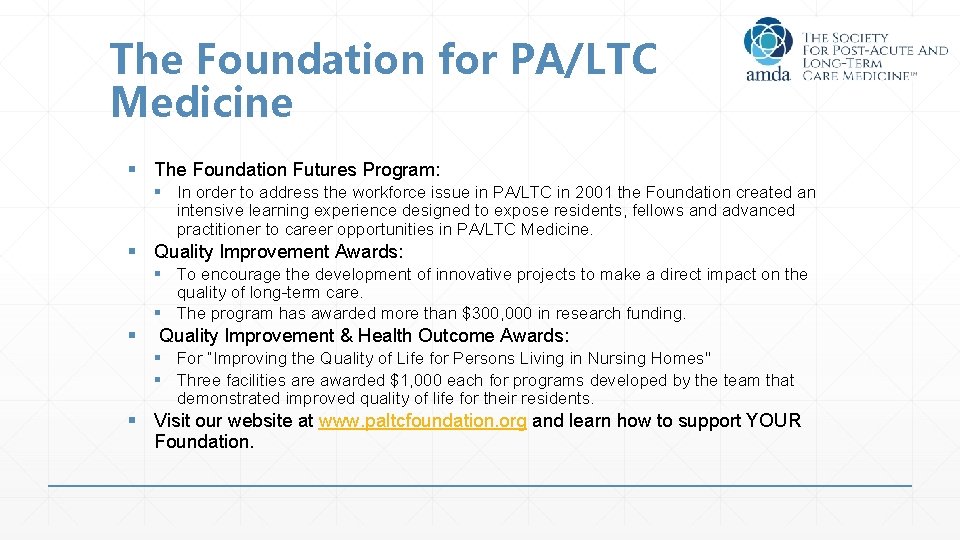
The Foundation for PA/LTC Medicine § § § Separately incorporated 501(c)(3) organization formed in 1996 to advance the quality of life for persons in post-acute & long-term care (PA/LTC) through inspiring, recognizing and educating future and current health care professionals. In 2016, the Society’s Board of Directors directed the Foundation to be the fundraising vehicle for all Society affiliates. In addition to changing its name to align with the Society, the Foundation Board restructured and created a Development Committee. Under the guidance of the Board, the committee is directly responsible for raising funds for its programs to support not only the Foundation’s mission but that of the Society and ABPLM. Proposals from all Society entities were solicited to determine funding priorities. The Board of Directors established the following priorities for fundraising: § Development of the PA/LTC workforce § Quality measures development § Professional impact research that demonstrates the value of our members in this continuum § In addition to fundraising, the Foundation will continue its successful awards programs to recognize and educate health care practitioners.
The Foundation for PA/LTC Medicine § The Foundation Futures Program: § In order to address the workforce issue in PA/LTC in 2001 the Foundation created an intensive learning experience designed to expose residents, fellows and advanced practitioner to career opportunities in PA/LTC Medicine. § Quality Improvement Awards: § To encourage the development of innovative projects to make a direct impact on the quality of long-term care. § The program has awarded more than $300, 000 in research funding. § Quality Improvement & Health Outcome Awards: § For “Improving the Quality of Life for Persons Living in Nursing Homes" § Three facilities are awarded $1, 000 each for programs developed by the team that demonstrated improved quality of life for their residents. § Visit our website at www. paltcfoundation. org and learn how to support YOUR Foundation.
Federal Policy Update
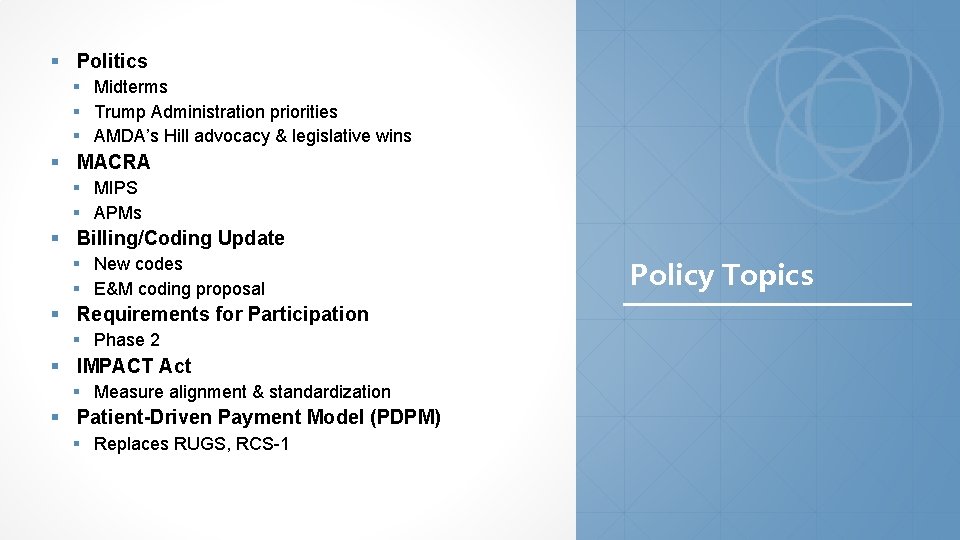
§ Politics § Midterms § Trump Administration priorities § AMDA’s Hill advocacy & legislative wins § MACRA § MIPS § APMs § Billing/Coding Update § New codes § E&M coding proposal § Requirements for Participation § Phase 2 § IMPACT Act § Measure alignment & standardization § Patient-Driven Payment Model (PDPM) § Replaces RUGS, RCS-1 Policy Topics
Political Update 2018
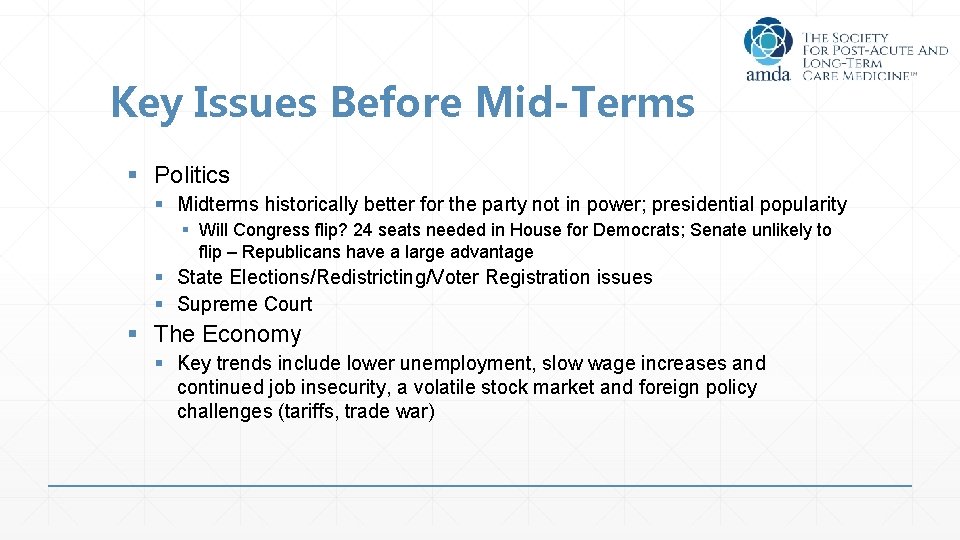
Key Issues Before Mid-Terms § Politics § Midterms historically better for the party not in power; presidential popularity § Will Congress flip? 24 seats needed in House for Democrats; Senate unlikely to flip – Republicans have a large advantage § State Elections/Redistricting/Voter Registration issues § Supreme Court § The Economy § Key trends include lower unemployment, slow wage increases and continued job insecurity, a volatile stock market and foreign policy challenges (tariffs, trade war)
Administration’s Regulatory Goals § Patients over Paperwork Campaign § Reduce Admin Burden § Less time spent on things like EHR and Documentation § Meaningful Measures § Too many measures across programs § Confusing and meaningless in terms of patient outcomes § Streamline measures and measure reporting § Complete overhaul of Meaningful Use/ACI (latest: ACI/MU renamed “promoting interoperability”) § My Health. EData Initiative (latest: hospital COP to require sharing data with patients? ) § Overhaul of E&M Guidelines
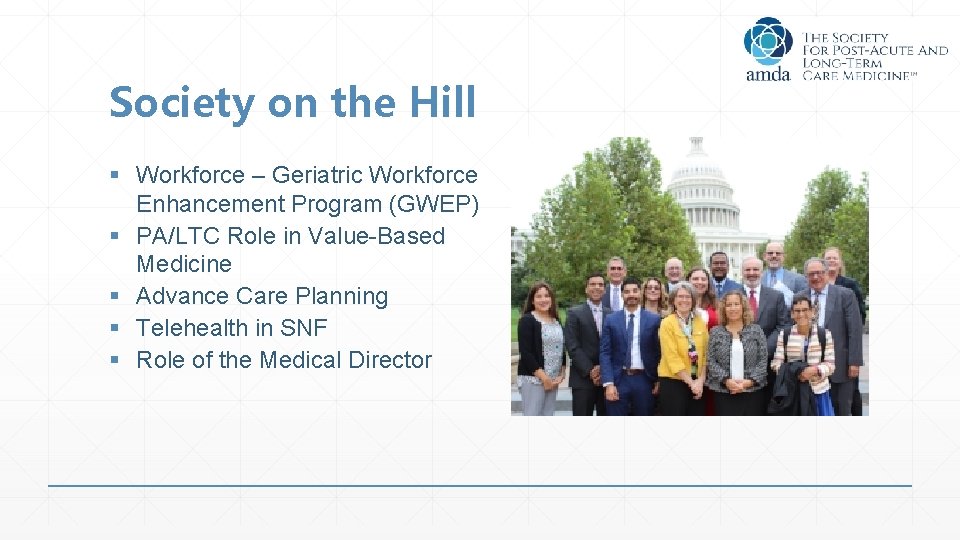
Society on the Hill § Workforce – Geriatric Workforce Enhancement Program (GWEP) § PA/LTC Role in Value-Based Medicine § Advance Care Planning § Telehealth in SNF § Role of the Medical Director
Legislative Victories § Permanent Repeal of Therapy Caps – 20+ years in the making § Signed into Law: Recognize, Assist, Include, Support and Engage (RAISE) Family Caregivers Act (S. 1028), requires the development of a national strategy that would identify specific actions that government, communities, providers, employers, and others can take to recognize and support family caregivers. § Passed out of committee: Good Samaritan Health Professional Act of 2017, a bill that protects health care professionals from being held liable for harm caused by providing health care services during a national or public health emergency, or a major disaster. § Physician Payment Changes – reduction in MACRA penalty liability; physician payment protections
MACRA MIPS / APMs
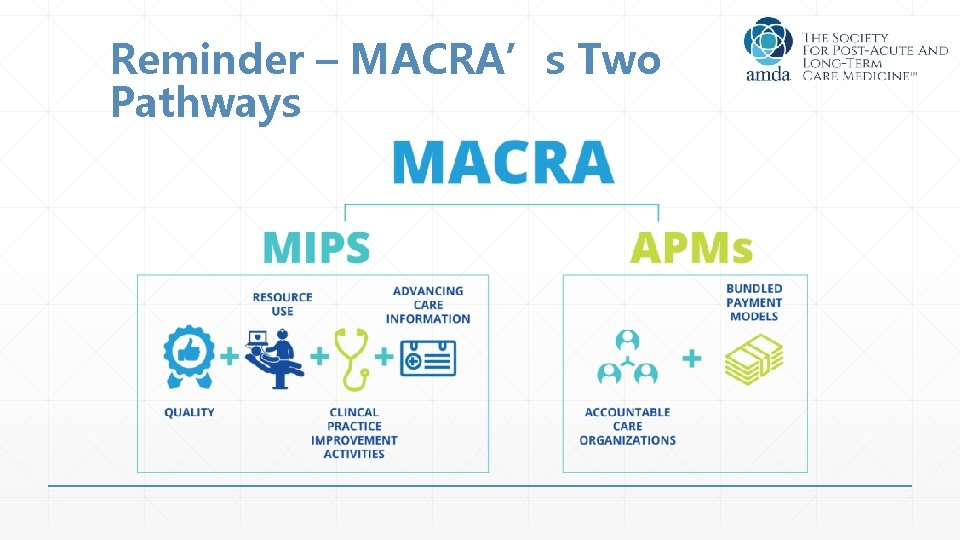
Reminder – MACRA’s Two Pathways
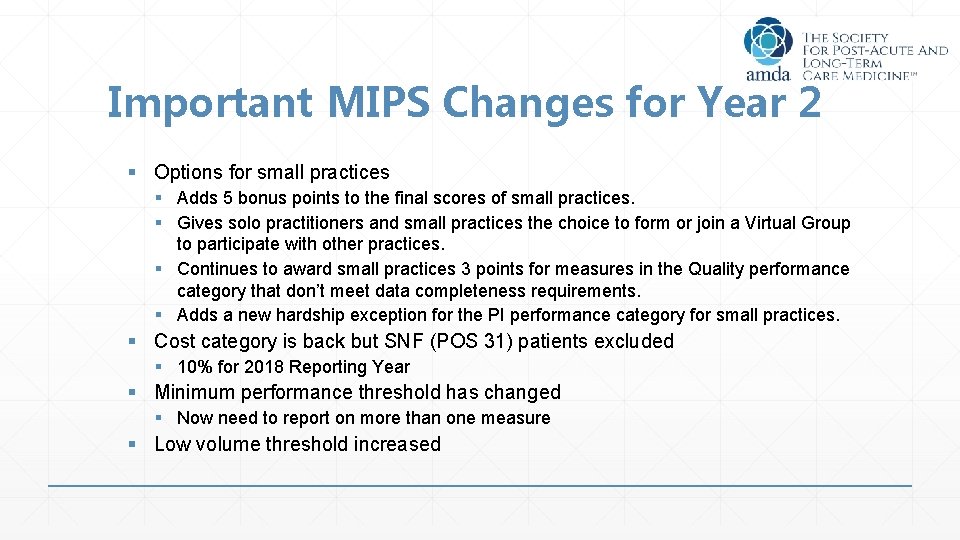
Important MIPS Changes for Year 2 § Options for small practices § Adds 5 bonus points to the final scores of small practices. § Gives solo practitioners and small practices the choice to form or join a Virtual Group to participate with other practices. § Continues to award small practices 3 points for measures in the Quality performance category that don’t meet data completeness requirements. § Adds a new hardship exception for the PI performance category for small practices. § Cost category is back but SNF (POS 31) patients excluded § 10% for 2018 Reporting Year § Minimum performance threshold has changed § Now need to report on more than one measure § Low volume threshold increased
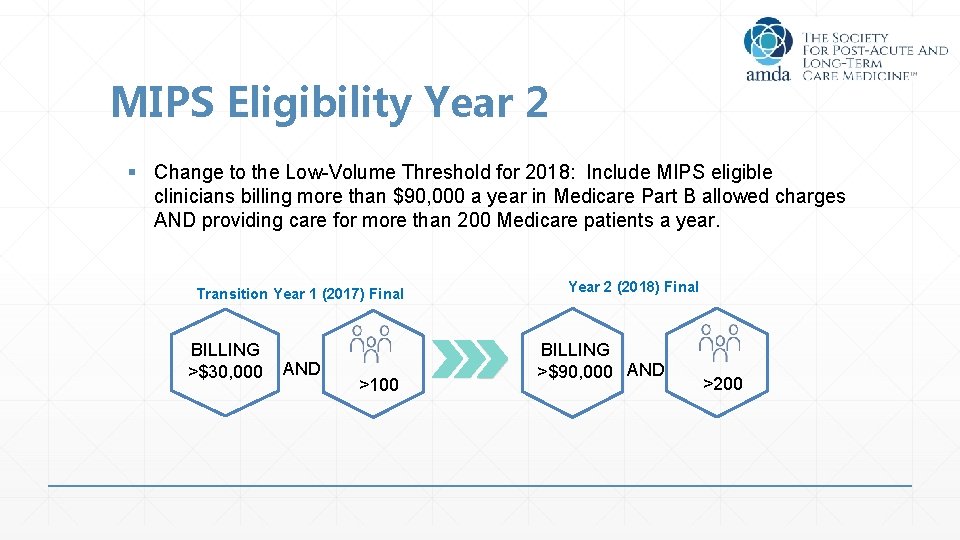
MIPS Eligibility Year 2 § Change to the Low-Volume Threshold for 2018: Include MIPS eligible clinicians billing more than $90, 000 a year in Medicare Part B allowed charges AND providing care for more than 200 Medicare patients a year. Transition Year 1 (2017) Final BILLING >$30, 000 AND >100 Year 2 (2018) Final BILLING >$90, 000 AND >200
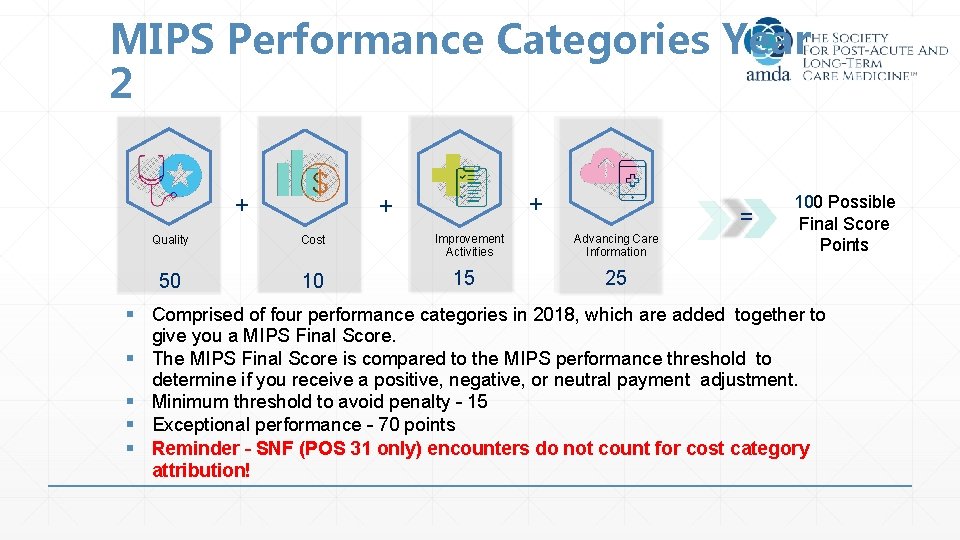
MIPS Performance Categories Year 2 + + + Quality Cost 50 10 Improvement Activities 15 = Advancing Care Information 100 Possible Final Score Points 25 § Comprised of four performance categories in 2018, which are added together to give you a MIPS Final Score. § The MIPS Final Score is compared to the MIPS performance threshold to determine if you receive a positive, negative, or neutral payment adjustment. § Minimum threshold to avoid penalty – 15 § Exceptional performance – 70 points § Reminder – SNF (POS 31 only) encounters do not count for cost category attribution!
MIPS – Should I stay or should I go? § Med. PAC, President’s Budget and Health Affairs articles have all called for repeal of MIPS § Specialty societies are so far not on board with the idea – continue work on simplification of reporting and scoring § Something to monitor but continue to participate – MIPS is likely to be with us for the foreseeable future!
Changes Proposed in Year 3 § SNF specialty set of measures – win for AMDA advocacy! § Facility-based scoring – currently available for hospitalists, CMS is looking for ideas on how to do this for PAC § New patient reported outcome measures § Deleting 10 measures from “library” § Changes to category weights – cost at 15 points! § Additional cost measures and refinement of current ones
Alternative Payment Models MIPS / APMs
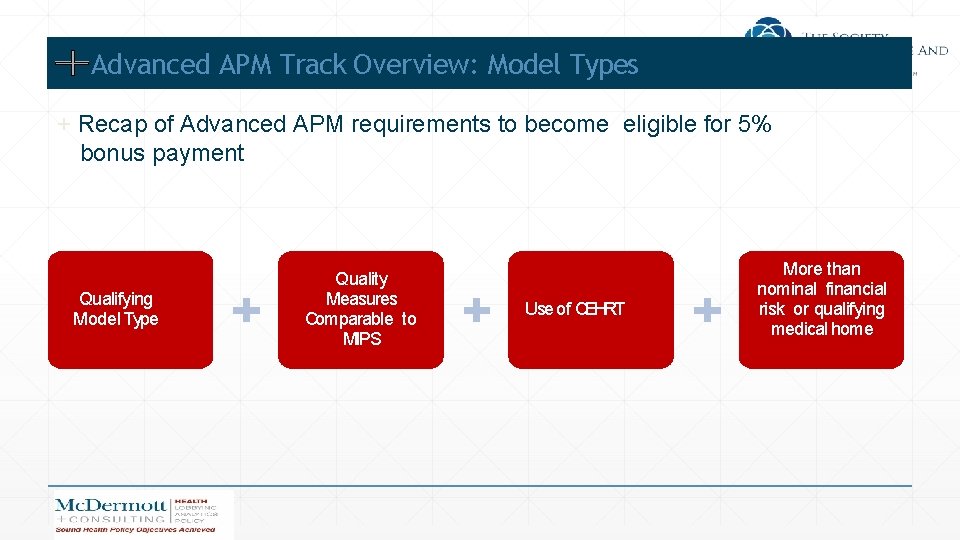
Advanced APM Track Overview: Model Types + Recap of Advanced APM requirements to become eligible for 5% bonus payment Qualifying Model Type Quality Measures Comparable to MIPS Use of CEHRT More than nominal financial risk or qualifying medical home
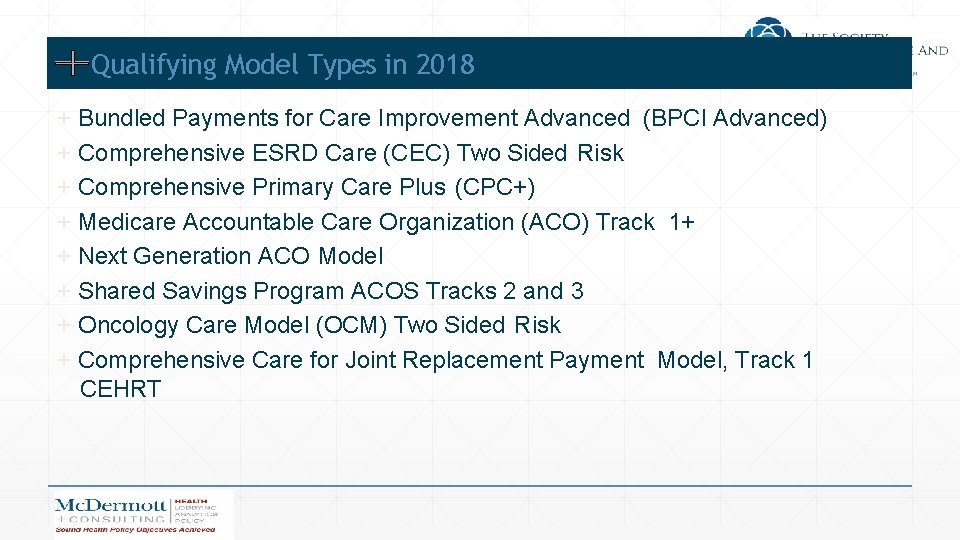
Qualifying Model Types in 2018 + Bundled Payments for Care Improvement Advanced (BPCI Advanced) + Comprehensive ESRD Care (CEC) Two Sided Risk + Comprehensive Primary Care Plus (CPC+) + Medicare Accountable Care Organization (ACO) Track 1+ + Next Generation ACO Model + Shared Savings Program ACOS Tracks 2 and 3 + Oncology Care Model (OCM) Two Sided Risk + Comprehensive Care for Joint Replacement Payment Model, Track 1 CEHRT
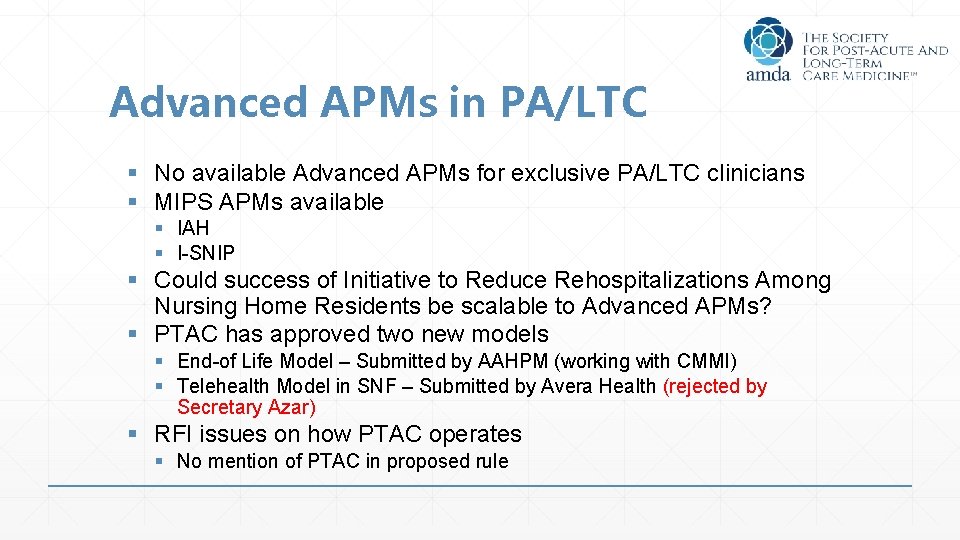
Advanced APMs in PA/LTC § No available Advanced APMs for exclusive PA/LTC clinicians § MIPS APMs available § IAH § I-SNIP § Could success of Initiative to Reduce Rehospitalizations Among Nursing Home Residents be scalable to Advanced APMs? § PTAC has approved two new models § End-of Life Model – Submitted by AAHPM (working with CMMI) § Telehealth Model in SNF – Submitted by Avera Health (rejected by Secretary Azar) § RFI issues on how PTAC operates § No mention of PTAC in proposed rule
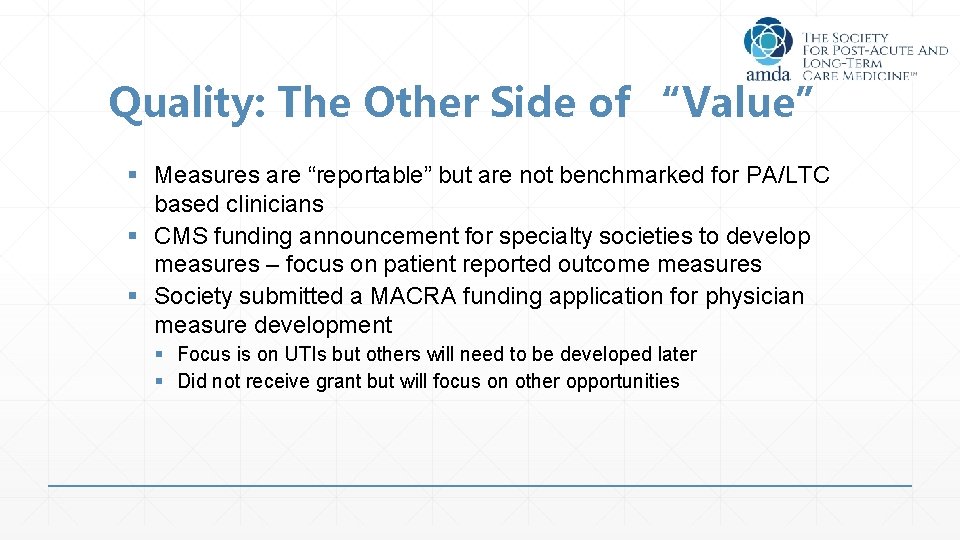
Quality: The Other Side of “Value” § Measures are “reportable” but are not benchmarked for PA/LTC based clinicians § CMS funding announcement for specialty societies to develop measures – focus on patient reported outcome measures § Society submitted a MACRA funding application for physician measure development § Focus is on UTIs but others will need to be developed later § Did not receive grant but will focus on other opportunities
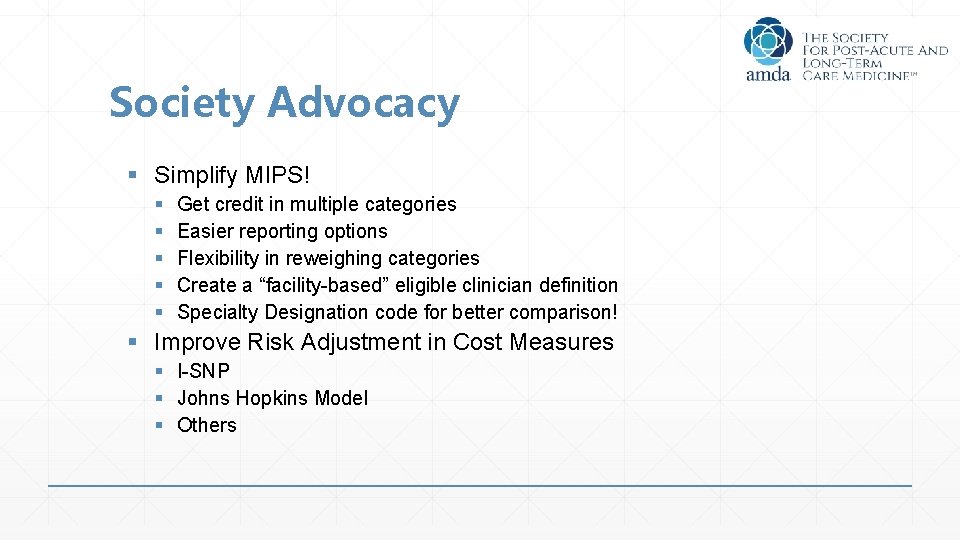
Society Advocacy § Simplify MIPS! § § § Get credit in multiple categories Easier reporting options Flexibility in reweighing categories Create a “facility-based” eligible clinician definition Specialty Designation code for better comparison! § Improve Risk Adjustment in Cost Measures § I-SNP § Johns Hopkins Model § Others
Billing/Coding Update
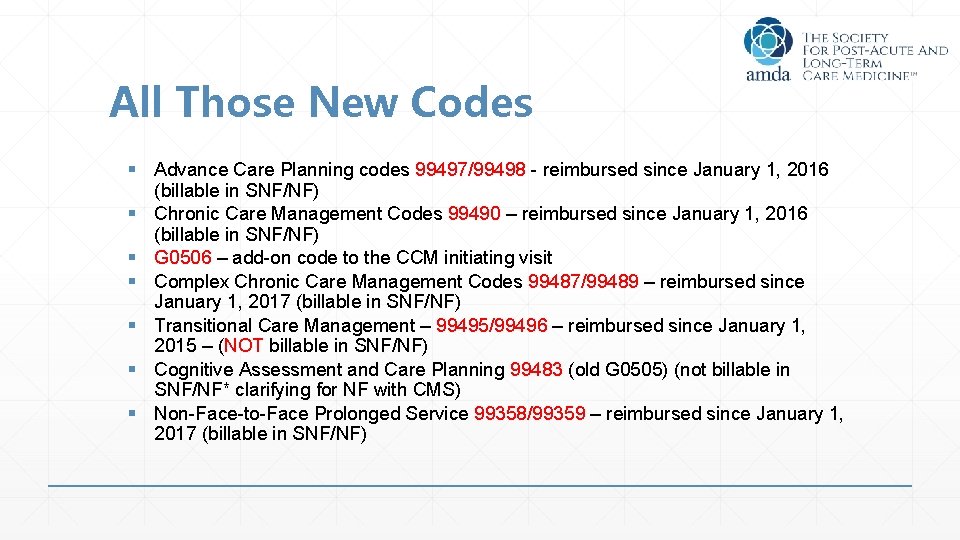
All Those New Codes § Advance Care Planning codes 99497/99498 - reimbursed since January 1, 2016 (billable in SNF/NF) § Chronic Care Management Codes 99490 – reimbursed since January 1, 2016 (billable in SNF/NF) § G 0506 – add-on code to the CCM initiating visit § Complex Chronic Care Management Codes 99487/99489 – reimbursed since January 1, 2017 (billable in SNF/NF) § Transitional Care Management – 99495/99496 – reimbursed since January 1, 2015 – (NOT billable in SNF/NF) § Cognitive Assessment and Care Planning 99483 (old G 0505) (not billable in SNF/NF* clarifying for NF with CMS) § Non-Face-to-Face Prolonged Service 99358/99359 – reimbursed since January 1, 2017 (billable in SNF/NF)
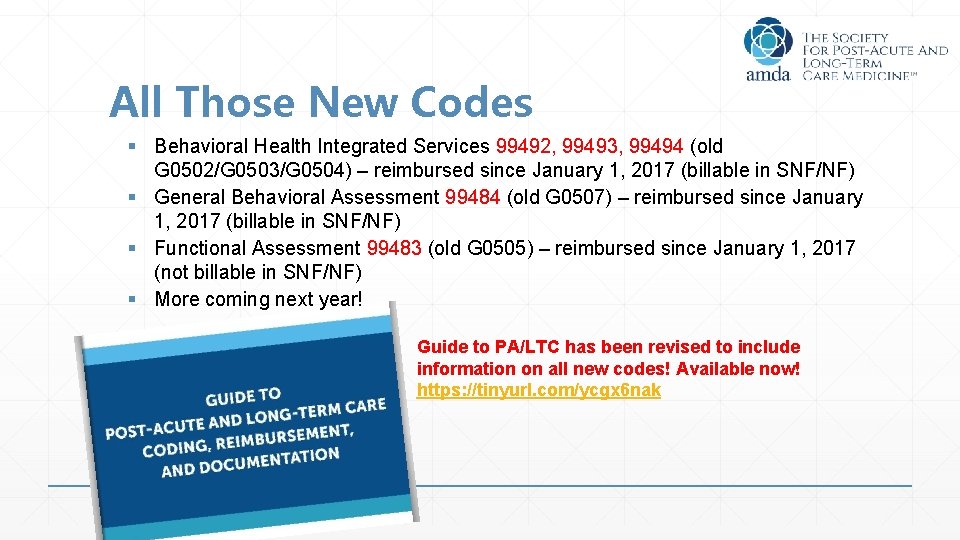
All Those New Codes § Behavioral Health Integrated Services 99492, 99493, 99494 (old G 0502/G 0503/G 0504) – reimbursed since January 1, 2017 (billable in SNF/NF) § General Behavioral Assessment 99484 (old G 0507) – reimbursed since January 1, 2017 (billable in SNF/NF) § Functional Assessment 99483 (old G 0505) – reimbursed since January 1, 2017 (not billable in SNF/NF) § More coming next year! Guide to PA/LTC has been revised to include information on all new codes! Available now! https: //tinyurl. com/ycgx 6 nak
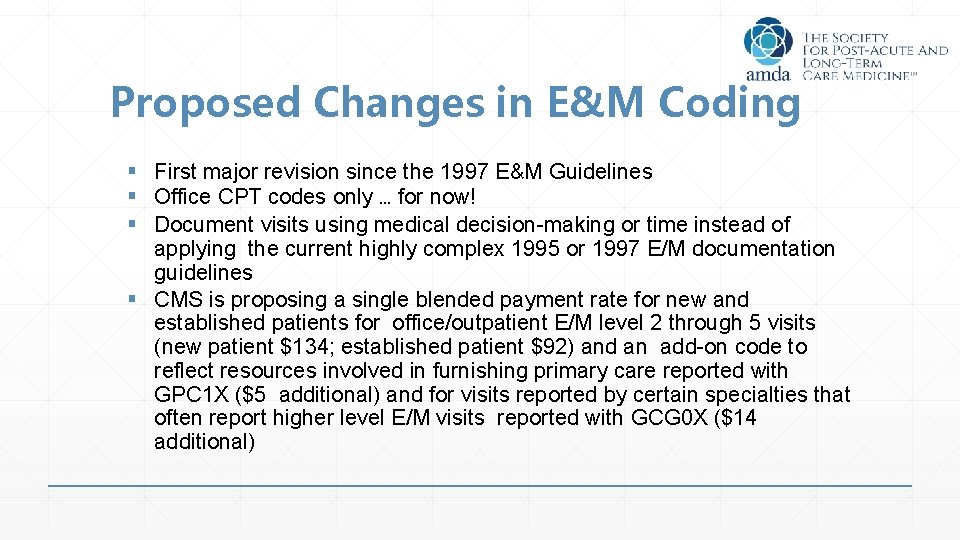
Proposed Changes in E&M Coding § First major revision since the 1997 E&M Guidelines § Office CPT codes only … for now! § Document visits using medical decision-making or time instead of applying the current highly complex 1995 or 1997 E/M documentation guidelines § CMS is proposing a single blended payment rate for new and established patients for office/outpatient E/M level 2 through 5 visits (new patient $134; established patient $92) and an add-on code to reflect resources involved in furnishing primary care reported with GPC 1 X ($5 additional) and for visits reported by certain specialties that often report higher level E/M visits reported with GCG 0 X ($14 additional)
Proposed Changes in E&M Coding § Concerns: § § What is the actual admin burden reduction? Do physician specialties treating complex patients lose? Are we taking money out of the physician payment pool? Will physician groups like RUC/CPT have input into value of codes?
CMS Nursing Home ROPs
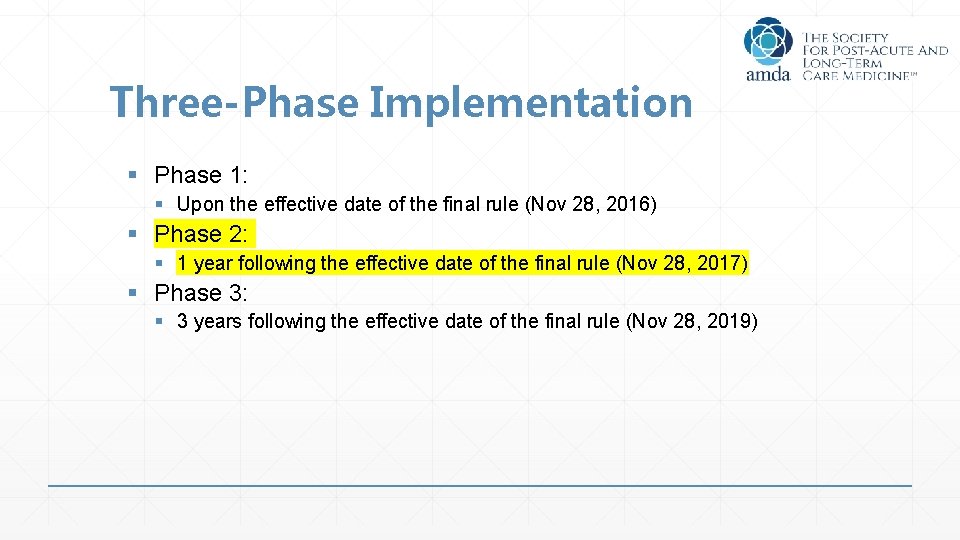
Three-Phase Implementation § Phase 1: § Upon the effective date of the final rule (Nov 28, 2016) § Phase 2: § 1 year following the effective date of the final rule (Nov 28, 2017) § Phase 3: § 3 years following the effective date of the final rule (Nov 28, 2019)
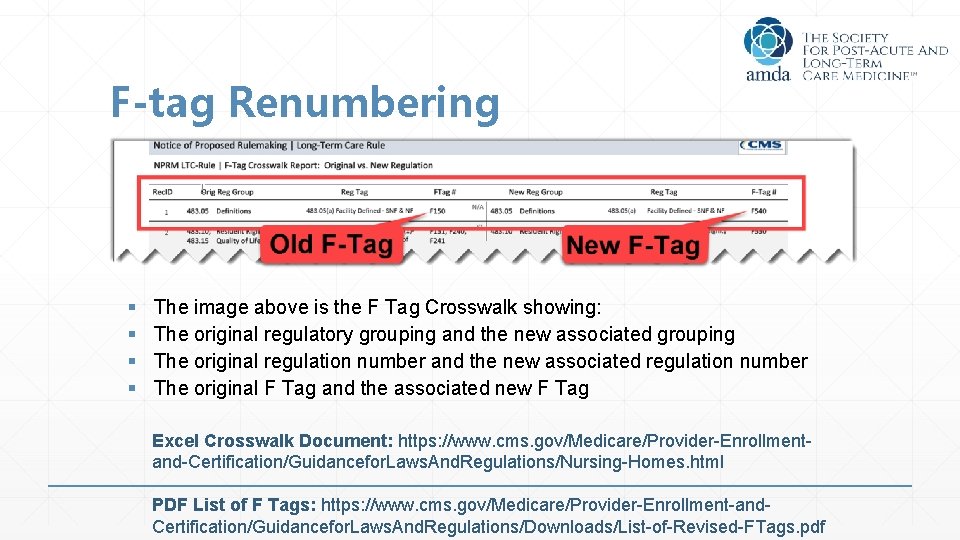
F-tag Renumbering § § The image above is the F Tag Crosswalk showing: The original regulatory grouping and the new associated grouping The original regulation number and the new associated regulation number The original F Tag and the associated new F Tag Excel Crosswalk Document: https: //www. cms. gov/Medicare/Provider-Enrollmentand-Certification/Guidancefor. Laws. And. Regulations/Nursing-Homes. html PDF List of F Tags: https: //www. cms. gov/Medicare/Provider-Enrollment-and. Certification/Guidancefor. Laws. And. Regulations/Downloads/List-of-Revised-FTags. pdf
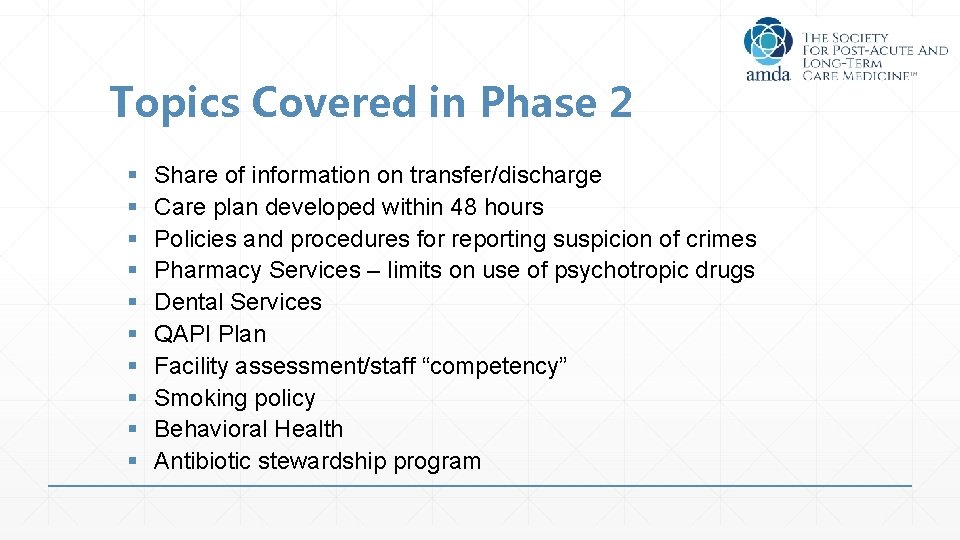
Topics Covered in Phase 2 § § § § § Share of information on transfer/discharge Care plan developed within 48 hours Policies and procedures for reporting suspicion of crimes Pharmacy Services – limits on use of psychotropic drugs Dental Services QAPI Plan Facility assessment/staff “competency” Smoking policy Behavioral Health Antibiotic stewardship program
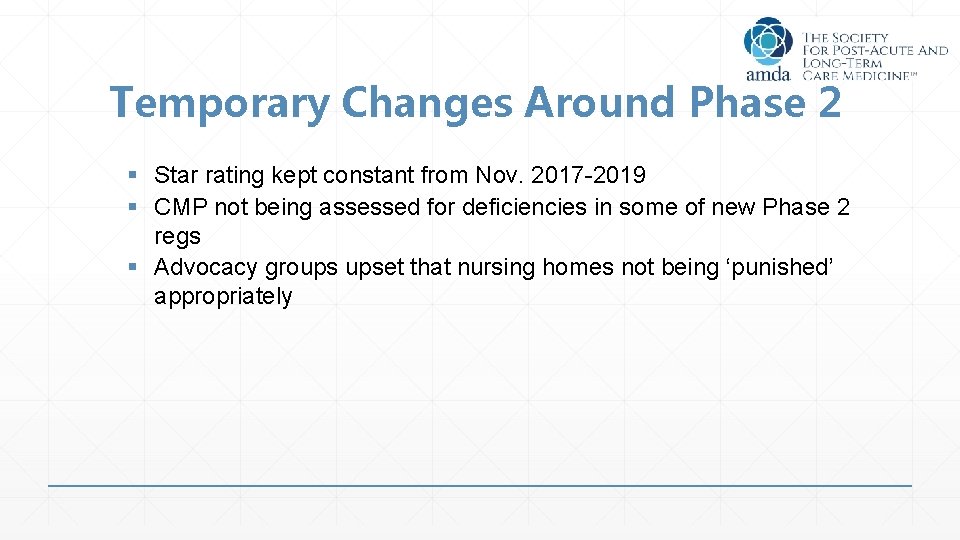
Temporary Changes Around Phase 2 § Star rating kept constant from Nov. 2017 -2019 § CMP not being assessed for deficiencies in some of new Phase 2 regs § Advocacy groups upset that nursing homes not being ‘punished’ appropriately
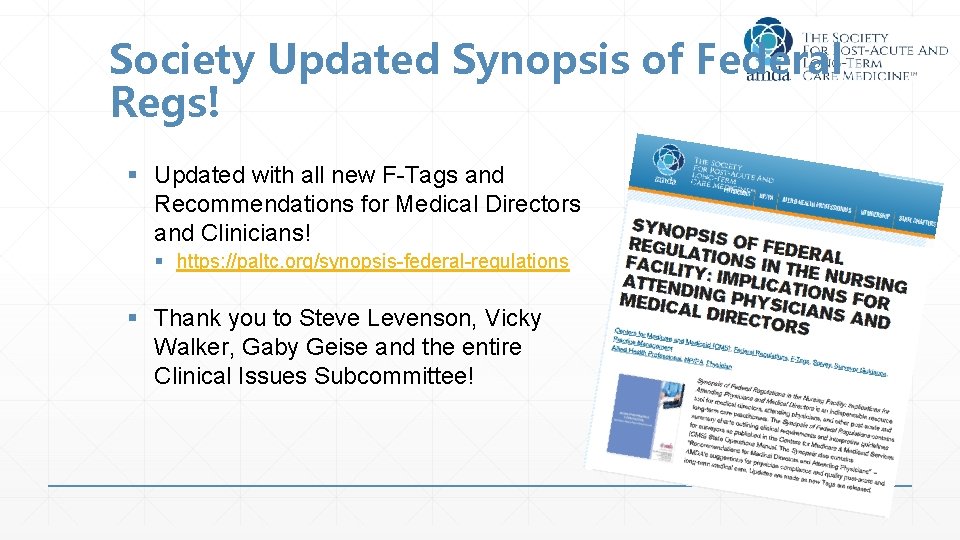
Society Updated Synopsis of Federal Regs! § Updated with all new F-Tags and Recommendations for Medical Directors and Clinicians! § https: //paltc. org/synopsis-federal-regulations § Thank you to Steve Levenson, Vicky Walker, Gaby Geise and the entire Clinical Issues Subcommittee!
IMPACT Act Improving Medicare Post-Acute Care Transformation Act of 2014
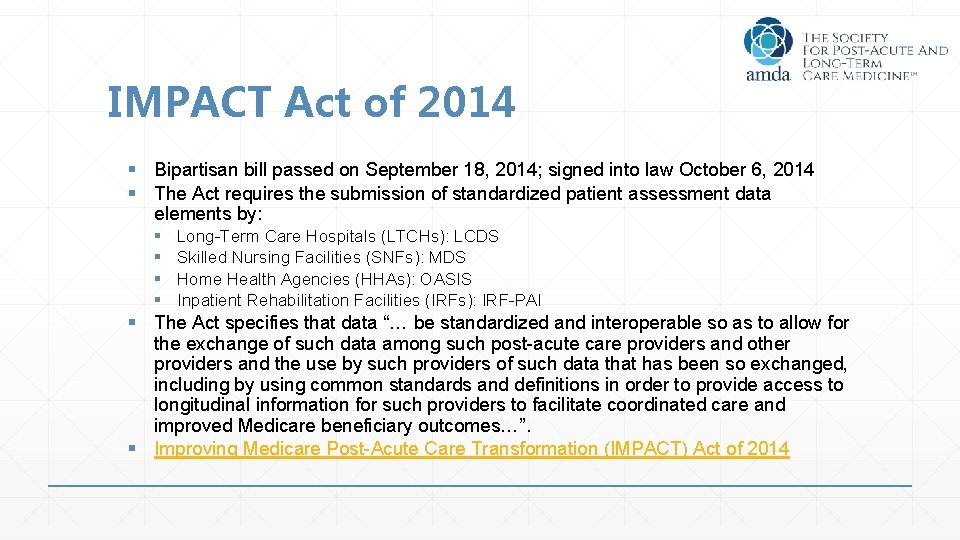
IMPACT Act of 2014 § Bipartisan bill passed on September 18, 2014; signed into law October 6, 2014 § The Act requires the submission of standardized patient assessment data elements by: § § Long-Term Care Hospitals (LTCHs): LCDS Skilled Nursing Facilities (SNFs): MDS Home Health Agencies (HHAs): OASIS Inpatient Rehabilitation Facilities (IRFs): IRF-PAI § The Act specifies that data “… be standardized and interoperable so as to allow for the exchange of such data among such post-acute care providers and other providers and the use by such providers of such data that has been so exchanged, including by using common standards and definitions in order to provide access to longitudinal information for such providers to facilitate coordinated care and improved Medicare beneficiary outcomes…”. § Improving Medicare Post-Acute Care Transformation (IMPACT) Act of 2014
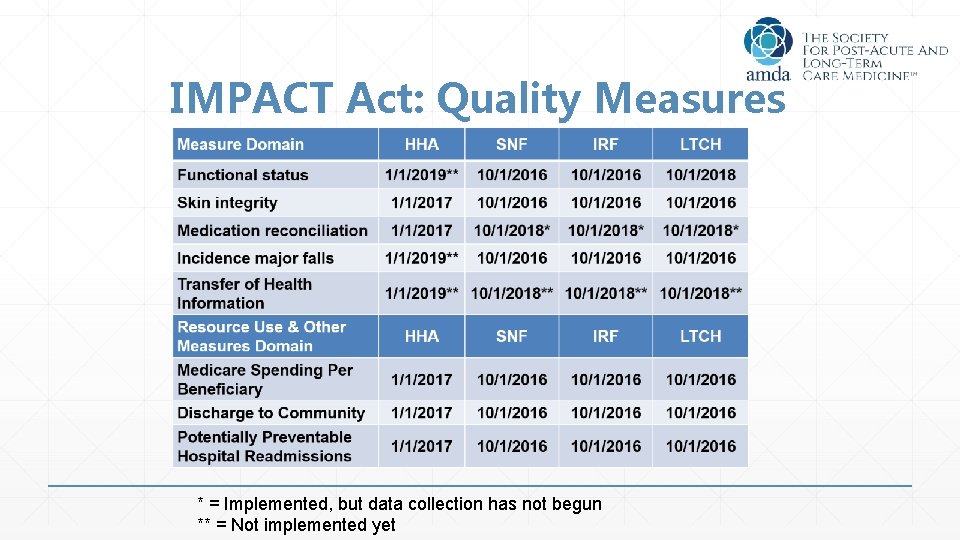
IMPACT Act: Quality Measures * = Implemented, but data collection has not begun ** = Not implemented yet
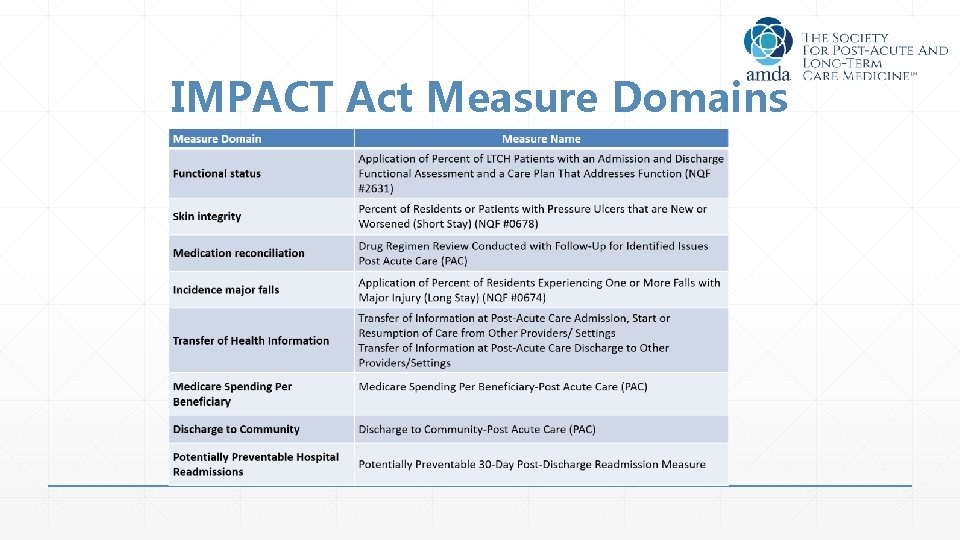
IMPACT Act Measure Domains
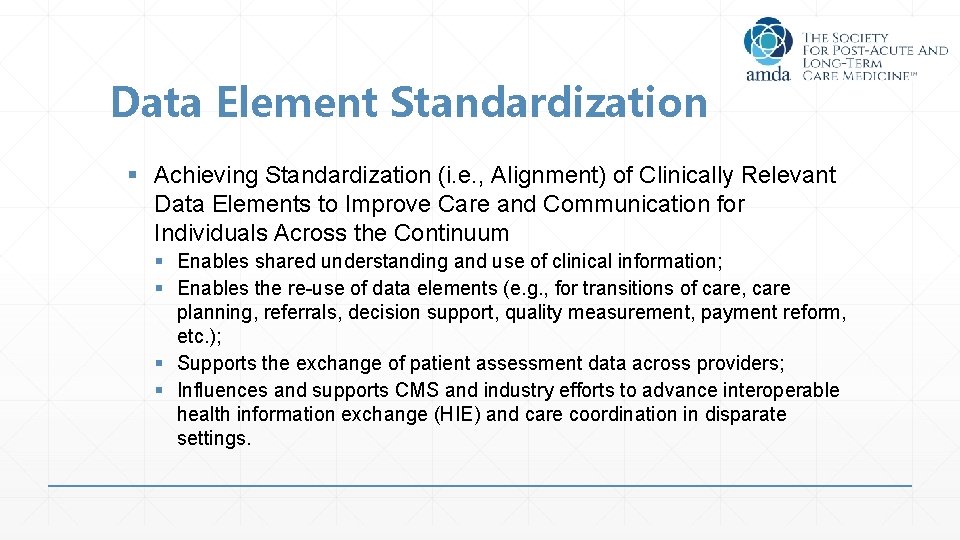
Data Element Standardization § Achieving Standardization (i. e. , Alignment) of Clinically Relevant Data Elements to Improve Care and Communication for Individuals Across the Continuum § Enables shared understanding and use of clinical information; § Enables the re-use of data elements (e. g. , for transitions of care, care planning, referrals, decision support, quality measurement, payment reform, etc. ); § Supports the exchange of patient assessment data across providers; § Influences and supports CMS and industry efforts to advance interoperable health information exchange (HIE) and care coordination in disparate settings.
PDPM – A Patient. Driven Payment Model
RUG-IV RCS 1 – Resident Classification System Patient Driven Payment Model § SNF Prospective Payment System in Place Since 1998 – Criticized Over Time § CMS hired Acumen to develop a new payment system with 3 goals in mind: § More accurately compensate SNFs § Reduce incentives for SNFs to deliver therapy based on financial considerations, rather than actual patient/resident need § Maintain simplicity, to the extent possible § CMS held expert panels – AMDA was represented § Replaces the current RUG-based system (RUG-IV) § SNF Payment Rule released recently begins to implement “money follows the patient” approach § PDPM is a switch from RCS-1
PDPM: Some Details § Scheduled for implementation October 2019! § Categorize residents across five categories, including two nursing case mixes (nursing and non-therapy ancillary) and one each for PT, OT, and speech language pathology § Regardless of therapy type, resident rated in that category to create an aggregate mix and determine the corresponding reimbursement rate § MDS plays a key role § ICD-10 coding important
PDPM: Advocacy Efforts § Coalition of Stakeholders worked together to develop and submit comments and concerns § Meetings with CMS § Coalition response to SNF PPS rule: PDPM would require SNFs to adapt to significant changes in payment policy and operations including but not limited to: § A shift away from therapy minutes as a key factor for payment to patient characteristics; § Collection of medical information defining patient characteristic in more detail than required in past; and § Use of the Minimum Data Set (MDS) assessment both as a care planning tool as well as now serving as the basis for payment. MDS items and clinical information classify patients into component case-mix groups which, in turn assign payment rates. This major change will require substantial education to prevent access to care challenges and payment errors. § Request a CMS workgroup with all stakeholders
Future Outlook
PA/LTC Specialty? § More research by Joan Teno and colleagues showing increased number of physicians practicing exclusively in SNF/NF setting. Estimated around 15 k physicians/nearly 50 k unique SNF/NF billing encounters § SNF/NF based physicians lose in value-based purchasing programs due to cost comparison with colleagues in IM/FM § No way to define physicians practicing in this space § Submitted an application to CMS for a self-selected specialty code § ABMS has a new “focused practice designation” under their umbrella
Staffing: PBJ – Payroll Based Journal § Section 6106 of ACA requires facilities to electronically submit direct care staffing data (including agency and contract staff) based on payroll and other auditable data § Reported in Nursing Home Compare § Medical director hours include both on site and off site work (AMDA advocacy win) § Latest: Nursing homes under fire in press for under-reporting staffing levels leading to questions of appropriate staffing ratios. § CMS continues not to keep any record of medical directors
State of Health IT in PA/LTC § AMDA Foundation completed a study in conjunction with HIMSS § 2 major companies Matrix. Care, Point. Click. Care control the market share § Majority of nursing homes are adopting HIT § Interoperability § Remains a big issue § Market is driving change § Administration focus on interoperability § RFI on Interoperability § Joint comments with LTPAC HIT Collaborative § Need latest information in clear and consice form to make decisions § Physician office EHR integration into system in PA/LTC still an oversight § No – we are not getting any more $$$
Telehealth § Growing in use in PA/LTC § Studies showing positive impact on patient care, readmission reduction etc. § CMS rejected AMDA’s request to remove once a month requirement for telehealth in subsequent care codes – AMDA will comment & continue to advocate § RUSH Act – emergency medicine in SNF § AMDA and others have many concerns but working in coalition to address bigger issue § AMA workgroup developing educational materials, best practices
Looking into the future § Think big picture: A strategic asset, not a referral source § Role of narrowing Preferred Provider Networks § Predictive Analytics/AI – Point. Right; Navi. Health etc, have platforms to help with SNF selection § Health IT – do you have a strategy for billing; reporting; and tracking performance? § How do you leverage your clinical expertise in PA/LTC population in value-based environment when others don’t understand what you do?
Thank You! Questions? Christopher E. Laxton, CAE claxton@paltc. org @PALTC_Chris