
National Initiative for School Heads and Teachers Holistic

- Slides: 23
National Initiative for School Heads’ and Teachers’ Holistic Advancement (NISHTHA) Pedagogy of Languages National Council of Educational Research and Training
Why this module on Language Pedagogy? � Familiarising teachers with the language teaching-learning situations in diverse (Indian) contexts. � Language pedagogy : How does language learning take place in and outside the classroom? � Multilingualism as strategy. � Ways and means of planning, teaching and assessing the various language skills. � Enhancing and enriching learners’ ‘engaging time’ with language?
Outline v Language learning and centrality of language in learning, language learning-teaching situations in India: v language-in-education policy, three language formula – multilingualism as a strategy in the classroom. v v v Teaching of languages as first, second and third: processes and resources. Objectives of language teaching and meeting the learning outcomes. Teaching of language skills- Listening, speaking, reading, writing, grammar, vocabulary and teaching literary texts with illustrations in English and Hindi. Addressing the concerns viz. gender, special needs, multilingualism, diversity and inclusion in teaching-learning contexts Language assessment and its processes- continuous Assessment, peer assessment, self assessment and reporting of outcomes.
Objectives…. To understand the various aspects of language education viz. nature of language learning, role of language in learning, multilingualism as a resource and a strategy; � To understand reflect on objectives of language teaching in Indian contexts, ideas and philosophy of National Curriculum Framework-2005; � To familiarize teachers with the approach to integration skills (LSRW) for literacy and language learning, engaging children in context based activities for developing communicative competence; � To be able to chalk out the learning outcomes and pedagogical process for language teaching-learning for different stages; � To sensitize teachers on using various strategies to language teaching in terms language skills-listening and speaking, reading, writing, grammar, vocabulary and so on; �
Objectives � To build an understanding of generic concerns such as ‘knowing the learner’, gender issues, special needs, inclusive classroom, school based pre-vocational education and others, � To understand the processes and use the strategies for continuous assessment and reporting of learning outcomes; and � To enable them to build the capacity of teachers towards achieving learning outcomes stipulated for every class in different subject areas.
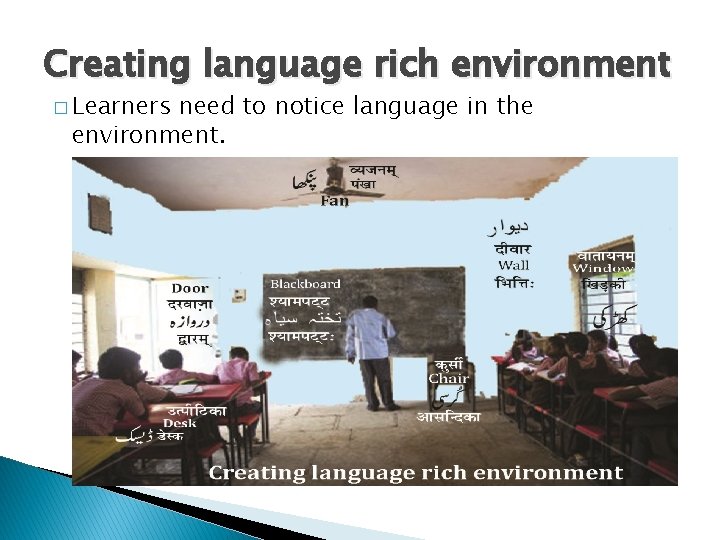
Creating language rich environment � Learners need to notice language in the environment.
Early literacy � Enriching oral language use by children. � Drawing and scribbling as pre-writing conventions. � Listening to stories and use story telling as a strategy for language input and language learning. � Connecting language learning to children's life, culture and society � Use media inputs such magazines, newspaper, ICT, etc. in the classroom.
What is engagement with language? � Learners work with language by using it for purposes. � Peer interaction: Group Work, Pair Work and problem solving tasks promote language use. � Strategies teacher can adopt: Story telling for language learning, thematic vocabulary formation by learners in groups, dictation as a learning technique, story weaving, process approach to writing.
Let’s read this anecdote �A Japanese family went to USA and the father worked in a multinational company. A three year old girl child in the family happened to meet the neighbour, who was a native English speaker. He befriended the child and started speaking to her in English as he did not know her language, Japanese. He first said simple words like “Hello!” “How are you? ” “Are you OK? ”
But the child did not respond. She was very receptive. The neighbour could not understand why the child was not responding to him even by nodding. He kept on speaking to the child with more and more such ‘formulaic structures’ for about six to eight month. After eight months, the Japanese family had to leave USA for their country as the father was transferred back. DO YOU THINK THE CHILD HAD LEARNT ENGLISH? .
� YES. The Japanese girl who was not speaking anything , not even responding to the neighbour had started speaking English almost as that of a native speaker. � To the surprise of the neighbour (who was also a linguist) she was speaking the language with such structures and constructions which she had not come across before. HOW AND WHY?
Let’s also know what Einstein did? � Einstein did not start speaking for long, even after two and half year of his age. His parents were worried. They even consulted with physicians to know the reason and to treat him. � One day sitting at the dining table Einstein spoke, “THE SOUP IS VERY HOT”. Every one was pleasantly surprised and could not believe this boy was speaking complete sentence without any stammer (as if he were speaking for a long time).
Einstein. . � When asked why he was not speaking and how he spoke very well at the moment Einstein said, “Everything was in order so far” � WHAT DOES IT TELL US? � CHILD SHOULD BE GIVEN CHANCE/ OPPORTUNITY / CHALLENCE / RISK TO MANIPULATE.
Einstein. . � When asked why he was not speaking and how he spoke very well at the moment Einstein said, “Everything was in order so far” � WHAT DOES IT TELL US? � CHILD SHOULD BE GIVEN CHANCE/ OPPORTUNITY / CHALLENCE / RISK TO MANIPULATE
SPEECH RECEPTION � CHILDREN HAVE REMARKABLE AUDITORY ABILITIES ◦ One day old babies: Mothers speaking normally and abnormally, and a stranger- they responded to mother’s normal voice. ◦ They turn towards the source sound in days of birth. ◦ To know human and non-human voice with in weeks ◦ Discriminate certain consonants /pa/ and /ba/ around four weeks
Speech comprehension. . � Two to four months: respond to meaning of different tones of voice, such as angry, soothing or playful voices � From six months: recognise some utterances relate to particular situations like Bye-bye clap, recognise names of individuals, family names, some number (orally). � By the end of the year: several words are recognised.
Cognitivism & Associationism Chomsky � EVERY CHILD IS BORN WITH LAD (Language Acquisition Device) So every language has grammar Universal grammar (noun, verb, adjective and then a structure)
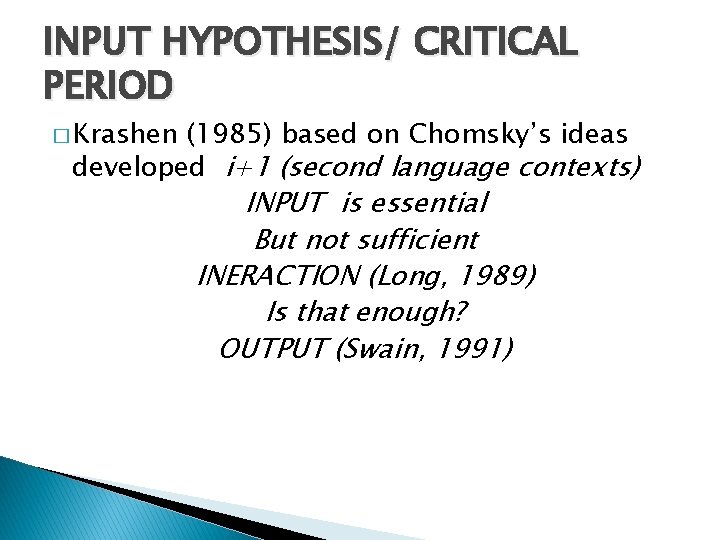
INPUT HYPOTHESIS/ CRITICAL PERIOD � Krashen (1985) based on Chomsky’s ideas developed i+1 (second language contexts) INPUT is essential But not sufficient INERACTION (Long, 1989) Is that enough? OUTPUT (Swain, 1991)
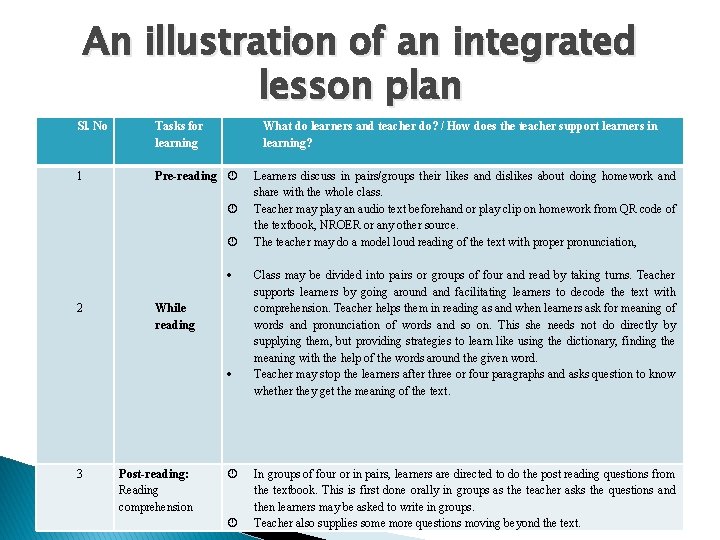
An illustration of an integrated lesson plan Sl. No 1 2 3 Tasks for learning Pre-reading While reading Post-reading: Reading comprehension What do learners and teacher do? / How does the teacher support learners in learning? Learners discuss in pairs/groups their likes and dislikes about doing homework and share with the whole class. Teacher may play an audio text beforehand or play clip on homework from QR code of the textbook, NROER or any other source. The teacher may do a model loud reading of the text with proper pronunciation, Class may be divided into pairs or groups of four and read by taking turns. Teacher supports learners by going around and facilitating learners to decode the text with comprehension. Teacher helps them in reading as and when learners ask for meaning of words and pronunciation of words and so on. This she needs not do directly by supplying them, but providing strategies to learn like using the dictionary, finding the meaning with the help of the words around the given word. Teacher may stop the learners after three or four paragraphs and asks question to know whether they get the meaning of the text. In groups of four or in pairs, learners are directed to do the post reading questions from the textbook. This is first done orally in groups as the teacher asks the questions and then learners may be asked to write in groups. Teacher also supplies some more questions moving beyond the text.
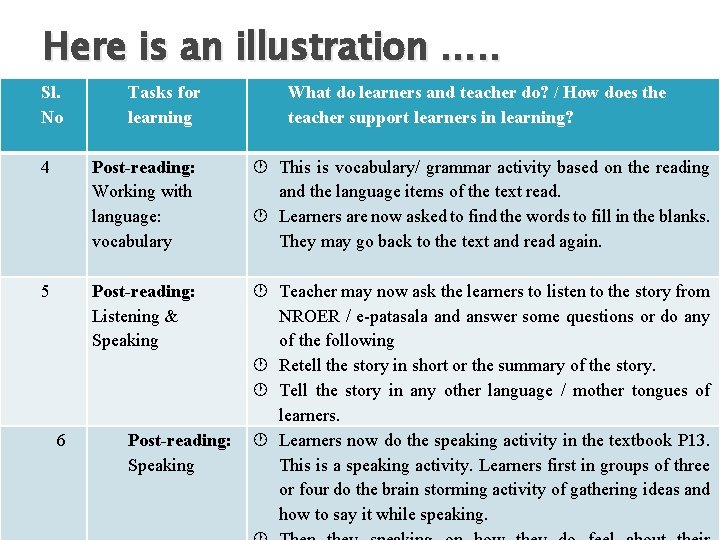
Here is an illustration …. . Sl. No 4 5 6 Tasks for learning Post-reading: Working with language: vocabulary Post-reading: Listening & Speaking Post-reading: Speaking What do learners and teacher do? / How does the teacher support learners in learning? This is vocabulary/ grammar activity based on the reading and the language items of the text read. Learners are now asked to find the words to fill in the blanks. They may go back to the text and read again. Teacher may now ask the learners to listen to the story from NROER / e-patasala and answer some questions or do any of the following Retell the story in short or the summary of the story. Tell the story in any other language / mother tongues of learners. Learners now do the speaking activity in the textbook P 13. This is a speaking activity. Learners first in groups of three or four do the brain storming activity of gathering ideas and how to say it while speaking.
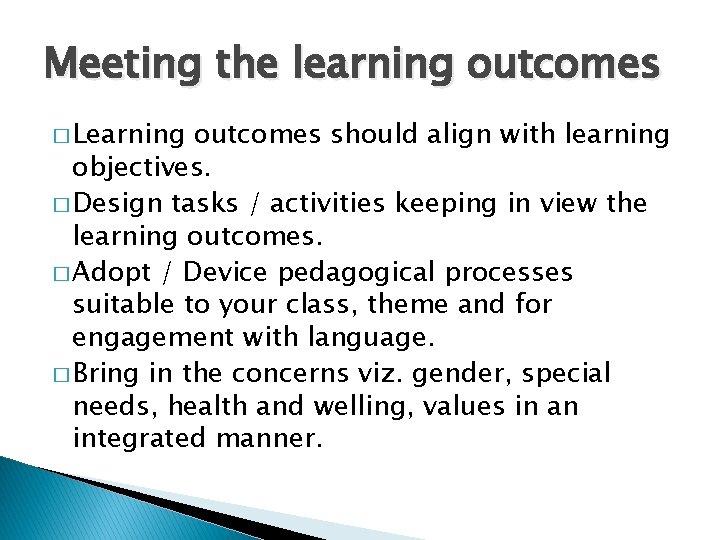
Meeting the learning outcomes � Learning outcomes should align with learning objectives. � Design tasks / activities keeping in view the learning outcomes. � Adopt / Device pedagogical processes suitable to your class, theme and for engagement with language. � Bring in the concerns viz. gender, special needs, health and welling, values in an integrated manner.
Activities / Assignment for KRPs /Teachers � Recall how you learnt your mother tongue and second language (English) and write your (first & second) language learning autobiographies. � Read the following books and write reviews of them. ◦ Kumar. K. (2008 Reprint). The Child’s Language and the Teacher. National Book Trust. New Delhi ◦ Badheka, Gijubhai (2018 Reprint) Dvasvapna (Day Dream). National Book Trust. New Delhi � Design at least four tasks / activities for promoting engagement with language.
Please read the Module 10 - Pedagogy of Languages …Thank you