
National Income Accounting Lecture 3 Outline Measurement of

- Slides: 46
National Income Accounting Lecture 3
Outline • Measurement of national income – Value-Added Approach – Factor Payments (or Income) Approach • Other measures of Income – GNP, National Income, Personal Income, Disposable income • Nominal and real measures • Limitations of the national income concept 2
Other Approaches to GDP • The Value-Added Approach • The Factor Payments/ Income Approach 3
The Value-Added Approach • In the Expenditure approach, – Count goods and services only when sold to final users • In Value-added approach, – Add up each firm’s contribution to a product as it is produced • A firm’s contribution to a product is called its value added 4
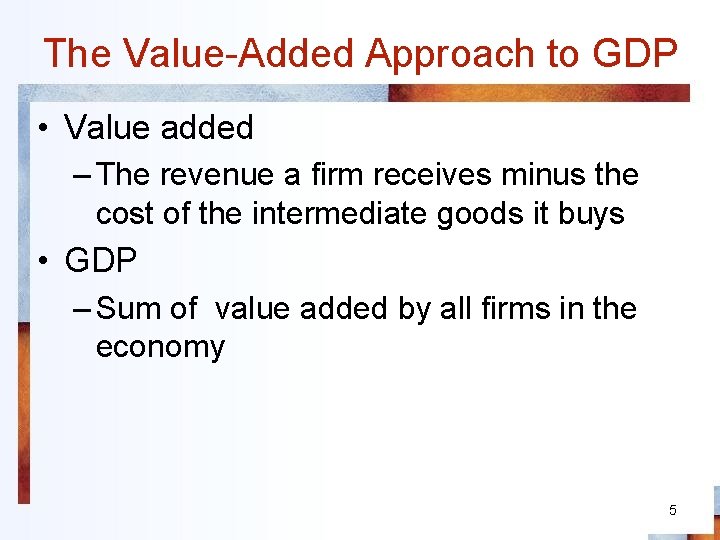
The Value-Added Approach to GDP • Value added – The revenue a firm receives minus the cost of the intermediate goods it buys • GDP – Sum of value added by all firms in the economy 5
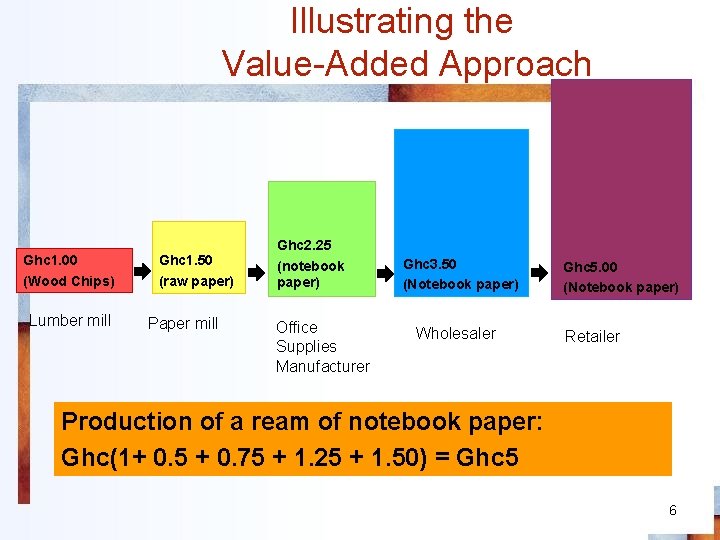
Illustrating the Value-Added Approach Ghc 1. 00 (Wood Chips) Lumber mill Ghc 1. 50 (raw paper) Paper mill Ghc 2. 25 (notebook paper) Office Supplies Manufacturer Ghc 3. 50 (Notebook paper) Wholesaler Ghc 5. 00 (Notebook paper) Retailer Production of a ream of notebook paper: Ghc(1+ 0. 5 + 0. 75 + 1. 25 + 1. 50) = Ghc 5 6
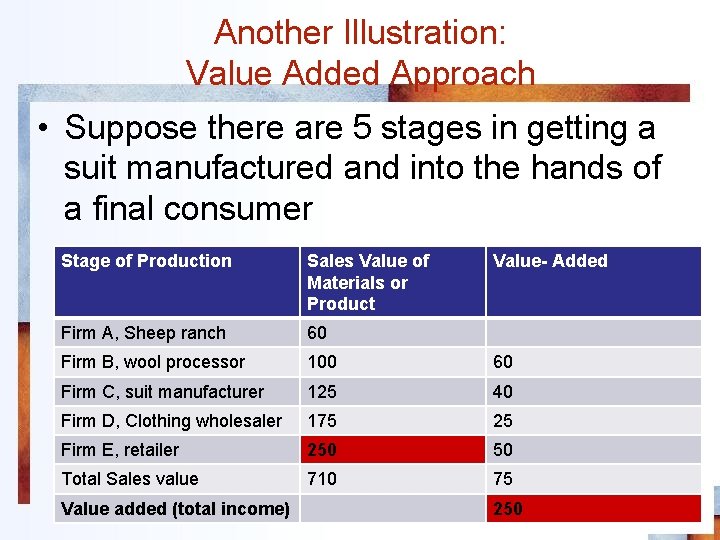
Another Illustration: Value Added Approach • Suppose there are 5 stages in getting a suit manufactured and into the hands of a final consumer Stage of Production Sales Value of Materials or Product Firm A, Sheep ranch 60 Firm B, wool processor 100 60 Firm C, suit manufacturer 125 40 Firm D, Clothing wholesaler 175 25 Firm E, retailer 250 50 Total Sales value 710 75 Value added (total income) Value- Added 250 7
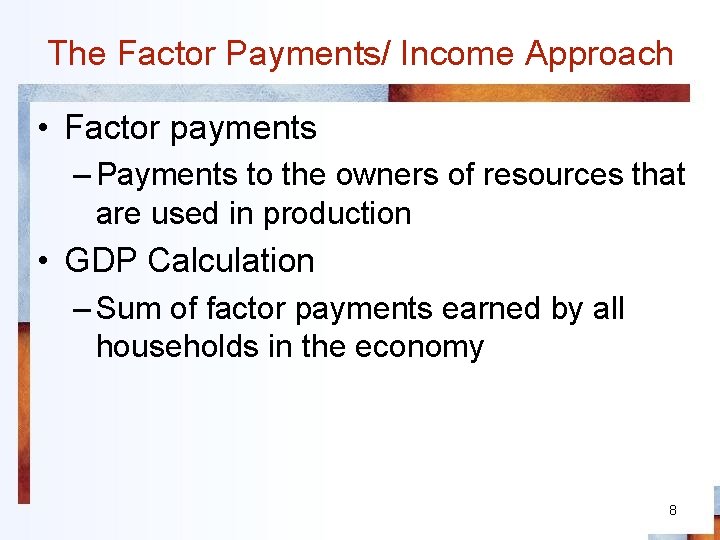
The Factor Payments/ Income Approach • Factor payments – Payments to the owners of resources that are used in production • GDP Calculation – Sum of factor payments earned by all households in the economy 8
The Income Approach • Domestic Income – Total income earned by residents and businesses in an economy • There are four (4) components – Employees compensation – Rents – Interests – Profits 9
The Factor Payments Approach • Compensation to employees – Wages and salaries paid to individuals – Fringe benefits • Makes up a largest proportion of national income 10
The Factor Payments Approach • Rents – Income received by households from properties that they own • Income received by firms from properties that they own form part of profits – Rent component of GDP may be small if depreciation is high in a particular year 11
The Factor Payments Approach • Interest – The income that private businesses pay to households that have lent the business money e. g. purchase of stocks • Interests paid to firms also show up in profits 12
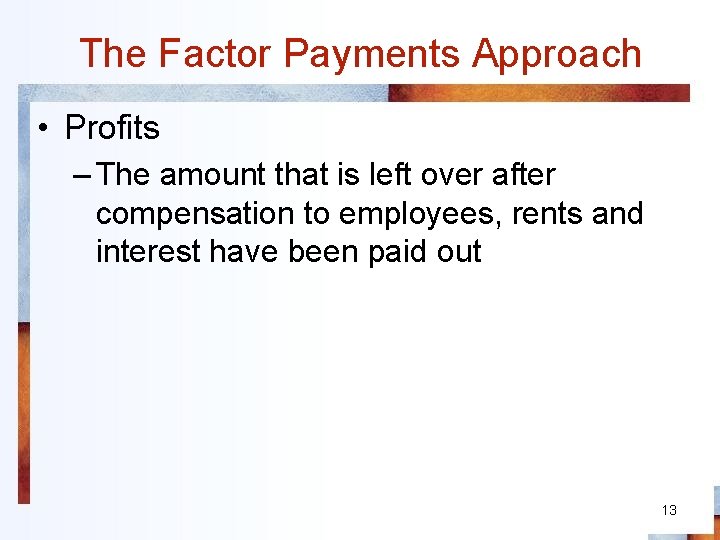
The Factor Payments Approach • Profits – The amount that is left over after compensation to employees, rents and interest have been paid out 13
Other Approaches to GDP • Why use more than one method to calculate GDP? – Measurement errors 14
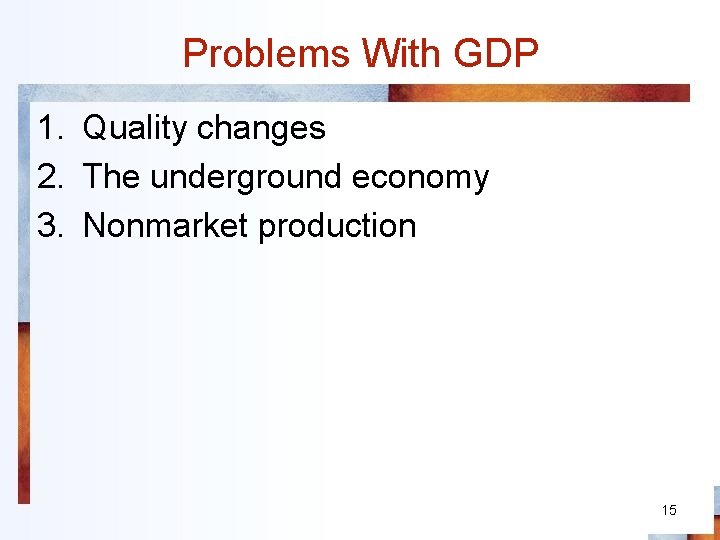
Problems With GDP 1. Quality changes 2. The underground economy 3. Nonmarket production 15
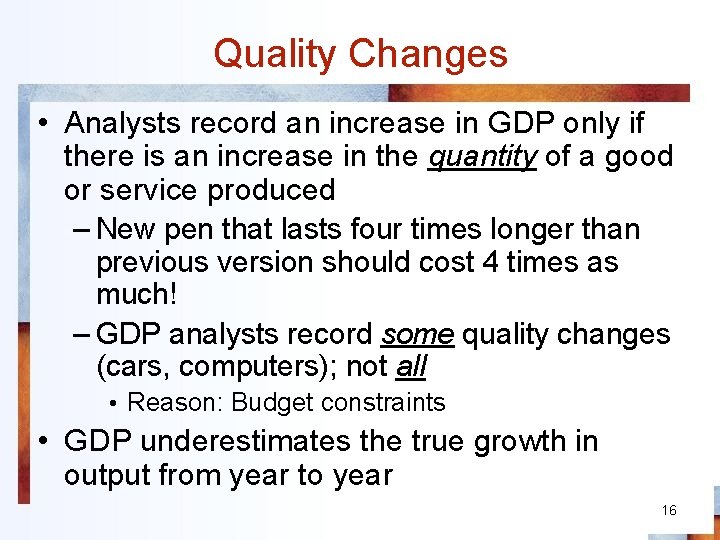
Quality Changes • Analysts record an increase in GDP only if there is an increase in the quantity of a good or service produced – New pen that lasts four times longer than previous version should cost 4 times as much! – GDP analysts record some quality changes (cars, computers); not all • Reason: Budget constraints • GDP underestimates the true growth in output from year to year 16
The Underground Economy • Some production hidden from government – Illegal (drugs, prostitution) – Tax avoidance • Underestimation of true production in economy 17
Non-Market Production • Excluded – – Housecleaning Sewing Lawn mowing Child rearing • Whenever non-market transactions become market transactions, GDP will rise, even though total production is the same • Over last century, much production shifted from home to market – – Parenting to day care Home-cooked food to takeout Talking to a friend to therapy Neighbour watching your house to alarm system • Real GDP increases although production has not • Exaggerate growth in GDP over time 18
OTHER MEASURES OF NATIONAL INCOME 19
Gross vs. Net concepts • Depreciation – The decrease in the value of a capital good over time – Wear and tear on economy’s stock of capital – Examples? 20
GDP vs. NDP • Gross Domestic Product (GDP) – Total output produced within a country • Net Domestic Product (NDP) – Total output produced within a country, minus depreciation 21
Market Price vs. Factor cost • Recall expenditure = income assumption • Prices paid by consumers revenue received by producers – Why? • Taxes and subsidies – Taxes imply producer receives less than consumer pays – Subsidies imply producers receive more than consumer pays 22
Market Price vs. Factor Cost • To convert the value at factor cost to the value at market prices, we must: – Add indirect taxes and subtract subsidies • The expenditure approach values goods at market prices; the income approach values them at factor cost 23
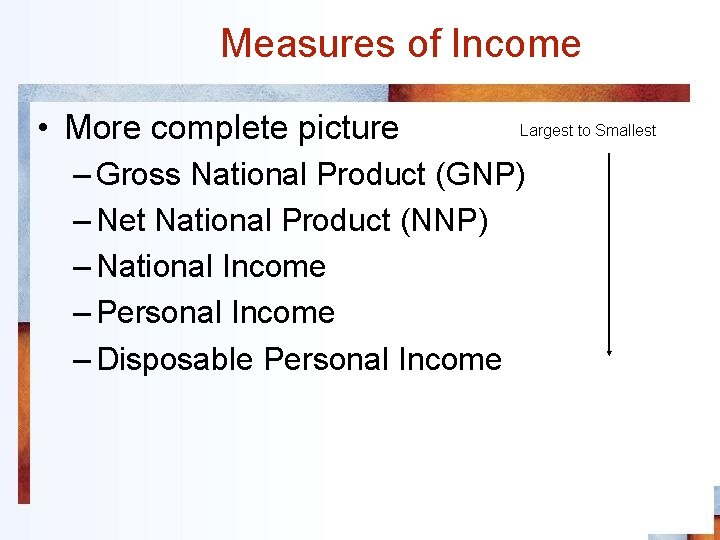
Measures of Income • More complete picture Largest to Smallest – Gross National Product (GNP) – Net National Product (NNP) – National Income – Personal Income – Disposable Personal Income 24
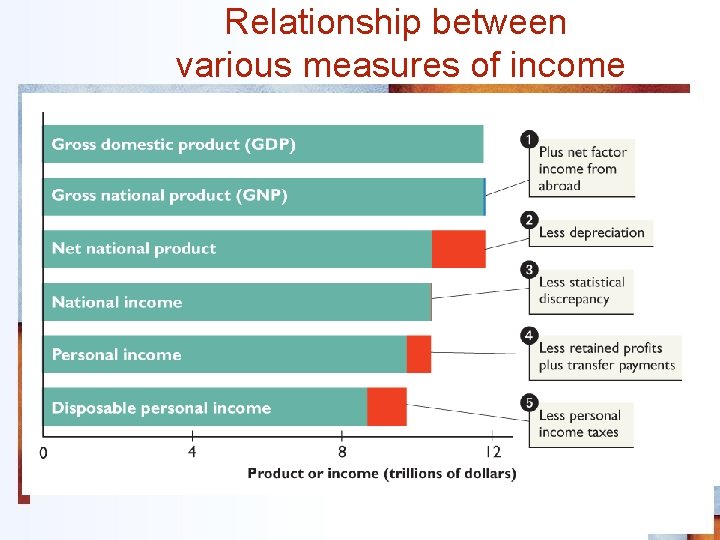
Other measures of Income • Gross National Product (GNP) – Total output of goods and services produced by nationals • Excludes production by foreigners within domestic economy; includes production by nationals in foreign country. 25
Other measures of income • Net Factor income from abroad = Output by nationals abroad - Output by foreigners • Ghana GNP = Ghana GDP + Net factor income from abroad • Question (True/False) – When a Nigerian businessman builds a factory in Ghana; his production is part of Ghana’s GDP, but not Ghana’s GNP. Why? 26
Other measures of Income • Net National Product (NNP) – Total production by a nation’s residents minus losses from depreciation • National Income – Total income earned by a nation’s residents. – Differs from NNP by statistical discrepancy • Market price vs. factor cost 27
Other measures of Income • Personal Income – Income received by households and businesses – Excludes retained earnings – Includes income from Transfer payments • PI= NI – retained earnings + transfer payments 28
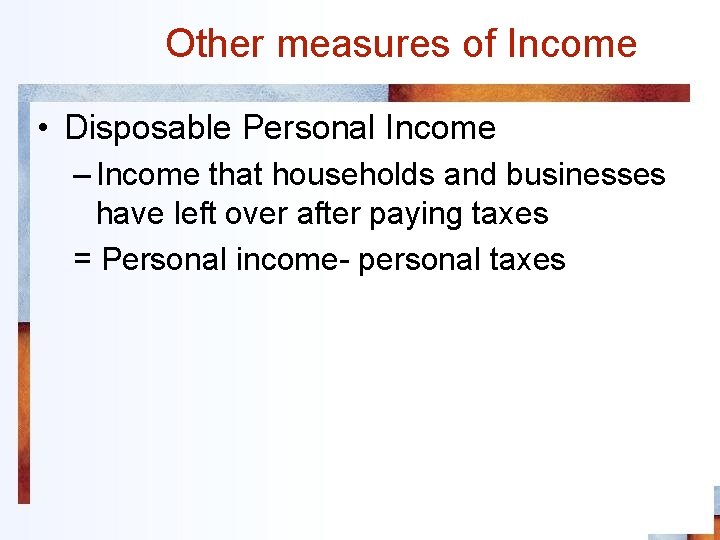
Other measures of Income • Disposable Personal Income – Income that households and businesses have left over after paying taxes = Personal income- personal taxes 29
Relationship between various measures of income 30
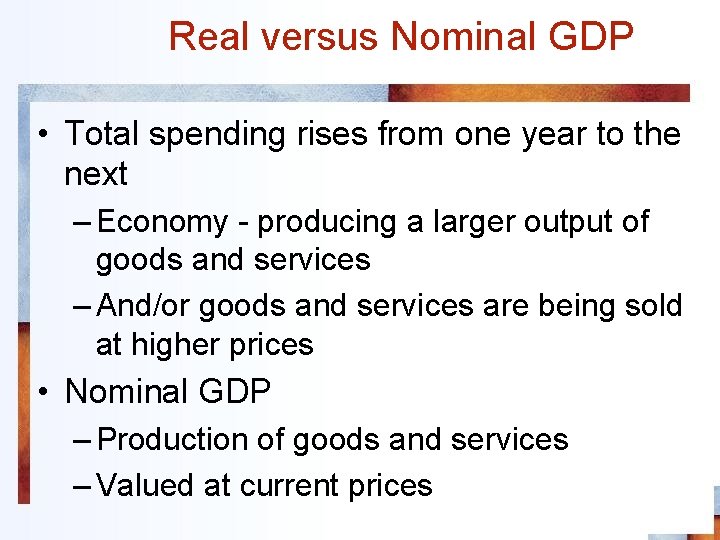
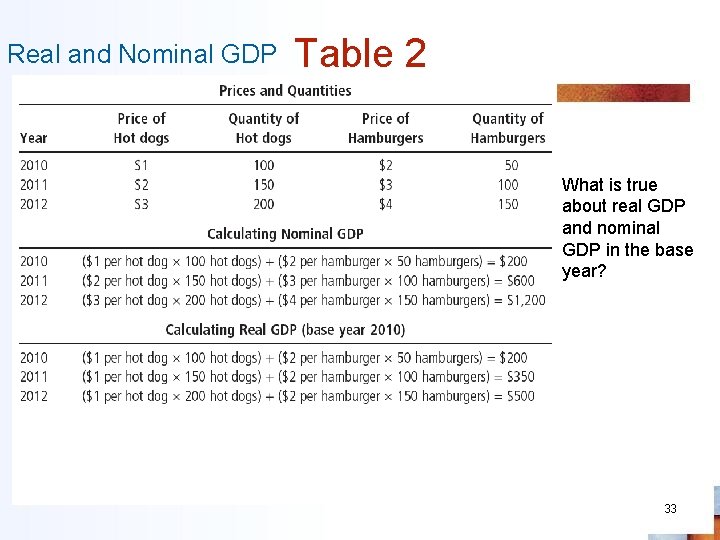
Real versus Nominal GDP • Total spending rises from one year to the next – Economy - producing a larger output of goods and services – And/or goods and services are being sold at higher prices • Nominal GDP – Production of goods and services – Valued at current prices 31
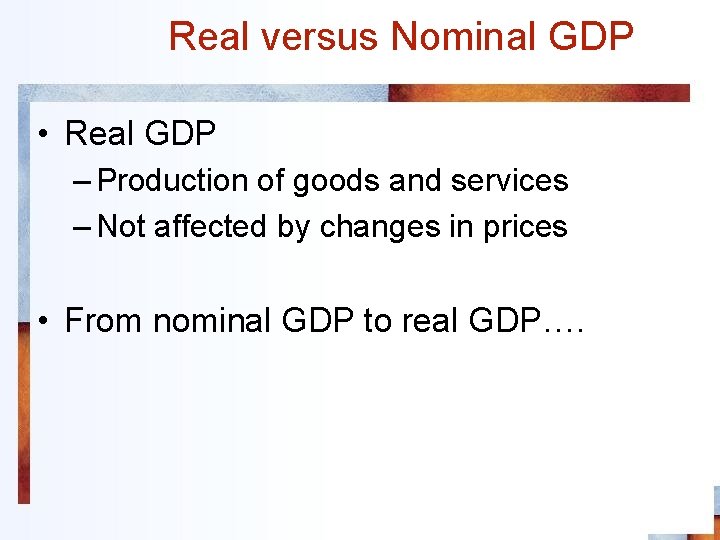
Real versus Nominal GDP • Real GDP – Production of goods and services – Not affected by changes in prices • From nominal GDP to real GDP…. 32
Real and Nominal GDP Table 2 What is true about real GDP and nominal GDP in the base year? 33
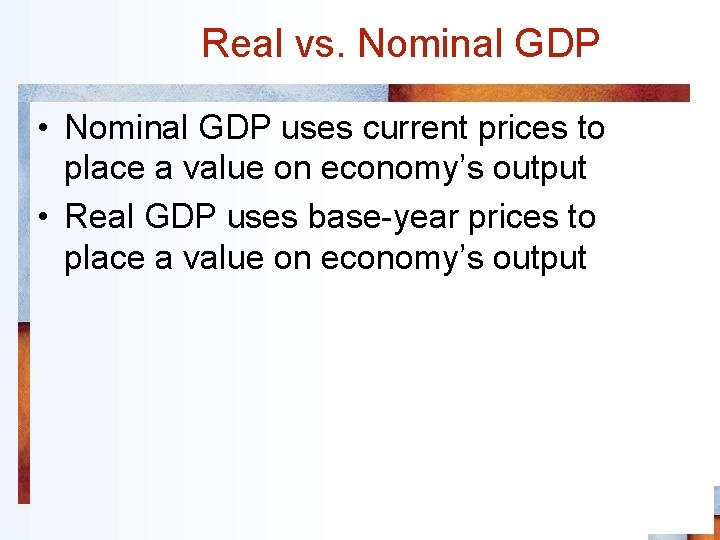
Real vs. Nominal GDP • Nominal GDP uses current prices to place a value on economy’s output • Real GDP uses base-year prices to place a value on economy’s output 34
Real vs. Nominal GDP • True/False – If Nominal GDP is rising, real GDP must also be rising. Why? 35
GDP • GDP – “the best single measure of the economic well-being of a society” – Economy’s total income – Economy’s total expenditure • Larger GDP – Good life, better healthcare – Better educational systems – Measure our ability to obtain many of the inputs into a worthwhile life 36
GDP • GDP – not a perfect measure of wellbeing. Why not? 37
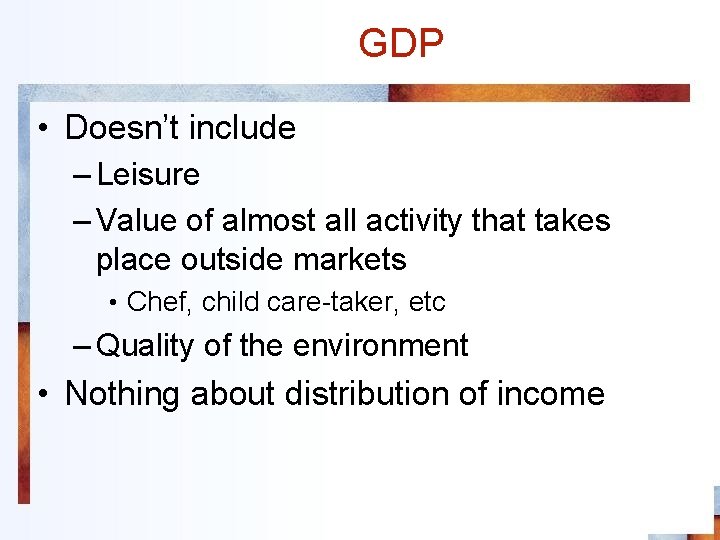
GDP • Doesn’t include – Leisure – Value of almost all activity that takes place outside markets • Chef, child care-taker, etc – Quality of the environment • Nothing about distribution of income 38
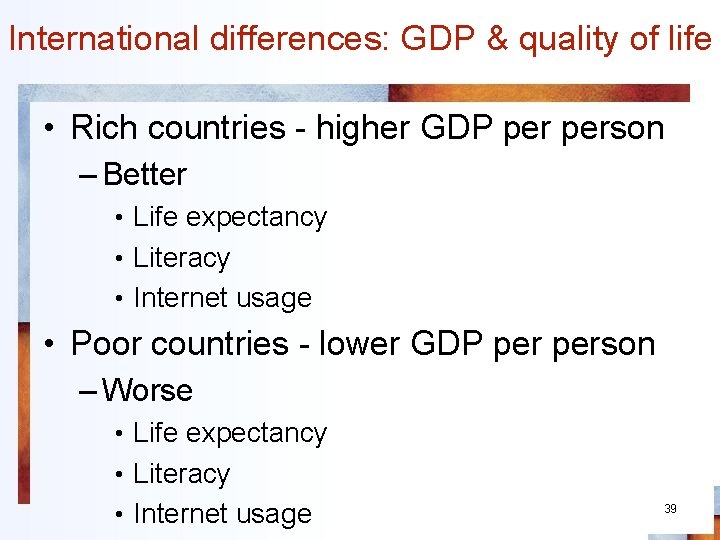
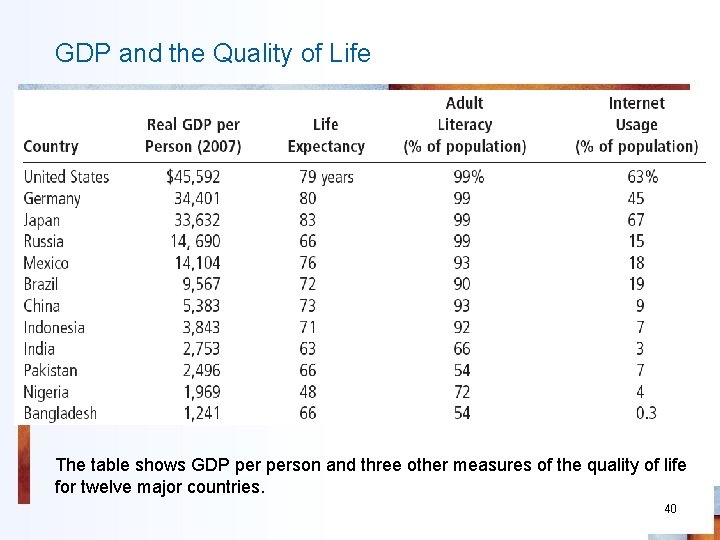
International differences: GDP & quality of life • Rich countries - higher GDP person – Better • Life expectancy • Literacy • Internet usage • Poor countries - lower GDP person – Worse • Life expectancy • Literacy • Internet usage 39
GDP and the Quality of Life The table shows GDP person and three other measures of the quality of life for twelve major countries. 40
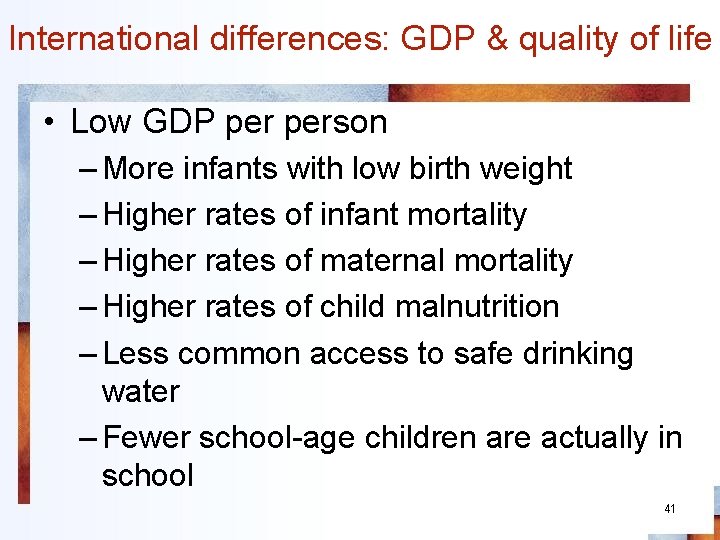
International differences: GDP & quality of life • Low GDP person – More infants with low birth weight – Higher rates of infant mortality – Higher rates of maternal mortality – Higher rates of child malnutrition – Less common access to safe drinking water – Fewer school-age children are actually in school 41
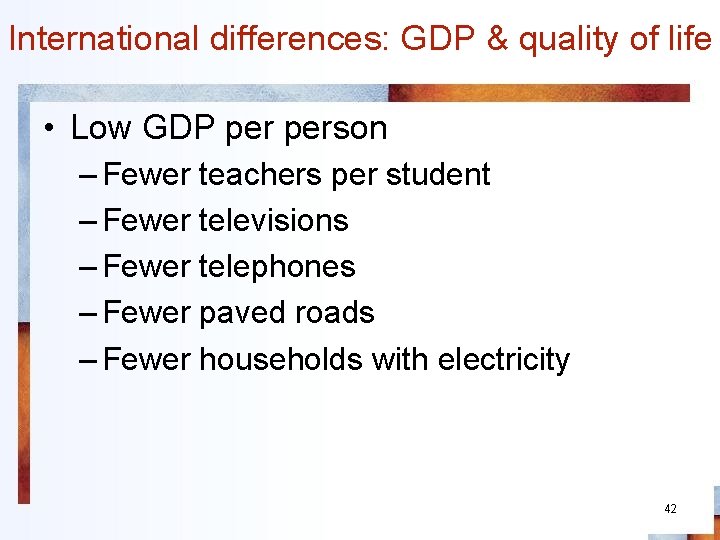
International differences: GDP & quality of life • Low GDP person – Fewer teachers per student – Fewer televisions – Fewer telephones – Fewer paved roads – Fewer households with electricity 42
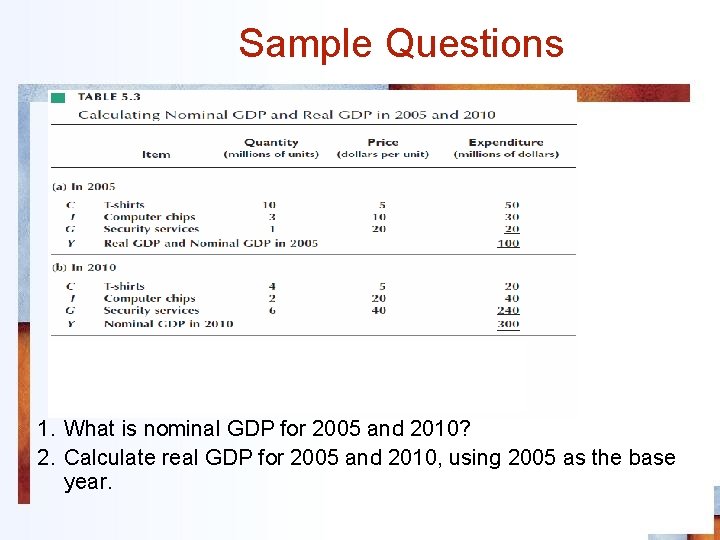
Sample Questions 1. What is nominal GDP for 2005 and 2010? 2. Calculate real GDP for 2005 and 2010, using 2005 as the base year. 43
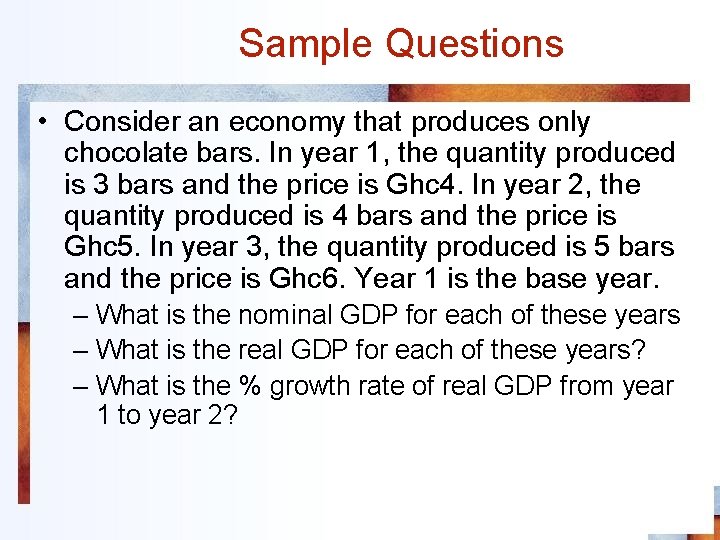
Sample Questions • Consider an economy that produces only chocolate bars. In year 1, the quantity produced is 3 bars and the price is Ghc 4. In year 2, the quantity produced is 4 bars and the price is Ghc 5. In year 3, the quantity produced is 5 bars and the price is Ghc 6. Year 1 is the base year. – What is the nominal GDP for each of these years – What is the real GDP for each of these years? – What is the % growth rate of real GDP from year 1 to year 2? 44
Take-Home Exercise • One day, Barry the Barber collects $400 for haircuts. Over this day, his equipment deteriorates in value by $50. Of the remaining $350, Barry sends $30 to the government in sales taxes, takes home $220 in wages, and retains $100 in his business to add new equipment in the future. From the $220 that Barry takes home, he pays $70 in income taxes. Based on this information, compute Barry’s contribution to the following measures of income: – Gross domestic product – Net national product – National income – Personal income – Disposable personal income 45
Next Class • The price level and inflation • Measuring the rate of inflation – The construction of the consumer price index (CPI)/retail price index (RPI) – GDP deflator • Unemployment – Definition and Measurement 46