
National Incident Management System and National Response Plan
- Slides: 27
National Incident Management System and National Response Plan NRT & RRT Co-Chairs Meeting March 2, 2004
Purpose § Introduce the National Incident Management System (NIMS) § Discuss the development and concepts of the National Response Plan (NRP)
Discussion Outline § Objectives & Implementation of HSPD 5 § NIMS and NRP Relationship § Development Process § Initial NRP § NIMS § NRP § Timeline
HSPD-5: Management of Domestic Incidents HSPD-5 Objectives: § Single comprehensive national approach § Prevention, Preparedness, Response and Recovery § Ensure all levels of government and private sector work together § Horizontal and vertical integration § Effective communications § Integrate crisis and consequence management § DHS Secretary as the principal Federal official for domestic incident management
HSPD-5 Implementation Develop and administer: § National Incident Management System (NIMS) § Core set of concepts, principles and terminology for incident command multi-agency coordination § National Response Plan (NRP) § All-discipline, all-hazards plan § Initial National Response Plan (INRP) created as an interim plan until the publication of the full NRP
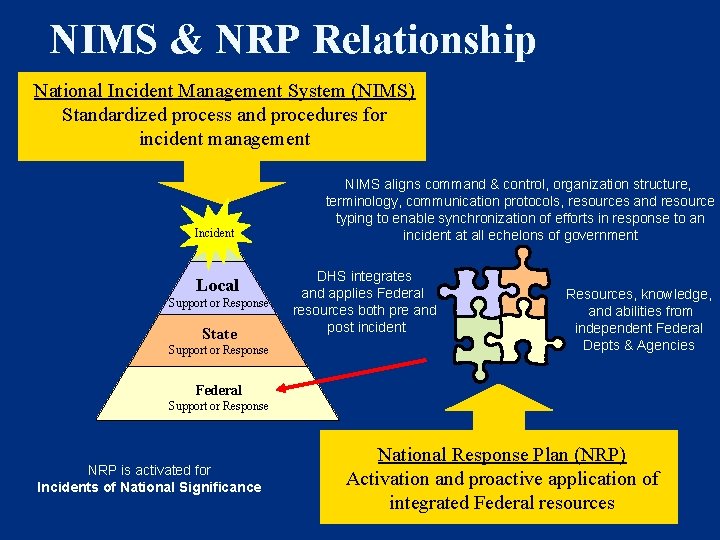
NIMS & NRP Relationship National Incident Management System (NIMS) Standardized process and procedures for incident management Incident Local Support or Response State Support or Response NIMS aligns command & control, organization structure, terminology, communication protocols, resources and resource typing to enable synchronization of efforts in response to an incident at all echelons of government DHS integrates and applies Federal resources both pre and post incident Resources, knowledge, and abilities from independent Federal Depts & Agencies Federal Support or Response NRP is activated for Incidents of National Significance National Response Plan (NRP) Activation and proactive application of integrated Federal resources
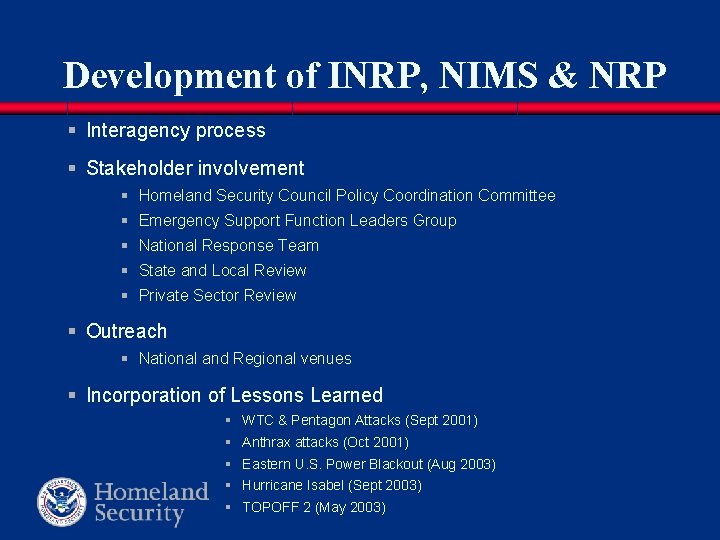
Development of INRP, NIMS & NRP § Interagency process § Stakeholder involvement § Homeland Security Council Policy Coordination Committee § Emergency Support Function Leaders Group § National Response Team § State and Local Review § Private Sector Review § Outreach § National and Regional venues § Incorporation of Lessons Learned § WTC & Pentagon Attacks (Sept 2001) § Anthrax attacks (Oct 2001) § Eastern U. S. Power Blackout (Aug 2003) § Hurricane Isabel (Sept 2003) § TOPOFF 2 (May 2003)
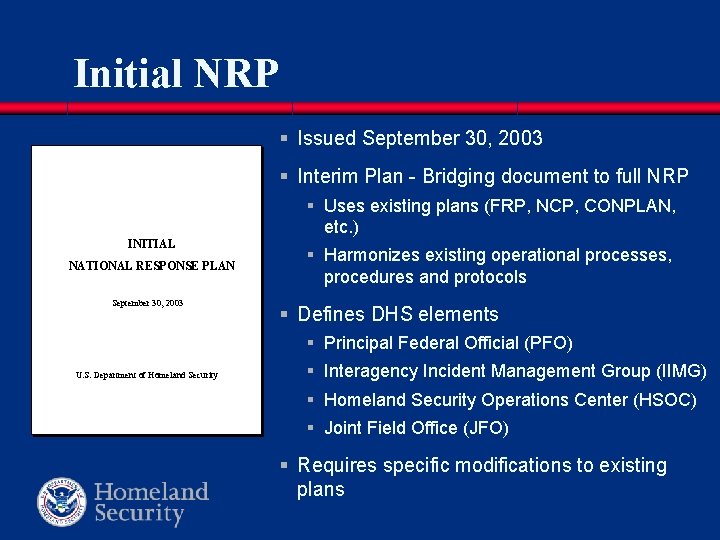
Initial NRP § Issued September 30, 2003 § Interim Plan - Bridging document to full NRP § Uses existing plans (FRP, NCP, CONPLAN, etc. ) INITIAL NATIONAL RESPONSE PLAN September 30, 2003 § Harmonizes existing operational processes, procedures and protocols § Defines DHS elements § Principal Federal Official (PFO) U. S. Department of Homeland Security § Interagency Incident Management Group (IIMG) § Homeland Security Operations Center (HSOC) § Joint Field Office (JFO) § Requires specific modifications to existing plans
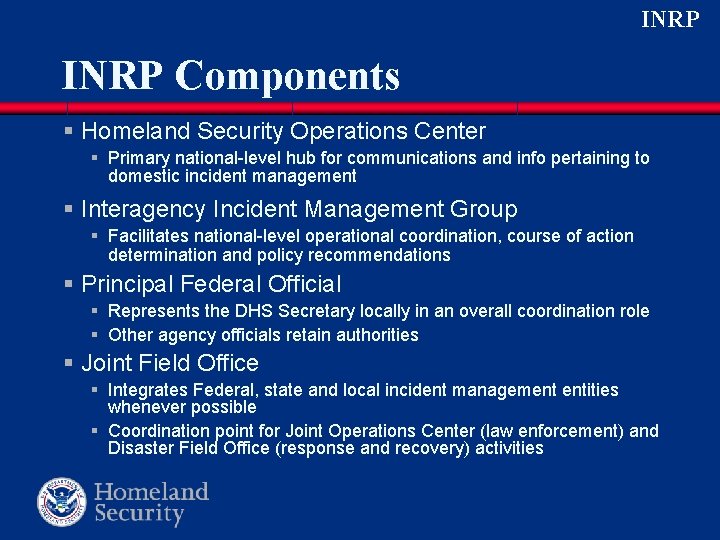
INRP Components § Homeland Security Operations Center § Primary national-level hub for communications and info pertaining to domestic incident management § Interagency Incident Management Group § Facilitates national-level operational coordination, course of action determination and policy recommendations § Principal Federal Official § Represents the DHS Secretary locally in an overall coordination role § Other agency officials retain authorities § Joint Field Office § Integrates Federal, state and local incident management entities whenever possible § Coordination point for Joint Operations Center (law enforcement) and Disaster Field Office (response and recovery) activities
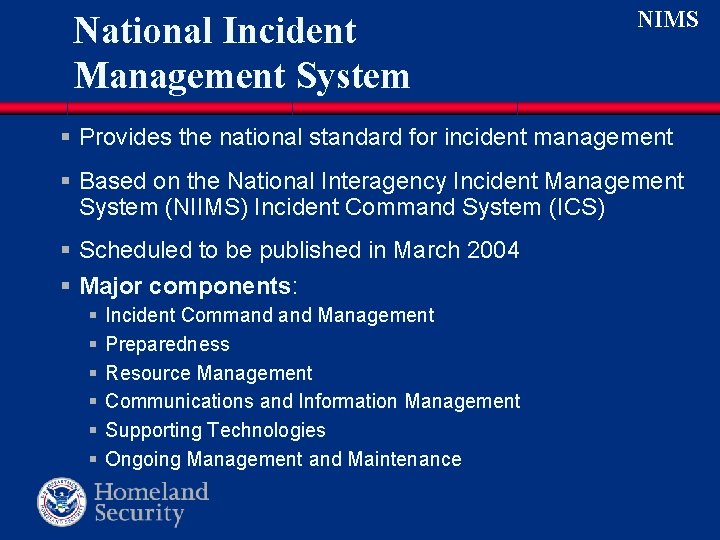
National Incident Management System NIMS § Provides the national standard for incident management § Based on the National Interagency Incident Management System (NIIMS) Incident Command System (ICS) § Scheduled to be published in March 2004 § Major components: § § § Incident Command Management Preparedness Resource Management Communications and Information Management Supporting Technologies Ongoing Management and Maintenance
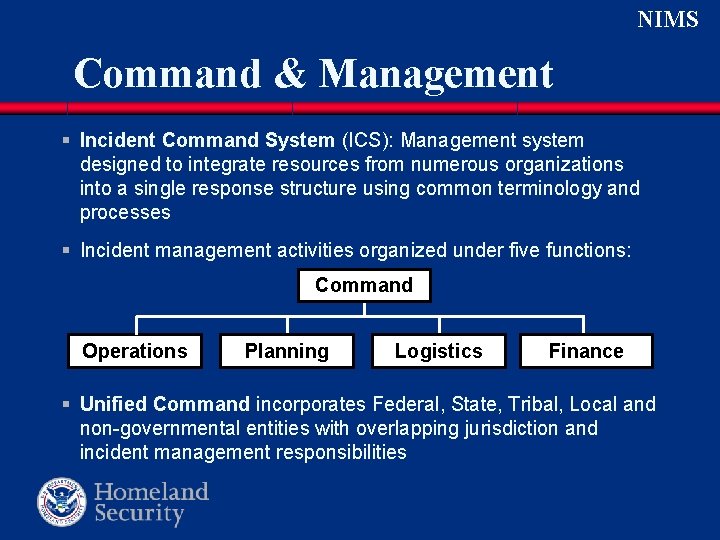
NIMS Command & Management § Incident Command System (ICS): Management system designed to integrate resources from numerous organizations into a single response structure using common terminology and processes § Incident management activities organized under five functions: Command Operations Planning Logistics Finance § Unified Command incorporates Federal, State, Tribal, Local and non-governmental entities with overlapping jurisdiction and incident management responsibilities
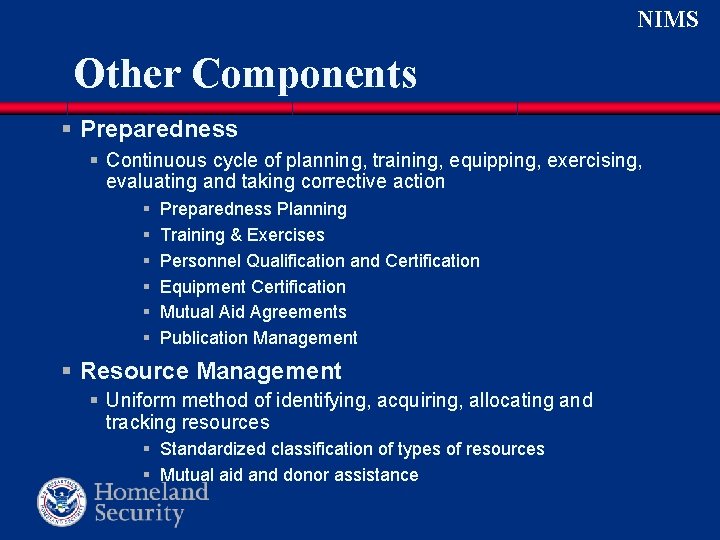
NIMS Other Components § Preparedness § Continuous cycle of planning, training, equipping, exercising, evaluating and taking corrective action § § § Preparedness Planning Training & Exercises Personnel Qualification and Certification Equipment Certification Mutual Aid Agreements Publication Management § Resource Management § Uniform method of identifying, acquiring, allocating and tracking resources § Standardized classification of types of resources § Mutual aid and donor assistance
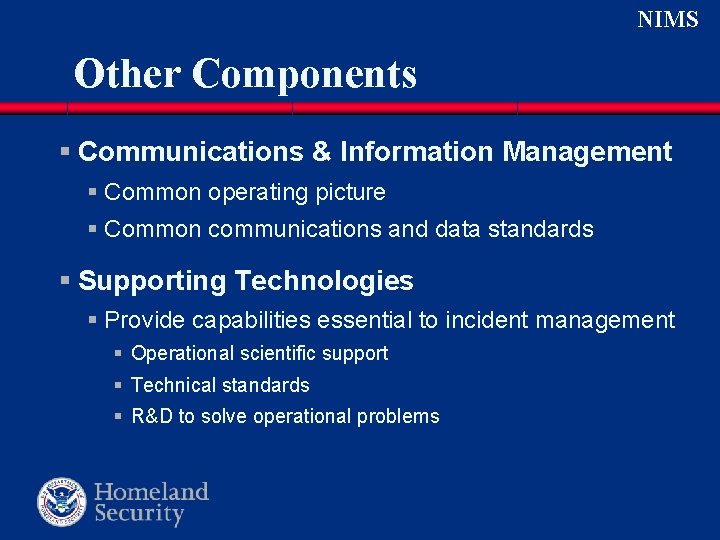
NIMS Other Components § Communications & Information Management § Common operating picture § Common communications and data standards § Supporting Technologies § Provide capabilities essential to incident management § Operational scientific support § Technical standards § R&D to solve operational problems
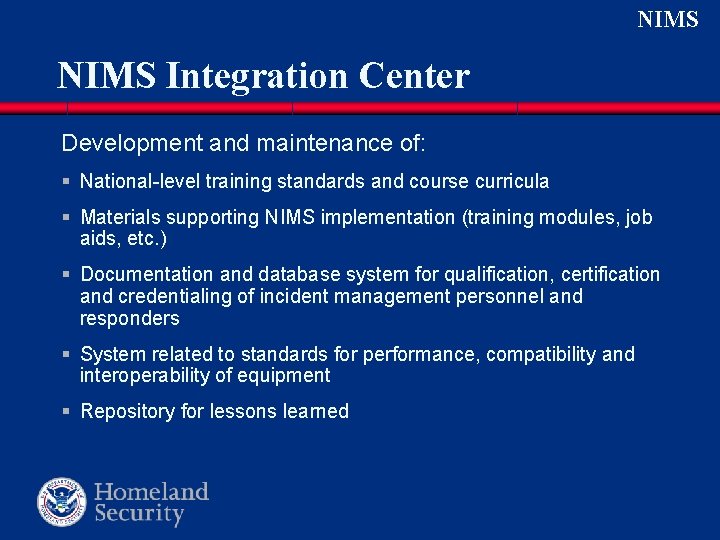
NIMS Integration Center Development and maintenance of: § National-level training standards and course curricula § Materials supporting NIMS implementation (training modules, job aids, etc. ) § Documentation and database system for qualification, certification and credentialing of incident management personnel and responders § System related to standards for performance, compatibility and interoperability of equipment § Repository for lessons learned
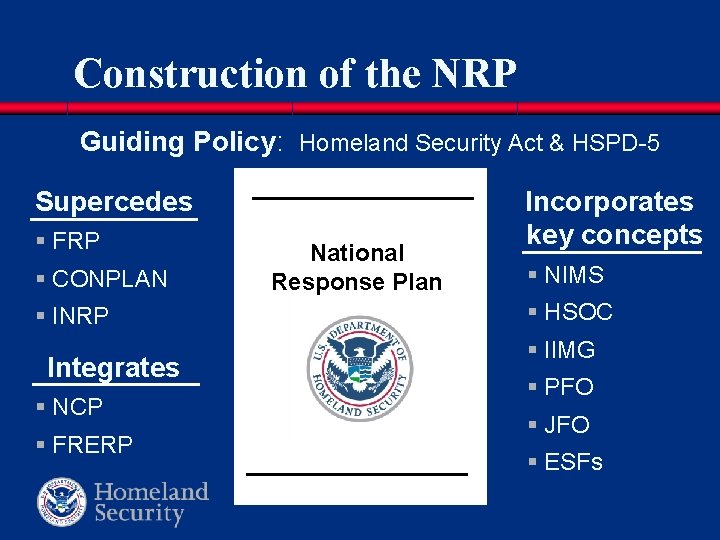
Construction of the NRP Guiding Policy: Homeland Security Act & HSPD-5 Supercedes § FRP § CONPLAN § INRP Integrates § NCP § FRERP National Response Plan Incorporates key concepts § NIMS § HSOC § IIMG § PFO § JFO § ESFs
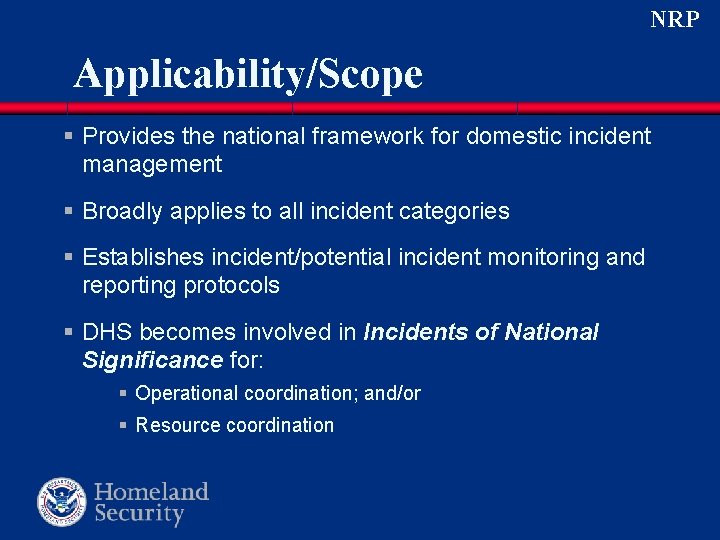
NRP Applicability/Scope § Provides the national framework for domestic incident management § Broadly applies to all incident categories § Establishes incident/potential incident monitoring and reporting protocols § DHS becomes involved in Incidents of National Significance for: § Operational coordination; and/or § Resource coordination
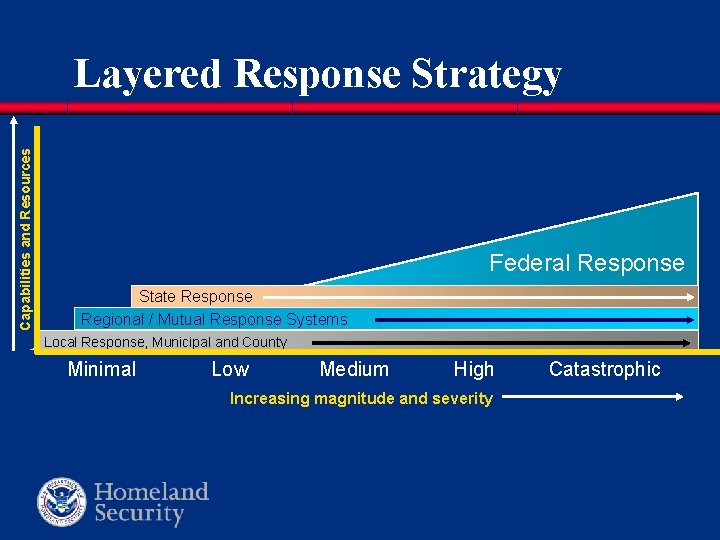
Capabilities and Resources Layered Response Strategy Federal Response State Response Regional / Mutual Response Systems Local Response, Municipal and County Minimal Low Medium High Increasing magnitude and severity Catastrophic
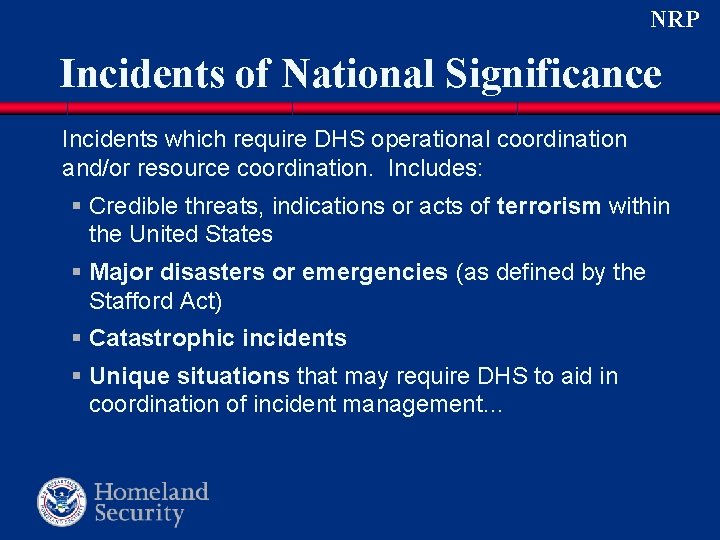
NRP Incidents of National Significance Incidents which require DHS operational coordination and/or resource coordination. Includes: § Credible threats, indications or acts of terrorism within the United States § Major disasters or emergencies (as defined by the Stafford Act) § Catastrophic incidents § Unique situations that may require DHS to aid in coordination of incident management…
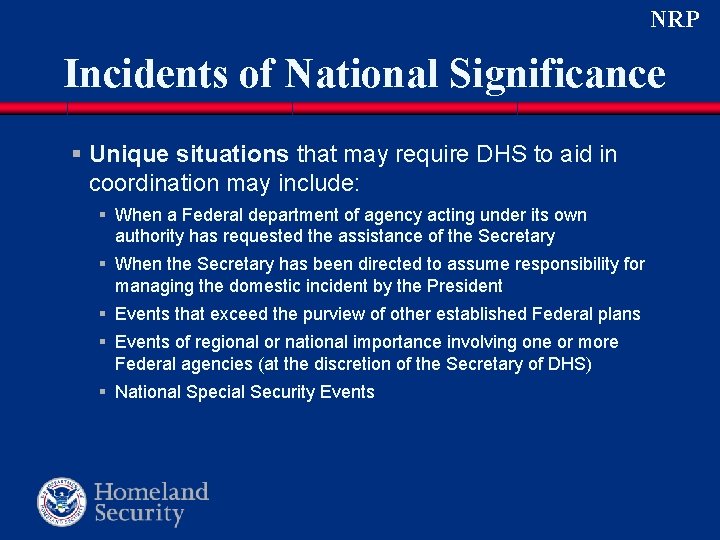
NRP Incidents of National Significance § Unique situations that may require DHS to aid in coordination may include: § When a Federal department of agency acting under its own authority has requested the assistance of the Secretary § When the Secretary has been directed to assume responsibility for managing the domestic incident by the President § Events that exceed the purview of other established Federal plans § Events of regional or national importance involving one or more Federal agencies (at the discretion of the Secretary of DHS) § National Special Security Events
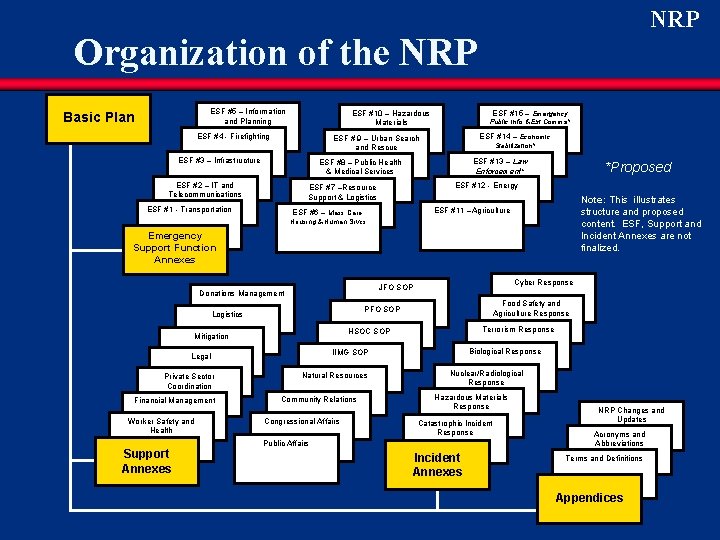
NRP Organization of the NRP ESF #5 – Information and Planning Basic Plan ESF #15 – Emergency Public Info & Ext Comms* ESF #10 – Hazardous Materials ESF #4 - Firefighting ESF #14 – Economic ESF # 9 – Urban Search and Rescue ESF #3 – Infrastructure Stabilization* ESF #13 – Law Enforcement* ESF #8 – Public Health & Medical Services ESF #2 – IT and Telecommunications ESF #12 - Energy ESF #7 –Resource Support & Logistics Management ESF #6 – Mass Care, ESF #1 - Transportation *Proposed Note: This illustrates structure and proposed content. ESF, Support and Incident Annexes are not finalized. ESF #11 –Agriculture Housing & Human Srvcs Emergency Support Function Annexes Support Annexes Biological Response IIMG SOP Legal Worker Safety and Health Terrorism Response HSOC SOP Mitigation Financial Management Food Safety and Agriculture Response PFO SOP Logistics Private Sector Coordination Cyber Response JFO SOP Donations Management Natural Resources Community Relations Congressional Affairs Nuclear/Radiological Response Hazardous Materials Response Catastrophic Incident Response Public Affairs Incident Annexes NRP Changes and Updates Acronyms and Abbreviations Terms and Definitions Appendices
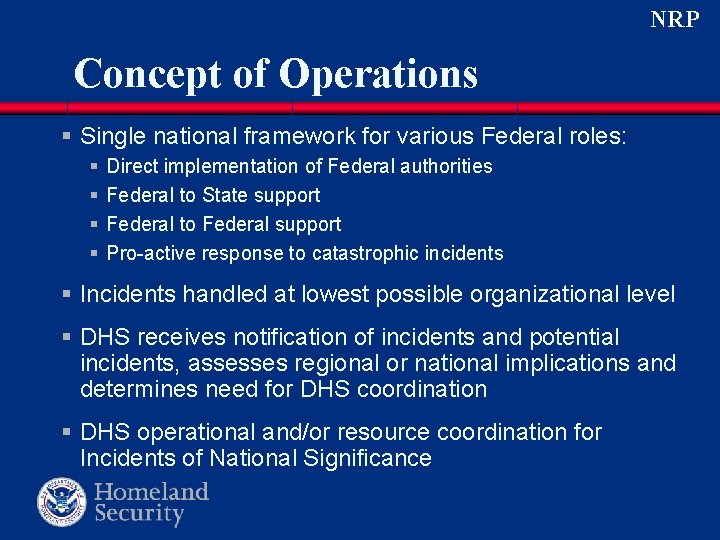
NRP Concept of Operations § Single national framework for various Federal roles: § § Direct implementation of Federal authorities Federal to State support Federal to Federal support Pro-active response to catastrophic incidents § Incidents handled at lowest possible organizational level § DHS receives notification of incidents and potential incidents, assesses regional or national implications and determines need for DHS coordination § DHS operational and/or resource coordination for Incidents of National Significance
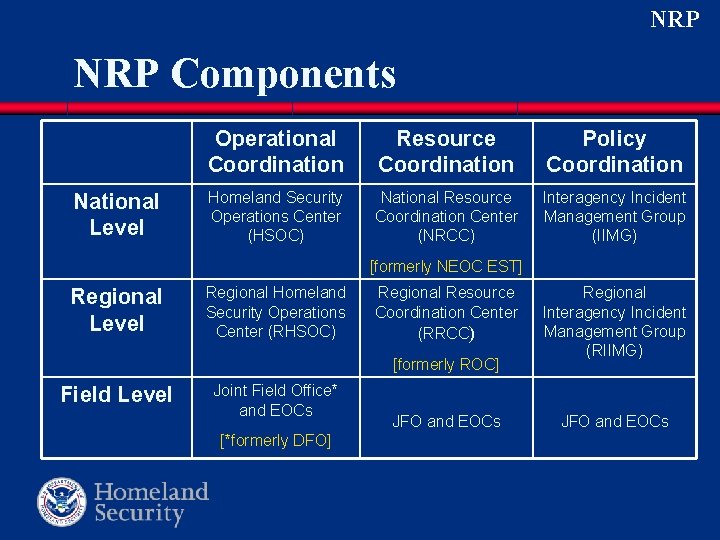
NRP Components National Level Operational Coordination Resource Coordination Policy Coordination Homeland Security Operations Center (HSOC) National Resource Coordination Center (NRCC) Interagency Incident Management Group (IIMG) [formerly NEOC EST] Regional Level Regional Homeland Security Operations Center (RHSOC) Regional Resource Coordination Center (RRCC) [formerly ROC] Field Level Joint Field Office* and EOCs [*formerly DFO] JFO and EOCs Regional Interagency Incident Management Group (RIIMG) JFO and EOCs
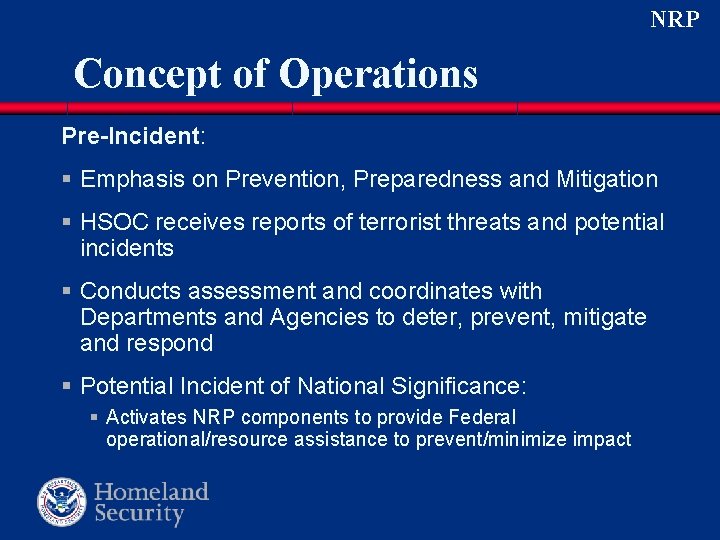
NRP Concept of Operations Pre-Incident: § Emphasis on Prevention, Preparedness and Mitigation § HSOC receives reports of terrorist threats and potential incidents § Conducts assessment and coordinates with Departments and Agencies to deter, prevent, mitigate and respond § Potential Incident of National Significance: § Activates NRP components to provide Federal operational/resource assistance to prevent/minimize impact
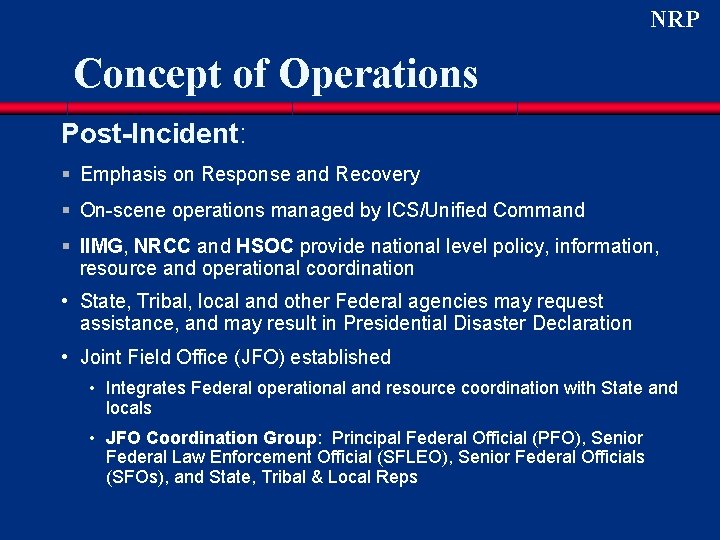
NRP Concept of Operations Post-Incident: § Emphasis on Response and Recovery § On-scene operations managed by ICS/Unified Command § IIMG, NRCC and HSOC provide national level policy, information, resource and operational coordination • State, Tribal, local and other Federal agencies may request assistance, and may result in Presidential Disaster Declaration • Joint Field Office (JFO) established • Integrates Federal operational and resource coordination with State and locals • JFO Coordination Group: Principal Federal Official (PFO), Senior Federal Law Enforcement Official (SFLEO), Senior Federal Officials (SFOs), and State, Tribal & Local Reps
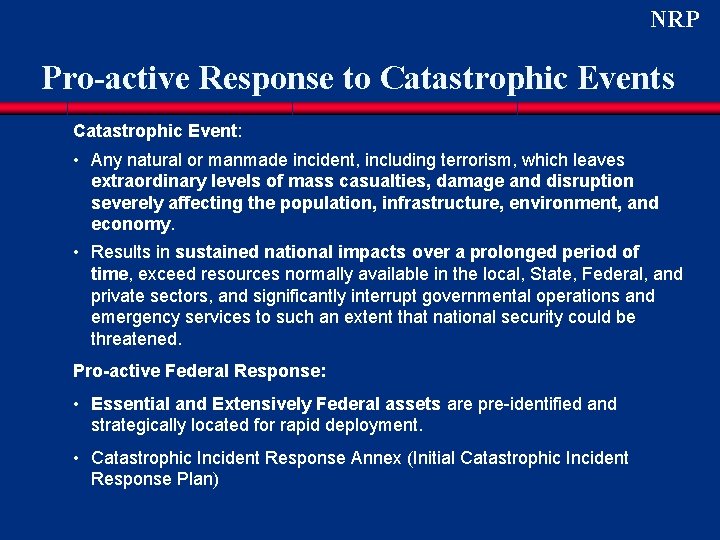
NRP Pro-active Response to Catastrophic Events Catastrophic Event: • Any natural or manmade incident, including terrorism, which leaves extraordinary levels of mass casualties, damage and disruption severely affecting the population, infrastructure, environment, and economy. • Results in sustained national impacts over a prolonged period of time, exceed resources normally available in the local, State, Federal, and private sectors, and significantly interrupt governmental operations and emergency services to such an extent that national security could be threatened. Pro-active Federal Response: • Essential and Extensively Federal assets are pre-identified and strategically located for rapid deployment. • Catastrophic Incident Response Annex (Initial Catastrophic Incident Response Plan)
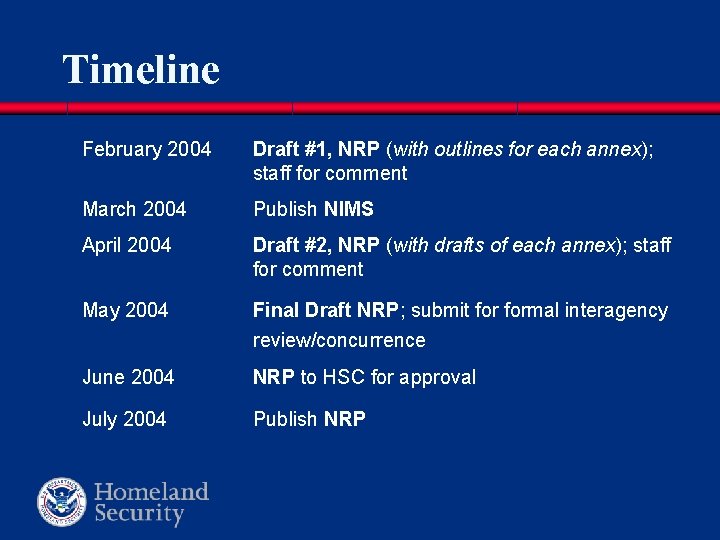
Timeline February 2004 Draft #1, NRP (with outlines for each annex); staff for comment March 2004 Publish NIMS April 2004 Draft #2, NRP (with drafts of each annex); staff for comment May 2004 Final Draft NRP; submit formal interagency review/concurrence June 2004 NRP to HSC for approval July 2004 Publish NRP
Questions?