
NATIONAL IMAGERY AND MAPPING AGENCY Know the Earth


- Slides: 22
NATIONAL IMAGERY AND MAPPING AGENCY Know the Earth Show the Way NIMA Commercial and Civil Applications Project (CCAP) Geopositional Accuracy Evaluations Terry Lehman December 4, 2003 ISPRS International Workshop on Radiometric and Geometric Calibration
CCAP Mission • CCAP is the NIMA process to assess the utility of emerging civil and commercial remote sensing systems • Do. D directive 5105. 60 states that NIMA shall: – Assess the applicability of evolving commercial capabilities to meet imagery and geospatial information needs of the department of defense and the intelligence community • CCAP partners include USGS and NASA-Stennis: – JACIE (joint agency commercial imagery evaluation) team – Space act agreement • Elements of the evaluations: – Image interpretation for intelligence, military, and civil applications – Feature extraction for mapping – Geopositional accuracy – Radiometric fidelity 2
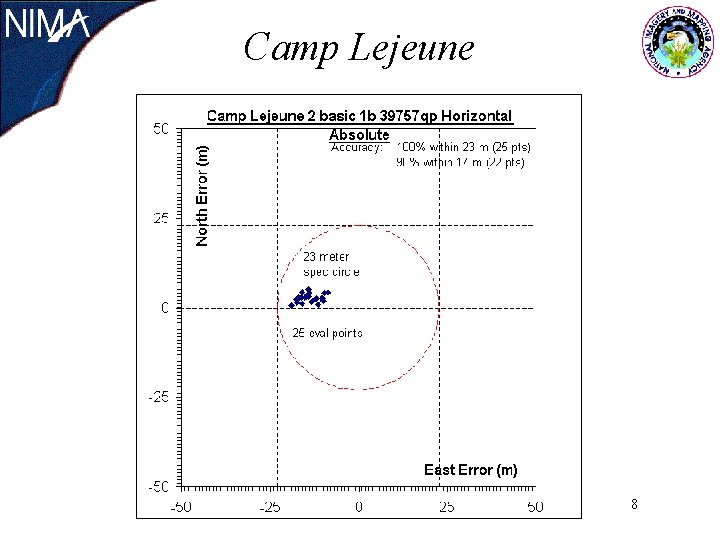
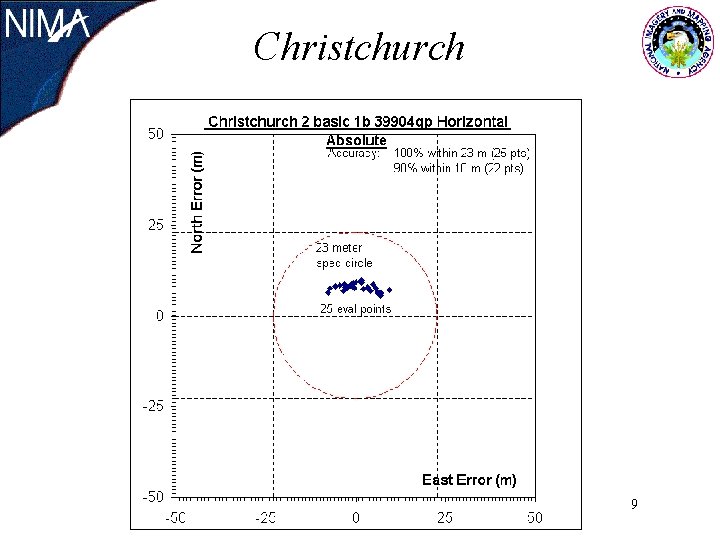
Approach • The evaluation of geopositional accuracy of basic products is based on a comparison to known ground control points of higher accuracy • Evaluation support provided by NIMA’s: – – Precision engagement staff (PTNT) Front end processing environment (FPE) Image quality & utility (AEAI) Innovison (IDR) ® • Primarily Socet Set was used to measure the coordinates in the imagery products 3
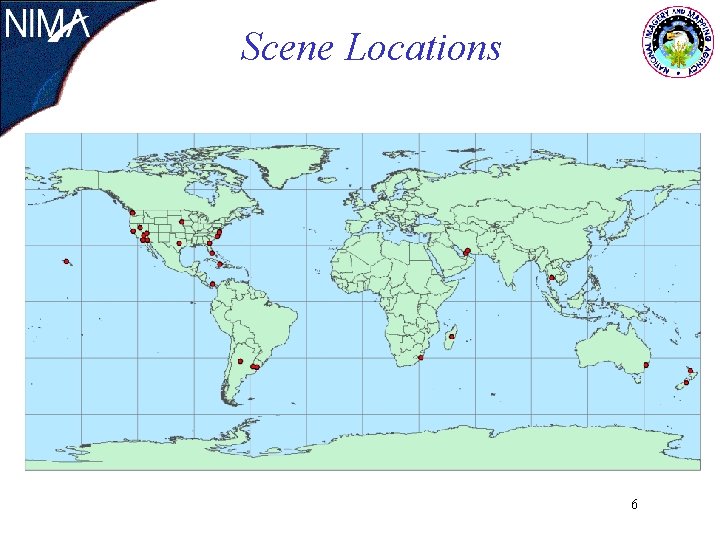
Approach (cont. ) • 13 scenes – Various locations having features with known ground truth geo-coordinates – Scenes vary by terrain elevation characteristics • 25 drop points geo-located per scene – Ground truth geo-coordinate data derived from controlled base – Only latitude and longitude determined – no stereo 4
Imagery Matrix 5 BOLD: Geopositional Products
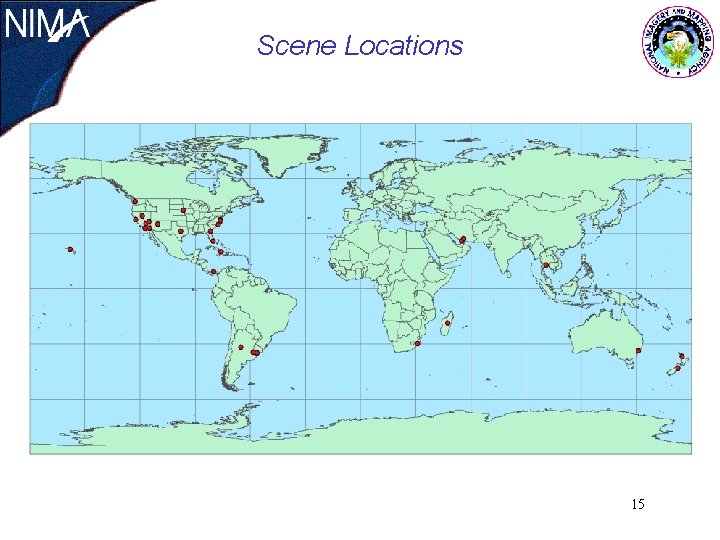
Scene Locations 6
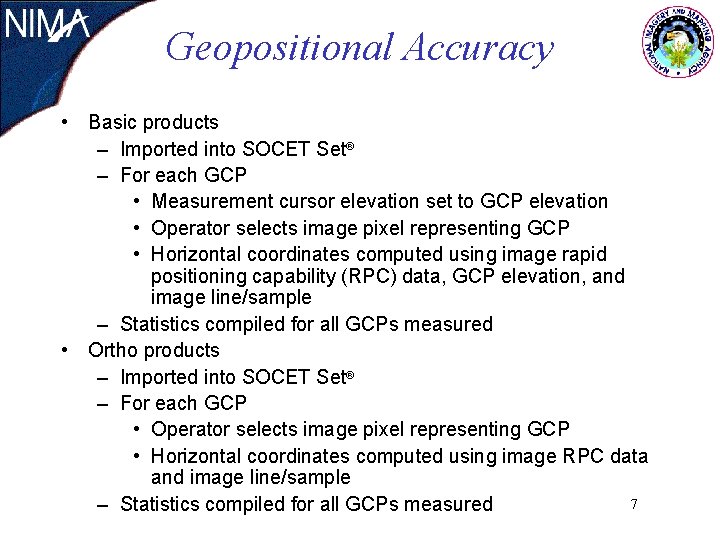
Geopositional Accuracy • Basic products – Imported into SOCET Set – For each GCP • Measurement cursor elevation set to GCP elevation • Operator selects image pixel representing GCP • Horizontal coordinates computed using image rapid positioning capability (RPC) data, GCP elevation, and image line/sample – Statistics compiled for all GCPs measured • Ortho products – Imported into SOCET Set – For each GCP • Operator selects image pixel representing GCP • Horizontal coordinates computed using image RPC data and image line/sample 7 – Statistics compiled for all GCPs measured
Camp Lejeune 8
Christchurch 9
Feature Selection • Features in this evaluation fall into broad coverage categories as listed in the Feature and Attribute Coding Catalog (FACC) • Some overlap of features exists between coverage categories • All confidence ratings and yes/no attribute responses for features were grouped by coverage category and averaged for each product type – This allowed for comparisons of products by general mapping applications • Multiple choice attribute responses were grouped by attribute category, compared with predetermined ground truth, and averaged for each product type 10
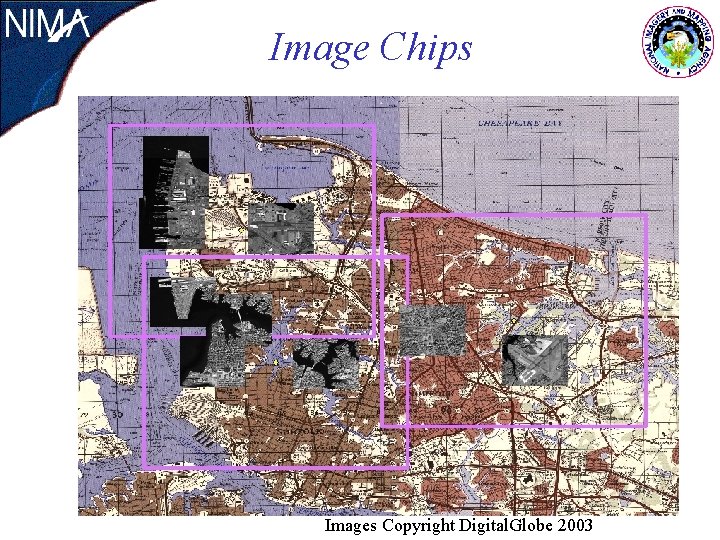
Feature Selection, cont. • 6 Geospatial Analysts/Cartographers • 265 Image chips; 29 unique geographic locations – – 112 Pan 112 MSI 41 Pan-Sharpened MSI Data were analyzed to determine the suitability and information content of standard imagery products in support of extraction and attribution tasks – Categories derived from the (FACC) 11
Image Chips 12 Images Copyright Digital. Globe 2003
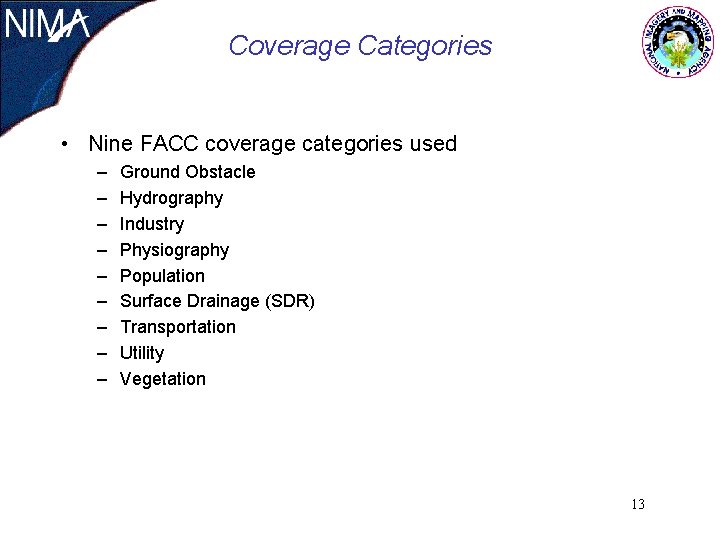
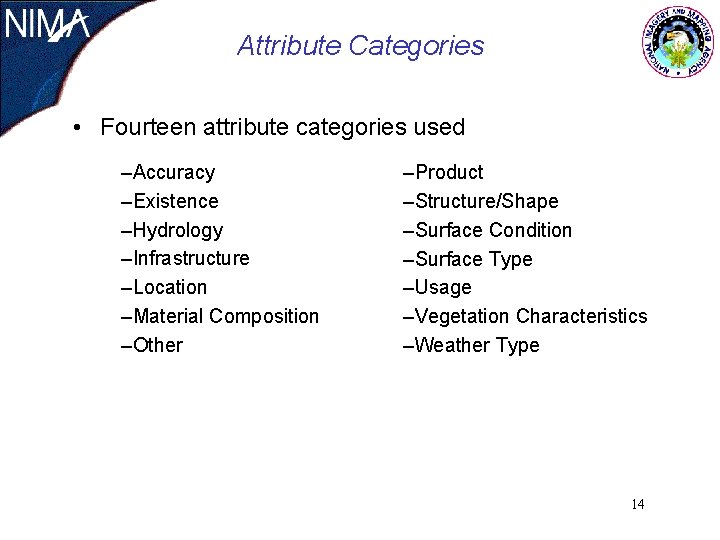
Coverage Categories • Nine FACC coverage categories used – – – – – Ground Obstacle Hydrography Industry Physiography Population Surface Drainage (SDR) Transportation Utility Vegetation 13
Attribute Categories • Fourteen attribute categories used –Accuracy –Existence –Hydrology –Infrastructure –Location –Material Composition –Other –Product –Structure/Shape –Surface Condition –Surface Type –Usage –Vegetation Characteristics –Weather Type 14
Scene Locations 15
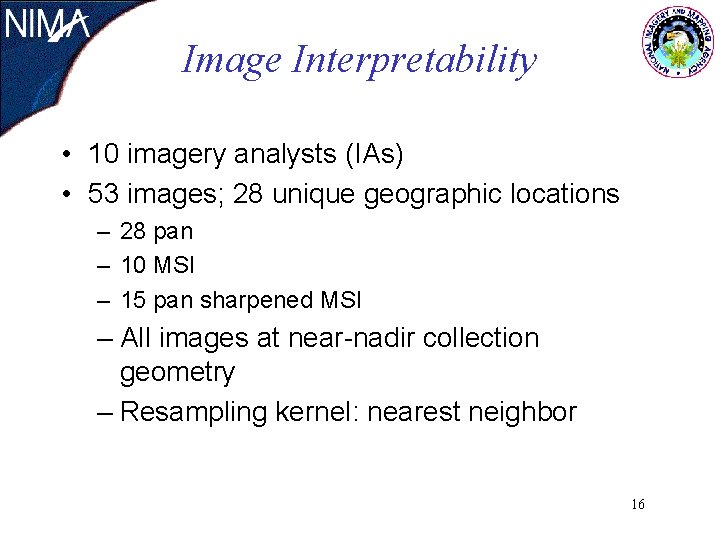
Image Interpretability • 10 imagery analysts (IAs) • 53 images; 28 unique geographic locations – 28 pan – 10 MSI – 15 pan sharpened MSI – All images at near-nadir collection geometry – Resampling kernel: nearest neighbor 16
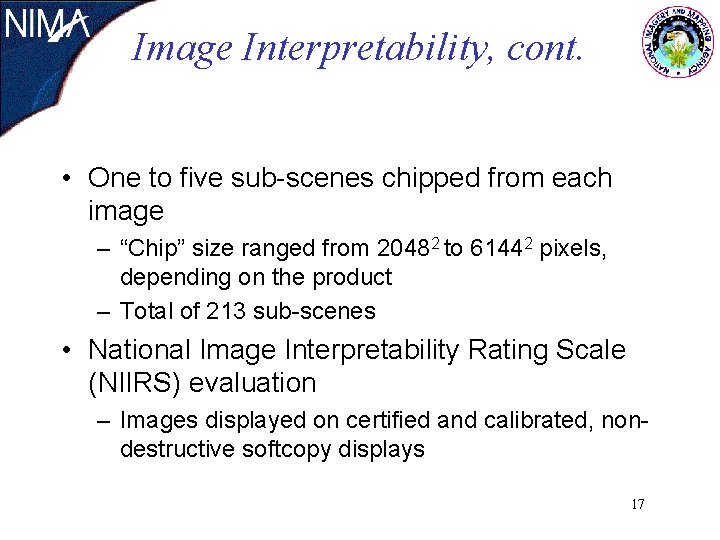
Image Interpretability, cont. • One to five sub-scenes chipped from each image – “Chip” size ranged from 20482 to 61442 pixels, depending on the product – Total of 213 sub-scenes • National Image Interpretability Rating Scale (NIIRS) evaluation – Images displayed on certified and calibrated, nondestructive softcopy displays 17
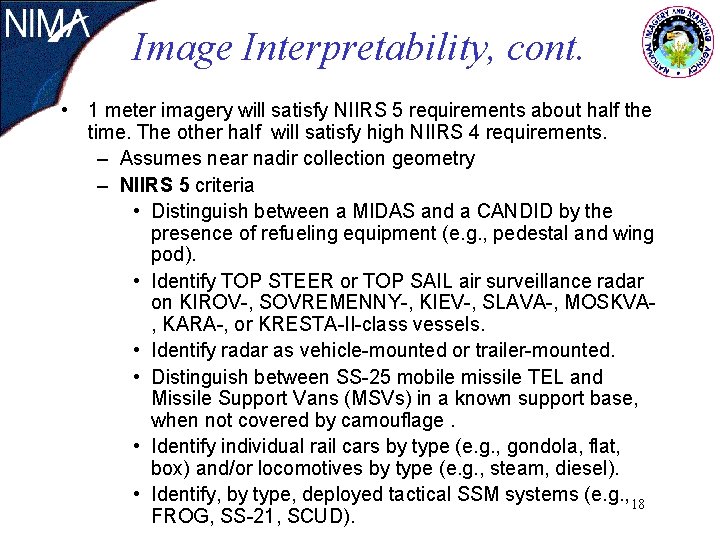
Image Interpretability, cont. • 1 meter imagery will satisfy NIIRS 5 requirements about half the time. The other half will satisfy high NIIRS 4 requirements. – Assumes near nadir collection geometry – NIIRS 5 criteria • Distinguish between a MIDAS and a CANDID by the presence of refueling equipment (e. g. , pedestal and wing pod). • Identify TOP STEER or TOP SAIL air surveillance radar on KIROV-, SOVREMENNY-, KIEV-, SLAVA-, MOSKVA, KARA-, or KRESTA-II-class vessels. • Identify radar as vehicle-mounted or trailer-mounted. • Distinguish between SS-25 mobile missile TEL and Missile Support Vans (MSVs) in a known support base, when not covered by camouflage. • Identify individual rail cars by type (e. g. , gondola, flat, box) and/or locomotives by type (e. g. , steam, diesel). • Identify, by type, deployed tactical SSM systems (e. g. , 18 FROG, SS-21, SCUD).
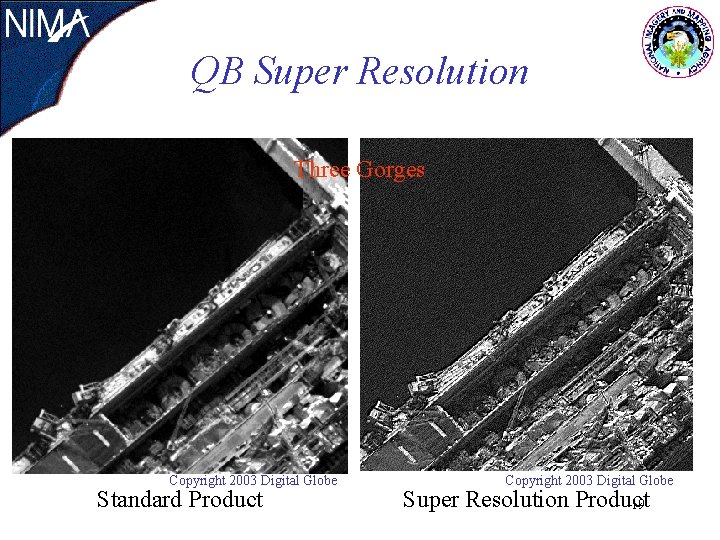
QB Super Resolution Three Gorges Copyright 2003 Digital Globe Standard Product Copyright 2003 Digital Globe Super Resolution Product 19
Conclusions • CCAP evaluates all commercial and civil satellite imagery that NIMA’s customers are interested in using • CCAP evaluations only insure the delivered products meet the supplier’s specifications, particularly with respect to geopositional accuracy • CCAP evaluations quantify the utility of commercial imagery for image analysis and mapping applications 20
Present and Future Projects • • Orb. View-3 SPOT-5 EROS A 1 ISTAR/ADS-40 Geo. SAR Star 3 I Radar. Sat 2 21
NATIONAL IMAGERY AND MAPPING AGENCY Know the Earth Show the Way Questions?