
National History Day NHD Orientation K Benson J
National History Day (NHD) Orientation K Benson J Obert D Knuth LSMS GT Facilitator EVMS GT Facilitator kbenson@nsd. org jobert@nsd 131. org dknuth@nsd 131. org
NHD (National History Day) q Began as a small, local contest in 1974 in Ohio q Created by educators to help spur students’ interest in history q Gained support from the National Endowment for the Humanities q Grown to over 2 million people involved nationwide q Has regional, state, and national competitions q Has become a program that truly makes history come alive National History - www. nhd. org
http: //www. nhd. org National History Day (NHD) wants your student to become the historian! They decide on their topic. They research the topic, finding many sources of information. They determine the impact and consequences of their topic based on their evidence. After they’ve finished their research, they choose how to present their conclusions. They may choose to create … ¨ ¨ ¨ a historical performance, a paper, a web site, a documentary an exhibit. NHD puts them in control of their learning.
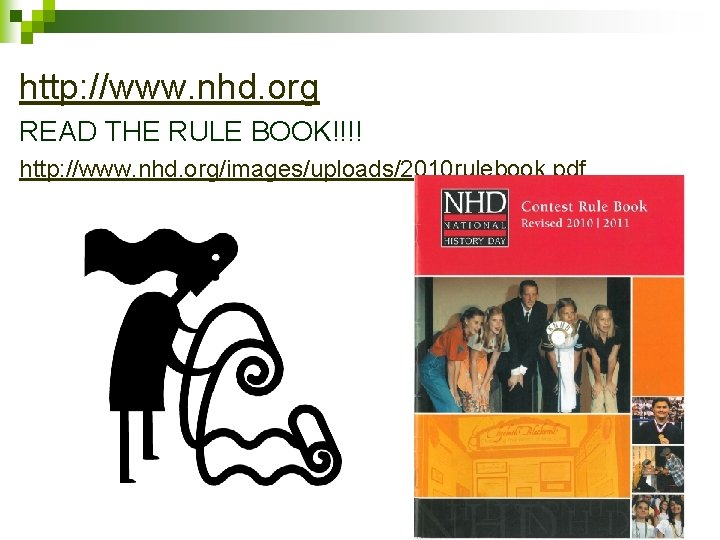
http: //www. nhd. org READ THE RULE BOOK!!!! http: //www. nhd. org/images/uploads/2010 rulebook. pdf
Where should I start? n This years theme is Turning Points in History: People, Ideas, Events The dictionary defines “turning point” as a point at which a decisive change takes place. ¨ A turning point is an idea, event or action that directly, and sometimes indirectly, caused change. ¨ A turning point involves ideas, events, and people. Turning points can be mapped with cause and effect chains. One example would be when an idea/philosophy inspires a person, who then causes actions or events to happen. These 3 parts of them can occur in any order. ¨ The impact and/or legacy of a turning point is measure by the amount of lasting change that occurs because of it. NHD 2013 Theme and Sample Topics ¨ http: //www. nhd. org/images/uploads/2013_NHD_Theme. Sheet. pdf ¨ http: //www. nhd. org/images/uploads/2013 Sample. Topics. pdf ¨ n
Get all sides of the turning point n n Turning Points in History: People, Ideas, Events always have at least two sides, or opposing perspectives. Part of being a thorough researcher is looking at a topic from all angles to see the whole story.
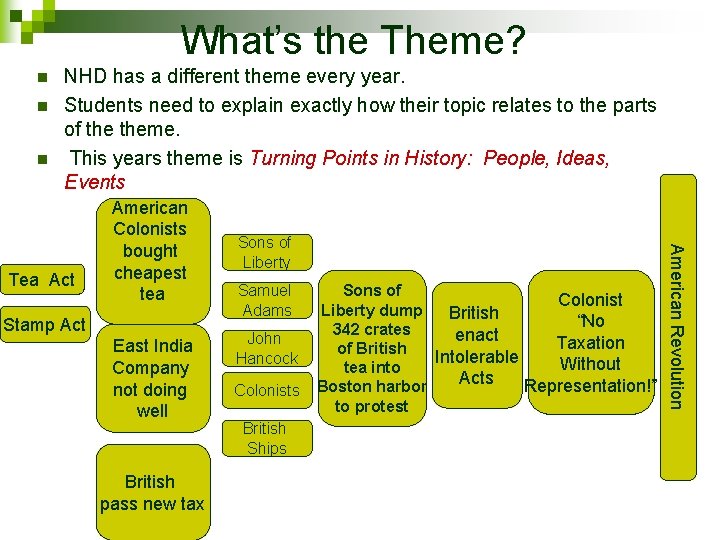
What’s the Theme? n n n NHD has a different theme every year. Students need to explain exactly how their topic relates to the parts of theme. This years theme is Turning Points in History: People, Ideas, Events Stamp Act East India Company not doing well British pass new tax Sons of Liberty Samuel Adams John Hancock Colonists British Ships Sons of Colonist Liberty dump British “No 342 crates enact Taxation of British Intolerable Without tea into Acts Representation!” Boston harbor to protest American Revolution Tea Act American Colonists bought cheapest tea
My topic can be a local, state, national, or world history topic. No “ 9/11” at all this year
Remember… n Not all turning points are political—they can be… ¨ Economic ¨ Social ¨ Cultural ¨ Scientific ¨ Medical ¨ Agricultural ¨ Industrial
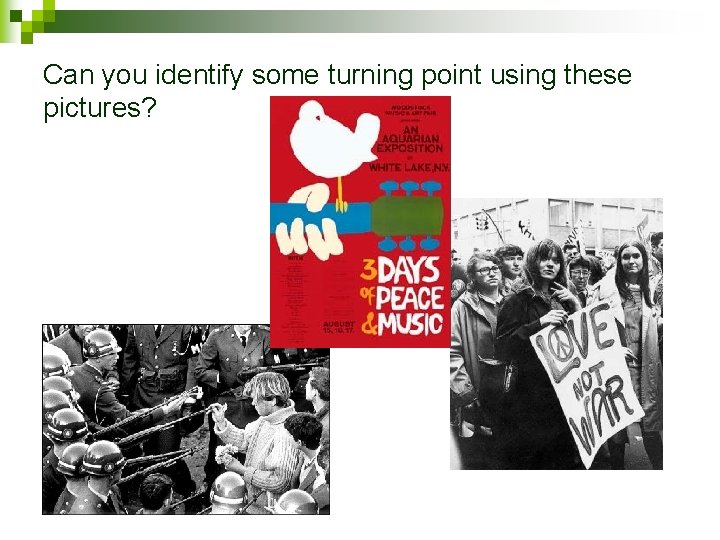
Can you identify some turning point using these pictures?
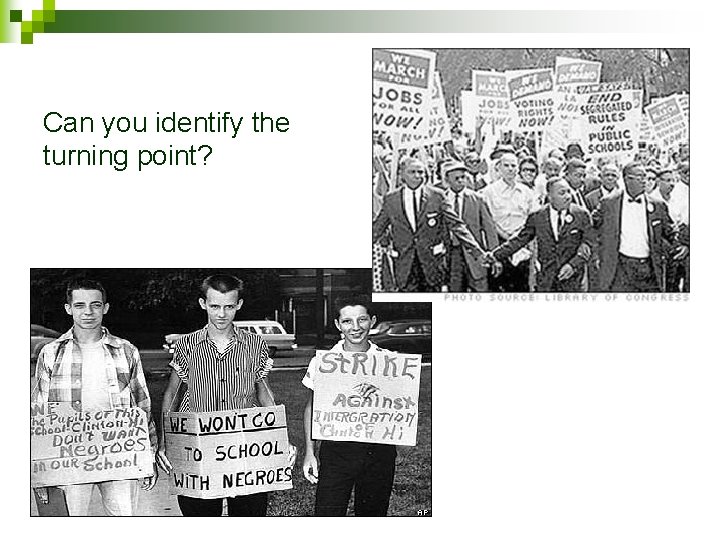
Can you identify the turning point?
Topic Selection Students will benefit most from the NHD project if they are encouraged to choose a topic that: q. Interests q. Relates q. Fits q. Is them to theme their desired final product narrow and manageable—specific
NHD is NOT A REPORT!!!! Students must do more than describe what happened! They must draw conclusions, basing their opinion on evidence, about how the topic affected individuals, communities, nations and the world. n Studies should include … ¨ an investigation into available primary and secondary sources, ¨ an analysis of the evidence, and … ¨ a clear explanation of the relationship of the topic to theme.
Creating a Project Help your student determine whether they want to do an individual or group project. Once they are on the journey— they are on the journey for the whole trip! Students use the Who Do I Sail with? analogy to learn about sails and anchors.
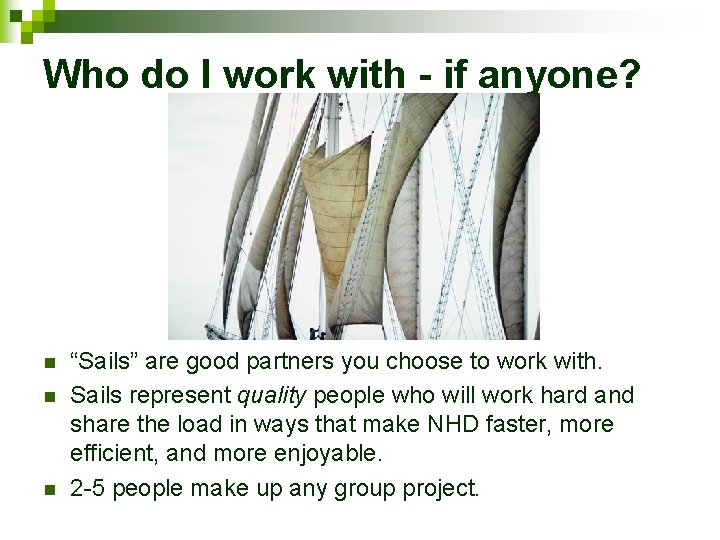
Who do I work with - if anyone? n n n “Sails” are good partners you choose to work with. Sails represent quality people who will work hard and share the load in ways that make NHD faster, more efficient, and more enjoyable. 2 -5 people make up any group project.
Who do I work with - if anyone? “Anchors” represent people who oftentimes choose to be. . . Lazy and don’t help much, or. . . 2. Comedians who provide a lot of laughs but little effort, or. . . 3. Are simply looking for you to ‘carry’ them through the project or … 4. Want to be “in charge” all the time and do not accept any other ideas or argue all the time. 1.
ANCHORS. . . v Can take up room and slow your ship down. v Can sink your “ship” and then you can’t get your project in on time…if ever. (You might have to do a “salvage job” – a last minute catch-up!) v Can beg to come on board ship, but once you are out to sea (working on the project) they can hold you back. v Can magically turn into “sails” if they are on a quality ship. The risk is yours to take or not take. v Can be left behind even though they may be offended. v—Make the decision that is best for your “ship” and your needs
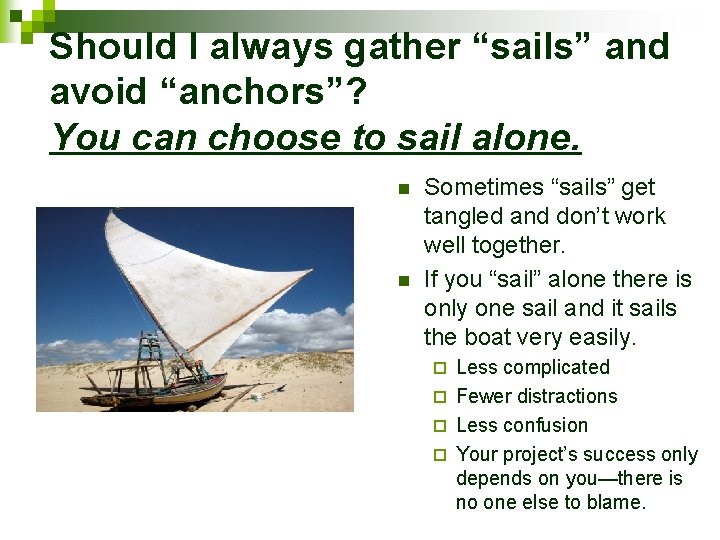
Should I always gather “sails” and avoid “anchors”? You can choose to sail alone. n n Sometimes “sails” get tangled and don’t work well together. If you “sail” alone there is only one sail and it sails the boat very easily. Less complicated ¨ Fewer distractions ¨ Less confusion ¨ Your project’s success only depends on you—there is no one else to blame. ¨
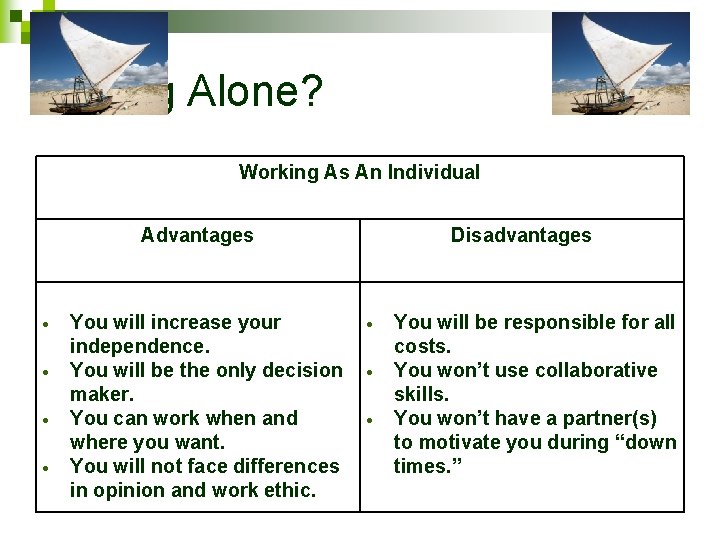
Sailing Alone? Working As An Individual Advantages You will increase your independence. You will be the only decision maker. You can work when and where you want. You will not face differences in opinion and work ethic. Disadvantages You will be responsible for all costs. You won’t use collaborative skills. You won’t have a partner(s) to motivate you during “down times. ”
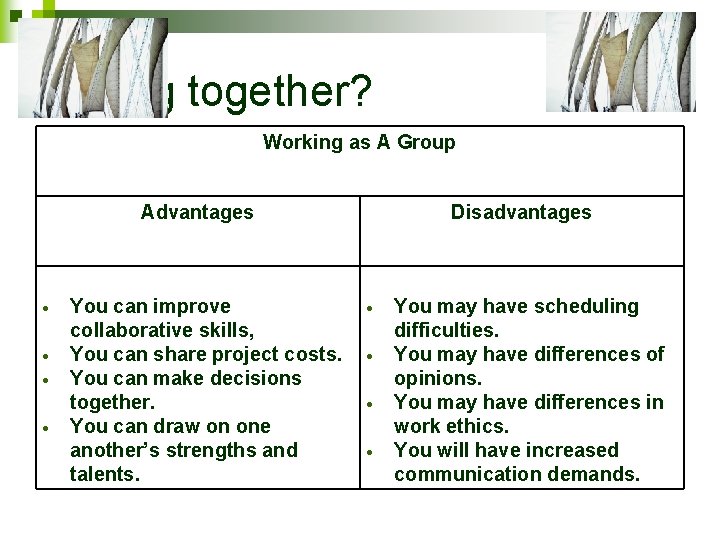
Sailing together? Working as A Group Advantages You can improve collaborative skills, You can share project costs. You can make decisions together. You can draw on one another’s strengths and talents. Disadvantages You may have scheduling difficulties. You may have differences of opinions. You may have differences in work ethics. You will have increased communication demands.
Decision Making Time n n Picking the right people or choosing working alone is one of the key elements in managing a quality NHD project It is one of the first decisions you must make, and it is certainly one of the BIGGEST !!! You will be able to choose your group, but in the end you “sail” or “sink” together. Once you leave the “harbor” on Tuesday , 1/22/2013 all your “sails” or “anchors” will be on board for the entire trip -- and you cannot “throw them over the side” once you are underway. In other words NO SWITCHING GROUPS!!!
Will your research answer these big topic questions? 5 Ws and How ¨ Reporter questions - who, what, when, where, why and how Historical Context and Historical Perspective ¨ How and why did the events and atmosphere—social, economic, political, and cultural—of my topic’s time influence my topic in history? ¨ How did my topic develop over time?
Will your research answer these big topic questions? So What? ¨ How is my topic important? ¨ How was my topic significant in history in relation to the NHD theme? ¨ How did my topic develop over time? What were the successes, failures, and consequences of my topic? ¨ How did my topic influence history over time?
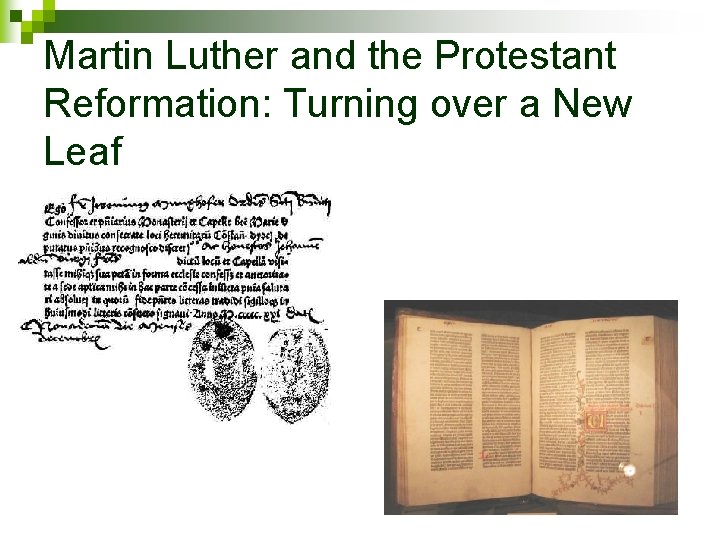
Martin Luther and the Protestant Reformation: Turning over a New Leaf
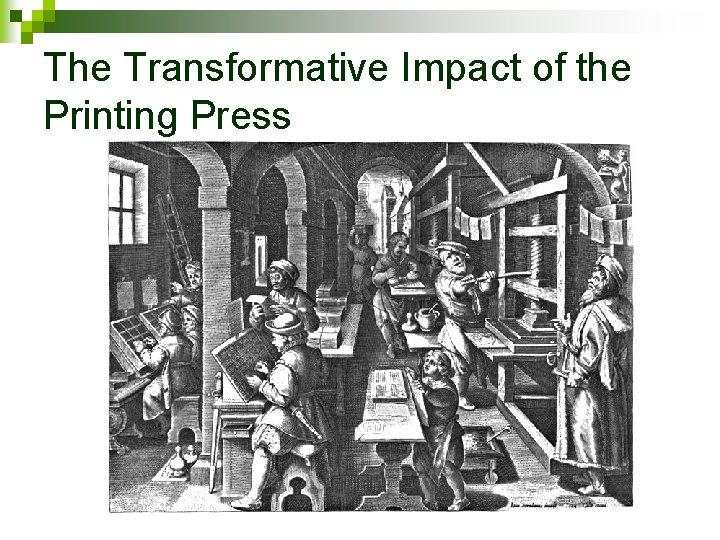
The Transformative Impact of the Printing Press

Research. Research Research. Research Folders
What are Sources? A source is any provider of information used to interpret a topic ¨ Written documents – diaries, letters, books, articles, certificates, journals ¨ Artifacts – physical remains, maps, photographs, art, tools, furniture (objects from everyday life that have historical significance ¨ Recordings – Video, film, audio recordings ¨ Personal Interviews – In-person discussions, discussions over the phone, or via e-mail
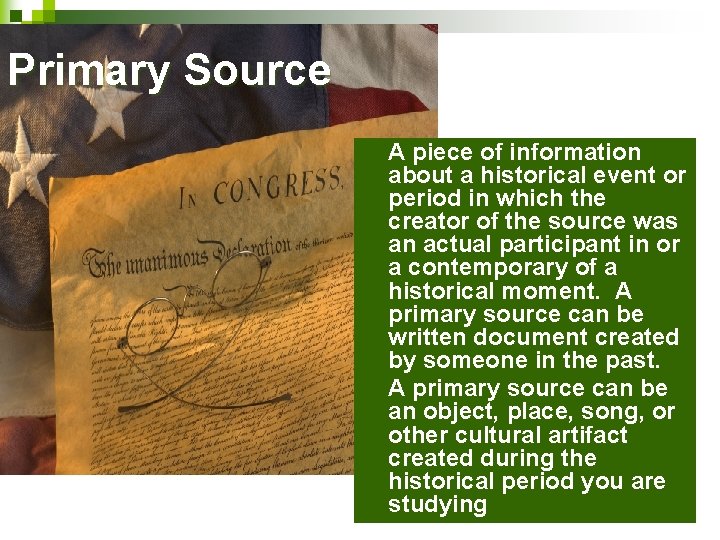
Primary Source n n A piece of information about a historical event or period in which the creator of the source was an actual participant in or a contemporary of a historical moment. A primary source can be written document created by someone in the past. A primary source can be an object, place, song, or other cultural artifact created during the historical period you are studying
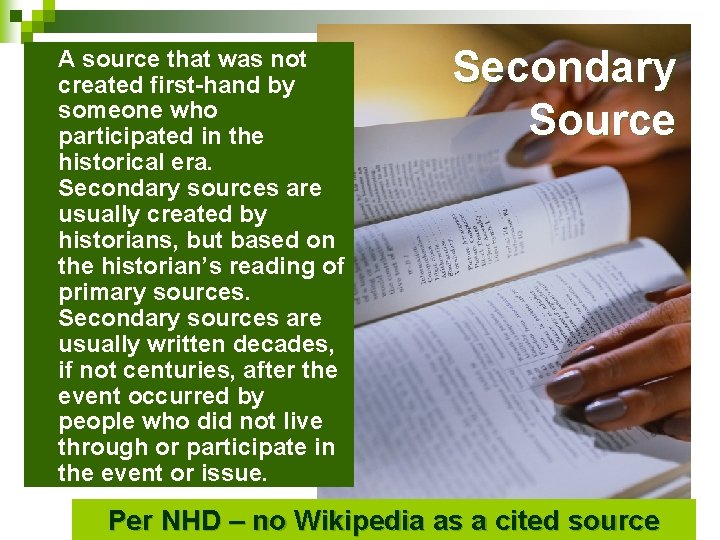
n A source that was not created first-hand by someone who participated in the historical era. Secondary sources are usually created by historians, but based on the historian’s reading of primary sources. Secondary sources are usually written decades, if not centuries, after the event occurred by people who did not live through or participate in the event or issue. Secondary Source Per NHD – no Wikipedia as a cited source
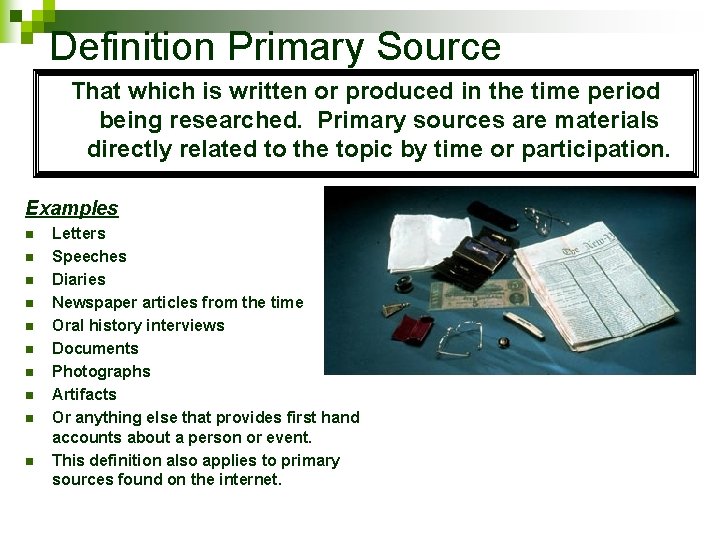
Definition Primary Source That which is written or produced in the time period being researched. Primary sources are materials directly related to the topic by time or participation. Examples n n n n n Letters Speeches Diaries Newspaper articles from the time Oral history interviews Documents Photographs Artifacts Or anything else that provides first hand accounts about a person or event. This definition also applies to primary sources found on the internet.
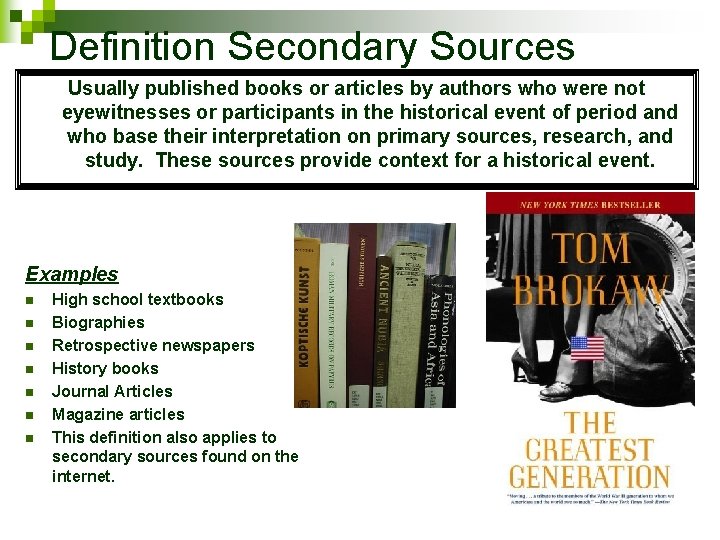
Definition Secondary Sources Usually published books or articles by authors who were not eyewitnesses or participants in the historical event of period and who base their interpretation on primary sources, research, and study. These sources provide context for a historical event. Examples n n n n High school textbooks Biographies Retrospective newspapers History books Journal Articles Magazine articles This definition also applies to secondary sources found on the internet.
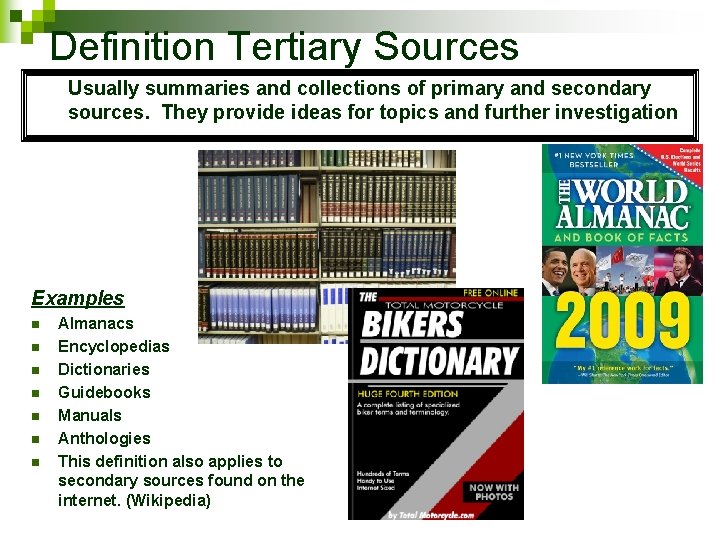
Definition Tertiary Sources Usually summaries and collections of primary and secondary sources. They provide ideas for topics and further investigation Examples n n n n Almanacs Encyclopedias Dictionaries Guidebooks Manuals Anthologies This definition also applies to secondary sources found on the internet. (Wikipedia)
THESIS Review Focus Questions to create thesis • Take a close look at historical significance and impact • Must be arguable and provable • Must connect to theme •
n NHD projects should do more than just tell a story. Each project should make a point about its topic. To do this, students must develop their own argument of the historical impact of the person, event, pattern or idea they are studying. The point they make is called a thesis statement. A thesis statement is not the same as a topic. A thesis statement explains what they believe to be the impact and significance of their topic in history. n Topic: Battle of Gettysburg Thesis Statement: The battle of Gettysburg was a major turning point of the Civil War. It turned the tide of the war from the South to the North, pushing back Lee's army that would never fight again on Northern soil and bringing confidence to the Union army.
What about Plagiarism? Plagiarism: Presenting the work or ideas of others in ways that give the impression that they are your own (e. g. , copying information word forword without using both quotations and footnotes; paraphrasing an author’s ideas without proper attribution; using visuals or music without giving proper credit).
Presenting the Information q Individual/Group Documentary q q q DVD-not Power Point Individual/Group Exhibit Individual Paper (early deadline) Individual/Group Performance Individual/Group Website (early deadline)
Presenting the Information n http: //www. nhd. org/Creating. Entry. htm ¨ Click on Student Project Examples – Red button on left menu bar n n Documentary Example ¨ n Revolutionizing Revolutions: What Gandhi Taught Us About Political Defiance Paper Example ¨ n Title IX: Empowerment Through Education Performance Example ¨ n The Revolutionary Reaper Website example ¨ n http: //www. nhd. org/Student. Project. Examples. htm The Trial of the Century: A Reaction to Nazi Atrocities Prompts Revolution and Reform in Principles of International Law Exhibit Example ¨ The Meiji Restoration: A Political Revolution
Projects Must Also Include q Title Page q Process Paper q http: //nhd. org/images/uploads/Process. Paper 1. pdf (historical papers do not need this) q Annotated Bibliography q http: //www. nhd. org/images/uploads/La my%20 Bibliography. pdf
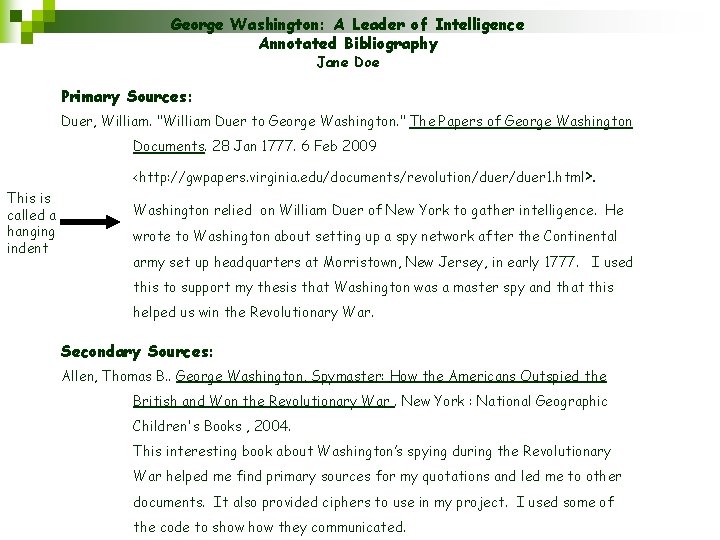
George Washington: A Leader of Intelligence Annotated Bibliography Jane Doe Primary Sources: Duer, William. "William Duer to George Washington. " The Papers of George Washington Documents. 28 Jan 1777. 6 Feb 2009 <http: //gwpapers. virginia. edu/documents/revolution/duer 1. html >. This is called a hanging indent Washington relied on William Duer of New York to gather intelligence. He wrote to Washington about setting up a spy network after the Continental army set up headquarters at Morristown, New Jersey, in early 1777. I used this to support my thesis that Washington was a master spy and that this helped us win the Revolutionary War. Secondary Sources: Allen, Thomas B. . George Washington, Spymaster: How the Americans Outspied the British and Won the Revolutionary War. New York : National Geographic Children's Books , 2004. This interesting book about Washington’s spying during the Revolutionary War helped me find primary sources for my quotations and led me to other documents. It also provided ciphers to use in my project. I used some of the code to show they communicated.
Helping your student manage their time productively Ø Ø Ø NHD is done in stages Watch for important notices of deadlines and due dates Check students agendas, folders, newsletters, emails, and websites weekly Ø Ø http: //www. kbensonlsms. weebly. com Watch for communication that is sent home with your student
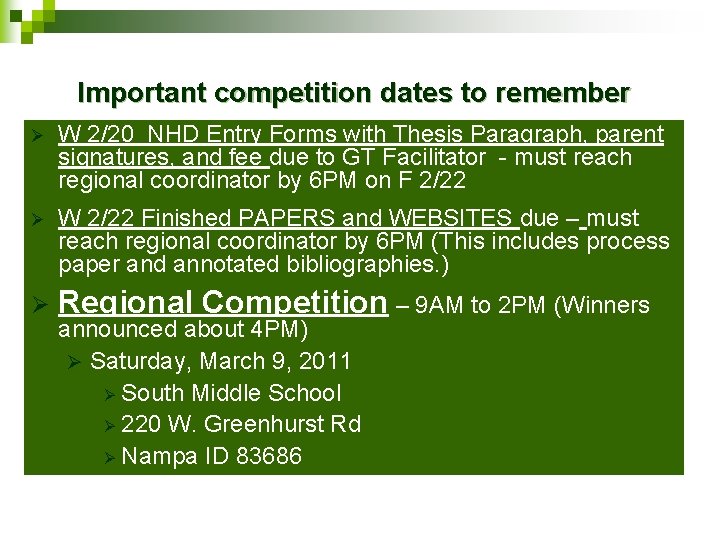
Important competition dates to remember Ø W 2/20 NHD Entry Forms with Thesis Paragraph, parent signatures, and fee due to GT Facilitator - must reach regional coordinator by 6 PM on F 2/22 Ø W 2/22 Finished PAPERS and WEBSITES due – must reach regional coordinator by 6 PM (This includes process paper and annotated bibliographies. ) Ø Regional Competition – 9 AM to 2 PM (Winners announced about 4 PM) Ø Saturday, March 9, 2011 Ø South Middle School Ø 220 W. Greenhurst Rd Ø Nampa ID 83686
“National History Day is not just a day, it’s an experience!” National History Day www. nhd. org
- Slides: 43