
National Highway Traffic Safety Administration Task Force 9

- Slides: 17
National Highway Traffic Safety Administration Task Force 9: Communication and Messaging Wayne Mc. Kenzie William Joel Sanchez Task Force Leaders
Background • Project Concern: The automotive application and use of a REESS, such as Lithium-ion battery based system, imposes certain safety risks to the operators and occupants of these vehicles, which are different than that of vehicles using only an internal combustion engine. • Potential Safety Risk: Thermal runaway of the battery pack(s), which in some cases may result in fire or explosion. • Project Scope: This research focuses on the safe management of an automotive REESS, i. e. its BMS and any electronic failures associated with it. Safer cars. Safer Drivers. Safer roads.
Project Goals and Scope Goals: 1. 2. 3. Identify diagnostic and prognostic elements based on a comprehensive HARA of automotive REESS, specifically BMS functionality Determine information and messaging needs for operators and responders Write report that informs potential agency regulatory decisions Scope: Focus on safe management of an automotive REESS; i. e. , its Battery Management System (BMS) and any electronic failures associated with it. Safer cars. Safer Drivers. Safer roads.
Project Objectives 1. Delineate the hazards and their severity levels pertaining to the functional safety of automotive REESS controls, and identify safety requirements and constraints of BMS functionality 2. Define system diagnostics, prognostics, and data logging 3. Identify safety-critical information needs and effective methods to communicate this information to operators 4. Address safety-related instructions and training needs for operators Safer cars. Safer Drivers. Safer roads.
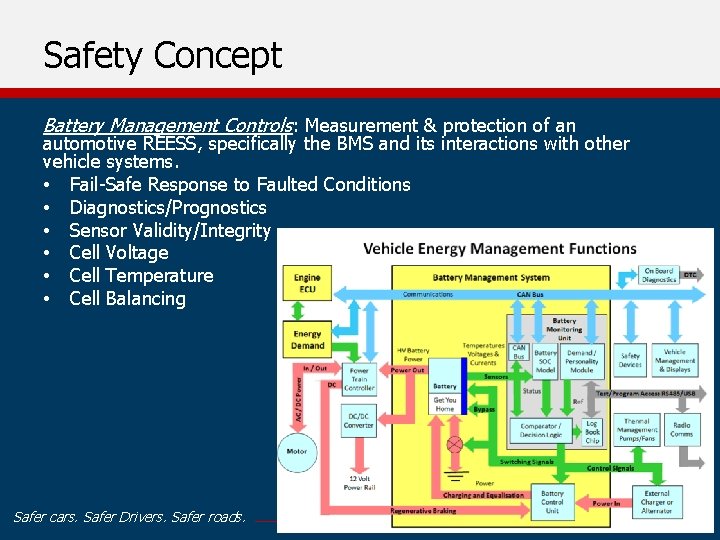
Safety Concept Battery Management Controls: Measurement & protection of an automotive REESS, specifically the BMS and its interactions with other vehicle systems. • Fail-Safe Response to Faulted Conditions • Diagnostics/Prognostics • Sensor Validity/Integrity • Cell Voltage • Cell Temperature • Cell Balancing Safer cars. Safer Drivers. Safer roads.
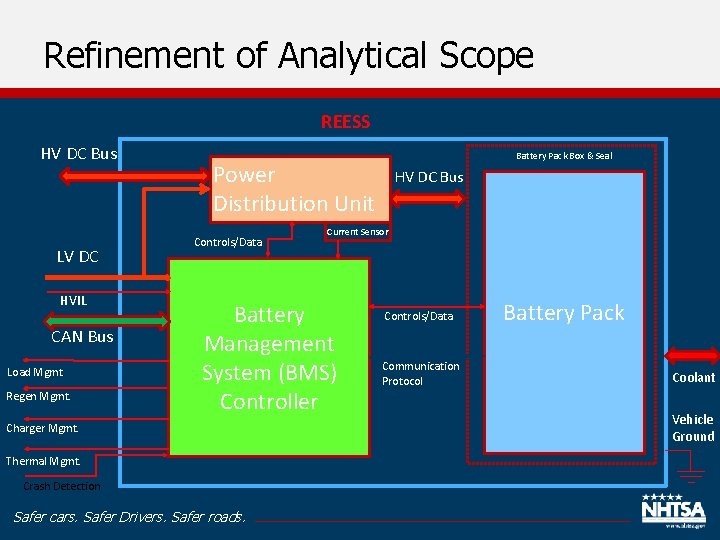
Refinement of Analytical Scope REESS HV DC Bus LV DC HVIL CAN Bus Load Mgmt. Regen Mgmt. Battery Pack Box & Seal Power Distribution Unit Controls/Data Current Sensor Battery Management System (BMS) Controller Charger Mgmt. Thermal Mgmt. Crash Detection Safer cars. Safer Drivers. Safer roads. HV DC Bus Controls/Data Communication Protocol Battery Pack Coolant Vehicle Ground
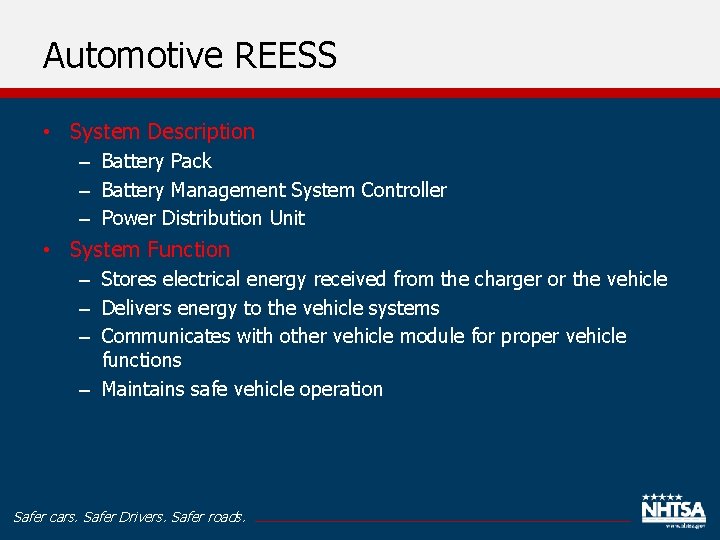
Automotive REESS • System Description – Battery Pack – Battery Management System Controller – Power Distribution Unit • System Function – Stores electrical energy received from the charger or the vehicle – Delivers energy to the vehicle systems – Communicates with other vehicle module for proper vehicle functions – Maintains safe vehicle operation Safer cars. Safer Drivers. Safer roads.
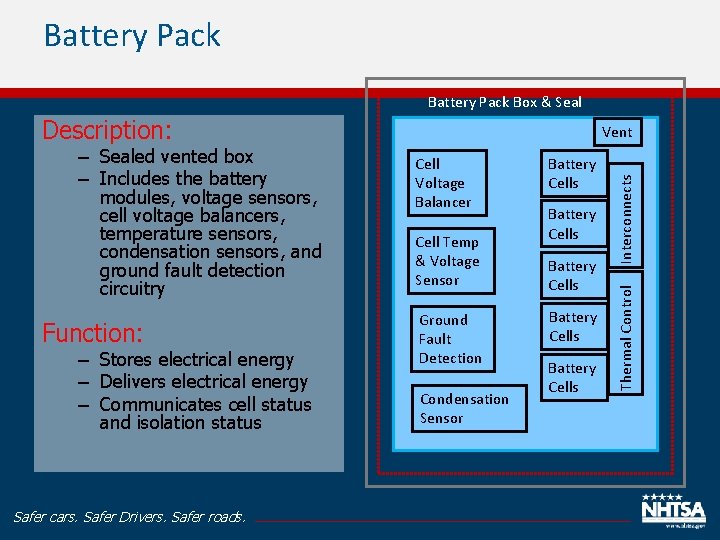
Battery Pack Box & Seal Description: Function: – Stores electrical energy – Delivers electrical energy – Communicates cell status and isolation status Safer cars. Safer Drivers. Safer roads. Cell Temp & Voltage Sensor Ground Fault Detection Condensation Sensor Battery Cells Battery Cells Interconnects Cell Voltage Balancer Thermal Control – Sealed vented box – Includes the battery modules, voltage sensors, cell voltage balancers, temperature sensors, condensation sensors, and ground fault detection circuitry Vent
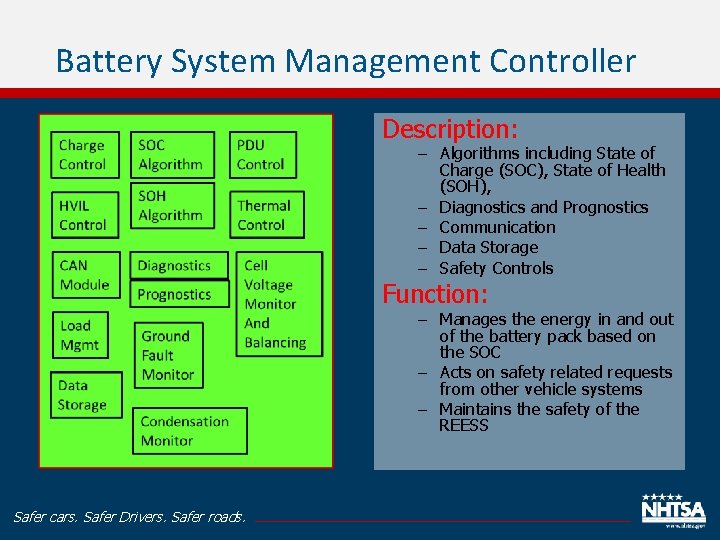
Battery System Management Controller Description: – Algorithms including State of Charge (SOC), State of Health (SOH), – Diagnostics and Prognostics – Communication – Data Storage – Safety Controls Function: – Manages the energy in and out of the battery pack based on the SOC – Acts on safety related requests from other vehicle systems – Maintains the safety of the REESS Safer cars. Safer Drivers. Safer roads.
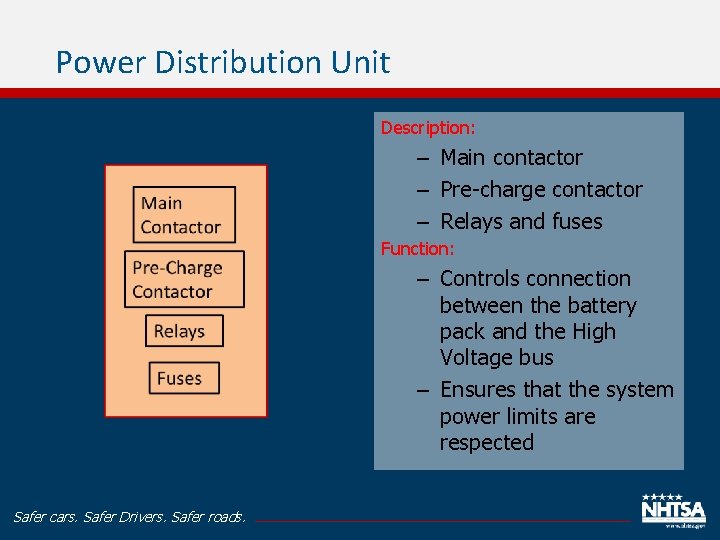
Power Distribution Unit Description: – Main contactor – Pre-charge contactor – Relays and fuses Function: – Controls connection between the battery pack and the High Voltage bus – Ensures that the system power limits are respected Safer cars. Safer Drivers. Safer roads.
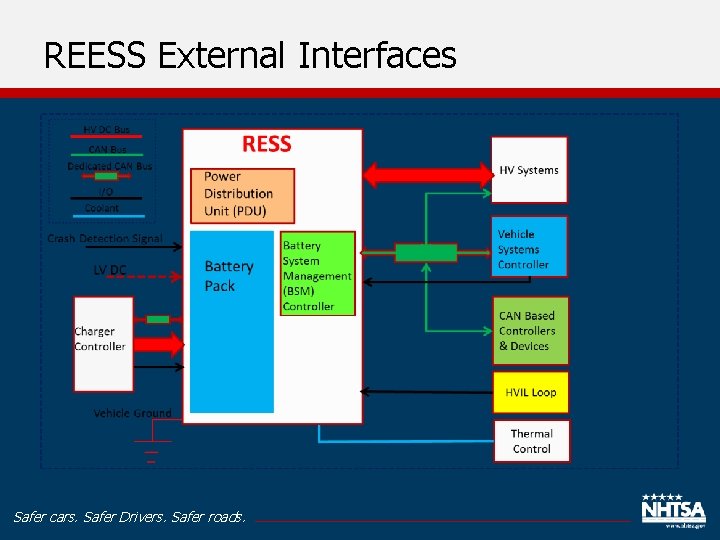
REESS External Interfaces Safer cars. Safer Drivers. Safer roads.
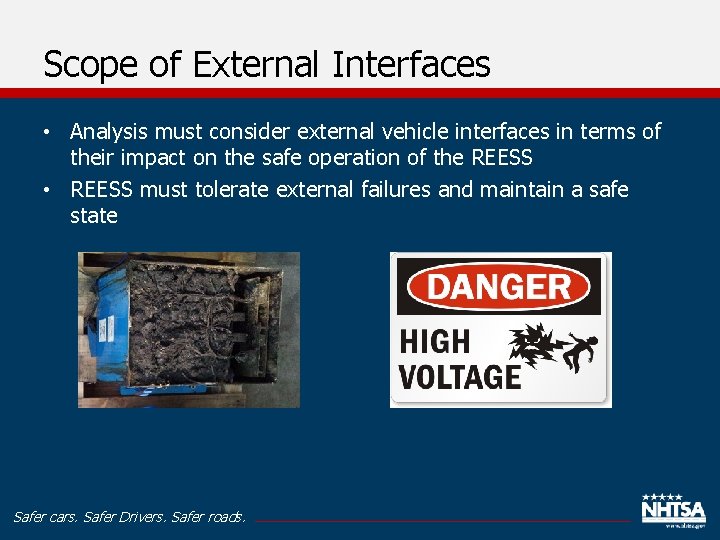
Scope of External Interfaces • Analysis must consider external vehicle interfaces in terms of their impact on the safe operation of the REESS • REESS must tolerate external failures and maintain a safe state Safer cars. Safer Drivers. Safer roads.
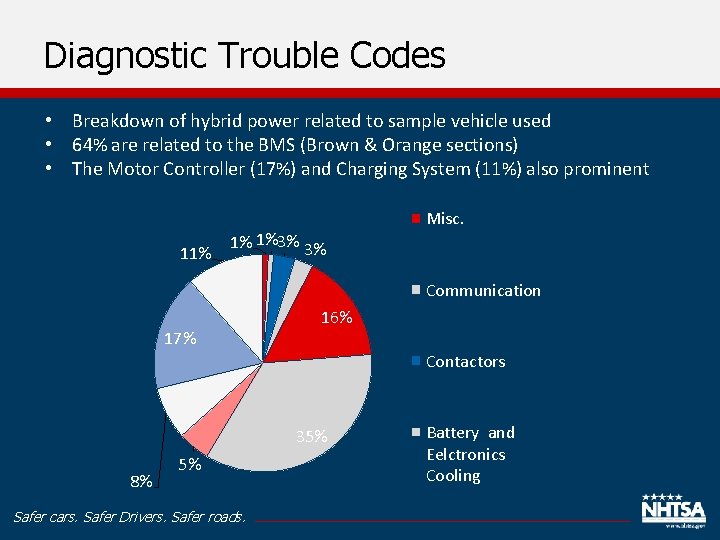
Diagnostic Trouble Codes • Breakdown of hybrid power related to sample vehicle used • 64% are related to the BMS (Brown & Orange sections) • The Motor Controller (17%) and Charging System (11%) also prominent 11% 1% 1%3% 3% Misc. Communication 17% 16% Contactors 35% 8% 5% Safer cars. Safer Drivers. Safer roads. Battery and Eelctronics Cooling
Communications and Messaging • Identify safety-critical information needs of owners and operators • Describe effective means to communicate this information • Describe barriers to effective communication and opportunities to remove them Safer cars. Safer Drivers. Safer roads.
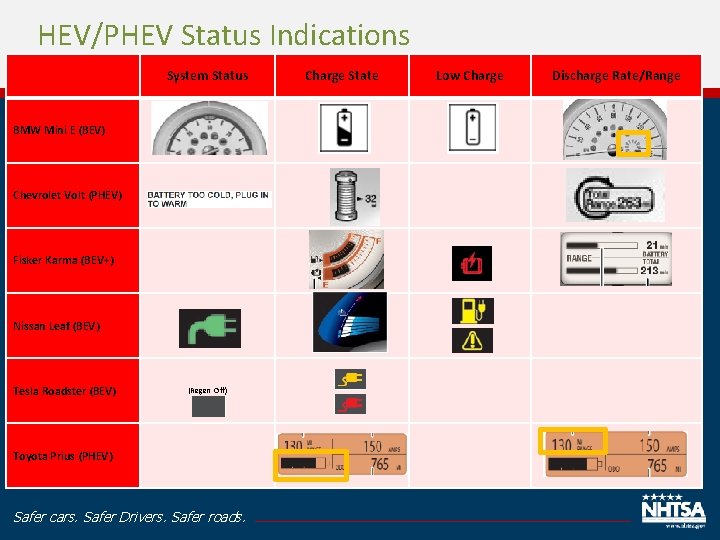
HEV/PHEV Status Indications System Status BMW Mini E (BEV) Chevrolet Volt (PHEV) Fisker Karma (BEV+) Nissan Leaf (BEV) Tesla Roadster (BEV) (Regen Off) Toyota Prius (PHEV) Safer cars. Safer Drivers. Safer roads. Charge State Low Charge Discharge Rate/Range
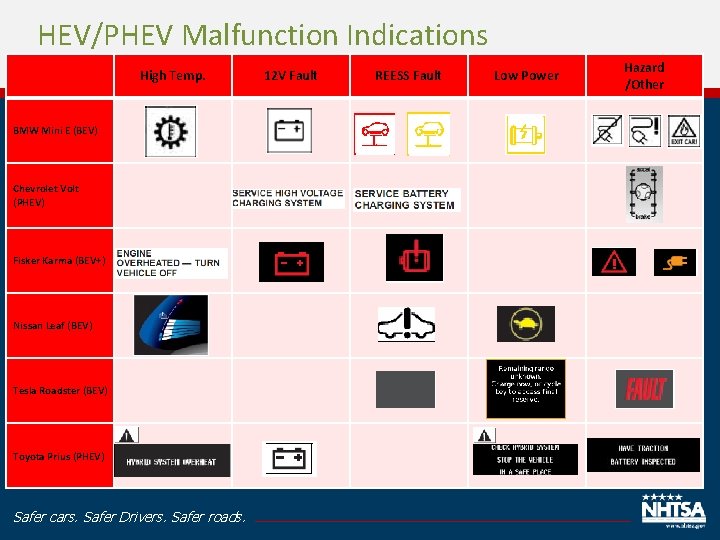
HEV/PHEV Malfunction Indications High Temp. BMW Mini E (BEV) Chevrolet Volt (PHEV) Fisker Karma (BEV+) Nissan Leaf (BEV) Tesla Roadster (BEV) Toyota Prius (PHEV) Safer cars. Safer Drivers. Safer roads. 12 V Fault REESS Fault Low Power Hazard /Other
Questions Safer cars. Safer Drivers. Safer roads.