
National Heavy Vehicle Inspection Manual Roadworthiness Program Daniel

- Slides: 14
National Heavy Vehicle Inspection Manual & Roadworthiness Program Daniel Elkins, Director Safety Bulk Tanker Day, Sydney 15 September 2016 National Heavy Vehicle Regulator
History of the NHVIM • Model document developed by the NTC in 2003 and reviewed in 2004 • Each jurisdiction created a version, with variations • Initial NHVR review in 2014 produced NHVIM v 1 • Comprehensive review in 2015 produced NHVIM v 2 • Implemented in all participating jurisdictions from 1 July 2016.
Review process • Request from Ministers in 2014 to review and agreement to adopt nationally • Section by section review • Wide consultation with industry and jurisdictions • Subject matter expert input • Run over 12 months • Finalised December 2015 • Implemented from 1 July 2016
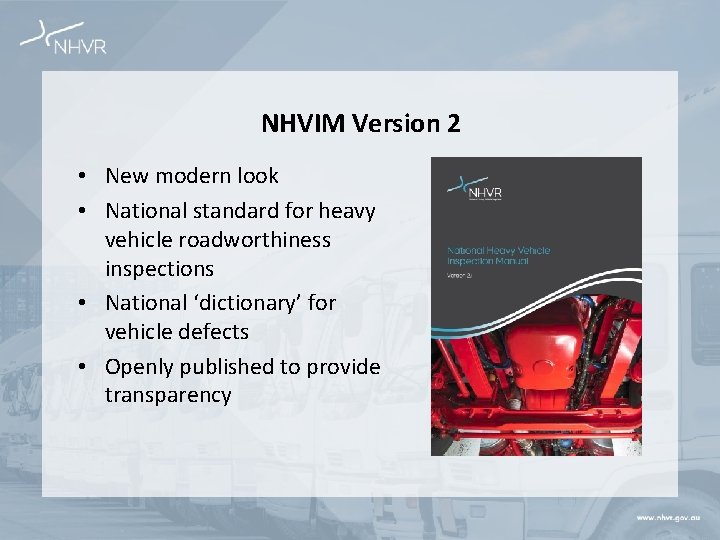
NHVIM Version 2 • New modern look • National standard for heavy vehicle roadworthiness inspections • National ‘dictionary’ for vehicle defects • Openly published to provide transparency
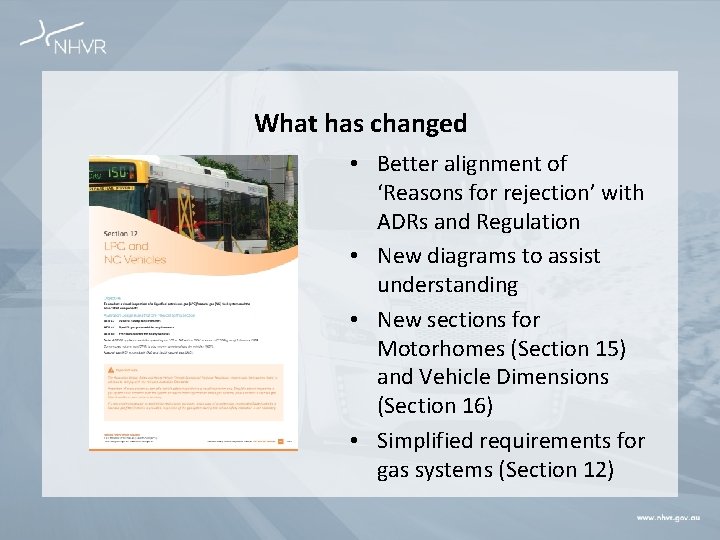
What has changed • Better alignment of ‘Reasons for rejection’ with ADRs and Regulation • New diagrams to assist understanding • New sections for Motorhomes (Section 15) and Vehicle Dimensions (Section 16) • Simplified requirements for gas systems (Section 12)
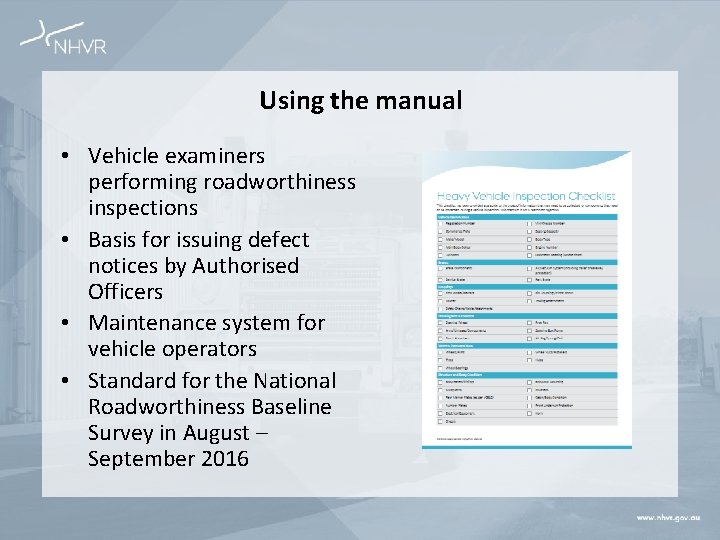
Using the manual • Vehicle examiners performing roadworthiness inspections • Basis for issuing defect notices by Authorised Officers • Maintenance system for vehicle operators • Standard for the National Roadworthiness Baseline Survey in August – September 2016
Keeping current • NHVIM is a live document on a 2 -3 year review cycle • NHVR will make routine minor updates regularly • In consultation with industry and subject matter experts • Feedback welcomed via form on the NHVR website • www. nhvr. gov. au/nhvim • Next scheduled update in late 2016 • Review of Section 2 Brakes • General updates based on feedback • Subsequent reviews will be aligned to HVNL amendments
National Heavy Vehicle Roadworthiness Program • Initiated by responsible Ministers in 2014 • Objectives: • to increase the safety of heavy vehicles by changing operator behaviour to encourage a proactive maintenance culture • Nationally consistent heavy vehicle roadworthiness framework • Adopt a risk-based approach, based on evidence, for auditing, monitoring and inspecting heavy vehicles
National Heavy Vehicle Roadworthiness Program 8 projects to develop a national approach to roadworthiness: Review of the National Heavy Vehicle Inspection Manual National roadworthiness baseline survey Roadworthiness data collection Roadworthiness criteria Inspection types Inspection competency standards Management and clearance of defects Risk-based inspection criteria
National Heavy Vehicle Roadworthiness Program Review of the NHVIM • Single national standards for inspections National roadworthiness baseline survey • Health check of the heavy vehicle fleet nationally • August & September 2016 • Provide evidence for risk-based approach to vehicle safety Roadworthiness data collection • Identify and collect data that gives evidence to make risk-based decisions about inspections
National Heavy Vehicle Roadworthiness Program Roadworthiness criteria • Defining when a defect makes a vehicle unsafe to be used on a road Inspection types • Nationally consistent inspection requirements (items to check, inspection methodology, facility and equipment requirements)
National Heavy Vehicle Roadworthiness Program Inspection competency standards • Nationally consistent inspector competency requirements • Matched to inspection type Management and clearance of defects • Consistent classification of defects (levels, clearance methods etc) Risk-based inspection criteria • Structure of inspections (what vehicles, when inspected, what is inspected) based on risk
Questions?
Contact Information Daniel Elkins Director Safety 07 3309 8543 daniel. elkins@nhvr. gov. au Peter Austin Manager (Vehicle Safety and Performance) 07 3309 8561 peter. austin@nhvr. gov. au