
NATIONAL HEALTH PROTECTION SCHEME Dr K Rajeswara Rao
- Slides: 44
NATIONAL HEALTH PROTECTION SCHEME Dr. K. Rajeswara Rao, IAS Joint Secretary, Ministry of Health & Family Welfare, Govt. of India
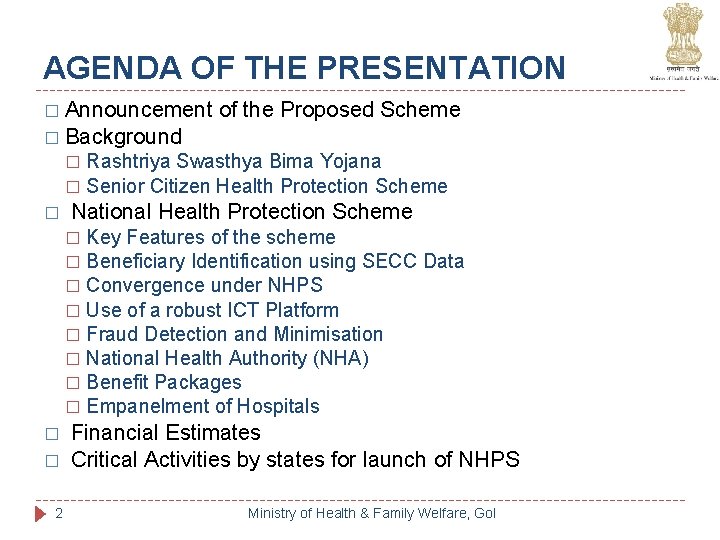
AGENDA OF THE PRESENTATION � Announcement of the Proposed Scheme � Background Rashtriya Swasthya Bima Yojana � Senior Citizen Health Protection Scheme � � National Health Protection Scheme Key Features of the scheme � Beneficiary Identification using SECC Data � Convergence under NHPS � Use of a robust ICT Platform � Fraud Detection and Minimisation � National Health Authority (NHA) � Benefit Packages � Empanelment of Hospitals � � � 2 Financial Estimates Critical Activities by states for launch of NHPS Ministry of Health & Family Welfare, Go. I
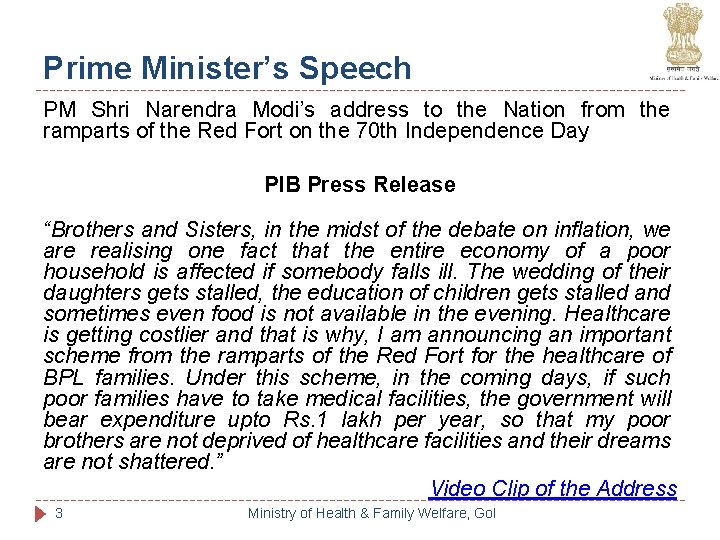
Prime Minister’s Speech PM Shri Narendra Modi’s address to the Nation from the ramparts of the Red Fort on the 70 th Independence Day PIB Press Release “Brothers and Sisters, in the midst of the debate on inflation, we are realising one fact that the entire economy of a poor household is affected if somebody falls ill. The wedding of their daughters gets stalled, the education of children gets stalled and sometimes even food is not available in the evening. Healthcare is getting costlier and that is why, I am announcing an important scheme from the ramparts of the Red Fort for the healthcare of BPL families. Under this scheme, in the coming days, if such poor families have to take medical facilities, the government will bear expenditure upto Rs. 1 lakh per year, so that my poor brothers are not deprived of healthcare facilities and their dreams are not shattered. ” Video Clip of the Address 3 Ministry of Health & Family Welfare, Go. I
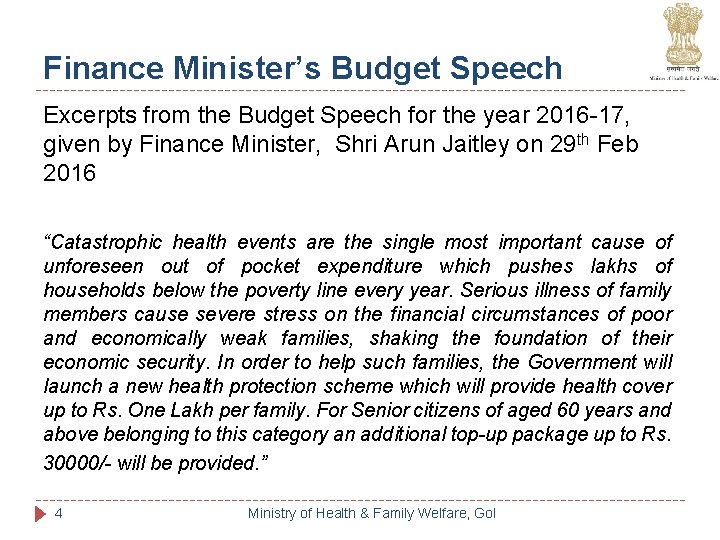
Finance Minister’s Budget Speech Excerpts from the Budget Speech for the year 2016 -17, given by Finance Minister, Shri Arun Jaitley on 29 th Feb 2016 “Catastrophic health events are the single most important cause of unforeseen out of pocket expenditure which pushes lakhs of households below the poverty line every year. Serious illness of family members cause severe stress on the financial circumstances of poor and economically weak families, shaking the foundation of their economic security. In order to help such families, the Government will launch a new health protection scheme which will provide health cover up to Rs. One Lakh per family. For Senior citizens of aged 60 years and above belonging to this category an additional top-up package up to Rs. 30000/- will be provided. ” 4 Ministry of Health & Family Welfare, Go. I
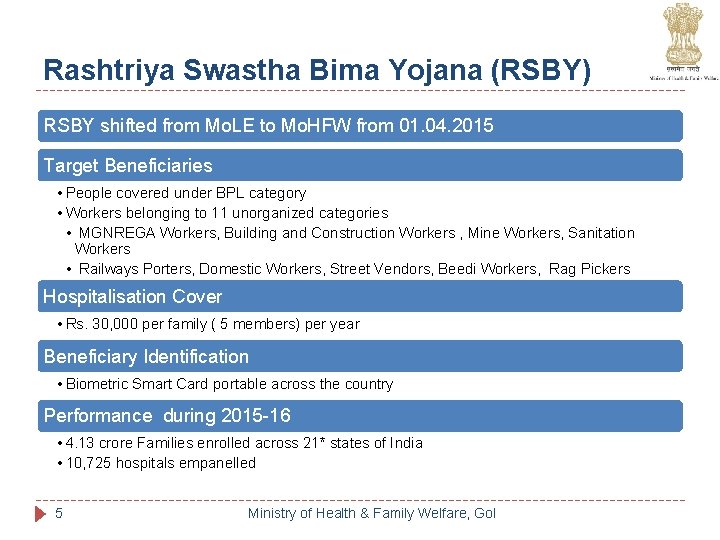
Rashtriya Swastha Bima Yojana (RSBY) RSBY shifted from Mo. LE to Mo. HFW from 01. 04. 2015 Target Beneficiaries • People covered under BPL category • Workers belonging to 11 unorganized categories • MGNREGA Workers, Building and Construction Workers , Mine Workers, Sanitation Workers • Railways Porters, Domestic Workers, Street Vendors, Beedi Workers, Rag Pickers • Taxi Drivers, Rickshaw Pullers Hospitalisation Cover • Rs. 30, 000 per family ( 5 members) per year Beneficiary Identification • Biometric Smart Card portable across the country Performance during 2015 -16 • 4. 13 crore Families enrolled across 21* states of India • 10, 725 hospitals empanelled 5 Ministry of Health & Family Welfare, Go. I
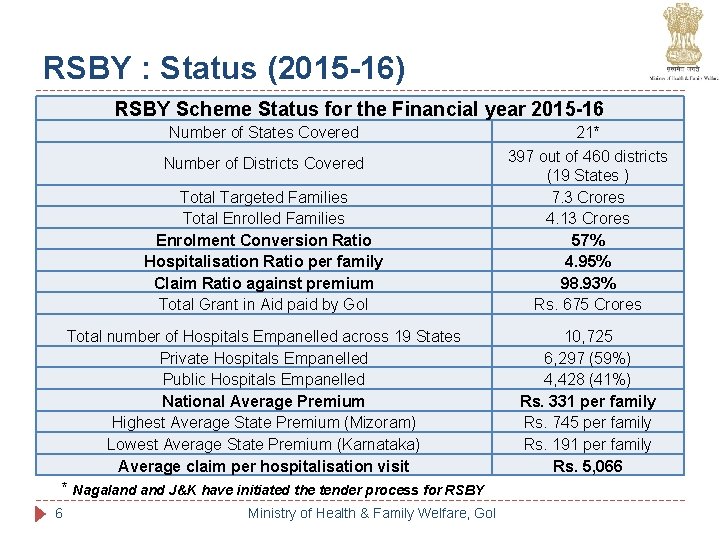
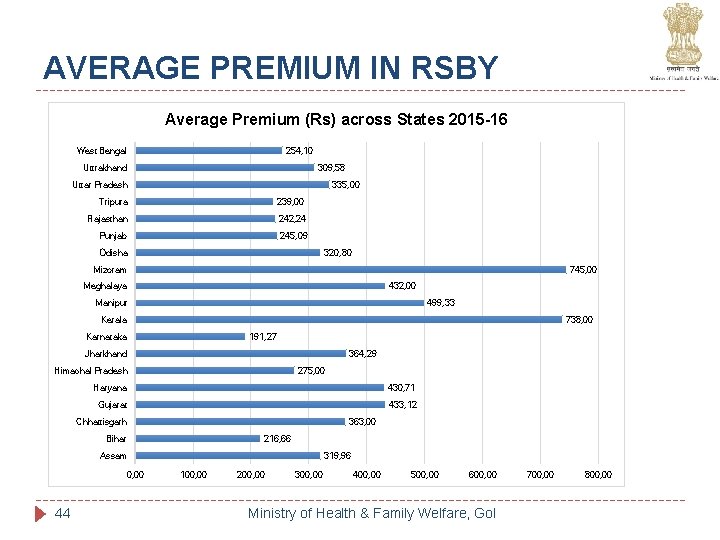
RSBY : Status (2015 -16) RSBY Scheme Status for the Financial year 2015 -16 Number of States Covered Total Targeted Families Total Enrolled Families Enrolment Conversion Ratio Hospitalisation Ratio per family Claim Ratio against premium Total Grant in Aid paid by Go. I 21* 397 out of 460 districts (19 States ) 7. 3 Crores 4. 13 Crores 57% 4. 95% 98. 93% Rs. 675 Crores Total number of Hospitals Empanelled across 19 States Private Hospitals Empanelled Public Hospitals Empanelled National Average Premium Highest Average State Premium (Mizoram) Lowest Average State Premium (Karnataka) Average claim per hospitalisation visit 10, 725 6, 297 (59%) 4, 428 (41%) Rs. 331 per family Rs. 745 per family Rs. 191 per family Rs. 5, 066 Number of Districts Covered * Nagaland J&K have initiated the tender process for RSBY 6 Ministry of Health & Family Welfare, Go. I
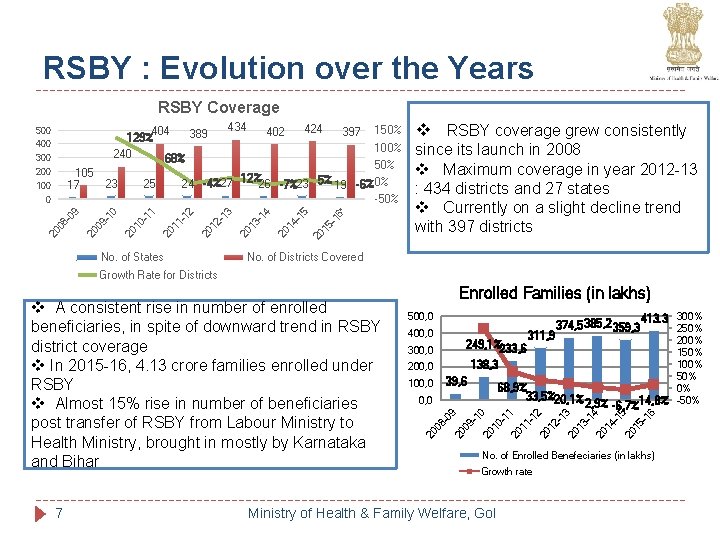
RSBY : Evolution over the Years RSBY Coverage 404 389 129% 240 68% 23 25 20 10 -1 1 100 20 09 -1 0 105 17 200 424 397 150% v RSBY coverage grew consistently 100% since its launch in 2008 v Maximum coverage in year 2012 -13 : 434 districts and 27 states v Currently on a slight decline trend with 397 districts 50% 12% 26 -7%23 5% 19 -6%0% 24 -4%27 -50% 20 11 -1 2 0 20 08 -0 9 402 No. of States 20 14 -1 5 20 15 -1 6* 300 20 12 -1 3 400 434 20 13 -1 4 500 No. of Districts Covered Growth Rate for Districts 7 500, 0 249, 1%233, 6 138, 3 39, 6 413. 3 300% 250% 200% 150% 100% 50% 0% 14, 8% -50% 16 15 - 20 14 - 15 14 20 13 - 13 20 12 - 11 10 - 20 09 - 10 09 20 08 - 374, 5 385, 2 359, 3 68, 9% 33, 5%20, 1% 2, 9% -6, 7% 0, 0 12 100, 0 11 - 200, 0 20 300, 0 311, 9 20 400, 0 20 v A consistent rise in number of enrolled beneficiaries, in spite of downward trend in RSBY district coverage v In 2015 -16, 4. 13 crore families enrolled under RSBY v Almost 15% rise in number of beneficiaries post transfer of RSBY from Labour Ministry to Health Ministry, brought in mostly by Karnataka and Bihar Enrolled Families (in lakhs) No. of Enrolled Benefeciaries (in lakhs) Growth rate Ministry of Health & Family Welfare, Go. I
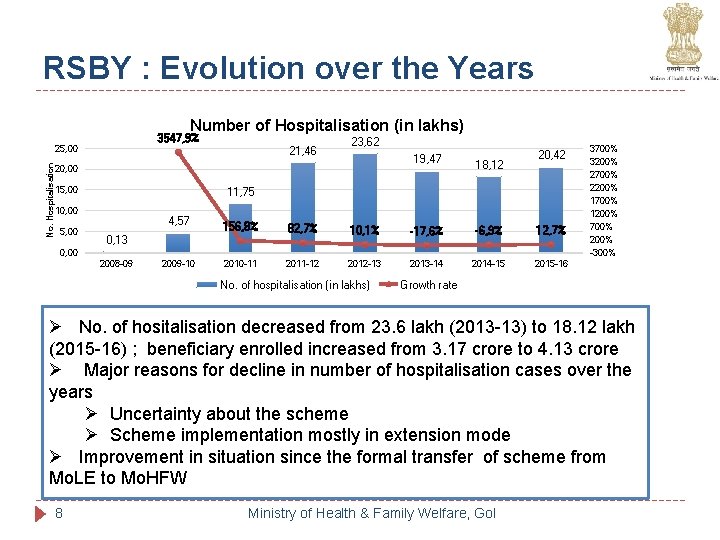
RSBY : Evolution over the Years Number of Hospitalisation (in lakhs) 3547, 9% No. Hospitalisation 25, 00 21, 46 23, 62 19, 47 20, 00 15, 00 11, 75 10, 00 5, 00 18, 12 20, 42 4, 57 156, 8% 82, 7% 10, 1% -17, 6% -6, 9% 12, 7% 2010 -11 2011 -12 2012 -13 2013 -14 2014 -15 2015 -16 0, 13 0, 00 2008 -09 2009 -10 No. of hospitalisation (in lakhs) 3700% 3200% 2700% 2200% 1700% 1200% 700% 200% -300% Growth rate Ø No. of hositalisation decreased from 23. 6 lakh (2013 -13) to 18. 12 lakh (2015 -16) ; beneficiary enrolled increased from 3. 17 crore to 4. 13 crore Ø Major reasons for decline in number of hospitalisation cases over the years Ø Uncertainty about the scheme Ø Scheme implementation mostly in extension mode Ø Improvement in situation since the formal transfer of scheme from Mo. LE to Mo. HFW 8 Ministry of Health & Family Welfare, Go. I
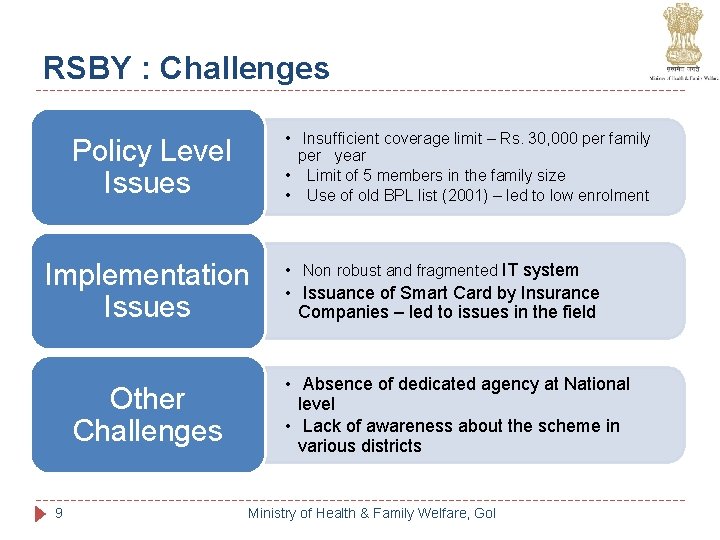
RSBY : Challenges • Insufficient coverage limit – Rs. 30, 000 per family per year • Limit of 5 members in the family size • Use of old BPL list (2001) – led to low enrolment Policy Level Issues Implementation Issues Other Challenges 9 • Non robust and fragmented IT system • Issuance of Smart Card by Insurance Companies – led to issues in the field • Absence of dedicated agency at National level • Lack of awareness about the scheme in various districts Ministry of Health & Family Welfare, Go. I
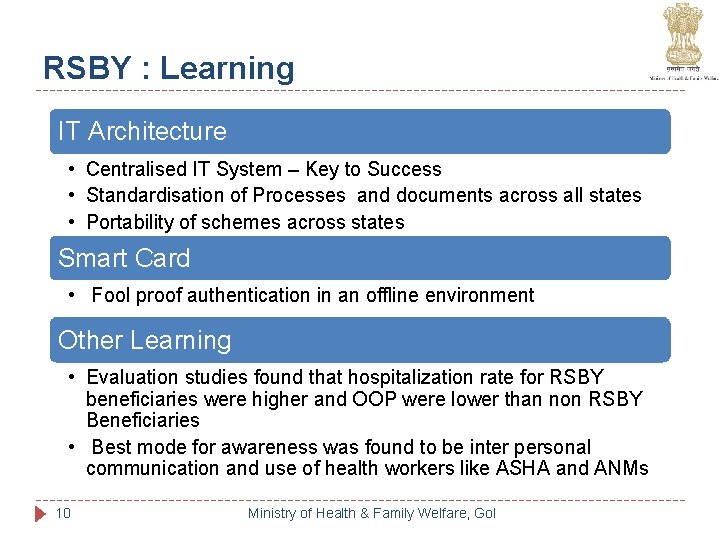
RSBY : Learning IT Architecture • Centralised IT System – Key to Success • Standardisation of Processes and documents across all states • Portability of schemes across states Smart Card • Fool proof authentication in an offline environment Other Learning • Evaluation studies found that hospitalization rate for RSBY beneficiaries were higher and OOP were lower than non RSBY Beneficiaries • Best mode for awareness was found to be inter personal communication and use of health workers like ASHA and ANMs 10 Ministry of Health & Family Welfare, Go. I
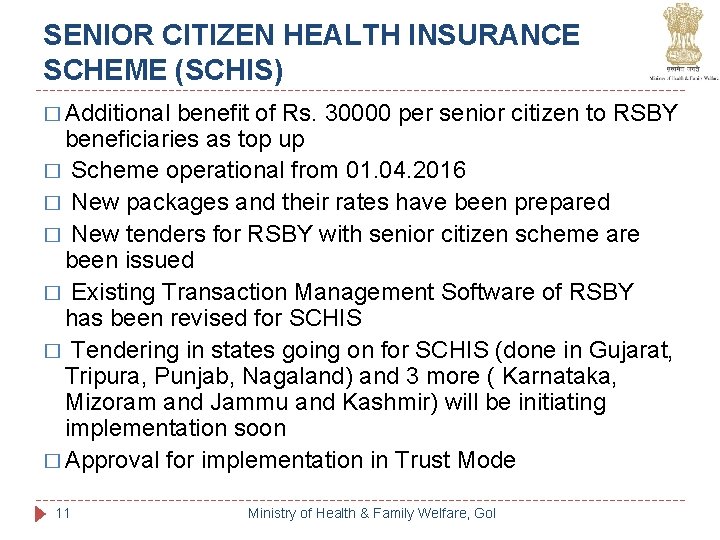
SENIOR CITIZEN HEALTH INSURANCE SCHEME (SCHIS) � Additional benefit of Rs. 30000 per senior citizen to RSBY beneficiaries as top up � Scheme operational from 01. 04. 2016 � New packages and their rates have been prepared � New tenders for RSBY with senior citizen scheme are been issued � Existing Transaction Management Software of RSBY has been revised for SCHIS � Tendering in states going on for SCHIS (done in Gujarat, Tripura, Punjab, Nagaland) and 3 more ( Karnataka, Mizoram and Jammu and Kashmir) will be initiating implementation soon � Approval for implementation in Trust Mode 11 Ministry of Health & Family Welfare, Go. I
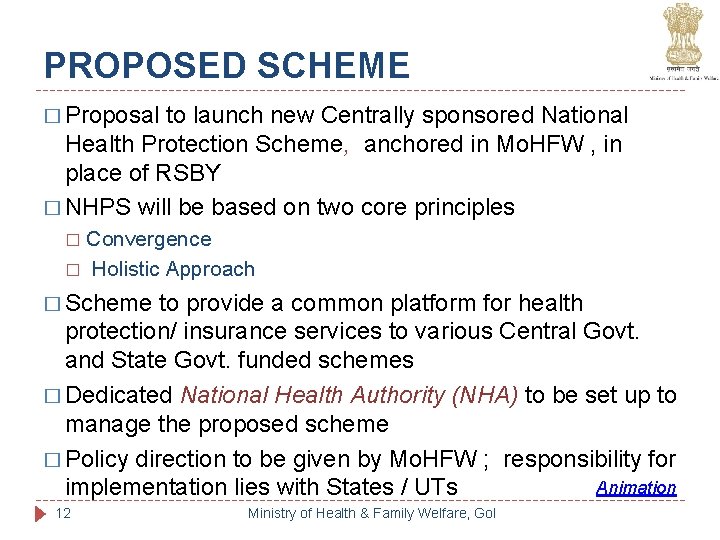
PROPOSED SCHEME � Proposal to launch new Centrally sponsored National Health Protection Scheme, anchored in Mo. HFW , in place of RSBY � NHPS will be based on two core principles Convergence � Holistic Approach � � Scheme to provide a common platform for health protection/ insurance services to various Central Govt. and State Govt. funded schemes � Dedicated National Health Authority (NHA) to be set up to manage the proposed scheme � Policy direction to be given by Mo. HFW ; responsibility for Animation implementation lies with States / UTs 12 Ministry of Health & Family Welfare, Go. I
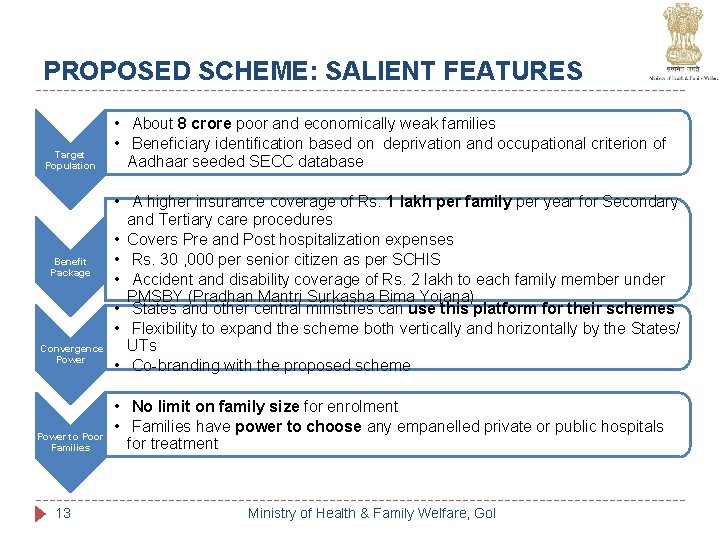
PROPOSED SCHEME: SALIENT FEATURES Target Population Benefit Package Convergence Power to Poor Families 13 • About 8 crore poor and economically weak families • Beneficiary identification based on deprivation and occupational criterion of Aadhaar seeded SECC database • A higher insurance coverage of Rs. 1 lakh per family per year for Secondary and Tertiary care procedures • Covers Pre and Post hospitalization expenses • Rs. 30 , 000 per senior citizen as per SCHIS • Accident and disability coverage of Rs. 2 lakh to each family member under PMSBY (Pradhan Mantri Surkasha Bima Yojana) • States and other central ministries can use this platform for their schemes • Flexibility to expand the scheme both vertically and horizontally by the States/ UTs • Co-branding with the proposed scheme • No limit on family size for enrolment • Families have power to choose any empanelled private or public hospitals for treatment Ministry of Health & Family Welfare, Go. I
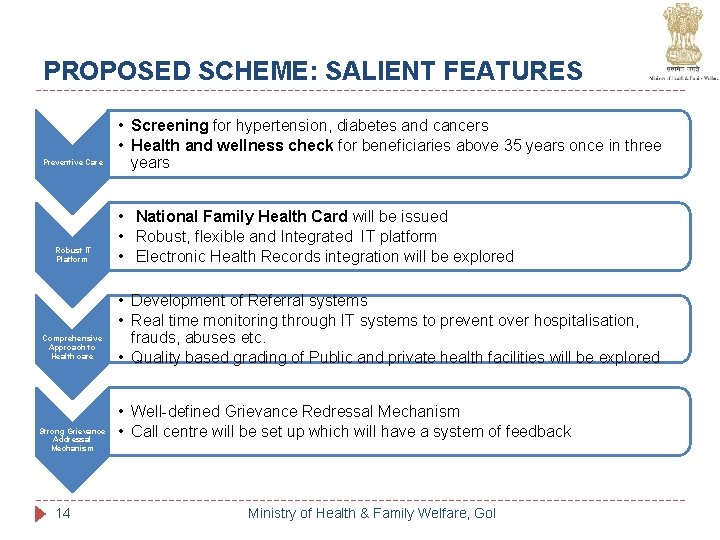
PROPOSED SCHEME: SALIENT FEATURES Preventive Care Robust IT Platform Comprehensive Approach to Health care Strong Grievance Addressal Mechanism 14 • Screening for hypertension, diabetes and cancers • Health and wellness check for beneficiaries above 35 years once in three years • National Family Health Card will be issued • Robust, flexible and Integrated IT platform • Electronic Health Records integration will be explored • Development of Referral systems • Real time monitoring through IT systems to prevent over hospitalisation, frauds, abuses etc. • Quality based grading of Public and private health facilities will be explored • Well-defined Grievance Redressal Mechanism • Call centre will be set up which will have a system of feedback Ministry of Health & Family Welfare, Go. I
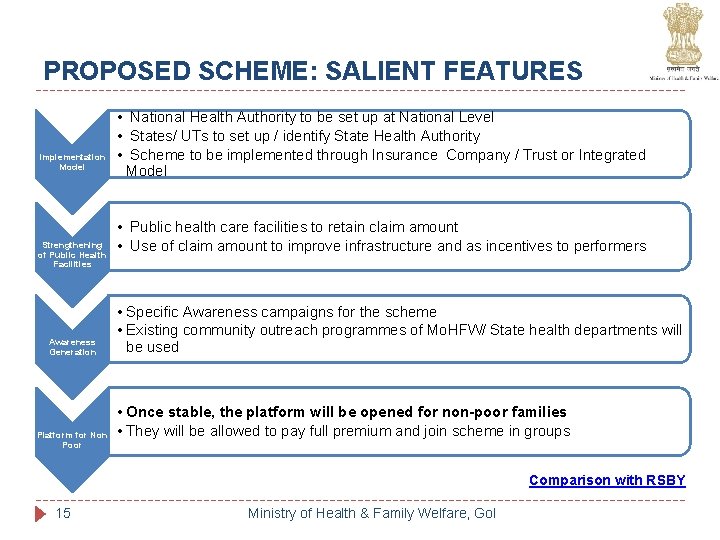
PROPOSED SCHEME: SALIENT FEATURES Implementation Model Strengthening of Public Health Facilities Awareness Generation Platform for Non Poor • National Health Authority to be set up at National Level • States/ UTs to set up / identify State Health Authority • Scheme to be implemented through Insurance Company / Trust or Integrated Model • Public health care facilities to retain claim amount • Use of claim amount to improve infrastructure and as incentives to performers • Specific Awareness campaigns for the scheme • Existing community outreach programmes of Mo. HFW/ State health departments will be used • Once stable, the platform will be opened for non-poor families • They will be allowed to pay full premium and join scheme in groups Comparison with RSBY 15 Ministry of Health & Family Welfare, Go. I
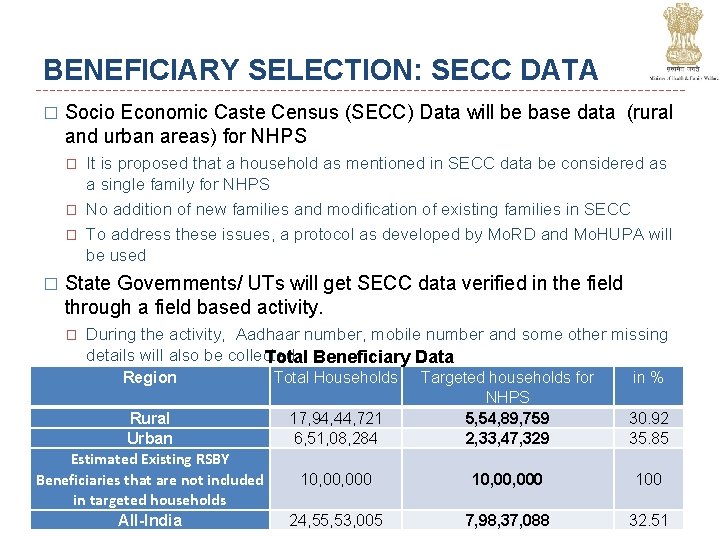
BENEFICIARY SELECTION: SECC DATA � Socio Economic Caste Census (SECC) Data will be base data (rural and urban areas) for NHPS � � It is proposed that a household as mentioned in SECC data be considered as a single family for NHPS No addition of new families and modification of existing families in SECC To address these issues, a protocol as developed by Mo. RD and Mo. HUPA will be used State Governments/ UTs will get SECC data verified in the field through a field based activity. � During the activity, Aadhaar number, mobile number and some other missing details will also be collected Total Beneficiary Data Region Total Households Targeted households for NHPS 5, 54, 89, 759 2, 33, 47, 329 Rural 17, 94, 44, 721 Urban 6, 51, 08, 284 Estimated Existing RSBY Beneficiaries that are not included 10, 00, 000 in targeted households 16 Ministry of Health & Family Welfare, Go. I All-India 24, 55, 53, 005 7, 98, 37, 088 in % 30. 92 35. 85 100 32. 51
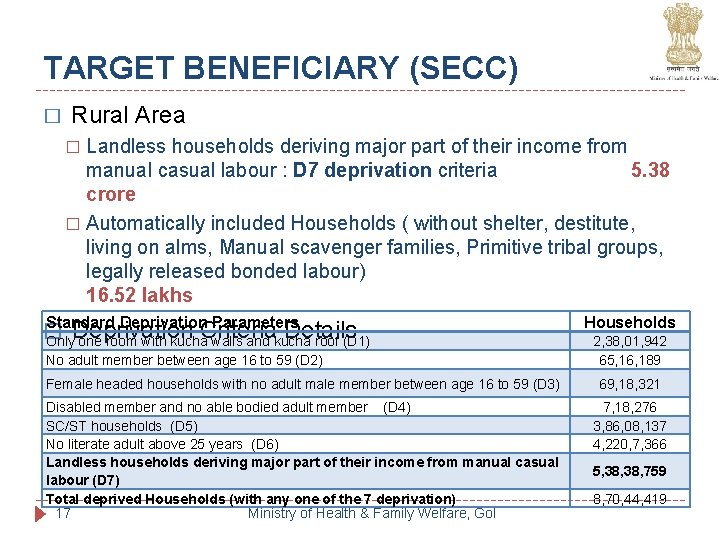
TARGET BENEFICIARY (SECC) � Rural Area Landless households deriving major part of their income from manual casual labour : D 7 deprivation criteria 5. 38 crore � Automatically included Households ( without shelter, destitute, living on alms, Manual scavenger families, Primitive tribal groups, legally released bonded labour) 16. 52 lakhs � Standard Deprivation Parameters � Deprivation Criteria Details Only one room with kucha walls and kucha roof (D 1) No adult member between age 16 to 59 (D 2) Households 2, 38, 01, 942 65, 16, 189 Female headed households with no adult male member between age 16 to 59 (D 3) 69, 18, 321 Disabled member and no able bodied adult member (D 4) SC/ST households (D 5) No literate adult above 25 years (D 6) Landless households deriving major part of their income from manual casual labour (D 7) Total deprived Households (with any one of the 7 deprivation) 17 Ministry of Health & Family Welfare, Go. I 7, 18, 276 3, 86, 08, 137 4, 220, 7, 366 5, 38, 759 8, 70, 44, 419
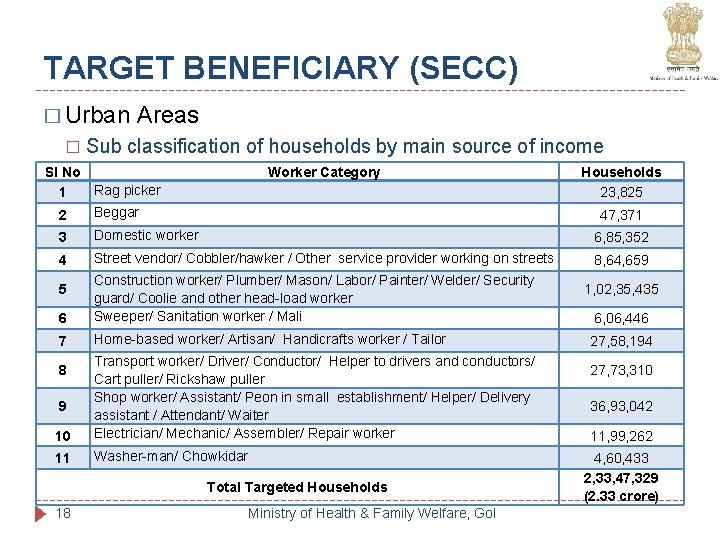
TARGET BENEFICIARY (SECC) � Urban � Areas Sub classification of households by main source of income Sl No Rag picker 1 Beggar 2 Worker Category Households 23, 825 47, 371 3 Domestic worker 6, 85, 352 4 Street vendor/ Cobbler/hawker / Other service provider working on streets 8, 64, 659 6 Construction worker/ Plumber/ Mason/ Labor/ Painter/ Welder/ Security guard/ Coolie and other head-load worker Sweeper/ Sanitation worker / Mali 7 Home-based worker/ Artisan/ Handicrafts worker / Tailor 5 10 Transport worker/ Driver/ Conductor/ Helper to drivers and conductors/ Cart puller/ Rickshaw puller Shop worker/ Assistant/ Peon in small establishment/ Helper/ Delivery assistant / Attendant/ Waiter Electrician/ Mechanic/ Assembler/ Repair worker 11 Washer-man/ Chowkidar 8 9 Total Targeted Households 18 Ministry of Health & Family Welfare, Go. I 1, 02, 35, 435 6, 06, 446 27, 58, 194 27, 73, 310 36, 93, 042 11, 99, 262 4, 60, 433 2, 33, 47, 329 (2. 33 crore)
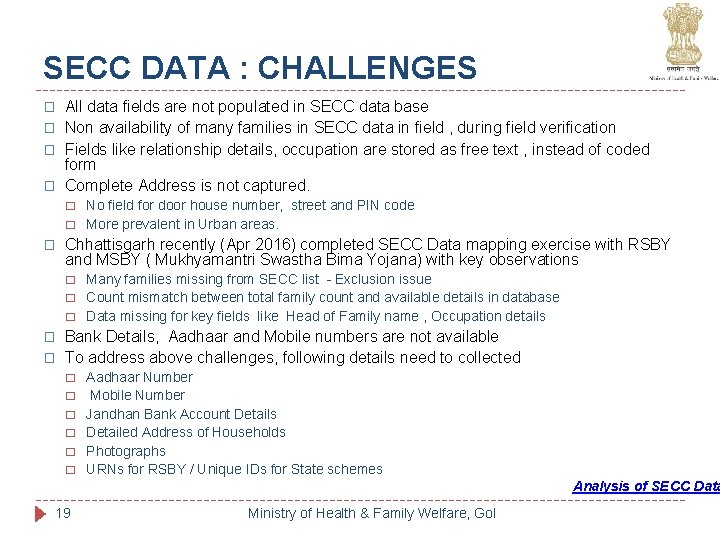
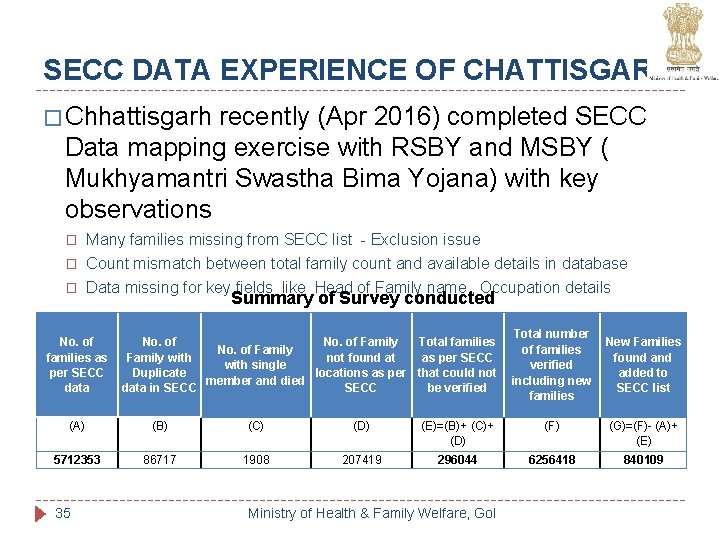
SECC DATA : CHALLENGES � � All data fields are not populated in SECC data base Non availability of many families in SECC data in field , during field verification Fields like relationship details, occupation are stored as free text , instead of coded form Complete Address is not captured. � � � Chhattisgarh recently (Apr 2016) completed SECC Data mapping exercise with RSBY and MSBY ( Mukhyamantri Swastha Bima Yojana) with key observations � � � No field for door house number, street and PIN code More prevalent in Urban areas. Many families missing from SECC list - Exclusion issue Count mismatch between total family count and available details in database Data missing for key fields like Head of Family name , Occupation details Bank Details, Aadhaar and Mobile numbers are not available To address above challenges, following details need to collected � � � Aadhaar Number Mobile Number Jandhan Bank Account Details Detailed Address of Households Photographs URNs for RSBY / Unique IDs for State schemes Analysis of SECC Data 19 Ministry of Health & Family Welfare, Go. I
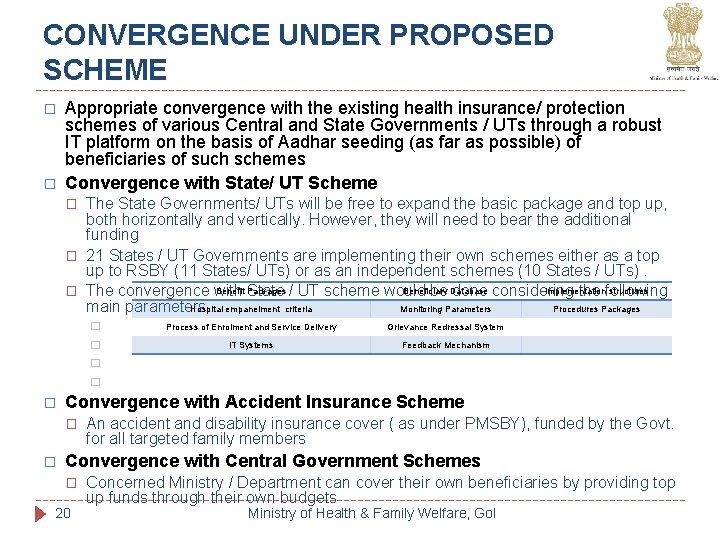
CONVERGENCE UNDER PROPOSED SCHEME � � Appropriate convergence with the existing health insurance/ protection schemes of various Central and State Governments / UTs through a robust IT platform on the basis of Aadhar seeding (as far as possible) of beneficiaries of such schemes Convergence with State/ UT Scheme � � � The State Governments/ UTs will be free to expand the basic package and top up, both horizontally and vertically. However, they will need to bear the additional funding 21 States / UT Governments are implementing their own schemes either as a top up to RSBY (11 States/ UTs) or as an independent schemes (10 States / UTs). Benefit Packages Beneficiary Implementation structures The convergence with State / UT scheme would be Database done considering the following main parameters Hospital empanelment criteria Monitoring Parameters Procedures Packages � Process of Enrolment and Service Delivery Grievance Redressal System � IT Systems Feedback Mechanism � � � Convergence with Accident Insurance Scheme � � An accident and disability insurance cover ( as under PMSBY), funded by the Govt. for all targeted family members Convergence with Central Government Schemes � 20 Concerned Ministry / Department can cover their own beneficiaries by providing top up funds through their own budgets Ministry of Health & Family Welfare, Go. I
CONVERGENCE WITH OTHER HEALTH INSURANCE SCHEMES � Development of single unified platform to enable integration with multiple health insurance schemes � Usage of Single SECC database will remove duplication, errors and overlaps � NHPS Platform will eliminate need of repeated enrolments � Schemes may be administered by different line ministries and departments, but brought together on this common platform � Beneficiary can avail service of multiple schemes usingle platform � Seeding with Aadhar, Bank account and mobile number to ensure that benefits are delivered to the right person � NHPS Platform will provide interface for monitoring of all schemes along with their utilization pattern 21 Ministry of Health & Family Welfare, Go. I
ICT PLATFORM � Complete responsibility on Meit. Y for end to end design, development, management and maintenance of IT architecture, portal and all applications/software related to the proposed health protection scheme � NIC will be the Nodal agency for this purpose on behalf of Meity � Robust, integrated and interoperable IT Platform � � � � � 22 Forms the backbone of the proposed scheme A Centralized IT Architecture with decentralized access through web browser/ desktop and mobile interface Unique NHPS ID for each beneficiary family across India Create a cashless transaction system Allows interoperability, convergence of various schemes and vertical and horizontal expansion by States / UTs Will ensure seamless exchange of information amongst all stakeholders Hospital Transaction System may follow Standard Treatment Guidelines Monitoring Dashboard with real time data and reports Inbuilt analytics, statistical models and algorithms for fraud detection and prevention Ministry of Health & Family Welfare, Go. I
ICT PLATFORM : KEY FEATURES � Unique NHPS ID for each beneficiary family across India � Desktop application/ software sync with central server should be able to handle scenarios of intermittent loss of internet connectivity. � The IT system should be linked with Aadhaar that can be used for verification and authentication purposes as far as possible. � In addition a convenient alternate mechanism including verification through other government issued photo identity cards (OTP/ IVRS/ USSD/ Call Center etc. ) will also be developed for providing services to the beneficiary who do not have Aadhaar � Capability of convergence with IT systems (through synchronization and syndication or any other feasible mode) of State schemes related to health insurance for delivery of Process Flow of IT System services. Provision for horizontal and vertical expansion of the 23 Ministry of Health & Family Welfare, Go. I
PREVENTION OF MISUSE � � While ensuring user convenience and to prevent misuse by providers and users by way of minimising chances of frauds / abuse, NHPS would create robust safeguards. Measures to minimise fraud and abuse � � � � Pre –authorisation : Pre-authorisation will be mandatory for all tertiary and select secondary packages Triggers and Alerts: Automatic triggers and alerts will be initiated Disease and Claim Pattern Analysis : Pattern analysis to study frauds and abuses Medical and Clinical Audit : Routine medical and clinical audits will be done regularly Risk Based Verification : Risk based verification of claims will be done on random basis SMS Alerts: Automatic SMS Alerts will be sent to all stake holders at each step of NHPS Feedback by Beneficiaries : Regular feedback will be collected from beneficiaries through various mechanisms Various tools and techniques would be adopted to identify potential frauds and abuses: Statistical healthcare fraud detection techniques � Analytic Healthcare Fraud Detection Methods providers 24� Statistical listings of risky Ministry of Health & Family Welfare, Go. I � Predictive Modelling �
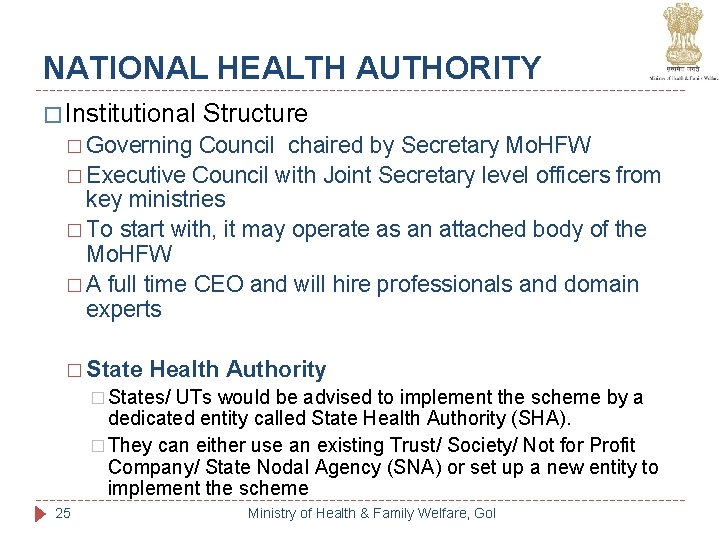
NATIONAL HEALTH AUTHORITY � Institutional Structure � Governing Council chaired by Secretary Mo. HFW � Executive Council with Joint Secretary level officers from key ministries � To start with, it may operate as an attached body of the Mo. HFW � A full time CEO and will hire professionals and domain experts � State Health Authority � States/ UTs would be advised to implement the scheme by a dedicated entity called State Health Authority (SHA). � They can either use an existing Trust/ Society/ Not for Profit Company/ State Nodal Agency (SNA) or set up a new entity to implement the scheme 25 Ministry of Health & Family Welfare, Go. I
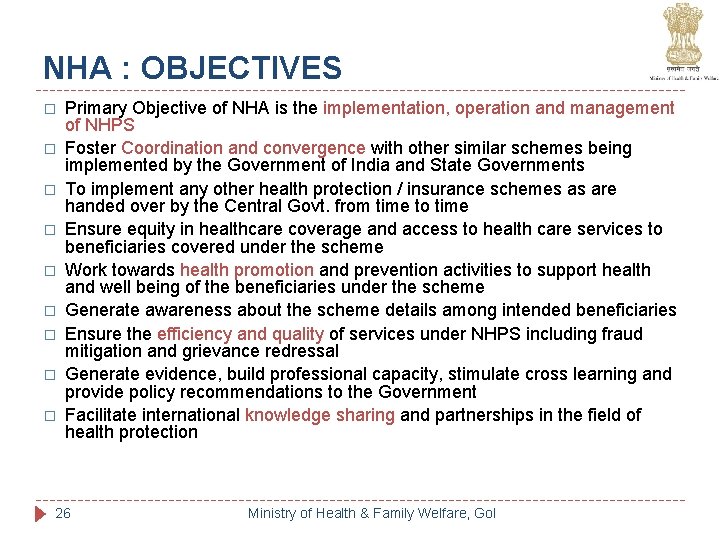
NHA : OBJECTIVES � � � � � Primary Objective of NHA is the implementation, operation and management of NHPS Foster Coordination and convergence with other similar schemes being implemented by the Government of India and State Governments To implement any other health protection / insurance schemes as are handed over by the Central Govt. from time to time Ensure equity in healthcare coverage and access to health care services to beneficiaries covered under the scheme Work towards health promotion and prevention activities to support health and well being of the beneficiaries under the scheme Generate awareness about the scheme details among intended beneficiaries Ensure the efficiency and quality of services under NHPS including fraud mitigation and grievance redressal Generate evidence, build professional capacity, stimulate cross learning and provide policy recommendations to the Government Facilitate international knowledge sharing and partnerships in the field of health protection 26 Ministry of Health & Family Welfare, Go. I
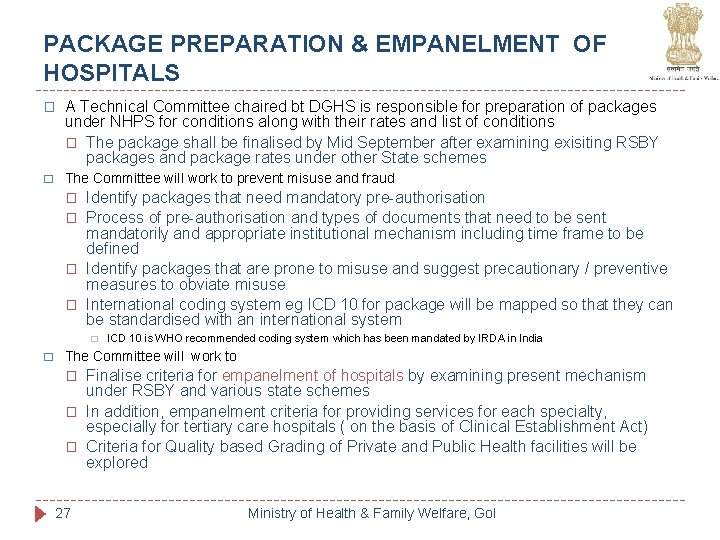
PACKAGE PREPARATION & EMPANELMENT OF HOSPITALS � A Technical Committee chaired bt DGHS is responsible for preparation of packages under NHPS for conditions along with their rates and list of conditions � The package shall be finalised by Mid September after examining exisiting RSBY packages and package rates under other State schemes � The Committee will work to prevent misuse and fraud � � Identify packages that need mandatory pre-authorisation Process of pre-authorisation and types of documents that need to be sent mandatorily and appropriate institutional mechanism including time frame to be defined Identify packages that are prone to misuse and suggest precautionary / preventive measures to obviate misuse International coding system eg ICD 10 for package will be mapped so that they can be standardised with an international system � � ICD 10 is WHO recommended coding system which has been mandated by IRDA in India The Committee will work to � � � 27 Finalise criteria for empanelment of hospitals by examining present mechanism under RSBY and various state schemes In addition, empanelment criteria for providing services for each specialty, especially for tertiary care hospitals ( on the basis of Clinical Establishment Act) Criteria for Quality based Grading of Private and Public Health facilities will be explored Ministry of Health & Family Welfare, Go. I
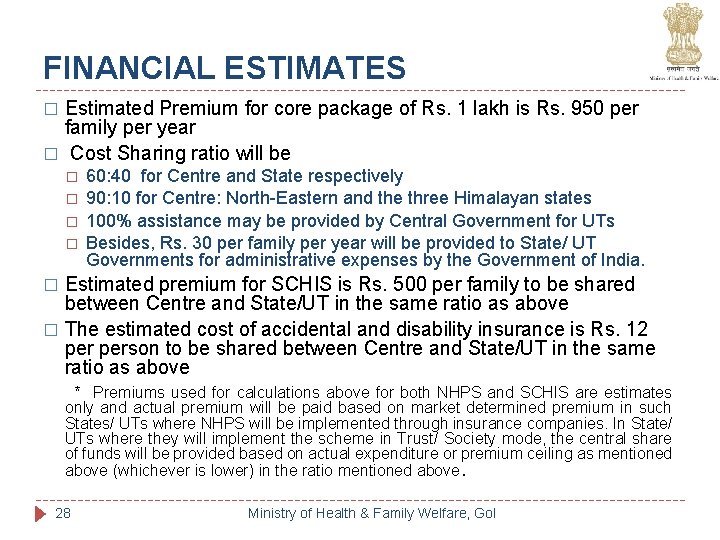
FINANCIAL ESTIMATES Estimated Premium for core package of Rs. 1 lakh is Rs. 950 per family per year � Cost Sharing ratio will be � � � 60: 40 for Centre and State respectively 90: 10 for Centre: North-Eastern and the three Himalayan states 100% assistance may be provided by Central Government for UTs Besides, Rs. 30 per family per year will be provided to State/ UT Governments for administrative expenses by the Government of India. Estimated premium for SCHIS is Rs. 500 per family to be shared between Centre and State/UT in the same ratio as above � The estimated cost of accidental and disability insurance is Rs. 12 person to be shared between Centre and State/UT in the same ratio as above � * Premiums used for calculations above for both NHPS and SCHIS are estimates only and actual premium will be paid based on market determined premium in such States/ UTs where NHPS will be implemented through insurance companies. In State/ UTs where they will implement the scheme in Trust/ Society mode, the central share of funds will be provided based on actual expenditure or premium ceiling as mentioned above (whichever is lower) in the ratio mentioned above. 28 Ministry of Health & Family Welfare, Go. I
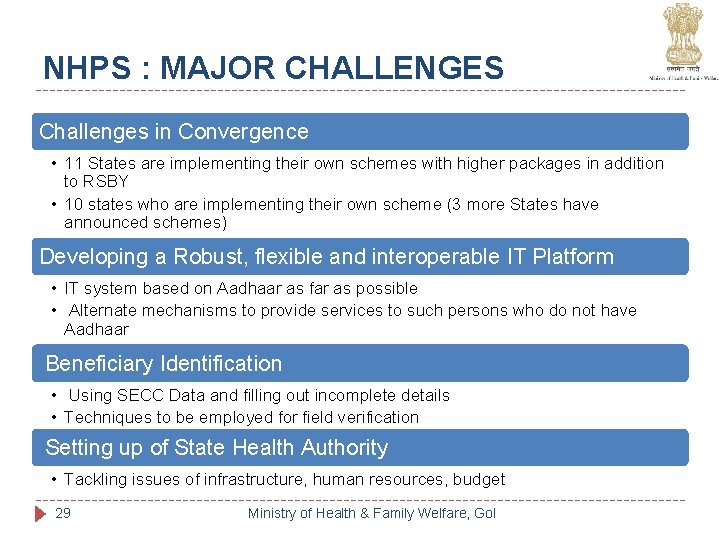
NHPS : MAJOR CHALLENGES Challenges in Convergence • 11 States are implementing their own schemes with higher packages in addition to RSBY • 10 states who are implementing their own scheme (3 more States have announced schemes) • Convergence of all these State schemes on NHPS IT Platform Developing a Robust, flexible and interoperable IT Platform • IT system based on Aadhaar as far as possible • Alternate mechanisms to provide services to such persons who do not have Aadhaar • A system that is able to handle intermittent connectivity issues Beneficiary Identification • Using SECC Data and filling out incomplete details • Techniques to be employed for field verification Setting up of State Health Authority • Tackling issues of infrastructure, human resources, budget 29 Ministry of Health & Family Welfare, Go. I
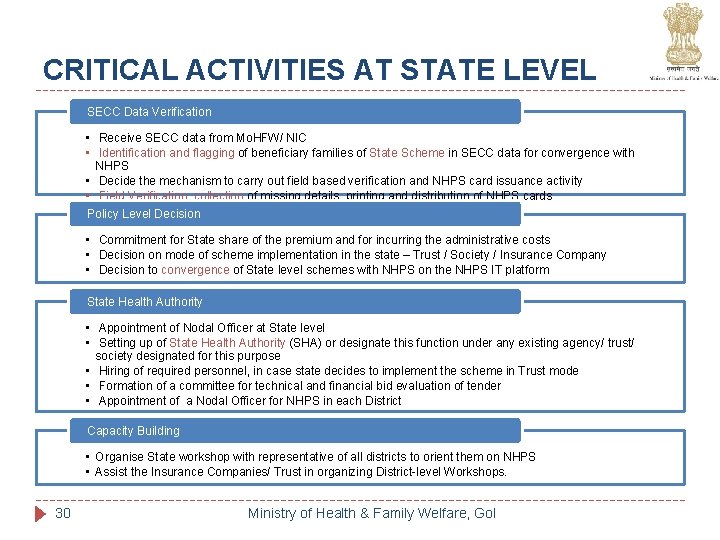
CRITICAL ACTIVITIES AT STATE LEVEL SECC Data Verification • Receive SECC data from Mo. HFW/ NIC • Identification and flagging of beneficiary families of State Scheme in SECC data for convergence with NHPS • Decide the mechanism to carry out field based verification and NHPS card issuance activity • Field Verification, collection of missing details, printing and distribution of NHPS cards Policy Level Decision • Commitment for State share of the premium and for incurring the administrative costs • Decision on mode of scheme implementation in the state – Trust / Society / Insurance Company • Decision to convergence of State level schemes with NHPS on the NHPS IT platform State Health Authority • Appointment of Nodal Officer at State level • Setting up of State Health Authority (SHA) or designate this function under any existing agency/ trust/ society designated for this purpose • Hiring of required personnel, in case state decides to implement the scheme in Trust mode • Formation of a committee for technical and financial bid evaluation of tender • Appointment of a Nodal Officer for NHPS in each District Capacity Building • Organise State workshop with representative of all districts to orient them on NHPS • Assist the Insurance Companies/ Trust in organizing District-level Workshops. 30 Ministry of Health & Family Welfare, Go. I
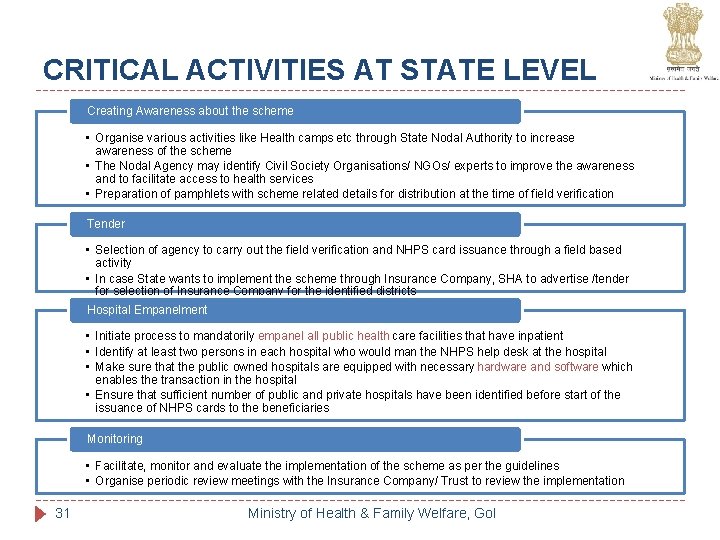
CRITICAL ACTIVITIES AT STATE LEVEL Creating Awareness about the scheme • Organise various activities like Health camps etc through State Nodal Authority to increase awareness of the scheme • The Nodal Agency may identify Civil Society Organisations/ NGOs/ experts to improve the awareness and to facilitate access to health services • Preparation of pamphlets with scheme related details for distribution at the time of field verification Tender • Selection of agency to carry out the field verification and NHPS card issuance through a field based activity • In case State wants to implement the scheme through Insurance Company, SHA to advertise /tender for selection of Insurance Company for the identified districts Hospital Empanelment • Initiate process to mandatorily empanel all public health care facilities that have inpatient • Identify at least two persons in each hospital who would man the NHPS help desk at the hospital • Make sure that the public owned hospitals are equipped with necessary hardware and software which enables the transaction in the hospital • Ensure that sufficient number of public and private hospitals have been identified before start of the issuance of NHPS cards to the beneficiaries Monitoring • Facilitate, monitor and evaluate the implementation of the scheme as per the guidelines • Organise periodic review meetings with the Insurance Company/ Trust to review the implementation 31 Ministry of Health & Family Welfare, Go. I
THANK YOU 32
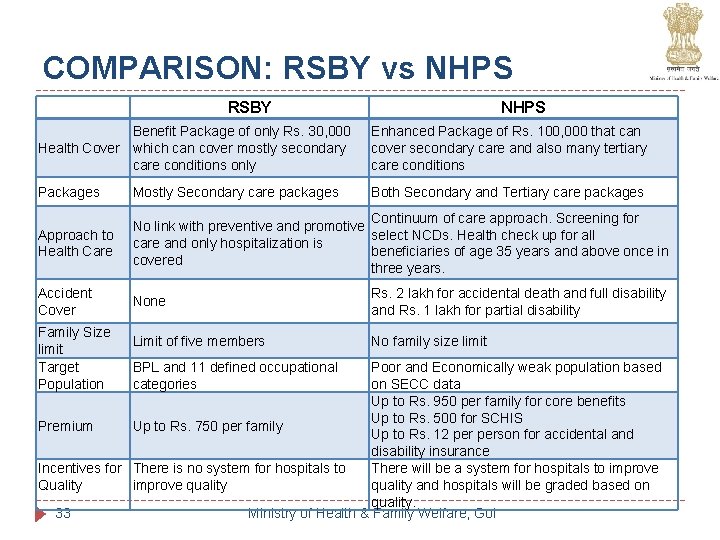
COMPARISON: RSBY vs NHPS RSBY NHPS Benefit Package of only Rs. 30, 000 Health Cover which can cover mostly secondary care conditions only Enhanced Package of Rs. 100, 000 that can cover secondary care and also many tertiary care conditions Packages Mostly Secondary care packages Both Secondary and Tertiary care packages Approach to Health Care Continuum of care approach. Screening for No link with preventive and promotive select NCDs. Health check up for all care and only hospitalization is beneficiaries of age 35 years and above once in covered three years. Accident Cover None Rs. 2 lakh for accidental death and full disability and Rs. 1 lakh for partial disability Limit of five members No family size limit Family Size limit Target Population BPL and 11 defined occupational categories Poor and Economically weak population based on SECC data Up to Rs. 950 per family for core benefits Up to Rs. 500 for SCHIS Premium Up to Rs. 750 per family Up to Rs. 12 person for accidental and disability insurance Incentives for There is no system for hospitals to There will be a system for hospitals to improve Quality improve quality and hospitals will be graded based on quality. 33 Ministry of Health & Family Welfare, Go. I
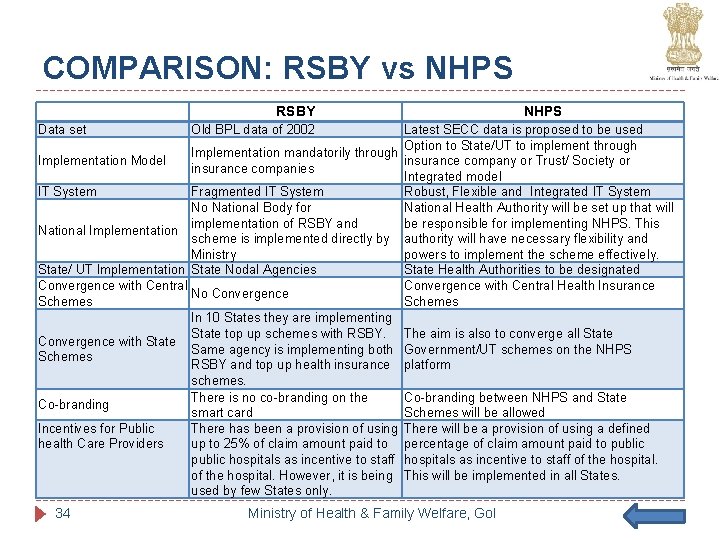
COMPARISON: RSBY vs NHPS RSBY Data set Latest SECC data is proposed to be used Option to State/UT to implement through Implementation mandatorily through Implementation Model insurance company or Trust/ Society or insurance companies Integrated model IT System Fragmented IT System Robust, Flexible and Integrated IT System No National Body for National Health Authority will be set up that will implementation of RSBY and be responsible for implementing NHPS. This National Implementation scheme is implemented directly by authority will have necessary flexibility and Ministry powers to implement the scheme effectively. State/ UT Implementation State Nodal Agencies State Health Authorities to be designated Convergence with Central Health Insurance No Convergence Schemes In 10 States they are implementing State top up schemes with RSBY. The aim is also to converge all State Convergence with State Same agency is implementing both Government/UT schemes on the NHPS Schemes RSBY and top up health insurance platform schemes. There is no co-branding on the Co-branding between NHPS and State Co-branding smart card Schemes will be allowed Incentives for Public There has been a provision of using There will be a provision of using a defined health Care Providers up to 25% of claim amount paid to percentage of claim amount paid to public hospitals as incentive to staff of the hospital. However, it is being This will be implemented in all States. used by few States only. 34 Old BPL data of 2002 NHPS Ministry of Health & Family Welfare, Go. I
SECC DATA EXPERIENCE OF CHATTISGARH � Chhattisgarh recently (Apr 2016) completed SECC Data mapping exercise with RSBY and MSBY ( Mukhyamantri Swastha Bima Yojana) with key observations � Many families missing from SECC list - Exclusion issue � Count mismatch between total family count and available details in database � Data missing for key fields like Head of Family name , Occupation details No. of families as per SECC data Summary of Survey conducted No. of Family Total families No. of Family with not found at as per SECC with single Duplicate locations as per that could not member and died data in SECC be verified Total number of families verified including new families New Families found added to SECC list (A) (B) (C) (D) (E)=(B)+ (C)+ (D) (F) (G)=(F)- (A)+ (E) 5712353 86717 1908 207419 296044 6256418 840109 35 Ministry of Health & Family Welfare, Go. I
HOUSEHOLDS ENUMERATED DURING SECC SURVEY FAMILY MEMBERS IN DEPRIVED HOUSEHOLDS (IN LAKHS) 36 Ministry of Health & Family Welfare, Go. I * Analysis Done by NIC
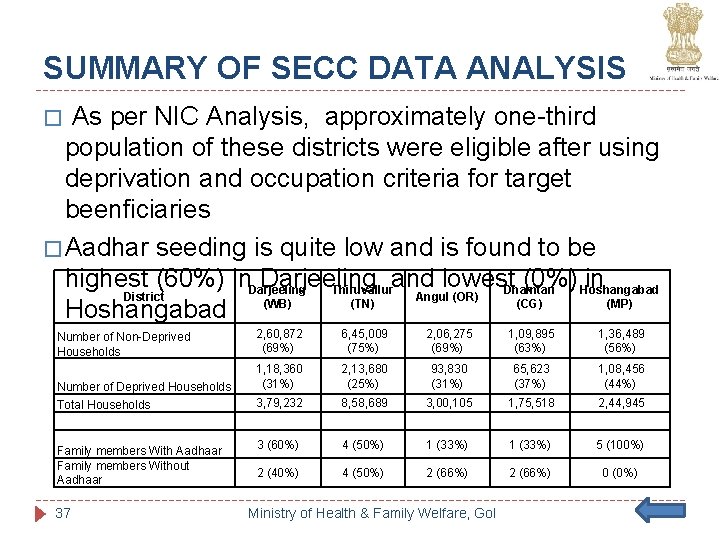
SUMMARY OF SECC DATA ANALYSIS As per NIC Analysis, approximately one-third population of these districts were eligible after using deprivation and occupation criteria for target beenficiaries � Aadhar seeding is quite low and is found to be highest (60%) in. Darjeeling and lowest. Dhamtari (0%) Hoshangabad in Thiruvallur District Angul (OR) (WB) (TN) (CG) (MP) Hoshangabad � Number of Non-Deprived Households 2, 60, 872 (69%) 6, 45, 009 (75%) 2, 06, 275 (69%) 1, 09, 895 (63%) 1, 36, 489 (56%) Number of Deprived Households 1, 18, 360 (31%) 2, 13, 680 (25%) 93, 830 (31%) 65, 623 (37%) 1, 08, 456 (44%) Total Households 3, 79, 232 8, 58, 689 3, 00, 105 1, 75, 518 2, 44, 945 3 (60%) 4 (50%) 1 (33%) 5 (100%) 2 (40%) 4 (50%) 2 (66%) 0 (0%) Family members With Aadhaar Family members Without Aadhaar 37 Ministry of Health & Family Welfare, Go. I
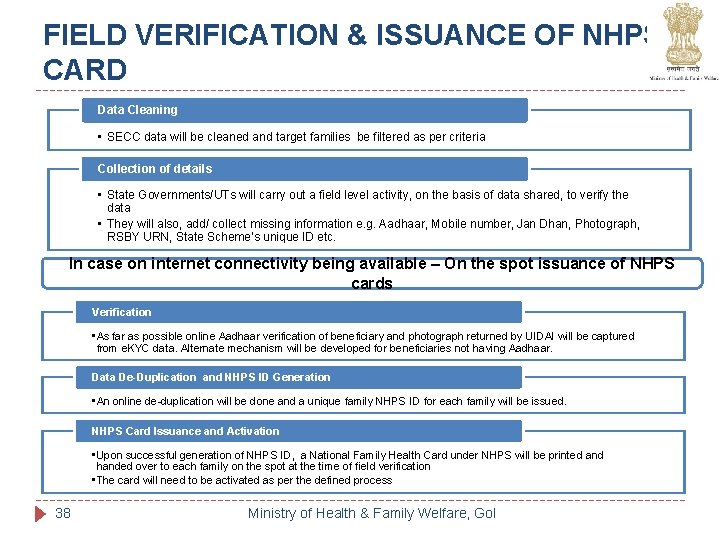
FIELD VERIFICATION & ISSUANCE OF NHPS CARD Data Cleaning • SECC data will be cleaned and target families be filtered as per criteria Collection of details • State Governments/UTs will carry out a field level activity, on the basis of data shared, to verify the data • They will also, add/ collect missing information e. g. Aadhaar, Mobile number, Jan Dhan, Photograph, RSBY URN, State Scheme’s unique ID etc. In case on internet connectivity being available – On the spot issuance of NHPS cards Verification • As far as possible online Aadhaar verification of beneficiary and photograph returned by UIDAI will be captured from e. KYC data. Alternate mechanism will be developed for beneficiaries not having Aadhaar. Data De-Duplication and NHPS ID Generation • An online de-duplication will be done and a unique family NHPS ID for each family will be issued. NHPS Card Issuance and Activation • Upon successful generation of NHPS ID, a National Family Health Card under NHPS will be printed and handed over to each family on the spot at the time of field verification • The card will need to be activated as per the defined process 38 Ministry of Health & Family Welfare, Go. I
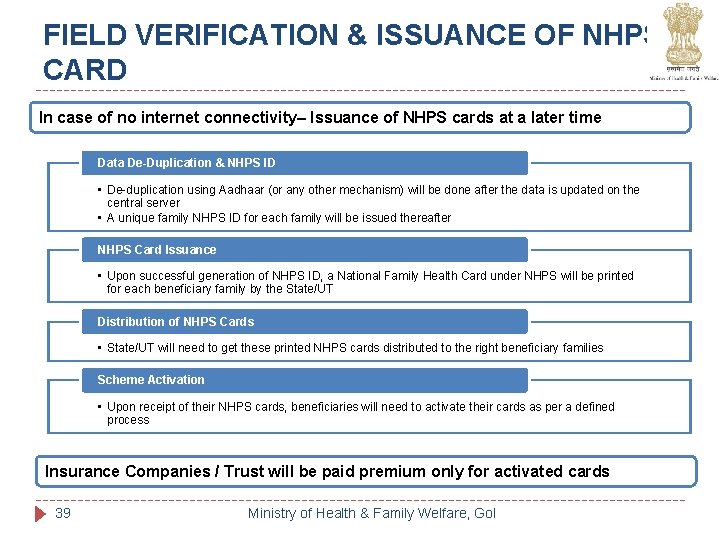
FIELD VERIFICATION & ISSUANCE OF NHPS CARD In case of no internet connectivity– Issuance of NHPS cards at a later time Data De-Duplication & NHPS ID • De-duplication using Aadhaar (or any other mechanism) will be done after the data is updated on the central server • A unique family NHPS ID for each family will be issued thereafter NHPS Card Issuance • Upon successful generation of NHPS ID, a National Family Health Card under NHPS will be printed for each beneficiary family by the State/UT Distribution of NHPS Cards • State/UT will need to get these printed NHPS cards distributed to the right beneficiary families Scheme Activation • Upon receipt of their NHPS cards, beneficiaries will need to activate their cards as per a defined process Insurance Companies / Trust will be paid premium only for activated cards 39 Ministry of Health & Family Welfare, Go. I
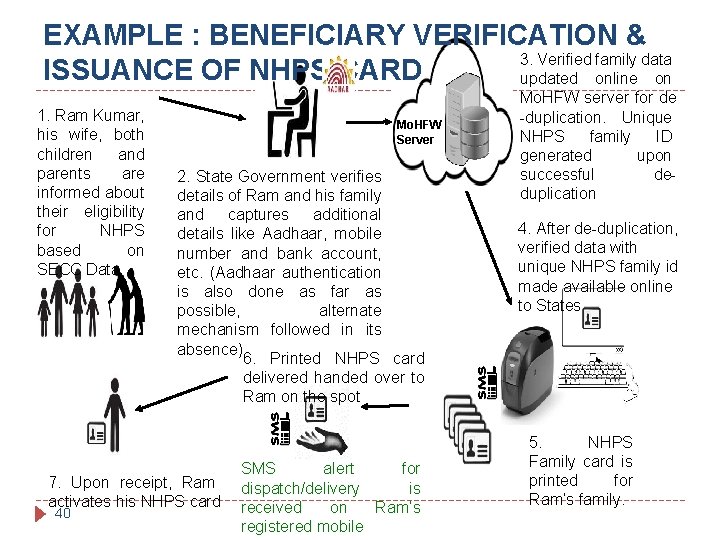
EXAMPLE : BENEFICIARY VERIFICATION & 3. Verified family data ISSUANCE OF NHPS CARD updated online on 1. Ram Kumar, his wife, both children and parents are informed about their eligibility for NHPS based on SECC Data Mo. HFW Server 2. State Government verifies details of Ram and his family and captures additional details like Aadhaar, mobile number and bank account, etc. (Aadhaar authentication is also done as far as possible, alternate mechanism followed in its absence) 6. Printed NHPS card delivered handed over to Ram on the spot 7. Upon receipt, Ram activates his NHPS card 40 SMS alert for dispatch/delivery is received on Ram’s registered mobile Mo. HFW server for de -duplication. Unique NHPS family ID generated upon successful deduplication 4. After de-duplication, verified data with unique NHPS family id made available online to States 5. NHPS Family card is printed for Ram’s family.
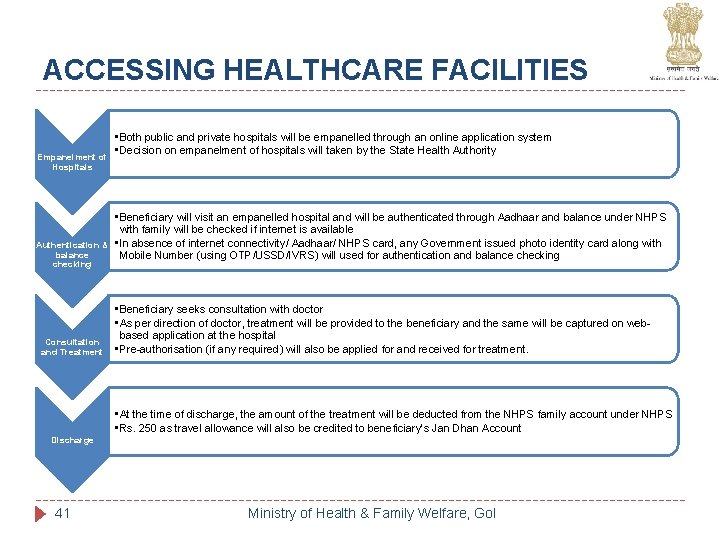
ACCESSING HEALTHCARE FACILITIES Empanelment of Hospitals Authentication & balance checking Consultation and Treatment • Both public and private hospitals will be empanelled through an online application system • Decision on empanelment of hospitals will taken by the State Health Authority • Beneficiary will visit an empanelled hospital and will be authenticated through Aadhaar and balance under NHPS with family will be checked if internet is available • In absence of internet connectivity/ Aadhaar/ NHPS card, any Government issued photo identity card along with Mobile Number (using OTP/USSD/IVRS) will used for authentication and balance checking • Beneficiary seeks consultation with doctor • As per direction of doctor, treatment will be provided to the beneficiary and the same will be captured on webbased application at the hospital • Pre-authorisation (if any required) will also be applied for and received for treatment. • At the time of discharge, the amount of the treatment will be deducted from the NHPS family account under NHPS • Rs. 250 as travel allowance will also be credited to beneficiary’s Jan Dhan Account Discharge 41 Ministry of Health & Family Welfare, Go. I
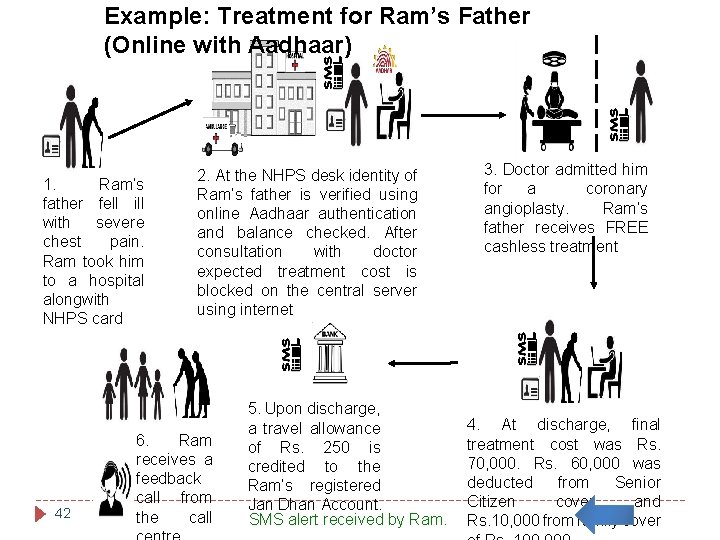
Example: Treatment for Ram’s Father (Online with Aadhaar) 1. Ram’s father fell ill with severe chest pain. Ram took him to a hospital alongwith NHPS card 42 2. At the NHPS desk identity of Ram’s father is verified using online Aadhaar authentication and balance checked. After consultation with doctor expected treatment cost is blocked on the central server using internet 6. Ram receives a feedback call from the call 5. Upon discharge, a travel allowance of Rs. 250 is credited to the Ram’s registered Jan Dhan Account. SMS alert received by Ram. 3. Doctor admitted him for a coronary angioplasty. Ram’s father receives FREE cashless treatment 4. At discharge, final treatment cost was Rs. 70, 000. Rs. 60, 000 was deducted from Senior Citizen cover and Rs. 10, 000 from family cover
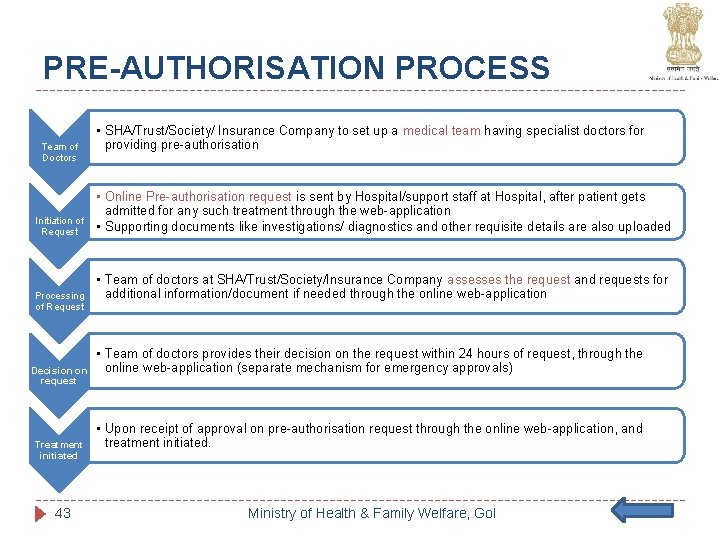
PRE-AUTHORISATION PROCESS Team of Doctors Initiation of Request Processing of Request Decision on request Treatment initiated 43 • SHA/Trust/Society/ Insurance Company to set up a medical team having specialist doctors for providing pre-authorisation • Online Pre-authorisation request is sent by Hospital/support staff at Hospital, after patient gets admitted for any such treatment through the web-application • Supporting documents like investigations/ diagnostics and other requisite details are also uploaded • Team of doctors at SHA/Trust/Society/Insurance Company assesses the request and requests for additional information/document if needed through the online web-application • Team of doctors provides their decision on the request within 24 hours of request, through the online web-application (separate mechanism for emergency approvals) • Upon receipt of approval on pre-authorisation request through the online web-application, and treatment initiated. Ministry of Health & Family Welfare, Go. I
AVERAGE PREMIUM IN RSBY Average Premium (Rs) across States 2015 -16 West Bengal 254, 10 Uttrakhand 309, 58 Uttar Pradesh 335, 00 Tripura 239, 00 Rajasthan 242, 24 Punjab 245, 09 320, 80 Odisha Mizoram 745, 00 Meghalaya 432, 00 499, 33 Manipur Kerala 738, 00 191, 27 Karnataka Jharkhand 364, 29 Himachal Pradesh 275, 00 Haryana 430, 71 Gujarat 433, 12 Chhattisgarh 363, 00 Bihar 216, 66 Assam 0, 00 44 319, 96 100, 00 200, 00 300, 00 400, 00 500, 00 600, 00 Ministry of Health & Family Welfare, Go. I 700, 00 800, 00