
National Health Insurance IMPLEMENTATION STRUCTURES 1 NHI Implementation



- Slides: 15
National Health Insurance IMPLEMENTATION STRUCTURES 1
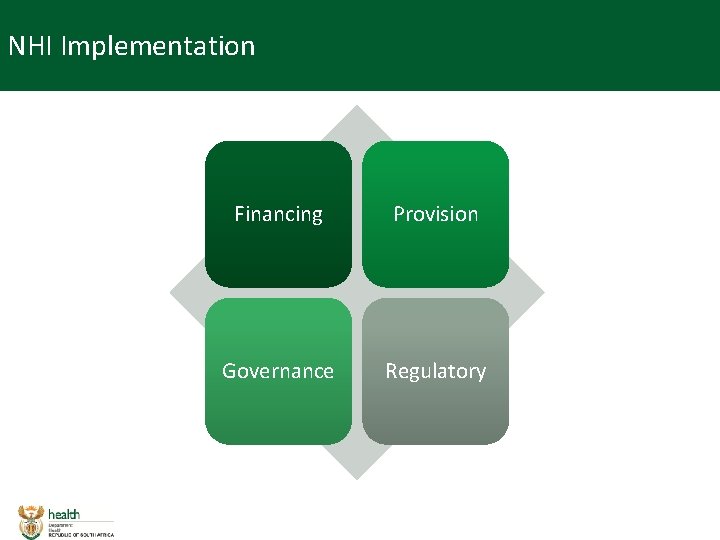
NHI Implementation Financing Provision Governance Regulatory
Transitional and Phased Implementation Structures • The implementation structures are established in terms of section 91 (1) of the National Health Act. 4
Setup for each structure • • • Terms of Reference (TORs) Composition Chairs/Leaders and Secretariats Adverts Dates of Appointment 5
National Tertiary Health Services Technical Implementation Committee A. Prepare and maintain a national tertiary services plan in coherence with the entire health system B. Develop the tools required for reporting on tertiary service provision, resources and outcomes. C. Monitor the commissioning of tertiary services as the planned expansion is rolled out to new sites and any planned consolidation of services. D. Evaluate and report on the outcomes of monitoring and evaluation, as well as relevant research to the NHC. E. Facilitate peer reviewed clinical governance audits. F. Recommend to the NHC, via the NHC Technical Advisory Committee, actions to be taken to address the evaluation and audit findings. G. Consult with clinicians, academics and professional groups (councils and associations) to recommend the need to draft, and /or set in place, comprehensive set of clinical guidelines and rationing criteria for all tertiary disciplines and for tertiary care in general. H. Consult with private sector specialist health service providers, Higher Education Institutions (HEIs) and other higher education forums, international donors, and any other interested parties regarding the roles and responsibilities of tertiary health services in a NHI system. 6
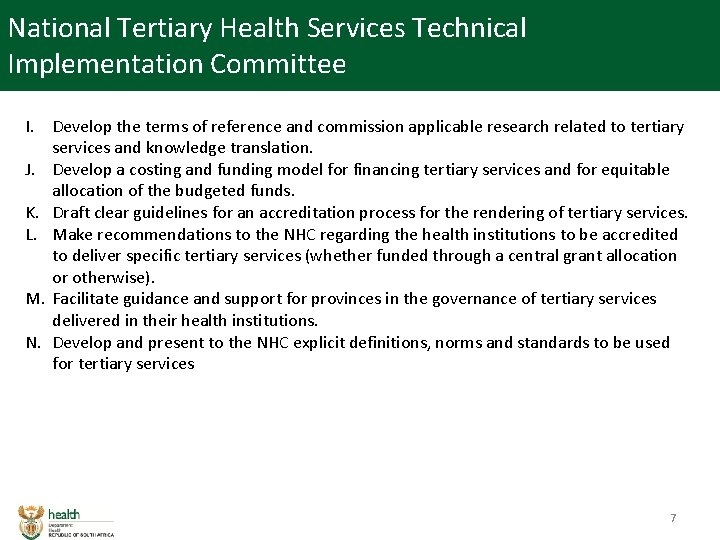
National Tertiary Health Services Technical Implementation Committee I. Develop the terms of reference and commission applicable research related to tertiary services and knowledge translation. J. Develop a costing and funding model for financing tertiary services and for equitable allocation of the budgeted funds. K. Draft clear guidelines for an accreditation process for the rendering of tertiary services. L. Make recommendations to the NHC regarding the health institutions to be accredited to deliver specific tertiary services (whether funded through a central grant allocation or otherwise). M. Facilitate guidance and support for provinces in the governance of tertiary services delivered in their health institutions. N. Develop and present to the NHC explicit definitions, norms and standards to be used for tertiary services 7
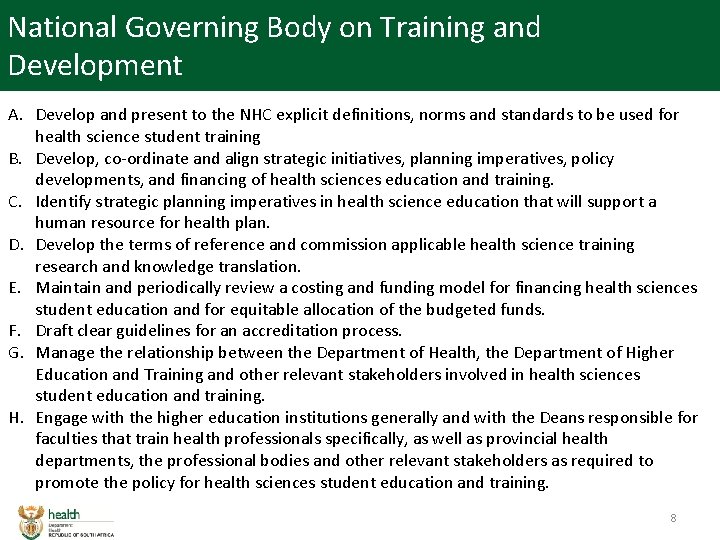
National Governing Body on Training and Development A. Develop and present to the NHC explicit definitions, norms and standards to be used for health science student training B. Develop, co-ordinate and align strategic initiatives, planning imperatives, policy developments, and financing of health sciences education and training. C. Identify strategic planning imperatives in health science education that will support a human resource for health plan. D. Develop the terms of reference and commission applicable health science training research and knowledge translation. E. Maintain and periodically review a costing and funding model for financing health sciences student education and for equitable allocation of the budgeted funds. F. Draft clear guidelines for an accreditation process. G. Manage the relationship between the Department of Health, the Department of Higher Education and Training and other relevant stakeholders involved in health sciences student education and training. H. Engage with the higher education institutions generally and with the Deans responsible for faculties that train health professionals specifically, as well as provincial health departments, the professional bodies and other relevant stakeholders as required to promote the policy for health sciences student education and training. 8
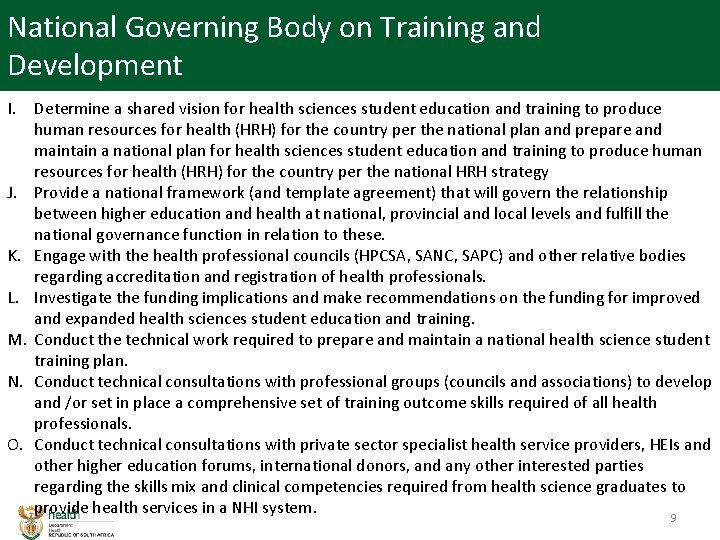
National Governing Body on Training and Development I. Determine a shared vision for health sciences student education and training to produce human resources for health (HRH) for the country per the national plan and prepare and maintain a national plan for health sciences student education and training to produce human resources for health (HRH) for the country per the national HRH strategy J. Provide a national framework (and template agreement) that will govern the relationship between higher education and health at national, provincial and local levels and fulfill the national governance function in relation to these. K. Engage with the health professional councils (HPCSA, SANC, SAPC) and other relative bodies regarding accreditation and registration of health professionals. L. Investigate the funding implications and make recommendations on the funding for improved and expanded health sciences student education and training. M. Conduct the technical work required to prepare and maintain a national health science student training plan. N. Conduct technical consultations with professional groups (councils and associations) to develop and /or set in place a comprehensive set of training outcome skills required of all health professionals. O. Conduct technical consultations with private sector specialist health service providers, HEIs and other higher education forums, international donors, and any other interested parties regarding the skills mix and clinical competencies required from health science graduates to provide health services in a NHI system. 9
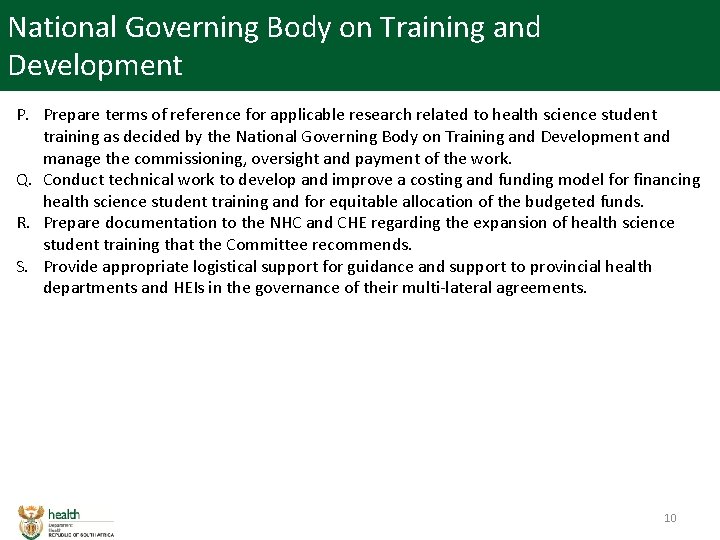
National Governing Body on Training and Development P. Prepare terms of reference for applicable research related to health science student training as decided by the National Governing Body on Training and Development and manage the commissioning, oversight and payment of the work. Q. Conduct technical work to develop and improve a costing and funding model for financing health science student training and for equitable allocation of the budgeted funds. R. Prepare documentation to the NHC and CHE regarding the expansion of health science student training that the Committee recommends. S. Provide appropriate logistical support for guidance and support to provincial health departments and HEIs in the governance of their multi-lateral agreements. 10
Ministerial Advisory Committee on Health Care Benefits for NHI A. The specification of a comprehensive set of benefits - The committee will advise the Minister of Health on which interventions should be included in the health service benefits. B. Develop norms and standards for effective health care service delivery C. Review and recommend development of treatment guidelines and protocols D. Develop and operationalize an implementation framework - The Ministerial Advisory Committee on Health Care Benefits will develop and operationalize an implementation framework. E. Periodically review the health care benefit specification F. Determine and adopt an appropriate process for resource estimate G. The Ministerial Advisory Committee on Health Care Benefits following consultation with key stakeholders with expertise in the public and private health sectors must recommend a final benefit structure for implementation from 1 st January 2018. H. Development of standardized materials communicating what services will be covered and how will they be accessed I. Information and data requirements - The Ministerial Advisory Committee on Health Care Benefits will stipulate the different requirements J. Review and advise on contracting of health providers 11
Ministerial Advisory Committee on Health Technology Assessment for NHI A. Determine Requirements for creation of HTA structure in terms of independence and financial sustainability B. Establish International collaboration structures C. Human resource development - It is very important that sufficient human resource capacity is built into HTA research organizations as well as decision-making bodies D. Stakeholder consultation and management: E. Linking HTA to policy decision-making mechanisms F. Adopt and Implement a prioritization framework - to be as explicit as possible about what services are included and excluded and about what criteria guide service selection G. Initiate the process of conducting HTA H. The HTA Committee will stipulate the different requirements of health information 12
National Health Pricing Advisory Committee A. Providing objective analysis on the appropriate pay levels for identifiable groups within the public sector; B. Implement interim measures and processes to stabilise price determination mechanisms in the private health system with the cooperation of private sector health stakeholders, until the full implementation of NHI in 2026. C. Undertaking a consultative process with the view to maximizing consensus on the implementation of a new pricing framework, which stakeholders and role-players must as far as possible include D. Determine appropriate rates for administrative and overhead expenditure related to health care provision and the management of the NHI Fund E. Define information requirements and establish processes to institutionalise routine collection of data appropriate F. Develop recommendations on the establishment of a Health Care Pricing Authority 13
National Advisory Committee on Consolidation of Financing Arrangements A. The Committee will be responsible for implementing the consolidation of financing arrangements • The consolidation of funding streams into 5 transitional funding arrangements will effectively reduce the current fragmentation and through a process of income cross-subsidisation allow for the transition towards the establishment of a single financing pool without having to wait for the raising of additional funding through the tax system. B. Consolidation of Civil Servants Funding arrangements C. Implementation within formal sector employment structures D. Introduction of Mandatory Cover and Contributions related to Formal employment 14
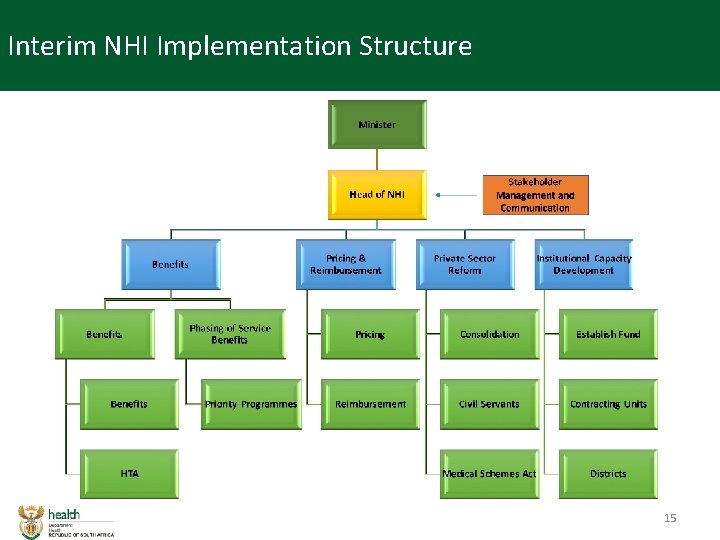
Interim NHI Implementation Structure 15