
NATIONAL FAMILY CAREGIVER SUPPORT PROGRAM HOW TO ADMINISTER

- Slides: 53
NATIONAL FAMILY CAREGIVER SUPPORT PROGRAM HOW TO ADMINISTER THE PROGRAM DECEMBER 12, 2019
LEARNING OBJECTIVES • Program intent • Caregiver Needs Assessment • Who program serves - Eligibility • Minimum service requirements • Paperwork • Data collection • Caregiver Coalitions
SUPPORTING DOCUMENTS • Everything referenced today is housed on the GWAAR website: www. gwaar. org > Technical Assistance > Family Caregiver Support > National Family Caregiver Support Program • Documentation and Forms • General Resources • Program Information • Always get forms directly from the website to ensure you are getting updated forms
NFCSP POLICY • Under Program Information on NFCSP Website page • Basic NFCSP Policy plus 2 Policy Memos: 1. Respite Definition 2. Non-Nursing Home Level of Care
PROGRAM INTENT WHAT THE PROGRAM IS ALL ABOUT
FOCUS ON THE CAREGIVER • Informal or Family Caregivers • Caregiver definition: “A person who is helping care for another individual, enabling them to remain living in the community. ” • Not focused on the person who is unable to care for themselves • Most people who come to your agency have a caregiver or are a caregiver • Train all staff to seek out caregivers who could utilize
MAINTAIN CAREGIVER HEALTH • Caregivers have higher stress levels and are more likely to suffer health problems. • Helping the caregiver improves their ability to provide better care for their loved one, and for a longer time. • It is easy to focus on the person receiving care instead of the caregiver, but that is not the purpose of the NFCSP. • The purpose of NFCSP is to support the caregiver which in turn will support the care recipient.
SERVING THE CAREGIVER Neighbor looking for help paying for friend’s hearing aids. First things to address: • The neighbor is a “caregiver” - do they identify as on? • What else is the neighbor doing for the neighbor? • What other needs does the caregiver/neighbor have? And finally, • What programs that can pay for hearing aids? * Use the Needs Assessment to determine caregiver’s greatest need(s)
CAREGIVER NEEDS ASSESSMENT DETERMINING CAREGIVER NEEDS
CAREGIVER NEEDS ASSESSMENT • Complete to help determine most urgent needs of the caregiver are being addressed • More than just more paperwork – a TOOL to help you • Helps put focus on the caregiver • Ensures full scope of services are being offered • Complete for all who are being enrolled in NFCSP • 2020 Caregiver Coordinator Statewide Training will be covering how to effectively use the Needs Assessment
CAREGIVER NEEDS ASSESSMENT • Include all areas in your discussion with the family § Unmet needs of Care Recipient § Unmet Caregiver Respite Needs § Unmet Caregiver Physical Health Needs § Unmet Caregiver Emotional Health Needs § Education and Resource Needs § Conversation Starters • Do not ask each question, but address each section
CAREGIVER NEEDS • ASSESSMENT Find the Needs Assessment under Documentation and Forms • Refer to Supplement and Best Practices documents for help (on website under Documentation and Forms) • Enter information into REDCap system – See Webinar and User Guide for help – Contact Lynn Gall at DHS for assistance
CAREGIVER PROGRAM EVALUATION • Rates how the caregiver feels about their caregiving role – before and after resources/services are in place • Completed by program participants before services begin and again after one year of participation or upon leaving the program. • Enter data into REDCap • Find the evaluation form under Documentation and Forms
CUSTOMER SATISFACTION SURVEY • Rates how well agency staff handled their situation • Give survey to participant after resources/services are set up • Include a self-addressed, stamped envelope • They will complete and mail survey to DHS in Madison
WHO DOES THE PROGRAM SERVE? ELIGIBILITY REQUIREMENTS
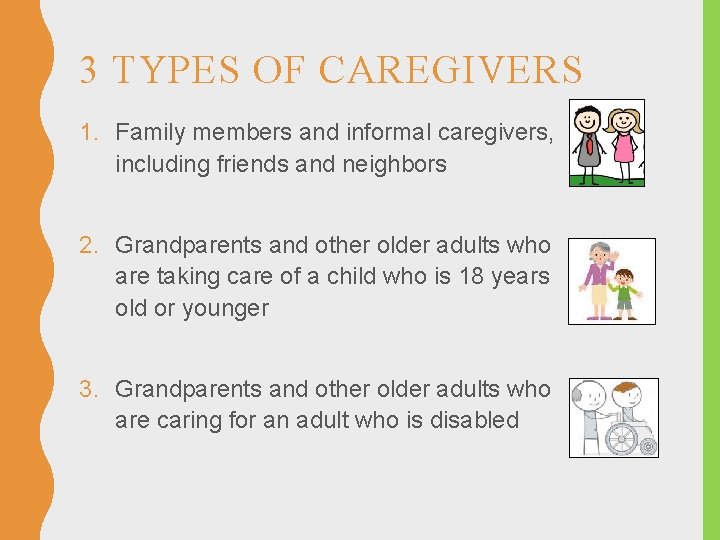
3 TYPES OF CAREGIVERS 1. Family members and informal caregivers, including friends and neighbors 2. Grandparents and other older adults who are taking care of a child who is 18 years old or younger 3. Grandparents and other older adults who are caring for an adult who is disabled
FAMILY, FRIEND, NEIGHBOR • The caregiver can be any age. • The person being cared for must be: – Age 60+ OR have a dementia diagnosis (any age). – “Frail” – need assistance with 2 ADLs or IADLs • The caregiver may be a friend or neighbor – they do not have to be “family. ” • The caregiver does not have to live with the person.
GRANDPARENT OR RELATIVE CARING FOR A CHILD • Must be age 55+ • Must be the child’s primary caregiver • Must live with the child • May have legal custody, but it is not required • Must be related to the child, not the parent • Child must be age 18 or under * Maximum of 10% of allocation can be used for grandparent/relative caregivers
OLDER ADULT CARING FOR DISABLED ADULT CHILD • Must be age 55+ • Must be the primary caregiver • Must live with the disabled adult • May have legal custody, but it is not required • Must be related to the child – CAN be the parent • The disability must substantially limit the ability to care for themselves
ELIGIBILITY REQUIREMENTS • Must meet definition of one of the three types of caregivers • No financial eligibility criteria – Different from any non-OAA services – Different concept from working with means-tested programs – Participants should have an opportunity to donate for services Priority should be given to: • Older caregivers • Caregivers of people with dementia • Caregivers with the greatest social and economic need
MINIMUM SERVICE REQUIREMEN TS SERVICES THAT MUST BE AVAILABLE
FIVE SERVICE REQUIREMENTS 1. Information to caregivers about available services 2. Assistance to caregivers in gaining access to services 3. Individual counseling, support groups and training 4. Respite care to temporarily relieve caregivers from their responsibilities 5. Supplemental services that complement care provided
INFORMATION ABOUT AVAILABLE SERVICES • Educational presentations at various community sites – Caregiving Awareness and Resources – Managing Stress – Dementia/Memory Loss • Marketing materials – Brochures and Flyers – Resource Guides – Support Group or Caregiving Class Information * In SAMS is referred to as Public Information or Information Services
INFORMATION ABOUT AVAILABLE SERVICES • Stories or articles about caregiving-related topics – Newsletters – yours and partner agencies – Local newspapers – Radio and Television • Vendor tables or exhibits – Conferences – Community events • Website and Facebook
ASSISTANCE IN GAINING ACCESS TO SERVICES • Information to Caregivers = broad spectrum • Helping Caregivers Gain Access to Services = personal connection • Listen to their story – needs assessment • Help them understand their options and form a plan • Visits may be in the office, on the phone or in their home • Follow up is important!
COUNSELING, SUPPORT GROUPS AND TRAINING • Individual Counseling = 1: 1 Professional Counseling • Support Groups including Caregiver Café’s and Telephone support groups • Caregiver Training – Powerful Tools for Caregivers – Books and DVDs – Caregiver Conferences – Any other type of education that benefits the caregiver
RESPITE CARE Temporarily relieves caregivers from their responsibilities – Adult day care – In home visits – Short-term institutional stay Services that are considered Respite: – – House cleaning Shopping Meal preparation Raking and snow shoveling *No more than 112 hours of respite per caregiver per
SUPPLEMENTAL SERVICES Things that make a caregiver’s job easier and less stressful; and “complement” the care provided: – Emergency Response Systems – Safe Return and Project Lifesaver – Transportation – Adaptive equipment/assistive technology – Activities to keep the care recipient engaged – Activities for the caregiver – Caregiving supplies • Use needs assessment to determine greatest needs *Max of 20% of allocation can be used for Supplemental Services
PROGRAM RESTRICTION S THINGS TO WATCH OUT FOR
PROGRAM RESTRICTIONS 1. A caregiver cannot receive more than 112 hours of respite care 2. No more than 20% of total expenditures can be spent on Supplemental Services 3. No more than 10% of total expenditures can be spent on Grandparents and Relative Caregivers for children 18 and under
REQUIRED PAPERWORK DO NOT OMIT THIS STEP!
PAPERWORK Two enrollment forms* 1. Caregiver Registration Form 2. Care Recipient Assessment Form These are required when providing: • • Respite Care Supplemental Services Counseling/Training/Support Groups Case Management * Found under Documentation and Forms
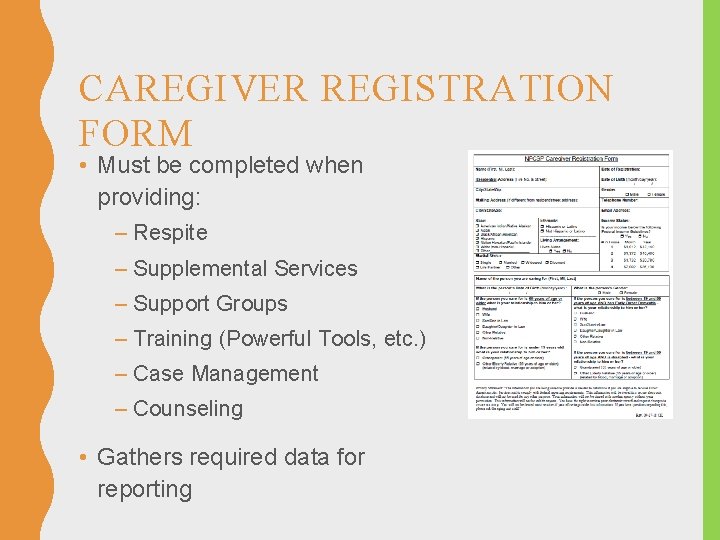
CAREGIVER REGISTRATION FORM • Must be completed when providing: – Respite – Supplemental Services – Support Groups – Training (Powerful Tools, etc. ) – Case Management – Counseling • Gathers required data for reporting
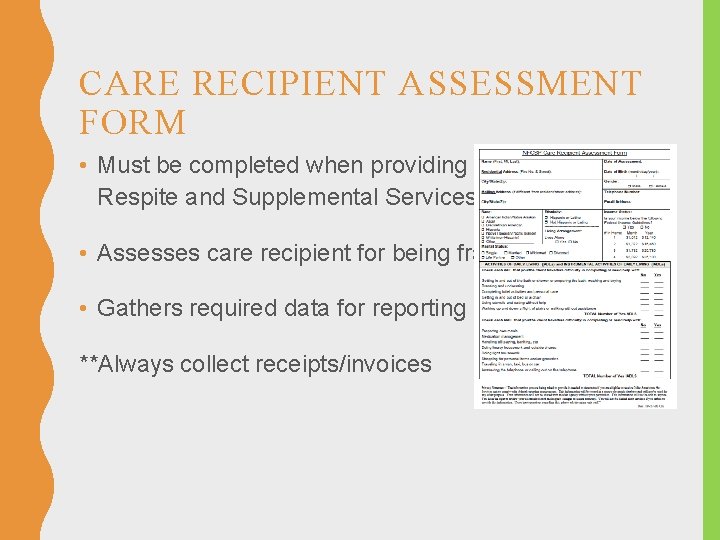
CARE RECIPIENT ASSESSMENT FORM • Must be completed when providing Respite and Supplemental Services • Assesses care recipient for being frail • Gathers required data for reporting **Always collect receipts/invoices
OTHER PAPERWORK MUSTS • For Respite and Supplemental Services – collect receipts/invoices • For Support Groups and Trainings - must keep attendance log • For Case Management and Counseling – must track number of contacts/sessions
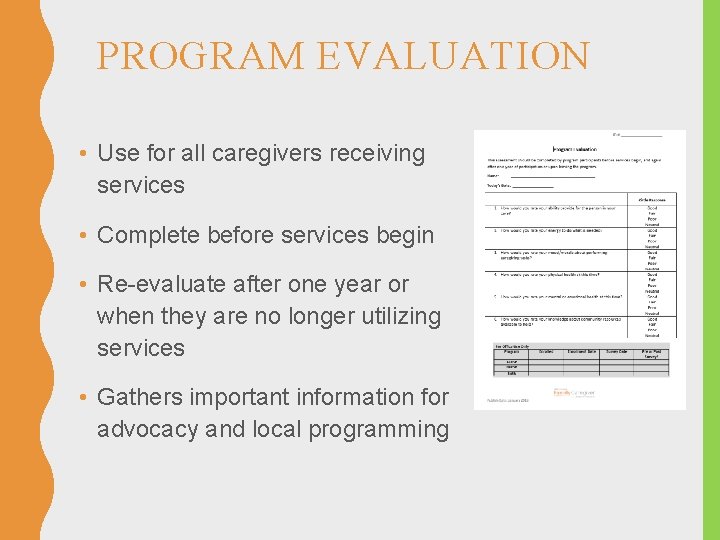
PROGRAM EVALUATION • Use for all caregivers receiving services • Complete before services begin • Re-evaluate after one year or when they are no longer utilizing services • Gathers important information for advocacy and local programming
REDCAP DATA ENTRY • Three entries into REDCap for each caregiver – Caregiver Needs Assessment – Pre-Program Evaluation – Post-Program Evaluation • See DHS REDCap Registration-User Guide and Webinar found on website – Documentation and Forms • Customer Satisfaction Survey – give to caregiver for them to complete and mail in self-addressed, stamped envelope
DATA COLLECTION SAMS REQUIREMENTS
DATA COLLECTION AND SAMS • Data must be collected and reported on all activities funded with NFCSP • Data is entered into the Social Assistance Management System (SAMS) • Data reported into SAMS must match fiscal reports • Even if you don’t do the actual SAMS data input, it is still important that you understand the information needed
WHY SAMS IS IMPORTANT • Data in SAMS shows how you used the grant money • Used to generate reports for the federal government • Shows what services were provided and how many people were served • This data is increasingly important for advocacy efforts
SAMS DATA COLLECTION TOOLS* 1. SAMS Reference Sheet - explains how and where to report services for all five service requirements. 2. NFCSP Data Collection Sheet - optional tool to collect data for Information Services (Public Information). 3. SAMS Service Definitions – gives detailed description of all SAMS categories * Found on the GWAAR Website under Documentation and Forms
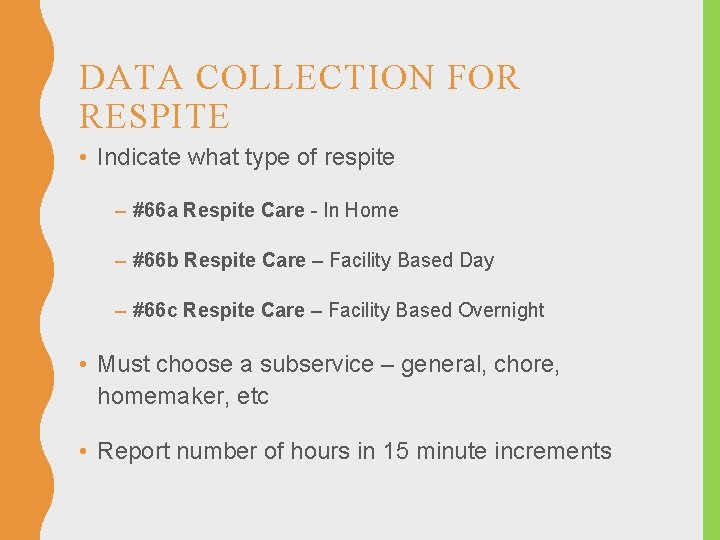
DATA COLLECTION FOR RESPITE • Indicate what type of respite – #66 a Respite Care - In Home – #66 b Respite Care – Facility Based Day – #66 c Respite Care – Facility Based Overnight • Must choose a subservice – general, chore, homemaker, etc • Report number of hours in 15 minute increments
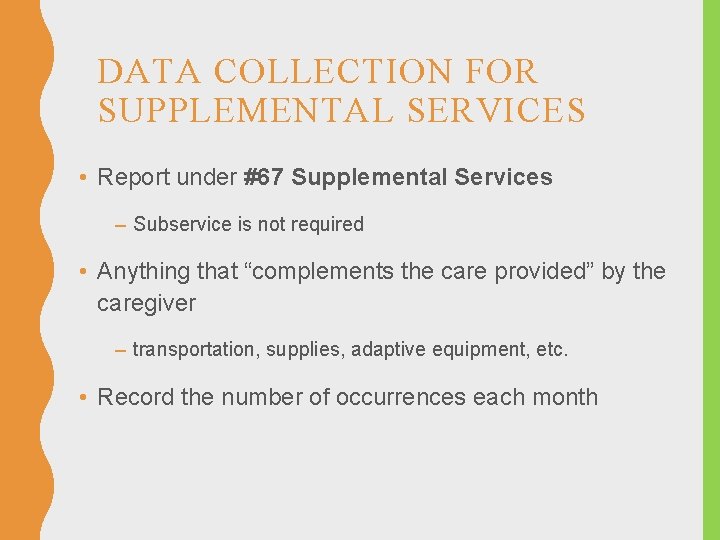
DATA COLLECTION FOR SUPPLEMENTAL SERVICES • Report under #67 Supplemental Services – Subservice is not required • Anything that “complements the care provided” by the caregiver – transportation, supplies, adaptive equipment, etc. • Record the number of occurrences each month
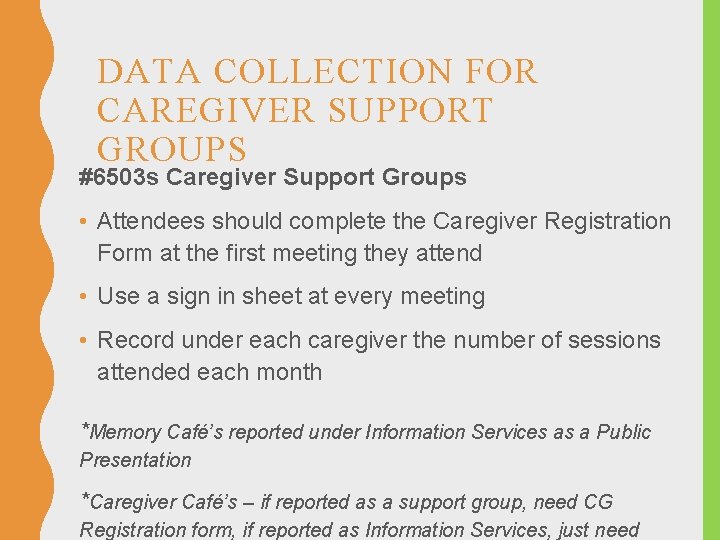
DATA COLLECTION FOR CAREGIVER SUPPORT GROUPS #6503 s Caregiver Support Groups • Attendees should complete the Caregiver Registration Form at the first meeting they attend • Use a sign in sheet at every meeting • Record under each caregiver the number of sessions attended each month *Memory Café’s reported under Information Services as a Public Presentation *Caregiver Café’s – if reported as a support group, need CG Registration form, if reported as Information Services, just need
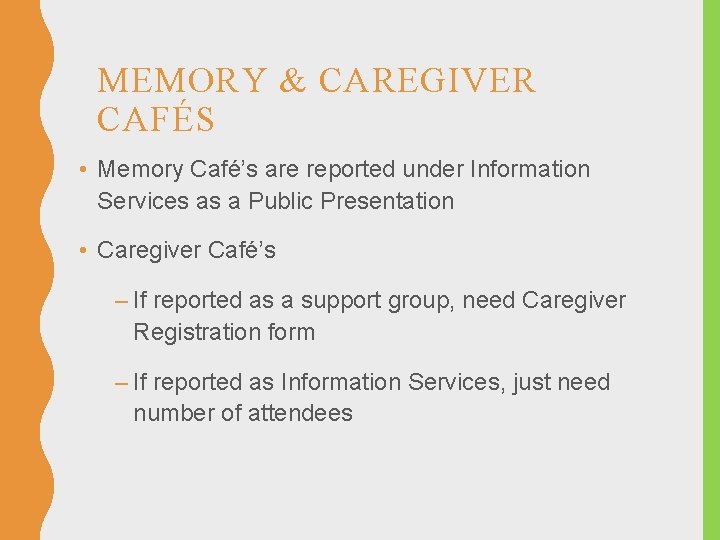
MEMORY & CAREGIVER CAFÉS • Memory Café’s are reported under Information Services as a Public Presentation • Caregiver Café’s – If reported as a support group, need Caregiver Registration form – If reported as Information Services, just need number of attendees
DATA COLLECTION FOR CAREGIVER TRAINING #6502 s Caregiver Training – Powerful Tools for Caregivers – Small presentations or classes – Sending caregiver(s) to a conference • Complete the Caregiver Registration Form at the first meeting or class they attend • Use a sign in sheet at every meeting • Record the number of sessions attended each month • Report under each caregiver
DATA COLLECTION FOR CASE MANAGEMENT 64 -Caregiver Case Management • Not the traditional definition of Case Management • Can be used for Coordinator Salary for time spent working with caregivers • Complete Caregiver Registration Form • Record the number of contacts made – not actual time spent • Suggest to enter all caregivers that are enrolled in NFCSP
DATA COLLECTION FOR CAREGIVER COUNSELING #6501 s-Caregiver Counseling • Refers to actual counseling provided by a professionally trained person • Complete Caregiver Registration Form • Record the number of contacts made, not actual time spent
DATA COLLECTION FOR INFORMATION TO CAREGIVERS #68 Information Services (Public Information) • Presentations, vendor fairs, mailings, articles, ads, etc. • No intake forms needed • Use NFCSP Data Collection sheet to keep track of the number of occurrences AND the number of consumers reached • Number of occurrences will be smaller than the number of consumers reached (1 health fair = 350 people reached)
INFORMATION AND ASSISTANCE • At this time, you are not able to report Information and Assistance for caregivers into SAMS – STAY TUNED!
CAREGIVER COALITIONS COMMUNITY PARTNERSHIPS
CAREGIVER COALITIONS • NFCSP policy requires each Aging Unit to be a member of a coalition with other agencies who work with family caregivers • Can utilize an existing coalition with similar membership • Aging Unit representative needs to attend meetings • Caregiver issues must be discussed • Ideally work on a project that benefits caregivers • Caregiver Coalition page on GWAAR Website
QUESTIONS? Contact Jane Mahoney or Lynn Gall any time with questions: Jane – Jane. Mahoney@gwaar. org Lynn - Lynn. Gall@dhs. wisconsin. gov