
National Education Policy Framework 2018 Federal Ministry of
- Slides: 14
National Education Policy Framework 2018 Federal Ministry of Education & Professional Training Prepared by Wajiha Saqib Idara-e-Taleem-o-Aagahi
Education Challenges in Pakistan Out-of-School-Children (OOSC) Lack of access Low participation High levels of poverty leading to OOSC Limited investment in early childhood education, leading to high dropout rates in early grades. Poor quality of non-formal and accelerated learning programs Uniform education system: Lack of coordination in formulating uniform policy and implementation Incoherent curriculum frameworks, textbooks and assessments Multiple schooling systems with varying syllabi across public, private and madrassah systems
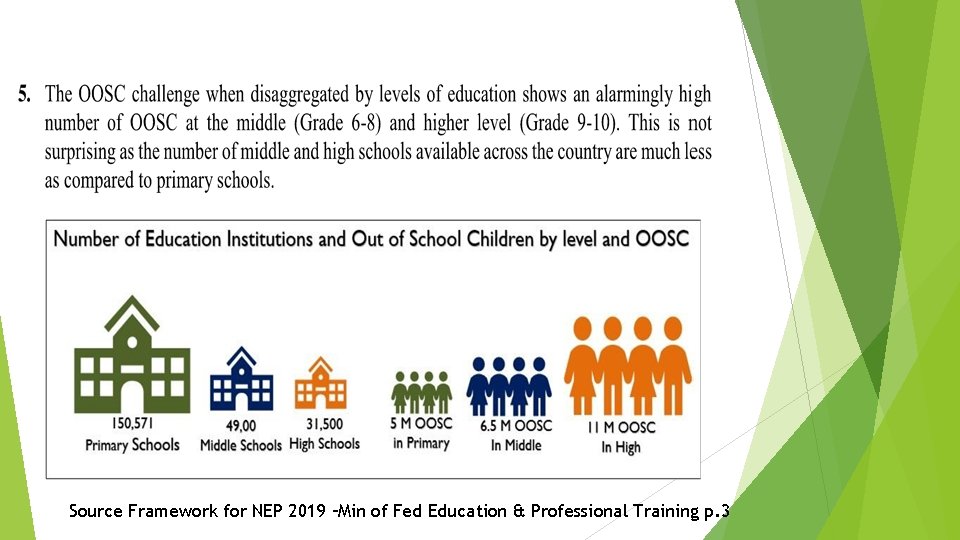
Source Framework for NEP 2019 –Min of Fed Education & Professional Training p. 3
Quality of education: Low student learning outcomes Lack of accountability Poor teacher quality Lack of school leadership Poor school environment – multi-grade teaching, limited facilities and poor infrastructure Lack of availability of student data to make policy decisions Skills and Higher Education Lack of access Inequitable access Lack of Participation Poor quality of teaching and research Weak linkages with industry Insufficient sector management
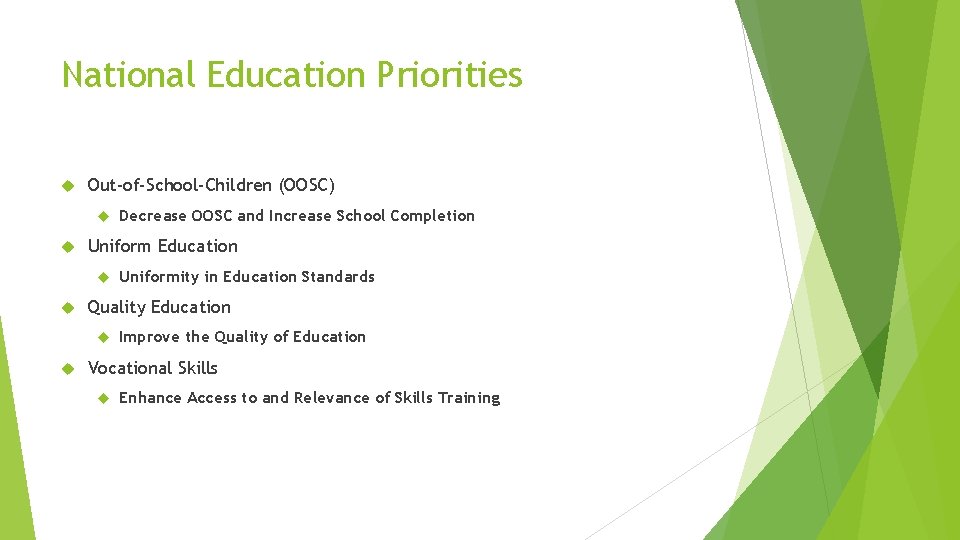
National Education Priorities Out-of-School-Children (OOSC) Uniform Education Uniformity in Education Standards Quality Education Decrease OOSC and Increase School Completion Improve the Quality of Education Vocational Skills Enhance Access to and Relevance of Skills Training
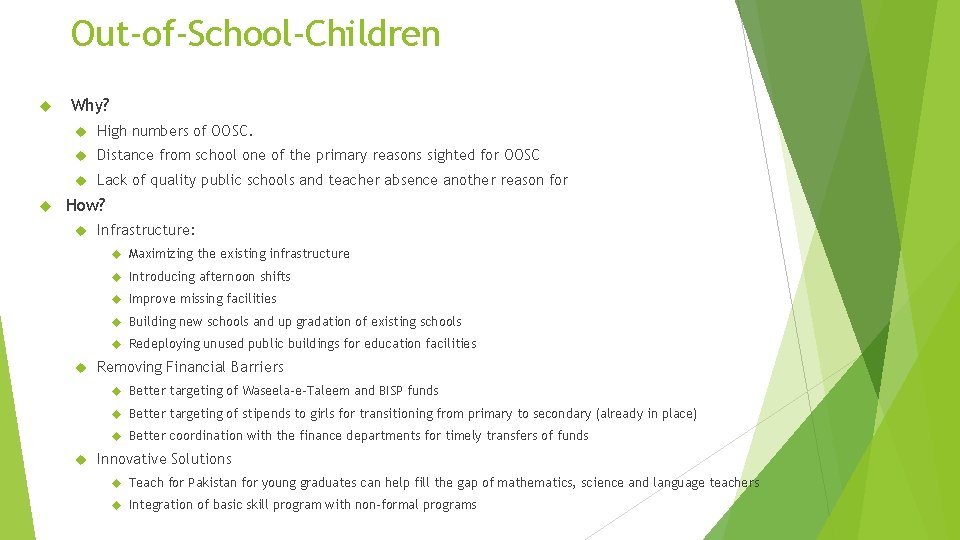
Out-of-School-Children Why? High numbers of OOSC. Distance from school one of the primary reasons sighted for OOSC Lack of quality public schools and teacher absence another reason for How? Infrastructure: Maximizing the existing infrastructure Introducing afternoon shifts Improve missing facilities Building new schools and up gradation of existing schools Redeploying unused public buildings for education facilities Removing Financial Barriers Better targeting of Waseela-e-Taleem and BISP funds Better targeting of stipends to girls for transitioning from primary to secondary (already in place) Better coordination with the finance departments for timely transfers of funds Innovative Solutions Teach for Pakistan for young graduates can help fill the gap of mathematics, science and language teachers Integration of basic skill program with non-formal programs
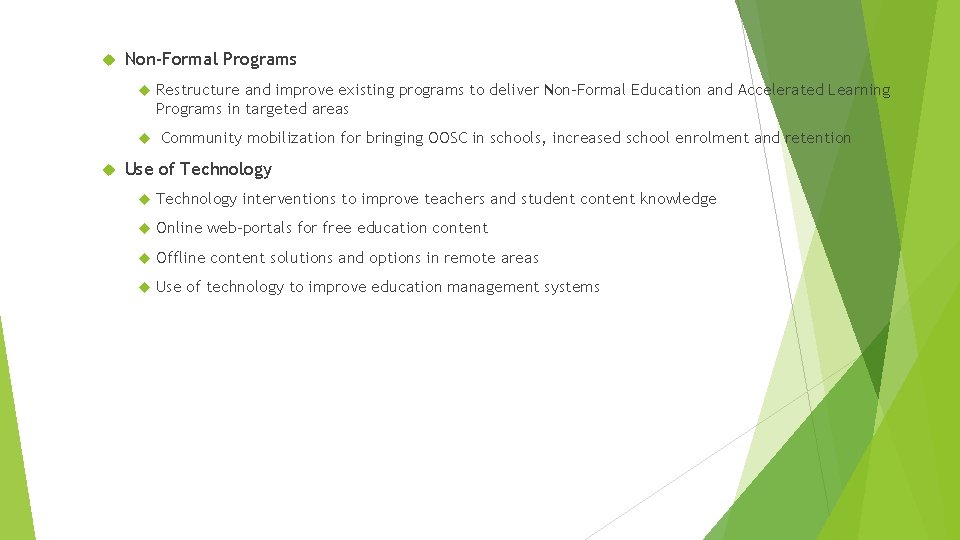
Non-Formal Programs Restructure and improve existing programs to deliver Non-Formal Education and Accelerated Learning Programs in targeted areas Community mobilization for bringing OOSC in schools, increased school enrolment and retention Use of Technology interventions to improve teachers and student content knowledge Online web-portals for free education content Offline content solutions and options in remote areas Use of technology to improve education management systems
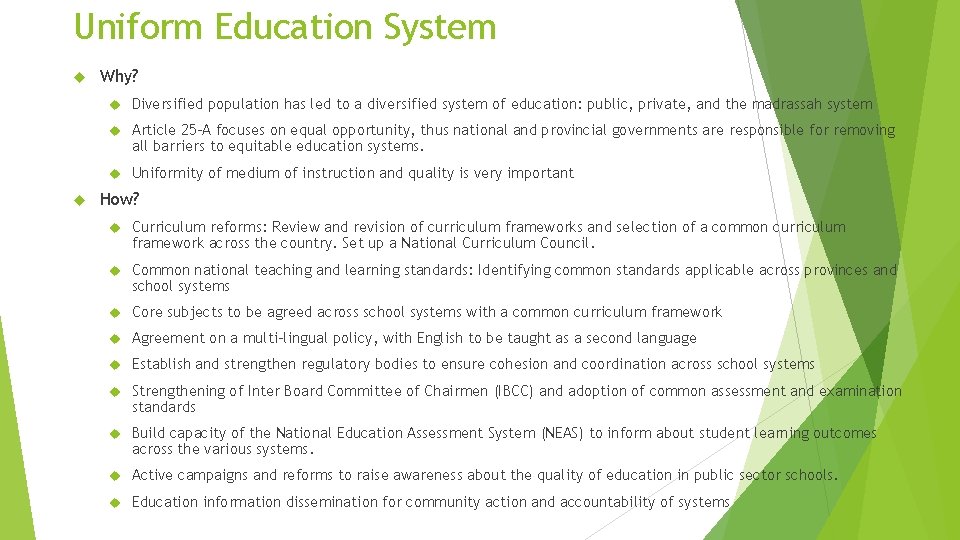
Uniform Education System Why? Diversified population has led to a diversified system of education: public, private, and the madrassah system Article 25 -A focuses on equal opportunity, thus national and provincial governments are responsible for removing all barriers to equitable education systems. Uniformity of medium of instruction and quality is very important How? Curriculum reforms: Review and revision of curriculum frameworks and selection of a common curriculum framework across the country. Set up a National Curriculum Council. Common national teaching and learning standards: Identifying common standards applicable across provinces and school systems Core subjects to be agreed across school systems with a common curriculum framework Agreement on a multi-lingual policy, with English to be taught as a second language Establish and strengthen regulatory bodies to ensure cohesion and coordination across school systems Strengthening of Inter Board Committee of Chairmen (IBCC) and adoption of common assessment and examination standards Build capacity of the National Education Assessment System (NEAS) to inform about student learning outcomes across the various systems. Active campaigns and reforms to raise awareness about the quality of education in public sector schools. Education information dissemination for community action and accountability of systems
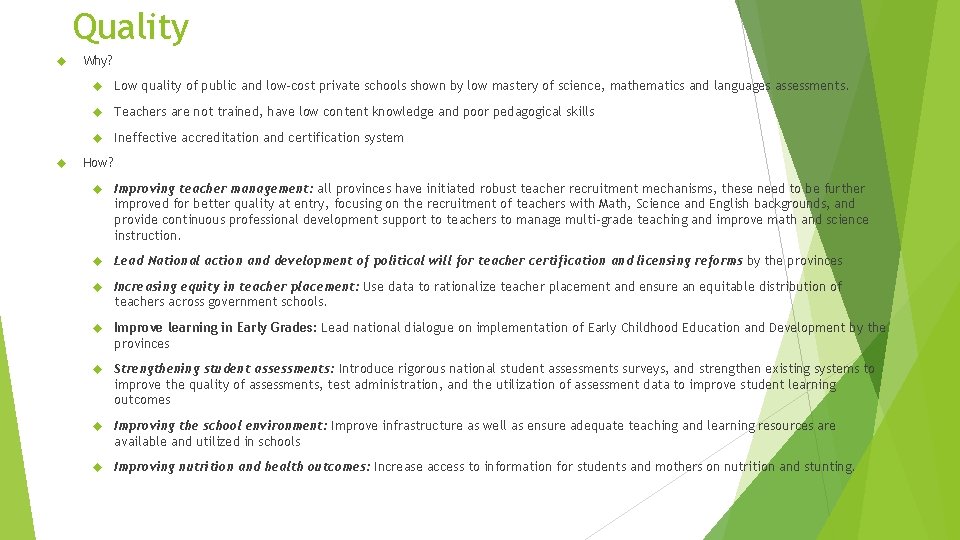
Quality Why? Low quality of public and low-cost private schools shown by low mastery of science, mathematics and languages assessments. Teachers are not trained, have low content knowledge and poor pedagogical skills Ineffective accreditation and certification system How? Improving teacher management: all provinces have initiated robust teacher recruitment mechanisms, these need to be further improved for better quality at entry, focusing on the recruitment of teachers with Math, Science and English backgrounds, and provide continuous professional development support to teachers to manage multi-grade teaching and improve math and science instruction. Lead National action and development of political will for teacher certification and licensing reforms by the provinces Increasing equity in teacher placement: Use data to rationalize teacher placement and ensure an equitable distribution of teachers across government schools. Improve learning in Early Grades: Lead national dialogue on implementation of Early Childhood Education and Development by the provinces Strengthening student assessments: Introduce rigorous national student assessments surveys, and strengthen existing systems to improve the quality of assessments, test administration, and the utilization of assessment data to improve student learning outcomes Improving the school environment: Improve infrastructure as well as ensure adequate teaching and learning resources are available and utilized in schools Improving nutrition and health outcomes: Increase access to information for students and mothers on nutrition and stunting.
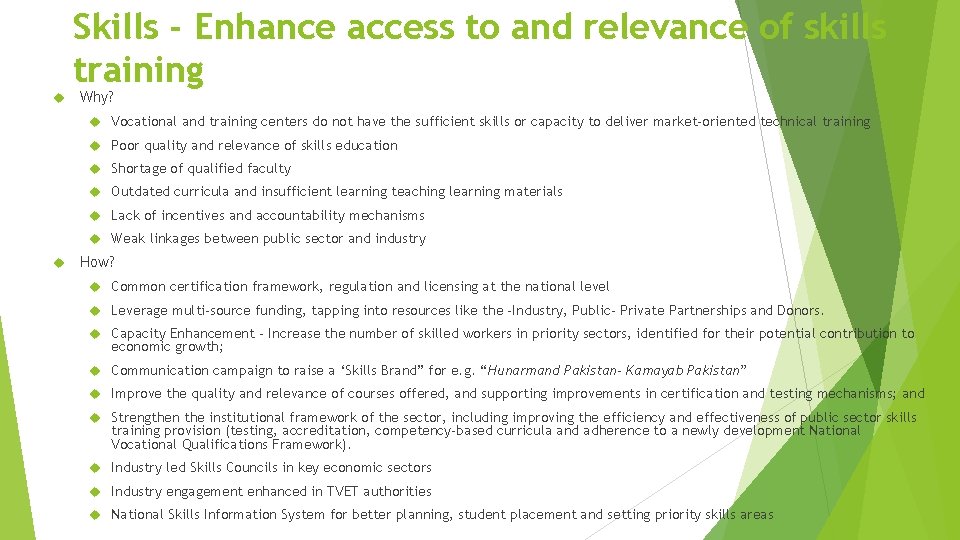
Skills - Enhance access to and relevance of skills training Why? Vocational and training centers do not have the sufficient skills or capacity to deliver market-oriented technical training Poor quality and relevance of skills education Shortage of qualified faculty Outdated curricula and insufficient learning teaching learning materials Lack of incentives and accountability mechanisms Weak linkages between public sector and industry How? Common certification framework, regulation and licensing at the national level Leverage multi-source funding, tapping into resources like the -Industry, Public- Private Partnerships and Donors. Capacity Enhancement - Increase the number of skilled workers in priority sectors, identified for their potential contribution to economic growth; Communication campaign to raise a ‘Skills Brand” for e. g. “Hunarmand Pakistan- Kamayab Pakistan” Improve the quality and relevance of courses offered, and supporting improvements in certification and testing mechanisms; and Strengthen the institutional framework of the sector, including improving the efficiency and effectiveness of public sector skills training provision (testing, accreditation, competency-based curricula and adherence to a newly development National Vocational Qualifications Framework). Industry led Skills Councils in key economic sectors Industry engagement enhanced in TVET authorities National Skills Information System for better planning, student placement and setting priority skills areas
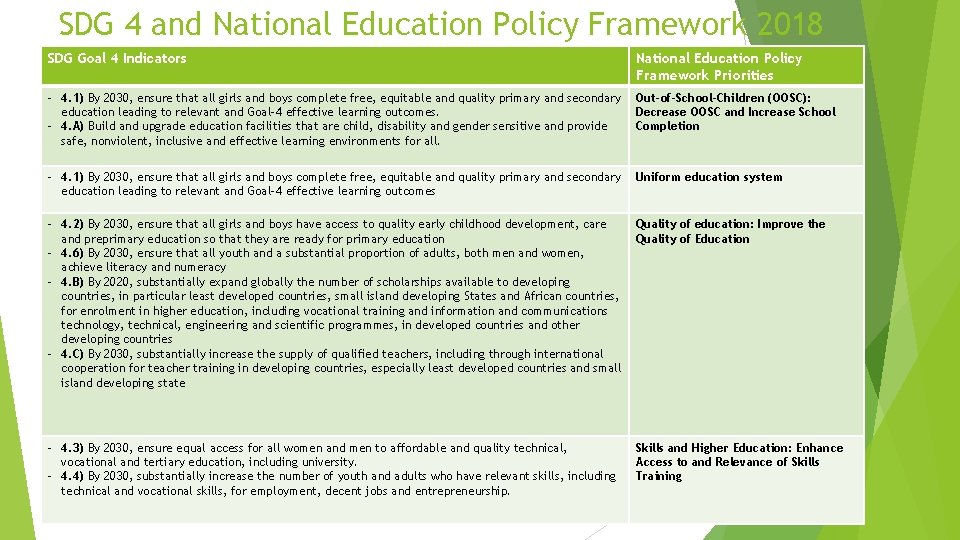
SDG 4 and National Education Policy Framework 2018 SDG Goal 4 Indicators National Education Policy Framework Priorities - 4. 1) By 2030, ensure that all girls and boys complete free, equitable and quality primary and secondary education leading to relevant and Goal-4 effective learning outcomes. - 4. A) Build and upgrade education facilities that are child, disability and gender sensitive and provide safe, nonviolent, inclusive and effective learning environments for all. Out-of-School-Children (OOSC): Decrease OOSC and Increase School Completion - 4. 1) By 2030, ensure that all girls and boys complete free, equitable and quality primary and secondary education leading to relevant and Goal-4 effective learning outcomes Uniform education system - 4. 2) By 2030, ensure that all girls and boys have access to quality early childhood development, care and preprimary education so that they are ready for primary education - 4. 6) By 2030, ensure that all youth and a substantial proportion of adults, both men and women, achieve literacy and numeracy - 4. B) By 2020, substantially expand globally the number of scholarships available to developing countries, in particular least developed countries, small island developing States and African countries, for enrolment in higher education, including vocational training and information and communications technology, technical, engineering and scientific programmes, in developed countries and other developing countries - 4. C) By 2030, substantially increase the supply of qualified teachers, including through international cooperation for teacher training in developing countries, especially least developed countries and small island developing state Quality of education: Improve the Quality of Education - 4. 3) By 2030, ensure equal access for all women and men to affordable and quality technical, vocational and tertiary education, including university. - 4. 4) By 2030, substantially increase the number of youth and adults who have relevant skills, including technical and vocational skills, for employment, decent jobs and entrepreneurship. Skills and Higher Education: Enhance Access to and Relevance of Skills Training
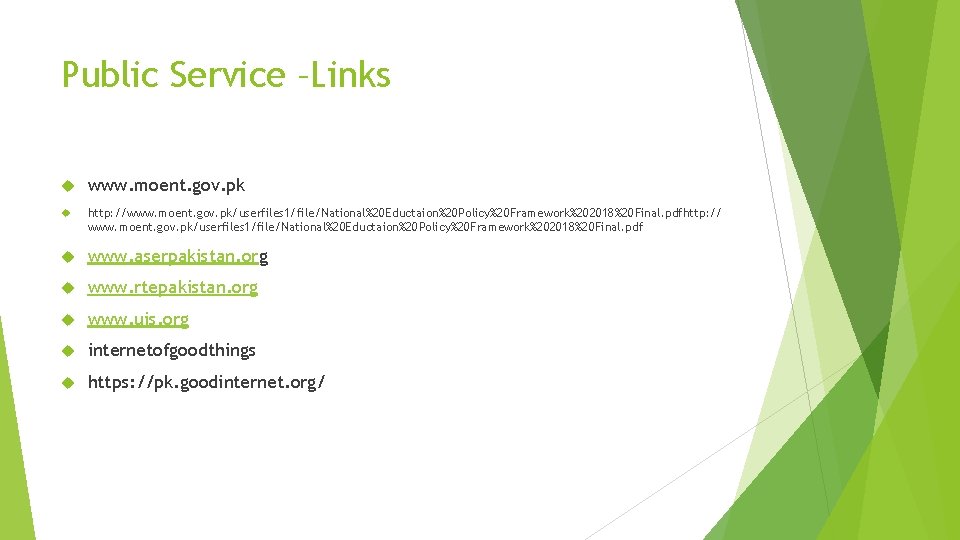
Public Service –Links www. moent. gov. pk http: //www. moent. gov. pk/userfiles 1/file/National%20 Eductaion%20 Policy%20 Framework%202018%20 Final. pdfhttp: // www. moent. gov. pk/userfiles 1/file/National%20 Eductaion%20 Policy%20 Framework%202018%20 Final. pdf www. aserpakistan. org www. rtepakistan. org www. uis. org internetofgoodthings https: //pk. goodinternet. org/
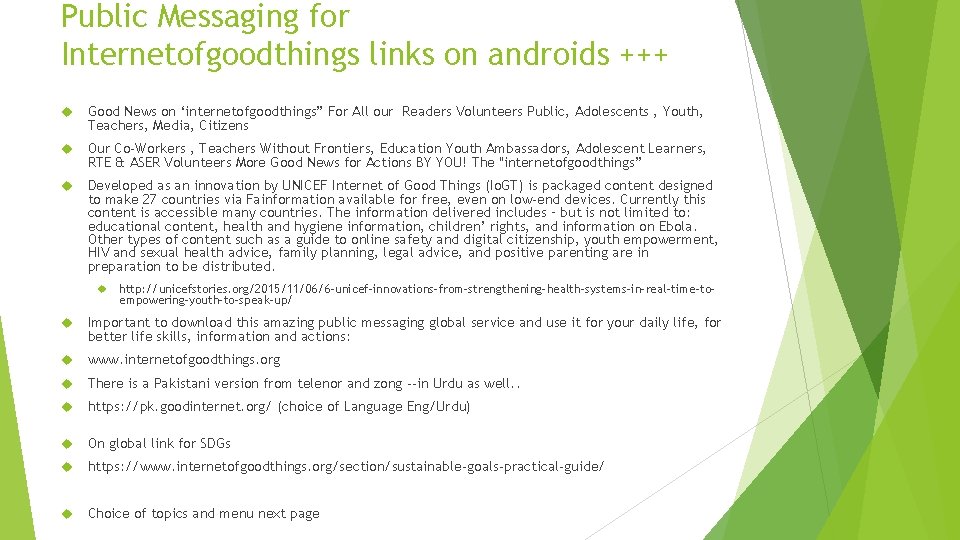
Public Messaging for Internetofgoodthings links on androids +++ Good News on ‘internetofgoodthings” For All our Readers Volunteers Public, Adolescents , Youth, Teachers, Media, Citizens Our Co-Workers , Teachers Without Frontiers, Education Youth Ambassadors, Adolescent Learners, RTE & ASER Volunteers More Good News for Actions BY YOU! The "internetofgoodthings” Developed as an innovation by UNICEF Internet of Good Things (Io. GT) is packaged content designed to make 27 countries via Fainformation available for free, even on low-end devices. Currently this content is accessible many countries. The information delivered includes – but is not limited to: educational content, health and hygiene information, children’ rights, and information on Ebola. Other types of content such as a guide to online safety and digital citizenship, youth empowerment, HIV and sexual health advice, family planning, legal advice, and positive parenting are in preparation to be distributed. http: //unicefstories. org/2015/11/06/6 -unicef-innovations-from-strengthening-health-systems-in-real-time-toempowering-youth-to-speak-up/ Important to download this amazing public messaging global service and use it for your daily life, for better life skills, information and actions: www. internetofgoodthings. org There is a Pakistani version from telenor and zong --in Urdu as well. . https: //pk. goodinternet. org/ (choice of Language Eng/Urdu) On global link for SDGs https: //www. internetofgoodthings. org/section/sustainable-goals-practical-guide/ Choice of topics and menu next page
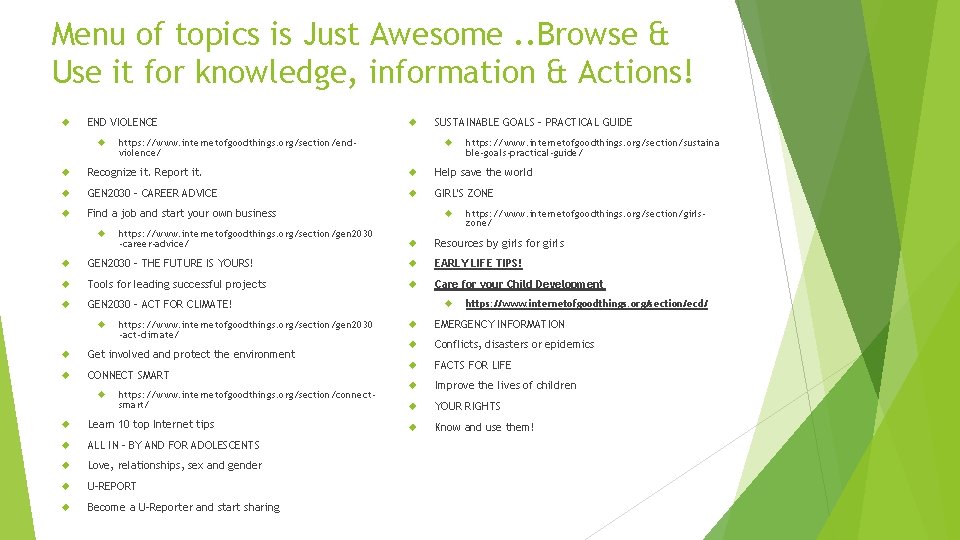
Menu of topics is Just Awesome. . Browse & Use it for knowledge, information & Actions! END VIOLENCE https: //www. internetofgoodthings. org/section/endviolence/ SUSTAINABLE GOALS - PRACTICAL GUIDE https: //www. internetofgoodthings. org/section/sustaina ble-goals-practical-guide/ Recognize it. Report it. Help save the world GEN 2030 - CAREER ADVICE GIRL'S ZONE Find a job and start your own business https: //www. internetofgoodthings. org/section/gen 2030 -career-advice/ https: //www. internetofgoodthings. org/section/girlszone/ Resources by girls for girls GEN 2030 - THE FUTURE IS YOURS! EARLY LIFE TIPS! Tools for leading successful projects Care for your Child Development GEN 2030 - ACT FOR CLIMATE! https: //www. internetofgoodthings. org/section/gen 2030 -act-climate/ Get involved and protect the environment CONNECT SMART https: //www. internetofgoodthings. org/section/connectsmart/ Learn 10 top Internet tips ALL IN – BY AND FOR ADOLESCENTS Love, relationships, sex and gender U-REPORT Become a U-Reporter and start sharing https: //www. internetofgoodthings. org/section/ecd/ EMERGENCY INFORMATION Conflicts, disasters or epidemics FACTS FOR LIFE Improve the lives of children YOUR RIGHTS Know and use them!