
National Early Warning Scores NEWS 2 National Survey
- Slides: 28
National Early Warning Scores (NEWS 2): National Survey March 2019 Headline Findings
• NEWS is a tool developed by the Royal College of Physicians to improve the detection and response to clinical deterioration in adult patients and is a key element of patient safety and improving patient outcomes. • In December 2017, an updated version of NEWS, NEWS 2 was published. • NEWS 2 has been endorsed by NHS England NHS Improvement for use in acute and ambulance settings. • In April 2018 a resource alert was issued to support providers to adopt the revised National Early Warning Score (NEWS 2) to detect deterioration in adult patients. • Deterioration is a key priority for NHS Improvement - the Patient Safety Collaboratives are supporting improvements including the adoption and testing of NEWS 2
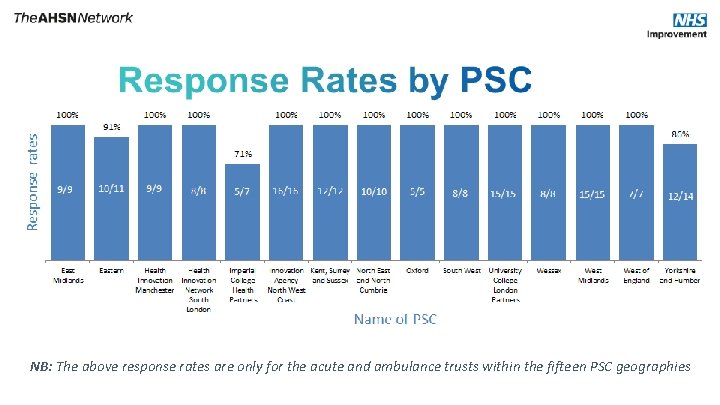
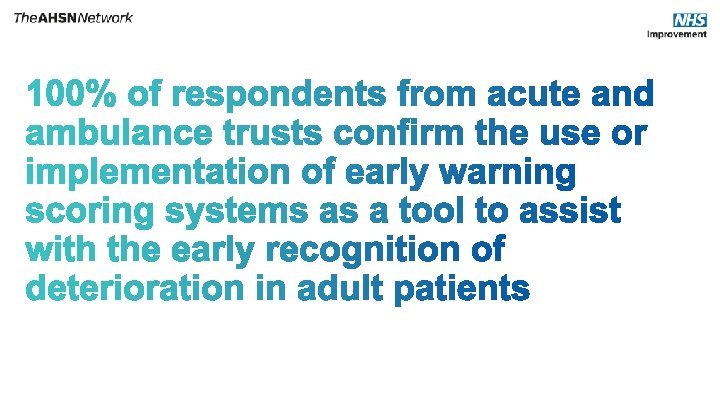
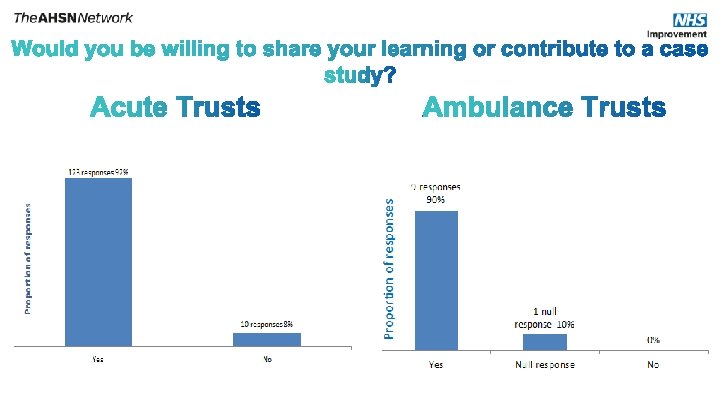
ØA NEWS survey carried out in November 2017 (for acute trusts) and April 2018 (for ambulance trusts) revealed the following: ØResponse rate: 100% (10 out of 10) of ambulance trusts and 87% (127 out of 145) of acute trusts responded to the NEWS survey Ø 100% of ambulance trusts were using NEWS § With 80% using NEWS across the whole organisation Ø 65% of acute trusts were using NEWS § With 14% having adapted NEWS § 20% were using other EWS ØA NEWS 2 Survey was carried out in March 2019 to assess the extent of adoption of NEWS 2, use of communication and escalation tools and to capture any challenges associated with implementation or use. ØResponse rate: 100% (10 out of 10) of the ambulance trusts and 97% (137 out the 144) of the acute trusts responded to the NEWS 2 survey.
This presentation contains: ØHeadline results of the 2019 survey from a national view point ØSurvey results have been anonymised and the original data is available from the Patient Safety Measurement Unit ØRegional results will be shared with all PSCs to support improvement
NB: The above response rates are only for the acute and ambulance trusts within the fifteen PSC geographies
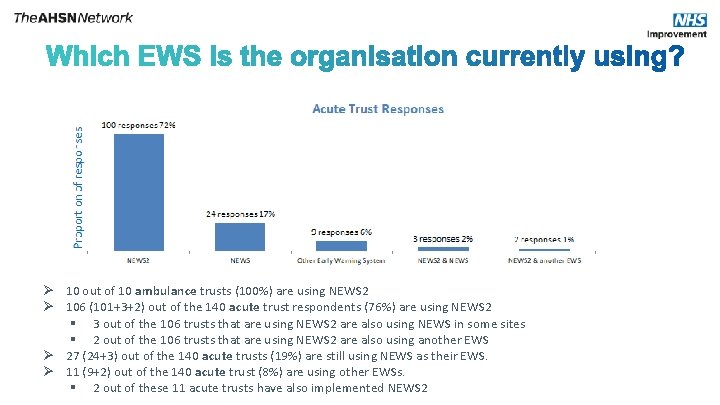
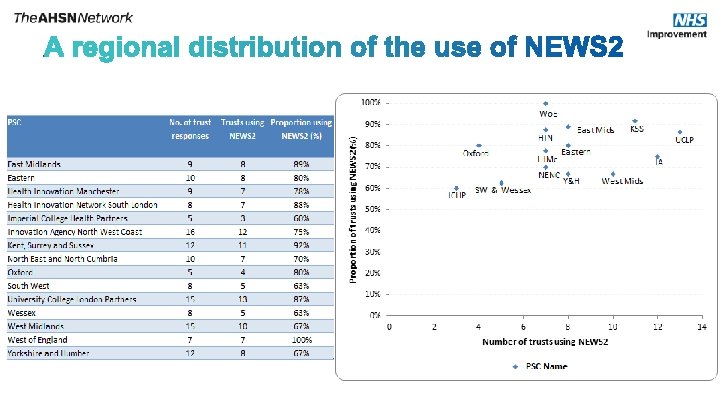
Ø 10 out of 10 ambulance trusts (100%) are using NEWS 2 Ø 106 (101+3+2) out of the 140 acute trust respondents (76%) are using NEWS 2 § 3 out of the 106 trusts that are using NEWS 2 are also using NEWS in some sites § 2 out of the 106 trusts that are using NEWS 2 are also using another EWS Ø 27 (24+3) out of the 140 acute trusts (19%) are still using NEWS as their EWS. Ø 11 (9+2) out of the 140 acute trust (8%) are using other EWSs. § 2 out of these 11 acute trusts have also implemented NEWS 2
Ø NEWS 2 is not expected to be adapted or modified in any way. Ø 10 out of 10 (100%) of ambulance trusts are using NEWS 2 as intended without any modification. Ø 91 out of 105 (87%) of acute trusts are using NEWS 2 as intended without any modification. No Ø A very small number 5 out of 105 (5%) have made adjustments to NEWS 2 Ø 9 out 105 (9%) of acute trusts did not respond to this question.
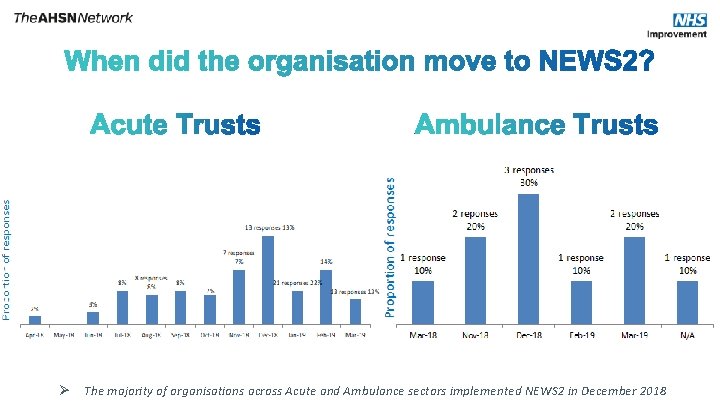
No Ø The majority of organisations across Acute and Ambulance sectors implemented NEWS 2 in December 2018
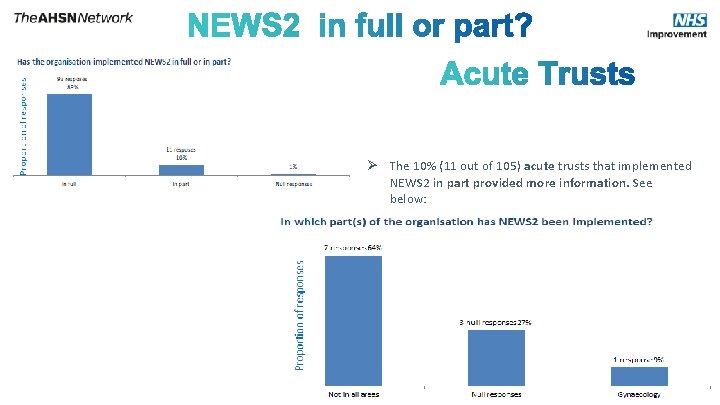
Ø The 10% (11 out of 105) acute trusts that implemented NEWS 2 in part provided more information. See below:
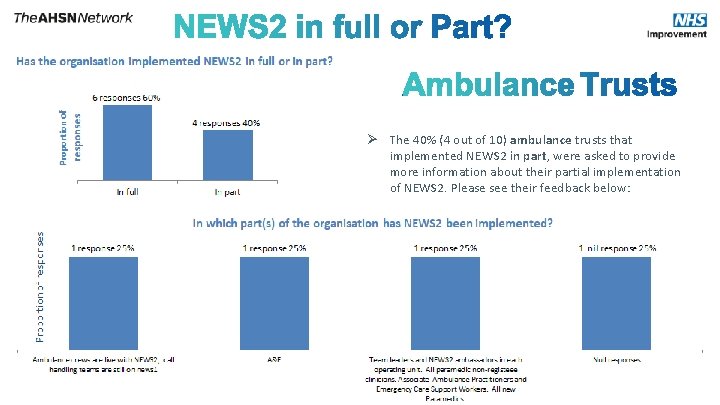
Ø The 40% (4 out of 10) ambulance trusts that implemented NEWS 2 in part, were asked to provide more information about their partial implementation of NEWS 2. Please see their feedback below: No
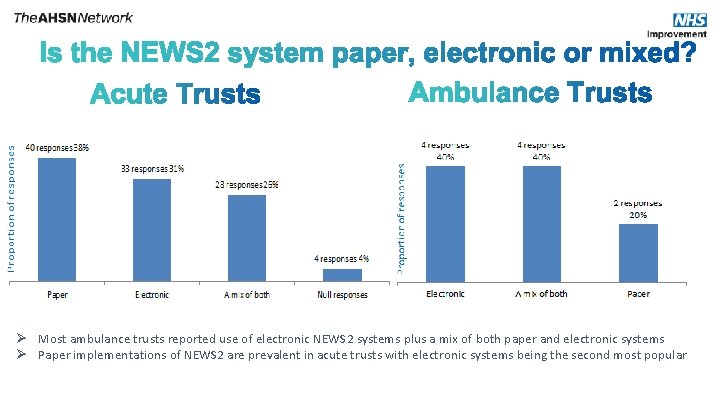
No Ø Most ambulance trusts reported use of electronic NEWS 2 systems plus a mix of both paper and electronic systems Ø Paper implementations of NEWS 2 are prevalent in acute trusts with electronic systems being the second most popular
No
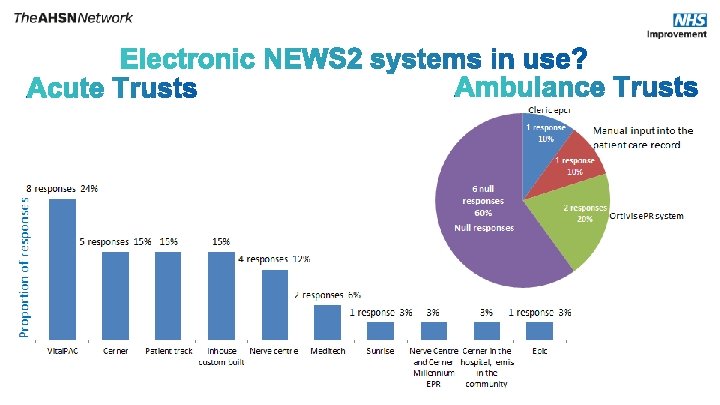
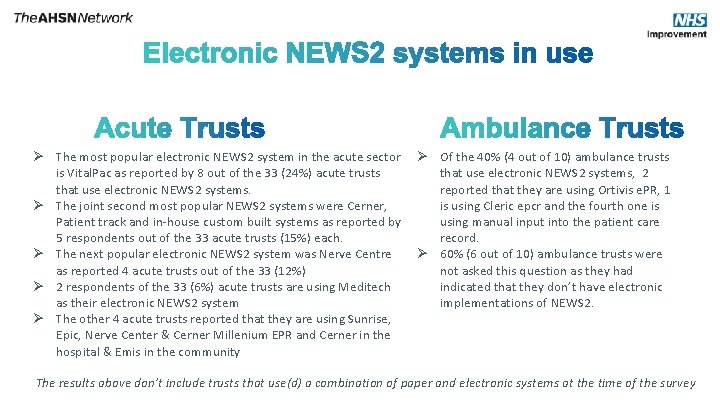
Ø The most popular electronic NEWS 2 system in the acute sector is Vital. Pac as reported by 8 out of the 33 (24%) acute trusts that use electronic NEWS 2 systems. Ø The joint second most popular NEWS 2 systems were Cerner, Patient track and in-house custom built systems as reported by 5 respondents out of the 33 acute trusts (15%) each. Ø The next popular electronic NEWS 2 system was Nerve Centre as reported 4 acute trusts out of the 33 (12%) Ø 2 respondents of the 33 (6%) acute trusts are using Meditech No as their electronic NEWS 2 system Ø The other 4 acute trusts reported that they are using Sunrise, Epic, Nerve Center & Cerner Millenium EPR and Cerner in the hospital & Emis in the community Ø Of the 40% (4 out of 10) ambulance trusts that use electronic NEWS 2 systems, 2 reported that they are using Ortivis e. PR, 1 is using Cleric epcr and the fourth one is using manual input into the patient care record. Ø 60% (6 out of 10) ambulance trusts were not asked this question as they had indicated that they don’t have electronic implementations of NEWS 2. The results above don’t include trusts that use(d) a combination of paper and electronic systems at the time of the survey
No
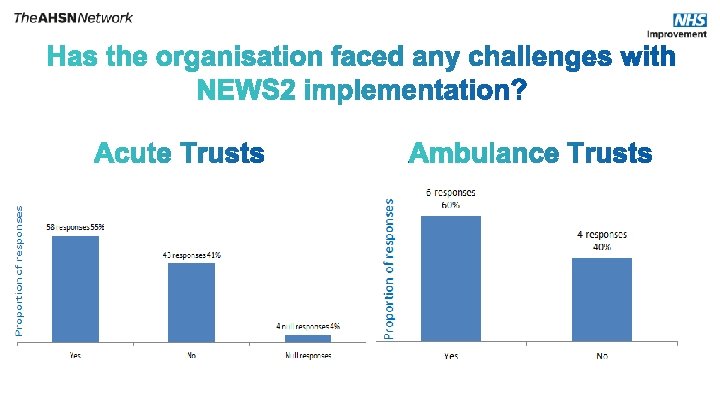
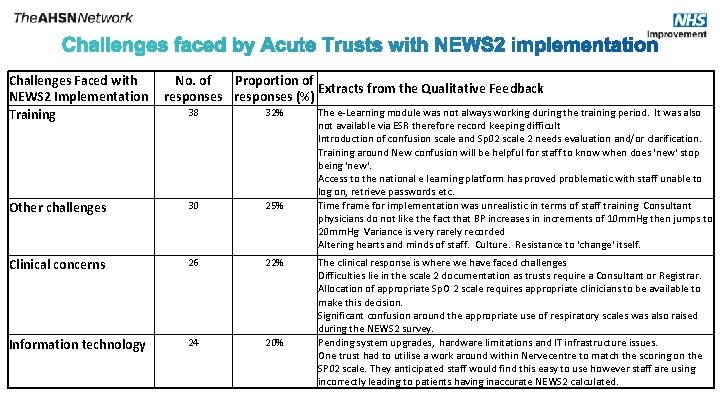
Challenges Faced with NEWS 2 Implementation Training No. of Proportion of Extracts from the Qualitative Feedback responses (%) 38 32% Other challenges 30 25% Clinical concerns 26 22% No Information technology 24 20% The e-Learning module was not always working during the training period. It was also not available via ESR therefore record keeping difficult Introduction of confusion scale and Sp 02 scale 2 needs evaluation and/or clarification. Training around New confusion will be helpful for staff to know when does 'new' stop being 'new'. Access to the national e learning platform has proved problematic with staff unable to log on, retrieve passwords etc. Time frame for implementation was unrealistic in terms of staff training Consultant physicians do not like the fact that BP increases in increments of 10 mm. Hg then jumps to 20 mm. Hg Variance is very rarely recorded Altering hearts and minds of staff. Culture. Resistance to 'change' itself. The clinical response is where we have faced challenges Difficulties lie in the scale 2 documentation as trusts require a Consultant or Registrar. Allocation of appropriate Sp. O 2 scale requires appropriate clinicians to be available to make this decision. Significant confusion around the appropriate use of respiratory scales was also raised during the NEWS 2 survey. Pending system upgrades, hardware limitations and IT infrastructure issues. One trust had to utilise a work around within Nervecentre to match the scoring on the SP 02 scale. They anticipated staff would find this easy to use however staff are using incorrectly leading to patients having inaccurate NEWS 2 calculated.
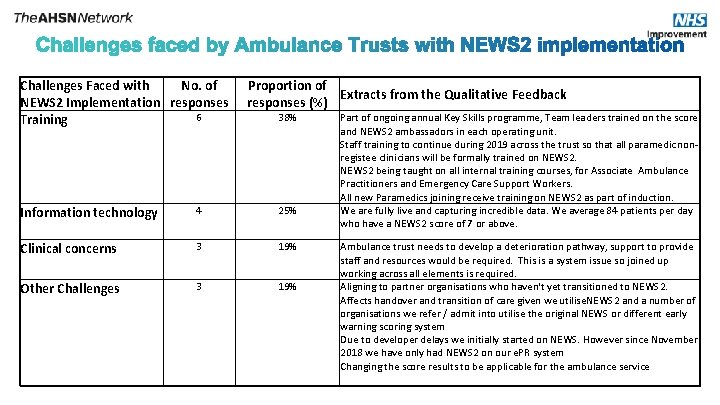
Challenges Faced with No. of NEWS 2 Implementation responses 6 Training Proportion of Extracts from the Qualitative Feedback responses (%) 38% Information technology 4 25% Clinical concerns 3 19% Other Challenges No 3 19% Part of ongoing annual Key Skills programme, Team leaders trained on the score and NEWS 2 ambassadors in each operating unit. Staff training to continue during 2019 across the trust so that all paramedic nonregistee clinicians will be formally trained on NEWS 2 being taught on all internal training courses, for Associate Ambulance Practitioners and Emergency Care Support Workers. All new Paramedics joining receive training on NEWS 2 as part of induction. We are fully live and capturing incredible data. We average 84 patients per day who have a NEWS 2 score of 7 or above. Ambulance trust needs to develop a deterioration pathway, support to provide staff and resources would be required. This is a system issue so joined up working across all elements is required. Aligning to partner organisations who haven't yet transitioned to NEWS 2. Affects handover and transition of care given we utilise. NEWS 2 and a number of organisations we refer / admit into utilise the original NEWS or different early warning scoring system Due to developer delays we initially started on NEWS. However since November 2018 we have only had NEWS 2 on our e. PR system Changing the score results to be applicable for the ambulance service
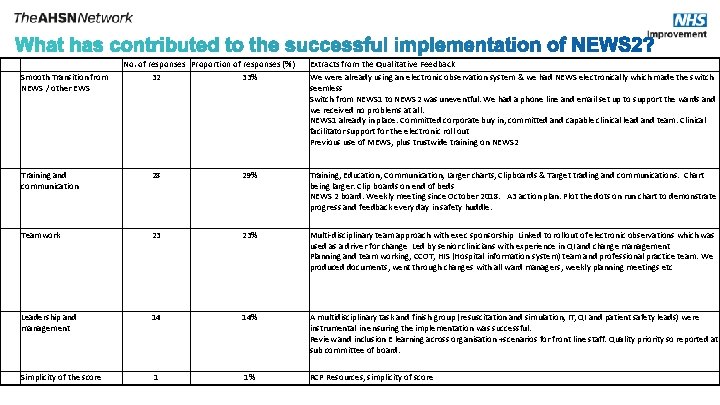
Smooth Transition from NEWS / other EWS No. of responses Proportion of responses (%) 32 33% Extracts from the Qualitative Feedback We were already using an electronic observation system & we had NEWS electronically which made the switch seemless Switch from NEWS 1 to NEWS 2 was uneventful. We had a phone line and email set up to support the wards and we received no problems at all. NEWS 1 already in place. Committed corporate buy in, committed and capable clinical lead and team. Clinical facilitator support for the electronic roll out Previous use of MEWS, plus trustwide training on NEWS 2 Training and communication 28 29% Training, Education, Communication, Larger charts, Clipboards & Target trading and communications. Chart being larger. Clip boards on end of beds NEWS 2 board. Weekly meeting since October 2018. A 3 action plan. Plot the dots on run chart to demonstrate progress and feedback every day in safety huddle. Teamwork 23 23% Multi-disciplinary team approach with exec sponsorship Linked to rollout of electronic observations which was used as a driver for change Led by senior clinicians with experience in QI and change management Planning and team working, CCOT, HIS (Hospital information system) team and professional practice team. We produced documents, went through changes with all ward managers, weekly planning meetings etc No Leadership and management 14 14% A multidisciplinary task and finish group (resuscitation and simulation, IT, QI and patient safety leads) were instrumental in ensuring the implementation was successful. Review and inclusion E learning across organisation +scenarios for front line staff. Quality priority so reported at sub committee of board. Simplicity of the score 1 1% RCP Resources, simplicity of score
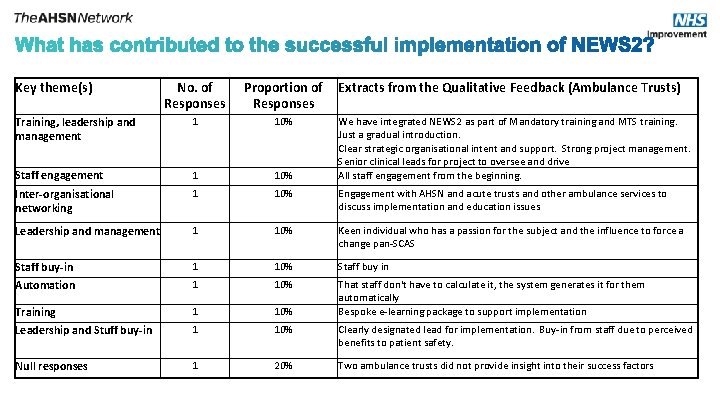
Key theme(s) No. of Responses Proportion of Extracts from the Qualitative Feedback (Ambulance Trusts) Responses Training, leadership and management 1 10% Staff engagement 1 10% Inter-organisational networking 1 10% Engagement with AHSN and acute trusts and other ambulance services to discuss implementation and education issues Leadership and management 1 10% Keen individual who has a passion for the subject and the influence to force a change pan-SCAS Staff buy-in 1 10% Staff buy in 1 10% Training 1 10% That staff don't have to calculate it, the system generates it for them automatically Bespoke e-learning package to support implementation Leadership and Stuff buy-in 1 10% Clearly designated lead for implementation. Buy-in from staff due to perceived benefits to patient safety. Null responses 1 20% Two ambulance trusts did not provide insight into their success factors Automation No We have integrated NEWS 2 as part of Mandatory training and MTS training. Just a gradual introduction. Clear strategic organisational intent and support. Strong project management. Senior clinical leads for project to oversee and drive All staff engagement from the beginning.
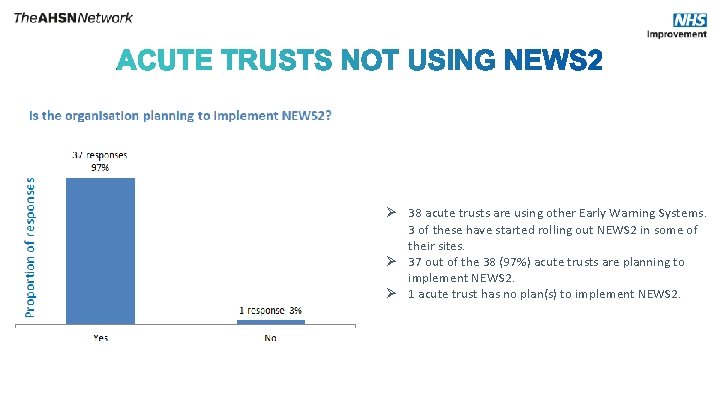
No Ø 38 acute trusts are using other Early Warning Systems. 3 of these have started rolling out NEWS 2 in some of their sites. Ø 37 out of the 38 (97%) acute trusts are planning to implement NEWS 2. Ø 1 acute trust has no plan(s) to implement NEWS 2.
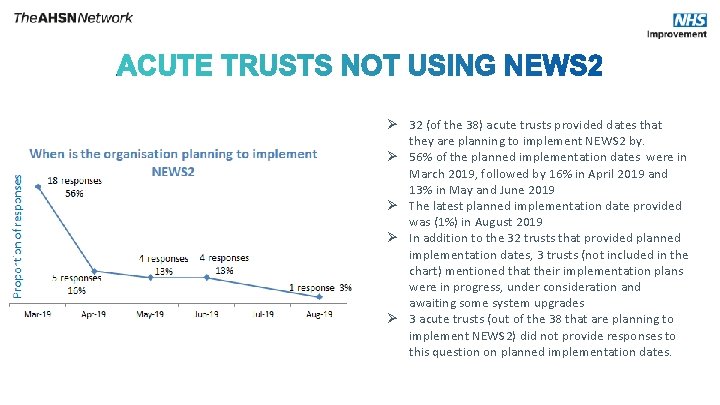
No Ø 32 (of the 38) acute trusts provided dates that they are planning to implement NEWS 2 by. Ø 56% of the planned implementation dates were in March 2019, followed by 16% in April 2019 and 13% in May and June 2019 Ø The latest planned implementation date provided was (1%) in August 2019 Ø In addition to the 32 trusts that provided planned implementation dates, 3 trusts (not included in the chart) mentioned that their implementation plans were in progress, under consideration and awaiting some system upgrades Ø 3 acute trusts (out of the 38 that are planning to implement NEWS 2) did not provide responses to this question on planned implementation dates.
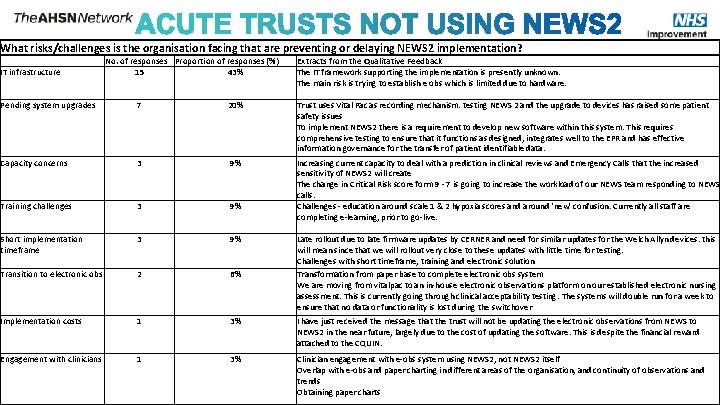
What risks/challenges is the organisation facing that are preventing or delaying NEWS 2 implementation? IT infrastructure No. of responses Proportion of responses (%) 15 43% Extracts from the Qualitative Feedback The IT framework supporting the implementation is presently unknown. The main risk is trying to establish e obs which is limited due to hardware. Pending system upgrades 7 20% Trust uses Vital Pac as recording mechanism. testing NEWS 2 and the upgrade to devices has raised some patient safety issues To implement NEWS 2 there is a requirement to develop new software within this system. This requires comprehensive testing to ensure that it functions as designed, integrates well to the EPR and has effective information governance for the transfer of patient identifiable data. Capacity concerns 3 9% Training challenges 3 9% Increasing current capacity to deal with a prediction in clinical reviews and Emergency Calls that the increased sensitivity of NEWS 2 will create The change in Critical Risk score form 9 - 7 is going to increase the workload of our NEWS team responding to NEWS calls. Challenges - education around scale 1 & 2 hypoxia scores and around 'new' confusion. Currently all staff are completing e-learning, prior to go-live. Short implementation timeframe 3 9% Late rollout due to late firmware updates by CERNER and need for similar updates for the Welch Allyn devices. this will mean since that we will rollout very close to these updates with little time for testing. Challenges with short timeframe, training and electronic solution Transition to electronic obs 2 6% Transformation from paper base to complete electronic obs system We are moving from vitalpac to an in-house electronic observations platform on our established electronic nursing assessment. This is currently going through clinical acceptability testing. The systems will double run for a week to ensure that no data or functionality is lost during the switchover No Implementation costs 1 3% I have just received the message that the trust will not be updating the electronic observations from NEWS to NEWS 2 in the near future, largely due to the cost of updating the software. This is despite the financial reward attached to the CQUIN. Engagement with clinicians 1 3% Clinician engagement with e-obs system using NEWS 2, not NEWS 2 itself Overlap with e-obs and paper charting in different areas of the organisation, and continuity of observations and trends Obtaining paper charts
No
No
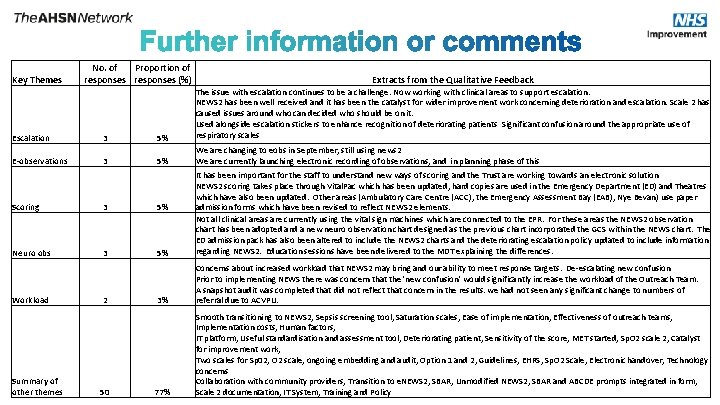
Key Themes No. of Proportion of responses (%) Extracts from the Qualitative Feedback Escalation 3 5% The issue with escalation continues to be a challenge. Now working with clinical areas to support escalation. NEWS 2 has been well received and it has been the catalyst for wider improvement work concerning deterioration and escalation. Scale 2 has caused issues around who can decided who should be on it. Used alongside escalation stickers to enhance recognition of deteriorating patients Significant confusion around the appropriate use of respiratory scales E-observations 3 5% We are changing to eobs in September, still using news 2 We are currently launching electronic recording of observations, and in planning phase of this Scoring 3 5% Neuro obs 3 5% It has been important for the staff to understand new ways of scoring and the Trust are working towards an electronic solution NEWS 2 scoring takes place through Vital. Pac which has been updated, hard copies are used in the Emergency Department (ED) and Theatres which have also been updated. Other areas (Ambulatory Care Centre (ACC), the Emergency Assessment Bay (EAB), Nye Bevan) use paper admission forms which have been revised to reflect NEWS 2 elements. Not all clinical areas are currently using the vital sign machines which are connected to the EPR. For these areas the NEWS 2 observation chart has been adopted and a new neuro observation chart designed as the previous chart incorporated the GCS within the NEWS chart. The ED admission pack has also been altered to include the NEWS 2 charts and the deteriorating escalation policy updated to include information regarding NEWS 2. Education sessions have been delivered to the MDT explaining the differences. 3% Concerns about increased workload that NEWS 2 may bring and our ability to meet response targets. De-escalating new confusion Prior to implementing NEWS there was concern that the 'new confusion' would significantly increase the workload of the Outreach Team. A snapshot audit was completed that did not reflect that concern in the results. we had not seen any significant change to numbers of referral due to ACVPU. Workload Summary of other themes 2 50 77% No Smooth transitioning to NEWS 2, Sepsis screening tool, Saturation scales, Ease of implementation, Effectiveness of outreach teams, Implementation costs, Human factors, IT platform, Useful standardisation and assessment tool, Deteriorating patient, Sensitivity of the score, MET started, Sp. O 2 scale 2, Catalyst for improvement work, Two scales for Sp 02, O 2 scale, ongoing embedding and audit, Option 1 and 2, Guidelines, EHRS, Sp. O 2 Scale, Electronic handover, Technology concerns Collaboration with community providers, Transition to e. NEWS 2, SBAR, Unmodified NEWS 2, SBAR and ABCDE prompts integrated in form, Scale 2 documentation, IT System, Training and Policy
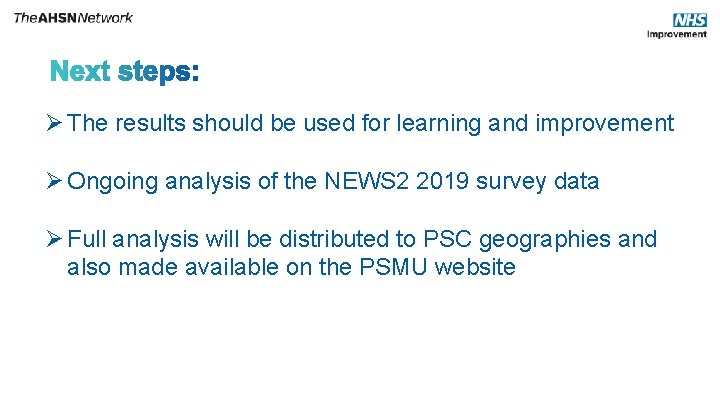
Ø The results should be used for learning and improvement Ø Ongoing analysis of the NEWS 2 2019 survey data Ø Full analysis will be distributed to PSC geographies and also made available on the PSMU website
Thanks to NEWS 2 Champions for helping to gather responses If you have any questions or queries then please send them to local. contact@ahsn. net If you have any specific queries with regard to the data or would like to request any further analysis please contact psmu. improvement@nhs. net