
NATIONAL DISASTER RECOVERY FRAMEWORK Operationalizing the National Disaster

- Slides: 55
NATIONAL DISASTER RECOVERY FRAMEWORK Operationalizing the National Disaster Recovery Framework Michelle Diamond Community Planning and Capacity Building Coordinator FEMA Region III Virginia Emergency Management Symposium 2016
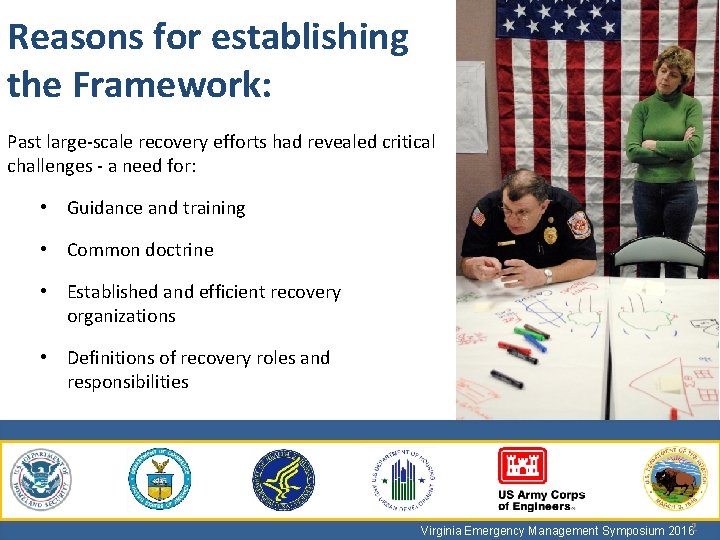
Reasons for establishing the Framework: Past large-scale recovery efforts had revealed critical challenges - a need for: • Guidance and training • Common doctrine • Established and efficient recovery organizations • Definitions of recovery roles and responsibilities Virginia Emergency Management Symposium 20162
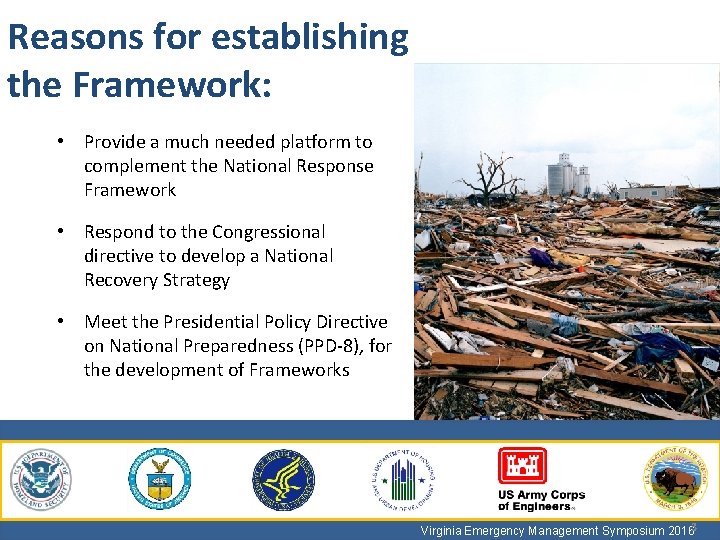
Reasons for establishing the Framework: • Provide a much needed platform to complement the National Response Framework • Respond to the Congressional directive to develop a National Recovery Strategy • Meet the Presidential Policy Directive on National Preparedness (PPD-8), for the development of Frameworks Virginia Emergency Management Symposium 20163
Whole Community Approach to Emergency Management • Everyone has a role in response and recovery • Federal, State, Local • Nonprofit, Faith-Based • Business • Citizens • Engage the whole community to determine actual needs • Engage and empower all parts of the community • Strengthen what works well Virginia Emergency Management Symposium 20164
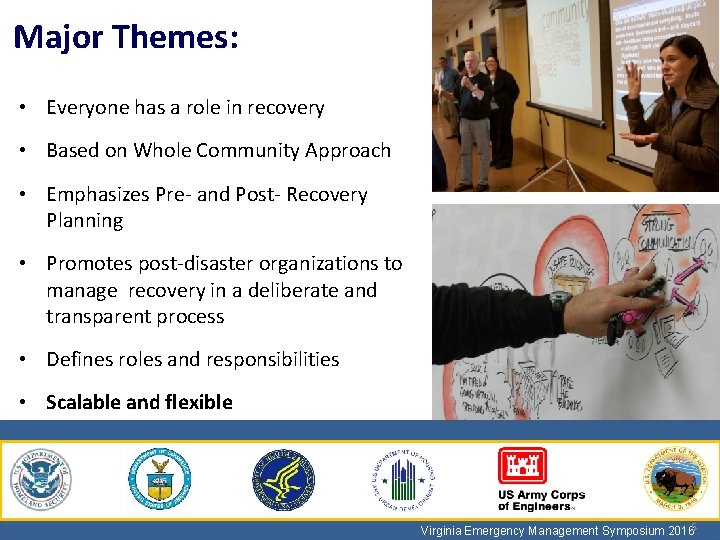
Major Themes: • Everyone has a role in recovery • Based on Whole Community Approach • Emphasizes Pre- and Post- Recovery Planning • Promotes post-disaster organizations to manage recovery in a deliberate and transparent process • Defines roles and responsibilities • Scalable and flexible Virginia Emergency Management Symposium 20165
Key Element #1 – Leadership at every level • Local Disaster Recovery Managers • State/Commonwealth Disaster Recovery Coordinator • Federal Disaster Recovery Coordinator Virginia Emergency Management Symposium 20166
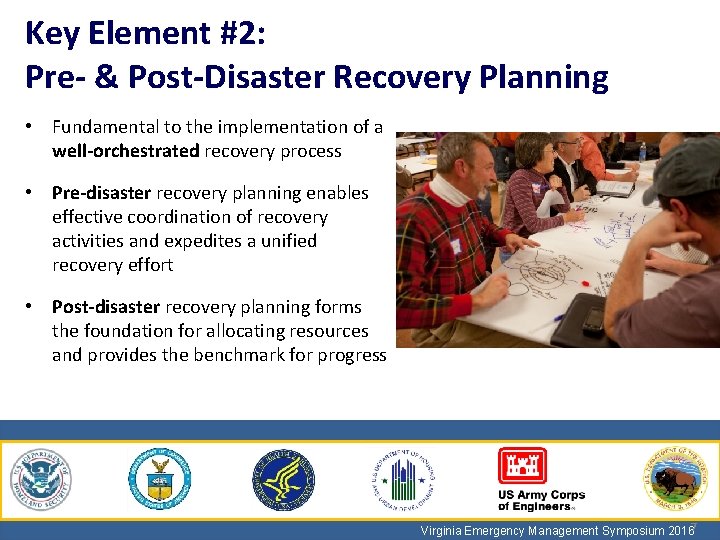
Key Element #2: Pre- & Post-Disaster Recovery Planning • Fundamental to the implementation of a well-orchestrated recovery process • Pre-disaster recovery planning enables effective coordination of recovery activities and expedites a unified recovery effort • Post-disaster recovery planning forms the foundation for allocating resources and provides the benchmark for progress Virginia Emergency Management Symposium 20167
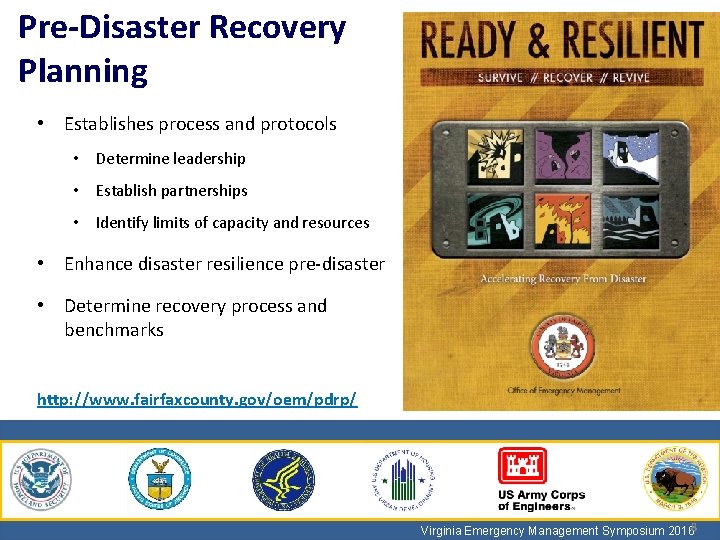
Pre-Disaster Recovery Planning • Establishes process and protocols • Determine leadership • Establish partnerships • Identify limits of capacity and resources • Enhance disaster resilience pre-disaster • Determine recovery process and benchmarks http: //www. fairfaxcounty. gov/oem/pdrp/ Virginia Emergency Management Symposium 20168
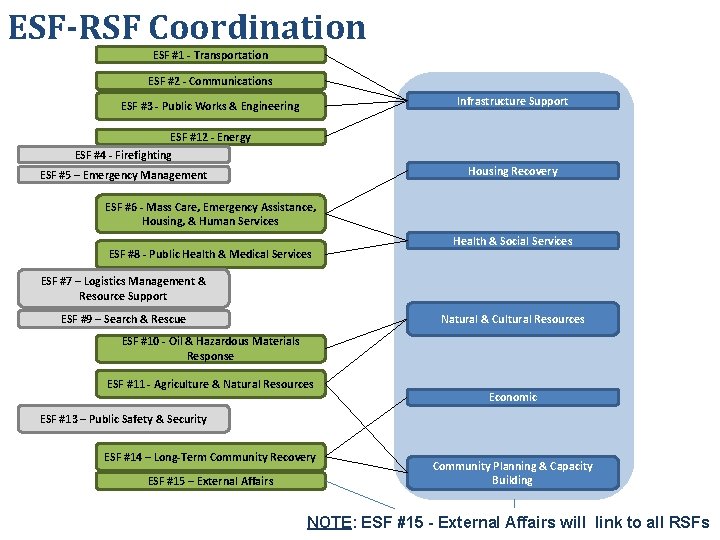
Key Element #3: Recovery Support Functions (RSFs) RSFs are led by designated Federal coordinating agencies at the national level • Community Planning and Capacity Building (DHS/FEMA) • Economic (Commerce) • Health and Social Services (HHS) • Housing (HUD) • Infrastructure Systems (USACE) • Natural and Cultural Resources (DOI) Virginia Emergency Management Symposium 20169
ESF-RSF Coordination ESF #1 - Transportation ESF #2 - Communications Infrastructure Support ESF #3 - Public Works & Engineering ESF #12 - Energy ESF #4 - Firefighting Housing Recovery ESF #5 – Emergency Management ESF #6 - Mass Care, Emergency Assistance, Housing, & Human Services ESF #8 - Public Health & Medical Services Health & Social Services ESF #7 – Logistics Management & Resource Support Natural & Cultural Resources ESF #9 – Search & Rescue ESF #10 - Oil & Hazardous Materials Response ESF #11 - Agriculture & Natural Resources Economic ESF #13 – Public Safety & Security ESF #14 – Long-Term Community Recovery ESF #15 – External Affairs Community Planning & Capacity Building NOTE: ESF #15 - External Affairs will link to all RSFs
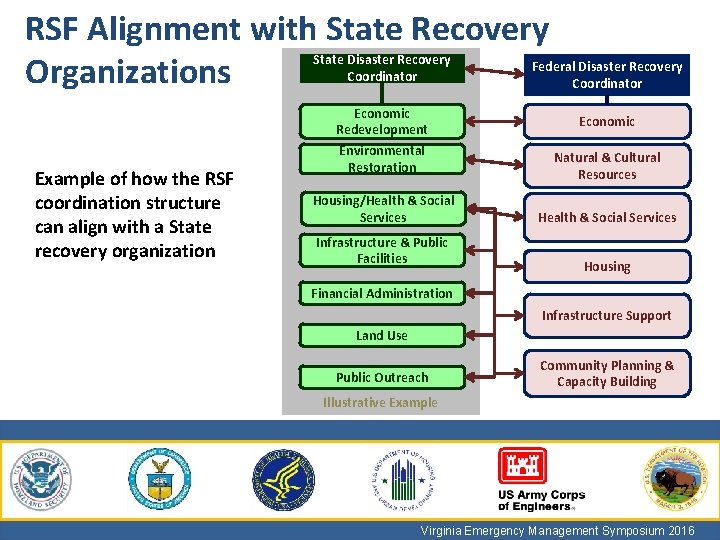
RSF Alignment with State Recovery Organizations State Disaster Recovery Coordinator Example of how the RSF coordination structure can align with a State recovery organization Federal Disaster Recovery Coordinator Economic Redevelopment Environmental Restoration Natural & Cultural Resources Housing/Health & Social Services Infrastructure & Public Facilities Economic Housing Financial Administration Infrastructure Support Land Use Public Outreach Community Planning & Capacity Building Illustrative Example Virginia Emergency Management Symposium 2016
Virginia Recovery Structure Virginia Department of Emergency Management’s Recovery and Mitigation JFO Standard Operating Guide 2013 Goals include: – Development of State Recovery Framework that interfaces effectively with national and local components – Identifies recovery roles and responsibilities – Operational capability to execute plans – Capability to develop event-specific Recovery Strategy NATIONAL DISASTER RECOVERY FRAMEWORK
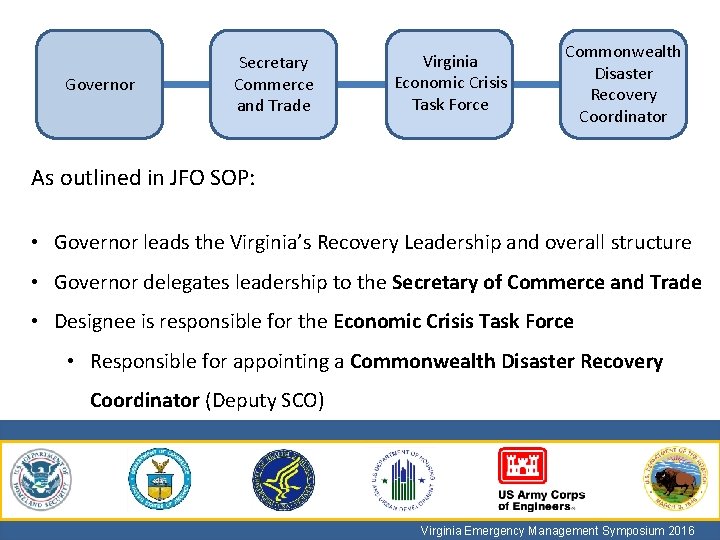
Governor Secretary Commerce and Trade Virginia Economic Crisis Task Force Commonwealth Disaster Recovery Coordinator As outlined in JFO SOP: • Governor leads the Virginia’s Recovery Leadership and overall structure • Governor delegates leadership to the Secretary of Commerce and Trade • Designee is responsible for the Economic Crisis Task Force • Responsible for appointing a Commonwealth Disaster Recovery Coordinator (Deputy SCO) Virginia Emergency Management Symposium 2016
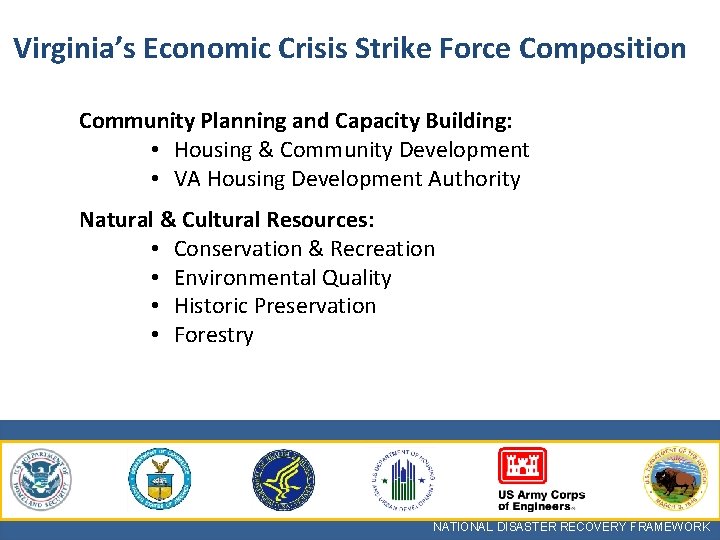
Virginia’s Economic Crisis Strike Force Composition Community Planning and Capacity Building: • Housing & Community Development • VA Housing Development Authority Natural & Cultural Resources: • Conservation & Recreation • Environmental Quality • Historic Preservation • Forestry NATIONAL DISASTER RECOVERY FRAMEWORK
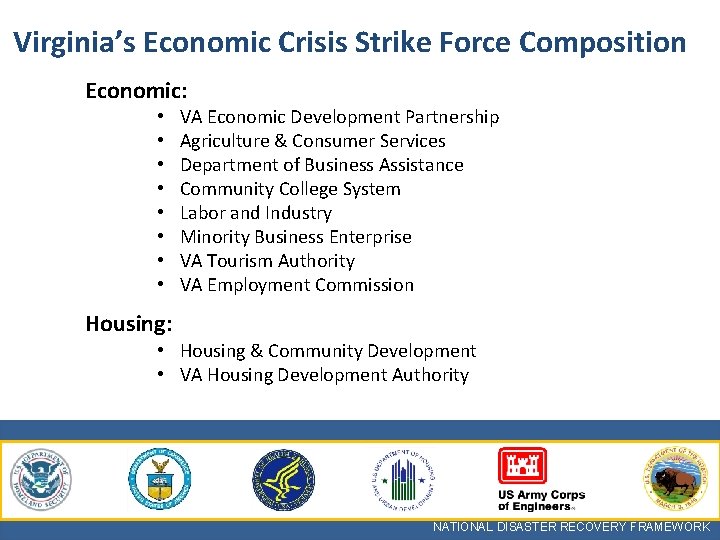
Virginia’s Economic Crisis Strike Force Composition Economic: • • VA Economic Development Partnership Agriculture & Consumer Services Department of Business Assistance Community College System Labor and Industry Minority Business Enterprise VA Tourism Authority VA Employment Commission Housing: • Housing & Community Development • VA Housing Development Authority NATIONAL DISASTER RECOVERY FRAMEWORK
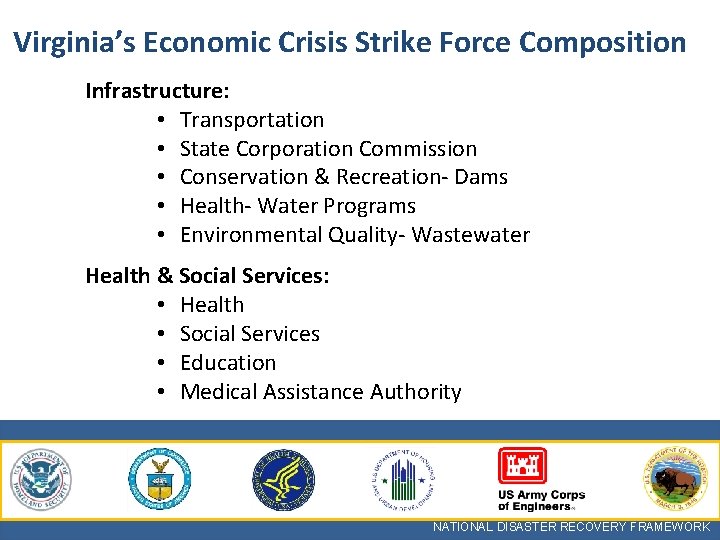
Virginia’s Economic Crisis Strike Force Composition Infrastructure: • Transportation • State Corporation Commission • Conservation & Recreation- Dams • Health- Water Programs • Environmental Quality- Wastewater Health & Social Services: • Health • Social Services • Education • Medical Assistance Authority NATIONAL DISASTER RECOVERY FRAMEWORK
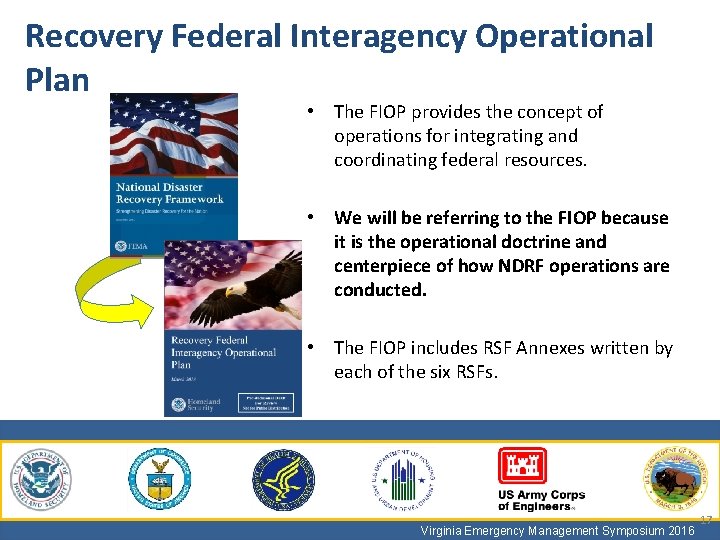
Recovery Federal Interagency Operational Plan • The FIOP provides the concept of operations for integrating and coordinating federal resources. • We will be referring to the FIOP because it is the operational doctrine and centerpiece of how NDRF operations are conducted. • The FIOP includes RSF Annexes written by each of the six RSFs. Virginia Emergency Management Symposium 2016 17
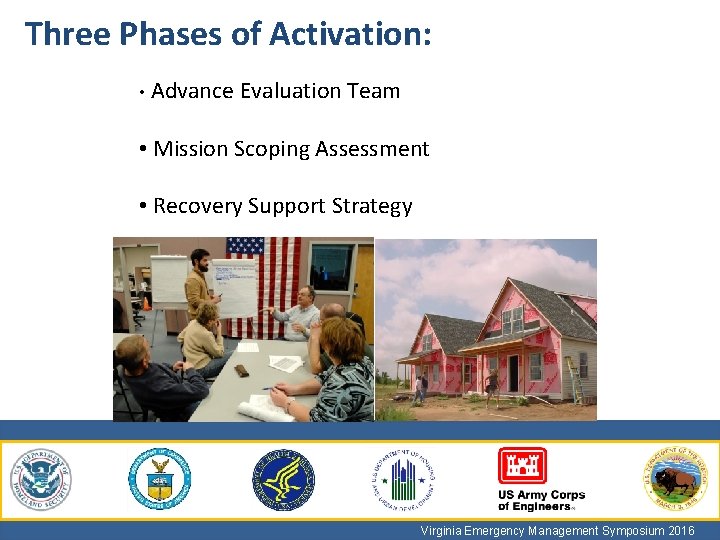
How will the NDRF in a disaster scenario? Three Phases ofwork Activation: • Advance Evaluation Team • Mission Scoping Assessment • Recovery Support Strategy Virginia Emergency Management Symposium 2016
Advanced Evaluation Overview Virginia Emergency Management Symposium 2016
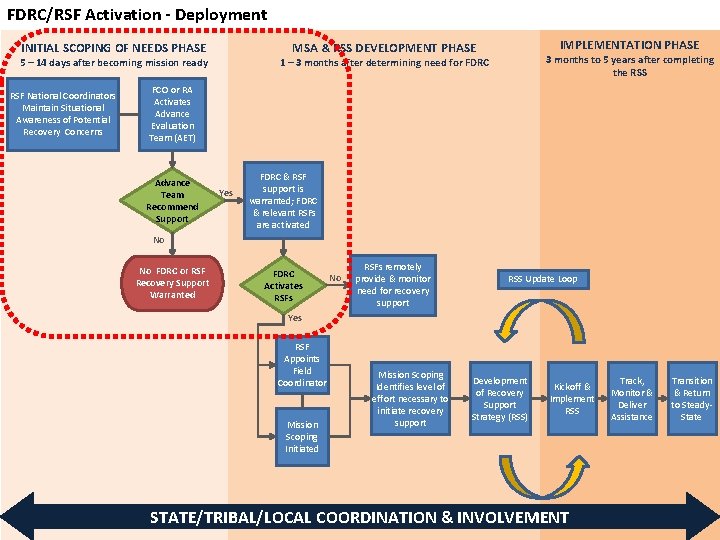
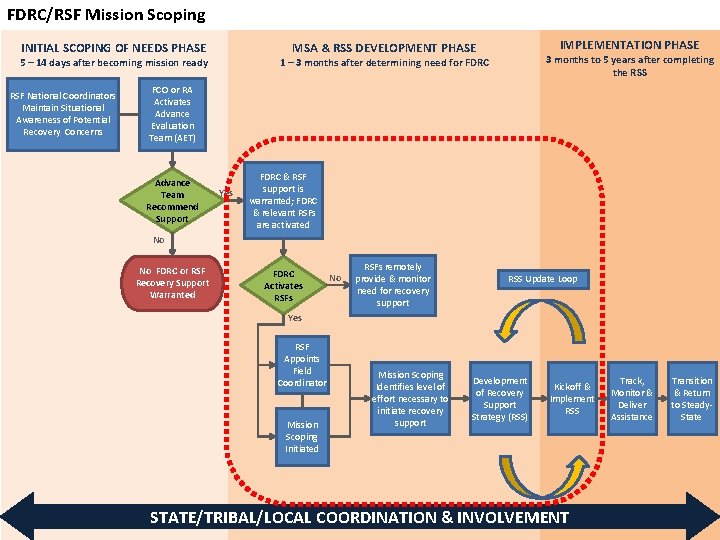
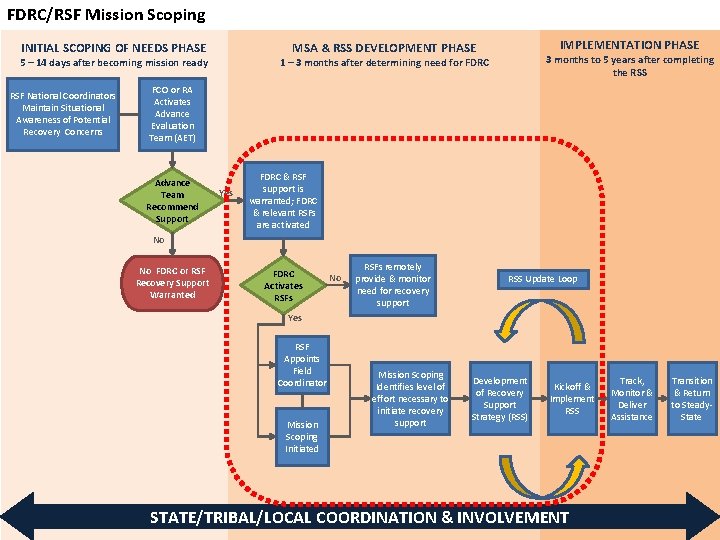
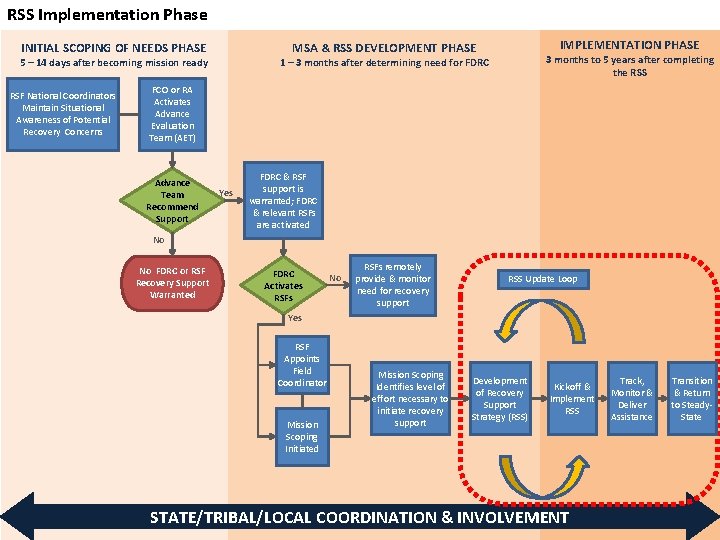
FDRC/RSF Activation - Deployment INITIAL SCOPING OF NEEDS PHASE 5 – 14 days after becoming mission ready RSF National Coordinators Maintain Situational Awareness of Potential Recovery Concerns IMPLEMENTATION PHASE MSA & RSS DEVELOPMENT PHASE 3 months to 5 years after completing the RSS 1 – 3 months after determining need for FDRC FCO or RA Activates Advance Evaluation Team (AET) Advance Team Recommend Support Yes FDRC & RSF support is warranted; FDRC & relevant RSFs are activated No No FDRC or RSF Recovery Support Warranted FDRC Activates RSFs No RSFs remotely provide & monitor need for recovery support RSS Update Loop Yes RSF Appoints Field Coordinator Mission Scoping Initiated Mission Scoping Identifies level of effort necessary to initiate recovery support Development of Recovery Support Strategy (RSS) Kickoff & Implement RSS STATE/TRIBAL/LOCAL COORDINATION & INVOLVEMENT Track, Monitor & Deliver Assistance Transition & Return to Steady. State
Advance Evaluation • Advance Evaluation is the process for helping the FCO and Regional Administrator to evaluate the need for an FDRC and RSFs. • The Advance Evaluation Team may be led by the Regional FDRC. • National Disaster Recovery Support Cadre reservists can be called upon to staff the Advance Evaluation Team as needed. Virginia Emergency Management Symposium 2016
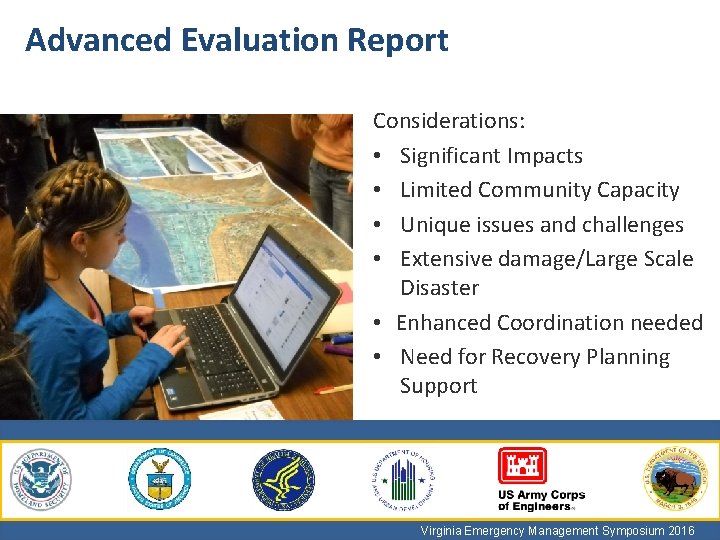
Advanced Evaluation Report Considerations: • Significant Impacts • Limited Community Capacity • Unique issues and challenges • Extensive damage/Large Scale Disaster • Enhanced Coordination needed • Need for Recovery Planning Support Virginia Emergency Management Symposium 2016
Benefits of Advance Evaluation • Provides information that will help determine if activation of an FDRC is warranted. • Provides recommendation on Recovery Support Function activations. • Provides insight into potential recovery issues and challenges. Virginia Emergency Management Symposium 2016
What kinds of information do we need? Included, but not limited to. . • Situational Reports • IA Applicant Registration info • Incident Action Plans • State Hazard Mitigation Plans • GIS Products • NFIP data • Demographic Data Maps • EHP Reports • Preliminary Damage Assessments • SBA Applicants Summaries • State Housing Plans • Media and Local News Reports • DSA Reports • Other Virginia Emergency Management Symposium 2016
What kinds of information do we need? Included, but not limited to. . • Situational Reports • IA Applicant Registration info • Incident Action Plans • State Hazard Mitigation Plans • GIS Products • NFIP data • Demographic Data Maps • EHP Reports • Preliminary Damage Assessments • SBA Applicants Summaries • State Housing Plans • Media and Local News Reports • DSA Reports • Other Virginia Emergency Management Symposium 2016
FDRC/RSF Mission Scoping INITIAL SCOPING OF NEEDS PHASE 5 – 14 days after becoming mission ready RSF National Coordinators Maintain Situational Awareness of Potential Recovery Concerns IMPLEMENTATION PHASE MSA & RSS DEVELOPMENT PHASE 3 months to 5 years after completing the RSS 1 – 3 months after determining need for FDRC FCO or RA Activates Advance Evaluation Team (AET) Advance Team Recommend Support Yes FDRC & RSF support is warranted; FDRC & relevant RSFs are activated No No FDRC or RSF Recovery Support Warranted FDRC Activates RSFs No RSFs remotely provide & monitor need for recovery support RSS Update Loop Yes RSF Appoints Field Coordinator Mission Scoping Initiated Mission Scoping Identifies level of effort necessary to initiate recovery support Development of Recovery Support Strategy (RSS) Kickoff & Implement RSS STATE/TRIBAL/LOCAL COORDINATION & INVOLVEMENT Track, Monitor & Deliver Assistance Transition & Return to Steady. State
RSF Activation and Deployment • RSFs are activated in order to: – Identify recovery challenges in collaboration with the state/tribe. – Strategize on how their capabilities, resources and authorities can be applied to those challenges. – Take action to support the state and local communities in addressing those challenges. Virginia Emergency Management Symposium 2016
RSF Activation/ Deployment • FDRC notifies relevant RSF National Coordinator of the RSF activation • RSF National Coordinator will identify and notify the corresponding primary/support agency representatives of activation • Deployed as needed via MA, IAA, other authority Virginia Emergency Management Symposium 2016
Mission Scoping Assessment Overview Virginia Emergency Management Symposium 2016
What is the MSA? The MSA is an early (snapshot) evaluation by the RSFs of the current and anticipated impacts of the disaster and identification of recovery issues and needs that may hinder an effective recovery. The issues and needs identified by the MSA serve as the foundation for the development of the RSS. Virginia Emergency Management Symposium 2016
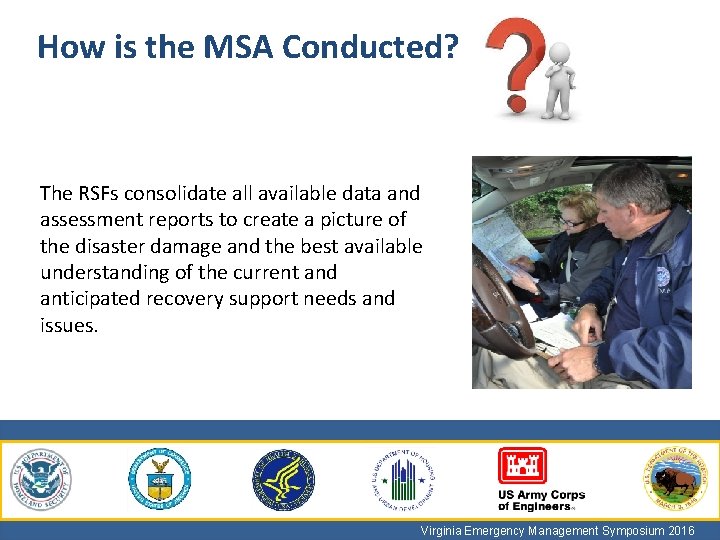
How is the MSA Conducted? The RSFs consolidate all available data and assessment reports to create a picture of the disaster damage and the best available understanding of the current and anticipated recovery support needs and issues. Virginia Emergency Management Symposium 2016
The MSA process is not tied to how specific recovery issues may be addressed or resolved. RSF strategic objectives and recovery support actions are developed later in the RSS process. Virginia Emergency Management Symposium 2016
What Kind of Information Does the MSA Process Capture? • • Current and anticipated issues and needs which may not be addressed by traditional Federal programs. Specific jurisdictions that may require enhanced Federal recovery support. Any area-wide or overarching, multi-sector recovery issues. Potential opportunities for improving sustainability and resiliency against future disasters. Virginia Emergency Management Symposium 2016
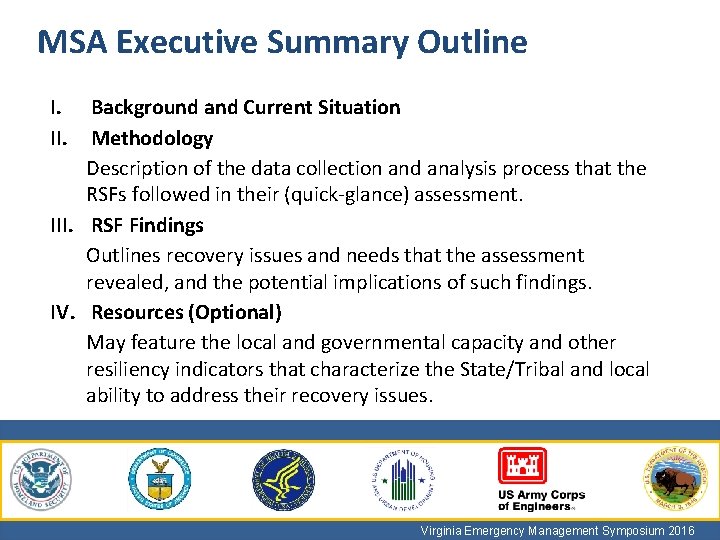
MSA Executive Summary Outline I. II. Background and Current Situation Methodology Description of the data collection and analysis process that the RSFs followed in their (quick-glance) assessment. III. RSF Findings Outlines recovery issues and needs that the assessment revealed, and the potential implications of such findings. IV. Resources (Optional) May feature the local and governmental capacity and other resiliency indicators that characterize the State/Tribal and local ability to address their recovery issues. Virginia Emergency Management Symposium 2016
FDRC/RSF Mission Scoping INITIAL SCOPING OF NEEDS PHASE 5 – 14 days after becoming mission ready RSF National Coordinators Maintain Situational Awareness of Potential Recovery Concerns IMPLEMENTATION PHASE MSA & RSS DEVELOPMENT PHASE 3 months to 5 years after completing the RSS 1 – 3 months after determining need for FDRC FCO or RA Activates Advance Evaluation Team (AET) Advance Team Recommend Support Yes FDRC & RSF support is warranted; FDRC & relevant RSFs are activated No No FDRC or RSF Recovery Support Warranted FDRC Activates RSFs No RSFs remotely provide & monitor need for recovery support RSS Update Loop Yes RSF Appoints Field Coordinator Mission Scoping Initiated Mission Scoping Identifies level of effort necessary to initiate recovery support Development of Recovery Support Strategy (RSS) Kickoff & Implement RSS STATE/TRIBAL/LOCAL COORDINATION & INVOLVEMENT Track, Monitor & Deliver Assistance Transition & Return to Steady. State
Recovery Support Strategy Overview Virginia Emergency Management Symposium 2016
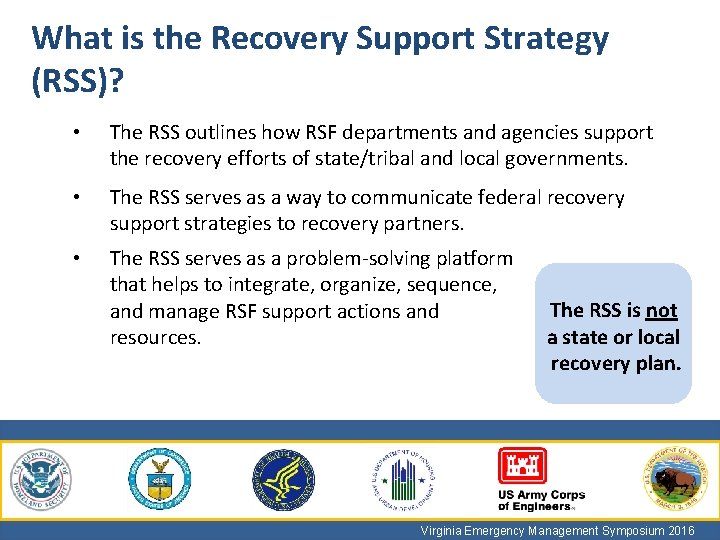
What is the Recovery Support Strategy (RSS)? • The RSS outlines how RSF departments and agencies support the recovery efforts of state/tribal and local governments. • The RSS serves as a way to communicate federal recovery support strategies to recovery partners. • The RSS serves as a problem-solving platform that helps to integrate, organize, sequence, and manage RSF support actions and resources. The RSS is not a state or local recovery plan. Virginia Emergency Management Symposium 2016
Why Do We Need a Recovery Support Strategy? • Harmonize and sequence recovery activities • Guide RSF operations • Communicate to stakeholders how the RSFs will support recovery efforts • Track recovery progress • Evaluate adequacy and pace of recovery assistance Virginia Emergency Management Symposium 2016
Development of the RSS is NOT the Objective of the Mission • The objective of the FDRC and RSFs is to support state/tribal and local community recovery goals in a coordinated manner. • The development of the RSS should not delay recovery support actions of the RSFs. • RSFs should develop recovery support actions to contribute to ongoing recovery efforts on the state/tribal and local levels. Virginia Emergency Management Symposium 2016
Who Develops the RSS? • The FDRC oversees development of the RSS. • RSS development is a collaborative process that requires focused engagement by the activated RSF agencies and departments. • The FDRC uses the Federal Disaster Recovery Officer (FDRO), and National Disaster Recovery Support Cadre staff to assist with RSS development. 40 Virginia Emergency Management Symposium 2016
What Should the RSS Tell Us? • • Describes the current and anticipated recovery issues and challenges. Identifies the RSFs’ strategic objectives and outlines the support actions that the RSFs will undertake to achieve those objectives. Helps to inform stakeholders of the RSF’s capabilities and how they plan to support their recovery efforts. Provides a broad time-frame for completing the recovery support by identifying deliverables and support milestones. Virginia Emergency Management Symposium 2016
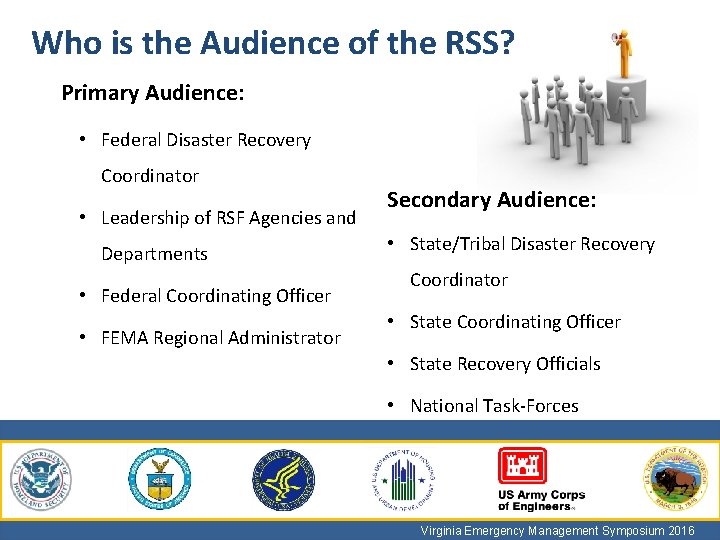
Who is the Audience of the RSS? Primary Audience: • Federal Disaster Recovery Coordinator • Leadership of RSF Agencies and Departments • Federal Coordinating Officer • FEMA Regional Administrator Secondary Audience: • State/Tribal Disaster Recovery Coordinator • State Coordinating Officer • State Recovery Officials • National Task-Forces Virginia Emergency Management Symposium 2016
RSS Development Having identified the recovery issues and needs through the Mission Scoping Assessment, the RSS development will focus on guiding RSF Field Coordinators through the RSS development process : • RSFs identify their Strategic Objective(s) • RSFs outline Recovery Support Actions • RSFs identify Recovery Metrics • RSFs identify Implementation Milestones Virginia Emergency Management Symposium 2016
Identify Strategic Objectives: • • • Based on disaster issues identified in the Mission Scoping Assessment. Crafted in support of the state/tribal and local recovery goals. Framed in the context of providing support rather than achieving a recovery goal. Strategic objectives should be attainable and based on RSF authorities, capabilities and resources 44 Virginia Emergency Management Symposium 2016
RSF Strategic Objective • • • ECONOMIC: Support the State/local governments in recovering the tourism economy. HOUSING: Assist the State with stabilizing available housing stock and provide communities with the tools to help them meet the need for quality affordable rental homes. CPCB: Provide training to municipalities to build planning capacity, provide direct planning support to communities who have experienced that lack the capacity to lead and implement a successful recovery process. Virginia Emergency Management Symposium 2016
RSF Work Sessions to Identify Recovery Support Activities/actions RSF Recovery Strategic Objectives tell us where the RSFs want to go; and RSF Support Activities tell us how to get there. Virginia Emergency Management Symposium 2016
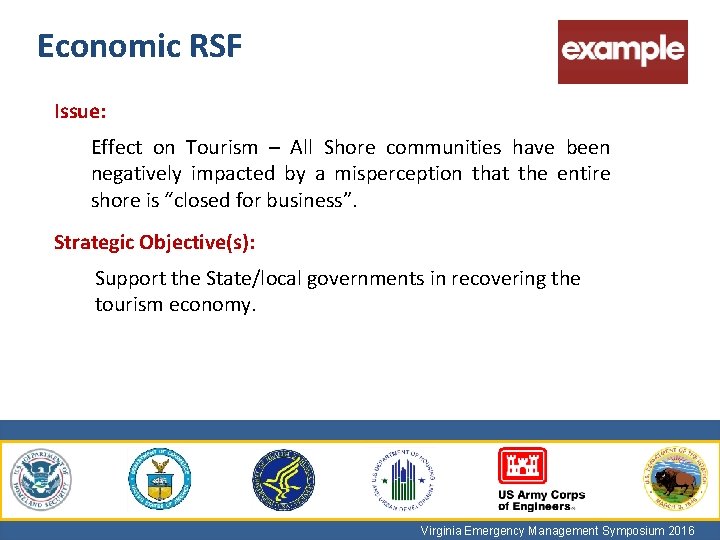
Economic RSF Issue: Effect on Tourism – All Shore communities have been negatively impacted by a misperception that the entire shore is “closed for business”. Strategic Objective(s): Support the State/local governments in recovering the tourism economy. Virginia Emergency Management Symposium 2016
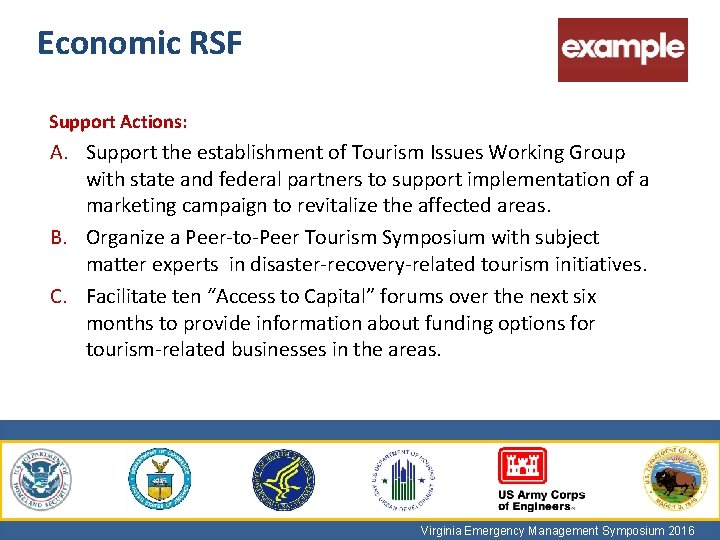
Economic RSF Support Actions: A. Support the establishment of Tourism Issues Working Group with state and federal partners to support implementation of a marketing campaign to revitalize the affected areas. B. Organize a Peer-to-Peer Tourism Symposium with subject matter experts in disaster-recovery-related tourism initiatives. C. Facilitate ten “Access to Capital” forums over the next six months to provide information about funding options for tourism-related businesses in the areas. Virginia Emergency Management Symposium 2016
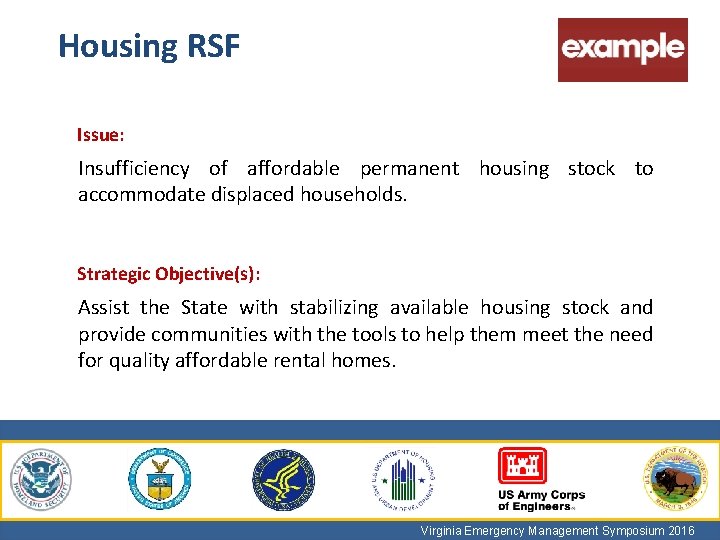
Housing RSF Issue: Insufficiency of affordable permanent housing stock to accommodate displaced households. Strategic Objective(s): Assist the State with stabilizing available housing stock and provide communities with the tools to help them meet the need for quality affordable rental homes. Virginia Emergency Management Symposium 2016
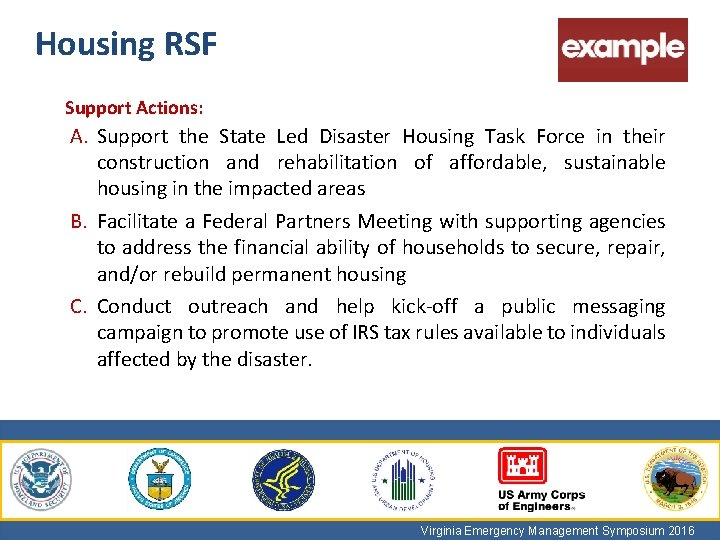
Housing RSF Support Actions: A. Support the State Led Disaster Housing Task Force in their construction and rehabilitation of affordable, sustainable housing in the impacted areas B. Facilitate a Federal Partners Meeting with supporting agencies to address the financial ability of households to secure, repair, and/or rebuild permanent housing C. Conduct outreach and help kick-off a public messaging campaign to promote use of IRS tax rules available to individuals affected by the disaster. Virginia Emergency Management Symposium 2016
Identify Recovery Metrics: RSF Recovery Metrics enable the FDRC to measure progress towards completion of support actions and tasks that are linked to RSF strategic objectives. Virginia Emergency Management Symposium 2016
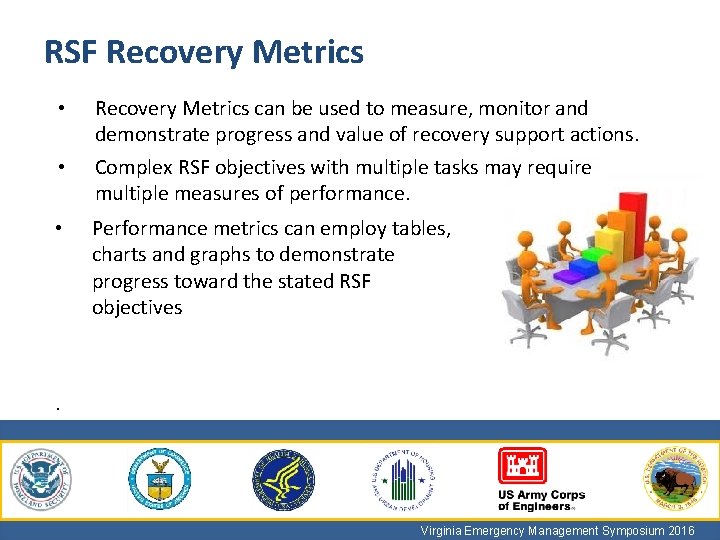
RSF Recovery Metrics • • • Recovery Metrics can be used to measure, monitor and demonstrate progress and value of recovery support actions. Complex RSF objectives with multiple tasks may require multiple measures of performance. Performance metrics can employ tables, charts and graphs to demonstrate progress toward the stated RSF objectives . Virginia Emergency Management Symposium 2016
RSS Implementation Phase INITIAL SCOPING OF NEEDS PHASE 5 – 14 days after becoming mission ready RSF National Coordinators Maintain Situational Awareness of Potential Recovery Concerns IMPLEMENTATION PHASE MSA & RSS DEVELOPMENT PHASE 3 months to 5 years after completing the RSS 1 – 3 months after determining need for FDRC FCO or RA Activates Advance Evaluation Team (AET) Advance Team Recommend Support Yes FDRC & RSF support is warranted; FDRC & relevant RSFs are activated No No FDRC or RSF Recovery Support Warranted FDRC Activates RSFs No RSFs remotely provide & monitor need for recovery support RSS Update Loop Yes RSF Appoints Field Coordinator Mission Scoping Initiated Mission Scoping Identifies level of effort necessary to initiate recovery support Development of Recovery Support Strategy (RSS) Kickoff & Implement RSS STATE/TRIBAL/LOCAL COORDINATION & INVOLVEMENT Track, Monitor & Deliver Assistance Transition & Return to Steady. State
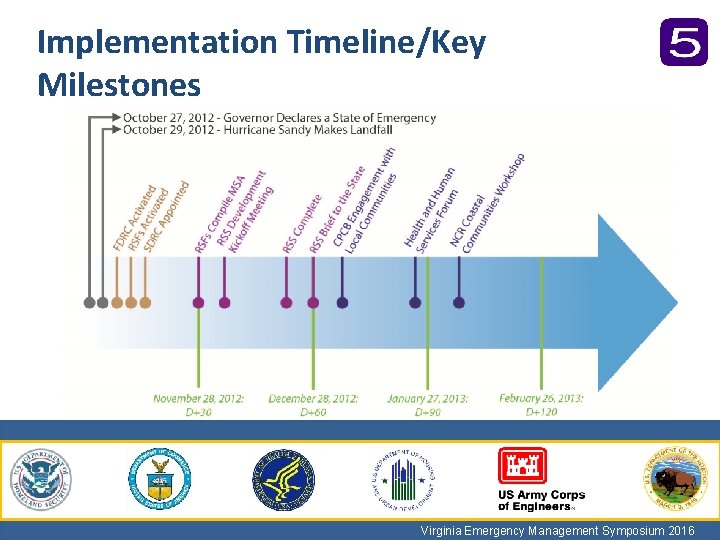
Implementation Timeline/Key Milestones Virginia Emergency Management Symposium 2016
NATIONAL DISASTER RECOVERY FRAMEWORK Questions? Michelle Diamond Community Planning & Capacity Building Coordinator michelle. diamond@fema. dhs. gov 215. 931. 5568 Virginia Emergency Management Symposium 2016