
NATIONAL CYCLONE RISK MITIGATION PROJECT NCRMP Sanjay K
- Slides: 19
NATIONAL CYCLONE RISK MITIGATION PROJECT (NCRMP) Sanjay K Sharma Env. Specialist NCRMP, NDMA
OUTLINE o Overview of NCRMP o Component of NCRMP o Mitigation Measures 2
Background q Indian population along the sea coast is most vulnerable to cyclones. q India has a history of cyclones, the most recent ones being: § Cyclone Phailin – Odisha & AP in Oct 2013 § § § Cyclone Hudhud – AP & Odisha in Oct 2014 Cyclone Nada - TN in 2016 Cyclone Vardha - TN & AP in 2016 Cyclone Titli - Odisha in Aug 2018 Cyclone Gaja - AP & TN in Nov 2018 3
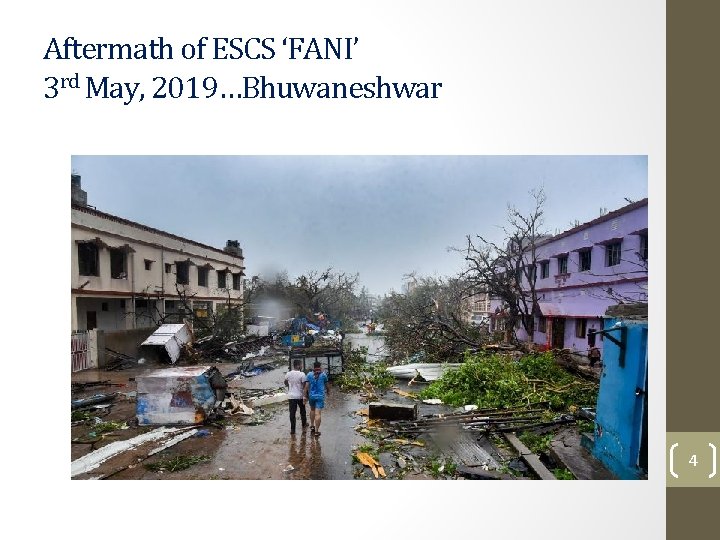
Aftermath of ESCS ‘FANI’ 3 rd May, 2019…Bhuwaneshwar 4
NCRMP- Overview § NCRMP is a flagship programme being implemented by NDMA in 8 Cyclone prone Coastal States. § NCRMP seeks to undertake suitable structural and non-structural measures to mitigate cyclone risks across the country. Objective: ü To reduce vulnerability to cyclone and other hydro-meteorological hazards of coastal communities. ü To increase the capacity of the State entities to effectively plan for and respond to disasters. q NCRMP Phase-I [2011 -2018] - Completed • States of AP and Odisha q NCRMP Phase-II [2015 -2021] - Ongoing • States of Gujarat, Maharashtra, Goa, Karnataka, Kerala and West Bengal 5
Components of NCRMP Component A – Early Warning Dissemination System (EWDS) and Last Mile Connectivity (LMC) Component B – Cyclone Risk Mitigation Infrastructure MPCS (Multi-Purpose Cyclone Shelters) Road/Bridge UGC (Underground electric cabling) Saline Embankment Component C – Technical Assistance for Multi-Hazard Risk Management & Capacity Building 6
Component - A: A Early Warning Dissemination System (EWDS) - Last Mile Connectivity (LMC) q Aims to reduce the vulnerability of coastal areas by addressing the existing gap in dissemination of warning to the communities. q EWDS is the state-of-art multi-technology option (Satellite, Radio, Mass Messaging, & Alert Siren) to provide reliable communication during disasters ensuring last–mile connectivity. § Leads to installation and operation of EWDS - enabling State and/or district/sub-district level control centre to send communication directly to the villages, using appropriate technologies. § To fail proof EWDS for disaster preparedness and response by preparing DM plan and organising mock drills and similar exercises. 7 Contd…
o Pre-Disaster Technology: § Group Alert based Message in the form of Text/ Voice SMS, FAX, Email Messages - to the State/District/ Authorities at Block level/Tehsil /Mandal /Community group Heads/Sarpanch of the village etc. • Such warning messages also sent to Media Broadcast Stations to broadcast on AM/FM Radios & TV. • Alert Siren System – at MPCS, Sea Beaches, District/Block EOCs, & FLCs. o During & Post-Disaster Technology: § Digital Mobile Radio (DMR) § § DMR Repeater Station- at Taluka/Block DMR Fixed Station- at MPCS DMR Mobile Station- In Vehicle DMR Handheld- Task Force § Satellite Based Communication § Satellite Phone § BGAN (Broadband Global Area Network) terminal § Portable VSAT (Very Small Aperture Terminal) 8
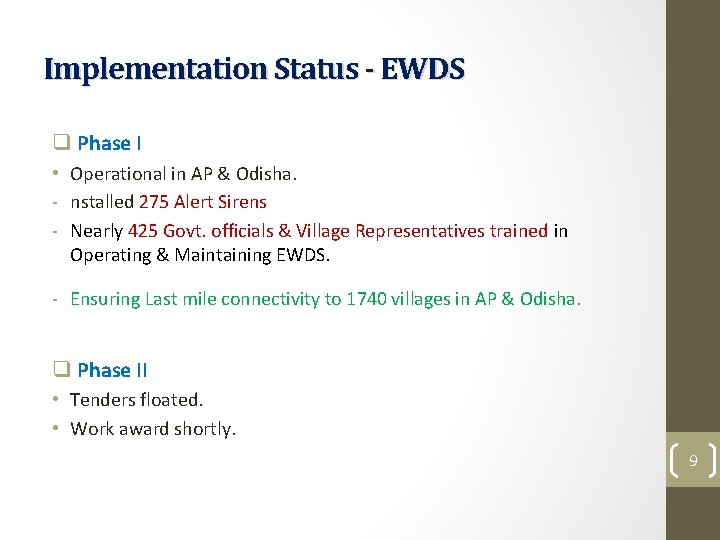
Implementation Status - EWDS q Phase I • Operational in AP & Odisha. - nstalled 275 Alert Sirens - Nearly 425 Govt. officials & Village Representatives trained in Operating & Maintaining EWDS. - Ensuring Last mile connectivity to 1740 villages in AP & Odisha. q Phase II • Tenders floated. • Work award shortly. 9
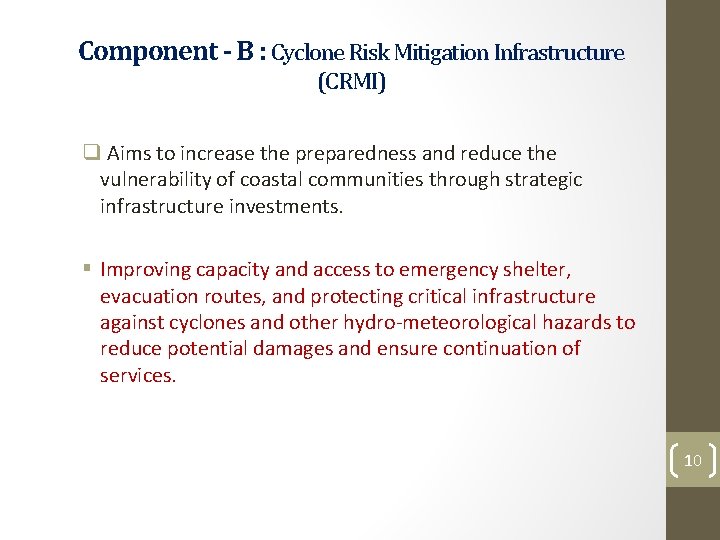
Component - B : Cyclone Risk Mitigation Infrastructure (CRMI) q Aims to increase the preparedness and reduce the vulnerability of coastal communities through strategic infrastructure investments. § Improving capacity and access to emergency shelter, evacuation routes, and protecting critical infrastructure against cyclones and other hydro-meteorological hazards to reduce potential damages and ensure continuation of services. 10
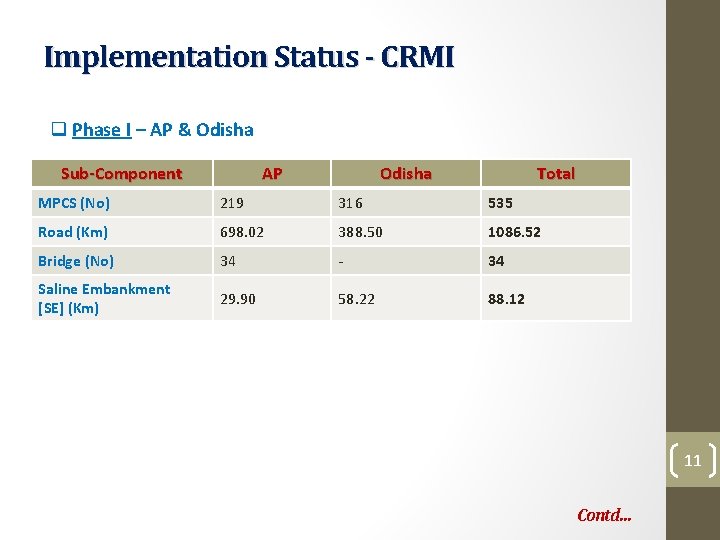
Implementation Status - CRMI q Phase I – AP & Odisha Sub-Component AP Odisha Total MPCS (No) 219 316 535 Road (Km) 698. 02 388. 50 1086. 52 Bridge (No) 34 - 34 Saline Embankment [SE] (Km) 29. 90 58. 22 88. 12 11 Contd…
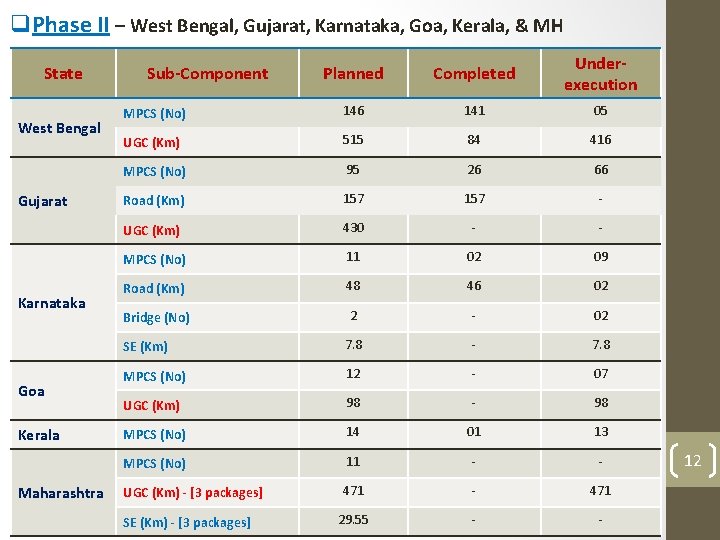
q. Phase II – West Bengal, Gujarat, Karnataka, Goa, Kerala, & MH State West Bengal Gujarat Karnataka Goa Kerala Maharashtra Planned Completed Underexecution MPCS (No) 146 141 05 UGC (Km) 515 84 416 MPCS (No) 95 26 66 Road (Km) 157 - UGC (Km) 430 - - MPCS (No) 11 02 09 Road (Km) 48 46 02 Bridge (No) 2 - 02 SE (Km) 7. 8 - 7. 8 MPCS (No) 12 - 07 UGC (Km) 98 - 98 MPCS (No) 14 01 13 MPCS (No) 11 - - UGC (Km) - [3 packages] 471 - 471 29. 55 - - Sub-Component SE (Km) - [3 packages] 12
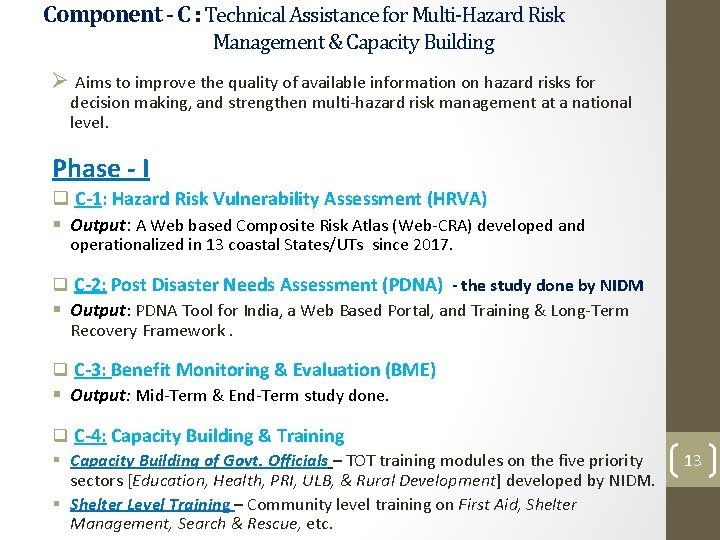
Component - C : Technical Assistance for Multi-Hazard Risk Management & Capacity Building Ø Aims to improve the quality of available information on hazard risks for decision making, and strengthen multi-hazard risk management at a national level. Phase - I q C-1: Hazard Risk Vulnerability Assessment (HRVA) § Output: A Web based Composite Risk Atlas (Web-CRA) developed and operationalized in 13 coastal States/UTs since 2017. q C-2: Post Disaster Needs Assessment (PDNA) - the study done by NIDM § Output: PDNA Tool for India, a Web Based Portal, and Training & Long-Term Recovery Framework. q C-3: Benefit Monitoring & Evaluation (BME) § Output: Mid-Term & End-Term study done. q C-4: Capacity Building & Training § Capacity Building of Govt. Officials – TOT training modules on the five priority sectors [Education, Health, PRI, ULB, & Rural Development] developed by NIDM. § Shelter Level Training – Community level training on First Aid, Shelter Management, Search & Rescue, etc. 13
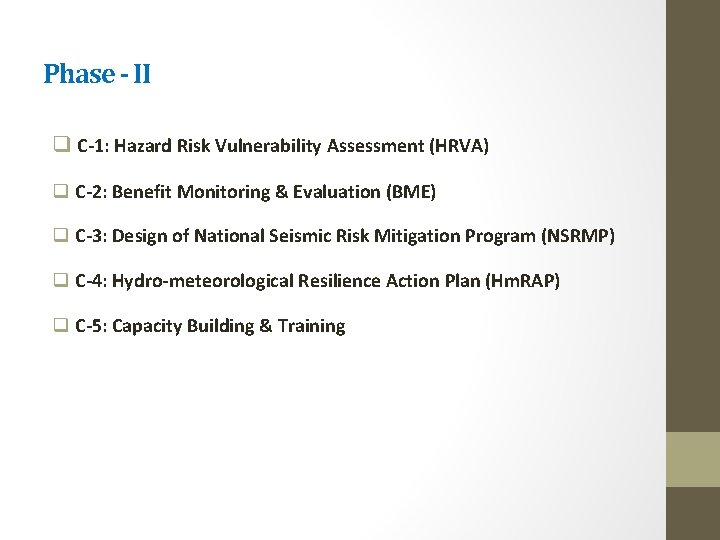
Phase - II q C-1: Hazard Risk Vulnerability Assessment (HRVA) q C-2: Benefit Monitoring & Evaluation (BME) q C-3: Design of National Seismic Risk Mitigation Program (NSRMP) q C-4: Hydro-meteorological Resilience Action Plan (Hm. RAP) q C-5: Capacity Building & Training
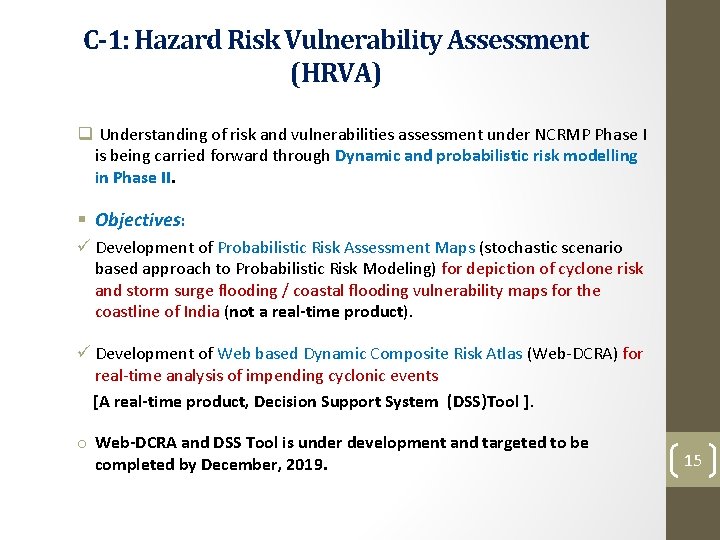
C-1: Hazard Risk Vulnerability Assessment (HRVA) q Understanding of risk and vulnerabilities assessment under NCRMP Phase I is being carried forward through Dynamic and probabilistic risk modelling in Phase II. § Objectives: ü Development of Probabilistic Risk Assessment Maps (stochastic scenario based approach to Probabilistic Risk Modeling) for depiction of cyclone risk and storm surge flooding / coastal flooding vulnerability maps for the coastline of India (not a real-time product). ü Development of Web based Dynamic Composite Risk Atlas (Web-DCRA) for real-time analysis of impending cyclonic events [A real-time product, Decision Support System (DSS)Tool ]. o Web-DCRA and DSS Tool is under development and targeted to be completed by December, 2019. 15
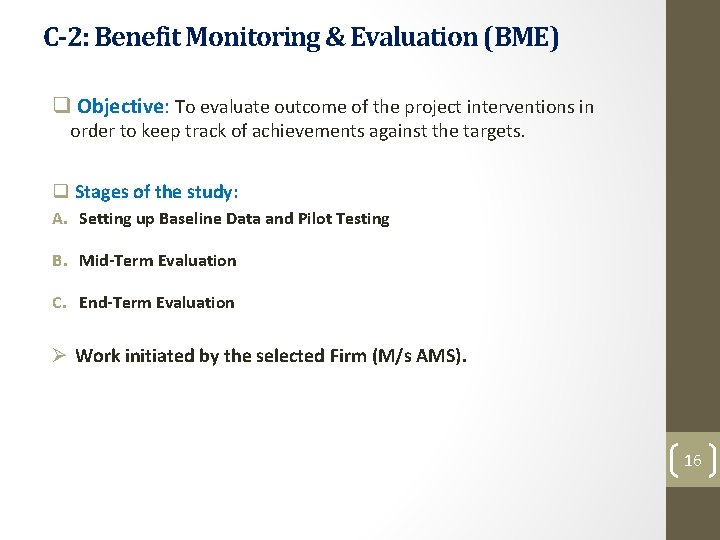
C-2: Benefit Monitoring & Evaluation (BME) q Objective: To evaluate outcome of the project interventions in order to keep track of achievements against the targets. q Stages of the study: A. Setting up Baseline Data and Pilot Testing B. Mid-Term Evaluation C. End-Term Evaluation Ø Work initiated by the selected Firm (M/s AMS). 16
C-3: Design of National Seismic Risk Mitigation Program (NSRMP) States - Assam, Bihar, HP, J & K, Manipur, Meghalaya, Tripura, & UK q Objective: to reduce vulnerability of communities and their assets to natural disaster by taking appropriate mitigating measures and to strengthen the capacity of National and State entities to effectively plan for and respond to earthquakes. • NSRMP is to be designed with a view to address the earthquake risk in the country – Phase I implementation to be started with 08 high risk states. [Other Seismic prone States/UTs will be taken up in subsequent phases] Ø Work initiated by the selected firm (M/s DDF-AKDN JV). 17
C-4: Hydro-meteorological Resilience Action Plan (Hm. RAP) States – Panaji (Goa), Ratnagiri (MH), Mangalore (Karnataka), Kochi (Kerala), Porbandar (Gujarat), & Bidhannagar (West Bengal) q Objective: to strengthen the capacity of National/ State and ULB entities to effectively plan for and respond to significant hydromet hazards/extreme events and climate change affecting urban areas. § focus on extreme weather events; develop resilience solutions/recommendations for sectors impacted by disasters such as agriculture, livelihoods, infrastructure, etc. , and urban hot-spot areas in helping develop urban resilience plans for six cities, one each in six NCRMP (Phase II) States. Ø Bids under-evaluation – Award shortly. 18
C-5: Capacity Building & Training q Capacity Building of Govt. Officials § TOT modules on the five priority sectors developed under NCRMP-I is being utilized. q Shelter Level Training – Community level training on First Aid, Shelter Management, Search & Rescue, etc. 19