
National Content Webinar CUSP A Framework for Success
National Content Webinar CUSP: A Framework for Success March 7, 2012 1
Today’s Speakers Marge Cannon, Medical Officer, CMS Minet Javellana, Health Insurance Specialist, CMS Barb Edson, Vice President of Clinical Quality, HRET Chris George, Director of National Projects, MHA Keystone Center Chris Goeschel, Director of Strategic Development and Research Initiatives at Armstrong Institute for Patient Safety and Quality, John Hopkins University • Mary Jo Skiba, Project Manager QI/Research, Alpena Regional Medical Center • • • 2
Working Together – The Players • Centers for Medicare & Medicaid Services Quality Improvement Organization (CMS QIO) • Agency for Health Care Research and Quality (AHRQ) • On the CUSP: Stop HAI www. onthecuspstophai. org • CLABSI National Project Team – Michigan Health & Hospital Association - Michigan Keystone Center for Patient Safety & Quality (MHA Keystone) – Armstrong Institute for Patient Safety and Quality Johns Hopkins University (JHU) – Health Research & Educational Trust (HRET), research affiliate of the American Hospital Association 3

Learning Objectives • Understand CUSP impact on safety • List CUSP components • Describe how a hospital implemented CUSP 4
The Michigan CUSP Experience Chris George, RN MS Director of National Projects Michigan Health & Hospital Association Keystone Center for Patient Safety & Quality
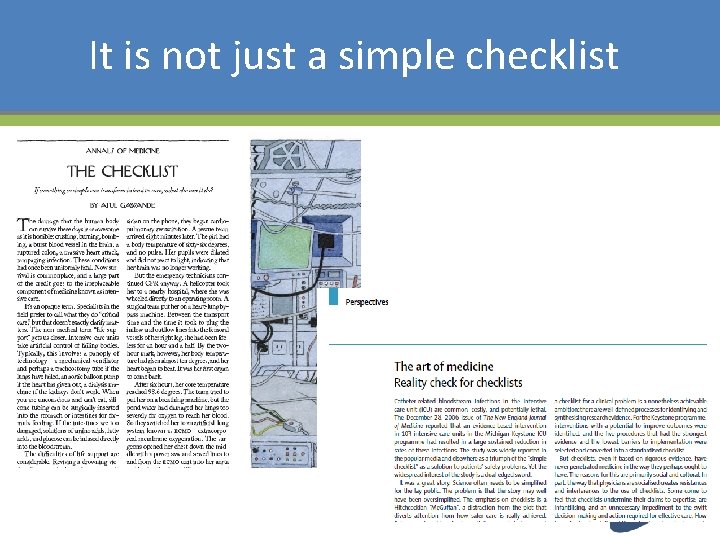
It is not just a simple checklist
CUSP – The Michigan Experience Use of CUSP tied with a technical intervention, such as central line-associated blood stream infection prevention “checklist. ” “Knowing the difference between adaptive and technical challenges is one of the key tasks of leadership. ” Ronald A. Heifetz 7
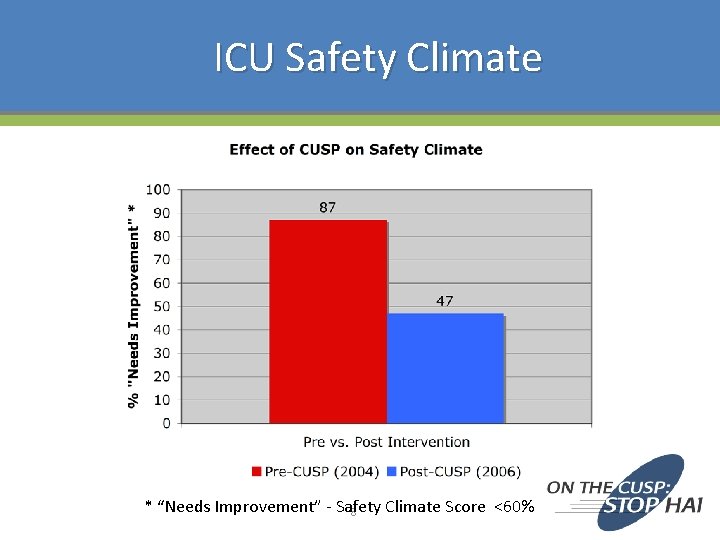
ICU Safety Climate * “Needs Improvement” - Safety Climate Score <60% 8
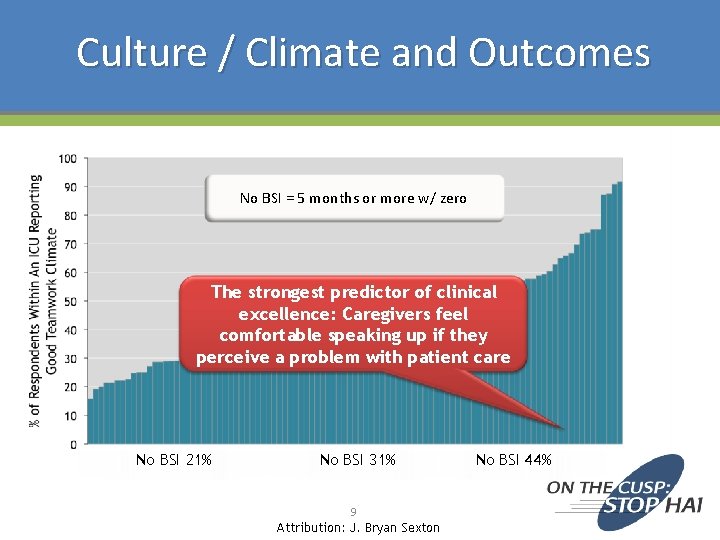
Culture / Climate and Outcomes No BSI = 5 months or more w/ zero The strongest predictor of clinical excellence: Caregivers feel comfortable speaking up if they perceive a problem with patient care No BSI 21% No BSI 31% 9 Attribution: J. Bryan Sexton No BSI 44%
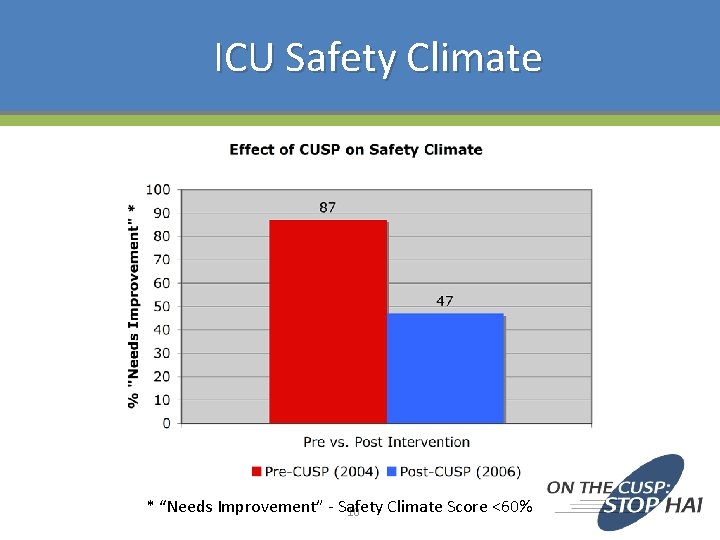
ICU Safety Climate * “Needs Improvement” - Safety Climate Score <60% 10
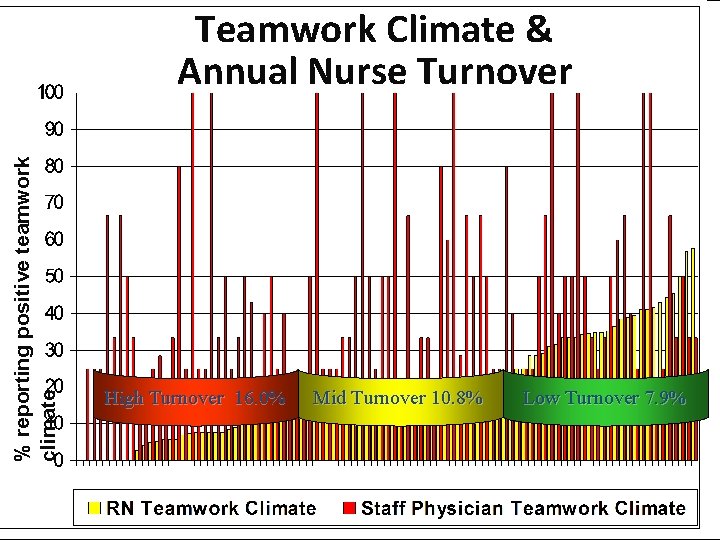
% reporting positive teamwork climate Teamwork Climate & Annual Nurse Turnover High Turnover 16. 0% Mid Turnover 10. 8% Low Turnover 7. 9%
“The reasonable man adapts himself to the world; the unreasonable one persists in trying to adapt the world to himself. Therefore all progress depends on the unreasonable man. ” Man and Superman George Bernard Shaw
The Comprehensive Unit-based Safety Program (CUSP): An Intervention to Learn from Mistakes and Improve Safety Culture Chris Goeschel, Sc. D MPA MPS RN FAAN Director, Strategic Development and Research Initiatives at Armstrong Institute for Patient Safety and Quality Johns Hopkins University 13
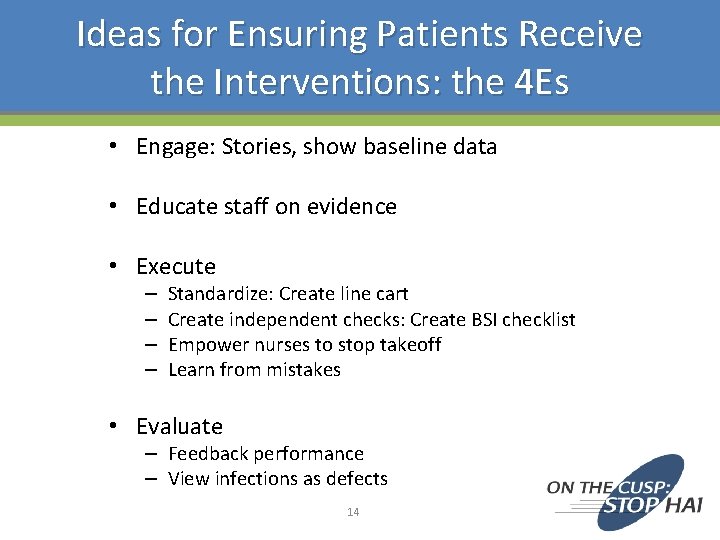
Ideas for Ensuring Patients Receive the Interventions: the 4 Es • Engage: Stories, show baseline data • Educate staff on evidence • Execute – – Standardize: Create line cart Create independent checks: Create BSI checklist Empower nurses to stop takeoff Learn from mistakes • Evaluate – Feedback performance – View infections as defects 14
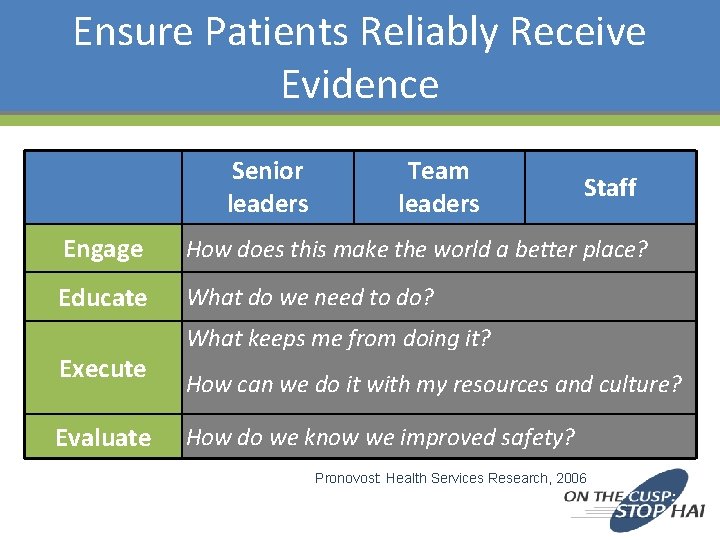
Ensure Patients Reliably Receive Evidence Senior leaders Team leaders Staff Engage How does this make the world a better place? Educate What do we need to do? Execute Evaluate What keeps me from doing it? How can we do it with my resources and culture? How do we know we improved safety? Pronovost: Health Services Research, 2006
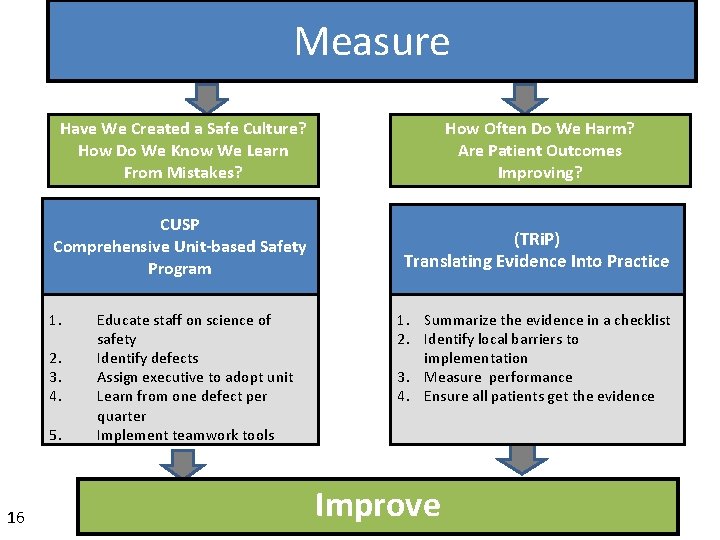
Measure Have We Created a Safe Culture? How Do We Know We Learn From Mistakes? How Often Do We Harm? Are Patient Outcomes Improving? CUSP Comprehensive Unit-based Safety Program (TRi. P) Translating Evidence Into Practice 1. 2. 3. 4. 5. 16 Educate staff on science of safety Identify defects Assign executive to adopt unit Learn from one defect per quarter Implement teamwork tools 1. Summarize the evidence in a checklist 2. Identify local barriers to implementation 3. Measure performance 4. Ensure all patients get the evidence Improve
What is CUSP? • Comprehensive Unit-based Safety Program • An intervention to learn from mistakes and improve safety culture www. onthecuspstophai. org 17
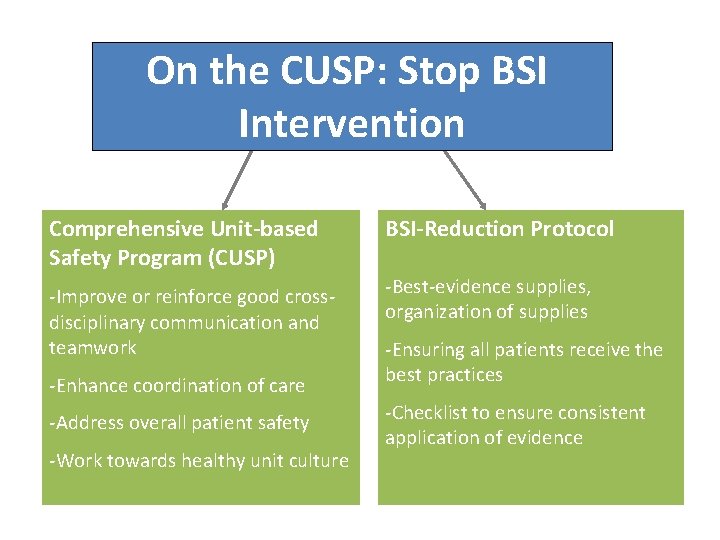
On the CUSP: Stop BSI Intervention Comprehensive Unit-based Safety Program (CUSP) -Improve or reinforce good crossdisciplinary communication and teamwork -Enhance coordination of care -Address overall patient safety -Work towards healthy unit culture BSI-Reduction Protocol -Best-evidence supplies, organization of supplies -Ensuring all patients receive the best practices -Checklist to ensure consistent application of evidence
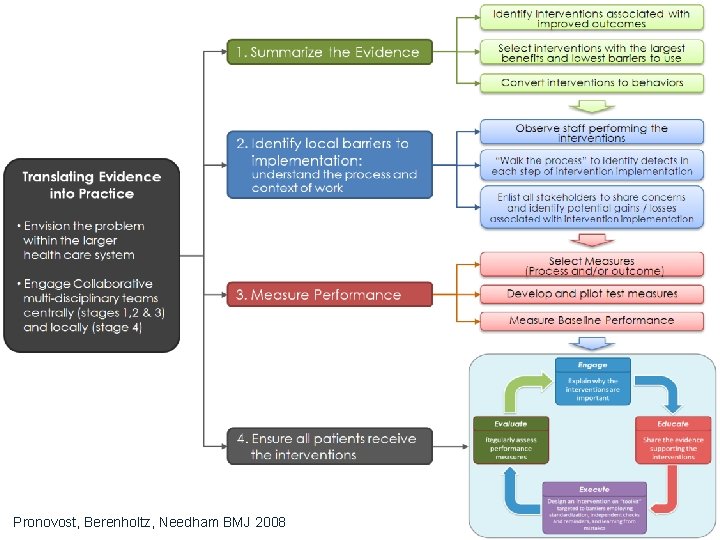
Pronovost, Berenholtz, Needham BMJ 2008
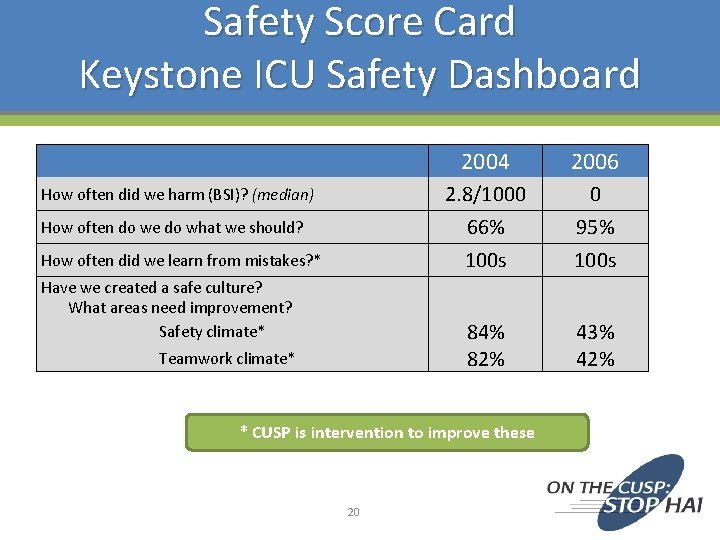
Safety Score Card Keystone ICU Safety Dashboard How often did we harm (BSI)? (median) How often do we do what we should? How often did we learn from mistakes? * Have we created a safe culture? What areas need improvement? Safety climate* Teamwork climate* 2004 2006 2. 8/1000 66% 100 s 0 95% 100 s 84% 82% 43% 42% * CUSP is intervention to improve these 20
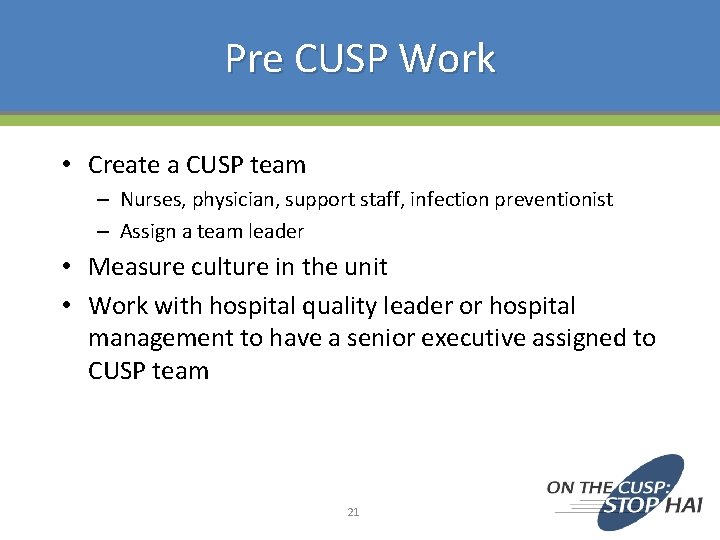
Pre CUSP Work • Create a CUSP team – Nurses, physician, support staff, infection preventionist – Assign a team leader • Measure culture in the unit • Work with hospital quality leader or hospital management to have a senior executive assigned to CUSP team 21
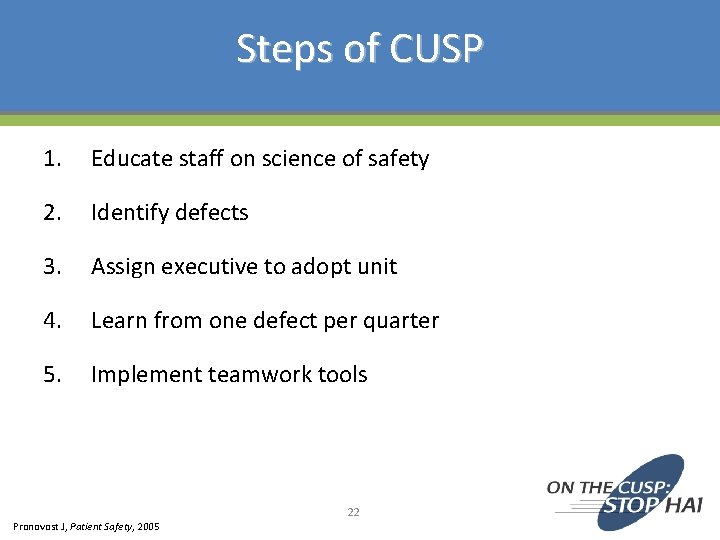
Steps of CUSP 1. Educate staff on science of safety 2. Identify defects 3. Assign executive to adopt unit 4. Learn from one defect per quarter 5. Implement teamwork tools Pronovost J, Patient Safety, 2005 22
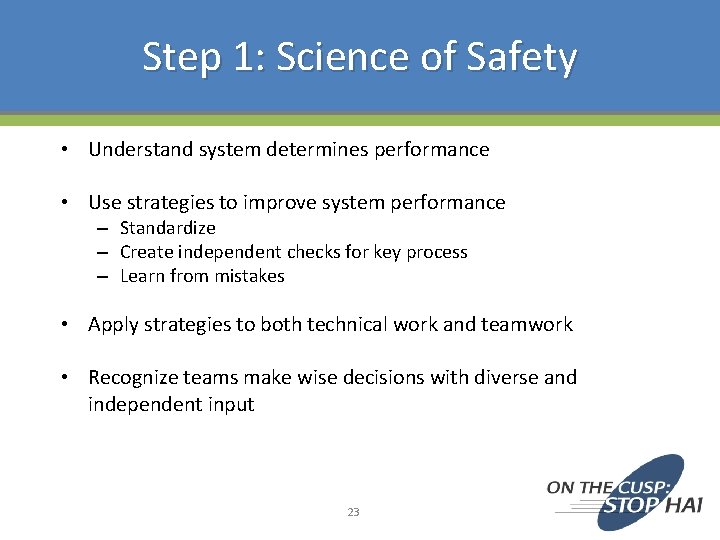
Step 1: Science of Safety • Understand system determines performance • Use strategies to improve system performance – Standardize – Create independent checks for key process – Learn from mistakes • Apply strategies to both technical work and teamwork • Recognize teams make wise decisions with diverse and independent input 23
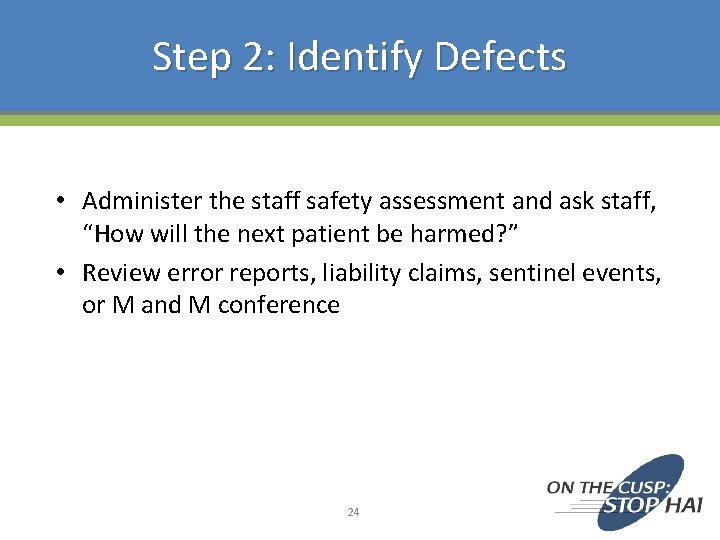
Step 2: Identify Defects • Administer the staff safety assessment and ask staff, “How will the next patient be harmed? ” • Review error reports, liability claims, sentinel events, or M and M conference 24
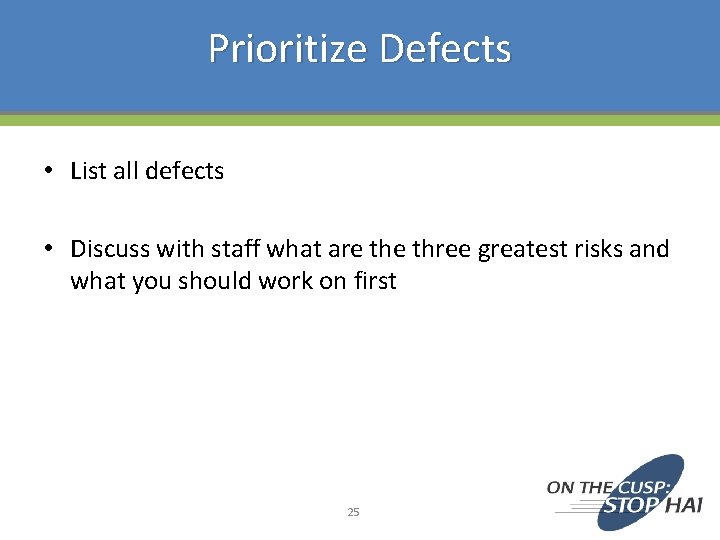
Prioritize Defects • List all defects • Discuss with staff what are three greatest risks and what you should work on first 25
Step 3: Executive Partnership • Executive should become a member of unit team • Executive should meet monthly with unit team • Executive should – – Review defects – Ensure unit team has resources to reduce risks – Hold team accountable for improving risks and central lineassociated blood steam infection rate 26
Step 4: Learning from Mistakes • • What happened? Why did it happen (system lenses)? What could you do to reduce risk? How do you know risk was reduced ? – Create policy, process, or procedure – Ensure staff know policy – Evaluate if policy is used correctly Pronovost 2005 JCJQI 27
Step 4 cont’d: Identify Most Important Contributing Factors • Rate each contributing factor – Importance of the problem and contributing factors • In causing the accident • In future accidents 28
Step 4 cont’d: Identify Most Effective Interventions • Rate each intervention – How well the intervention solves the problem or mitigates the contributing factors for the accident – Rate the team belief that the intervention will be implemented and executed as intended 29
Step 4 cont’d: Evaluate Whether Risks Were Reduced • • Did you create a policy or procedure Do staff know about the policy Are staff using it as intended Do staff believe risks have been reduced 30
Step 5: Teamwork Tools • • • Pronovost JCC, JCJQI Call list Daily goals Morning briefing Shadowing Culture check up 31
Step 5 cont’d: Call List • Ensure your unit has a process to identify which physician to page or call for each patient • Make sure call list is easily accessible and updated 32
Step 5 cont’d: Morning Briefing • Have a morning meeting with charge nurse and unit attending(s) about the unit-level plan for the day • Discuss work for the day – What happened during the evening – Who is being admitted and discharged today – What are potential risks during the day; how can we reduce these risks 33
Step 5 cont’d: Shadowing • Follow another type of clinician doing his or her job for between 2 and 4 hours • Have the shadower discuss with staff what he or she will do differently now that he or she has walked in another person’s shoes 34
CUSP is a Continuous Effort • • Add science of safety education to orientation Learn from one defect per quarter; share or post lessons Implement teamwork tools that best meet the unit’s needs Review details in the CUSP manual 35
Action Items -- CUSP • • Look over the CUSP manual with team members Brainstorm potential hazards with team Assess team composition with respect to CUSP elements Review pre-implementation checklist — where are you? 36
Action Items • Review content of Web site at www. onthecuspstophai. org • • Toolkits Slidesets Manuals Project Management Checklists – Pre-Implementation Checklist – CEO/Senior Leader Checklist – Infection Preventionist Checklist 37
References • Pronovost P, Weast B, Rosenstein B, et al. Implementing and validating a comprehensive unit-based safety program. J Pat Safety. 2005; 1(1): 33 -40. • Pronovost P, Berenholtz S, Dorman T, et al. Improving communication in the ICU using daily goals. J Crit Care. 2003; 18(2): 71 -75. • Pronovost PJ, Weast B, Bishop K, et al. Senior executive adopt-a-work unit: A model for safety improvement. Jt Comm J Qual Saf. 2004; 30(2): 59 -68. • Thompson DA, Holzmueller CG, Cafeo CL, et al. A morning briefing: Setting the stage for a clinically and operationally good day. Jt Comm J Qual and Saf. 2005; 31(8): 476 -479. 38
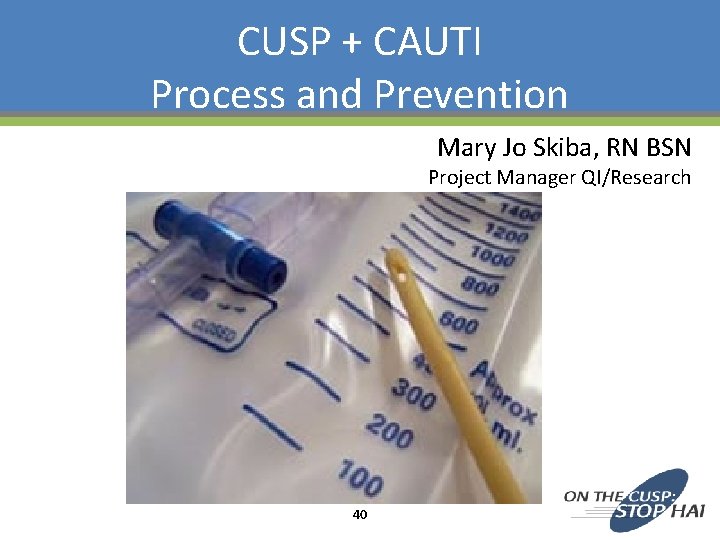
CUSP + CAUTI Process and Prevention Mary Jo Skiba, RN BSN Project Manager QI/Research 40
Objectives • Apply CUSP interventions to CAUTI project • Remove barriers/identify steps to successful CAUTI project initiation • Use CUSP to maintain success 41
Science of Safety Education • Education done prior to CAUTI • Safety survey to identify at-risk departments • Mandatory science of safety training 42
Project Planning • • CAUTI Team Policies Awareness campaign Data collection plan Project start date Education Plan for follow-up 43
Project Planning • Establish and engage CAUTI team members – – Involve frontline staff – Respect the wisdom Have a physician champion Include charge nurses/staff development Engage an executive leader • Identify defects – Review baseline data – CAUTI rate – Brainstorm safety concerns – Determine the scope of your initial project • Policy - Urinary catheterization – Review, revise, consolidate – Use policy in toolkit – Don’t re-create the wheel 44
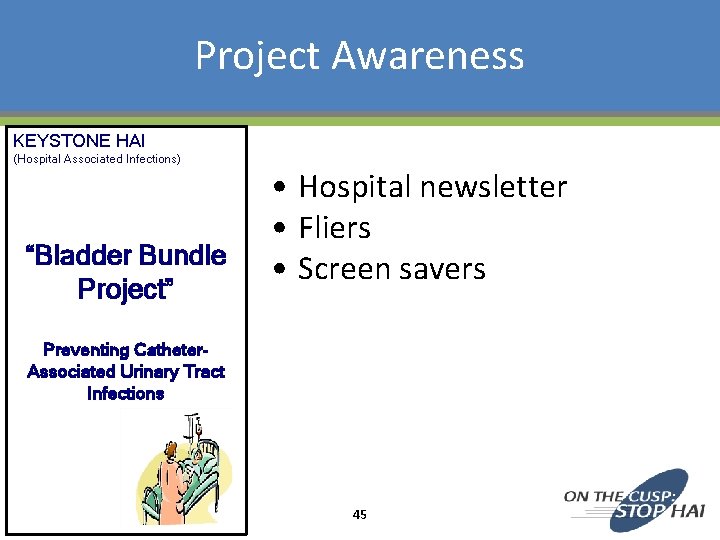
Project Awareness KEYSTONE HAI (Hospital Associated Infections) “Bladder Bundle Project” • Hospital newsletter • Fliers • Screen savers Preventing Catheter. Associated Urinary Tract Infections 45
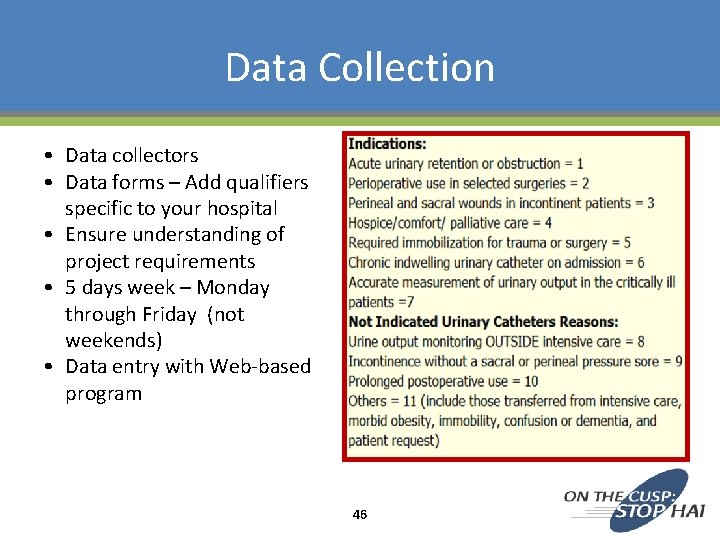
Data Collection • Data collectors • Data forms – Add qualifiers specific to your hospital • Ensure understanding of project requirements • 5 days week – Monday through Friday (not weekends) • Data entry with Web-based program 46
Planning Education Identify Defects -- Plan Ahead to Prevent Roadblocks • Nursing • Physicians • Who will be trained • Who will train • How will we train • When will we train • How will we do makeups • How much ongoing training or re-training needed 47
Educate on the Evidence 1. Didactic • • • CAUTI face-to-face inservice All nursing/aides Guideline for prevention of CAUTI Physician CME Department meetings 2. Demonstration of insertion competency 48
Developing CAUTI Education • Don’t re-create the wheel • Use other hospitals’ Power. Point slides • Multiple CAUTI toolkits • Update/revise to fit 49
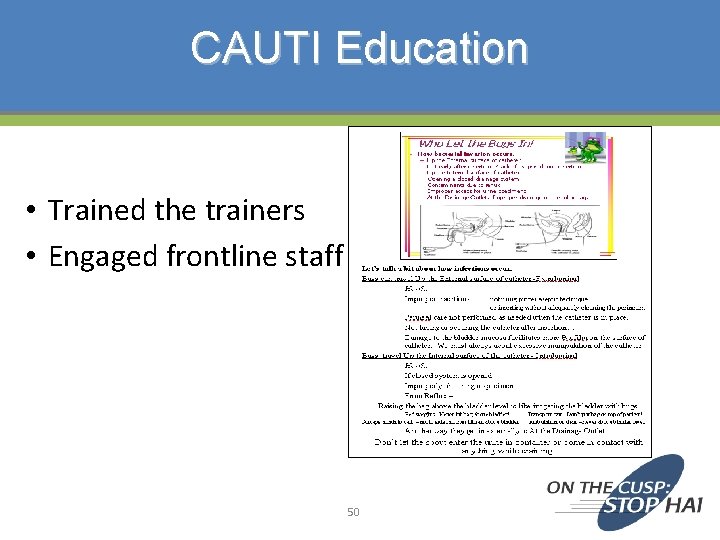
CAUTI Education • Trained the trainers • Engaged frontline staff 50
Urinary Catheter Insertion Competency • Traveling mannequin • 100 percent of aides and all nurse frequent inserters (ED, OR, WHU, IP rehab, ICU) • Read policy • Take quiz • Perform procedure • Instant remediation and repeat demonstration 51
Evaluate - Learn from Defects • 167 Competencies • Average 15 min/staff member • 41 aides, 126 nurses Improper cleaning Improper gloving Contaminated field Didn’t know needleless cath port for specimens 26 24 45 30 52
Execute New Plan • Improvement plan for competency • Require field competency all aides within 2 months, supervised by RNs • Newly hired aides trained by RNs • Yearly aide hands-on demo of competency 53
Other Strategies • Caths flagged with date of insertion • Secured to legs • Specimen collection for culture - Don’t use first urine drained from catheter - ED patients – Prior to collection, change catheter unless known change within 7 days - Inpatients – If catheter in for 7 days must change prior to specimen collection • Perineal hygiene prior to cath • “John Door” educational posters 54
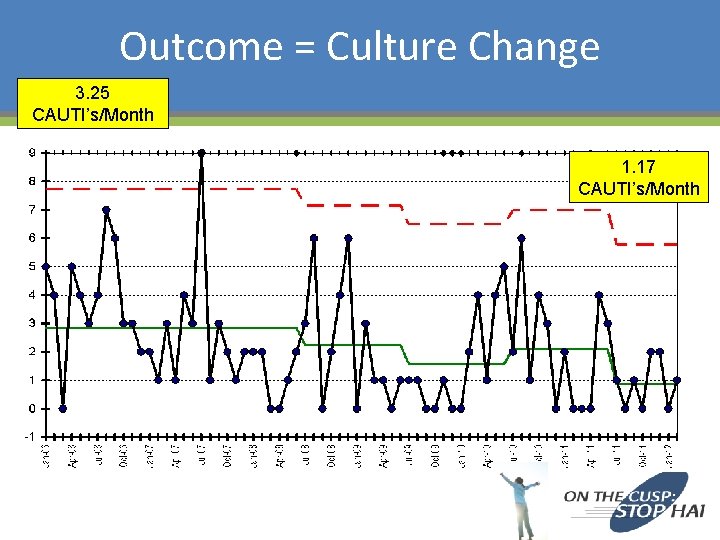
Outcome = Culture Change 3. 25 CAUTI’s/Month 1. 17 CAUTI’s/Month
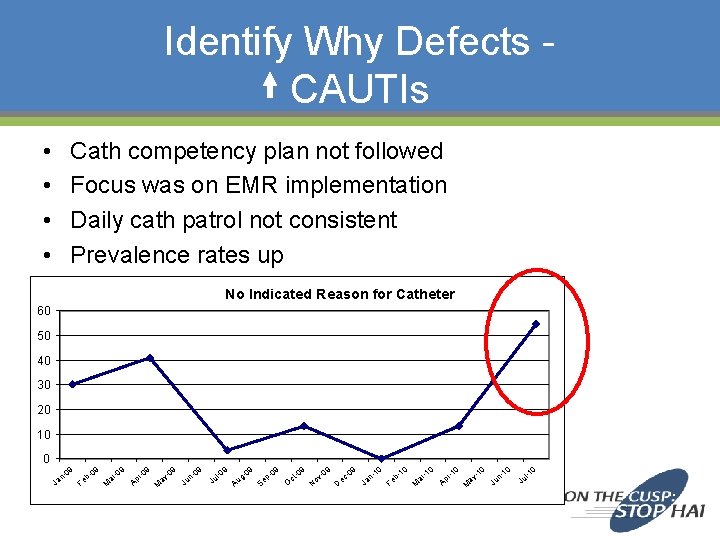
Identify Why Defects CAUTIs • • Cath competency plan not followed Focus was on EMR implementation Daily cath patrol not consistent Prevalence rates up No Indicated Reason for Catheter 60 50 40 30 20 10 0 09 n- Ja 09 b- Fe ar M 9 -0 9 r-0 Ap 9 -0 ay M 09 n. Ju 9 l-0 Ju 09 g. Au 9 9 9 -0 p Se -0 ct O 0 v- No 09 c- De 0 1 n- Ja 10 b- Fe 0 -1 ar M 0 0 -1 ay -1 r Ap M n. Ju 10 0 l-1 Ju
Execute New Plans • Annual competency aide and ED/OR nurses • Imbedded competency orientation/annual skill evaluations • Agenda item every leadership/staff meeting • Charge nurse daily cath patrol • Feedback monthly staff and physicians 57
Execute New Plans • Build cath necessity into EMR • Consider decrease size standard cath - #16 to 14 • ED data capture of cath necessity 58
CUSP - Not a Linear Process “You might have to fight the battle more than once in order to win it. ” (Margaret Thatcher) Don’t worry alone. CUSP is a team sport. “Shoot for the moon. Even if you miss, you'll land among the stars. ” (Les Brown) Questions? mjskiba@agh. org 59
Polling Questions 1) Have – – you ever heard of the Comprehensive Unit-based Safety Program (CUSP) before? I have never heard of CUSP I have heard of CUSP, but have not implemented it I have heard of CUSP, but have not successfully implemented it Have implemented CUSP successfully and actively using it in my unit 2) My senior executive regularly attends safety meetings on my unit, and can identify the top three safety issues that our safety team is currently working on: – Very rarely attends and is out of touch with our unit safety issues – Intermittently attends, and is somewhat aware of our unit safety issues – Attends whenever possible, and is aware of our unit’s top three safety issues 3) By ensuring that your senior executive is a part of your safety team, meeting monthly with your unit team, and holding your unit team accountable for improving risks surrounding a hospital inquired condition, my unit will be successfully utilizing the executive partnership component of CUSP? – No, not at all – Not sure – Yes, those are the main elements of the executive partnership component of CUSP 60
- Slides: 60