
National Conference on Public Employee Retirement Systems Public
National Conference on Public Employee Retirement Systems Public Pensions & Social Security Hank Kim, Esq. Executive Director & Counsel National Conference on Public Employee Retirement Systems 1
National Conference on Public Employee Retirement Systems Presentation Overview • Social Security Facts • Social Security Offsets • Wrap up and Q & As
National Conference on Public Employee Retirement Systems Will Social Security Be There for Me? • Yes! A better question is: How might Social Security change? • Social Security reforms are needed to address the long-range deficit facing the program. • However, NCPERS opposes mandatory Social Security coverage for newly hired State and local government workers. 3
National Conference on Public Employee Retirement Systems How Do I Qualify? • Must have 40 credits-roughly 10 years of Social Security taxed work (not consecutive) • In 2016, earn 1 credit for each $1, 260 earned, but no more than 4 credits/year ($5, 040) • Or qualify for dependent’s benefits on Spouse’s record 4
National Conference on Public Employee Retirement Systems Relationship Between Earnings & Benefits • Benefits are earnings related— the higher the earnings, the higher the benefit • The benefit formula is weighted in favor of low wage earners— the lower the earnings, the higher the replacement rate (initial benefits as a percent of pre-retirement earnings)
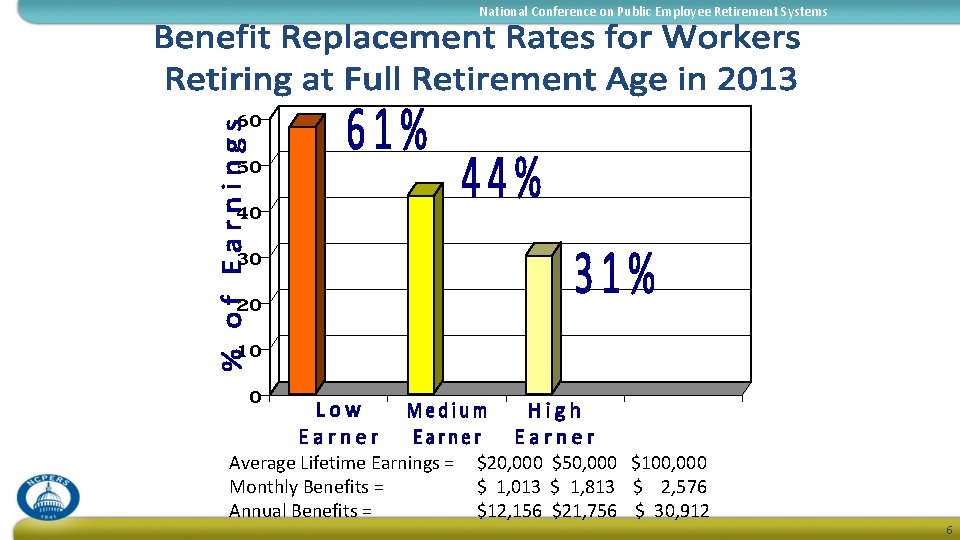
National Conference on Public Employee Retirement Systems 60 50 40 30 20 10 0 Average Lifetime Earnings = Monthly Benefits = Annual Benefits = $20, 000 $50, 000 $100, 000 $ 1, 013 $ 1, 813 $ 2, 576 $12, 156 $21, 756 $ 30, 912 6
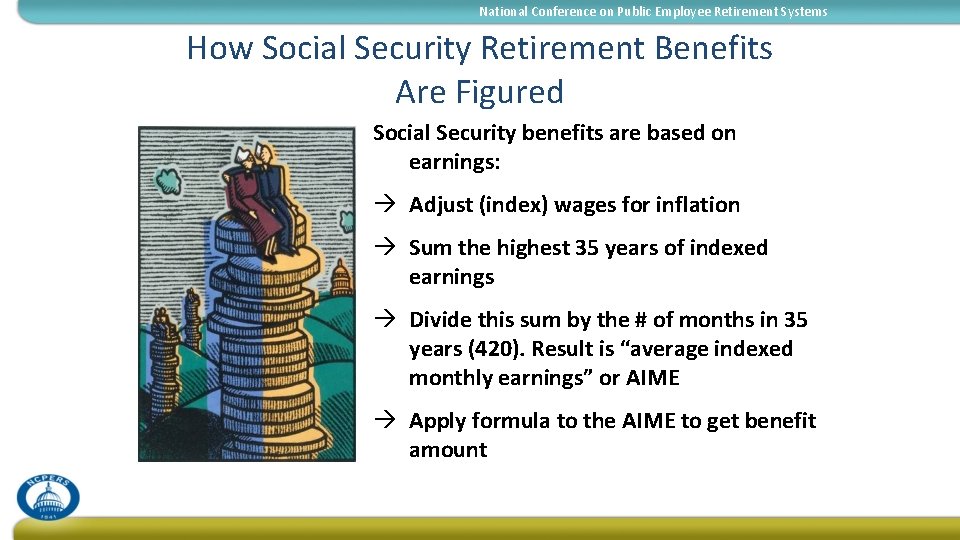
National Conference on Public Employee Retirement Systems How Social Security Retirement Benefits Are Figured Social Security benefits are based on earnings: à Adjust (index) wages for inflation à Sum the highest 35 years of indexed earnings à Divide this sum by the # of months in 35 years (420). Result is “average indexed monthly earnings” or AIME à Apply formula to the AIME to get benefit amount
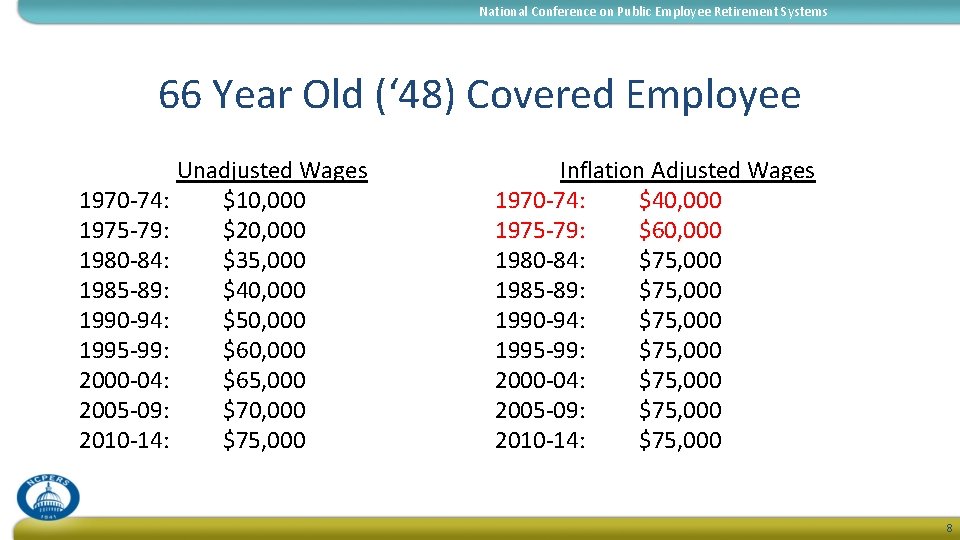
National Conference on Public Employee Retirement Systems 66 Year Old (‘ 48) Covered Employee Unadjusted Wages 1970 -74: $10, 000 1975 -79: $20, 000 1980 -84: $35, 000 1985 -89: $40, 000 1990 -94: $50, 000 1995 -99: $60, 000 2000 -04: $65, 000 2005 -09: $70, 000 2010 -14: $75, 000 Inflation Adjusted Wages 1970 -74: $40, 000 1975 -79: $60, 000 1980 -84: $75, 000 1985 -89: $75, 000 1990 -94: $75, 000 1995 -99: $75, 000 2000 -04: $75, 000 2005 -09: $75, 000 2010 -14: $75, 000 8
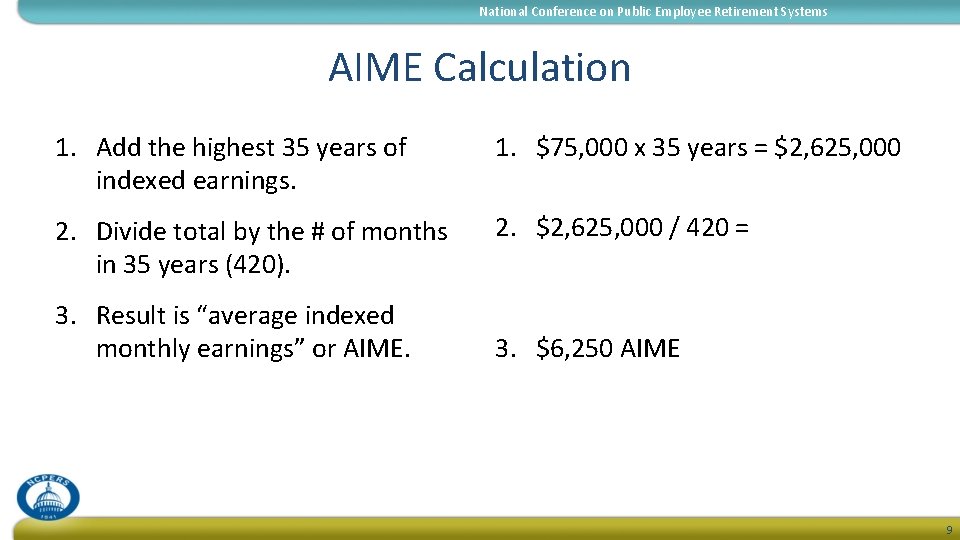
National Conference on Public Employee Retirement Systems AIME Calculation 1. Add the highest 35 years of indexed earnings. 1. $75, 000 x 35 years = $2, 625, 000 2. Divide total by the # of months in 35 years (420). 2. $2, 625, 000 / 420 = 3. Result is “average indexed monthly earnings” or AIME. 3. $6, 250 AIME 9
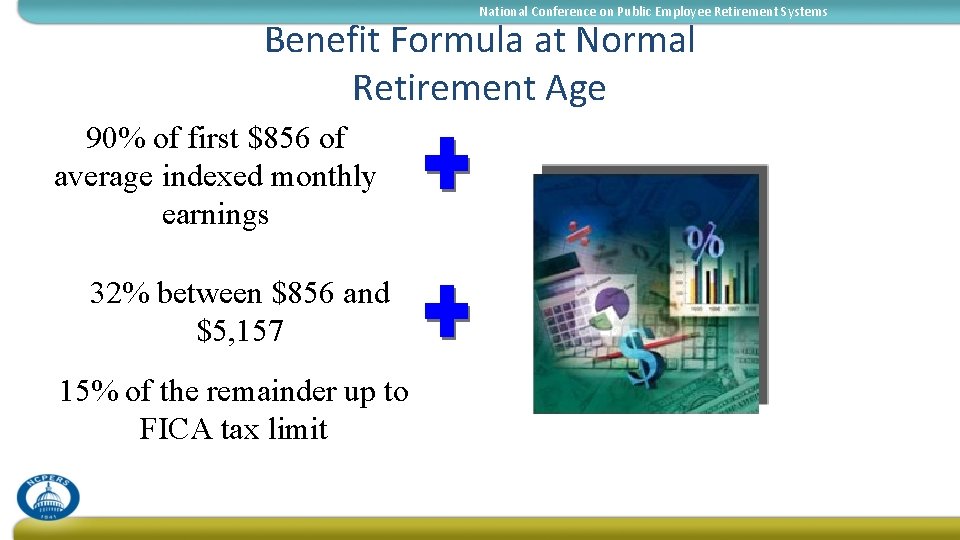
National Conference on Public Employee Retirement Systems Benefit Formula at Normal Retirement Age 90% of first $856 of average indexed monthly earnings 32% between $856 and $5, 157 15% of the remainder up to FICA tax limit
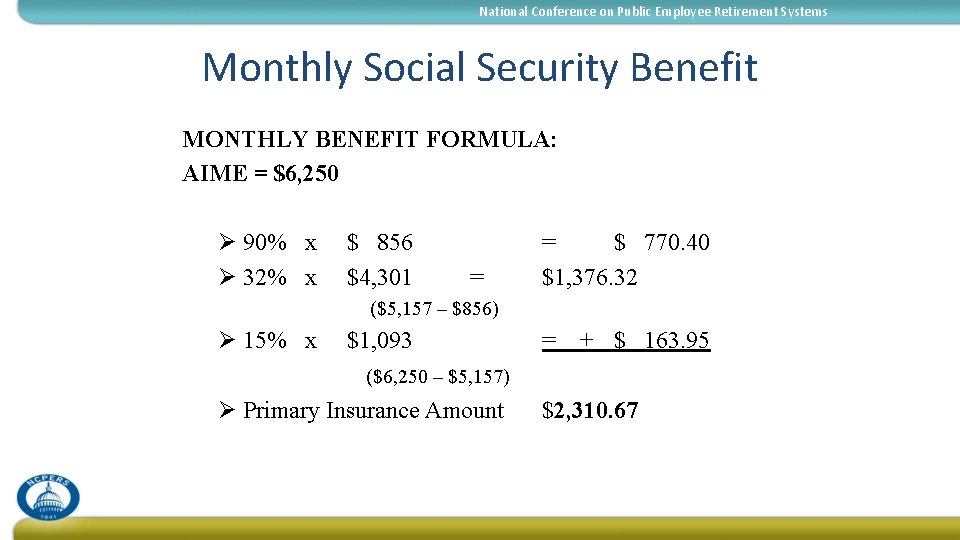
National Conference on Public Employee Retirement Systems Monthly Social Security Benefit MONTHLY BENEFIT FORMULA: AIME = $6, 250 Ø 90% x Ø 32% x $ 856 $4, 301 = = $ 770. 40 $1, 376. 32 ($5, 157 – $856) Ø 15% x $1, 093 = + $ 163. 95 ($6, 250 – $5, 157) Ø Primary Insurance Amount $2, 310. 67
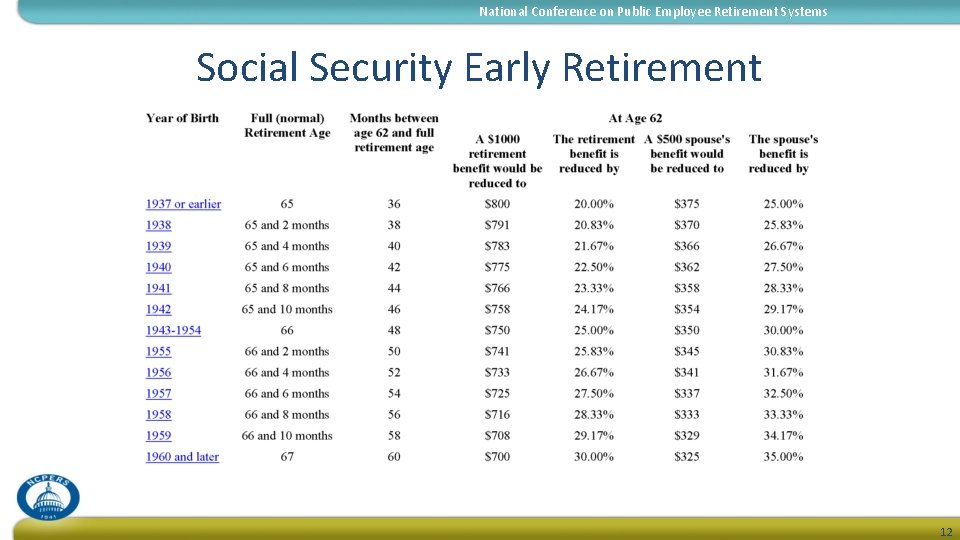
National Conference on Public Employee Retirement Systems Social Security Early Retirement 12
National Conference on Public Employee Retirement Systems Non-covered Employees • About 6. 8 million state and local government employees are not covered by Social Security. • These workers account for about 28% of all State and local government employees. 13
National Conference on Public Employee Retirement Systems Governmental Employees • If you pay into Social Security, no offset. • If you DO NOT pay into Social Security and receive a pension from that work, there are offsets that could affect you: – Windfall Elimination Provision – Government Pension Offset
National Conference on Public Employee Retirement Systems Offsets -- WEP & GPO • The windfall elimination provision (WEP) and the government pension offset (GPO) affect people with pensions from noncovered employment. • The WEP affects benefits on the record of retired or disabled worker. • The GPO affects benefits received as a spouse or widow(er)— dependent’s benefits.
National Conference on Public Employee Retirement Systems Windfall Elimination Provision WEP Affects: • Retired & disabled workers with non-covered pensions who have enough covered earnings to receive a Social Security benefit based on their own work.
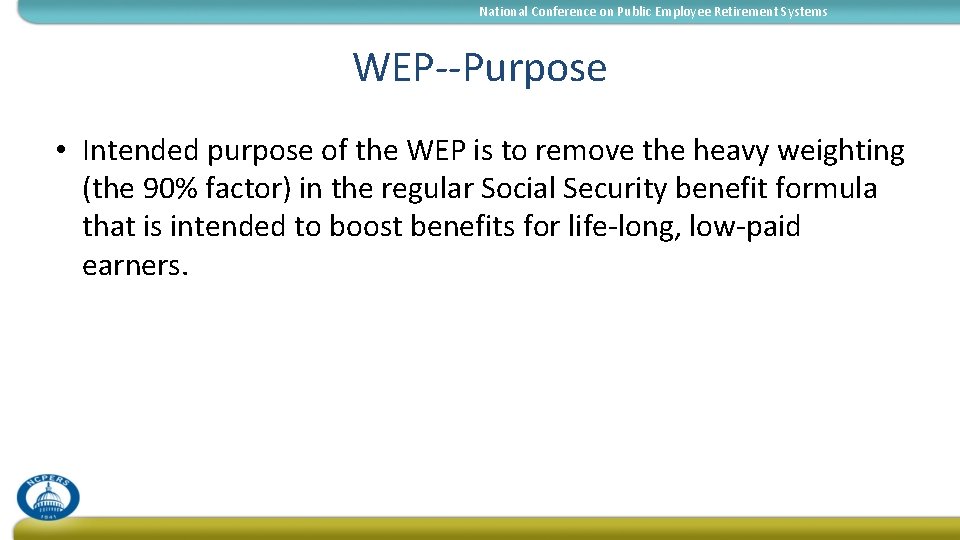
National Conference on Public Employee Retirement Systems WEP--Purpose • Intended purpose of the WEP is to remove the heavy weighting (the 90% factor) in the regular Social Security benefit formula that is intended to boost benefits for life-long, low-paid earners.
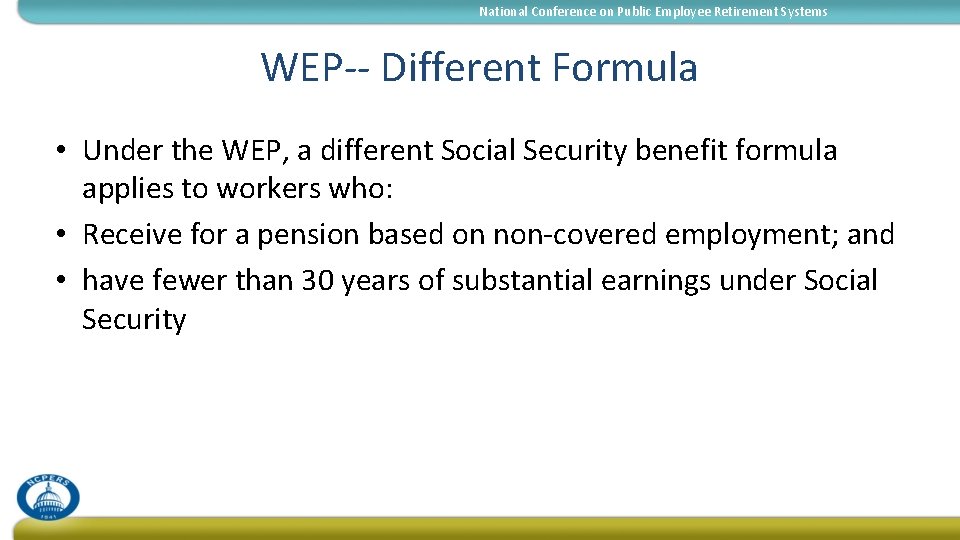
National Conference on Public Employee Retirement Systems WEP-- Different Formula • Under the WEP, a different Social Security benefit formula applies to workers who: • Receive for a pension based on non-covered employment; and • have fewer than 30 years of substantial earnings under Social Security
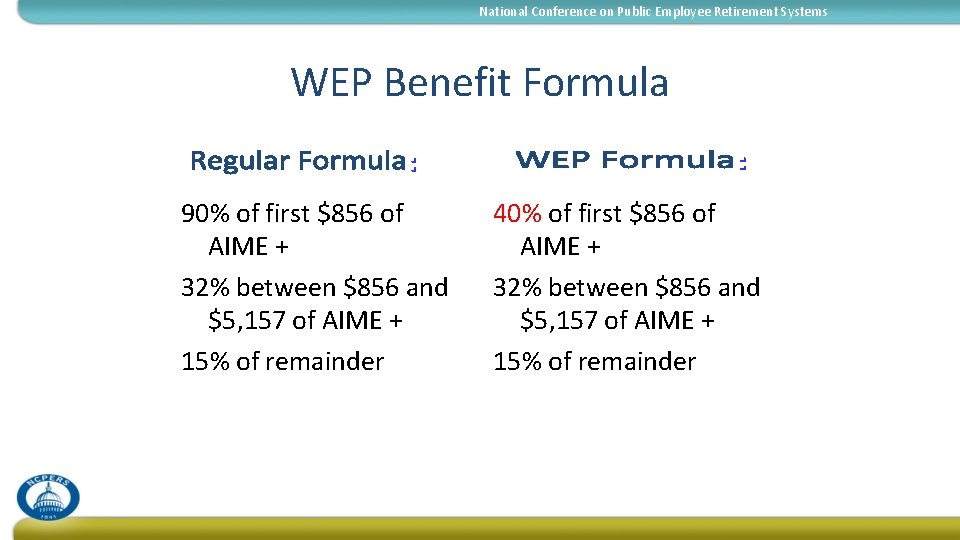
National Conference on Public Employee Retirement Systems WEP Benefit Formula 90% of first $856 of AIME + 32% between $856 and $5, 157 of AIME + 15% of remainder 40% of first $856 of AIME + 32% between $856 and $5, 157 of AIME + 15% of remainder
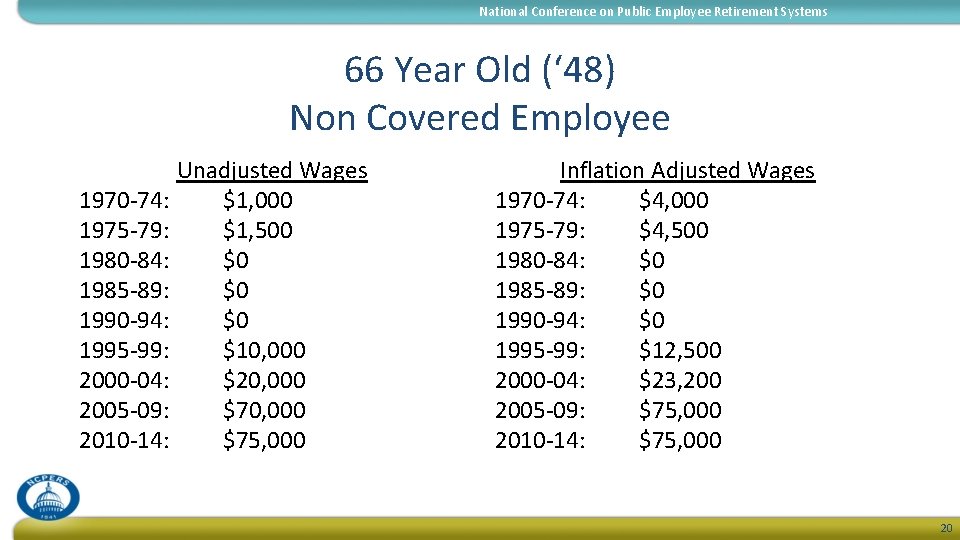
National Conference on Public Employee Retirement Systems 66 Year Old (‘ 48) Non Covered Employee Unadjusted Wages 1970 -74: $1, 000 1975 -79: $1, 500 1980 -84: $0 1985 -89: $0 1990 -94: $0 1995 -99: $10, 000 2000 -04: $20, 000 2005 -09: $70, 000 2010 -14: $75, 000 Inflation Adjusted Wages 1970 -74: $4, 000 1975 -79: $4, 500 1980 -84: $0 1985 -89: $0 1990 -94: $0 1995 -99: $12, 500 2000 -04: $23, 2005 -09: $75, 000 2010 -14: $75, 000 20
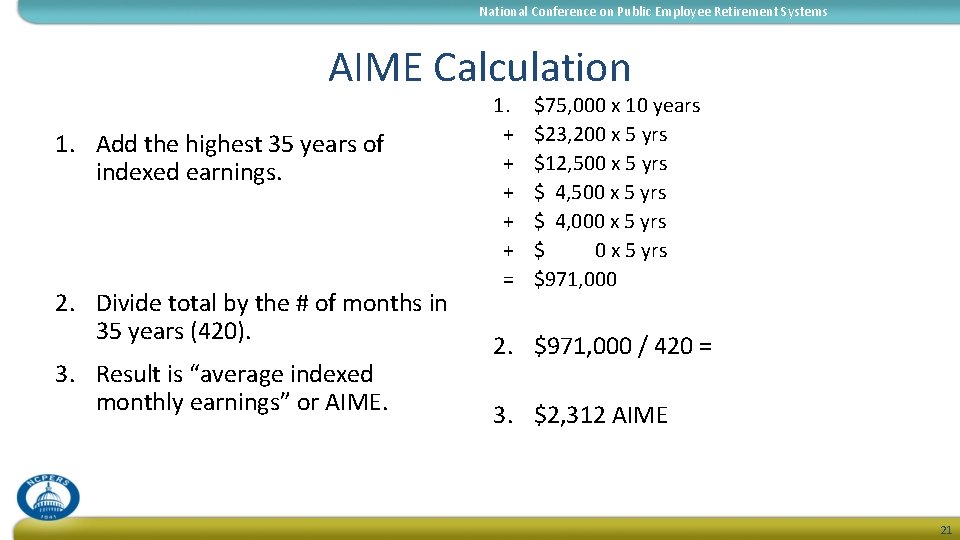
National Conference on Public Employee Retirement Systems AIME Calculation 1. Add the highest 35 years of indexed earnings. 2. Divide total by the # of months in 35 years (420). 3. Result is “average indexed monthly earnings” or AIME. 1. + + + = $75, 000 x 10 years $23, 200 x 5 yrs $12, 500 x 5 yrs $ 4, 000 x 5 yrs $971, 000 2. $971, 000 / 420 = 3. $2, 312 AIME 21
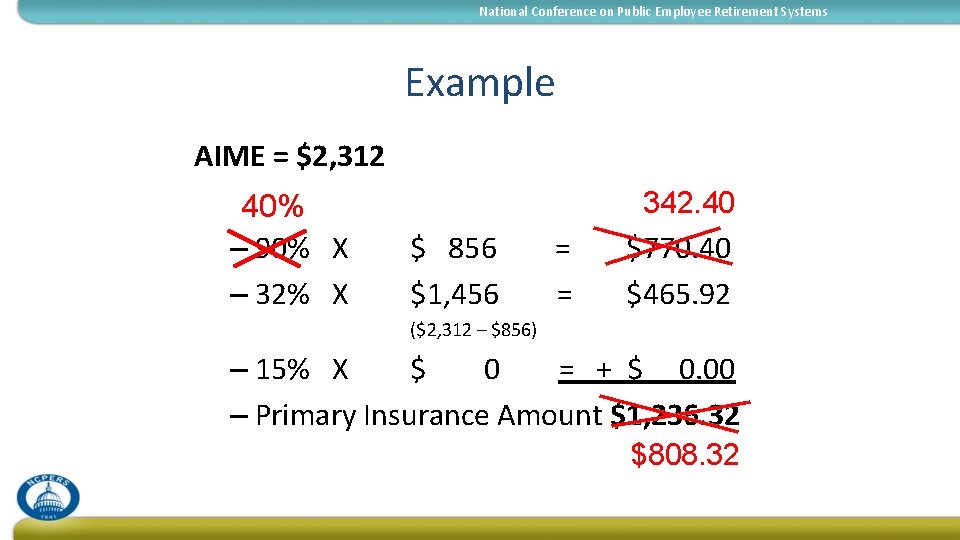
National Conference on Public Employee Retirement Systems Example AIME = $2, 312 40% – 90% X – 32% X 342. 40 $ 856 $1, 456 = = $770. 40 $465. 92 ($2, 312 – $856) – 15% X $ 0 = + $ 0. 00 – Primary Insurance Amount $1, 236. 32 $808. 32
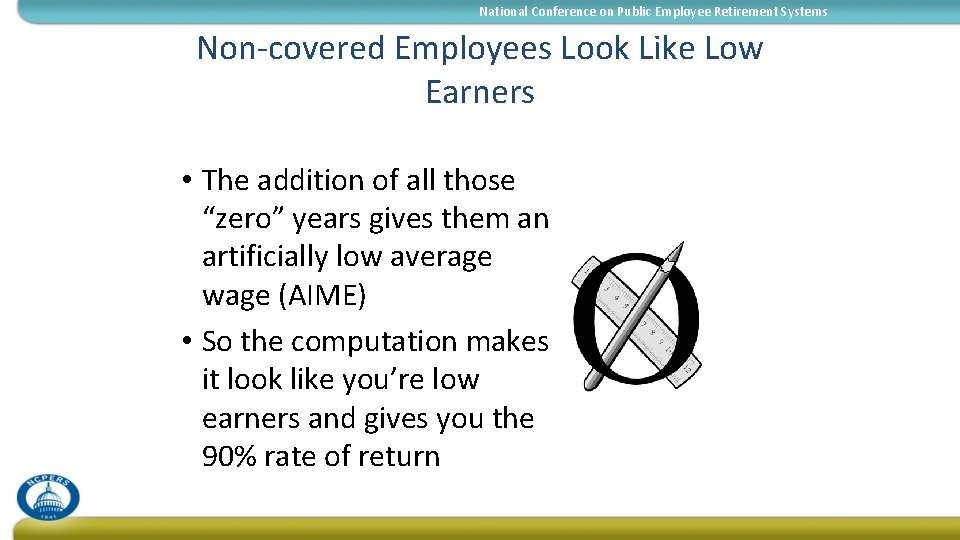
National Conference on Public Employee Retirement Systems Non-covered Employees Look Like Low Earners • The addition of all those “zero” years gives them an artificially low average wage (AIME) • So the computation makes it look like you’re low earners and gives you the 90% rate of return
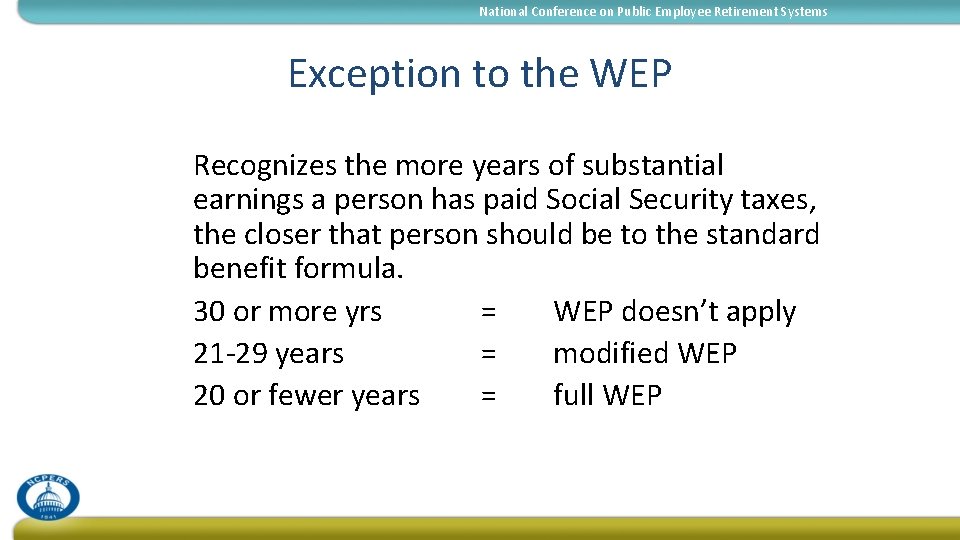
National Conference on Public Employee Retirement Systems Exception to the WEP Recognizes the more years of substantial earnings a person has paid Social Security taxes, the closer that person should be to the standard benefit formula. 30 or more yrs = WEP doesn’t apply 21 -29 years = modified WEP 20 or fewer years = full WEP
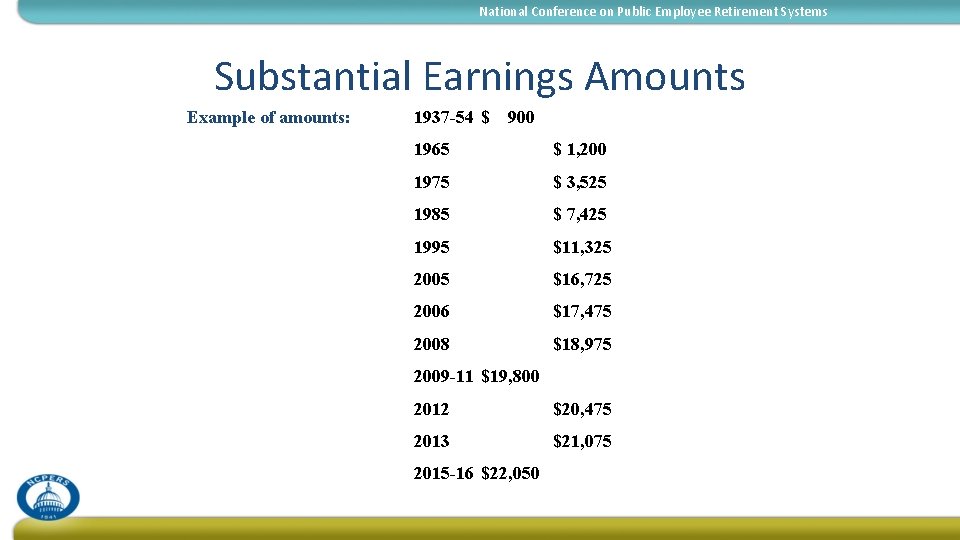
National Conference on Public Employee Retirement Systems Substantial Earnings Amounts Example of amounts: 1937 -54 $ 900 1965 $ 1, 200 1975 $ 3, 525 1985 $ 7, 425 1995 $11, 325 2005 $16, 725 2006 $17, 475 2008 $18, 975 2009 -11 $19, 800 2012 $20, 475 2013 $21, 075 2015 -16 $22, 050
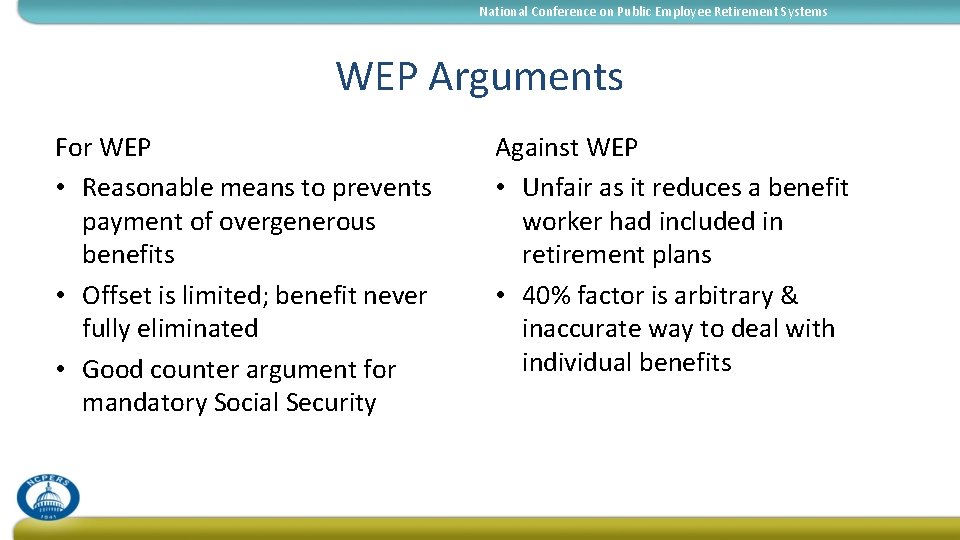
National Conference on Public Employee Retirement Systems WEP Arguments For WEP • Reasonable means to prevents payment of overgenerous benefits • Offset is limited; benefit never fully eliminated • Good counter argument for mandatory Social Security Against WEP • Unfair as it reduces a benefit worker had included in retirement plans • 40% factor is arbitrary & inaccurate way to deal with individual benefits
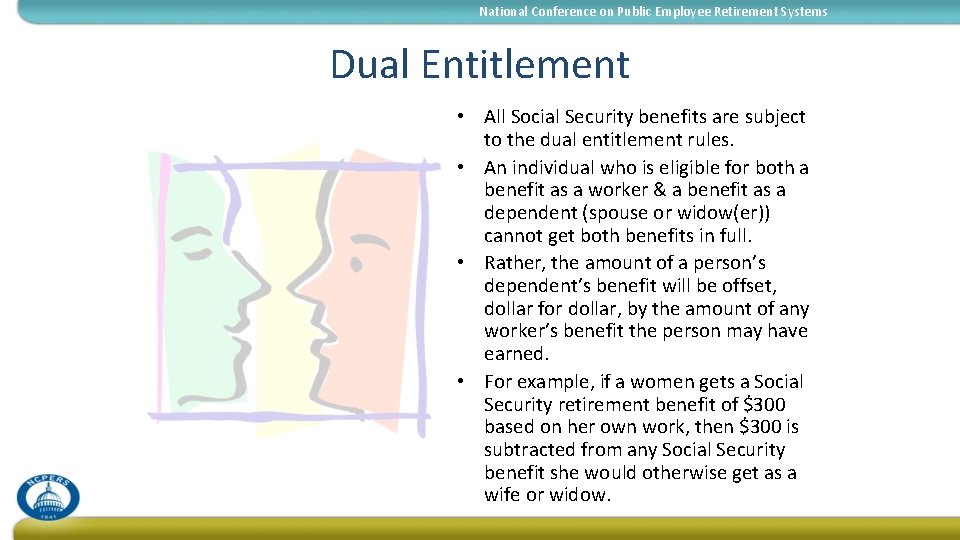
National Conference on Public Employee Retirement Systems Dual Entitlement • All Social Security benefits are subject to the dual entitlement rules. • An individual who is eligible for both a benefit as a worker & a benefit as a dependent (spouse or widow(er)) cannot get both benefits in full. • Rather, the amount of a person’s dependent’s benefit will be offset, dollar for dollar, by the amount of any worker’s benefit the person may have earned. • For example, if a women gets a Social Security retirement benefit of $300 based on her own work, then $300 is subtracted from any Social Security benefit she would otherwise get as a wife or widow.
National Conference on Public Employee Retirement Systems Government Pension Offset The GOP affects government retirees who receive two benefits: 1. A government pension not covered by Social Security, and 2. A Social Security dependent spousal benefit 28
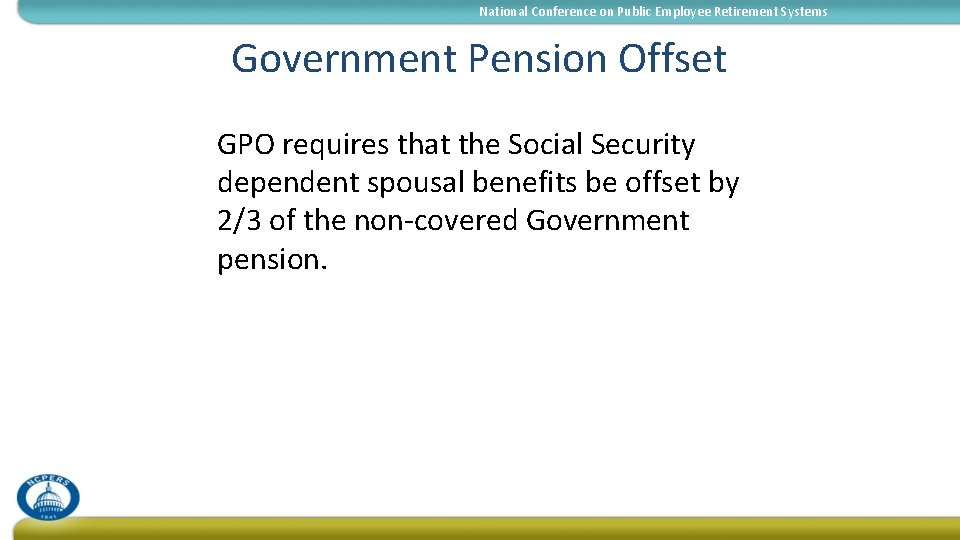
National Conference on Public Employee Retirement Systems Government Pension Offset • GPO requires that the Social Security dependent spousal benefits be offset by 2/3 of the non-covered Government pension.
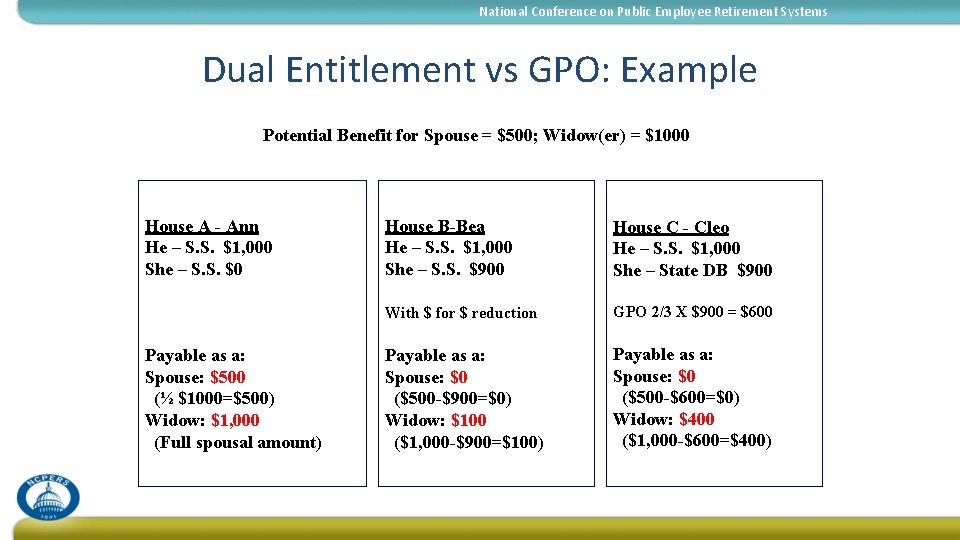
National Conference on Public Employee Retirement Systems Dual Entitlement vs GPO: Example Potential Benefit for Spouse = $500; Widow(er) = $1000 House A - Ann He – S. S. $1, 000 She – S. S. $0 Payable as a: Spouse: $500 (½ $1000=$500) Widow: $1, 000 (Full spousal amount) House B-Bea He – S. S. $1, 000 She – S. S. $900 House C - Cleo He – S. S. $1, 000 She – State DB $900 With $ for $ reduction GPO 2/3 X $900 = $600 Payable as a: Spouse: $0 ($500 -$900=$0) Widow: $100 ($1, 000 -$900=$100) Payable as a: Spouse: $0 ($500 -$600=$0) Widow: $400 ($1, 000 -$600=$400)
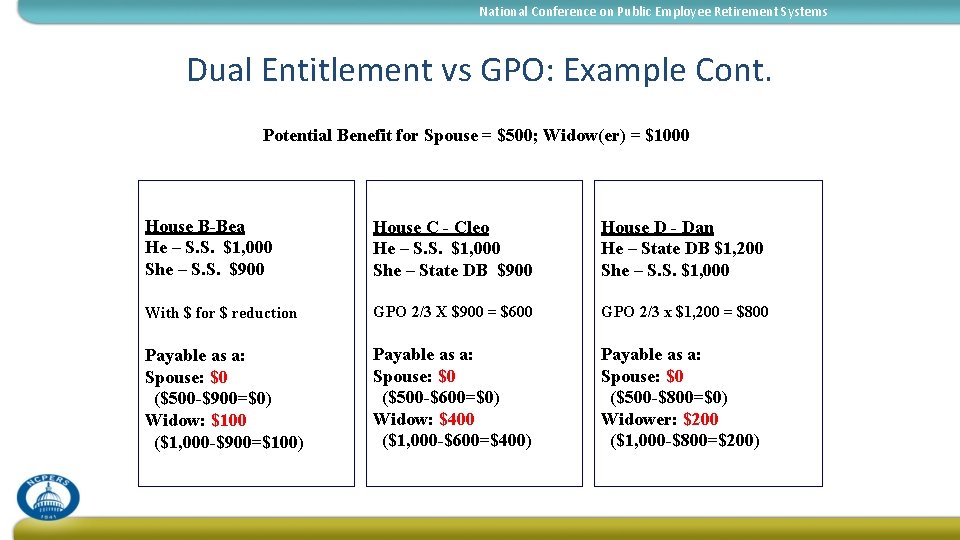
National Conference on Public Employee Retirement Systems Dual Entitlement vs GPO: Example Cont. Potential Benefit for Spouse = $500; Widow(er) = $1000 House B-Bea He – S. S. $1, 000 She – S. S. $900 House C - Cleo He – S. S. $1, 000 She – State DB $900 House D - Dan He – State DB $1, 200 She – S. S. $1, 000 With $ for $ reduction GPO 2/3 X $900 = $600 GPO 2/3 x $1, 200 = $800 Payable as a: Spouse: $0 ($500 -$900=$0) Widow: $100 ($1, 000 -$900=$100) Payable as a: Spouse: $0 ($500 -$600=$0) Widow: $400 ($1, 000 -$600=$400) Payable as a: Spouse: $0 ($500 -$800=$0) Widower: $200 ($1, 000 -$800=$200)
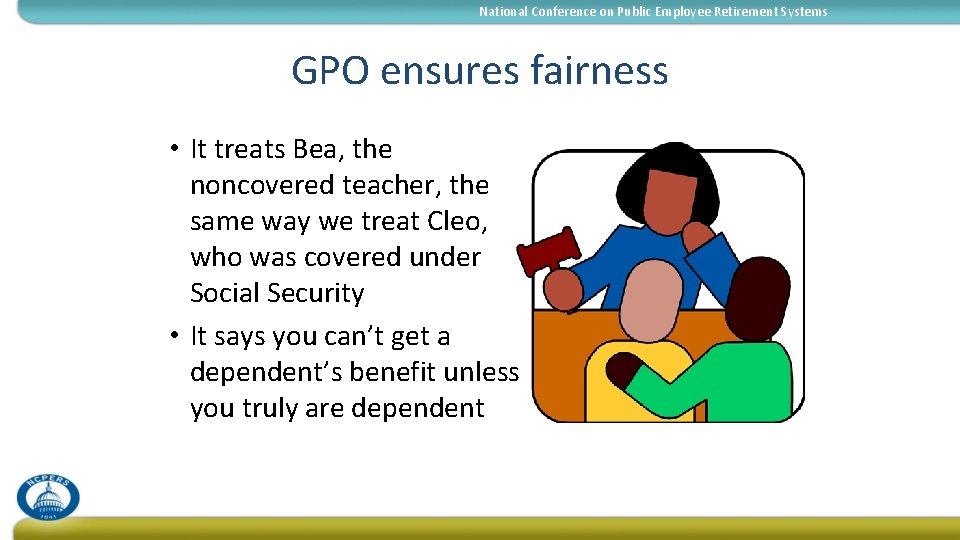
National Conference on Public Employee Retirement Systems GPO ensures fairness • It treats Bea, the noncovered teacher, the same way we treat Cleo, who was covered under Social Security • It says you can’t get a dependent’s benefit unless you truly are dependent
National Conference on Public Employee Retirement Systems GPO Exceptions • Anyone paying Social Security tax for the last 60 months of government employment.
National Conference on Public Employee Retirement Systems GPO Arguments For GPO • Effective method of preventing what would otherwise be an unfair advantage for Government workers Against GOP • Unfair because it reduces a benefit that the worker had included in retirement plans
National Conference on Public Employee Retirement Systems Additional References Social Security web site http: //www. socialsecurity. gov/ Social Security web site for information on WEP http: //www. socialsecurity. gov/retire 2/wep. htm Social Security web site for information on GPO http: //www. socialsecurity. gov/retire 2/gpo. htm
National Conference on Public Employee Retirement Systems NCPERS 2016/17 Educational Programs Public Pension Funding Forum August 21 -23, 2016 at Yale University, CT Public Safety Employee Pension & Benefits Conference October 23 -26, 2016 in Las Vegas, NV Legislative Conference January 29 -31, 2017 in Washington, DC Trustee Educational Seminar (TEDS) May 20 -21, 2017 in Hollywood, FL NCPERS Accredited Fiduciary (NAF) Program May 20 -21, 2017 in Hollywood, FL Annual Conference & Exhibition (ACE) May 21 -24, 2017 in Hollywood, FL 36
National Conference on Public Employee Retirement Systems For More Information NCPERS 444 North Capitol Street, NW Suite 630 Washington, DC 20001 info@NCPERS. org 1 -877 -202 -5706 www. NCPERS. org
- Slides: 37