
NATIONAL CONFERENCE ON AGRICULTURE FOR KHARIF CAMPAIGN 2018

- Slides: 21
NATIONAL CONFERENCE ON AGRICULTURE FOR KHARIF CAMPAIGN - 2018 25 th and 26 th April 2018 Department of Agriculture Development & Farmers Welfare, Government of Kerala
Kerala- at a Glance Southern most State of India Lies in between 8° 18' and 12° 48' latitude and 74° 52' and 72° 22' longitude. To its east and north-east, Kerala borders Tamil Nadu and Karnataka; to its west lies the Arabian Sea and to its south the Indian Ocean islands of Lakshadweep and the Maldives, respectively. With network of backwaters, 44 rainfed rivers flowing over the terrain of the State, boasts of an agrarian economy. Adequate annual rainfall of 3000 mm received by the state All these facilitates agriculture to a great extent and hence the economy of the state is dominated by agriculture.
Agriculture Sector - an Overview • Agriculture is the main occupation of Kerala • Coconut and paddy are the main crops • The name ‘’Kerala’ signifies ‘land of coconut’ • Kerala accounts for 1. 18 per cent of the geographical area of the country and supports 3. 9 per cent of its population leading to a very high degree of land use • The farm models in Kerala are unique and essentially revolving around homestead farming system. Main cropping systems are: Coconut based Rice based Plantation based Arecanut based Spices based Mixed farming Homestead farming Pure crops of Rubber, Coffee and Tea
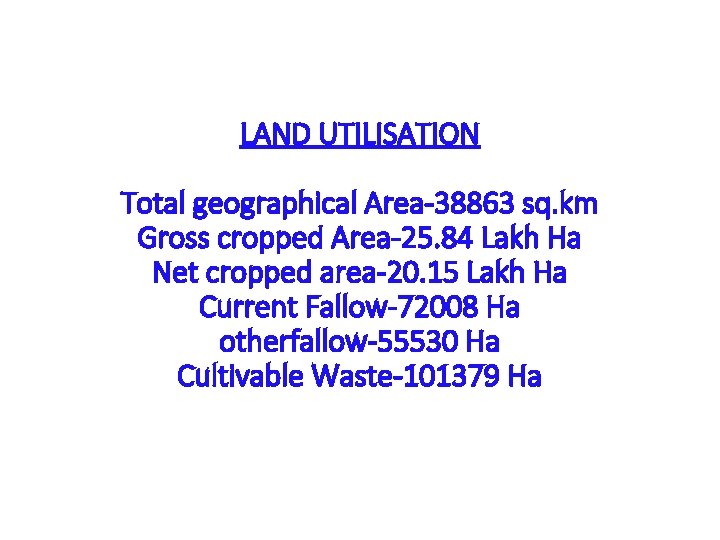
LAND UTILISATION Total geographical Area-38863 sq. km Gross cropped Area-25. 84 Lakh Ha Net cropped area-20. 15 Lakh Ha Current Fallow-72008 Ha otherfallow-55530 Ha Cultivable Waste-101379 Ha
Focus Areas Expanding Paddy Area from the present 2. 2 Lakh Ha to 3 lakh ha and production from 5. 5 LTto 10 lakh MT by the end of 13 th FYP. Increasing the area(7. 8 LHa), production(5873 M no) and productivity (6889 No. /Ha)of coconut in the State in a phased manner. Expanding Vegetable Area from the present 69000 Ha to One lakh ha and production from 10 LTto 17 lakh MT by the end of 13 th FYP.
Focus Areas Special Agricultural Zones declared for five crops Paddy, vegetables, Banana, Flowers, and coconut Area Expansion of location specific crops such as sesamum, sugarcane, groundnut, millets in areas such as Onattukara, Pathanamthitta, Palakkad, Idukki, Wayanad etc • Promoting Safe to eat production of food by adopting good agricultural practices and PGS certification • Targets to increase organic cultivation to 50000 Ha by the end of thirteenth plan
Focus Areas Area expansion of major fruits Jack fruit, banana, pineapple, mango, papaya Fruit villages will be implemented in wynad district for the promotion of five selected fruits Avocado, passion fruit, Mangosteen, Papaya and litchi It is proposed to increase the area and production of spices and condiments such as pepper, ginger, turmeric, clove, cardamom etc. • Promotion of Value addition and marketing • Promotion of Agrl. Extension
Specific Innovations Special Agricultural Zones declared for five crops Paddy, vegetables, Banana, Flowers, and coconut Formation of Agroservice Centres and Farm Facilitation Centres for promoting agricultural mechanization and providing labour force. Constitution of an Enforcement Cell at State. Level and District level to prevent indiscriminate use of pesticides Provision of karshaka pension for 3 lakh farmers above 60 years of age@Rs. 1100/month Establishment of 427 no. of ecoshops and 400 weekly rural markets for marketing of organicand safe to eat farmer produces in their immediate locality promoting direct marketing.
Specific Innovations (contd…. . ) Declared Jack Fruit as our State Fruit which is fully organic to promote awareness among public Implementation of sujalam suphalam Haritha Keralam Mission Project A Bill related to the formation of Farmer Welfare Fund Board is under consideration by the Government. Involvement of students, media, public and private institution in safe-to-eat food production.
BEST PRACTICES- EXTENSION ATMA Plus for supplementing ATMA Activities in the State to cover more ATMA components for which Rs. 9 crores was provided Conducted 440 Farm schools, 1450 demonstrations 244 FFS and other district specific activities LEADS (Lead Farmer Centered Extension Advisory and Delivery services) Programme implemented in four districs for promoting extension activities Online Farmer Registration database and e-payment using DBT in which 18. 7 lakh farmers enrolled IFS Models implemented 2300 no in the state demonstrating suitable Integrated Farming system models
BEST PRACTICES- EXTENSION Honouring the farmers by way of farmers day celebration on ‘Chingam 1’ every year. Karshaka sabhas and njattuvela markets are envisaged from 2018 -19 onwards as a part of feed back mechanism Kerala Innovation Extension programme is visualised in the for 2018 Farm news, Najttuvela radio programme and video production Nooru Meni through Door darshan , Kerala karshakan monthly magazine published by Farm Information Beaureau
Best Practices Stringent efforts for fallow land paddy cultivation to bring 49000 Ha additionally in 2017 -18 eg. In Aranmula (79 ha) and Methran Kayal (160 ha) Provision of free electricity to small and marginal farmers Maximising crop production and farmer income through Special Agricultural Zone approach Plant Health Clinic for Diagnostic and Advisory facilities to Farmers (202 clinics and 2020 pest surveillance units established) Farmer Markets under VDP and VFPCK The Web Based Platform to document the entire activities in the supply chain of Paddy Procurement scheme
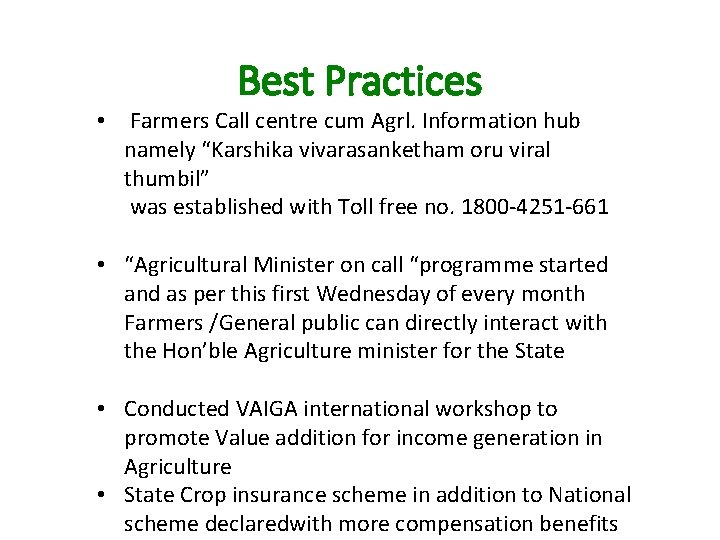
Best Practices • Farmers Call centre cum Agrl. Information hub namely “Karshika vivarasanketham oru viral thumbil” was established with Toll free no. 1800 -4251 -661 • “Agricultural Minister on call “programme started and as per this first Wednesday of every month Farmers /General public can directly interact with the Hon’ble Agriculture minister for the State • Conducted VAIGA international workshop to promote Value addition for income generation in Agriculture • State Crop insurance scheme in addition to National scheme declaredwith more compensation benefits
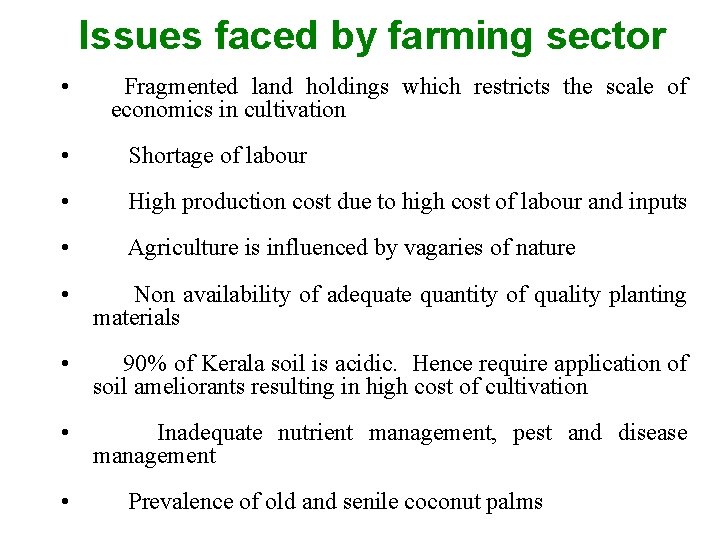
Issues faced by farming sector • Fragmented land holdings which restricts the scale of economics in cultivation • Shortage of labour • High production cost due to high cost of labour and inputs • Agriculture is influenced by vagaries of nature • Non availability of adequate quantity of quality planting materials • 90% of Kerala soil is acidic. Hence require application of soil ameliorants resulting in high cost of cultivation • Inadequate nutrient management, pest and disease management • Prevalence of old and senile coconut palms
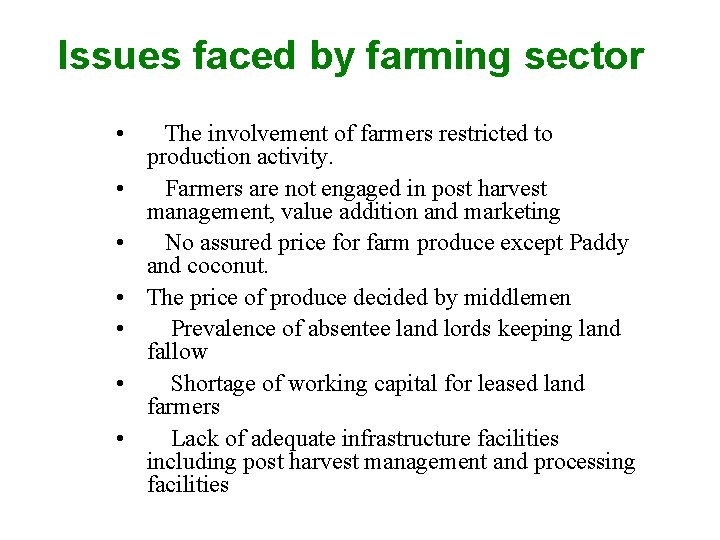
Issues faced by farming sector • • The involvement of farmers restricted to production activity. Farmers are not engaged in post harvest management, value addition and marketing No assured price for farm produce except Paddy and coconut. The price of produce decided by middlemen Prevalence of absentee land lords keeping land fallow Shortage of working capital for leased land farmers Lack of adequate infrastructure facilities including post harvest management and processing facilities
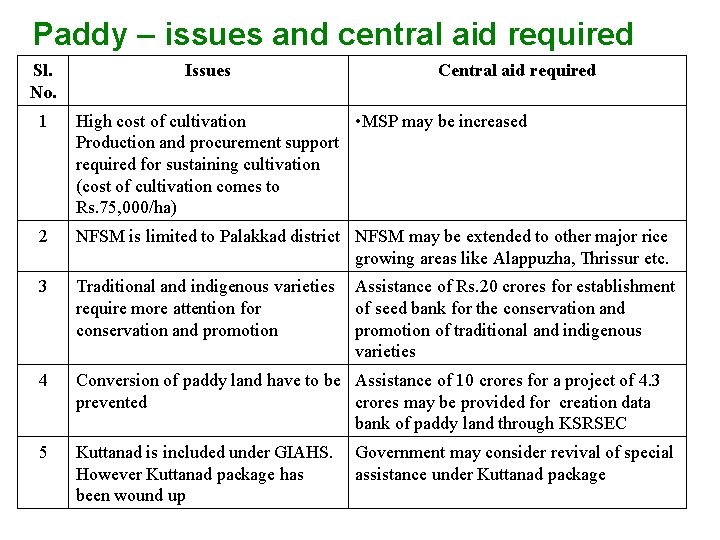
Paddy – issues and central aid required Sl. No. Issues Central aid required 1 High cost of cultivation • MSP may be increased Production and procurement support required for sustaining cultivation (cost of cultivation comes to Rs. 75, 000/ha) 2 NFSM is limited to Palakkad district NFSM may be extended to other major rice growing areas like Alappuzha, Thrissur etc. 3 Traditional and indigenous varieties require more attention for conservation and promotion 4 Conversion of paddy land have to be Assistance of 10 crores for a project of 4. 3 prevented crores may be provided for creation data bank of paddy land through KSRSEC 5 Kuttanad is included under GIAHS. However Kuttanad package has been wound up Assistance of Rs. 20 crores for establishment of seed bank for the conservation and promotion of traditional and indigenous varieties Government may consider revival of special assistance under Kuttanad package
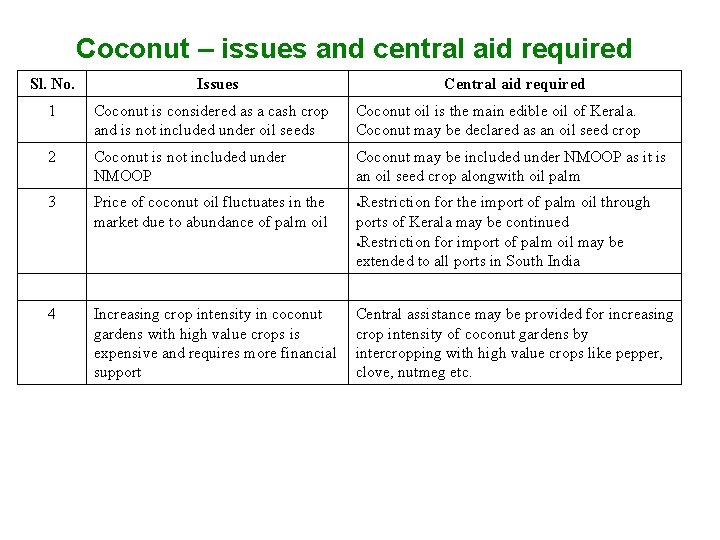
Coconut – issues and central aid required Sl. No. Issues Central aid required 1 Coconut is considered as a cash crop and is not included under oil seeds Coconut oil is the main edible oil of Kerala. Coconut may be declared as an oil seed crop 2 Coconut is not included under NMOOP Coconut may be included under NMOOP as it is an oil seed crop alongwith oil palm 3 Price of coconut oil fluctuates in the market due to abundance of palm oil 4 Increasing crop intensity in coconut gardens with high value crops is expensive and requires more financial support Restriction for the import of palm oil through ports of Kerala may be continued ●Restriction for import of palm oil may be extended to all ports in South India ● Central assistance may be provided for increasing crop intensity of coconut gardens by intercropping with high value crops like pepper, clove, nutmeg etc.
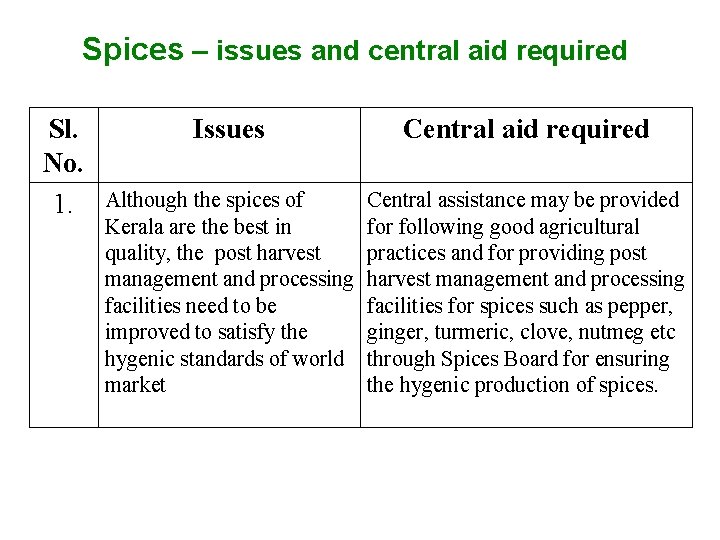
Spices – issues and central aid required Sl. No. 1. Issues Central aid required Although the spices of Kerala are the best in quality, the post harvest management and processing facilities need to be improved to satisfy the hygenic standards of world market Central assistance may be provided for following good agricultural practices and for providing post harvest management and processing facilities for spices such as pepper, ginger, turmeric, clove, nutmeg etc through Spices Board for ensuring the hygenic production of spices.
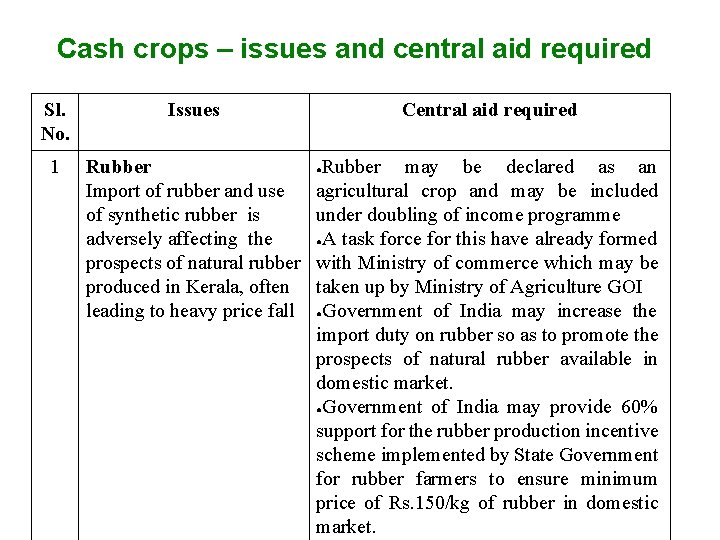
Cash crops – issues and central aid required Sl. No. Issues 1 Rubber Import of rubber and use of synthetic rubber is adversely affecting the prospects of natural rubber produced in Kerala, often leading to heavy price fall Central aid required Rubber may be declared as an agricultural crop and may be included under doubling of income programme ●A task force for this have already formed with Ministry of commerce which may be taken up by Ministry of Agriculture GOI ●Government of India may increase the import duty on rubber so as to promote the prospects of natural rubber available in domestic market. ●Government of India may provide 60% support for the rubber production incentive scheme implemented by State Government for rubber farmers to ensure minimum price of Rs. 150/kg of rubber in domestic market. ●
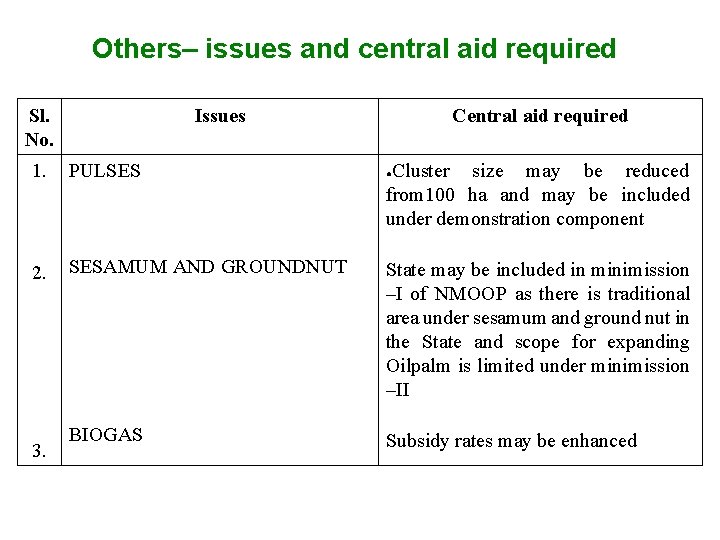
Others– issues and central aid required Sl. No. Issues Central aid required 1. PULSES 2. SESAMUM AND GROUNDNUT State may be included in minimission –I of NMOOP as there is traditional area under sesamum and ground nut in the State and scope for expanding Oilpalm is limited under minimission –II BIOGAS Subsidy rates may be enhanced 3. Cluster size may be reduced from 100 ha and may be included under demonstration component ●
21