
National Compact Stellarator Experiment NCSX Hutch Neilson for
- Slides: 15
National Compact Stellarator Experiment (NCSX) Hutch Neilson for the NCSX Team Princeton Plasma Physics Laboratory Oak Ridge National Laboratory Lawrence Livermore National Laboratory Univ. of California at San Diego Office of Fusion Energy Sciences FY-05 Budget Planning Meeting March 19, 2003
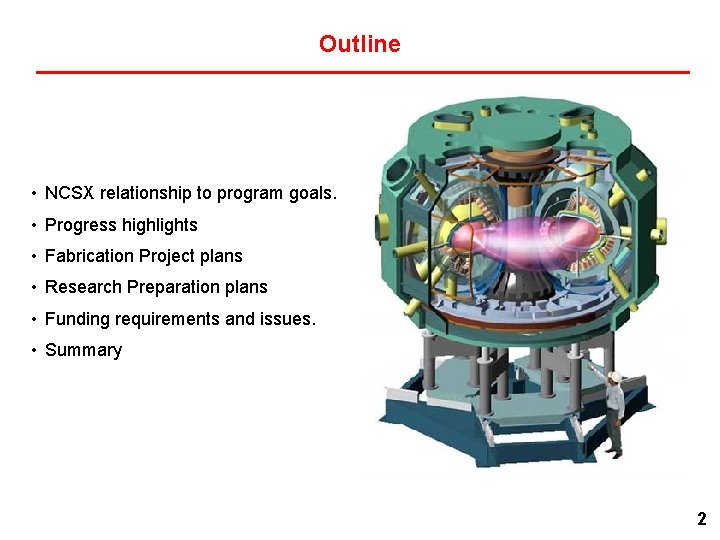
Outline • NCSX relationship to program goals. • Progress highlights • Fabrication Project plans • Research Preparation plans • Funding requirements and issues. • Summary 2
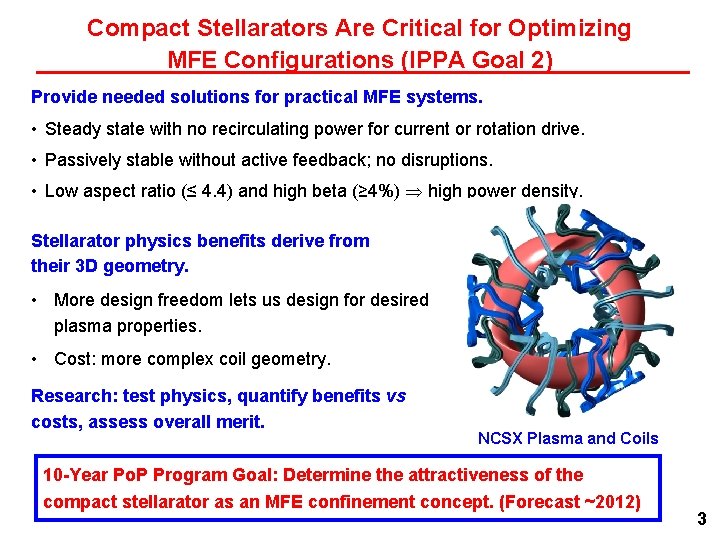
Compact Stellarators Are Critical for Optimizing MFE Configurations (IPPA Goal 2) Provide needed solutions for practical MFE systems. • Steady state with no recirculating power for current or rotation drive. • Passively stable without active feedback; no disruptions. • Low aspect ratio (≤ 4. 4) and high beta (≥ 4%) high power density. Stellarator physics benefits derive from their 3 D geometry. • More design freedom lets us design for desired plasma properties. • Cost: more complex coil geometry. Research: test physics, quantify benefits vs costs, assess overall merit. NCSX Plasma and Coils 10 -Year Po. P Program Goal: Determine the attractiveness of the compact stellarator as an MFE confinement concept. (Forecast ~2012) 3
Compact Stellarators Are Critical for Our Fundamental Science Goals (IPPA Goal 1) Stellarators advance 3 D plasma physics understanding important to MFE science generally. • Rotational transform sources (int. , ext. ): effect on stability, disruptions? • 3 D plasma shaping: stabilize without conducting walls or feedback? • Magnetic quasi-symmetry: tokamak-like transport properties? • 3 D divertors: effects on boundary plasma, plasma-material interactions? NCSX quasi-axisymmetric design provides strong physics link with tokamaks, STs, and RFPs. • Builds on tokamak advances, including ITER burning plasma R&D. • Compact stellarator advances will benefit other configurations. Compact stellarators are needed to achieve our energy and science aims. We have an important role in the world’s stellarator research. Timely construction of NCSX is critical. 4
Since Last BPM: NCSX Project Start Approved By DOE Lehman Project Review in May, 2002, was very positive. • Conclusion: sound physics, design, cost, schedule, ES&H, management. Acquisition Plan and CD-1 approved by DOE in November, 2002. • Approved Project Start and preliminary funding profile based on $73. 5 M cost, 1 st Plasma in June, 2007. Good technical progress has been made. • Resolved design issues affecting, e. g. , plasma control, divertor performance, machine assembly. • Procurement for manufacturing development activities in industry. • Coil winding development at PPPL. NCSX PAC reviewed progress and plans at December meeting. PAC’s advice is folded into project work plans. Project is off to a good start. 5
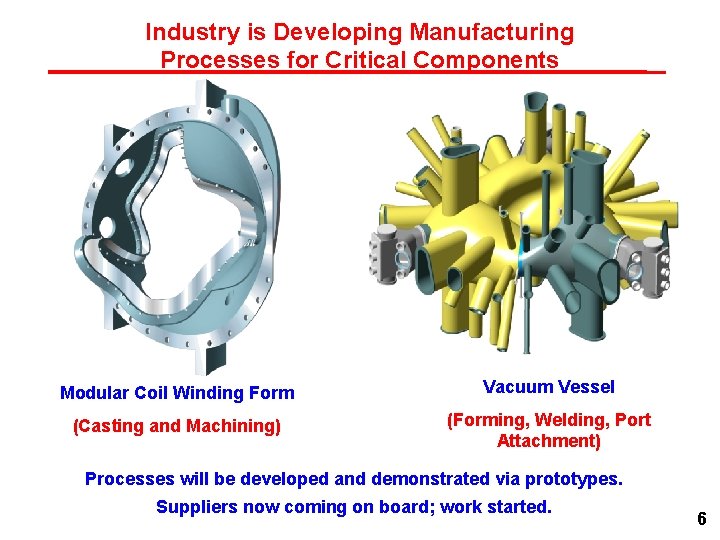
Industry is Developing Manufacturing Processes for Critical Components Modular Coil Winding Form Vacuum Vessel (Casting and Machining) (Forming, Welding, Port Attachment) Processes will be developed and demonstrated via prototypes. Suppliers now coming on board; work started. 6
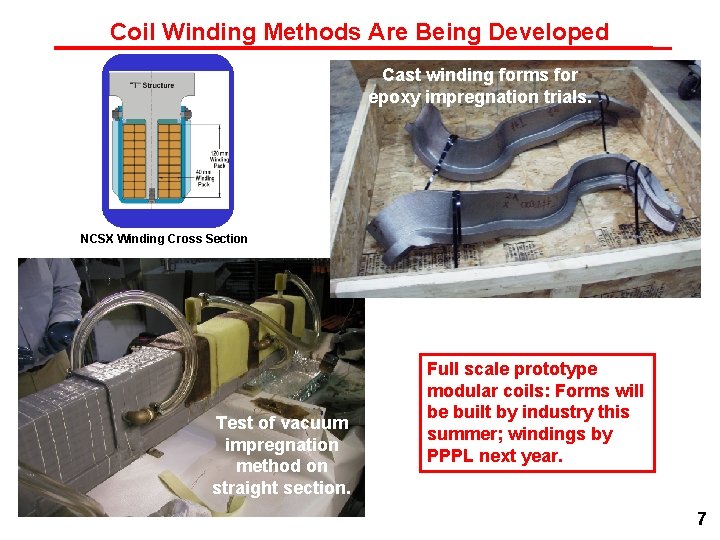
Coil Winding Methods Are Being Developed Cast winding forms for epoxy impregnation trials. NCSX Winding Cross Section Test of vacuum impregnation method on straight section. Full scale prototype modular coils: Forms will be built by industry this summer; windings by PPPL next year. 7
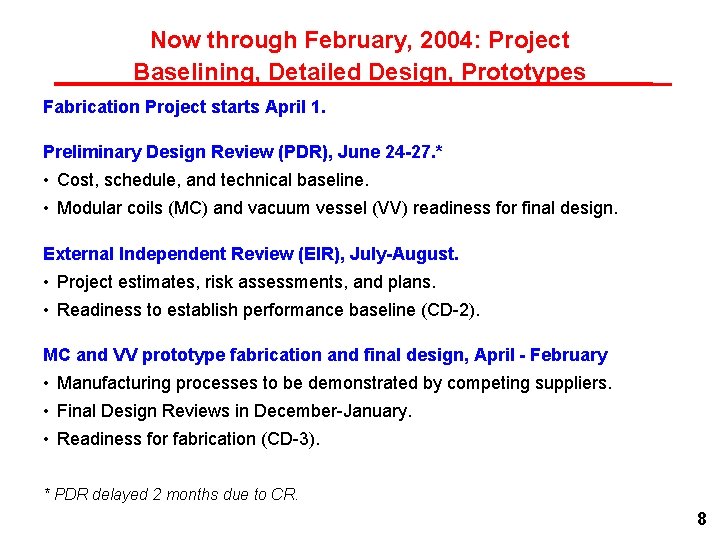
Now through February, 2004: Project Baselining, Detailed Design, Prototypes Fabrication Project starts April 1. Preliminary Design Review (PDR), June 24 -27. * • Cost, schedule, and technical baseline. • Modular coils (MC) and vacuum vessel (VV) readiness for final design. External Independent Review (EIR), July-August. • Project estimates, risk assessments, and plans. • Readiness to establish performance baseline (CD-2). MC and VV prototype fabrication and final design, April - February • Manufacturing processes to be demonstrated by competing suppliers. • Final Design Reviews in December-January. • Readiness for fabrication (CD-3). * PDR delayed 2 months due to CR. 8
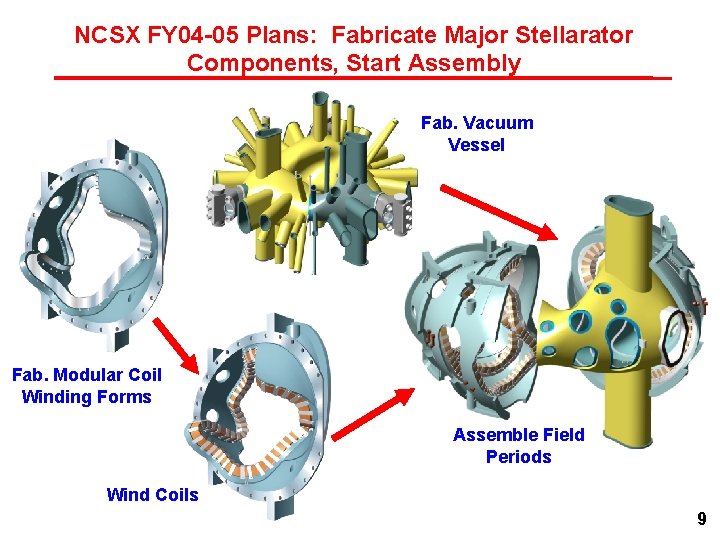
NCSX FY 04 -05 Plans: Fabricate Major Stellarator Components, Start Assembly Fab. Vacuum Vessel Fab. Modular Coil Winding Forms Assemble Field Periods Wind Coils 9
March 2004 through FY-05: Progress Along the Critical Path Vacuum vessel and modular coil production. • Award VV and winding form contracts, March - April, 2004. • Complete winding and impregnation of prototype modular coil, May, 2004. • Receive first winding form and start winding coil, June, 2004. • Complete fabrication and test of first production modular coil, Sept. , 2004. Will accomplish OFES FY-04 performance target: “Complete Final Design of NCSX and Begin Fabrication. ” Receive first vacuum vessel sector (of 3), March, 2005. • Start attaching cooling tubes and insulation. Start field-period sub-assembly, August, 2005. • Assemble modular coils over vacuum vessel. 10
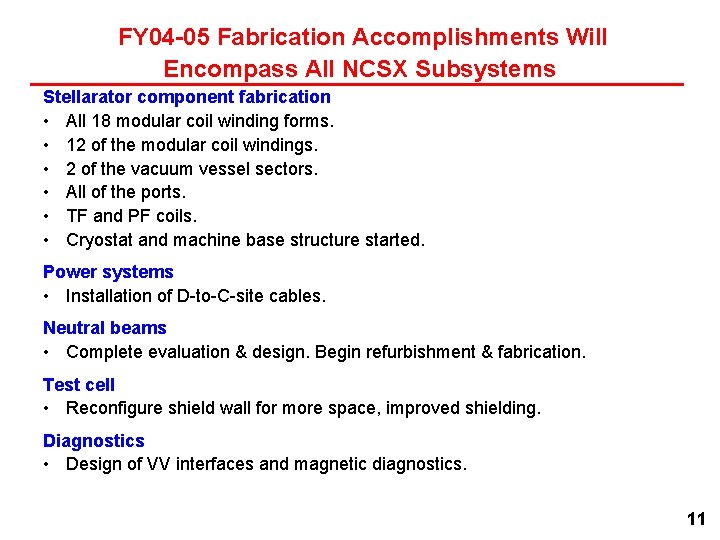
FY 04 -05 Fabrication Accomplishments Will Encompass All NCSX Subsystems Stellarator component fabrication • All 18 modular coil winding forms. • 12 of the modular coil windings. • 2 of the vacuum vessel sectors. • All of the ports. • TF and PF coils. • Cryostat and machine base structure started. Power systems • Installation of D-to-C-site cables. Neutral beams • Complete evaluation & design. Begin refurbishment & fabrication. Test cell • Reconfigure shield wall for more space, improved shielding. Diagnostics • Design of VV interfaces and magnetic diagnostics. 11
NCSX Research Preparation Plans, FY 04 -05 Advanced Diagnostics (post-1 st Plasma installation) • Develop concepts; ensure compatibility with vacuum vessel and coils. • FY-05: Fund design study contracts for long-lead systems. Edge Control (ORNL, UCSD, LLNL) • Concepts for plasma-facing components and edge diagnostics. Plasma Control (PPPL, ORNL) • Trim coils, control algorithms, advanced magnetics, data analysis capabilities. Participation in MHD analysis of stellarator high discharges (OFES Science sub-program target) • Why do LHD and W 7 -AS seem to exceed predicted instability thresholds? National Research Forum (Dec. , 2004) is planned to broaden community involvement in NCSX preparations. 12
NCSX Fabrication Funding is Following DOE’s Acquisition Plan Research Prep: FY-04 increment requested so preparation tasks can proceed on original schedule. 13
10% Cut in Fabrication Project Funding Would Be Damaging Cost and schedule adversely impacted • First plasma delay of 6 months. • Project cost increase of $2 M. • Stretched-out procurements run risk of further increases. Broader implications • Cost in lost credibility and negative attention when projects get in trouble. • Delayed physics results: less-informed program decisions downstream. 14
NCSX Project Has Made A Good Start and Is On Track Critical reviews and DOE decisions have been positive. Design issues are getting resolved. Industry development efforts are starting. In FY 04 -05, major component fabrication will be largely completed and field period assembly will start. • On track for FY-2007 First Plasma. Compact stellarator program strongly supports U. S. goals and lets us make important contributions to world stellarator research. • Thanks to strong DOE and community support. 15