
National Chung Cheng University Dept Computer Science Information
- Slides: 56
National Chung Cheng University Dept. Computer Science & Information Engineering Realization of 5 G Network Slicing Using Open Source Softwares Sheng Chen National Sun Yat-sen University, Taiwan Chung-Nan Lee National Sun Yat-sen University, Taiwan Ming-Feng Lee National Sun Yat-sen University, Taiwan 2020 Asia-Pacific Signal and Information Processing Association Annual Summit and Conference (APSIPA ASC) 1
National Chung Cheng University Dept. Computer Science & Information Engineering Abstract In this paper we realize the network slicing using Open. Stack as a cloud platform, Tacker to manage the required virtual network functions for each service and Open. Flow switch for slice. We also apply Open. Flow Queue command to schedule the priority and proportion of each service. Finally, the actual implementation is carried out via Open. Air. Interface and next. EPC. Experimental results show that the network slicing is feasible using open sources and the bandwidth can be assigned using queue. As a result, the Qo. S is guaranteed for each slice. 2
National Chung Cheng University Dept. Computer Science & Information Engineering SECTION I. Introduction The purpose of this study is to implement and verify the Proof of Concept (Po. C) of 5 G network slicing using existing open source softwares. We use Open. Stack as a cloud platform, use Tacker to realize the Virtualized Network Functions (VNFs) required by each service, and then combine with Open. Flow switch, and use Open. Flow Queue command to ensure the priority and proportion of each service slice. 3
National Chung Cheng University Dept. Computer Science & Information Engineering SECTION I. Introduction The SDN controller Open. Daylight (ODL) is used to control the physical/virtual SDN switches, and the Open. Flow commands is used to implement 5 G network slicing through the controller. In the proposed implementation, the framework of the mobile communication network is realized through Open. Air. Interface (OAI) and next. EPC. Finally, some experiments are designed to verify that the proposed implementation in this paper can comply with the architecture and principles proposed by 3 GPP. 4
National Chung Cheng University Dept. Computer Science & Information Engineering SECTION I. Introduction The main characteristics of this study are as follows. We propose an open source network architecture based on OAI, next. EPC, and Open. Stack. On this architecture, we implement and verify the technical concept of 5 G network slicing and adjust the Open. Flow Queue command at the service end to ensure the priority and usage ratio of each service 5
National Chung Cheng University Dept. Computer Science & Information Engineering SECTION I. Introduction. This effectively improve the utilization of network resources, and make the architecture more in line with low latency and higher transmission guarantee. The propoased open source network architecture makes it easy to modify or adjust the system through Software Defined Networking (SDN) and Network Function Virtualization (NFV), which makes the overall system architecture more versatile and convenient for management. 6
National Chung Cheng University Dept. Computer Science & Information Engineering SECTION II. Related Work Li et al. [2] They then proposed a network architecture, and explained the required technology from the control plane and the data plane, and what conditions need to be met at each plane. For example, the four conditions that need to be met at the data plane are as follows. Traffic isolation: the network must be able to guarantee the quality of service (Qo. S) of each tenant. Any tenant in the network will not be affected by the amount of traffic of other tenants. 7
National Chung Cheng University Dept. Computer Science & Information Engineering SECTION II. Related Work Traffic separation: any tenant cannot hear or obtain other tenants’ traffic or find their usage trends in any way. Traffic differentiation: even if different tenants enter the same network connection point, tenants’ packets can be forwarded in different ways. Statistical multiplexing: the network can simultaneously handle network traffic of different tenants through different channels. 8
National Chung Cheng University Dept. Computer Science & Information Engineering SECTION II. Related Work Salvatore et al. [4] implemented network slicing in the open source network using the open source software OAI. They adopted the OAI C-RAN version, used Flex. RAN as their controller to control the switches and achieve network slicing by issuing Open. Flow commands. Their verification method is to download packets through two user equipments (UE) at the same time. One UE increases the download traffic to test whether the other UE will be affected by it. The result of the experiment confirm that their architecture has met the concept of network slicing. 9
National Chung Cheng University Dept. Computer Science & Information Engineering SECTION II. Related Work Chien et al. [13] proposed a service-based approach to provide network slicing, aiming at allocating a slice to each service. Their architecture mainly integrates Open. Stack with Tacker and other related open source softwares. This research also introduced a value R to define slice efficiency. By comparing the resources required by the computing service with the resources that can actually be given, R can be used to verify whether the method meets the needs of the three major application scenarios of 5 G, including URLLC and m. MTC and e. MBB. 10
National Chung Cheng University Dept. Computer Science & Information Engineering SECTION II. Related Work The main research direction of our work is similar to the studies of [4] and [13]. Compared with [4] and [13], we design more experiments for verification according to the standard proposed by 3 GPP, so as to ensure that the system can meet the network slicing criteria 11
National Chung Cheng University Dept. Computer Science & Information Engineering SECTION II. Related Work More specifically, the literature [4] does not provide appropriate experimental scenarios and experimental verification, nor does it express how to verify the independence between slices, and the overall architecture is relatively incomplete. In the literature [13], although a good architecture is proposed to implement network slicing, it also lacks verification of the independence between slices. This paper not only provides more complete simulation and practical tests, but also verifies the independence between slices and the security under UDP DDo. S attacks. 12
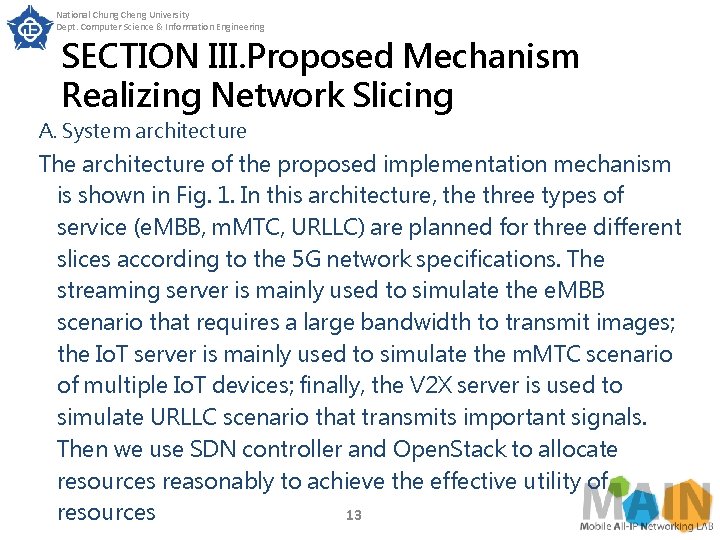
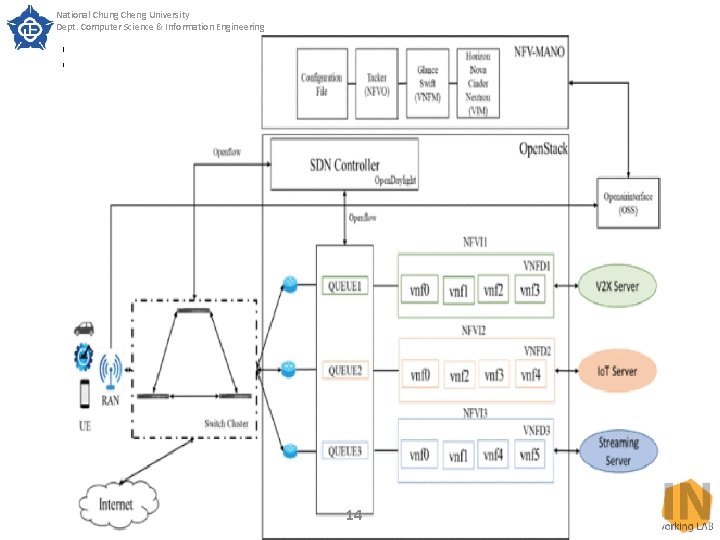
National Chung Cheng University Dept. Computer Science & Information Engineering SECTION III. Proposed Mechanism Realizing Network Slicing A. System architecture The architecture of the proposed implementation mechanism is shown in Fig. 1. In this architecture, the three types of service (e. MBB, m. MTC, URLLC) are planned for three different slices according to the 5 G network specifications. The streaming server is mainly used to simulate the e. MBB scenario that requires a large bandwidth to transmit images; the Io. T server is mainly used to simulate the m. MTC scenario of multiple Io. T devices; finally, the V 2 X server is used to simulate URLLC scenario that transmits important signals. Then we use SDN controller and Open. Stack to allocate resources reasonably to achieve the effective utility of resources 13
National Chung Cheng University Dept. Computer Science & Information Engineering SECTION III. Proposed Mechanism Realizing Network Slicing 14
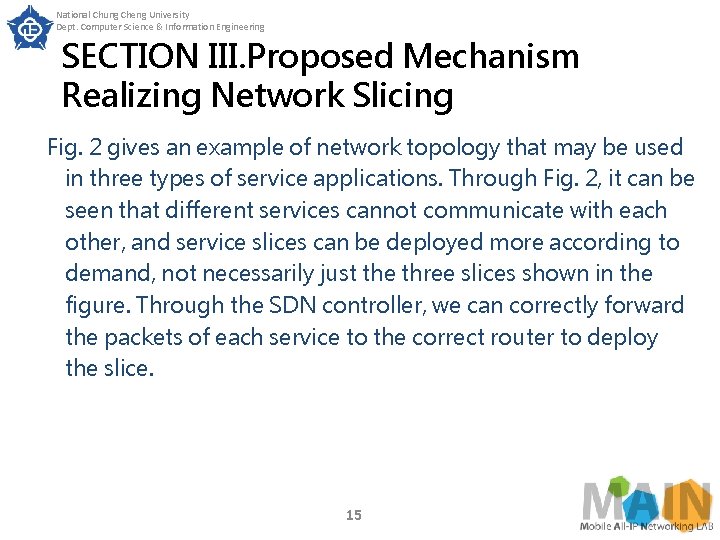
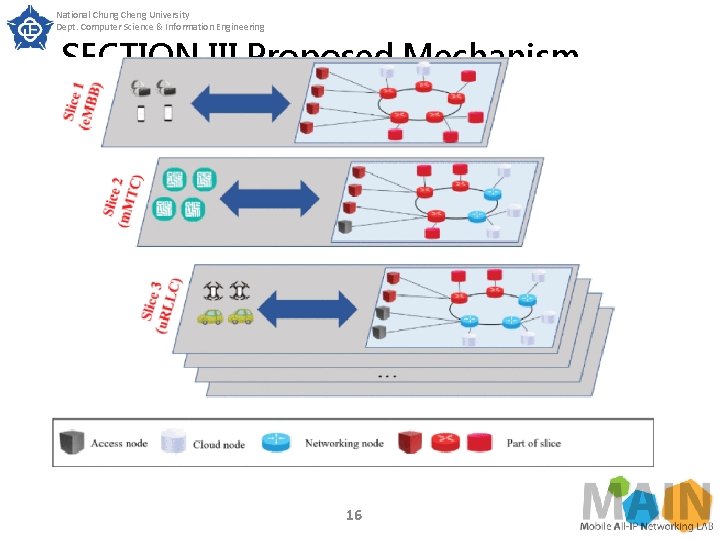
National Chung Cheng University Dept. Computer Science & Information Engineering SECTION III. Proposed Mechanism Realizing Network Slicing Fig. 2 gives an example of network topology that may be used in three types of service applications. Through Fig. 2, it can be seen that different services cannot communicate with each other, and service slices can be deployed more according to demand, not necessarily just the three slices shown in the figure. Through the SDN controller, we can correctly forward the packets of each service to the correct router to deploy the slice. 15
National Chung Cheng University Dept. Computer Science & Information Engineering SECTION III. Proposed Mechanism Realizing Network Slicing 16
National Chung Cheng University Dept. Computer Science & Information Engineering SECTION III. Proposed Mechanism Realizing Network Slicing we also adopt Virtual e. Xtensible Local Area Network (VXLAN) in the proposed implementation mechanism. VXLAN is a new type of network virtualization technology. Compared with traditional Virtual LAN (VLAN), VXLAN can provide better scalability and flexibility. In 5 G, services need to be provided to more users, so it is one of the reasonable methods to improve large cloud computing deployments through VXLAN. Based on the Open. Stack architecture, we modify the configuration files of the controller node, network node, and compute node to implement VXLAN. 17
National Chung Cheng University Dept. Computer Science & Information Engineering SECTION III. Proposed Mechanism Realizing Network Slicing B. Control plane In order to implement the network slicing architecture, the control plane and the data plane must be separated in practice. The proposed implementation mechanism realizes the control plane interface through the open source SDN controller ODL and Open. Flow protocol. 18
National Chung Cheng University Dept. Computer Science & Information Engineering SECTION III. Proposed Mechanism Realizing Network Slicing We implement resource management of network slice instances (NSIs) through ODL, and transfer signals through Application Programming Interface (API). In order to realize that each network slice is isolated from each other, the system logically separates each slice through NFV and SDN, and each slice obtains the network functions it needs. 19
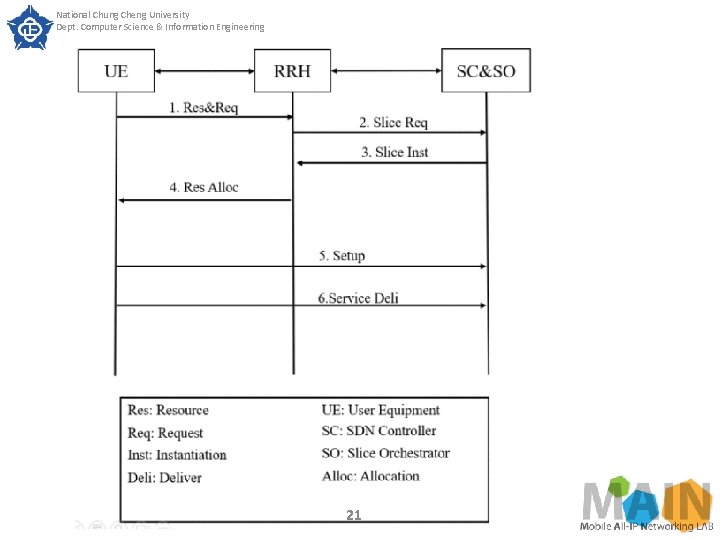
National Chung Cheng University Dept. Computer Science & Information Engineering SECTION III. Proposed Mechanism Realizing Network Slicing C. Signal processing and slice management Fig illustrates the signal processing in the proposed implementation mechanism. First, the UE sends its resource requirements to Remote Radio Head (RRH), then RRH passes the requirements to SDN Conroller and Slice Orchestrator (SC&SO), and finally SC&SO allocates the required resources to the UE, and establishes a service-based slice to the UE. 20
National Chung Cheng University Dept. Computer Science & Information Engineering 21
National Chung Cheng University Dept. Computer Science & Information Engineering SECTION III. Proposed Mechanism Realizing Network Slicing In different service scenarios of 5 G, there are different process sequences. In the two scenarios of e. MBB service and m. MTC service, first of all, the service requirements will be passed to SC&SO through API. Then SC&SO will set the required resources for slicing according to the network resources and space resources owned by the system. In contrast, if it is a URLLC service, the required resources will be created directly through the SC, and will not go through the network functions created by the SO, thus the URLLC service will be delivered more quickly. 22
National Chung Cheng University Dept. Computer Science & Information Engineering SECTION III. Proposed Mechanism Realizing Network Slicing D. Implementation of VNF through Tacker and Queue Tacker is an official project of Open. Stack that builds a Generic VNF Manager (VNFM) and an NFV Orchestrator (NFVO) to deploy and operate network services and VNFs on Open. Stack platform. In the proposed implementation mechanism, we first create a Tacker database, then connect with Open. Stack, and create a Virtualized Infrastructure Manager (VIM) and VNF through a configuration file. 23
National Chung Cheng University Dept. Computer Science & Information Engineering SECTION III. Proposed Mechanism Realizing Network Slicing Then we write the configuration file of the Virtual Network Function Description (VNFD), and finally we can create the VNF required by the service through the VNFD configuration file. Open. Flow commands are used to create Queues to the corresponding ports, and Weighted Fair Queue (WFQ) is used to accurately ensure that services with higher priority are first guaranteed. 24
National Chung Cheng University Dept. Computer Science & Information Engineering SECTION IV. Experimental Results 25
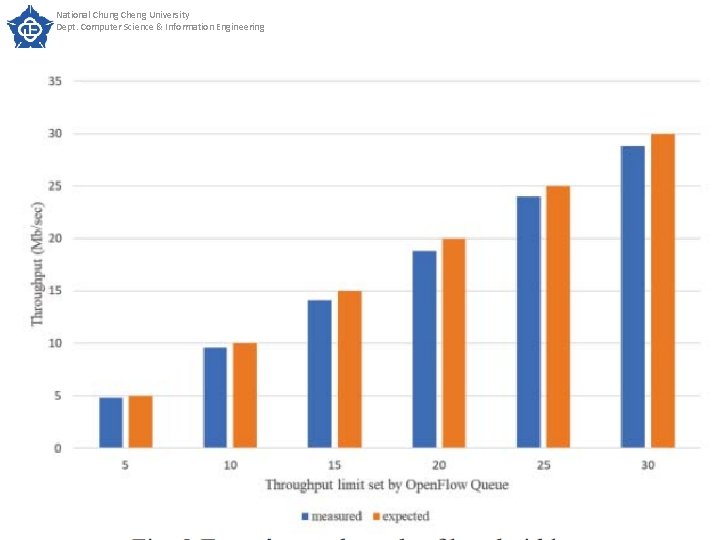
National Chung Cheng University Dept. Computer Science & Information Engineering SECTION IV. Experimental Results Experimental results Experiment 1 The purpose of experiment 1 is to verify the error rate of bandwidth guaranteed by Queue. The test method is to set the upper and lower limits of the slice bandwidth guaranteed by the Queue to be the same, then generate traffic flow and measure the actual throughput through the iperf software. We measured once every 10 seconds and took the average of the other 10 times except the first measurement. 26
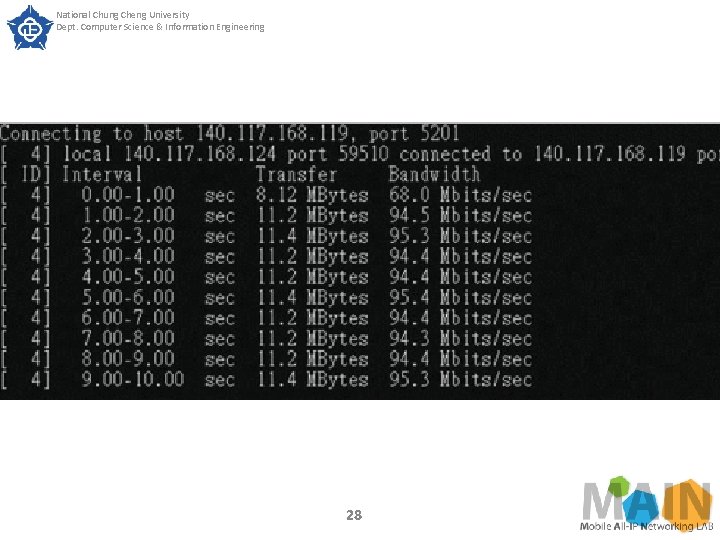
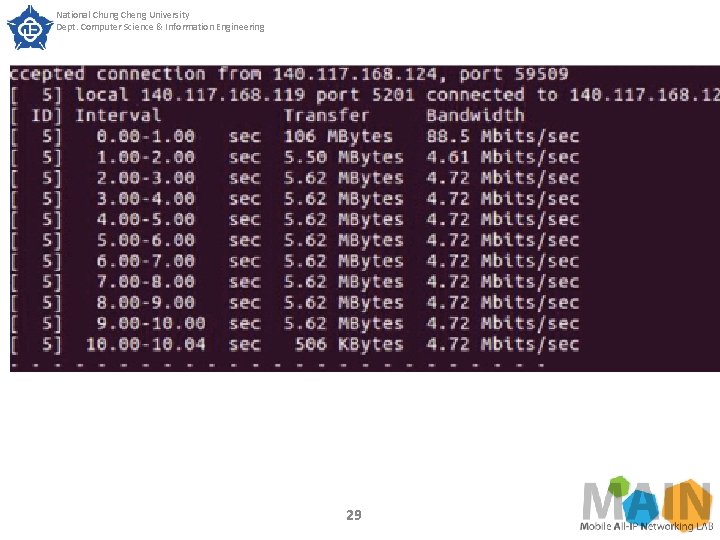
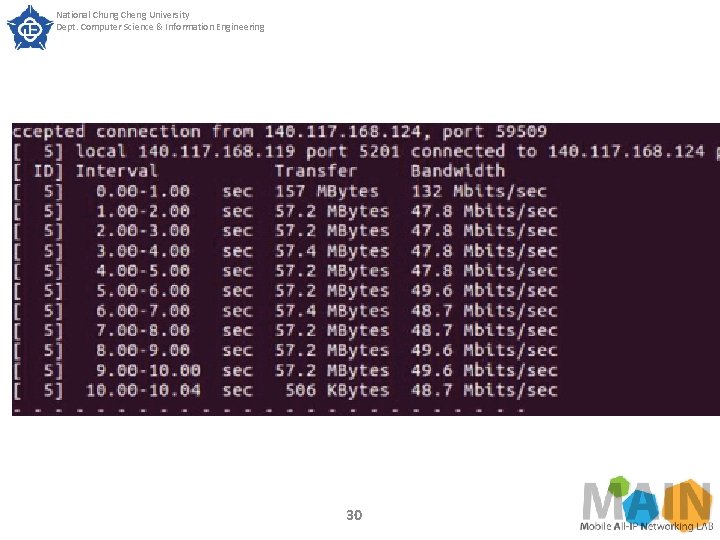
National Chung Cheng University Dept. Computer Science & Information Engineering SECTION IV. Experimental Results Fig. 6 shows the measurement before the Queue command has been issued. At the first second, because iperf is establishing a connection, the measured data is not accurate. Therefore, we do not take the measured result of the first second. After the measurement, the bandwidth is about 95 -100 Mbits/sec before the Open. Flow Queue command is issued. Next, we issued Queue through ODL, and set the upper and lower slice throughput limits to 5 Mbits/sec and 50 Mbits/sec, as shown in Figure 7 and Figure 8, respectively. 27
National Chung Cheng University Dept. Computer Science & Information Engineering 28
National Chung Cheng University Dept. Computer Science & Information Engineering 29
National Chung Cheng University Dept. Computer Science & Information Engineering 30
National Chung Cheng University Dept. Computer Science & Information Engineering 31
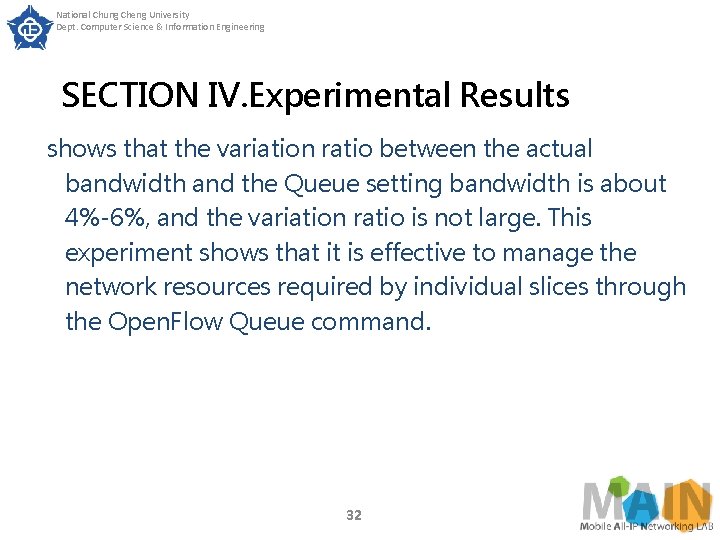
National Chung Cheng University Dept. Computer Science & Information Engineering SECTION IV. Experimental Results shows that the variation ratio between the actual bandwidth and the Queue setting bandwidth is about 4%-6%, and the variation ratio is not large. This experiment shows that it is effective to manage the network resources required by individual slices through the Open. Flow Queue command. 32
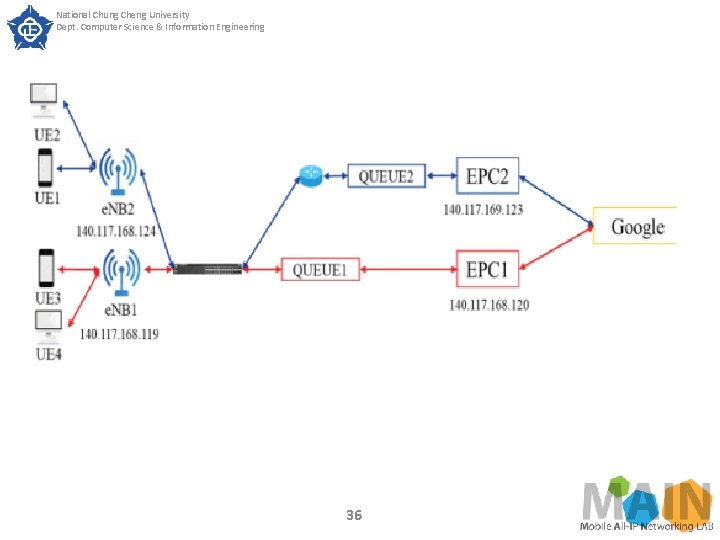
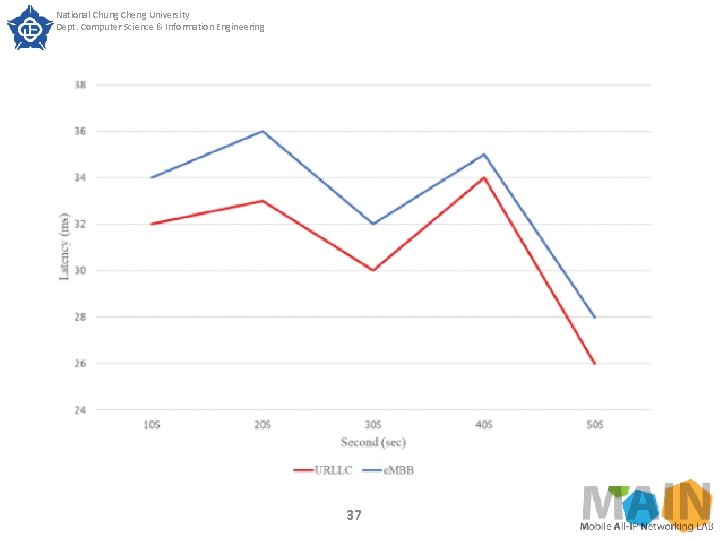
National Chung Cheng University Dept. Computer Science & Information Engineering SECTION IV. Experimental Results Experiment 2 The purpose of experiment 2 is to explore the end to end delay of the service slice. The architecture of experiment 2 is shown in Fig. 10. This experiment is divided into two kinds of tests. The first test is to check the variation of end to end latency from UE 1 to the Google server (e. MBB slice) and that from UE 3 to the Google server (URLLC slice) under normal transmission conditions. 33
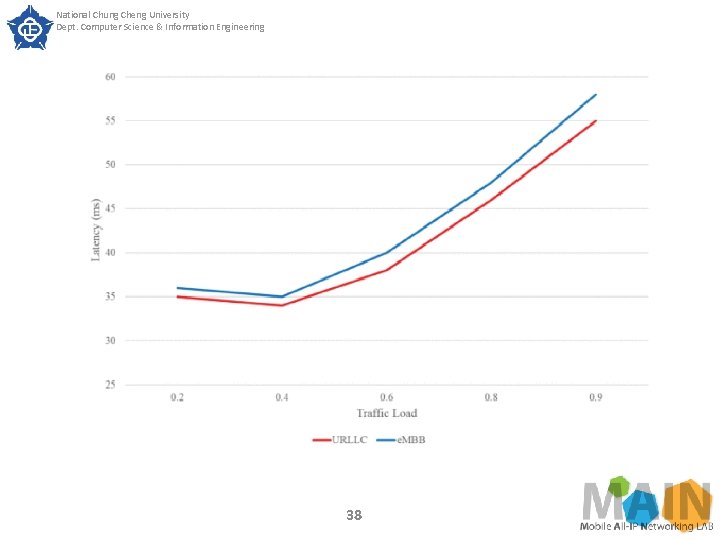
National Chung Cheng University Dept. Computer Science & Information Engineering SECTION IV. Experimental Results The second test is to observe the variation of end to end latency by increasing traffic load. To be more specifically, UE 2 and UE 4 used iperf to generate heavy traffic, we then used IP-Tools to observe the end to end latency from UE 1 to the Google server and that from UE 3 to the Google server. Note that in Fig. 10, the setting of URLLC slice (in red) is to install the core network in the physical machine instead of in the Virtual Machine (VM) of Open. Stack and the transmission does not go through Open v. Switch (OVS), so it can reduce the latency slightly. . 34
National Chung Cheng University Dept. Computer Science & Information Engineering SECTION IV. Experimental Results Fig. 11 shows the end to end latency variation under normal transmission conditions, and Fig. 12 shows the end to end latency variation under heavy traffic load. Since this experiment uses next. EPC and OAI e. NB to implement, there is a transmission delay error in the experiment, so the latency of both e. MBB and URLLC performs zigzag style curve under normal transmission condition in Figure 11. From Fig. 12, it can be found that both URLLC and e. MBB slices have a significant increase in latency when the traffic load is greater than 0. 6. 35
National Chung Cheng University Dept. Computer Science & Information Engineering 36
National Chung Cheng University Dept. Computer Science & Information Engineering 37
National Chung Cheng University Dept. Computer Science & Information Engineering 38
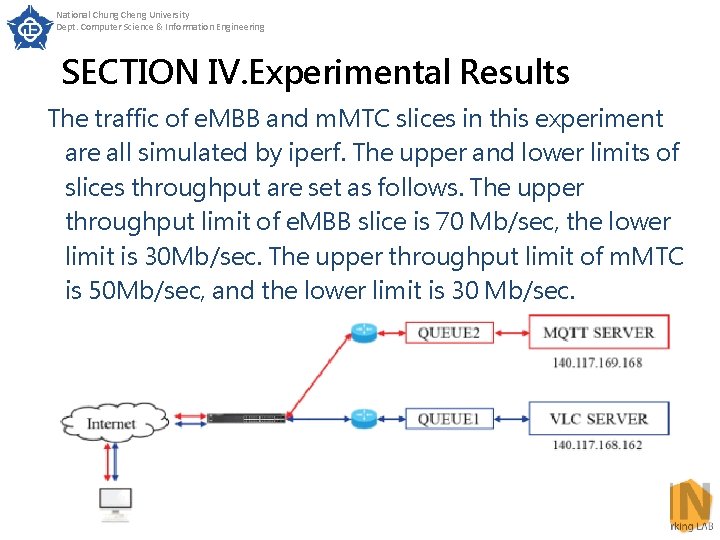
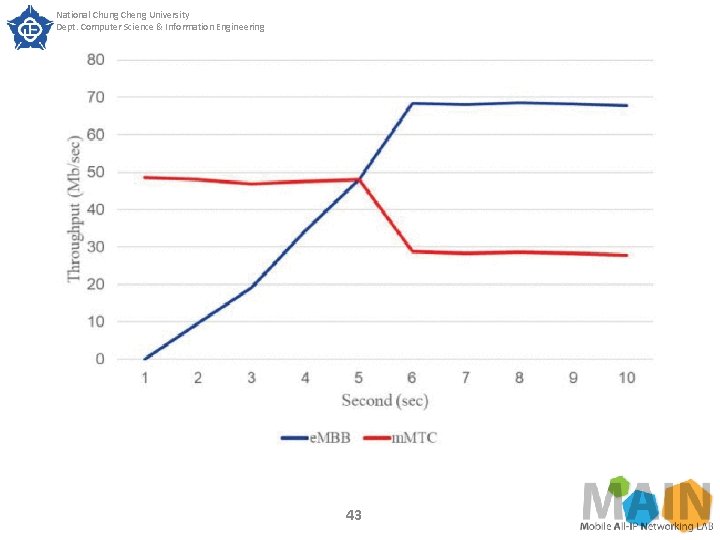
National Chung Cheng University Dept. Computer Science & Information Engineering SECTION IV. Experimental Results Experiment 3 The purpose of experiment 3 is to test whether the service of slices can be guaranteed through Queue. The experiment architecture is shown in Fig. 13. First, we used Queue to set the upper and lower throughput limits of of e. MBB and m. MTC slices, and then injected heavy traffic flow to the m. MTC slice to simulate network congestion, in order to verify whether the slice service can be guaranteed. 39
National Chung Cheng University Dept. Computer Science & Information Engineering SECTION IV. Experimental Results The traffic of e. MBB and m. MTC slices in this experiment are all simulated by iperf. The upper and lower limits of slices throughput are set as follows. The upper throughput limit of e. MBB slice is 70 Mb/sec, the lower limit is 30 Mb/sec. The upper throughput limit of m. MTC is 50 Mb/sec, and the lower limit is 30 Mb/sec. 40
National Chung Cheng University Dept. Computer Science & Information Engineering SECTION IV. Experimental Results Fig. shows the experimental result of traffic guarantee of slices. In this experiment, in order to facilitate the experiment process, we started the m. MTC slice service and kept it stable through the Queue command, and then added the e. MBB slice to verify whether the upper and lower throughput limits were guaranteed. 41
National Chung Cheng University Dept. Computer Science & Information Engineering SECTION IV. Experimental Results It can be seen that when the traffic load of m. MTC slice is heavy, the throughput of the m. MTC slice gradually drops to about the guaranteed lower limit, and then does not continue to decrease. Thus it can be confirmed that the slice throughput can be guaranteed by Queue. Note that because the setting bandwidth and the actual measured bandwidth have a variation rate of about 4%6% (as shown in experiment 1), the actual minimum throughput of m. MTC slice in Fig. 14 is slightly lower than the lower limit of 30 Mb/sec set by Queue. 42
National Chung Cheng University Dept. Computer Science & Information Engineering 43
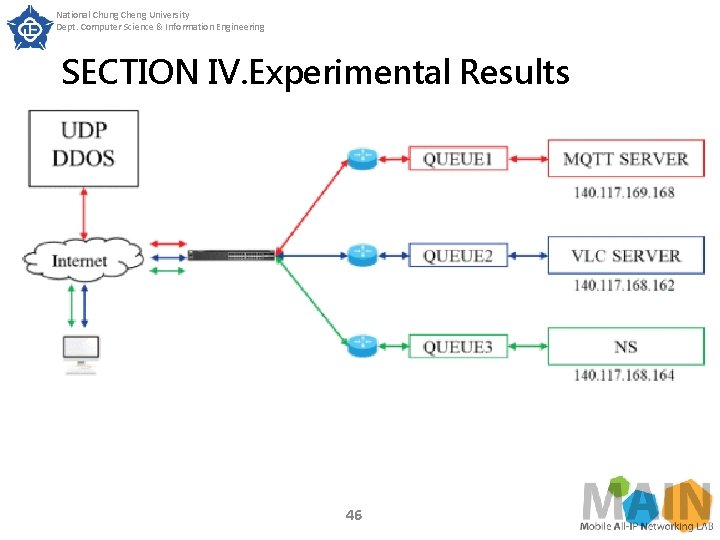
National Chung Cheng University Dept. Computer Science & Information Engineering SECTION IV. Experimental Results Experiment 4 The scenario of experiment 4 is that there are three slices in the system, two of which are in normal service, and the third slice suffers from UDP DDo. S. The experiment checks whether the throughput of these two normally operating slices were also affected by DDo. S. The architecture of experiment 5 is shown in Fig. 44
National Chung Cheng University Dept. Computer Science & Information Engineering SECTION IV. Experimental Results First of all, we set the upper and lower limits of the throughput of three slices. The upper throughput limit of m. MTC slice is 30 Mb/s, and the lower limit is 10 Mb/s. The upper throughput limit of e. MBB slice is 60 Mb/s, and the lower limit is 30 Mb/s. The upper throughput limit of NS slice is 5 Mb/s, and the lower limit is 1 Mb/s. We then set the priority of the three slices to be NS > e. MBB > m. MTC. Note that the NS slice is created to test and compare other slices and its internal VNF does not contain EPC core. 45
National Chung Cheng University Dept. Computer Science & Information Engineering SECTION IV. Experimental Results 46
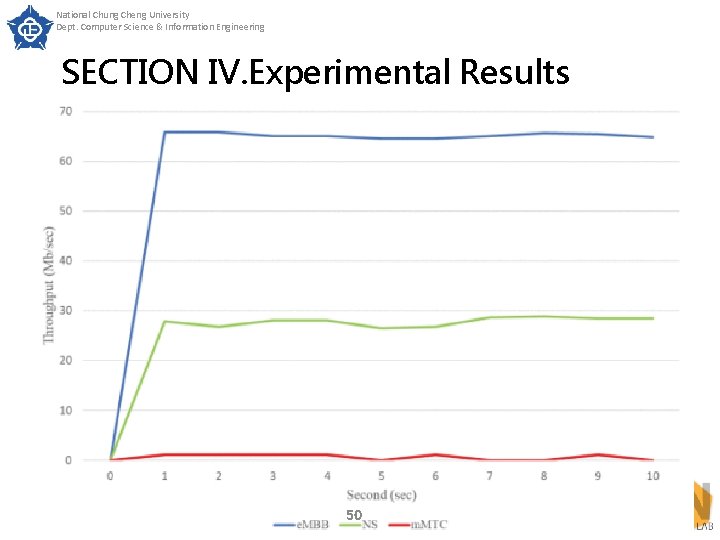
National Chung Cheng University Dept. Computer Science & Information Engineering SECTION IV. Experimental Results In this experiment, three slices m. MTC, e. MBB and NS were activated first and the traffic of these three slices is generated using iperf. Then we used open source software tfn 2 K to inject UDP DDo. S traffic flow into the m. MTC slice from the third second. Fig. 17 shows the result of experiment 5. From Fig. 17, it can be seen that when the UDP DDo. S attack is launched, the m. MTC slice cannot be connected intermittently after the fourth second, but it has no effect on the other two slices. e. MBB and NS slices can still provide normal services. 47
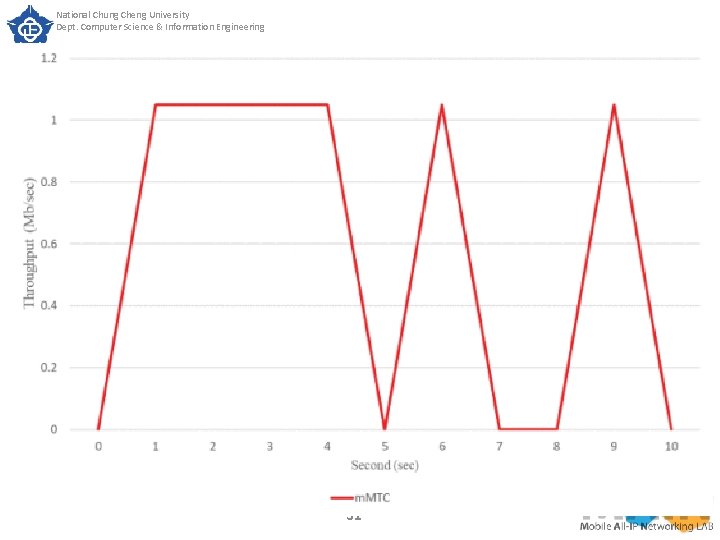
National Chung Cheng University Dept. Computer Science & Information Engineering SECTION IV. Experimental Results Due to the scale problem, it is not easy to see throughput variation from Fig. 17, so we present the throughput variation of m. MTC slice separately in Fig. 18. As can be seen from Fig. 18, UDP DDo. S makes the connection of the m. MTC slice extremely unstable after the fourth second. This intermittent connection causes the throughput of the m. MTC slice to oscillate between approximately 1 Mbps and 0 Mbps. At this time m. MTC slice is difficult to serve normally. 48
National Chung Cheng University Dept. Computer Science & Information Engineering SECTION IV. Experimental Results Noted that the guarantee of Queue in this experiment can only be achieved based on the fact that the switch can properly handle traffic packets. If the switch shared by the three slices cannot work because of a largerscale DDo. S, then the guarantee of all slices will not be able to achieve. 49
National Chung Cheng University Dept. Computer Science & Information Engineering SECTION IV. Experimental Results 50
National Chung Cheng University Dept. Computer Science & Information Engineering SECTION IV. Experimental Results 51
National Chung Cheng University Dept. Computer Science & Information Engineering SECTION V. Conclusions This research integrates various open source softwares, SDN controller and cloud platform to achieve network slicing. The proposed implementation mechanism guarantees the priority of use of each service, and uses VXLAN to cut the network segment, so as to protect the independence of each service. In terms of service deployment, Tacker can also be used to quickly set up the required VNFs to efficiently create different services. 52
National Chung Cheng University Dept. Computer Science & Information Engineering SECTION V. Conclusions Therefore, it is very convenient to set up different slices for difference service needs in the proposed implementation mechanism. In the future research, we hope to ensure the service resources on the user side and achieve better network utilization and also add appropriate scheduling scheme to adaptively improve resource utilization. 53
National Chung Cheng University Dept. Computer Science & Information Engineering References 1. Study on scenarios and requirements for next generation access technologies, May 2017. 2. X. Li, R. Casellas, G. Landi, A. de la Oliva, X. Costa- Perez, A. García-Saavedra, et al. , "5 G-crosshaul network slicing enabling multitenancy in mobile transport networks", IEEE Communications Magazine, vol. 55, no. 8, pp. 128 -137, 2017. 3. M. Yuki, T. Atsushi, K. Taichi, S. Norio and S. Katsuhiro, "An architecture and implementation of automatic network slicing for microservices", 2018 IEEE/IFIP Network Operations and Management Symposium (NOMS 2018), pp. 1 -4, Apr 2018. 4. C. Salvatore, F. Ilhem, A. Nadjib and L. Rami, "DEMO: SDN-based network slicing in C-RAN", 2018 15 th IEEE Annual Consumer Communications & Networking Conference (CCNC 2018), pp. 1 -2, Jan 2018. 5. J. Kwak, J. Moon, H. W. Lee and L. B. Le, "Dynamic network slicing and resource allocation for heterogeneous wireless services", 2017 IEEE 28 th Annual International Symposium on Personal Indoor and Mobile Radio Communications (PIMRC 2017), pp. 1 -5, Oct 2017. 54
National Chung Cheng University Dept. Computer Science & Information Engineering References 6. S. Vassilaras, L. Gkatzikis, N. Liakopoulos, I. N. Stiakogiannakis, M. Qi, L. Shi, et al. , "The algorithmic aspects of network slicing", IEEE Communications Magazine, vol. 55, no. 8, pp. 112 -119, 2017. 7. J. Ordonez-Lucena, O. Adamuz-Hinojosa, P. Ameigeiras, P. Munoz, Juan J. Ramos-Munoz, J. F. Chavarria, et al. , "The creation phase in network slicing: from a service order to an operative network slice", 2018 European Conference on Networks and Communications (Eu. CNC 2018), pp. 1 -6, Jul 2018. 8. C. Song, M. Zhang, Y. Zhan, D. Wang and L. Guan, "Hierarchical edge cloud enabling network slicing for 5 G optical fronthaul", IEEE/OSA Journal of Optical Communications and Networking, vol. 11, no. 4, pp. B 60 -B 70, 2019. 9. W. Guan, X. Wen, L. Wang, Z. Lu and Y. Shen, "Serviceoriented deployment policy of end-to-end network slicing based on complex network theory", IEEE Access, vol. 6, pp. 19691 -19701, 2018. 10. A. Farrel, "Recent developments in Service Function Chaining (SFC) and network slicing in backhaul and metro networks in support of 5 G", 2018 20 th International Conference on Transparent Optical Networks (ICTON 2018), pp. 1 -4, Jul 2018. 55
National Chung Cheng University Dept. Computer Science & Information Engineering References 11. A. A. Barakabitze, A. Ahmad, R. Mijumbi and A. Hines, "5 G network slicing using SDN and NFV: A survey of taxonomy architectures and future challenges", Computer Communications, vol. 167, pp. 1 -40. 12. M. Afaq, J. Iqbal, T. Ahmed, I. U. Islam, M. Khan and M. S. Khan, "Towards 5 G network slicing for vehicular adhoc networks: An end-to-end approach", Computer Communications, vol. 149, pp. 252 -258, 2020. 13. H. T. Chien, Y. R. Lin, C. L. Lai and C. T. Wang, "Endto- end slicing as a service with computing and communication resource allocation for multitenant 5 G systems", IEEE Wireless Communications, vol. 26, no. 15, pp. 104 -112, 2019. 56