
National Child Protection Statistics 2014 Prevention CAPTA Children

- Slides: 14
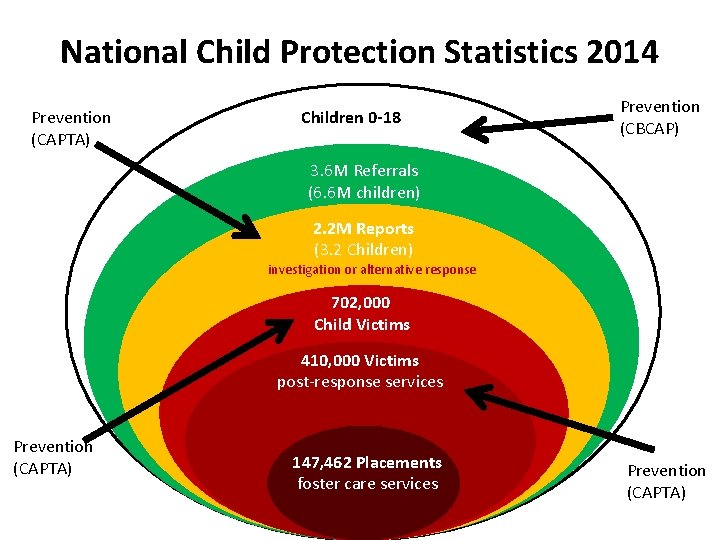
National Child Protection Statistics 2014 Prevention (CAPTA) Children 0 -18 Prevention (CBCAP) 3. 6 M Referrals (6. 6 M children) 2. 2 M Reports (3. 2 Children) investigation or alternative response 702, 000 Child Victims 410, 000 Victims post-response services Prevention (CAPTA) 147, 462 Placements foster care services Prevention (CAPTA)
Federal Support: Community-Based Child Abuse Prevention • Community-Based Child Abuse Prevention (CBCAP) Grants— provides funding to states to develop, operate, expand, and enhance community-based, prevention-focused programs and activities designed to strengthen and support families to prevent child abuse and neglect. To receive funds, the governor of the state must designate a lead agency to receive the funds and implement the program. • Child Abuse Prevention and Treatment Act (CAPTA)—supports research and demonstration projects related to the identification, prevention, and treatment of child abuse and neglect.
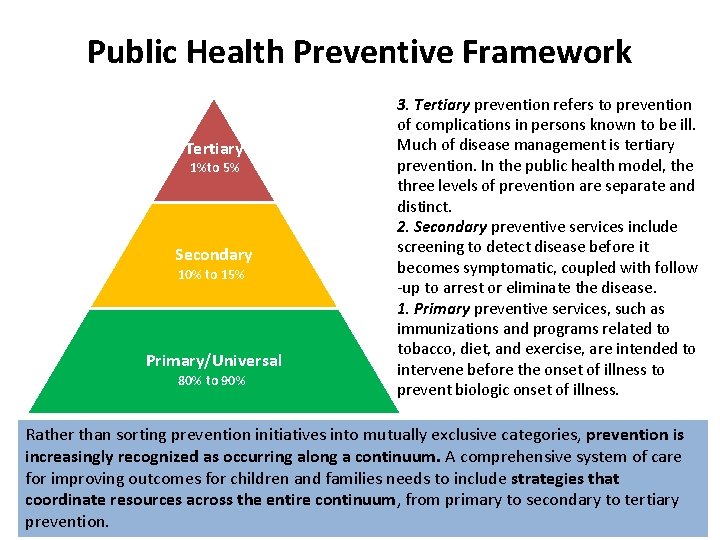
Public Health Preventive Framework Tertiary 1%to 5% Secondary 10% to 15% Primary/Universal 80% to 90% 3. Tertiary prevention refers to prevention of complications in persons known to be ill. Much of disease management is tertiary prevention. In the public health model, the three levels of prevention are separate and distinct. 2. Secondary preventive services include screening to detect disease before it becomes symptomatic, coupled with follow -up to arrest or eliminate the disease. 1. Primary preventive services, such as immunizations and programs related to tobacco, diet, and exercise, are intended to intervene before the onset of illness to prevent biologic onset of illness. Rather than sorting prevention initiatives into mutually exclusive categories, prevention is increasingly recognized as occurring along a continuum. A comprehensive system of care for improving outcomes for children and families needs to include strategies that coordinate resources across the entire continuum, from primary to secondary to tertiary prevention.
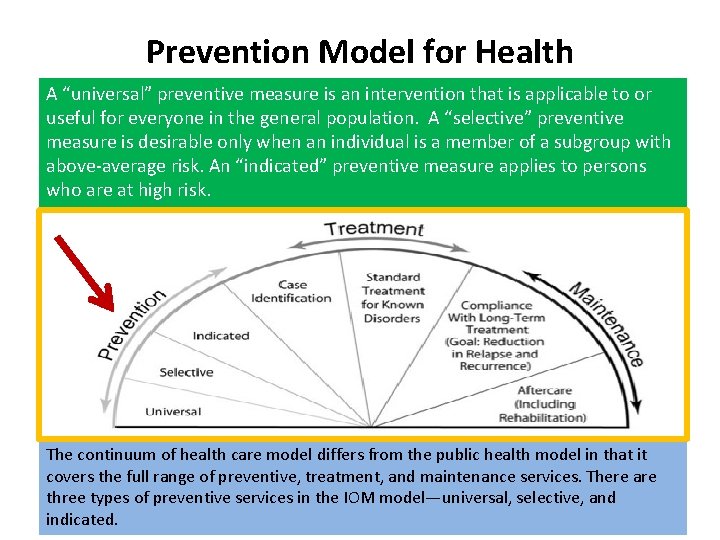
Prevention Model for Health A “universal” preventive measure is an intervention that is applicable to or useful for everyone in the general population. A “selective” preventive measure is desirable only when an individual is a member of a subgroup with above-average risk. An “indicated” preventive measure applies to persons who are at high risk. The continuum of health care model differs from the public health model in that it covers the full range of preventive, treatment, and maintenance services. There are three types of preventive services in the IOM model—universal, selective, and indicated.
Prevention Model for Behavioral Health A comprehensive approach to behavioral health also means seeing prevention as part of an overall continuum of care. Promotion—These strategies are designed to create environments and conditions that support behavioral health and the ability of individuals to withstand challenges. Promotion strategies also reinforce the entire continuum of behavioral health services. Preventing Mental, Emotional, and Behavioral Disorders Among Young People, Institute of Medicine, 2009
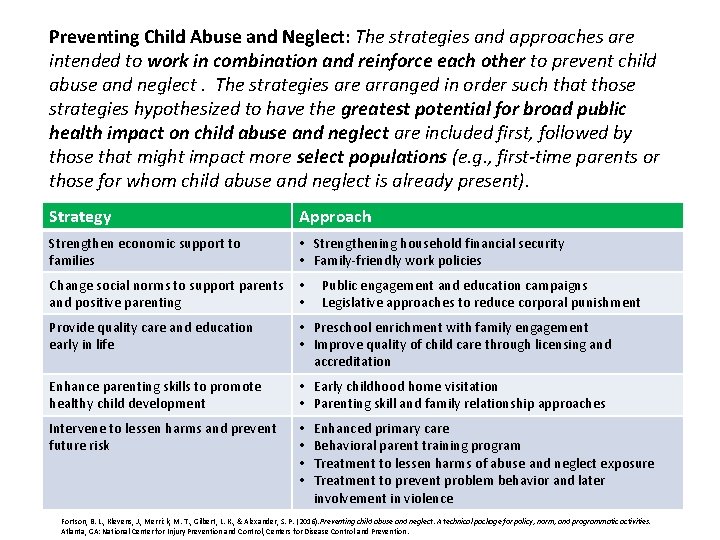
Preventing Child Abuse and Neglect: The strategies and approaches are intended to work in combination and reinforce each other to prevent child abuse and neglect. The strategies are arranged in order such that those strategies hypothesized to have the greatest potential for broad public health impact on child abuse and neglect are included first, followed by those that might impact more select populations (e. g. , first-time parents or those for whom child abuse and neglect is already present). Strategy Approach Strengthen economic support to families • Strengthening household financial security • Family-friendly work policies Change social norms to support parents • and positive parenting • Public engagement and education campaigns Legislative approaches to reduce corporal punishment Provide quality care and education early in life • Preschool enrichment with family engagement • Improve quality of child care through licensing and accreditation Enhance parenting skills to promote healthy child development • Early childhood home visitation • Parenting skill and family relationship approaches Intervene to lessen harms and prevent future risk • • Enhanced primary care Behavioral parent training program Treatment to lessen harms of abuse and neglect exposure Treatment to prevent problem behavior and later involvement in violence Fortson, B. L. , Klevens, J. , Merrick, M. T. , Gilbert, L. K. , & Alexander, S. P. (2016). Preventing child abuse and neglect: A technical package for policy, norm, and programmatic activities. Atlanta, GA: National Center for Injury Prevention and Control, Centers for Disease Control and Prevention.
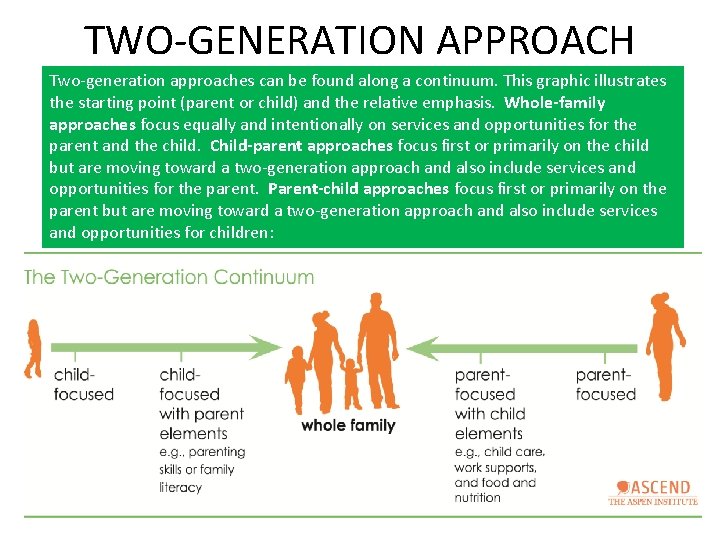
TWO-GENERATION APPROACH Two-generation approaches can be found along a continuum. This graphic illustrates the starting point (parent or child) and the relative emphasis. Whole-family approaches focus equally and intentionally on services and opportunities for the parent and the child. Child-parent approaches focus first or primarily on the child but are moving toward a two-generation approach and also include services and opportunities for the parent. Parent-child approaches focus first or primarily on the parent but are moving toward a two-generation approach and also include services and opportunities for children:
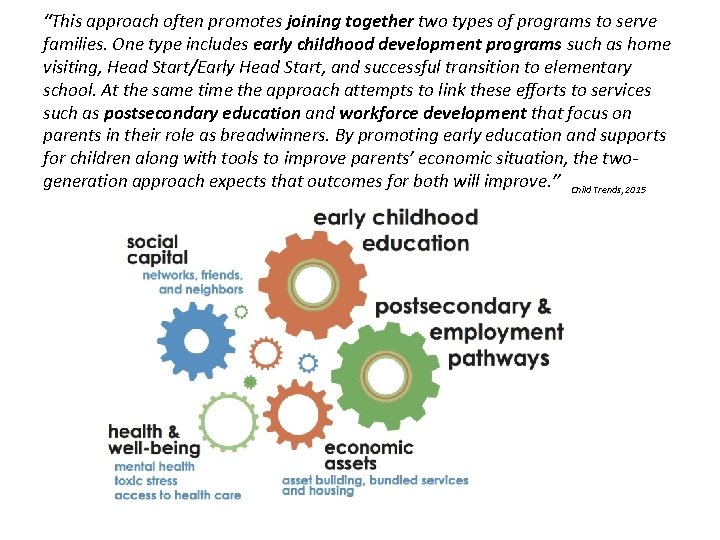
“This approach often promotes joining together two types of programs to serve families. One type includes early childhood development programs such as home visiting, Head Start/Early Head Start, and successful transition to elementary school. At the same time the approach attempts to link these efforts to services such as postsecondary education and workforce development that focus on parents in their role as breadwinners. By promoting early education and supports for children along with tools to improve parents’ economic situation, the twogeneration approach expects that outcomes for both will improve. ” Child Trends, 2015
The Center for State Child Welfare Data The Data Center provides child welfare agencies with the precision tools they need to examine the extent to which they achieve their intended outcomes, whether they receive the best return on their investments, and how they might allocate future funds toward a more cost-effective system. The result is knowledge that enables states to make informed decisions about future programming and investments, sparking a cycle of continuous quality improvement based on evidence. Membership to the Data Center includes the following: • A state-of-the-art, longitudinal child welfare database: For each member state, the Data Center designs, builds, and provides a copy of a sophisticated, flexible, longitudinal database built from the state’s own administrative child welfare records. Member states receive semiannual updates of this database. • Access to the Multistate Foster Care Data Archive (FCDA) web tool: The FCDA web tool is an online portal to states’ longitudinal databases. The web tool is a high-powered, user-friendly, decision support instrument that enables a wide variety of users to answer critical questions about systemic trends and outcomes.
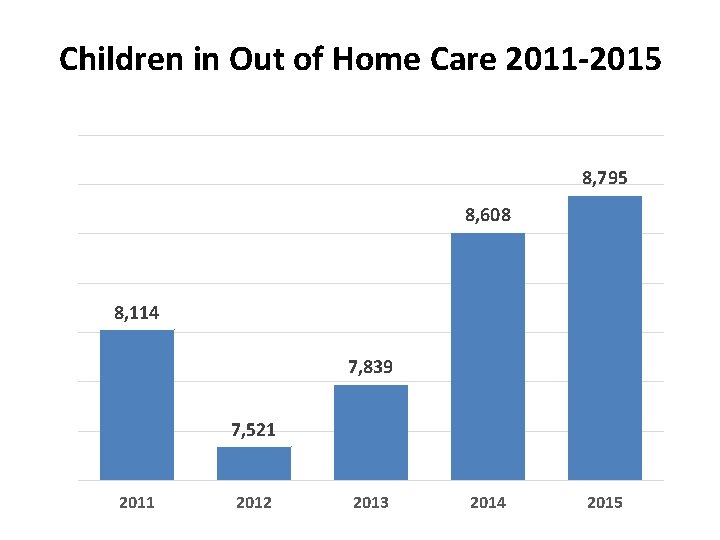
Children in Out of Home Care 2011 -2015 8, 795 8, 608 8, 114 7, 839 7, 521 2012 2013 2014 2015
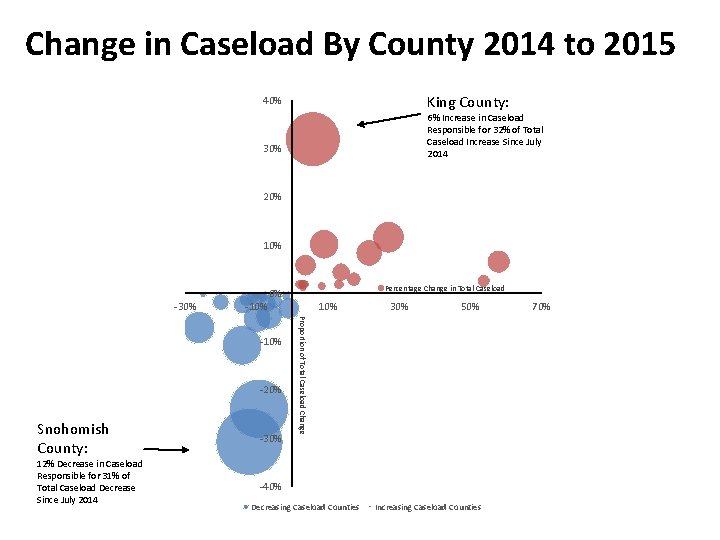
Change in Caseload By County 2014 to 2015 King County: 40% 6% Increase in Caseload Responsible for 32% of Total Caseload Increase Since July 2014 30% 20% 10% Percentage Change in Total Caseload 0% -30% -10% -20% Snohomish County: 12% Decrease in Caseload Responsible for 31% of Total Caseload Decrease Since July 2014 -30% 50% Proportion of Total Caseload Change -10% -40% Decreasing Caseload Counties Increasing Caseload Counties 70%
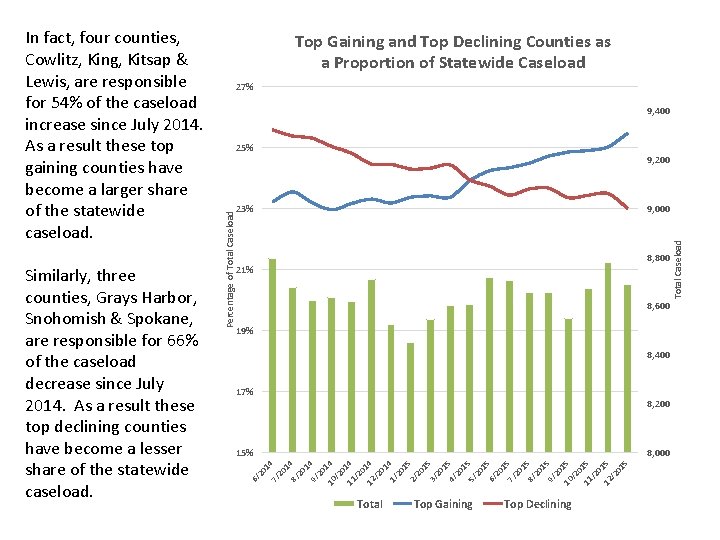
27% 9, 400 25% 9, 200 9, 000 8, 800 21% 8, 600 19% 8, 400 17% 8, 200 8, 000 1 7/ 4 20 1 8/ 4 20 1 9/ 4 20 10 14 /2 0 11 14 /2 0 12 14 /2 01 1/ 4 20 1 2/ 5 20 1 3/ 5 20 1 4/ 5 20 1 5/ 5 20 1 6/ 5 20 1 7/ 5 20 1 8/ 5 20 1 9/ 5 20 10 15 /2 0 11 15 /2 0 12 15 /2 01 5 15% Total Top Gaining Top Declining Total Caseload 23% 6/ 20 Similarly, three counties, Grays Harbor, Snohomish & Spokane, are responsible for 66% of the caseload decrease since July 2014. As a result these top declining counties have become a lesser share of the statewide caseload. Top Gaining and Top Declining Counties as a Proportion of Statewide Caseload Percentage of Total Caseload In fact, four counties, Cowlitz, King, Kitsap & Lewis, are responsible for 54% of the caseload increase since July 2014. As a result these top gaining counties have become a larger share of the statewide caseload.
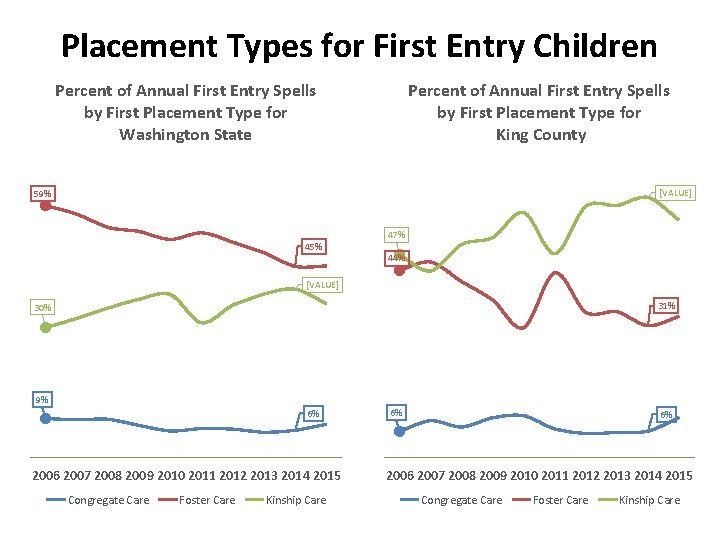
Placement Types for First Entry Children Percent of Annual First Entry Spells by First Placement Type for Washington State Percent of Annual First Entry Spells by First Placement Type for King County [VALUE] 59% 45% 47% 44% [VALUE] 31% 30% 9% 6% 2006 2007 2008 2009 2010 2011 2012 2013 2014 2015 Congregate Care Foster Care Kinship Care 6% 6% 2006 2007 2008 2009 2010 2011 2012 2013 2014 2015 Congregate Care Foster Care Kinship Care
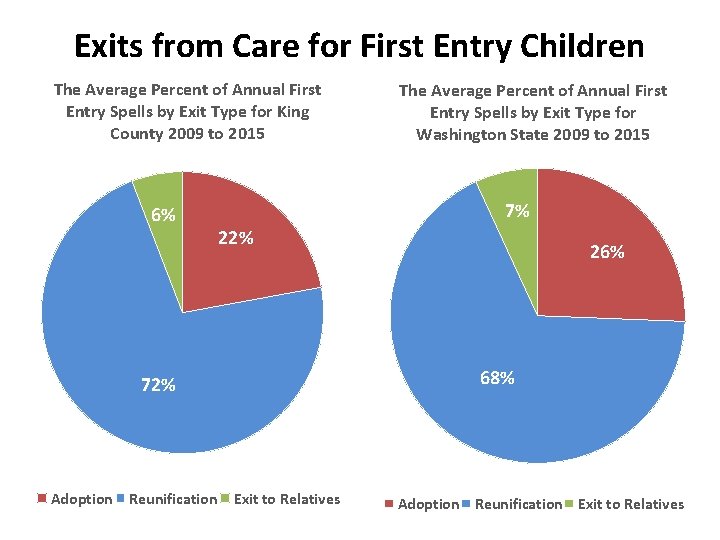
Exits from Care for First Entry Children The Average Percent of Annual First Entry Spells by Exit Type for King County 2009 to 2015 6% 7% 22% Reunification 26% 68% 72% Adoption The Average Percent of Annual First Entry Spells by Exit Type for Washington State 2009 to 2015 Exit to Relatives Adoption Reunification Exit to Relatives