
National Center for Homeless Education NCHE Operates U

- Slides: 37
National Center for Homeless Education (NCHE) • Operates U. S. Department of Education’s homeless education technical assistance & information center • NCHE has Ø Website: www. ed. gov/nche Ø Toll-free helpline: 800 -308 -2145 or homeless@serve. org Ø Listserv: Visit www. ed. gov/nche/listserv. php for subscription instructions Ø Free resources: www. ed. gov/nche/products. php
Eligible or Not? Understanding & Applying the Mc. Kinney-Vento Definition of Homeless National Center for Homeless Education Jacinda Goodwain jgoodwin@serve. org Jan Moore jmoore@serve. org
Goals for Today’s Session • Understand the Mc. Kinney-Vento (MV) definition of homeless • Learn the key questions to ask & characteristics to look for when making eligibility determinations • Apply your learning to real-life scenarios
The Mc. Kinney-Vento Act • Establishes education definition of homeless • Covers pre-K through high school Ø All public schools including preschools, charter, magnet, & virtual schools • No age limitations • Any student who meets age criteria for public education in your state can be eligible
Homeless Definition Children or youth who lack fixed, regular, & adequate nighttime residence, including: • Sharing housing of others due to loss of housing, economic hardship, or similar reason • Living in motels, hotels, trailer parks, or campgrounds due to the lack of alternative, adequate accommodations • Living in emergency or transitional shelters • Abandoned in hospitals
Homeless Definition (cont. ) • Living in a public or private place not designed for or ordinarily used as a regular sleeping accommodation for human beings • Living in cars, parks, public spaces, abandoned buildings, substandard housing, bus or train stations, or similar settings • Migratory children living in the above circumstances • Awaiting foster care placement
Awaiting Foster Care Placement (AFCP) • Non-covered states Ø AFCP removed from homeless definition on December 10, 2016 • Covered states (Check with your State Coordinator) Ø Ø Define or describe the phrase AFCP in statutory law for purposes of a program under subtitle VII-B of MV AFCP removed from homeless definition on December 10, 2017
Awaiting Foster Care Placement (cont. ) • After the deadline for removing AFCP from the definition Ø Ø Students AFCP are no longer eligible for Mc. Kinney. Vento services unless they meet the revised definition of homeless Children in any stage of child welfare involvement will be served under Title I, Part A EHCY Non-Regulatory Guidance, A-2, http: //www 2. ed. gov/policy/elsec/leg/essa/160240 ehcyg uidance 072716. pdf
Fixed, Regular, & Adequate (FRA) • Fixed Ø Stationary, permanent, not subject to change • Regular Used on a predictable, routine, consistent basis Ø Consider the relative permanence Ø • Adequate Lawfully & reasonably sufficient Ø Sufficient for meeting physical & psychological needs typically met in a home environment Ø
Can the student go to the SAME PLACE (fixed) EVERY NIGHT (regular) to sleep in a SAFE & SUFFICIENT SPACE (adequate)?
Substandard Housing • Standards vary by locality. Consider: Ø Accessibility of utilities Ø Infestations of vermin or mold Ø Working condition of kitchen or bathrooms Ø Ø Presence of dangerous living conditions due to structural issues Building or housing code requirements EHCY Non-Regulatory Guidance, A-3, www 2. ed. gov/policy/elsec/leg/essa/160240 ehcyguidance 072716. pdf
Sharing Housing of Others Due to loss of housing, economic hardship, or a similar reason • Involves a crisis of some type; is not mutually beneficial, planned housing • Intended to be short term • Typically have no legal right to be in home; can be asked to leave at any time Ø Often do not have keys to home • Leaving the situation would result in other types of homelessness
Loss of Housing • Eviction or foreclosure • Destruction of or damage to their home • Unhealthy or unsafe conditions • Domestic violence • Abuse or neglect • Abandonment, parental incarceration, or similar reasons
Economic Hardship • Limited financial resources forced the student to leave home & share housing due to an inability to pay rent/mortgage & other household bills • Clarifying question Ø Did an accident, illness, loss of employment, loss of public benefits, or a similar reason force the family or youth to share housing of others temporarily?
Motels, Hotels, Trailer Parks, & Camping Grounds Due to a lack of alternative adequate accommodations. Consider • Is it a planned move for a job or due to a crisis? • Where would the student live if not there? Are FRA options available? • Is it suitable housing, such as hotel with kitchen & adequate space? • Who is paying for the room? Ø Can ask for a receipt, but lack of one cannot be a barrier to identifying or enrolling students
Transitional Housing • Temporary accommodation for homeless individuals & families as a step to permanent housing • May last up to 24 months, provide wraparound services, & typically requires participants to pay a portion of their housing costs based on a sliding scale NCHE’s Guide to Reporting Federal Data http: //nche. ed. gov/downloads/data-guide-15 -16. pdf
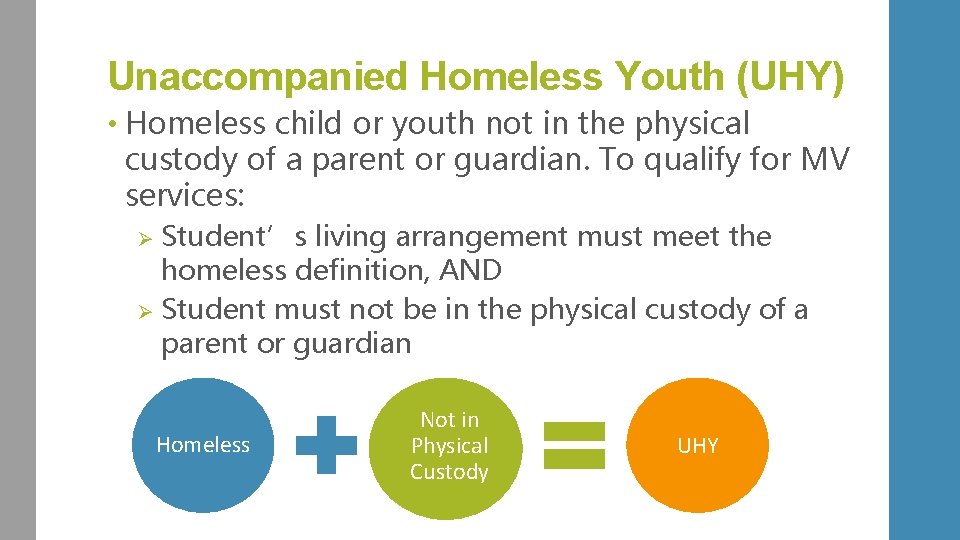
Unaccompanied Homeless Youth (UHY) • Homeless child or youth not in the physical custody of a parent or guardian. To qualify for MV services: Student’s living arrangement must meet the homeless definition, AND Ø Student must not be in the physical custody of a parent or guardian Ø Homeless Not in Physical Custody UHY
Specific UHY Considerations • Eligibility is based on the current living situation Can be eligible regardless of whether the youth "chose” to leave or was “asked” to leave Ø Behavior of student while at home is not relevant Ø There is usually more than meets the eye to the youth’s home life Ø
Review of Eligibility Considerations • Use legislative wording as a guide to eliminate irrelevant information • Make determinations on case-by-case basis • Note MV only lists a few common homeless situations; others may qualify because they are not FRA • Recognize you may have to ask more questions • Best practice: re-evaluate each student’s living situation before the next school year
Analyze the Facts • Eliminate information unrelated to student’s housing Ø What other specifics do you need to know about the student’s housing? • Compare housing situation to list provided in the law Ø Ø Does the student’s housing fit into one of the homeless examples in the law? If not, how might the housing otherwise qualify as not FRA? Determining Eligibility for Mc. Kinney-Vento Services
General Questions?
The Browns lived in their own home until storm damage made it unlivable. The insurance company has not determined if the damage will be covered. The family is still paying the mortgage, but they can’t rebuild until the claim is settled. In the meantime, they’re staying with friends. • What relevant information do you have about the Browns’ housing? • What additional information do you need?
Emily told the school counselor her home’s heating system is broken. The counselor thinks Emily may be eligible for MV services. • What relevant information do we have about Emily’s housing? • What additional information do you need?
Janine Eighteen year old Janine ran away from home. Her mother won’t talk to her, but her dad keeps in touch. She’s staying with another family, where she’s not allowed to see her boyfriend. Janine really cares for her boyfriend, so she’s thinking of moving to another friend’s home. • What relevant information do you have about Janine’s housing? • What additional information do you need?
Amy Amy’s family was living in the Elm School District. Her parents split up over the summer. Now, dad is living in Dixon District and mom is residing in a temporary housing situation in Easton District. • Is the parents’ marital status relevant to determining eligibility? • What clues do you have that Amy might be homeless? • What information do you need? • Does it matter if one parent has permanent housing but the other does not?
The Shaws Mr. Shaw just took a job in your LEA. His family is staying in their RV while they look for permanent housing. Someone told Mrs. Shaw that the children qualify for MV services, so she wants to enroll them in the school that serves the area where they are seeking housing. • How would you determine if the children are eligible? • If they do not meet the MV eligibility criteria, how will you handle the situation?
Aileen’s mom was recently incarcerated, so Aileen is staying nearby with her aunt, Victoria Burke. Ms. Burke told the school social worker that she is struggling to take care of Aileen due to her health problems. • Is Aileen eligible for MV services? • What additional information do you need?
The Millers lost their home in District A last spring and doubled up with Mrs. Miller’s mother. Children, Micah and June, were determined to be MV eligible. During the summer, the parents and June moved into permanent housing, but Micah stayed at his grandmother’s to help out as she recovers from her hip surgery. It’s time for registration for the new school year. • What’s the relevant information about Micah’s housing? • Do you need any other information?
The Riddles The Riddle family with three children are living in a house with Mrs. Riddle’s sister’s family & the children’s grandparents. The three families have lived together for at least two years & have no plans to move. • What clues do you have that the Riddle family may or may not be homeless? • What additional information do you need?
The Nordstroms Mr. Nordstrom contacts you about arranging transportation for his grandchildren. He says his daughter, the children’s mother, has “issues” and dropped off the children with him and his wife. Due to their work schedules, they cannot transport the children to school. • What questions would you ask Mr. Nordstrom to determine if the children are homeless? • What additional information do you need?
Diane & Susan Diane is at a residential treatment center. During the summer, her sister Susan’s family moved to Diane’s home from another state to care for Diane’s children. At the end of the summer, Susan took all the children back to her hometown & moved into a motel until she can find housing for all five of them. The motel is in the district next to where her children attended school last year. • What’s the relevant information about Susan’s housing? • What additional information do you need?
The Jeffersons Mrs. Jefferson came to the school and reported that her family in a neighboring school district is having some difficulties and her grandson, Doug, is staying with her in your district. She wants to enroll Doug in the school near where she lives. • What clues do you have that Doug might be homeless? • What information do you need? • How would you determine if Doug is MV eligible?
The Phillips Kathy Phillips & her two children lived with her mom last school year, & the children were identified as MV eligible. Kathy recently enrolled in college full time. Once her classes start, she & the children will stay at her sister’s apartment close to the college during the week & at her mom’s on the weekend. Kathy asked for transportation to keep the children in the school of origin in her mom’s school district. • What’s the relevant information about Kathy’s housing? • Do you need any additional information?
The Lesters The Lester family was living in an apartment. When the landlord raised the rent, they moved to a hotel while they look for another rental. • What relevant information do you have about the Lesters’ housing? • What additional information do you need?
Ray A divorced mom with custody of her son, Ray, lost her housing. No one knows where she is staying. Ray is staying at the home of his biological father who travels frequently for his job. The school has tried to contact the father several times, but he does not respond. • What relevant information do you have about Ray’s housing? • What additional information do you need?
The Uptons The Upton family moved in with Mr. Upton’s sister in a neighboring town. The school principal says their daughter, Sarah, must transfer since she’s no longer living in the attendance zone, but the school social worker thinks Sarah is homeless. • What relevant information do we have about Sarah’s housing? • What additional information do you need? • How would you handle this situation since there’s a disagreement?
Contact Us NCHE Helpline homeless@serve. org or (800) 308 -2145 Jacinda Goodwin jgoodwin@serve. org or (336) 315 -7417 Jan Moore jmoore@serve. org or (336) 315 -7403