
National Center for Emerging and Zoonotic Infectious Diseases
- Slides: 14
National Center for Emerging and Zoonotic Infectious Diseases Partnerships to Prevent Healthcare Associated Infections and Antibiotic Resistance: Challenges and Opportunities Nimalie D. Stone, MD Medical Officer Prevention and Response Branch Division of Healthcare Quality Promotion AHFSA Annual conference August 21, 2017 http: //www. cumbriacrack. com/2015/03/19/clouds-castshadow-on-solar-eclipse/
Session objectives § Describe current activities led by healthcare-associated infection/antibiotic resistance (HAI/AR) prevention programs and opportunities for coordination with state survey agencies § Identify potential challenges with information sharing across state groups and strategies to overcome § Discuss opportunities to leverage the quality payment program to foster partnerships and create synergy https: //linustechtips. com/main/topic/236420 -partial-solar-eclipse-on-oct-23/
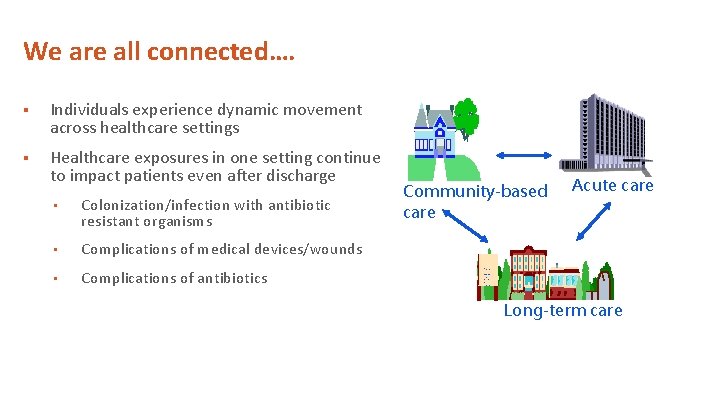
We are all connected…. § Individuals experience dynamic movement across healthcare settings § Healthcare exposures in one setting continue to impact patients even after discharge • Colonization/infection with antibiotic resistant organisms • Complications of medical devices/wounds • Complications of antibiotics Community-based care Acute care Tranqu il Garde ns Nursin g Home Long-term care
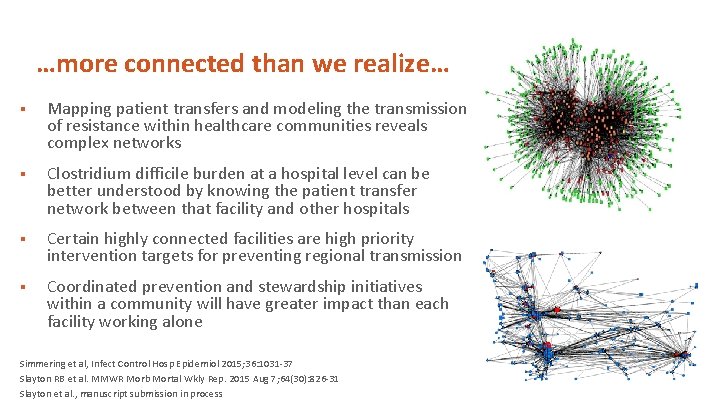
…more connected than we realize… § Mapping patient transfers and modeling the transmission of resistance within healthcare communities reveals complex networks § Clostridium difficile burden at a hospital level can be better understood by knowing the patient transfer network between that facility and other hospitals § Certain highly connected facilities are high priority intervention targets for preventing regional transmission § Coordinated prevention and stewardship initiatives within a community will have greater impact than each facility working alone Simmering et al, Infect Control Hosp Epidemiol 2015; 36: 1031 -37 Slayton RB et al. MMWR Morb Mortal Wkly Rep. 2015 Aug 7; 64(30): 826 -31 Slayton et al. , manuscript submission in process
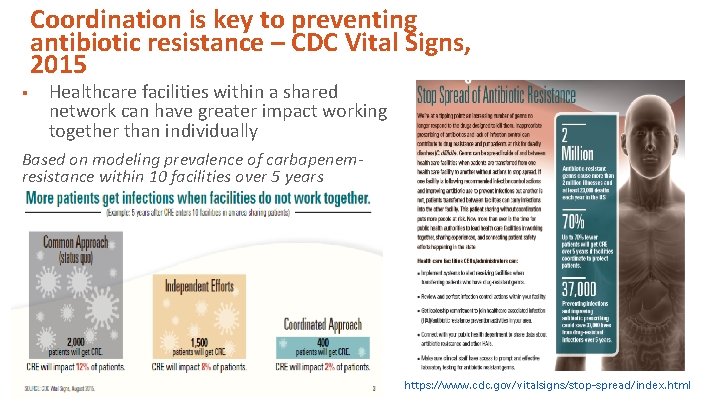
Coordination is key to preventing antibiotic resistance – CDC Vital Signs, 2015 § Healthcare facilities within a shared network can have greater impact working together than individually Based on modeling prevalence of carbapenemresistance within 10 facilities over 5 years https: //www. cdc. gov/vitalsigns/stop-spread/index. html
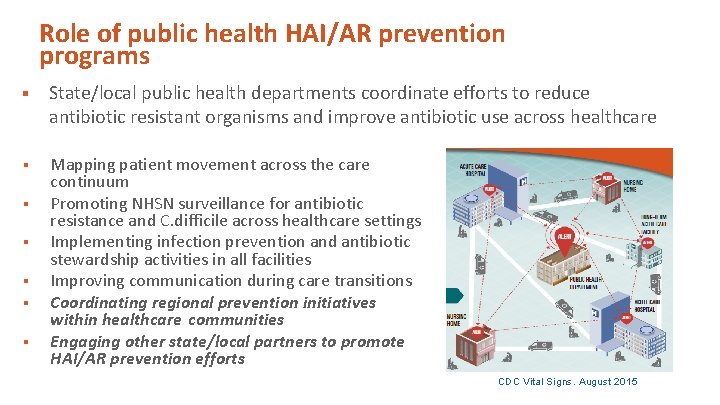
Role of public health HAI/AR prevention programs § State/local public health departments coordinate efforts to reduce antibiotic resistant organisms and improve antibiotic use across healthcare Portfolio of activities including: § § § Mapping patient movement across the care continuum Promoting NHSN surveillance for antibiotic resistance and C. difficile across healthcare settings Implementing infection prevention and antibiotic stewardship activities in all facilities Improving communication during care transitions Coordinating regional prevention initiatives within healthcare communities Engaging other state/local partners to promote HAI/AR prevention efforts CDC Vital Signs. August 2015
Partner coordination – Example #1: Regional prevention project § A health department partners with an academic group to implement a quality improvement initiative to address rising antibiotic resistance in the community § The team recruits acute care hospitals, long-term care hospitals and nursing homes within the region to participate in a 12 month project § § Every facility will implement a point prevalence survey for resistant bacteria among a random sample of patients at the beginning and end of the project § § Every facility will change their standing bathing protocol to incorporate an antiseptic which is known to reduce skin carriage of bacteria The survey will entail collection of swabs from the nose, axilla, groin and perirectal area for culture of resistant bacteria (e. g. , MRSA, VRE, CRE) The health department will also monitor the rates of infections from resistance bacteria within the community
Regional prevention project -- questions § Is this quality improvement or research? § Could this initiative be viewed differently among survey teams in hospitals vs. nursing homes? § What information might a surveyor want to know about this public health effort before going into a participating facility? § Implementation issues for consideration: § § What actions can be considered part of facility QAPI? How does any QI project address resident rights to be informed and to decline participation? What is the role of IRB review and decisions on what activities are considered research and what activities require informed consent? How can public health translate evidence-based prevention strategies across healthcare environments?
Regional prevention project – solutions § A series of informational sessions about the public health QI initiative were conducted for surveyors and CMS national and regional staff § Protocols, order sets and resident/family educational materials were made available at each participating facility to demonstrate the policies and practices during the implementation of the new bathing practice § Discussions were had about how facility QAPI projects should document a resident’s assent or declination to participate in a bath § Decisions were made about how to add a layer of informed consent for the sample of residents asked to participate in the post-project prevalence survey
Partner coordination – Example #2 Infection prevention assessments § A CMS survey team is piloting a new approach to evaluating infection prevention and control (IPC) programs within hospitals and nursing homes. § They are also assessing infection risk factors and antibiotic use information shared during care transitions between facilities § Although participation was not voluntary, these assessments were educational in nature and not intended to generate citations – unless serious (IJ level) concerns were identified https: //www. cms. gov/Medicare/Provider-Enrollment-and. Certification/Survey. Certification. Gen. Info/Downloads/Survey-and-Cert-Letter-17 -09. pdf
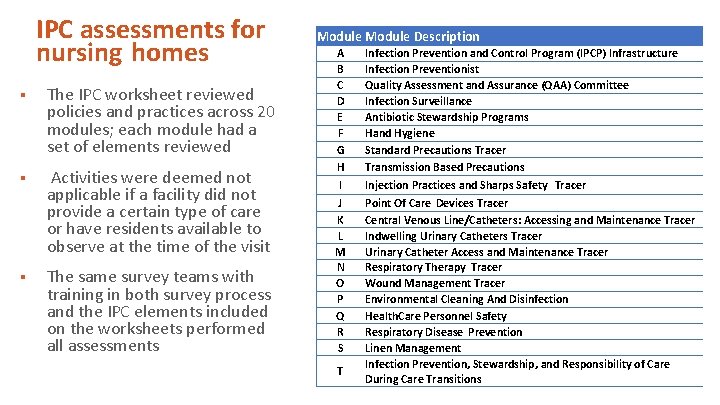
IPC assessments for nursing homes § The IPC worksheet reviewed policies and practices across 20 modules; each module had a set of elements reviewed § Activities were deemed not applicable if a facility did not provide a certain type of care or have residents available to observe at the time of the visit § The same survey teams with training in both survey process and the IPC elements included on the worksheets performed all assessments Module Description A B C D E F G H Infection Prevention and Control Program (IPCP) Infrastructure Infection Preventionist Quality Assessment and Assurance (QAA) Committee Infection Surveillance Antibiotic Stewardship Programs Hand Hygiene Standard Precautions Tracer Transmission Based Precautions I J K L M N O P Q R S Injection Practices and Sharps Safety Tracer Point Of Care Devices Tracer Central Venous Line/Catheters: Accessing and Maintenance Tracer Indwelling Urinary Catheters Tracer Urinary Catheter Access and Maintenance Tracer Respiratory Therapy Tracer Wound Management Tracer Environmental Cleaning And Disinfection Health. Care Personnel Safety Respiratory Disease Prevention Linen Management Infection Prevention, Stewardship, and Responsibility of Care During Care Transitions T
Infection prevention assessments questions § As the team identifies gaps within IPC programs, how could they handle requests from a facility for technical assistance? § § § Are surveyors able to provide resources on IPC, antibiotic stewardship or other patient safety issues to facilities ? Can surveyors make referrals to other organizations to provide technical assistance? Implementation issues for consideration: § § § Are there organizations in your state who could offer assistance with IPC/stewardship questions from nursing home providers? Does your survey agency have a connection to the state HAI/AR prevention program? Does your survey agency work with the CMS funded state qualityinnovation network-quality improvement organization (QIN-QIO)?
IPC technical assistance – solutions § Information learned from the survey team was used to help develop a plan of action and priorities for the nursing home IPC program § Identified a project within the QIN-QIOs existing work which allowed for a hand off from the survey team to ensure the nursing homes had access to ongoing assistance § State/local HAI prevention programs were identified as IPC resources to both the survey team and the QIN-QIOs working with facilities § Coordination between the QIN-QIO and the state HAI program will ensure the facility receives the support needed to address IPC program gaps
Thank you!! Email: nstone@cdc. gov with questions/comments Email: For more information, contact CDC 1 -800 -CDC-INFO (232 -4636) TTY: 1 -888 -232 -6348 www. cdc. gov The findings and conclusions in this report are those of the authors and do not necessarily represent the official position of the Centers for Disease Control and Prevention.