
National Center for Earth and Space Science Education
- Slides: 9
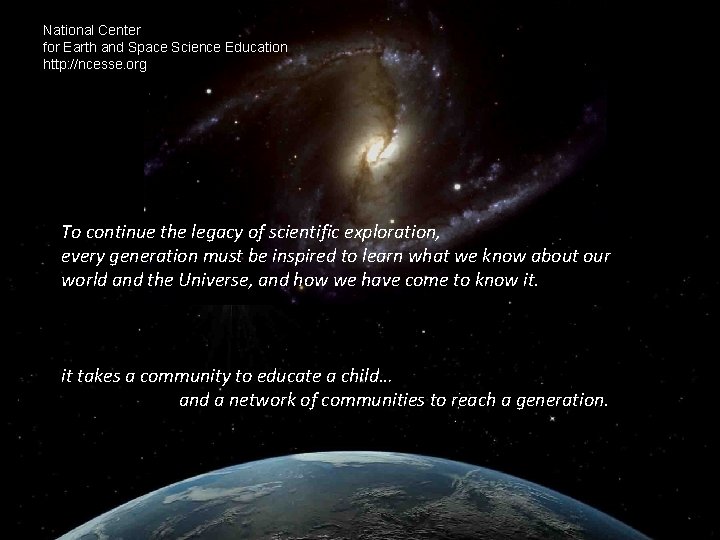
National Center for Earth and Space Science Education http: //ncesse. org To continue the legacy of scientific exploration, every generation must be inspired to learn what we know about our world and the Universe, and how we have come to know it. it takes a community to educate a child… and a network of communities to reach a generation.
Student Spaceflight Experiments Program (SSEP) A program of the National Center for Earth and Space Science Education SSEP on the International Space Station (ISS) • Routine operations beginning Fall 2011 • NCESSE onboarding participating communities Summer 2011 • Same cost as SSEP on STS-135 • Fall 2011 Competition • Spring Flights • Soyuz 29 up April 1 • Soyuz 30 down May 16 • Substantially greater capability for Lab Apparatus compared to MDA
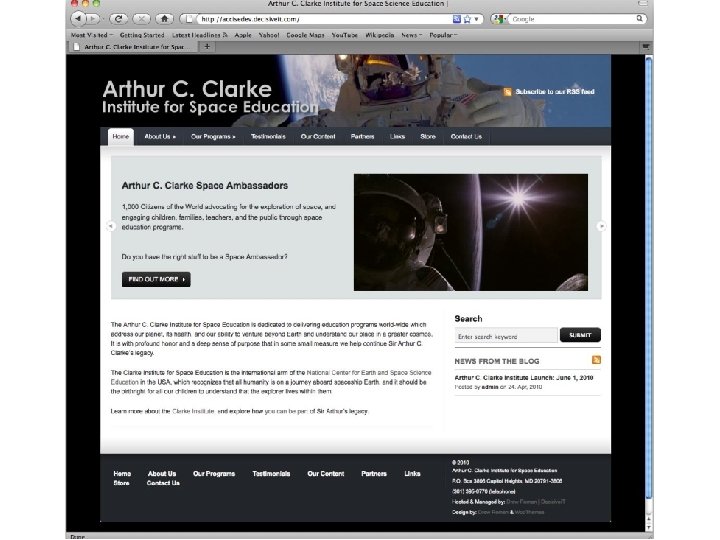
Student Spaceflight Experiments Program (SSEP) A program of the National Center for Earth and Space Science Education Critical Timeline Phase 1: The Timeline through student experiments selection— July 11, 2011: SSEP National Announcement of Opportunity (AO) for SSEP Mission 1 to the International Space Station Announcement across U. S. via NCESSE: opportunity open to School Districts (pre-college grades 5 -12), 2 -Year Community Colleges; and 4 -Year Colleges and Universities with emphasis on underserved communities. Announcement to European Union nations, Japan, and Canada via NCESSE’s new international arm, the Arthur C. Clarke Institute for Space Education. July 11 – September 15, 2011 (2 months): Communities Decide to Come Aboard WE CAN HELP IDENTIFY FUNDING September 15, 2011: Formal Letter of Commitment of Funding Due September 16, 2011: Go-No-Go Decision - minimum requirement of 12 booked experiment slots
Student Spaceflight Experiments Program (SSEP) A program of the National Center for Earth and Space Science Education October 1, 2011: SSEP begins in all participating communities YOU CAN START EARLIER THAN OCTOBER 1 October 1, 2011: NCESSE ships 5 Fluids Mixing Enclosure (Mix. Stik) Kits to Each Participating Community October 15, 2011: Deadline for Signed Contract October 1 – November 28, 2011: 8 weeks of Experiment Design and Proposal Writing in Participating Communities November 28, 2011: Deadline for Student Team Proposal Submission for Step 1 Review December 2, 2011: Deadline for Finalist Proposals to be Received by NCESSE for Step 2 Review December 8, 2011: Flight Experiments Tentatively Selected December 23, 2011: Flight Experiments Formally Selected December 26, 2011: List of Flight Experiment Samples Submitted to Nano. Racks December 30, 2011: NASA Toxicology Receives List of Experiment Samples
Student Spaceflight Experiments Program (SSEP) A program of the National Center for Earth and Space Science Education Phase 2: The timeline for selected experiments— February 24, 2012 (T= 0 Handover): Deadline for Nano. Racks to Receive all Mix. Stiks from Flight Experiment Teams March 1, 2012 (Handover + 6 days): SSEP Mission 1 Payload turned over by Nano. Racks to NASA for Vehicle Integration Launch Minus 2 Days, to Launch Minus 8 Hours: SSEP Mission 1 Payload is Loaded onto Soyuz 30 April 1, 2012 (Handover +5 Weeks): Launch of SSEP Mission 1 Payload on Soyuz 30 By Launch Plus 1 Week (Handover +6 Weeks): Payload Transferred from Soyuz 30 to ISS May 16, 2012 (Handover + 11 Weeks): SSEP Mission 1 Payload Returns to Earth on Soyuz 29 Return to Earth plus 15 – 20 Hours: SSEP Mission 1 Payload Received by Nano. Racks in Houston; Mix. Stiks Shipped Directly To Experiment Teams
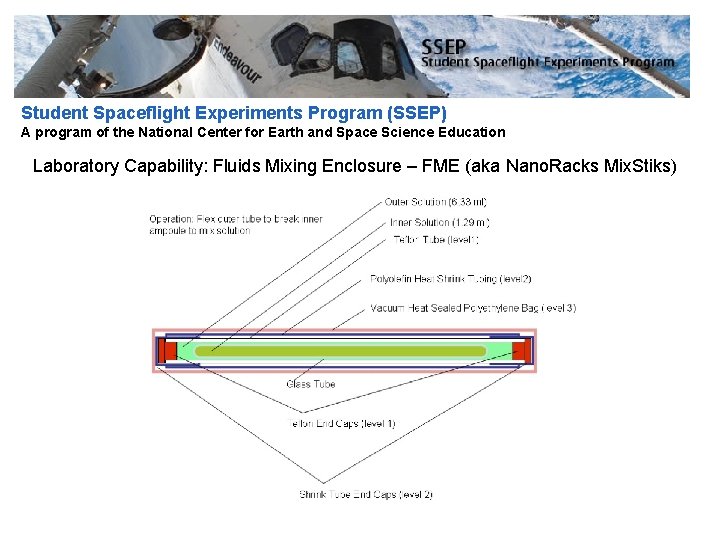
Student Spaceflight Experiments Program (SSEP) A program of the National Center for Earth and Space Science Education Laboratory Capability: Fluids Mixing Enclosure – FME (aka Nano. Racks Mix. Stiks)
Student Spaceflight Experiments Program (SSEP) A program of the National Center for Earth and Space Science Education Sample Volumes: Compare to MDA Well – 0. 125 ml Type 2 outer chamber: 6. 33 ml central chamber (glass ampule): 1. 29 ml Type 3: outer chamber: 6. 33 ml central chamber 1 (glass ampule): 0. 645 ml central chamber 2 (glass ampule): 0. 645 ml Filling the Sample Volumes: Each sample volume in the Mix. Stik does not need to be completely filled. Air voids are fine. Transparency: the Mix. Stik is opaque. There is therefore no means to photograph samples once loaded. Payload Stacking: 24 Mix. Stiks can be placed in a single payload box Thermal Control: there is no active thermal control, the Mix. Stik is subject to ambient temperature conditions. Exploring refrigeration, even incubation on ISS.
Student Spaceflight Experiments Program (SSEP) A program of the National Center for Earth and Space Science Education Advantages over MDA 1. Volumes 5 to 10 x larger 2. Air voids fine 1. Mixing protocol fully defined by student team 2. Can mix up to 3 fluids, including biological inhibitors and fixatives 3. Triple containment: so no Master List of Samples (yeah), only samples not allowed: no radioactive fluids or solids no perfumes no hydrofluoric acid no magnets no cadmium no beryllium 6. Student Flight Team Loads and Unloads Flight Mix. Stik – you have flight hardware, and for ground-truth