
National Borders East and West Germany 27 years
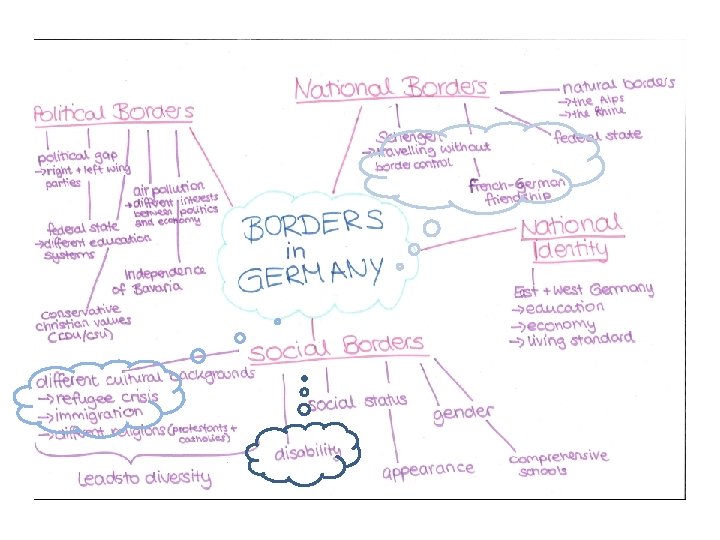
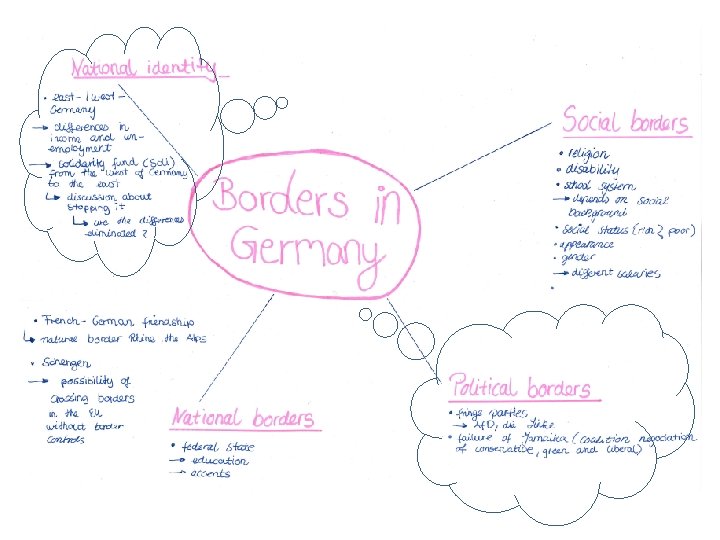
National Borders East and West Germany 27 years after the German reunification there are still borders between West and East Germany, although those are no national borders anymore. For one thing borders in peoples heads that can be felt by lots of prejudices, caused by the influence of the former social and political systems people grew up with. 34% of the East Germans think that the West Germans are arrogant and 8% of West Germans think that East Germans are dissatisfied. It is significant that differences are perceived more intensively by people living in the eastern part of the country, probably because they have to deal with bigger changes and challenges.
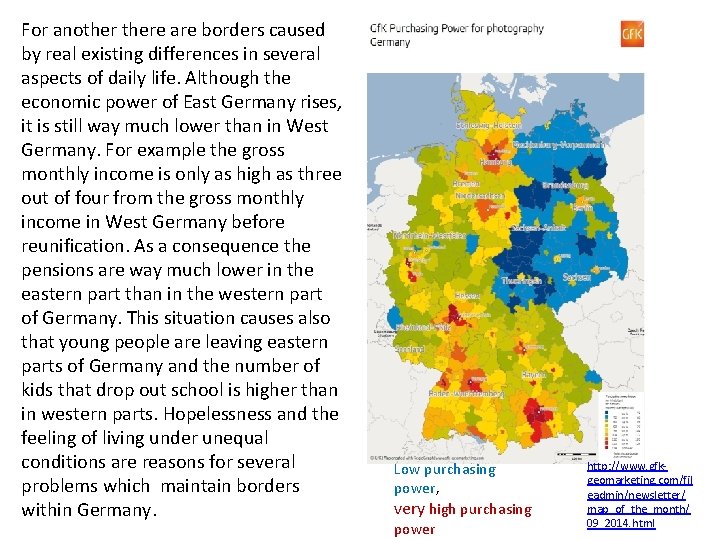
For anothere are borders caused by real existing differences in several aspects of daily life. Although the economic power of East Germany rises, it is still way much lower than in West Germany. For example the gross monthly income is only as high as three out of four from the gross monthly income in West Germany before reunification. As a consequence the pensions are way much lower in the eastern part than in the western part of Germany. This situation causes also that young people are leaving eastern parts of Germany and the number of kids that drop out school is higher than in western parts. Hopelessness and the feeling of living under unequal conditions are reasons for several problems which maintain borders within Germany. Low purchasing power, very high purchasing power http: //www. gfkgeomarketing. com/fil eadmin/newsletter/ map_of_the_month/ 09_2014. html
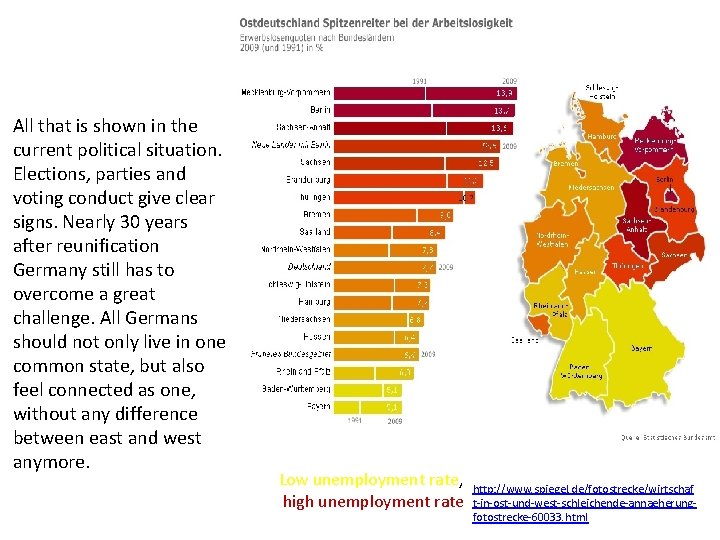
All that is shown in the current political situation. Elections, parties and voting conduct give clear signs. Nearly 30 years after reunification Germany still has to overcome a great challenge. All Germans should not only live in one common state, but also feel connected as one, without any difference between east and west anymore. Low unemployment rate, high unemployment rate http: //www. spiegel. de/fotostrecke/wirtschaf t-in-ost-und-west-schleichende-annaeherungfotostrecke-60033. html
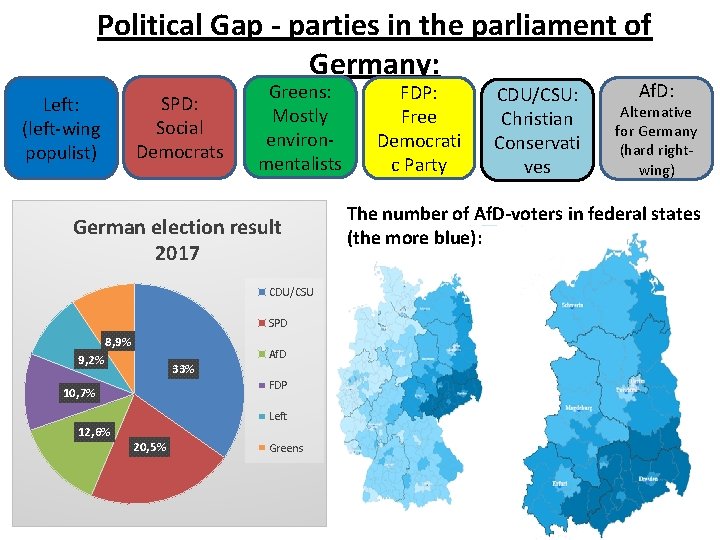
Political Gap - parties in the parliament of Germany: SPD: Social Democrats Left: (left-wing populist) Greens: Mostly environmentalists German election result 2017 CDU/CSU SPD 8, 9% 9, 2% 33% FDP 10, 7% 12, 6% Af. D Left 20, 5% Greens FDP: Free Democrati c Party CDU/CSU: Christian Conservati ves Af. D: Alternative for Germany (hard rightwing) The number of Af. D-voters in federal states (the more blue):
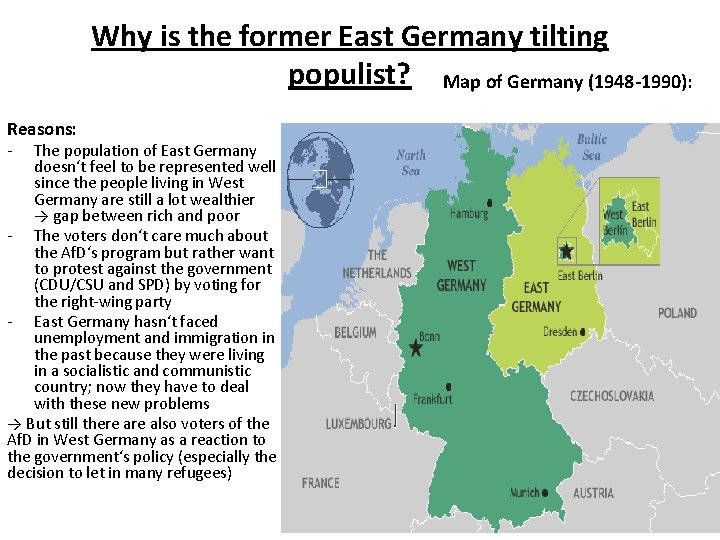
Why is the former East Germany tilting populist? Map of Germany (1948 -1990): Reasons: - The population of East Germany doesn‘t feel to be represented well since the people living in West Germany are still a lot wealthier → gap between rich and poor - The voters don‘t care much about the Af. D‘s program but rather want to protest against the government (CDU/CSU and SPD) by voting for the right-wing party - East Germany hasn‘t faced unemployment and immigration in the past because they were living in a socialistic and communistic country; now they have to deal with these new problems → But still there also voters of the Af. D in West Germany as a reaction to the government‘s policy (especially the decision to let in many refugees)
Sources: - http: //www. spiegel. de/international/germany/easterngermany-and-its-affinity-for-populists-a-1177790. html http: //www. spiegel. de/international/europe/germany-avisit-to-the-afd-stronghold-of-wilsdruff-saxony-a 1169968. html http: //www. zeit. de/politik/deutschland/2017 -08/federalelection-germany-survey-populism-refugees https: //www. pinterest. de/pin/154107618471316498/ https: //perspektive-online. net/2017/09/bundestagswahl-im -osten-deutschlands-und-der-sieg-der-afd/
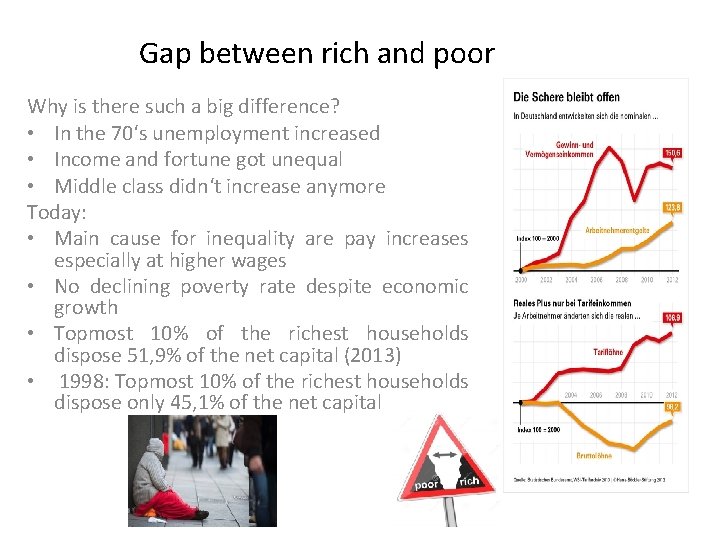
Gap between rich and poor Why is there such a big difference? • In the 70‘s unemployment increased • Income and fortune got unequal • Middle class didn‘t increase anymore Today: • Main cause for inequality are pay increases especially at higher wages • No declining poverty rate despite economic growth • Topmost 10% of the richest households dispose 51, 9% of the net capital (2013) • 1998: Topmost 10% of the richest households dispose only 45, 1% of the net capital
Sources: • https: //www. stern. de/wirtschaft/geld /armut--schere-zwischen-arm-undreich-oeffnet-sich-6712890. html • https: //deutsche-wirtschaftsnachrichten. de/2017/01/16/scherezwischen-arm-und-reich-nochgroesser-als-gedacht/ • https: //www. bing. com/images/searc h? view=detail=schere+zwischen+arm +und+reich+deutschland+statistik Nathalie Lindlbauer – Gap between poor and rich 10
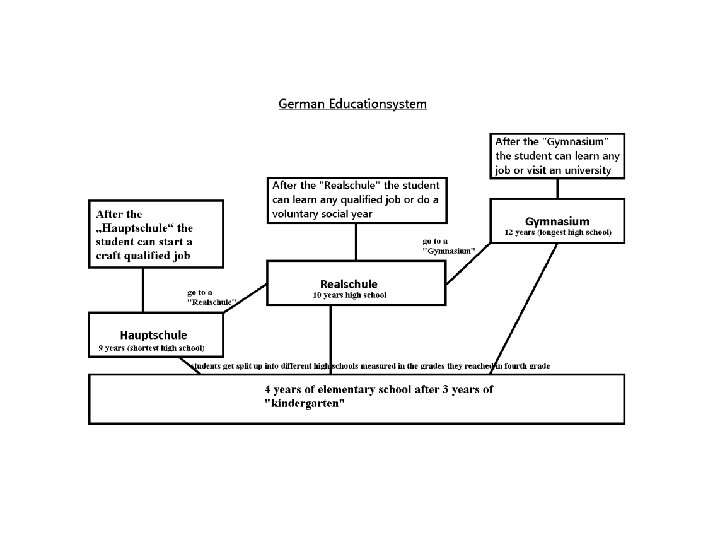
The German Education system The German school system is states matter, this means every federal state is responsible for its own school system, the staff and the curriculum. The local commune provides the financial means for buildings and equipment. A child starts at the age of 3 years in the „kindergarten“ and is sent to the elementary school at the age of about 6. The elementary school takes 4 years (first to fourth class) in Baden-Würtemberg, in other states such as Berlin the elementary school takes 6 years. There the children learn to count, read and write. After elementary school the children are split up into three different secondary schools. The grades they reached in fourth grade usually determine the choice of school: the „Gymnasium“ for really good students, the „Realschule“ for good students and the „Hauptschule“ for less good students.
The „Hauptschule“ is the shortest secondary track, it ends after 9 th grade. After the „Hauptschule“ the student can start an apprenticeship or go to a „Realschule“. The „Realschule“ ends after 10 th grade. A student that finished the „Realschule“ can apply for a qualified job training , do a voluntary social year or go to a „Gymnasium“. The „Gymnasium“ ends after 12 th grade with the „Abitur“. It is the highest high school certificate you can reach in Germany and required if students want to go to university. So the German school system first splits students into different high schools but it is always possible to carry on and achieve a higher high school diploma. For many the system seems unfair as children from poor family backgrounds, immigrants often don‘t make it to grammar school. Studies show that success in school depends on your parents‘ background and social environment.
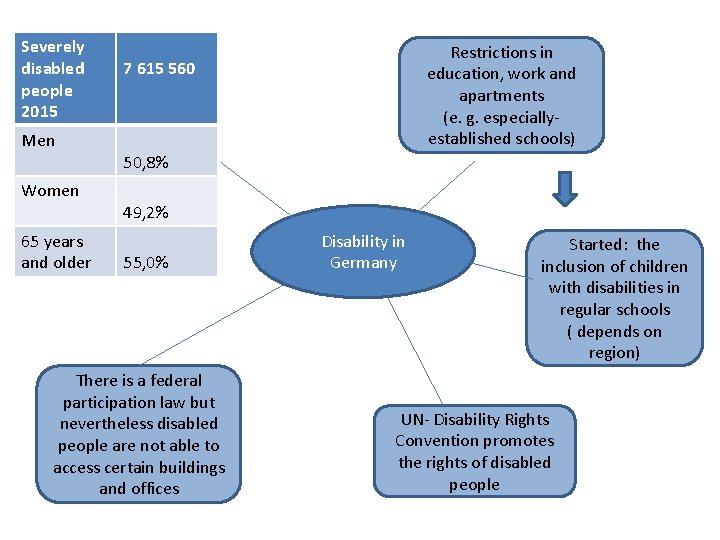
Severely disabled people 2015 7 615 560 Men 50, 8% Women 49, 2% 65 years and older 55, 0% There is a federal participation law but nevertheless disabled people are not able to access certain buildings and offices Restrictions in education, work and apartments (e. g. especially- established schools) Disability in Germany Started: the inclusion of children with disabilities in regular schools ( depends on region) UN- Disability Rights Convention promotes the rights of disabled people
Asylum and refugees • Immigrants are people, who leave their country and come to our country to start a better and a new life here. So are refugees but they leave their country because their safety is not guaranteed and they often are scared to death. • In 2008 Germany hosted 28. 018 refugees ( according to the numbers of application for asylum) • Due the refugee crisis, which started in 2014, the number of refugees coming to Germany had a huge increase. In 2014 there were 476. 649 application for asylum. In 2016 the number raised to 745. 545 • But not everyone who applies for an asylum, is getting one. • You will get a residency permit for 3 years, if you are politically or religiously persecuted, if in your country is war or if you get tortured. • Living as a refugee is not easy. They live in constant fear whether they are allowed to stay or not, because the process of a residency permit can take a long time. For that time the refugees live in refugee’s homes but they have very limited possibilities to work somewhere. • Due to that they have a lot of time which they can use for learning German or to integrate but often they keep thinking what happened until they got to Germany and all the horrible things they saw and experienced in their country of origin.
• If the refugee is not accepted, doesn't get a residency permit, he is from a „save“ country. Meaning he could live there without the fear of being persecuted or even killed. • Example for that are the economic refugees. They want to start a new life in Germany because they would get more money working or just living in Germany, than working really hard in their country of origin. • Most of economic refugees are from the Western Balkans. As they don't get a residency permit, they get deported. The official number is 21. 789 and these are only from the Western Balkans. • The deportation and the acceptation of the asylum application is determined by the asylum law. This law causes problems for refugees, because they are not allowed to reunite their families in Germany; especially for kids who were sent by their families to Germany: They could become • a lost generation • unable to integrate without family ties • Some children would rather go back to their dangerous home countries • It’s Germany’s legal responsibility to protect them. http: //www. bamf. de/DE/Fluechtlingsschu tz/Ablauf. Asylv/Schutzformen/Asylbe rechtigung/asylberechtigungnode. html https: //www. planetwissen. de/geschichte/menschenrech te/fluechtlinge/asyl-wer-darf-bleiben -100. html https: //medienstintegration. de/fileadmin/_processed _/csm_Asylantragszahlen_2016_eec 4580429. png https: //de. wikipedia. org/wiki/Abschiebun g_(Recht) https: //www. anwalt. org/asylrechtmigrationsrecht/abschiebung/
Integration/Inclusion of refugees in Germany and its problems In 2015, there was a huge wave of refugees coming to Europa and in particular to Germany. For many, Germany seemed to be a safer place to live and to – eventually - work, as Germany is an economically strong country. Chancellor Angela Merkel ( CDU, Conservative Party ) also played a big role, as she welcomed every refugee to be part of Germany. This welcoming culture caused criticism among many politicians and among parts of the population. Many claimed, Germany would not be able to integrate all those people but would rather be pushed too hard and overtaxed. Today, the number of immigrants coming to Germany decreased but we still have to integrate thousands of people. The government offers a lot of language lessons, because being able to speak German is one of the most important things when it comes to integration. Secondly, they try to give the possibility of going to school to as many kids as possible, as only good education gives them a chance in their future. Unfortunately, there is a big shortage of teachers. That`s why there is a lot of voluntary work needed: Next to our school, there is a refugee hostel. A few students of our school go there every week to help the children with their homework or they just play and talk trying to distract them from all the terrible pictures of war and violence they must have in their minds.
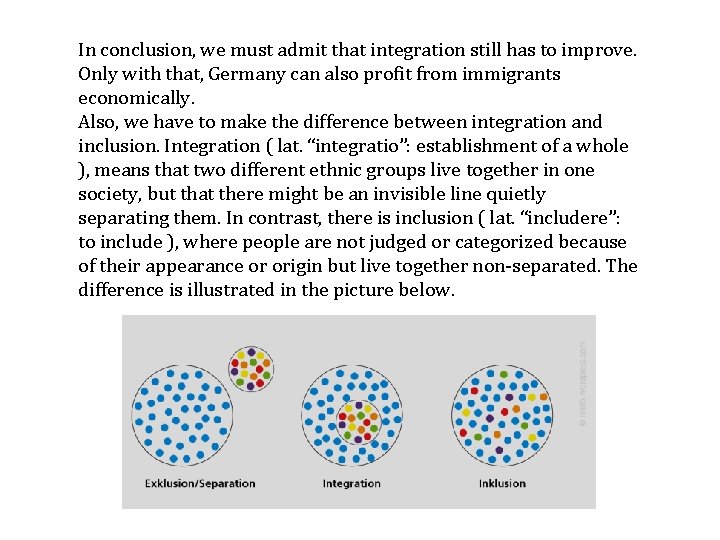
In conclusion, we must admit that integration still has to improve. Only with that, Germany can also profit from immigrants economically. Also, we have to make the difference between integration and inclusion. Integration ( lat. “integratio”: establishment of a whole ), means that two different ethnic groups live together in one society, but that there might be an invisible line quietly separating them. In contrast, there is inclusion ( lat. “includere”: to include ), where people are not judged or categorized because of their appearance or origin but live together non-separated. The difference is illustrated in the picture below.
From „hereditary enemies“ for centuries to the so-called Franco-German „tandem“ of nowadays: The Franco-German Friendship • Élysée-Treaty of 1963 (Adenauer – de Gaulle): cooperation in the areas of foreign affairs – defence – education and youth 1963 – Establishment of the Franco-German Youth Office • 1988 Establishment of two new structures: The Franco-German Defence and Security Council The Franco-German Economic and Financial Council • Treaty of Maastricht 1992 (Helmut Schmidt – Mitterrand) Common currency, European citizenship, common foreign and security policy • TODAY: The two countries present a common front when it matters: e. g. in case of EU‘s roblems like the Ukraine crisis, migration and the Brexit
Schengen Area • • • The free movement of persons is a fundamental right guaranteed by the EU to its citizens Entitlement to travel, work an live in any EU country without special formalities 1985 in Schengen (Lux. ): Agreement on gradual abolition on checks at common borders (initially an intergovernmental initiative) 1990: Signing of the Convention implementing that Agreement 1995: Implementation of the Schengen Agreements, involving 7 EU States TODAY: The Schengen Agreements are incorporated into the body of rules governing the EU and the Schengen Area incompasses most of EU States. Some non-EU States joined Iceland, Norway, Switzerland, Liechtenstein WHAT? => crossing borders without border checks (except for police checks) => harmonisation of conditions of entry and documents needed => enhanced police and judicial cooperation
- Slides: 21